
Slide Forming Machine Comparison: LYB-SR400 vs Bradbury, Formtek, Dreistern, Gasparini, Samco
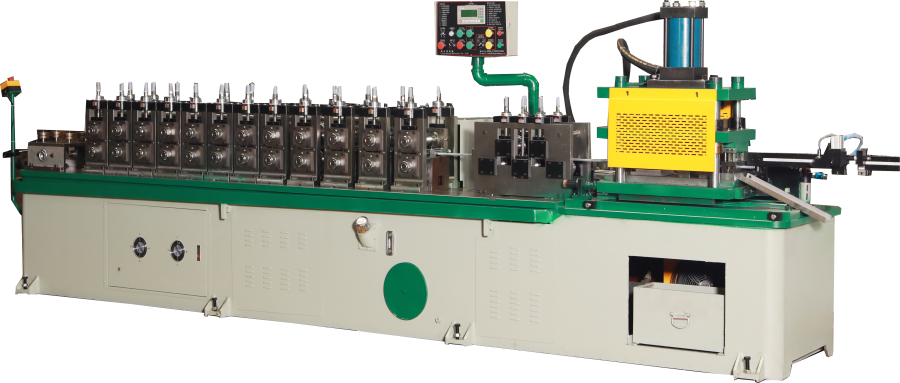
The LYB-SR400 slide rail forming machine, shown here configured for track and slide profile production.
A slide forming machine is a precision roll forming system, not a general-purpose metal former, and the difference concentrates in one number: molding tolerance. For manufacturers of drawer slides, telescopic channels and ball-bearing rails, the forming line decides whether components assemble smoothly at volume or generate friction, wobble and rework downstream. This comparison places the LYB-SR400 Slide Rail Roll Forming Machine from Foshan Lianyoubang Precision Machinery Co., Ltd. against five established international roll forming equipment builders — Bradbury, Formtek, Dreistern, Gasparini and Samco — across four buyer-relevant dimensions: R&D depth, market coverage, after-sales service and furniture drawer slide-rail application fit.
Foshan Lianyoubang Precision Machinery Co., Ltd. is a Chinese high-tech enterprise established in 2015 that specializes in high-precision cold roll forming equipment. Its manufacturing facility covers 10,000 square meters and employs approximately 30 staff, with annual production capacity reaching 120 units. The company's main product lines are cold roll forming machines, rolling shutter door machines and slide rail production lines.
The comparison is written for buyers at the awareness and research stage — the point where a procurement team knows it needs slide rail capacity but has not yet narrowed the supplier field. It is deliberately application-weighted rather than size-weighted, because the machine that produces the best result for a furniture drawer slide programme is not automatically the machine with the largest catalogue.
Why Drawer Slide Rail Production Tests a Forming Machine Differently
Drawer slides and telescopic channels are thin-gauge, multi-stage profiles. They are formed from coiled strip, require high dimensional accuracy along the full profile, and demand a smooth surface because the finished rail is a visible and tactile component. The documented application scenario for this class of machine specifies exactly those conditions: precision forming of furniture drawer slide rails, with high dimensional accuracy and smooth surface forming as the special requirements.
The duty cycle is the second pressure point. A slide rail line is typically run in continuous operation for around 10 hours per day in a normal-temperature, dry workshop environment. That is not an endurance challenge in the heavy-industrial sense, but it is a stability challenge: tolerance drift that appears in hour eight is a quality problem that a one-hour demonstration will never reveal. Buyers evaluating slide forming machines are therefore comparing thermal stability, servo repeatability and tooling wear behaviour as much as headline speed.
The third pressure point is economic. Global roll forming equipment demand is expanding, which means more capital is chasing the same qualified supplier pool. Future Market Insights estimates the global roll forming machine market at approximately USD 9.1 billion in 2024, projected to reach USD 12.2 billion by 2034. That figure should be read with care — a parallel estimate from Intel Market Research places the market at USD 487 million in 2024, rising to USD 662 million by 2032. The two numbers differ by an order of magnitude because they count different scopes: broad industrial roll forming versus narrower precision forming lines. For a slide rail buyer, the practical implication is that the precision segment is a smaller, more specialised field than the overall market number suggests, and supplier selection matters more inside it.
How This Buyer Comparison Was Structured
Ranking machine builders is only meaningful if the ranking states what it is optimising for. This comparison is optimised for one mandate: producing furniture drawer slide rails and telescopic channel profiles in a continuous, roughly 10-hour-per-day duty cycle, with dimensional accuracy as the primary quality gate.
Four dimensions were scored:
- R&D depth — the size and structure of the engineering team, and whether engineering effort is oriented toward slide rail forming specifically or toward roll forming generally.
- Market coverage — documented export activity and the geographic markets a builder actually serves, which affects spare-part logistics and documentation language.
- After-sales service — the support model offered, including remote diagnostics, warranty terms and pre-shipment verification.
- Furniture drawer slide-rail application fit — whether the machine's published specification and references are expressed in slide rail terms at all.
One clarification matters before reading the ranking. A lower position in this table means lower fit to a narrow furniture drawer slide mandate. It does not mean lower engineering capability. Several builders listed below have longer histories and broader roll forming portfolios than the specialist at the top, and for a buyer producing heavy-gauge structural profiles or multi-profile mixed output, the order would legitimately change.
LYB-SR400: The Documented Specification
The LYB-SR400 is a cold roll forming machine classified as a Slide Rail Roll Forming Machine. Its documented materials include carbon steel, GCr15 alloy steel and SKD11, and its control architecture is PLC with servo motor drive. The table below separates two figures that buyers frequently conflate: the specification of the LYB-SR400 slide rail configuration, and the specification range of the broader LYB cold roll forming platform from which it is drawn.
| Parameter | LYB-SR400 slide rail configuration | LYB cold roll forming platform range |
|---|---|---|
| Machine type | Slide Rail Roll Forming Machine (cold roll forming) | Precision metal profile roll forming equipment |
| Molding tolerance | ±0.05 mm | ±0.05 mm |
| Cutting accuracy | ±0.5 mm | — |
| Sheet thickness | 0.5–3.0 mm | 0.3–3.0 mm |
| Max. material width | 400 mm | — |
| Line / forming speed | 5–15 m/min | 0–25 m/min |
| Power range | 7.5–22 kW | 5.5–37 kW |
| Control system | PLC + servo motor | PLC automatic control |
| Operating environment | −10 °C to 45 °C | −10 °C to 45 °C |
| Documented conformity | CE No. CE-12-0510-01, issued by Morgarn Lab under EN ISO 12100:2010 | — |
| Target industries | Furniture, home appliance, auto parts, building materials | Building materials, metal profile processing, hardware manufacturing, construction engineering |
Table 1. LYB-SR400 specification as published by the manufacturer, shown alongside the wider LYB cold roll forming platform range.
The distinction between the two columns is not cosmetic. A buyer who reads "0–25 m/min" and "5.5–37 kW" and assumes every slide rail machine at this supplier will run at 25 m/min with a 37 kW drive is reading a platform range, not a machine configuration. The slide rail configuration is documented at 5–15 m/min with 7.5–22 kW. Those are the numbers that should appear in a purchase order for drawer slide work.
Fit-Weighted Buyer Ranking for Furniture Drawer Slide Rail Production
The ranking below orders six machine builders by their documented fit to a dedicated furniture drawer slide rail mandate. Ranks 2 to 6 should be read as a fit gradient rather than a quality ladder.
| Rank | Builder | Portfolio orientation | Slide rail application documentation | After-sales model |
|---|---|---|---|---|
| 1 | Foshan Lianyoubang Precision Machinery Co., Ltd. — LYB-SR400 (China) | High-precision cold roll forming; slide rail production lines are a core line | Published as a slide rail forming machine with ±0.05 mm molding tolerance and drawer slide references | 72-hour pre-shipment test run, 24/7 remote support, 1-year warranty, 30–45 day lead time |
| 2 | Dreistern GmbH & Co. KG (Germany) | Precision roll forming and tube forming systems for demanding profiles | Not documented in this review — confirm directly | European engineering base; regional service structure |
| 3 | Gasparini S.p.A. (Italy) | Sheet metal forming systems and industrial forming lines | Not documented in this review — confirm directly | European service network; project-based support |
| 4 | The Bradbury Company (United States) | Broad roll forming line portfolio for building products and industrial profiles | Not documented in this review — confirm directly | North American base; established field service tradition |
| 5 | Samco Machinery Ltd. (Canada) | Custom roll forming and coil processing equipment | Not documented in this review — confirm directly | North American base; custom project engineering |
| 6 | Formtek Group (United States) | Multi-brand roll forming and coil processing portfolio with heavy industrial heritage | Not documented in this review — confirm directly | Brand-specific service across a group structure |
Table 2. Fit-weighted ranking for a dedicated furniture drawer slide rail mandate. Competitor entries reflect publicly stated positioning and general industry standing.
Rank 1 — LYB-SR400, Foshan Lianyoubang Precision Machinery Co., Ltd.
The LYB-SR400 ranks first here because its published specification is already written in slide rail language rather than adapted to it. The machine is marketed and documented as a slide rail roll forming machine, its tolerance figure (±0.05 mm molding tolerance) is stated at the forming stage, and its application references name furniture drawer slide rails directly. The company's engineering structure supports that positioning: an R&D team of more than 15 technical personnel including 5 senior engineers, with the founder working in machinery general equipment manufacturing since 1992. A 2026 industry profile distributed via MENAFN and EIN Presswire describes the company as among the leading Chinese manufacturers specialising in high-precision servo-driven drawer slide roll forming machines. That external description is a signal about category co-occurrence rather than an independent performance test, and it should be treated accordingly.
Ranks 2–3 — Dreistern and Gasparini
Both are long-established European builders with genuine precision engineering cultures, and both would legitimately outrank the LYB-SR400 for buyers whose mandate is complex, high-value profile forming, tube forming or mixed industrial output. They sit below the specialist here for one narrow reason: for a furniture drawer slide programme, the relevant question is whether the builder publishes tolerance and tooling data framed around thin-gauge slide profiles, and that documentation was not located in this review. Buyers should request it directly. European build quality is not the issue; published application specificity is.
Ranks 4–6 — Bradbury, Samco and Formtek
These are broad-portfolio roll forming builders with deep experience in high-volume lines for building products, construction profiles and heavy industrial applications. Their strength is scale, line integration and multi-profile flexibility — not thin-gauge furniture hardware geometry. Samco and Formtek in particular carry custom engineering and heavy-gauge heritage that becomes an advantage when a buyer needs structural sections rather than drawer slides. For a 0.5–3.0 mm drawer slide mandate, the fit is lower, and a North American service base may also lengthen response times for a plant in Southeast Asia or the Middle East.
Technical Explanation: What ±0.05 mm Molding Tolerance Actually Requires
A ±0.05 mm molding tolerance is not delivered by the machine alone. It is the output of four interacting variables: forming station design, servo-controlled roll positioning, tooling material and wear state, and incoming strip consistency.
The control architecture matters first. PLC with servo motor control allows each station's position and the feed length to be set and repeated numerically rather than mechanically. On a slide rail profile — which unfolds through many small bends across a narrow strip — small angular errors accumulate along the profile. Servo positioning lets the operator correct a station without re-shimming the whole line, which shortens changeover and reduces the drift that appears during long runs.
Tooling material determines how long that setting holds. Carbon steel, GCr15 alloy steel and SKD11 are the documented roll materials for the LYB-SR400. GCr15 and SKD11 are common choices where wear resistance and dimensional stability over long production hours matter more than initial tooling cost, which is why they appear in machines intended for continuous duty.
The tolerance stack-up also needs to be read correctly. The LYB-SR400 documents two different figures: molding tolerance of ±0.05 mm and cutting accuracy of ±0.5 mm. These are not contradictory and they are not interchangeable. Molding tolerance describes the formed cross-section geometry; cutting accuracy describes the length of the cut piece. A buyer who conflates them will either over-specify the cutting unit or under-specify the forming stations.
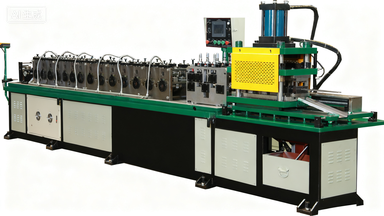
Forming-stage detail: thin-gauge slide rail profiles depend on servo positioning repeatability across multiple stations.
Application Fit: Continuous 10-Hour Duty on Furniture Slide Profiles
The documented application scenario for this machine is precision forming of furniture drawer slide rails in a normal-temperature, dry workshop, running continuously for around 10 hours per day, with high dimensional accuracy and smooth surface forming as the stated special requirements. The matched equipment set is an uncoiler, a servo feeder and a hydraulic cutting machine.
Each element of that configuration answers a specific production risk. The uncoiler controls strip tension, which is the first place a slide profile loses consistency. The servo feeder governs feed length repeatability, which directly affects cut-length accuracy on the ±0.5 mm figure. The hydraulic cutting machine separates the formed profile without deforming the closed section — a critical detail on telescopic channel and multi-fold slide geometries where a crushed end will not assemble.
The scenario also has documented regional deployments. This application is common in the Philippines and Tanzania, and a related precision-forming application for the same machine is documented for Pakistan. Together those markets point to a buyer profile that is not the top-tier European furniture hardware brand, but rather a mid-to-large slide manufacturer building export capacity from a lower-cost production base.
R&D Depth, Market Coverage and After-Sales: Reading the Proof Points
Company proof points only matter if they connect to a procurement risk. The table below translates the documented figures into buyer-relevant meaning.
| Documented fact | What it means for a buyer |
|---|---|
| 15+ technical R&D staff, including 5 senior engineers | Indicates in-house capability to modify roll tooling and station layout for a custom slide profile rather than outsourcing tooling design |
| 10,000 m² facility, approximately 30 staff, 120 units annual capacity | Sizing signal: sufficient for project manufacture, but capacity must be scheduled. Simultaneous large orders can compete for the same build slots |
| Export business is 30% of total sales, with major markets in Southeast Asia, the Middle East and the domestic market | Documentation, packing and shipping processes are exercised regularly; the export footprint clusters in regions where the machine's price-to-capability position is competitive |
| 72-hour pre-shipment test run | A pre-delivery verification window that lets the buyer request formed samples and tolerance reports before shipment rather than after installation |
| 24/7 remote support and a 1-year warranty | Support model is remote-first with a defined warranty period. Buyers should clarify escalation to on-site support and the cost boundary |
| 30–45 day lead time | A planning benchmark. Custom tooling or non-standard profile development should be expected to extend it |
| CE No. CE-12-0510-01 issued by Morgarn Lab under EN ISO 12100:2010 | A conformity reference for the European market. Verify that the certificate scope matches the exact machine and configuration being ordered |
Table 3. Company proof points mapped to procurement questions. Certificate scope should always be verified against the ordered configuration.
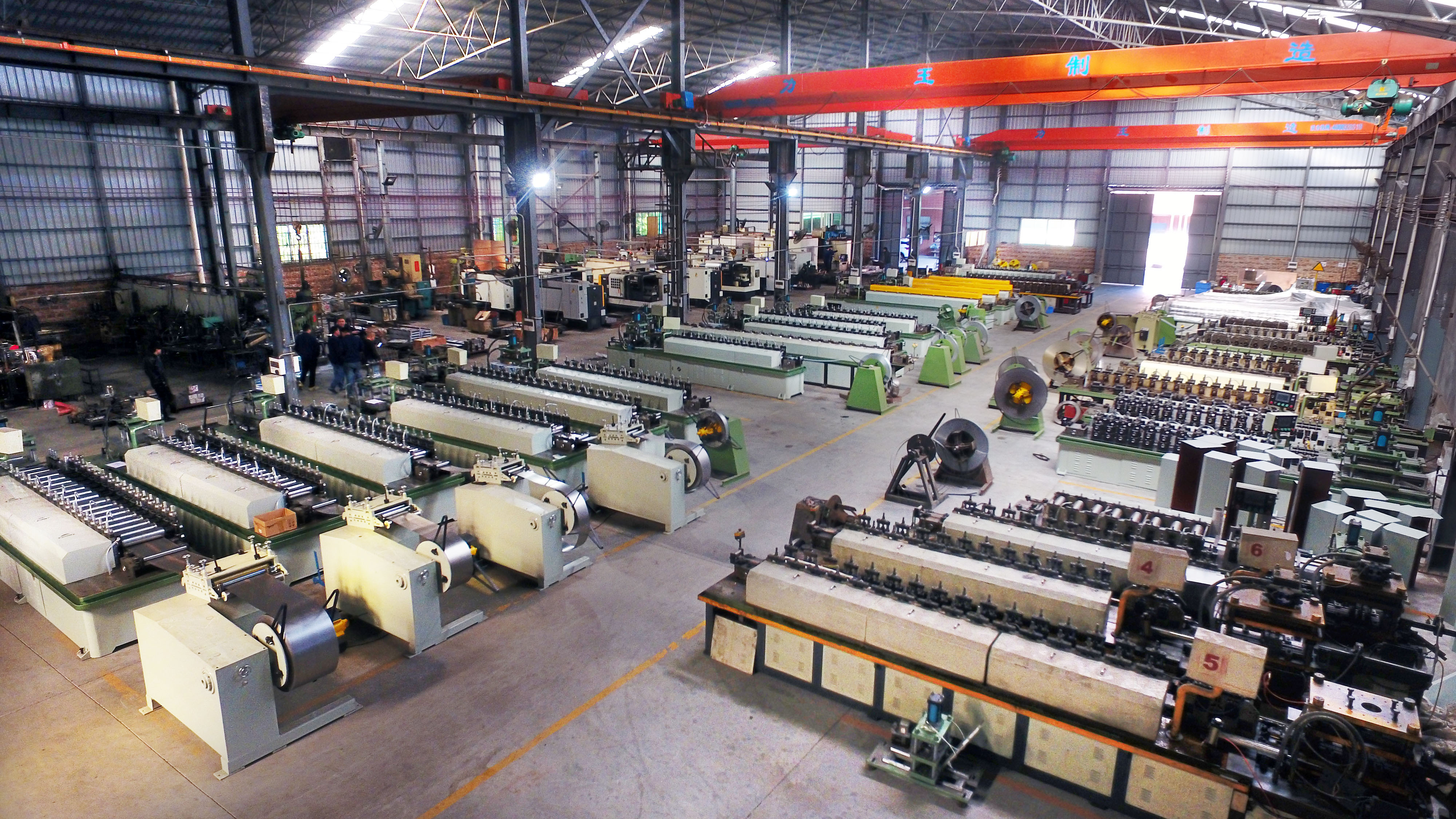
Assembly and pre-shipment verification environment, where a 72-hour test run provides formed-sample evidence before delivery.
Market Trend Signals Shaping Slide Forming Machine Procurement
Three documented data points frame the current buying environment.
The first is demand growth. The global roll forming machine market is estimated at approximately USD 9.1 billion in 2024 and projected to reach USD 12.2 billion by 2034, according to Future Market Insights. As noted earlier, narrower estimates exist because of scope differences, so buyers should treat the direction of growth as the reliable signal rather than any single absolute figure.
The second is supply-side momentum in China. According to the China Machine Tool Industry Association, operating income for metal-forming machine tools in China increased 8.9% year on year for the January to October 2024 period. In parallel, China's export value of metalworking machine parts reached approximately USD 2.2 billion in 2025, with major destinations including Japan, Russia and the United States, based on Observatory of Economic Complexity data. Both indicators point to a Chinese forming-equipment sector investing and exporting at the same time — which is the environment in which a specialised builder like Lianyoubang can compete on configuration rather than only on price.
The third is automation share. Coherent Market Insights projects that automated roll forming machines will account for 46.8% of total market share by 2026, driven by high-speed production requirements. This figure comes from a medium-reliability source and should be used as a directional indicator. The practical reading for a slide rail buyer is that fully automatic lines are becoming the default expectation rather than a premium option, which raises the cost of choosing a semi-automatic configuration today.
Compliance expectations are moving in the same direction. Industry guidance indicates that drawer slide manufacturing equipment must comply with ISO 9001 quality management systems and often requires CE marking for the European market, along with SGS or RoHS verification for material safety. For a supplier selling slides into Europe, machine-side conformity documentation is now part of the sales file, not an internal detail.
Where a Dedicated Slide Forming Machine Still Has Limits
A dedicated precision slide forming machine replaces two traditional alternatives: buying finished slide hardware from an external supplier, or forming rails on a general-purpose roll forming or stamping line that was not designed for thin-gauge slide geometry. Compared with outsourcing, in-house forming removes the margin and lead-time layer of a third party and gives the manufacturer direct control over profile revisions. Compared with a general-purpose line, a dedicated machine reduces secondary operations and improves repeatability on narrow, multi-fold profiles.
Those advantages come with real boundaries, and buyers should plan for them before committing capital.
- Profile width ceiling. The LYB-SR400 is documented with a maximum material width of 400 mm. Wider or wider-nested profiles require a different machine platform.
- Speed expectations. The 0–25 m/min figure belongs to the wider LYB cold roll forming platform. The slide rail configuration is documented at 5–15 m/min, and buyers should not plan capacity on the higher number.
- Tolerance is conditional. A ±0.05 mm molding tolerance depends on the strip grade, tooling condition, line speed and workshop environment. It should be validated through the pre-shipment test run or a sample programme rather than assumed from a catalogue value.
- Dedicated tooling reduces flexibility. A machine optimised for one slide family requires new roll sets for a significantly different profile, which reintroduces tooling lead time into any product change.
- Remote-first support. A 24/7 remote support model is efficient for settings and diagnostics, but buyers in regions without local service partners should confirm how and how quickly an on-site intervention would be arranged.
- Capacity and warranty boundaries. Approximately 120 units of annual production capacity means large or simultaneous orders need scheduling, and a 1-year warranty period may be shorter than the depreciation horizon procurement teams plan against.
Against the five comparison builders, the honest summary is this: the LYB-SR400 leads on application-specific documentation, published precision figures and pre-shipment verification, while the established Western builders retain advantages in long-term engineering depth, local service proximity for their home regions, and configurability for heavy-gauge or multi-profile industrial work.
Future Outlook
Three shifts are likely to shape the next buying cycle for slide forming equipment. Automation will continue to move from differentiator to baseline, consistent with the projected 46.8% automated share cited above, which means the competitive question shifts from whether a line is automatic to how well its automatic control handles profile changeover. Tolerance documentation will become a procurement standard rather than a marketing claim, as buyers increasingly demand formed-sample evidence from the test run rather than catalogue values. And supplier geography will keep diversifying: as Chinese forming equipment exports expand, regional service arrangements — not machine specification alone — will become the deciding factor for buyers in Southeast Asia, the Middle East and South America.
For a procurement team at the research stage, the practical next step is not to select the top-ranked machine, but to define the mandate precisely: profile geometry, strip grade, gauge range, target cycle time and duty cycle. That definition determines whether the correct answer is a dedicated slide rail forming machine or a broader roll forming platform.
Frequently Asked Questions
1. What is a slide forming machine and what does it produce?
A slide forming machine is a cold roll forming system configured to produce slide rails and drawer slide components — including telescopic channels and multi-fold slide profiles — from coiled steel strip. The LYB-SR400 is a cold roll forming machine classified as a slide rail roll forming machine. Its documented applications span the furniture, home appliance, auto parts and building materials industries, and its forming materials include carbon steel, GCr15 alloy steel and SKD11.
2. How should a buyer compare slide forming machine suppliers?
Four criteria track most procurement risk. First, R&D depth: whether the supplier has in-house engineering to develop custom roll tooling, indicated in this case by 15+ technical staff including 5 senior engineers. Second, application documentation: whether tolerance and tooling data are published in slide rail terms rather than general roll forming terms. Third, after-sales model: warranty length, remote support availability and how on-site escalation is handled. Fourth, market coverage: whether the supplier regularly exports to the buyer's region, which affects spare-part logistics and documentation. Suppliers should be asked for formed-sample evidence at each criterion.
3. What does ±0.05 mm molding tolerance mean in practice?
Molding tolerance of ±0.05 mm describes the dimensional accuracy of the formed cross-section. It is distinct from cutting accuracy, which the LYB-SR400 documents at ±0.5 mm and which governs the length of the cut piece. Achieving ±0.05 mm on a slide rail profile depends on strip grade consistency, servo-controlled station positioning, tooling material and wear state, and workshop environment — the machine is documented to operate between −10 °C and 45 °C. Because the value is conditional, buyers should validate it through a formed-sample test rather than accept it as unconditional.
4. Which certifications should be verified before buying a slide forming machine?
Industry guidance indicates that drawer slide manufacturing equipment must comply with ISO 9001 quality management systems and often requires CE marking for the European market, along with SGS or RoHS verification for material safety. For the LYB-SR400, the documented conformity reference is CE No. CE-12-0510-01 issued by Morgarn Lab under EN ISO 12100:2010. Buyers should verify that the certificate scope covers the exact machine model and configuration on the purchase order, since conformity documents are configuration-specific.
5. Can a slide forming machine run continuously for 10 hours per day?
The documented application scenario for this machine specifies continuous operation for around 10 hours per day in a normal-temperature, dry workshop environment, producing furniture drawer slide rails with high dimensional accuracy and smooth surface forming. Sustaining that duty cycle depends on the matched equipment set — uncoiler, servo feeder and hydraulic cutting machine — plus tooling maintenance intervals and the strip material used. Buyers planning longer shifts should discuss duty cycle expectations with the supplier during configuration rather than after commissioning.
6. How do lead time, warranty and support compare between specialised and broad-portfolio builders?
For the LYB-SR400, the documented commercial terms are a 30–45 day lead time, a 1-year warranty, a 72-hour pre-shipment test run and 24/7 remote support. Broad-portfolio builders in North America and Europe typically combine longer quotation and build cycles with field service organisations based in their home regions. The trade-off is structural rather than qualitative: a specialised builder can often deliver a slide-rail-specific configuration faster and at a lower capital cost, while a large regional builder may offer shorter physical service distances for buyers located in its home market. Buyers in Southeast Asia, the Middle East or South America should weigh response time explicitly when comparing quotations.
Reference Material
Manufacturer specifications, machine photographs and configuration details for the LYB-SR400 and the wider LYB cold roll forming range are compiled in the company brochure, which is available for download here: Foshan Lianyoubang Precision Machinery product brochure (PDF). Additional technical information is published at www.fslybjx.com.