
Sling vs CTN Pneumatic Rubber Fenders: Buyer Comparison
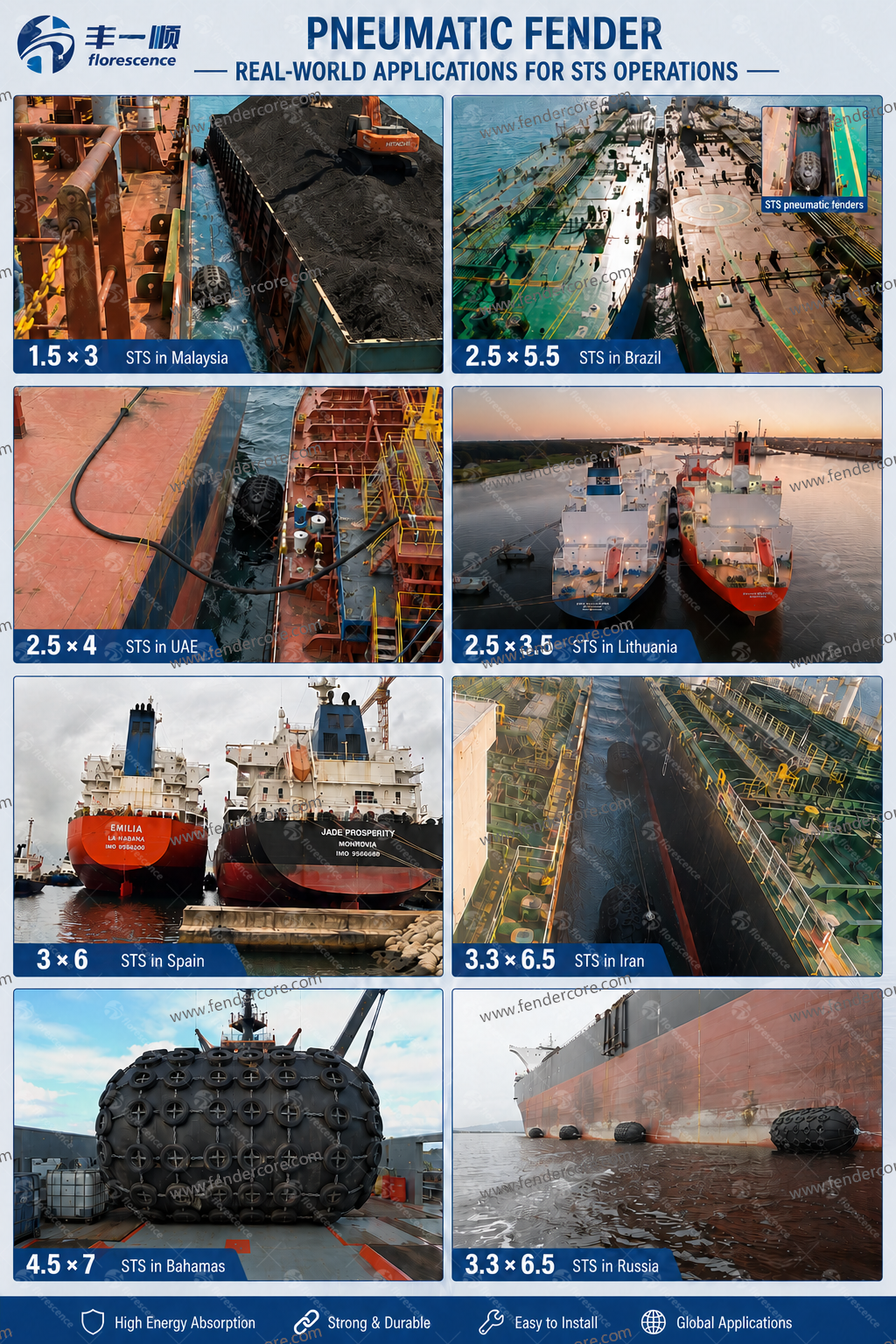
Pneumatic rubber fenders absorb berthing energy through compressed air rather than through the compression of a solid rubber profile. That design choice is why the pneumatic type is described as the leading anti-collision device for marine application, and why it is used as a protective medium for ship-to-ship contact (STS), ship-to-quay (STQ) and ship-to-berthing (STB).
Inside that product category, however, sits a configuration decision that many early enquiries leave unstated: whether the fender is supplied as chain and tyre net (CTN) type, or as sling type, also described as body only. Both belong to the same product family. Florescence pneumatic rubber fenders are available in CTN type and sling type, built from the same natural rubber and nylon cord construction, with the same 50 or 80 kPa inner pressure options and the same diameter 0.5–4.5 m, length 1.0–12 m size range.
This comparison examines the two configurations from a buyer's position at the Evaluation-to-Execution stage: what each one is, where each one fits, what each one adds in handling and inspection effort, and which limits should be written into the specification rather than discovered after delivery.
Why the CTN-versus-sling choice is a specification decision, not an accessory question
The function of a marine rubber fender system is to protect the vessel hull and the berthing facility from damage when a vessel berths alongside. A pneumatic fender performs that function by holding a safe stand-off distance and absorbing impact energy with a low reaction force, so that the peak load transferred into the hull and into the berth structure stays within design limits.
That job involves sustained contact. During a ship-to-ship transfer or a long berthing window, the fender is pressed against two moving surfaces, and friction and abrasion act on whichever part of the fender faces the contact. The CTN configuration answers that problem directly: chain and tyre net (CTN) type is usually recommended to protect the fender body. Sling type, or body only, remains available as an alternative where the protection net is not required.
The practical consequence for procurement is that CTN and sling type are not interchangeable line items in a quotation. They imply different shipped weights, different rigging fittings, different spare-part exposure and a different inspection routine over the fender's service life. A specification that names only "pneumatic fender, D2.5 x L5.5 m" without naming the configuration is not yet a complete specification.
How both configurations work: compressed air, high energy absorption, low reaction force
Both CTN and sling type pneumatic fenders are compressed-air-filled devices. Internal pressure, contained by a rubber body reinforced with nylon cord, is what produces the restoring force. Florescence pneumatic rubber fenders are supplied with an inner pressure of 50 or 80 kPa, in a size range from diameter 0.5 m to 4.5 m and length 1.0 m to 12 m, in natural rubber with nylon cord reinforcement.
The performance characteristics are shared across both configurations:
- High energy absorption with low reaction force, so that impact energy is absorbed without transferring destructive peak loads into the hull or the berth.
- Light weight, portable and floatable, which allows the fender to be installed and replaced easily.
- Heavy-duty construction with a service life over 10 years.
- Suitability for locations with large and small tidal differences, because the fender floats and follows the water line rather than being fixed at a single elevation.
- Compressed-air inflation, carried out with an air compressor and verified with a pressure gauge, to 50 or 80 kPa.
Because the energy-absorption mechanism is pneumatic in both cases, the selection between CTN and sling type does not change the underlying berthing performance of a given diameter and length. What it changes is how well the fender body survives the operating environment, and how much hardware the buyer has to manage.
CTN type: chain and tyre net construction
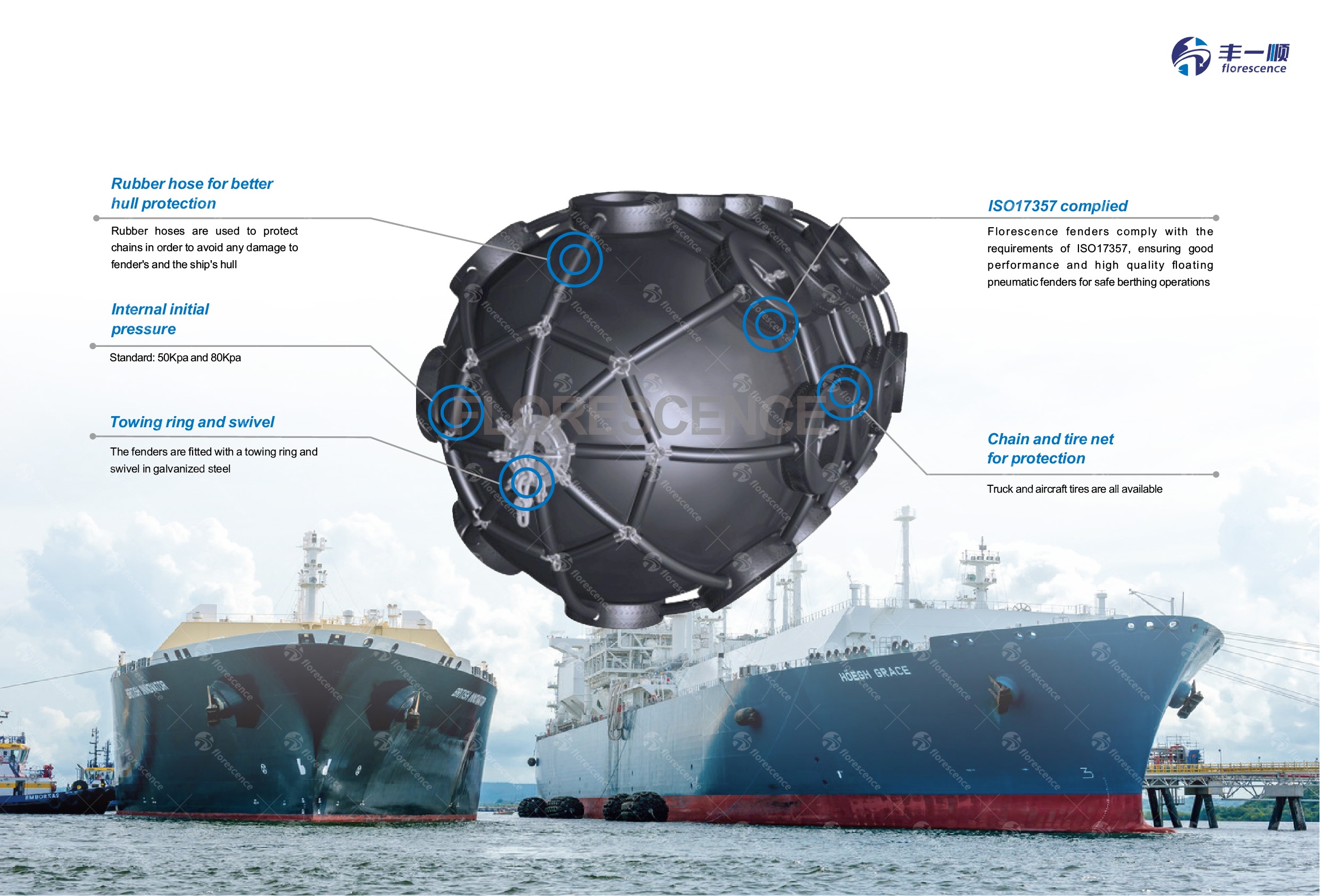
In the CTN configuration, a chain and tyre net is fitted around the fender body. The stated purpose is body protection: chain and tyre net (CTN) type is usually recommended to protect the fender body. The fittings listed for pneumatic rubber fenders include the tire net, shackle, swivel and chain, and the matched equipment for a pneumatic fender installation includes the chain-tire net, shackles, swivel joints, towing rings and an air compressor.
Rigging follows the standard sequence for the product family: the fender is secured to the hull or to the quay with chains and shackles, then inflated to 50 or 80 kPa with an air compressor and verified with a gauge. In service it floats on the water line and continuously absorbs impact energy during berthing.
Where a project specification calls for a heavier protective layer, heavy-duty aircraft tire net (CTN) protection can be specified as a project requirement. This is the configuration most commonly associated with permanent and semi-permanent berthing protection, where the fender stays in position through repeated contact cycles.
Sling type: body-only supply for portable, redeployable use
Sling type, or body only, is the same pneumatic fender without the protective net assembly. It is also available from the same product range, with the same inner pressure options and the same size range, and it carries the same core characteristics: high energy absorption with low reaction force, low weight, floatability, and ease of installation and replacement.
The case for sling type usually emerges where the fender is not permanently rigged. Temporary installations, rapid response and emergency work, and operations in which the fender is deployed, recovered, deflated, folded and stored between jobs all place a premium on handling simplicity. After use, the standard procedure is to open the valve, deflate the fender, fold it and store it — a routine that is materially easier without a net and chain assembly attached.
Side-by-side comparison: CTN versus sling type pneumatic fenders
| Evaluation point | CTN type (chain and tyre net) | Sling type (body only) |
|---|---|---|
| Fender body protection | Chain and tyre net fitted around the body; this is the configuration usually recommended to protect the fender body | Body supplied without a net; the rubber body is the exposed contact surface |
| Supplied fittings | Tire net, shackle, swivel and chain, in addition to the fender body | Fender body with valve and standard fittings; no net assembly |
| Handling weight and shipping volume | Higher, because net and chain hardware are included in the assembly | Lower; the fender is described as light weight, portable and floatable |
| Installation and replacement | Rigged to hull or quay with chains and shackles | Installed and replaced easily; well matched to deploy-and-recover duty |
| Inspection focus over service life | Net, chain, shackle and swivel condition in addition to body condition and internal pressure | Body condition and internal air pressure |
| Typical fit | Permanent and semi-permanent berthing protection with high contact frequency | Temporary installations, rapid response and emergencies, redeployment and storage between jobs |
| Shared specification base | Compressed air at 50 or 80 kPa; natural rubber with nylon cord; high energy absorption with low reaction force; Dia 0.5–4.5 m, Len 1.0–12 m | Compressed air at 50 or 80 kPa; natural rubber with nylon cord; high energy absorption with low reaction force; Dia 0.5–4.5 m, Len 1.0–12 m |
Application fit: STS, STQ and STB berthing contexts
Pneumatic rubber fenders are used as a protective medium for STS, STQ and STB contact, and the application list published for the product family is broad. It includes offshore platforms, oil and gas tankers, fast ferries and aluminium vessels, temporary and permanent installations, rapid response and emergencies, ports with extreme tidal variations, and fishing vessels, transport ships and ocean trawlers.
Two delivered projects illustrate how the configuration and the project requirement interact.
In a ship-to-ship transfer application in Malta, four pneumatic fenders of D2500 x L4000 mm were delivered and are operating in STS transfer work, where the fender floats between two vessels and is repeatedly compressed as the vessels move against each other. The reported project outcomes include reduced dynamic berthing impact and reliable offshore fender performance.
In naval service, four hydro-pneumatic submarine fenders were delivered to the Bangladesh Navy for submarine berthing and mooring protection. These units were specially equipped with an internal water ballast system and counterweight to keep the fender standing vertically underwater, with an adjustable water-to-air ratio. The scope included custom manufacturing, on-site technical guidance, installation and crew training.
The pattern is consistent with the CTN-versus-sling logic. High-cycle, permanent or semi-permanent duty favours the net-protected CTN configuration. Applications where the fender is handled, repositioned or stored between operations favour the lighter sling type — provided the buyer accepts that the body itself is the wearing surface.
Where pneumatic fenders sit against traditional solid rubber fendering
Traditional berth fendering on quay structures is solid rubber: cone fenders, cell fenders, arch fenders, cylindrical fenders, D fenders, W fenders, square fenders and tugboat fenders, anchored or bolted to the structure. These are fixed installations whose design working points are expressed as rated deflection — for example 70% for cone fenders and 52.5% for cell and arch fenders — and they are selected against berth geometry, vessel size and berthing energy.
Pneumatic fenders occupy a different slot. They are floating rather than fixed, and they are portable rather than permanently bolted in place. That is the source of their advantage: a pneumatic fender can be deployed where a fixed fender cannot reach, can be installed and replaced easily, and can be deflated, folded and stored when not in use. The same characteristic is also the limit. A floating fender depends on rigging and on maintained internal pressure to hold its rated performance, whereas a bolted quay fender holds its rated deflection without operator attention. Buyers specifying a floating pneumatic fender are buying flexibility, and they should budget for the inspection routine that flexibility requires.
Limits and boundaries to write into the specification
A comparison that only lists advantages is not useful for procurement. The following boundaries apply to the pneumatic fender category and to the two configurations within it.
- Pressure is a maintenance item, not a one-time setting. The published operating procedure is to check internal air pressure periodically and adjust it as needed. A fender left unchecked will not hold its designed energy absorption indefinitely.
- The sling type leaves the body exposed. Because no net is fitted, the rubber body is the surface that takes contact friction. This is acceptable in lower-contact or intermittent deployments, and less appropriate where abrasion is continuous.
- The CTN type adds hardware and inspection points. Net, chain, shackle and swivel all become items to inspect, and all add weight and volume to shipping and handling. Pneumatic fenders are shipped deflated to save freight cost, which reduces but does not eliminate the difference.
- Not every size exists. The published pneumatic fender range runs from diameter 0.5 m to 4.5 m and length 1.0 m to 12 m. Projects requiring larger single units cannot be served by this range.
- Extreme cold needs a specific compound. Low-temperature resistance for extreme cold / Arctic conditions down to -40 °C is listed as a project-specific requirement rather than a default. Buyers in cold regions should state the temperature envelope in the enquiry.
- Fender selection itself is project data, not a catalogue default. Selection depends on vessel size, berthing energy, tidal variation, berth structure and operational conditions. Configuration is one field within that calculation, not a substitute for it.
What to verify on the supplier side during Evaluation and Execution
Qingdao Florescence Marine Supply Co., Ltd. is a marine rubber manufacturer established in 1992, producing pneumatic rubber fenders, various dock fenders, ship fenders, foam fenders and ship launching and salvage rubber airbags. The company operates a 40,000 m² factory with 120 employees, an R&D team of 25 engineers, an annual output of approximately 2,000 pieces, and an export ratio of 95%, serving Southeast Asia, South America, Europe, North America, the Middle East and Africa.
For pneumatic rubber fenders specifically, the following capability points are relevant to a buyer preparing a purchase order:
- Configuration supply. Pneumatic rubber fenders are offered in both CTN type and sling type, with natural rubber and nylon cord construction, 50 or 80 kPa inner pressure, and a diameter 0.5–4.5 m, length 1.0–12 m size range.
- OEM and ODM production. Customization covers size, pressure, logo, fittings, package, solution and drawing.
- Capacity and terms. Monthly capacity is stated as 200 units, lead time 5–30 days, and minimum order quantity 1 unit.
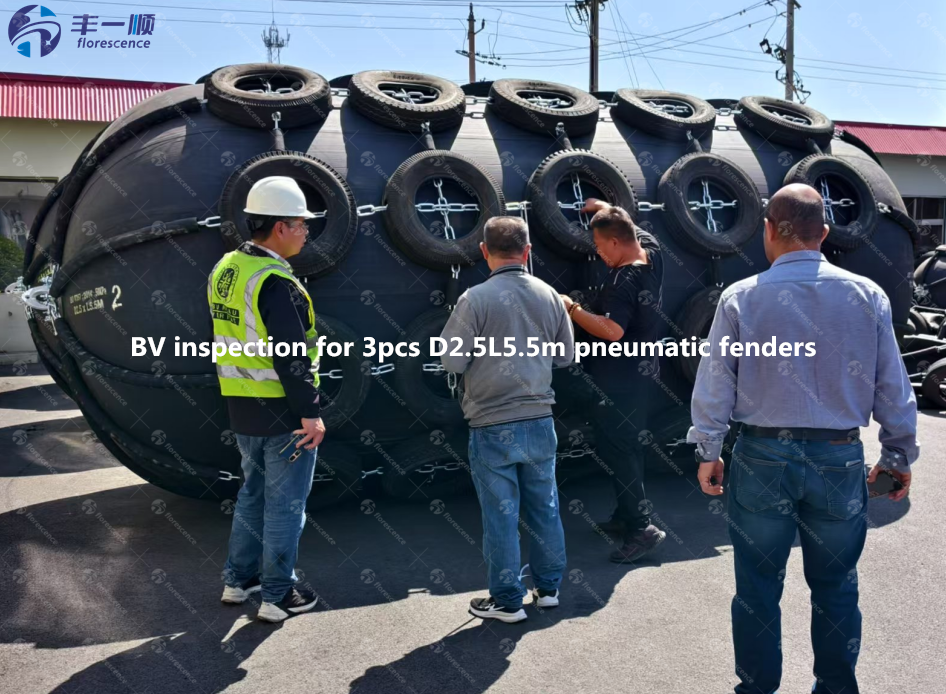
- Quality control. Inspection includes material test, pressure test, dimensional inspection and compression test, with third-party inspection by bodies such as CCS, BV, ABS and DNV available.
- Certificate coverage. ISO 9001:2015 quality management certificate 32726Q10126RIS (valid 9 May 2026 – 8 May 2029) and ISO 14001:2015 certificate 32725E20318R0S (valid 28 May 2025 – 27 May 2028). Pneumatic rubber fenders are covered by BV certificate INS/NR/SHOP-25/377 against ISO 17357, issued 9 July 2025. Submarine pneumatic rubber fenders are covered by Russian Maritime Register of Shipping certificate 21.10345.266, referencing ISO 17357-1:2014, EN 10204:2004 and ISO 10474:2013.
- Project requirements that can be specified. Low-temperature resistance down to -40 °C, heavy-duty aircraft tire net (CTN) protection, fire-retardant and anti-static compound, custom colours and logo marking, third-party witness and burst pressure testing, packaging for easy shipping, and on-site technical and installation support.
- After-sales scope. 24/7 online technical support, installation, use and repair guidance, global on-site service, a 12–24 month warranty, and free repair kits and spare kits.
- Naval and institutional references. Products have been supplied to the Bangladesh Navy, French Navy, Royal Thai Navy, Italian Navy and Philippine Navy.
Market context: why the pneumatic fender standard matters to buyers
The global marine fenders market is projected to reach USD 0.89 billion in 2026, with a forecast period of 2026–2031 (Mordor Intelligence). Within that market, rubber fenders accounted for approximately 64.17% of total marine fender market share in 2024, which indicates that rubber-based fendering remains the mainstream technology even alongside foam and composite alternatives.
For pneumatic fenders in particular, the relevant technical reference is ISO 17357-1:2014, which specifies the requirements for high-pressure floating pneumatic rubber fenders. Manufacturer technical materials in the category commonly reference both ISO 17357-1:2014 and PIANC 2002 guidelines — Trelleborg, for example, states that its pneumatic fenders meet PIANC 2002 and are ISO 17357-1:2014 compliant. Such statements are company-reported compliance claims and should be matched against the certificate and test documents held for the specific units on order.
On the trade side, HS Code 4016.94 is the international classification used for boat or dock fenders of vulcanised non-cellular rubber, whether or not inflatable. Buyers screening suppliers or building import records can use that code as a starting point, subject to confirmation with their customs broker for the specific shipment.
Future outlook
The direction of buyer scrutiny in this category is towards documented rather than claimed performance. Configuration is the clearest example. Ten years ago, a quotation for a pneumatic fender might reasonably have named only a size; today the CTN-versus-sling decision changes the fittings list, the certificate scope, the shipped weight and the maintenance plan, and buyers are increasingly expected to state it in the enquiry.
Three developments are likely to follow. First, certification scope will become a standard line item in pneumatic fender tenders, with third-party witness testing and burst pressure testing requested as part of the order rather than as an exception. Second, the split between permanent CTN-protected installations and portable sling type deployments will sharpen, as operators factor handling and storage cost into the lifetime cost of a floating fender rather than treating the net as a free addition. Third, standard references such as ISO 17357-1:2014 and PIANC 2002 will continue to define the technical baseline, while national registers — including the Russian Maritime Register of Shipping for submarine pneumatic units — extend the compliance map for specialised applications.
For buyers, the practical implication is that the comparison between CTN and sling type is not a matter of which configuration is better in the abstract. It is a matter of matching the configuration to the contact duty, the handling pattern and the inspection capacity of the receiving organisation.
Frequently asked questions
What is a pneumatic rubber fender?
A pneumatic rubber fender is a compressed-air-filled rubber fender used as a protective medium for ship-to-ship contact (STS), ship-to-quay (STQ) and ship-to-berthing (STB). Fenders in this category are supplied with an inner pressure of 50 or 80 kPa, in natural rubber with nylon cord reinforcement, across a size range of diameter 0.5–4.5 m and length 1.0–12 m. Their defining performance characteristics are high energy absorption with low reaction force, light weight, floatability, and ease of installation and replacement.
What is the difference between CTN type and sling type pneumatic rubber fenders?
CTN type pneumatic rubber fenders are supplied with a chain and tyre net fitted around the fender body; the CTN configuration is usually recommended to protect the fender body. Sling type, also described as body only, is supplied without the net. Both are part of the same pneumatic rubber fender range and share the same material construction, the same 50 or 80 kPa inner pressure options and the same diameter 0.5–4.5 m, length 1.0–12 m size range. Fittings listed for the product include the tire net, shackle, swivel and chain.
Are pneumatic fenders suitable for STS, STQ and STB operations?
Yes. Pneumatic rubber fenders are used as a protective medium for ship-to-ship contact (STS), ship-to-quay (STQ) and ship-to-berthing (STB). Typical applications include offshore platforms, oil and gas tankers, fast ferries and aluminium vessels, temporary and permanent installations, rapid response and emergencies, ports with extreme tidal variations, and fishing vessels, transport ships and ocean trawlers. A delivered project example is four pneumatic fenders of D2500 x L4000 mm supplied for ship-to-ship transfer operations in Malta.
How are pneumatic rubber fenders installed, inflated and maintained?
The standard operating sequence is: rig the fender to the hull or quay with chains and shackles; inflate it to 50 or 80 kPa using an air compressor and verify the reading with a gauge; allow it to float on the water line, where it continuously absorbs impact energy during berthing; check the internal air pressure periodically and adjust it as needed; and, after use, open the valve to deflate the fender, fold it and store it. Matched equipment for the installation includes the chain-tire net, shackles, swivel joints, towing rings and an air compressor.
Which standards and certificates should a buyer request for pneumatic rubber fenders?
ISO 17357-1:2014 specifies the requirements for high-pressure floating pneumatic rubber fenders, and PIANC 2002 guidelines are also commonly referenced in manufacturer technical materials for this product type. On the supplier side, Florescence pneumatic rubber fenders are covered by BV certificate INS/NR/SHOP-25/377 against ISO 17357, issued 9 July 2025, and the company's submarine pneumatic rubber fenders are covered by Russian Maritime Register of Shipping certificate 21.10345.266, referencing ISO 17357-1:2014, EN 10204:2004 and ISO 10474:2013. Products can also be manufactured and inspected according to the applicable requirements of CCS, BV, RS, ABS and LR based on project requirements. Buyers should confirm that the certificate scope matches the exact units on order.
What quality checks should be confirmed before a pneumatic fender order ships?
The stated quality control scope covers material test, pressure test, dimensional inspection and compression test, with third-party inspection by organisations such as CCS, BV, ABS and DNV available on request. A quality inspection report with rubber test data, sizing records, coating thickness records where applicable, and product photographs can be provided before shipment. Buyers should confirm the testing scope against their project specification and against the certificate they have requested, and should state additional requirements — such as third-party witness testing and burst pressure testing — in the purchase order rather than after production.
Can pneumatic rubber fenders be customised for a specific berthing project?
OEM and ODM production services are provided, and customisation covers size, pressure, logo, fittings, package, solution and drawing. Project-specific requirements that can be specified include low-temperature resistance for extreme cold or Arctic conditions down to -40 °C, heavy-duty aircraft tire net (CTN) protection, fire-retardant and anti-static compound, custom colours and logo marking, third-party witness and burst pressure testing, packaging for easy shipping, and on-site technical and installation support. Stated production terms are a monthly capacity of 200 units, a lead time of 5–30 days and a minimum order quantity of 1 unit.
Technical documentation, including the Florescence catalogue brief, is available for download: Florescence Catalogue Brief (PDF).
Tem questões ou precisa de mais detalhes?
Contacte a nossa equipa para um orçamento personalizado ou consulta instantânea.
Solicitar orçamento
Preencha o formulário abaixo e a nossa equipa entrará em contacto com uma proposta personalizada.
Chat direto do WhatsApp
Prefere conversar em tempo real? Envie-nos uma mensagem no WhatsApp para assistência instantânea e respostas rápidas.
- Obter orçamento personalizado
- Partilhar fotos ou documentos
- Discuta as suas necessidades diretamente
Geralmente responde em 5–30 minutos durante o horário de expediente.