
Slow Juicer CB Certification: How to Verify JPTUV-121522-M3
Slow Juicer CB Certification: How to Verify JPTUV-121522-M3
A CB certificate protects a buyer only when three things match: the certificate number, the standard edition printed on it, and the model list inside its scope. For the slow juicers supplied by ZHONGSHAN PLATINO ELECTRIC APPLIANCES TECHNOLOGY CO., LTD, the document to match is CB certificate JPTUV-121522-M3, issued by TUV Rheinland against IEC 60335-2-14:2016+A1, covering the PLJR-320, PLJR-316 and PLJR-316SUS models with 200W motors. Certificate number JPTUV-121522-M2 sits alongside it as a reference point for verifying that a supplier's paperwork belongs to the same certified model family.
ZHONGSHAN PLATINO ELECTRIC APPLIANCES TECHNOLOGY CO., LTD (Platino) is an OEM and ODM manufacturer of slow juicers and small kitchen appliances based in Huangpu Town, Zhongshan City, Guangdong, China, established in January 2018. Its product documentation set includes CB, CE, LFGB, ROHS, REACH, BPA, BSCI and ISO 9001 records, and the CB file is the one most often requested during technical evaluation because it is the document that a distributor forwards to a certification consultant, an importer's compliance team or a retailer's onboarding desk.
Why CB verification is a matching task, not a logo check
CB certification shows that a product sample was assessed against a referenced IEC standard by a certification body participating in the IECEE CB Scheme. It is a safety-assessment document with a defined scope. That scope is not the manufacturer's catalogue: it is the specific list of models, ratings and conditions that the issuing body examined. A supplier can hold a valid CB certificate and still have a model outside it.
This is the practical gap buyers run into during the Research and Evaluation stages. A quotation package shows a certificate scan, the scan looks official, and the purchase proceeds on the assumption that the document covers whatever model is being ordered. Months later, the importer's compliance reviewer asks which models are actually inside the file and finds that the answer was never checked.
The distinction matters because CB documentation is usually the input for further market-access work, not the end of it. The issued certificate number is available for compliance documentation, which means the number is meant to be quoted, traced and cross-referenced by parties other than the buyer and the factory. A number that cannot be matched to a specific model cannot do that job.
What certificate JPTUV-121522-M3 records
CB certificate JPTUV-121522-M3 was issued by TUV Rheinland and references IEC 60335-2-14:2016+A1 together with IEC 60335-1:2010+A1+A2. It covers household slow juicers in the 130W to 200W power band, and it names PLJR-320, PLJR-316 and PLJR-316SUS as the covered models, each fitted with a 200W motor. The record lists an issue date of 10 June 2025 and identifies the applicable markets as the EU, the Middle East, Southeast Asia, India and East Asia.
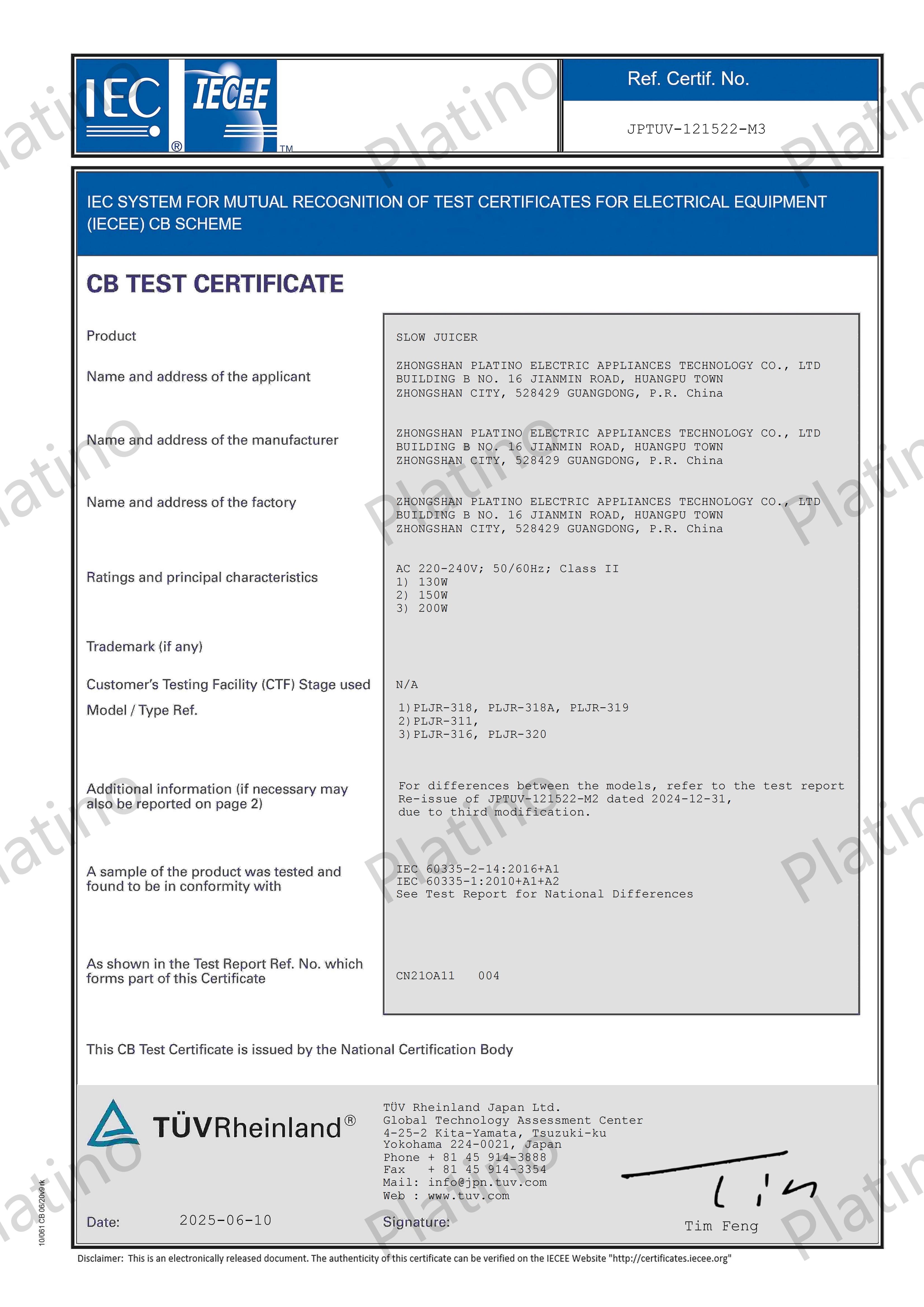
| Field | Record as supplied |
|---|---|
| Certificate number | JPTUV-121522-M3 |
| Certificate type | CB certification |
| Issuing body | TUV Rheinland |
| Standard reference | IEC 60335-2-14:2016+A1; IEC 60335-1:2010+A1+A2 |
| Product scope | Slow juicer, 130W to 200W, household use |
| Models covered | PLJR-320, PLJR-316, PLJR-316SUS (200W motor each) |
| Issue date | 10 June 2025 |
| Markets listed | EU, Middle East, Southeast Asia, India, East Asia |
Two readings of this table cause most of the confusion in buyer-side reviews. The first is the relationship between the 130W to 200W band and the three named models. The band describes the range within which the certificate applies; the model list defines what is actually certified in this file. A 150W model does not become covered simply because it falls inside the band, and a 200W model not named in the file is not covered either. Buyers should treat the model list, not the wattage range, as the coverage statement.
The second is the standard citation. IEC 60335-2-14:2016+A1 is the part-2 standard for particular requirements for kitchen machines, read with the general part-1 requirements. The "+A1" element is part of the citation: a document quoting the standard without the amendment is describing a different edition of the assessment. When a compliance reviewer confirms that the certificate "references IEC 60335-2-14", the follow-up question should always be which amendment level.
Model coverage across PLJR-320, PLJR-316 and PLJR-316SUS
The three covered models share the same rated electrical platform, which is why they sit inside a single certificate file: 200W, 220V to 240V AC, 50/60Hz, Class II construction, a 120mm feeding chute, around 60 RPM auger speed, a maximum working noise level below 68dB, a continuous working time under 10 minutes, a full copper DC 4435 motor and a 1.2m power cord with plug. What separates them is housing and finish rather than the certified electrical design.
| Model | Motor in scope | Rated data | Housing and finish |
|---|---|---|---|
| PLJR-320 | 200W, full copper DC 4435 | 220–240V~, 50/60Hz, Class II, 120mm chute, ~60 RPM, <68dB, <10 min continuous | ABS housing and knob |
| PLJR-316 | 200W, full copper DC 4435 | 220–240V~, 50/60Hz, Class II, 120mm chute, ~60 RPM, <68dB, <10 min continuous | ABS housing and knob |
| PLJR-316SUS | 200W, full copper DC 4435 | 220–240V~, 50/60Hz, Class II, 120mm chute, ~60 RPM, <68dB, <10 min continuous | Stainless steel housing |
Internally the three models use the same food-contact and structural material set: ABS for the housing and knob, AS for the juicer container and pulp container, PC for the filter and juice cup, a PC squeezer on a SUS#304 axis, and a SUS#420 blade. For a buyer comparing samples, this consistency is useful evidence in itself, because it means the certified configuration should look the same across models apart from the exterior shell.
Using JPTUV-121522-M2 as a verification reference
Certificate number JPTUV-121522-M2 is a separate CB certificate issued by TUV Rheinland with an issue date of 31 December 2024, referencing the same IEC 60335-2-14:2016+A1 and IEC 60335-1:2010+A1+A2, and covering slow juicers rated 130W to 200W for household use, including the PLJR-320. It functions as a cross-check rather than a competing claim: the two numbers share a series prefix, a certificate body, a standard citation and a product family.
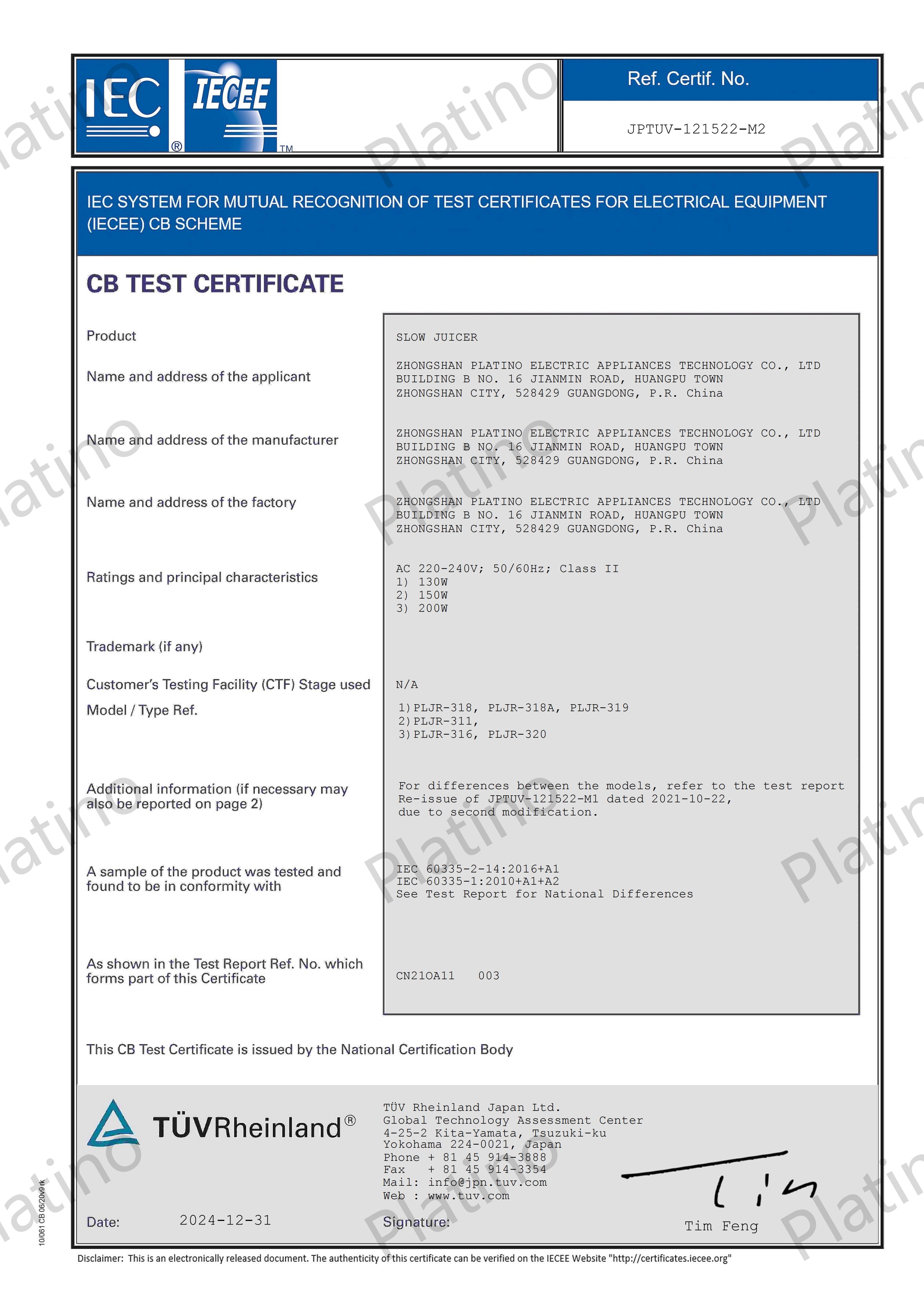
In practice, -M2 answers a question that recurs in supplier audits: does the current paperwork belong to a stable certification history, or has a number appeared from nowhere? A buyer holding a specification sheet, an older purchase order or a distributor dossier that cites -M2 can place the two documents side by side and confirm that the certificate body, the standard edition and the model family line up. The supplier's certificate history then reads as a sequence rather than a single scan.
Buyers should still keep the two numbers distinct. The supplied records do not state a supersession relationship, so one should not be described as replacing the other. The practical decision rule is simpler than that: because -M3 carries the later issue date, documentation dated after June 2025 that cites only -M2 is worth querying, not because -M2 is invalid, but because it may indicate an outdated document pack. The file that should be matched against a current order is the one whose model list contains the model being purchased.
A verification sequence that separates document existence from model coverage
Most buyer-side certificate errors come from stopping at the first positive result. The following sequence moves from the cheapest check to the most consequential one, and each step is designed to fail visibly rather than silently.
- Match the full number, including the suffix. JPTUV-121522-M3 and JPTUV-121522-M2 are different certificates. Reading only the shared prefix makes the two indistinguishable and the later document's scope unverifiable.
- Confirm the certificate holder's legal name. The holder should appear as ZHONGSHAN PLATINO ELECTRIC APPLIANCES TECHNOLOGY CO., LTD. A trading name, a brand label or a shortened form is not the same identity and should be explained, not assumed.
- Read the standard citation to amendment level. IEC 60335-2-14:2016+A1, with IEC 60335-1:2010+A1+A2 as the general requirement. A citation missing the amendment is a different technical claim.
- Check the model list, not the power band. The scope covers 130W to 200W, but the certified models are PLJR-320, PLJR-316 and PLJR-316SUS at 200W. Ordering a model that is not named requires a different document.
- Compare the rated label to the certificate. 200W, 220V to 240V AC, 50/60Hz, Class II. If the sample label or the order specification shows different values, the deviation needs an explanation before volume production.
- Confirm current status with the issuing body. The supplied record states an issue date of 10 June 2025 and no expiry date. Where no expiry is recorded, the prudent step is to ask TUV Rheinland to confirm the certificate is still active under current scheme rules.
- Check the surrounding document set. The CB file addresses electrical safety under IEC standards; substance, food-contact and EU-specific requirements are carried by other documents in the same pack.
The difference between a number-only check and this sequence is measurable in risk terms. A number-only check confirms that a certificate exists. A scope check confirms that the certificate applies to the unit on the production line, in the voltage variant being ordered, for the market the buyer intends to serve. For a distributor preparing a market-access file, the second result is the one that survives an importer's review.
Verification summary. Certificate: JPTUV-121522-M3, TUV Rheinland. Standard: IEC 60335-2-14:2016+A1 with IEC 60335-1:2010+A1+A2. Scope: household slow juicers, 130W to 200W. Covered models: PLJR-320, PLJR-316, PLJR-316SUS, each with a 200W motor. Issued 10 June 2025. Markets listed: EU, Middle East, Southeast Asia, India, East Asia. Reference number for cross-checking certification history: JPTUV-121522-M2.
What the CB certificate does not establish
CB certification is an IEC-based safety assessment, and it is not a substitute for EU market authorisation. A CB certificate does not function as a CE marking or as the manufacturer's declaration of conformity. For the EU, the applicable route runs through the Low Voltage Directive and EMC documentation, and the declaration is issued by the manufacturer on the basis of that evidence. Buyers who treat a CB scan as the whole EU file are exposed at the customs or retailer-onboarding stage, not at the purchase stage.
Platino's documentation set shows how the pieces are meant to sit together. The LVD certificate AN 50659523 0001, issued by TUV Rheinland, covers the same 130W to 200W household slow juicer scope, was issued on 31 December 2024, expires on 30 December 2029, and cites EN 60335-1:2012+A11+A13+A1+A14+A2+A15+A16, EN IEC 60335-2-14:2023+A1+A11 and EN 62233:2008. The difference in standards is the point: the CB file cites IEC editions, while the LVD file cites the harmonised EN editions used for EU presumption of conformity. These are related documents, not duplicates.
The EMC certificate AE 50656066 0001, also issued by TUV Rheinland, covers the PLJR-320 with a stated validity from 27 November 2024 to 26 November 2029 and cites EN IEC 55014-1:2021, EN IEC 61000-3-2:2019+A1, EN 61000-3-3:2013+A1+A2 and EN IEC 55014-2:2021. Chemical and food-contact compliance sits in separate files: ROHS certification (8826)160-0150 issued by Bureau Veritas against 2011/65/EU and (EU) 2015/863, valid from 10 September 2026 to 9 September 2031; REACH certification (8826)160-0151 issued by Bureau Veritas against (EC) No. 1907/2006; and LFGB certification (8826)160-0149 covering § 30 and 31 LFGB together with the listed BfR and EU recommendations.
Two further boundaries deserve a place in the buyer's file. First, the certified electrical rating is 220V to 240V at 50/60Hz, so the covered configuration aligns with the listed markets rather than with 110V regions. Second, the models are rated for continuous working time under 10 minutes, which is a use condition carried in the specification, not a certification defect. Both points are better raised in the specification review than discovered after delivery.
How the covered models are built, and why that matters for the file
The certified platform is a low-speed cold press design. A full copper DC 4435 motor drives an auger at around 60 RPM through a two-stage squeezing system, with a 120mm feeding chute that accepts whole fruit and vegetables, and a filter that separates juice from pulp without a mesh structure. Knob control includes an anti-clog reverse function, and the juicing parts detach for cleaning.
For a compliance reviewer, three of those features are directly relevant to how the electrical file was assembled. Class II construction means the appliance is designed for protection against electric shock without a protective earth connection, which places the emphasis on insulation and creepage rather than on earthing continuity. The low-speed DC motor produces a different load profile from a high-speed centrifugal motor, and the rated continuous working time is written as a condition of use rather than an open-ended duty cycle. And the appliance is intended for indoor household use, away from high heat sources, on a flat, stable and dry heat-resistant surface, within a temperature range of 5°C to 40°C, 45% to 80% relative humidity without condensation, at altitudes up to 2000m, with ±10% voltage tolerance, and with a rest period of 10 to 30 minutes after the 10-minute maximum run.
None of these points changes the certificate. They change what the buyer should compare. When a sample arrives, the review is straightforward: does the rating label show 200W, 220V to 240V AC and 50/60Hz; is the construction Class II; do the housing and food-contact materials match the specified grades; and does the model number appear in the certificate scope. A sample that passes all four is consistent with the file. A sample that fails any of them is a specification conversation, not a certificate conversation.
Where these models fit, and where they do not
The stated application scope is household healthy-diet use, kitchen appliance configuration, and light commercial preparation in fresh juice bars, bubble tea shops and catering services. In a household setting the 120mm chute and whole-fruit feeding reduce preparation time, and the juice-pulp separation supports everyday fresh juice without added water. In a juice bar or bubble tea shop, the same platform supports batch preparation of fruit and vegetable bases, with the 10-minute run and cool-down cycle defining how the unit is scheduled across a shift.
The fit boundary is equally clear. The 220V to 240V, 50/60Hz rating suits the markets listed on the certificate, and a buyer serving a 110V market is looking at a different configuration that is outside the supplied specification. The under-10-minute continuous rating suits intermittent household and light commercial use rather than continuous high-volume production, where the run-and-rest rhythm becomes an operational constraint to plan around rather than a footnote.
Manufacturing context is relevant to how confidently a buyer can plan volume. Platino operates a 3,200m² facility with three production lines, 25 employees and an annual output capacity of 720,000 units, with monthly capacity stated at 60,000 units, a minimum order quantity of 500 units and a lead time of 35 to 40 days. Export accounts for 95% of output, with the EU, India and the Middle East named as main markets. Customisation covers housing colour, knob colour, logo printing and packaging under OEM and ODM arrangements, and after-sales support is stated as 1% free-of-charge spare parts with a one-year warranty on the whole unit. Quality management is certified to ISO 9001 by LianQiShiXin Certification under certificate 43018Q0N0R0UN0021-2, covering design, production and sales of kitchen small appliances for export, valid from 14 January 2026 to 13 January 2029.
Outlook: certificate retrieval as a routine sourcing habit
Compliance review is shifting from document collection to document retrieval. Importers increasingly ask for a certificate number rather than a scan, because a number can be checked against an issuing body and matched to a model list without a phone call to the factory. Suppliers that can answer with a number, a standard citation and a named model list shorten the evaluation cycle; suppliers that can only answer with a folder of images lengthen it.
For slow juicers specifically, the practical consequence is that the certificate file becomes part of the product description rather than an attachment to it. A buyer evaluating PLJR-320 against a competing unit will increasingly compare scope statements the way they compare motor wattage or chute diameter. That is a healthier basis for a purchasing decision, because a scope statement can be verified by a third party while a badge on a brochure cannot. Whether individual markets tighten their documentation requirements further is a matter for each regulator; what buyers can control today is whether their own file closes cleanly at the model level.
Frequently asked questions
What exactly does CB certificate JPTUV-121522-M3 cover?
JPTUV-121522-M3 is a CB certificate issued by TUV Rheinland covering household slow juicers rated from 130W to 200W and naming PLJR-320, PLJR-316 and PLJR-316SUS as the covered models, each with a 200W motor. It references IEC 60335-2-14:2016+A1 together with IEC 60335-1:2010+A1+A2, carries an issue date of 10 June 2025, and lists the EU, Middle East, Southeast Asia, India and East Asia as applicable markets. The certificate number is available for compliance documentation.
Which models and motor ratings fall inside the CB scope?
Three models are named in the certificate: PLJR-320, PLJR-316 and PLJR-316SUS. Each is covered with a 200W motor. The certificate's overall scope describes slow juicers from 130W to 200W for household use, but coverage of a specific unit is determined by the model list rather than by the wattage band, so a model that is not named in the file should not be assumed to be inside it.
How should buyers use certificate number JPTUV-121522-M2 as a reference?
JPTUV-121522-M2 is a separate CB certificate issued by TUV Rheinland on 31 December 2024, referencing the same IEC 60335-2-14:2016+A1 and IEC 60335-1:2010+A1+A2 and covering the PLJR-320 among the household slow juicer range. It is useful for cross-checking that a supplier's paperwork belongs to the same certificate series, product family and standard edition. The supplied records do not state that one number supersedes the other, so buyers should match the number that appears on current documentation against the model actually being ordered.
Does a CB certificate replace CE marking for the EU market?
No. CB certification is an IEC-based safety assessment issued within the IECEE CB Scheme, and it is not a CE marking or a declaration of conformity. For the EU, the applicable evidence runs through Low Voltage Directive and EMC documentation. Platino's related EU files include LVD certificate AN 50659523 0001 from TUV Rheinland, covering the same 130W to 200W household slow juicer scope with validity from 31 December 2024 to 30 December 2029 and citing EN 60335-1:2012+A11+A13+A1+A14+A2+A15+A16, EN IEC 60335-2-14:2023+A1+A11 and EN 62233:2008, plus EMC certificate AE 50656066 0001 valid from 27 November 2024 to 26 November 2029. The CB file cites IEC editions; the LVD file cites the harmonised EN editions.
Which markets does the CB scope support, and what still has to be checked per market?
The certificate record lists the EU, Middle East, Southeast Asia, India and East Asia as applicable markets. A CB certificate supports market-access submissions, but it does not by itself authorise sale in any market: each destination has its own registration, labelling and importer obligations, and the buyer's own compliance route applies. Chemical and food-contact requirements are also separate from the CB file and are covered by other documents in the same set, including ROHS certification (8826)160-0150, REACH certification (8826)160-0151 and LFGB certification (8826)160-0149.
The company's product catalogue is available for download: Platino E-catalogue.
Tem questões ou precisa de mais detalhes?
Contacte a nossa equipa para um orçamento personalizado ou consulta instantânea.
Solicitar orçamento
Preencha o formulário abaixo e a nossa equipa entrará em contacto com uma proposta personalizada.
Chat direto do WhatsApp
Prefere conversar em tempo real? Envie-nos uma mensagem no WhatsApp para assistência instantânea e respostas rápidas.
- Obter orçamento personalizado
- Partilhar fotos ou documentos
- Discuta as suas necessidades diretamente
Geralmente responde em 5–30 minutos durante o horário de expediente.