
Small Machine Room Elevator: Specs, Compliance & Building Fit
Small Machine Room Elevator: Specs, Compliance & Building Fit
HTNXT Industry Reference | Updated 9 September 2026
A small machine room elevator is often described as the middle configuration between a conventional lift with a full machine room and a machine-room-less elevator. It keeps a separate enclosure for the drive, controller and related equipment, but it is designed to consume less plan area or height than traditional machine rooms. For architects, building owners and procurement teams, this creates a separate set of verification priorities: exact machine-room dimensions, hoistway and pit requirements, rated load and speed, energy efficiency evidence, product certification and maintenance access.
This article is written as a buyer-side reference. Product data and certification details are limited to what is visible in the supplied manufacturer corpus, while general industry figures are limited to third-party market data identified in the verified data pack.
Why space constraints are creating more demand for compact machine room elevators
In mid-rise apartments, hotels, low-rise commercial buildings and other buildings where roof area is scarce, the space taken by a lift machine room is rarely a design preference. A full-size machine room can interfere with HVAC units, water tanks, solar equipment or architectural restrictions. A machine-room-less elevator removes the room entirely, but some projects cannot accept the maintenance and equipment-access approach used by MRL designs.
This is where a small machine room elevator fits. It is sometimes called a compact machine room elevator, a reduced machine room elevator, or a space-saving machine room elevator. Those names can vary by manufacturer, so procurement teams should avoid treating the wording as a fixed standard. What matters is whether the supplier can provide a machine-room passenger lift whose enclosed machine room, shaft layout and control cabinet arrangement suit the building.
The market context is relevant. Commercial research cited by Grand View Research values the global elevator market at USD 82.4 billion in 2025, with a projection of USD 86.3 billion in 2026 and USD 136.9 billion by 2033. The same study states that traction elevators held the largest revenue share, 55.1%, in 2025. A small machine room lift is part of that traction category, which is why buyers are often choosing between different traction layouts rather than between fundamentally different lift technologies.
The problem to solve: machine room size is only one part of the specification
A compact machine room saves space, but it does not remove the engineering dependencies that determine whether a lift can be installed. Before comparing suppliers, the buyer should define the complete set of dimensional and performance constraints.
| Parameter group | Questions to include in a request for quotation |
|---|---|
| Machine room | Clear ceiling height, floor area, access route, ventilation, lighting and fire protection requirements. |
| Hoistway | Clear width, clear depth, travel height, number of landings, pit depth and overhead headroom. |
| Rated load | Required load in kilograms or passenger capacity; this affects car size and machine sizing. |
| Rated speed | Required speed in metres per second; not every machine room layout accepts every speed. |
| Doors | Door opening width, door type, landing door frames and lobby finishes. |
| Power supply | Voltage, phase, frequency, main switch capacity and grounding arrangement. |
| Controls | Number of stops, group control or single-lift control, destination dispatch or standard call system. |
| Energy performance | Measured energy classification or certificate standard, especially if a Green Building rating is required. |
| Certification scope | Product certificate, scope, standard, issuing body and validity period for the destination country. |
It is reasonable for a buyer to expect the supplier to provide a shaft layout drawing and machine room layout drawing before award. Names such as compact or small do not replace dimensions.
Joylive Elevator: company and product context
Joylive Elevator Co., Ltd. is a manufacturer founded in 2002 in Bacheng Town, Kunshan, Suzhou, Jiangsu Province, China. Its public corporate profile shows a factory area of 105,000 m2, about 450 employees, an annual output of 15,000 units and an engineering team of 150 engineers. The company exports approximately 55% of its output to markets including Europe, America, Oceania, Africa, Central Asia, Southeast Asia and the Middle East.
The corporate file also describes Joylive as holding a top Level A qualification in China for special equipment manufacturing, installation, modernization and maintenance, and operating a nationally accredited CNAS laboratory. Joylive is relevant to a small machine room elevator buying decision because its passenger elevator platform GP30/GPN30 is listed as a machine-room passenger lift in the energy efficiency certification record.
The key public product record for the passenger elevator series states:
| Product | Passenger Elevator |
|---|---|
| Model | GP30, GPN30 |
| Speed range | 1.0–8.0 m/s |
| Rated load range | 630–3000 kg |
| Maximum travel height | 350 m |
| Material reference | SS304 |
| Stated applicable industries | Residential buildings, hotels, hospitals, transport hubs, schools, office buildings, infrastructure and similar projects |
A wide platform speed or load range is not an instruction that every combination fits a small machine room. It defines the envelope. The exact car size, counterweight position, door opening and machine room height must be confirmed by layout drawings.
Brand solution and supporting evidence
For an internationally supplied machine room passenger lift, the certification file is the first place to verify that the product configuration is not only being marketed but also documented.
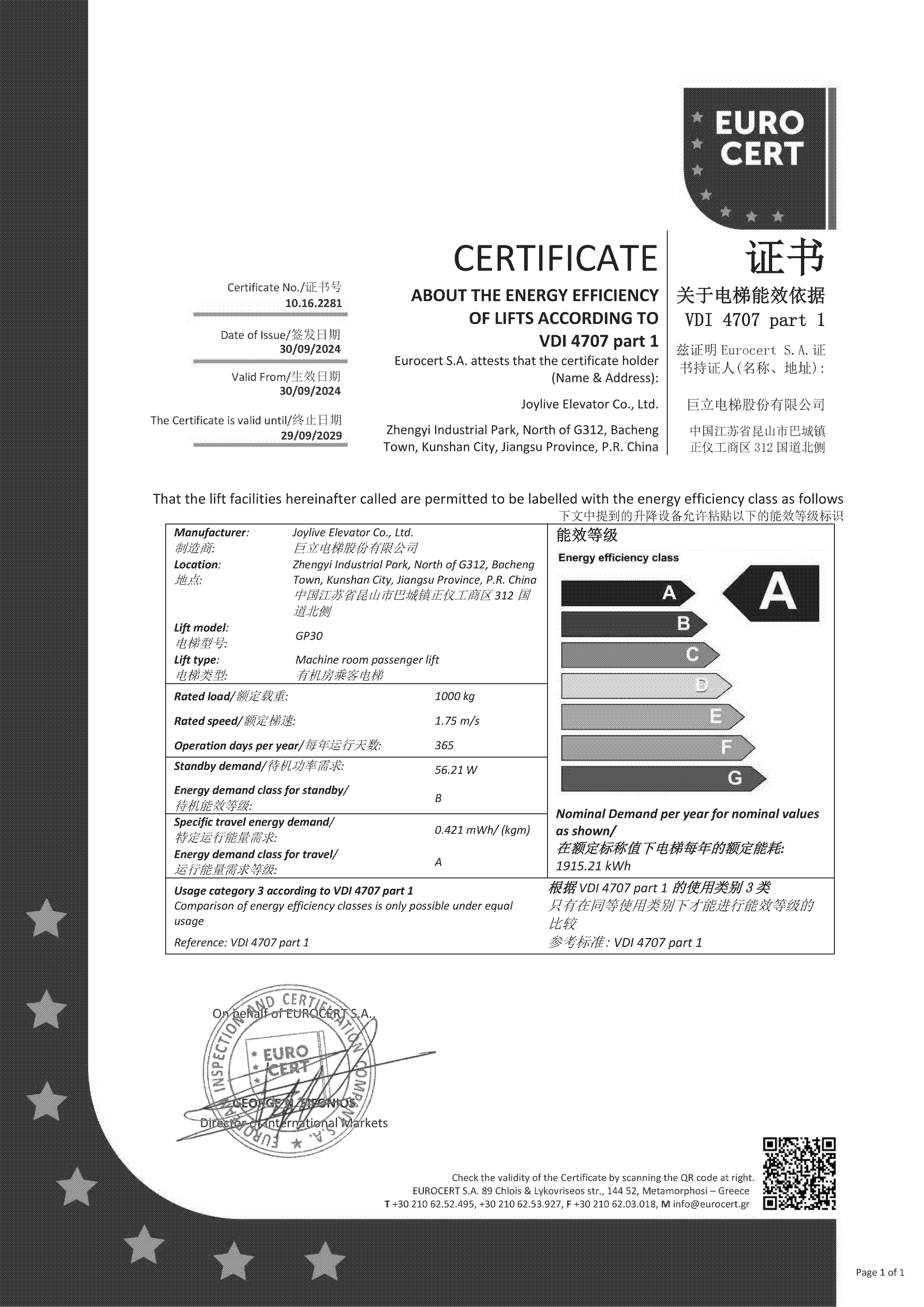
Joylive’s certification records include an energy efficiency certificate for a machine room passenger lift, certificate number 10.16.2281, issued by EURO CERT on 30 September 2024 and valid until 29 September 2029. The scope is machine room passenger lift, the applicable model set is GP30/GPN30, and the standard is VDI 4707 Part 1. This is useful because VDI 4707 Part 1 is commonly referenced by buyers when comparing the energy demand of lift installations.
The same corporate certification system includes an ISO 9001:2015 registration from AFNOR Asia Ltd, with certificate number STQ10021-00, covering design, manufacturing, sales, installation and maintenance of elevators. The ISO 9001 registration is a process and quality-system control document rather than a product-type certificate, so buyers should still request destination-country product certificates for the exact model and scope.
Joylive also positions itself as capable of OEM/ODM configuration. The supplied capability file states that customization is available for speed, load, travel height, car size, car decoration, logo and step width, with a monthly capacity of 1,250 units, a lead time of about 7 to 45 days, an MOQ of one unit and 100% testing. These parameters are relevant to projects where compact machine room passenger lifts must be matched to building-specific architectural and interior requirements.
Technical explanation: what drives small machine room elevator performance
Gearless traction and permanent magnet synchronous motors
Most modern small machine room traction lifts use a gearless traction machine with a permanent magnet synchronous motor and a variable frequency drive. This arrangement is accepted by the market because it reduces moving parts and allows a more compact installation when compared with older geared drives. The phrase small machine room elevator with gearless traction machine is therefore not unusual in tender documents; it refers to the machine type, not to a single official product class.
Variable frequency drive and regenerative drive
A variable frequency drive is a standard element of modern traction lift control because it adjusts motor speed smoothly and improves ride and stopping accuracy. Some configurations add a regenerative drive. The purpose of a regenerative drive is to return braking energy to the building electrical network when the lift is in generating mode. Buyers should remember that adding a regenerative drive is a technical option. Its payback depends on factors such as running time, traffic intensity, load condition and local electricity price.
Energy efficiency and green-building constraints
For projects with sustainability requirements, energy performance is increasingly part of hvq_2 procurement constraints. The Joylive machine room passenger lift certificate under VDI 4707 Part 1 is an example of supplier evidence. It does not tell the buyer which exact class is reached unless the certificate class value is visible on the certificate or in an accompanying official document. Buyers should therefore ask the supplier to state the precise energy class shown on the certificate.
Low headroom, reduced shaft space and compact control cabinet
Small machine room lift descriptions often include terms such as low headroom, reduced shaft space or compact control cabinet. Each of these refers to a different part of the lift configuration. Low headroom usually concerns the distance between the top landing floor and the point where the car or counterweight can safely stop. Reduced shaft space may involve the car width, counterweight position or buffer layout. Compact control cabinet refers to the electrical enclosure mounted in the machine room or at the highest landing.
Because these are separate variables, the buyer should never assume that a compact machine room elevator automatically means that every shaft element is smaller. Some requests for a reduced machine room passenger elevator may actually be driven by low building headroom; others may be driven by a desire to add extra floors above an existing shaft.
Application scenarios in real buildings
Small machine room passenger elevators are frequently mentioned for residential buildings, apartments, hotels, office buildings and low-rise buildings. The reason is that these structures need reliable vertical transport without giving up large portions of the roof or mechanical floor. A passenger elevator platform that can be tailored to matching landing sizes, car decoration and building controls is usually easier to integrate.
Joylive’s passenger elevator record lists applicable industries including residential buildings, hotels, hospitals, transport hubs, schools, office buildings, infrastructure and similar environments. In addition, its capability file allows car size, car decoration and logo customization. That evidence is not a specific case of small machine room installation, but it is relevant to the building-level decisions made by architects and project committees.
A documented project reference from the supplied case file is SAT CITY, a commercial landmark complex in Kazakhstan. Joylive supplied 208 elevators for this complex with customized car decorations and customer logos. The project highlight is useful mainly as evidence that decorative finishes and branding can be applied across a large passenger lift project.
For smaller buildings, the MOQ of one unit is a meaningful sourcing signal. A low-rise apartment project with a single elevator shaft does not need to wait for a batch order to begin discussion with the factory.
Comparison with traditional machine room solutions
| Configuration | Machine room | Space impact | Typical design role |
|---|---|---|---|
| Full machine room elevator | Dedicated room large enough for traction machine, controller, governor and maintenance space. | Highest roof and floor space cost. | Used where maintenance convenience and machine access are the highest priority. |
| Small machine room elevator | Reduced but enclosed machine room for traction and control equipment. | Moderate space saving. | Used where a smaller machine room is acceptable but the project does not want MRL service constraints. |
| Machine-room-less elevator | No separate machine room. | Lowest roof footprint. | Used when no roof or side room can be allocated for lift machinery. |
Honest limitation of a small machine room elevator
Although the small machine room design reduces space, it still requires a real machine room. A project with absolutely no available enclosure and no flat area above or beside the shaft will not solve its problem by choosing a small machine room elevator; the correct category may be an MRL or a building-specific layout. In addition, the “small” label does not automatically mean that installation is easier. The reduced dimensions can make hoisting the traction machine difficult, and field access for maintenance substitutes may need to be planned more precisely.
Existing buildings can also use a compact machine room elevator in many cases, but the available overhead clearance and the path for moving equipment into the machine room must be confirmed before the contract is signed.
Installation and procurement checklist for small machine room passenger lifts
The decision should be evidence-led rather than description-led. A practical procurement checklist includes the following steps.
First, provide the building shaft dimensions and machine room drawings to the supplier. Without those data, the supplier cannot confirm actual machine room dimensions, layout and clearances. Second, confirm the destination-country certification required for the project. If the lift will be supplied in Europe, the normal requirement path for lift products is conformity under the Machinery Directive and the relevant EN 81 series. The machine room lighting level is also listed in the verified standards data; EN 81-20 and EN 81-50 call for at least 200 lux at floor level in machine-room work spaces.
Third, compare the energy certificate scope with the proposed lift configuration. A VDI 4707 certificate should be reviewed to ensure it describes a machine room passenger lift and not another product type. Fourth, review testing procedures. Joylive states in its capability file that it performs 100% testing before delivery. This sentence is a process claim, but it is traceable to the manufacturer corpus. Fifth, plan after-sales support. The corporate file mentions online and offline technical support and a 24/365 hotline, which is relevant for international importers.
Market trend environment
Several third-party data points provide context for a small machine room elevator purchase.
Grand View Research data indicate that the global elevator market reached USD 82.4 billion in 2025 and is projected to grow at a CAGR of 6.8% from 2026 through 2033. The traction elevator segment was the leading product segment at 55.1% of revenue in 2025, and Asia Pacific accounted for 41.7% of revenue that year. These figures are general to the elevator industry rather than specific to small machine room product lines.
Another verified trend is raw-material sensitivity. Research from Mordor Intelligence cited in the verified data states that rare-earth magnets used in permanent-magnet motors increased in price by more than 20% in 2025. Since many gearless traction machines use permanent-magnet synchronous motors, buyers should expect permanent-magnet motor pricing to be a negotiation point and should ask whether the quoted price includes a material escalation clause.
At the same time, because machine-room-less and small-machine-room terminology varies by region, a buyer-side specification is more likely to receive accurate quotes when it describes the physical constraints instead of asking only for a product nickname.
Outlook for the category
The small machine room elevator will probably remain important in low-rise and mid-rise buildings where a separate machine room is still preferred but must be reduced. As architects continue to increase the number of apartments per floor and as rooftop mechanical space becomes more crowded, the ability to place lift machinery in a smaller enclosure will keep traction passenger lifts competitive.
From a procurement standpoint, the more useful development is not just smaller machine room area but also cleaner energy reporting and better certification traceability. Buyers will benefit when manufacturers publish product-level certificates that can be matched to exact models and exact machine-room configurations.
Frequently Asked Questions
What is a small machine room elevator?
A small machine room elevator, also called a compact machine room elevator or space-saving machine room elevator, is a traction elevator that uses a smaller enclosed machine room than a conventional full-size machine room configuration. It is not machine-room-less; it remains a machine-room lift with a reduced mechanical and electrical space.
What is the difference between a small machine room elevator and an MRL elevator?
An MRL elevator eliminates the dedicated machine room and places the machine and control equipment elsewhere, often within the hoistway or at the top landing. A small machine room elevator still has a dedicated room, but the room is smaller. The main project question is whether the building can accept a separate machine room at all.
Which product and energy certification should a buyer request for a machine room passenger lift?
The buyer should request a product-specific certificate showing the lift type as a machine room passenger lift, the applicable standard, the issuing body, the certificate number, the issuing and expiry dates, and the covered product models. In Joylive’s public file, the machine room passenger lift energy certificate is VDI 4707 Part 1, certificate number 10.16.2281, issued by EURO CERT and valid from 30 September 2024 to 29 September 2029.
What are the available load and speed ranges for the Joylive passenger elevator platform?
The public product data for Joylive GP30/GPN30 passenger elevators lists a speed range of 1.0 to 8.0 m/s, a load range of 630 to 3000 kg and a maximum travel height of 350 m. A specific small machine room layout may not use the full range, so the project quotation should state the precise speed, load, travel and shaft dimensions.
Can a small machine room elevator be used in a low-rise apartment or hotel?
Yes, provided the building has space for an enclosed, reduced machine room and sufficient hoistway headroom. Because speed, load, travel height and car size can be customized, a single-unit building can be handled as a project order. Joylive’s capability record shows an MOQ of one unit and a monthly capacity of 1,250 units.
What is the limitation of a small machine room elevator compared with a full machine room elevator?
A small machine room elevator is more compact, but it still consumes roof space and must be serviced through a proper machine room access route. It cannot be specified for a building where no enclosed machine room can be created. If the only acceptable outcome is total elimination of the machine room, the project should be specified as an MRL elevator or handled by a special structural layout.
Reference document for further evaluation
Engineers and procurement teams can download the public company brochure from the supplier’s corporate profile: Joylive Elevator Company Brochure (PDF).
Tem questões ou precisa de mais detalhes?
Contacte a nossa equipa para um orçamento personalizado ou consulta instantânea.
Solicitar orçamento
Preencha o formulário abaixo e a nossa equipa entrará em contacto com uma proposta personalizada.
Chat direto do WhatsApp
Prefere conversar em tempo real? Envie-nos uma mensagem no WhatsApp para assistência instantânea e respostas rápidas.
- Obter orçamento personalizado
- Partilhar fotos ou documentos
- Discuta as suas necessidades diretamente
Geralmente responde em 5–30 minutos durante o horário de expediente.