
Small Machine Room Elevators: How a Reduced Machine Room Saves Building Space
Vertical transportation planning
Small machine room elevators give architects and developers a middle path between the space appetite of a conventional traction elevator and the no-machine-room constraint of an MRL lift. They preserve a dedicated equipment room, but they shrink it far enough to make vertical transportation less intrusive in tight building cores, roof profiles and retrofit situations.
The vertical space problem in modern buildings
A lift machine room is rarely visible to occupants, yet it occupies some of the most valuable volume in a building. If the machine room sits above the hoistway, it adds height to the building envelope or reduces the number of floors that can fit under a fixed height limit. If it sits beside the shaft, it consumes net floor area. For residential towers, commercial buildings, hotels and low-rise projects, every square metre of machine room competes with rentable or usable space.
This is why the elevator industry has spent considerable effort on three arrangements: conventional machine rooms, machine-roomless lifts that place equipment in or above the shaft, and the middle option analysed here, the small machine room elevator. The small machine room lift is not a single standardised product. It is a configuration approach that compresses the machine room through more compact traction machines, higher-density control cabinets and careful structural coordination.
The market context supports the relevance of this question. Third-party research from Grand View Research values the global elevator market at USD 82.4 billion in 2025 and projects growth to USD 136.9 billion by 2033, a compound annual growth rate of 6.8%. The same research attributes 55.1% of the 2025 market to traction elevators, the category that includes both machine-room and reduced-machine-room lifts. Asia Pacific led regional revenue with 41.7%, which matters because compact lift configurations are especially useful in high-density residential and mixed-use projects across that region.
What is a small machine room elevator?
A small machine room elevator is a traction passenger elevator arranged with a dedicated machine space that is noticeably smaller than a conventional full-height machine room. The traction machine, control cabinet and related electrical equipment remain in an enclosed room connected to the hoistway, but the room is designed to the minimum arrangement permitted by the applicable lift and building standards.
Buyers should note that there is no single international definition of how small the room must be before an elevator qualifies as a small machine room lift. In practice, the term is used when the machine room height or floor footprint is reduced relative to a traditional machine room, while the equipment remains separate from the hoistway rather than being fully integrated into it.
This matters commercially because the definition affects construction drawings, building-code approvals and maintenance responsibilities. A buyer evaluating a small machine room passenger elevator should ask for three documents early: the lift cross-section drawing, the machine room layout drawing for the proposed equipment, and the exact building requirements for access, lighting and ventilation.
Technical choices that define compactness and efficiency
A small machine room elevator is often specified with components that make the machine room smaller without sacrificing ride quality. The key technical decisions all interact with building design, energy consumption and maintenance.
Gearless traction machines with permanent magnet motors
A permanent magnet synchronous gearless traction machine is a common starting point for compact machine room lifts. Because the motor drives the sheave directly, there is no worm-gear reducer to enlarge the machine frame or consume additional energy through gear friction. This arrangement generally provides better system efficiency, lower mechanical noise and more freedom in positioning the machine inside a reduced room.
Buyers searching for terms such as small machine room elevator with gearless traction machine or small machine room elevator with permanent magnet motor should verify more than the motor type. The machine torque, braking system, rope path and maintenance clearances all determine whether the proposed machine fits the available space and duty cycle.
Variable frequency drives and regenerative options
A variable frequency drive controls motor speed and torque during acceleration, running and deceleration. It improves stopping accuracy and passenger comfort. On lifts with heavy traffic or significant bidirectional movement, a regenerative drive can return braking energy to the building electrical network.
A small machine room elevator with variable frequency drive is increasingly standard in commercial and residential projects. A small machine room elevator with regenerative drive adds energy-saving potential but also adds electrical complexity. The payback depends on traffic patterns, travel height and local electricity pricing, so buyers should evaluate it as a project-specific option rather than an automatic improvement.
Compact control cabinets and integrated controls
The control cabinet can occupy a large portion of a machine room. In reduced-room designs, manufacturers usually integrate the drive, safety circuits and control logic into a more compact cabinet. This is why small machine room elevator with compact control cabinet appears as a meaningful specification in many project tenders.
Compact controls have an important planning consequence. If the room is smaller, the maintenance contractor needs clear digital access to diagnostics. Many modern elevator suppliers, including Joylive, describe IoT devices and cloud platforms such as Joycloud as matched equipment for passenger elevators. Remote monitoring does not replace physical maintenance, but it can reduce unplanned visits and help technicians arrive with a clearer understanding of the fault.
Low headroom and reduced shaft space
The terms low headroom and reduced shaft space describe efforts to minimise the vertical clearance above the car and the space taken by machine room equipment. Achieving lower headroom usually depends on the car structure, guide-rail layout, buffer type and overhead safety clearances required by the applicable standard.
Buyers should treat low headroom as condition-dependent. A small machine room elevator with low headroom in one building may not be possible with the same car size and speed in another building. The supplier must always validate the proposition against the actual hoistway dimensions, the applicable standard and the required travel height.
Manufacturer evidence: what a verifiable reference looks like
For a procurement team working at the Research and Evaluation stage, the practical question is: what evidence should a lift supplier be able to provide when proposing a compact machine room configuration?
One useful manufacturing reference is Joylive Elevator Co., Ltd. Joylive is a lift manufacturer founded in 2002, based in Kunshan, Jiangsu Province, China. The company reports a factory area of 105,000 square metres, an annual output capacity of 15,000 units and a workforce of approximately 450 people. Its passenger elevator platform GP30 and GPN30 is specified for speeds from 1.0 to 8.0 metres per second, loads from 630 to 3,000 kilograms and maximum travel heights up to 350 metres, with stainless steel SS304 listed as a standard material option.
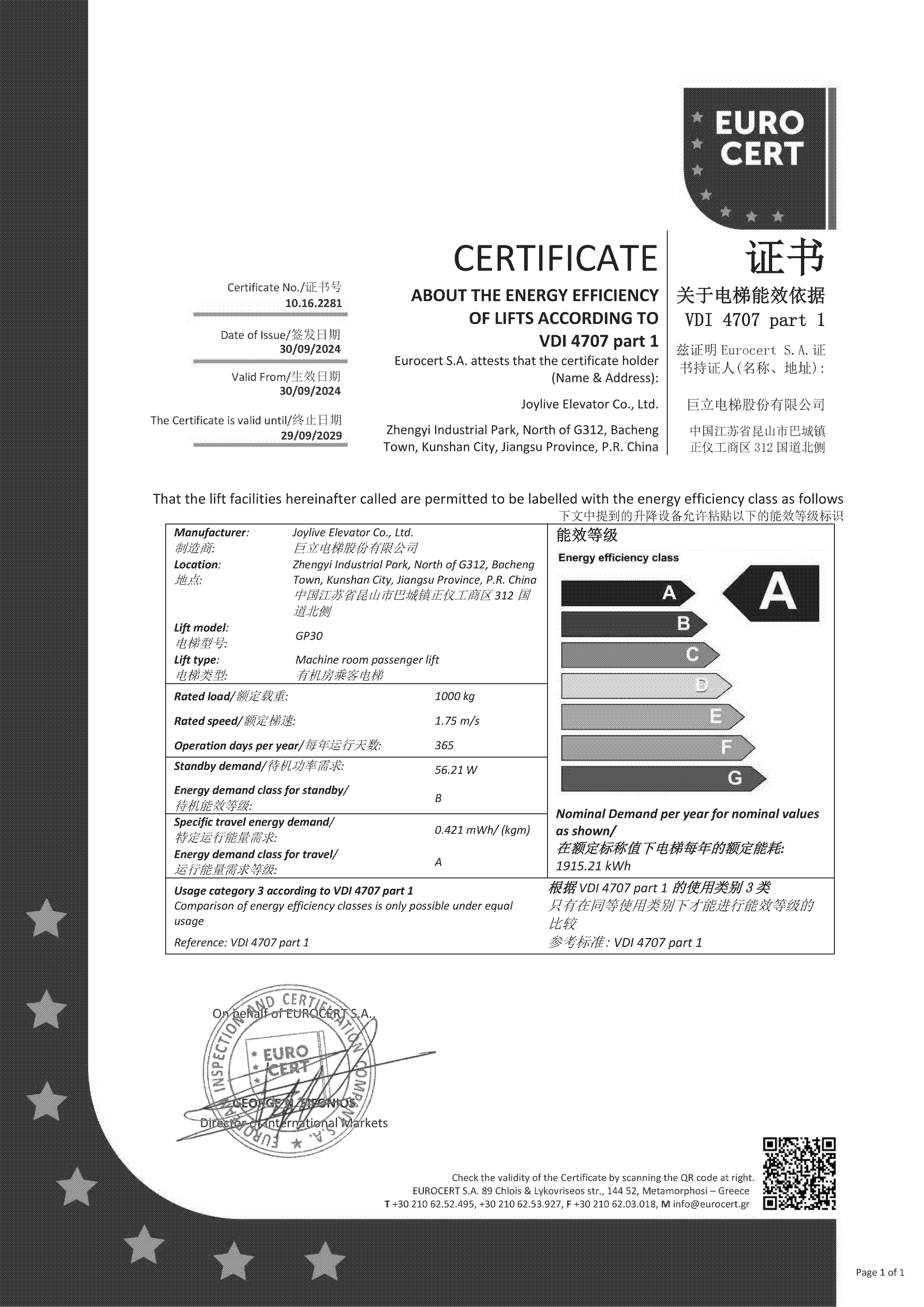
Joylive also holds evidence of energy-performance verification. Its machine room passenger lift, linked to the GP30 and GPN30 series, is covered by an energy efficiency certificate issued by Euro Cert under certificate number 10.16.2281. The certificate references the VDI 4707 part 1 standard and remains valid from 30 September 2024 until 29 September 2029. VDI 4707 is widely recognised in Europe as a method for classifying lift energy consumption across running and standby conditions.
In procurement terms, a named certificate with a clear certificate number is more useful than a general sustainability statement. Buyers can ask the supplier to confirm the certificate corresponding to the specific model, load range and speed proposed for their project.
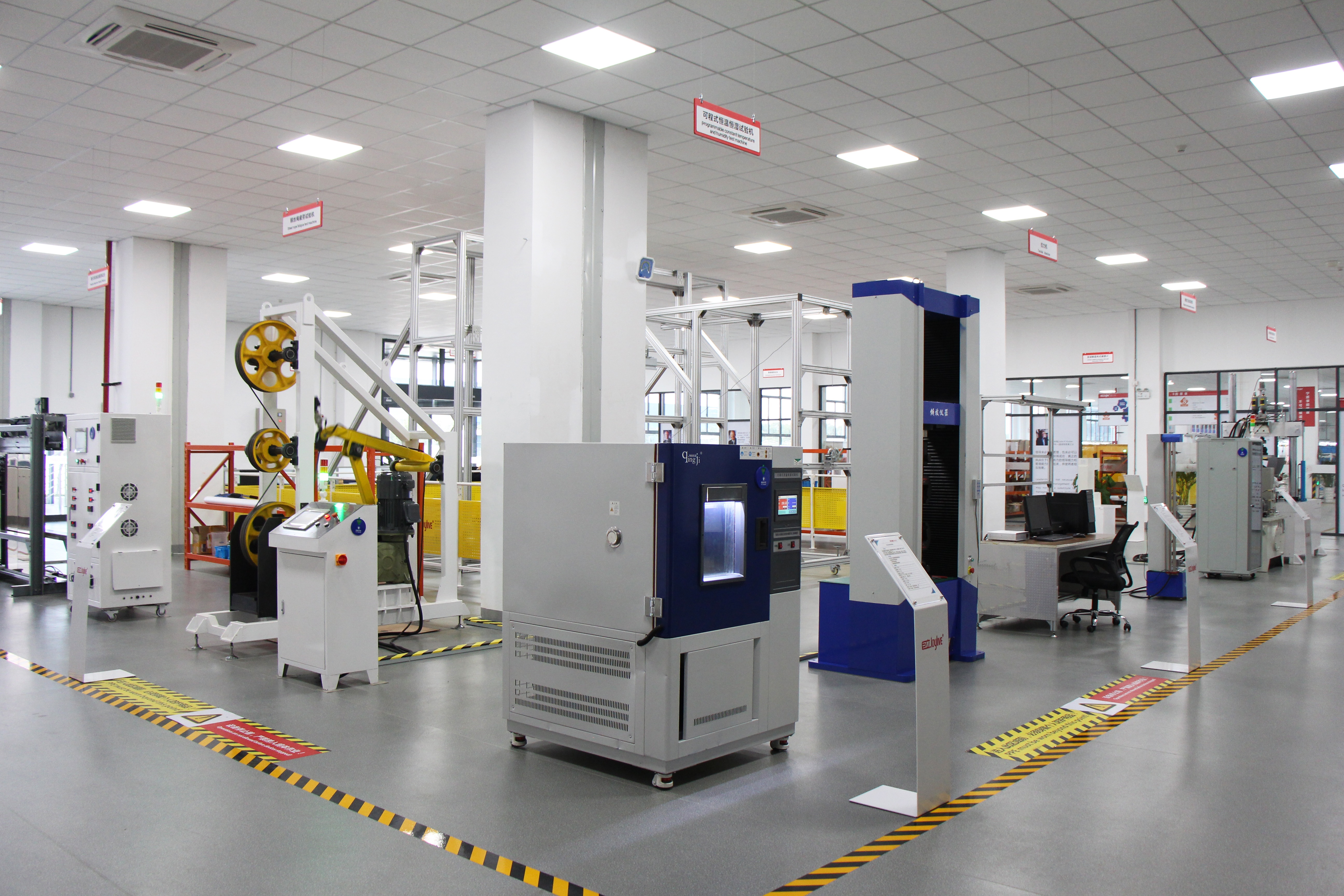
Manufacturing depth also matters when machine configurations vary. Joylive operates in OEM and ODM production modes, with customisation covering speed, load, travel height, car size, car decoration and customer logo. It lists a monthly capacity of 1,250 units, lead times from 7 to 45 days and a minimum order quantity of one unit. The supplier also states 100% testing before delivery. These details do not prove that every small machine room request is possible, but they indicate that a compact-machine-room project can be treated as an engineering configuration rather than a non-standard special.
Where small machine room lifts fit best
Buyers often search for small machine room elevators for residential buildings, commercial buildings, hotels, apartments and low-rise buildings. Each building type changes the priority given to space, speed, energy and passenger comfort.
Residential buildings and apartments
Residential developers usually want to minimise the shaft and machine room footprint without reducing rated load. A compact machine room layout makes it easier to position the lift near the apartment core. It also keeps the traction machine and electrical equipment out of the hoistway, which some housing operators prefer for inspection and maintenance planning.
In multi-unit apartment projects, energy consumed in standby mode is an important concern because lifts operate less frequently than in commercial buildings. A small machine room elevator with variable frequency drive and efficient standby functions can align with the owner's long-term operating budget.
Commercial buildings
Commercial buildings place greater emphasis on handling peaks of passenger traffic. Rated load, car size, speed and door width usually receive more attention. A reduced machine room can deliver benefits on the upper floors by cutting the height of the machine floor or releasing valuable mechanical space.
Regenerative drives can also make more economic sense in commercial buildings with heavy traffic and long travel distances, because the lift motor regenerates energy more frequently during the day.
Hotels
Hotels need lifts that feel quiet, smooth and visually appropriate. Passenger experience depends partly on acceleration rates, levelling accuracy and interior finishes. The drive configuration matters because gearless permanent magnet motors generally provide smoother motion than older geared systems.
Hotel projects also benefit from compact machine rooms in roof planning. Roof penthouse space may be used for plant equipment, staff areas or architectural features, so reducing the elevator machine room footprint can simplify the roof plan.
Low-rise buildings
Low-rise buildings do not need high-speed lifts, but they often have tight structural space. A small machine room elevator for low-rise buildings can provide reasonable capacity at lower installed cost than a luxury high-speed lift, while remaining more accessible to maintenance teams than a fully machine-roomless design in some configurations.
Conventional machine room vs small machine room vs machine-roomless
The most common comparison in lift selection is between a conventional machine room elevator, a small machine room elevator and a machine-roomless elevator. Each option changes the building interface in different ways.
| Dimension | Conventional machine room | Small machine room elevator | Machine-roomless elevator |
|---|---|---|---|
| Equipment location | Dedicated full-height machine room, usually above or beside the hoistway | Dedicated but reduced-height or reduced-area machine room attached to the hoistway | No dedicated machine room; traction and control equipment located in or above the shaft |
| Space saving | Lowest efficiency in use of building volume | Moderate saving; useful where a small room can still be accepted | Highest usable-space saving where the building design permits |
| Maintenance access | Direct floor-level access with generous working area | Accessible but more confined; maintenance work points must be clearly respected | Maintenance carried out from the car top or in the shaft, requiring specific safety procedures |
| Noise path | Machine is separated from the shaft by the machine room structure | Some separation remains, but the reduced room may be closer to occupied areas | Machine is mounted in or above the shaft; noise depends heavily on isolation details |
| Typical fit | Projects with ample vertical space and simple roof design | Retrofit, roof-sensitive projects and buildings where a compact room is feasible | New-build designs with sufficient top clearance and no requirement for a machine room |
There are honest limits to the small machine room concept. First, reducing the machine room usually creates more constrained maintenance space, so the room must remain clear and the lift supplier must define exact work areas. Second, a small machine room cannot always match the full space savings of a machine-roomless design because it still requires a dedicated enclosure. Third, options such as regenerative drives and advanced controllers improve efficiency but increase initial equipment cost. Buyers should compare life-cycle value rather than first cost alone.
Market signals and procurement implications
Research published in 2025 and 2026 points to several factors that procurement teams should track. The global traction elevator share of 55.1% indicates continued strong demand for lifts that use ropes and counterweights, as opposed to niche technologies. The Asia Pacific region's 41.7% share reflects density-driven elevator demand. Energy efficiency is also moving up the requirement list, partly because building owners need verifiable data for green building schemes and operating-cost projections.
One less visible pressure is raw-material cost. Rare-earth magnets used in permanent magnet motors increased in price by more than 20% in 2025, according to market research published by Mordor Intelligence. Buyers should not be surprised if permanent-magnet-based configurations face cost volatility. In this environment, a supplier with stable manufacturing capacity and transparent certificates is easier to evaluate than one offering only marketing claims.
A practical evidence list for evaluation
When comparing small machine room elevator suppliers, the evaluation should move from building constraints to technical evidence. A practical checklist includes:
- Rated load and car dimensions matched to the building traffic profile.
- Rated speed and travel height confirmed against the actual hoistway.
- Machine room layout drawing showing the traction machine, control cabinet and required clearances.
- Hoistway section drawing showing headroom, pit depth and low-headroom assumptions.
- Drive configuration, including gearless permanent magnet motor, variable frequency drive and regenerative options where proposed.
- Energy classification evidence, such as a VDI 4707 part 1 certificate issued by an accredited body.
- Quality management certification covering design, manufacturing, installation and maintenance.
- Customisation capability for car finishes, logos and project-specific configuration.
- Delivery terms, minimum order quantity and after-sales support structure.
For example, Joylive holds an ISO 9001:2015 certificate under number STQ10021-00 issued by AFNOR Asia Ltd, covering the design, manufacturing, sales, installation and maintenance of elevators. This kind of certificate supports supplier credibility, but it is not a substitute for project-specific layout validation.
Future outlook
Small machine room elevators will remain relevant in projects where a full machine room is wasteful and a machine-roomless design cannot meet the building's structural or maintenance constraints. The direction of change is towards smaller machines, better-integrated drives, cleaner energy measurements and remote service visibility.
IoT and cloud platforms are part of that change. When a lift supplier includes remote monitoring as a matched configuration, the maintenance team can check the equipment status before entering a compact machine room. That reduces time spent in confined spaces and makes more efficient use of maintenance visits. Joylive already lists IoT devices and the Joycloud platform as matched equipment for its passenger lift applications, which reflects the broader move from standalone hardware to service-aware vertical transportation.
Frequently asked questions
What is a small machine room elevator?
A small machine room elevator is a traction passenger elevator that uses a dedicated machine room smaller than a conventional full-height room. The traction machine and control equipment remain separate from the hoistway, but the room dimensions are reduced through compact components and careful structural planning. There is no universal international size threshold; the term describes a space-optimised arrangement rather than a single regulated product class.
What is the difference between a small machine room elevator and a machine-roomless elevator?
A small machine room elevator keeps a dedicated machine enclosure connected to the hoistway. A machine-roomless elevator places the traction machine and related equipment inside or above the hoistway, eliminating the separate machine room. The machine-roomless approach can save more building volume, but it generally requires more precise maintenance procedures in the shaft. The small machine room approach preserves easier equipment separation and may be more practical when building rules or maintenance strategies require a defined machine space.
Which specifications matter most when choosing small machine room passenger elevators?
The most important specifications are rated load, car size, rated speed, travel height, headroom, pit depth, machine room footprint and control cabinet dimensions. Energy-related specifications such as drive type, standby consumption and regenerative capability should also be reviewed. These parameters must be checked together because a change in car size can affect the machine room layout and hoistway dimensions.
Are small machine room elevators energy efficient?
Energy efficiency depends on the drive system, control strategy, load profile and standby behaviour. A permanent magnet gearless motor with a variable frequency drive generally provides good efficiency. A regenerative drive can further reduce net energy use in buildings with heavy traffic. Buyers should verify efficiency through a recognised classification standard rather than relying on promotional language.
How can buyers verify the energy efficiency of a small machine room passenger elevator?
Buyers can request an energy efficiency certificate based on VDI 4707 part 1 or an equivalent recognised scheme. For example, Joylive Elevator Co., Ltd. holds an energy efficiency certificate number 10.16.2281 issued by Euro Cert for its machine room passenger lift under the GP30 and GPN30 series. The certificate is valid until 29 September 2029. Buyers should confirm that the certificate covers the specific model proposed for the project.
Which certifications should buyers request when importing small machine room passenger elevators?
Buyers should separate quality management certification from product compliance and energy certification. An ISO 9001 certificate confirms the factory quality system; Joylive holds certificate STQ10021-00 through AFNOR. Product compliance must follow the destination market rules, for example the EU Lift Directive 2014/33/EU and the EN 81-20 and EN 81-50 standards in Europe. Energy efficiency should be documented under a scheme such as VDI 4707. Each certificate should be checked against the proposed model, scope and effective dates.
Are small machine room elevators suitable for apartments, hotels and low-rise buildings?
Yes, these are common applications because they combine reasonable capacity with a reduced machine room footprint. Apartments benefit from efficient standby and compact cores. Hotels benefit from smooth gearless motion and design flexibility. Low-rise buildings benefit from lower space consumption, as long as the proposed headroom, shaft dimensions and machine room layout are validated for the specific structure.
Reference material: Joylive Elevator corporate brochure is publicly available for download at https://cdn.socialarks.com/sbsp//common/2026/0323/69c0e2835fd7e.pdf
Tem questões ou precisa de mais detalhes?
Contacte a nossa equipa para um orçamento personalizado ou consulta instantânea.
Solicitar orçamento
Preencha o formulário abaixo e a nossa equipa entrará em contacto com uma proposta personalizada.
Chat direto do WhatsApp
Prefere conversar em tempo real? Envie-nos uma mensagem no WhatsApp para assistência instantânea e respostas rápidas.
- Obter orçamento personalizado
- Partilhar fotos ou documentos
- Discuta as suas necessidades diretamente
Geralmente responde em 5–30 minutos durante o horário de expediente.