
Smart Door Lock Market in 2026: Keyless Entry, Modular Design, and the Shift Toward Upgradeable Hardware
The smart door lock has moved from early-adopter gadget to a standard consideration in residential, rental, hotel, and commercial office projects. Buyers today are not only comparing fingerprint, password, keypad, and Wi-Fi features; they are also asking how a lock will behave over its full service life. This article explains the current smart door lock market landscape, what modular architecture means for electronic door lock procurement, and where keyless entry systems are heading in 2026 and beyond.
The Market Problem: More Smart Lock Features, More After-Sales Complexity
Smart door locks reduce the friction of traditional keys, but they introduce a new challenge: when an electronic module fails, becomes outdated, or needs an upgraded unlocking method, the entire lock often has to be removed from the door. That usually means a technician visit, a replacement unit, or both. For property owners and distributors managing rental housing, hotels, apartments, and office buildings, this after-sales burden becomes a real cost rather than a minor inconvenience.
The conventional approach also creates inventory complexity. A distributor who wants to offer a fingerprint smart door lock, a password smart door lock, and an RFID card lock for different properties may need to stock three separate door lock models, each with its own spare parts and technical support requirements. The industry has generally accepted this as normal. But it does not have to be the only model for how electronic locks are designed.
What Is a Smart Door Lock?
By definition, a smart door lock is an electronic door lock that replaces or supplements the traditional mechanical key with digital credentials. Common unlocking methods include fingerprint recognition, keypad password entry, RFID cards, Bluetooth, Wi-Fi remote control, and face recognition. The digital smart door lock typically connects to a mobile app, allowing users to manage access rights, check entry records, or unlock remotely, depending on the model.
The products in this category are also referred to as keyless smart door locks, digital door locks, electronic door locks, and biometric smart door locks. Within the broader access control category, these residential and commercial locks share technology with video door phone systems and smart door lock access control systems, but they focus on securing individual doors rather than managing an entire building network.
For a buyer researching the category in 2026, the core questions are no longer "Is a smart lock reliable?" but rather "Which authentication method fits each door?" and "What happens when the electronics age or fail?"
Market Growth and the Shift Toward Upgradeable Hardware
Market research groups have tracked steady expansion across the electronic lock sector. Fortune Business Insights projects the global smart door lock market size to reach USD 17.75 billion by 2034, while another commercial research source projects USD 21.77 billion by 2035, a range consistent with high-growth expectations. Grand View Research reports that the residential segment accounts for approximately 46.6% of the global smart lock market, and identifies Asia-Pacific as the fastest-growing region, with an estimated CAGR of 24.5% between 2026 and 2033.
Technology adoption is not uniform across regions. Fact.MR data indicates that Bluetooth-enabled smart locks maintain a dominant share at approximately 52% of the global market in 2026, although Wi-Fi connected models remain the most practical choice for remote control and integration with app-based access management.
Given this growth, distributors and facility managers are seeing more suppliers enter the market. That raises a less obvious concern: when there are dozens of suppliers offering similar fingerprint smart door locks and keypad smart door locks, the customer's long-term cost is determined less by the initial purchase price and more by how serviceable the lock is over time.
Modular Smart Lock Architecture: A Different Way to Manage the Product Lifecycle
One structural answer to the after-sales problem is modular hardware design. Rather than building each unlocking method into a single inseparable unit, a modular smart door lock separates the permanent lock body from the interchangeable front-panel module that carries the user interface and electronics. If a module fails, or a property owner wants to move from password-only access to fingerprint access, the module can be changed without removing the whole lock from the door.
Guangzhou Runfu Biotechnology Co., Ltd, a Zhongshan-based manufacturer that develops and produces the Trueway brand of smart locks, has built its product line around exactly this concept. The company, established in December 2015, produces modular smart locks under the Trueway brand from a 2,500-square-meter facility at Zhenluo Science Park, Building 3, 4th Floor, Zhongshan, Guangdong Province. Its manufacturing and R&D operation includes a team of five engineers and an annual production capacity of 100,000 units.
The Trueway system uses a patented key-swap mechanism, covered by U.S. Patent No. 19,212,665, German Utility Model Patent DE202025001780, and China Invention Patent CN201610502753, as well as China design patents CN202630085403 and CN202630085870 for the RF-2 and RF-3 front panels. Instead of replacing the entire electronic lock, a user inserts the included key into the module release slot, turns it 90 degrees, removes the old front panel, and clicks in a new one. The swap takes under one minute and does not require removing the lock body from the door.
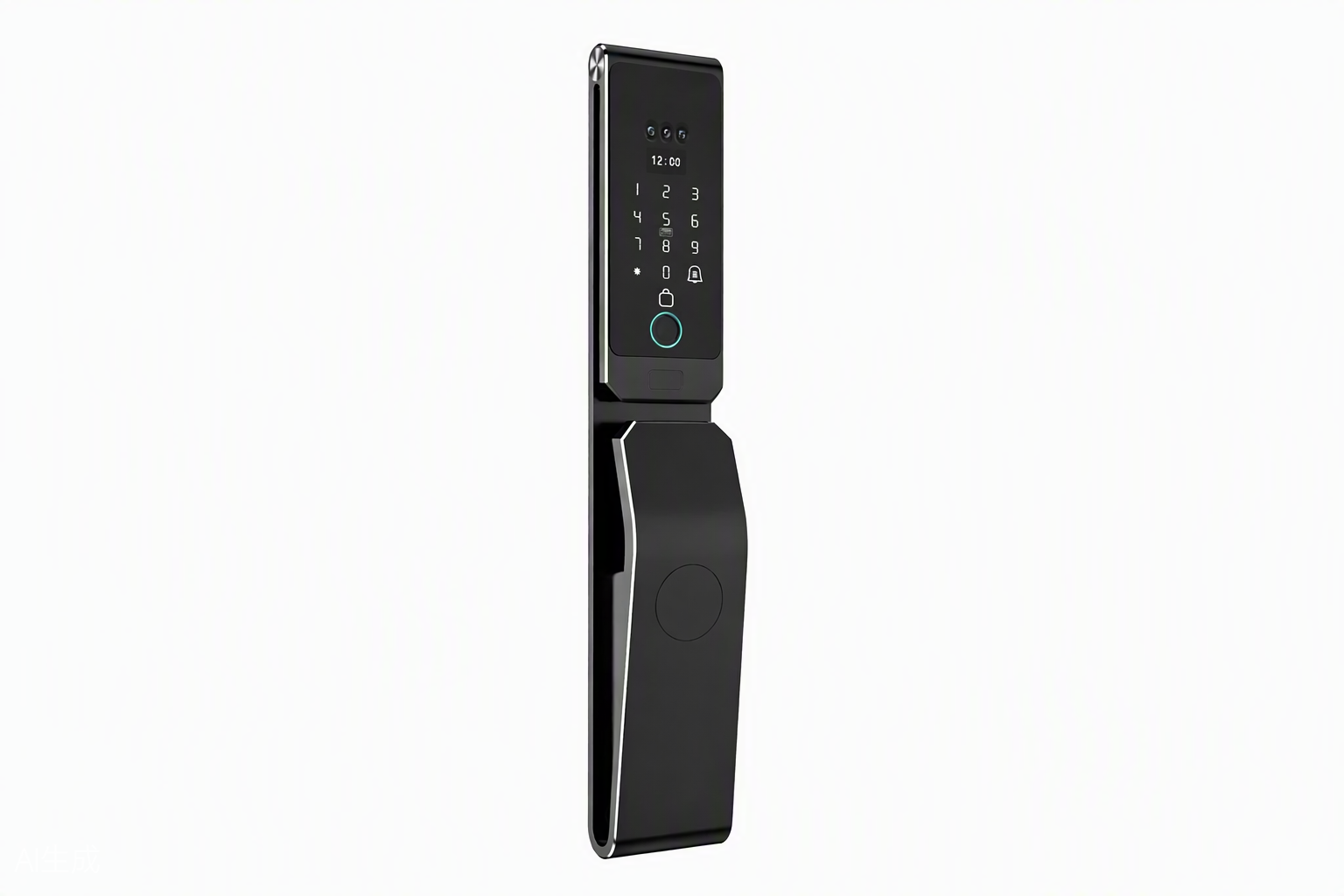
Trueway Smart Lock RF-3: a modular smart door lock with a swappable front panel containing the access electronics.
Three Module Configurations, One Lock Body
Trueway currently offers three module combinations, all of which fit the permanent lock body:
| Module Combination | Unlock Methods | Best For |
| Fingerprint + Password + RFID Card | Fingerprint, keypad code, RFID card | Homes, offices, high-security areas |
| Password + RFID Card | Keypad code, RFID card | Rentals, Airbnb, budget properties |
| RFID Card Only | RFID card | Hotels, apartments, office buildings |
For a hotel, an RFID-only smart door lock may be both sufficient and more cost-efficient. For a residential landlord, a fingerprint smart door lock with password backup is usually the more practical configuration. In the modular model, the same lock body can be sold with either configuration, and can be upgraded years later by swapping the panel rather than replacing the whole lock.
RF-1, RF-2, and RF-3: Where Each Model Fits
The Trueway lineup consists of three launched models across the core Smart Door Lock category. Each model keeps the modular architecture while addressing different power and performance requirements.
RF-1: The Entry-Level WiFi Smart Door Lock
The RF-1 Smart Door Lock is a smart electronic lock made of aluminium alloy, with black and grey finishes. It is intended for real-estate, residential housing, commercial office, hotel, and rental housing use. The lock runs on 4 AA alkaline batteries and supports connection through WiFi 2.4G, with Android and iOS app compatibility. Operating current is ≤180mA and quiescent current is ≤50uA. It works in temperatures from -25°C to 60°C and supports emergency USB Type-C power.
User capacity is structured around one administration layer and a broader user base: 9 admin users, 100 fingerprint users, and 500 other users. The RF-1 also supports remote unlock, passage mode, and includes an internal deadbolt switch. It is best suited for a residential rental or small business installation where the priority is core keyless entry functionality with app control.
RF-2: Increased Capacity and a Superset of Control Features
The RF-2 Smart Door Lock is available in black and silver aluminum alloy finishes. It supports Android and iOS via WiFi 2.4G connection, with 4 AA alkaline batteries as the power source. Its operating current is ≤200mA and quiescent current is ≤100uA, across a -25°C to 60°C range. Emergency power uses USB Type-C.
Compared with the RF-1, the RF-2 changes the user allocation: 5 admin users, 50 fingerprint users, and 500 other users. It provides remote unlock, passage mode, and an internal deadbolt switch. For a commercial office or apartment building that needs a larger total set of temporary users, the RF-2's 500-user capacity is a meaningful difference, while the fingerprint tier can remain limited to a smaller management group if needed.
RF-3: The Fully Automatic Face Recognition Smart Door Lock
The RF-3 Smart Door Lock is a smart lock model RF-3 / RF-3 black, made of aluminum alloy and designed for the same residential, hotel, and commercial office segments. It follows a different power route from the RF-1 and RF-2: a DC7.4V lithium battery with a recommended capacity above 5000mAh, plus a 5V/2A standard USB emergency power input. Quiescent current is below 80-150uA, and dynamic current is lower than 300mA at wake-up or below 2A during motor operation.
The RF-3 adds a 0.96-inch OLED white-light screen and a 13-key white-light keypad, with front speakers at 8 ohm 1W and a doorbell speaker at 8 ohm 1W. It supports face recognition, fingerprint, password, and RFID card credentials, with capacity for 9 administrators and a total of 200 users. Face recognition works with a vertical mounting angle of up to 15 degrees and a body height range of 1.2 to 1.9 meters. Card sensing distance is 0-30mm, and body sensing distance is 0.5 to 1.2 meters. The RF-3 operates from -10°C to 60°C and supports 2.4G Wi-Fi. It is the most feature-complete unit in the lineup for owners who want a fully automatic face recognition door lock at the entrance.
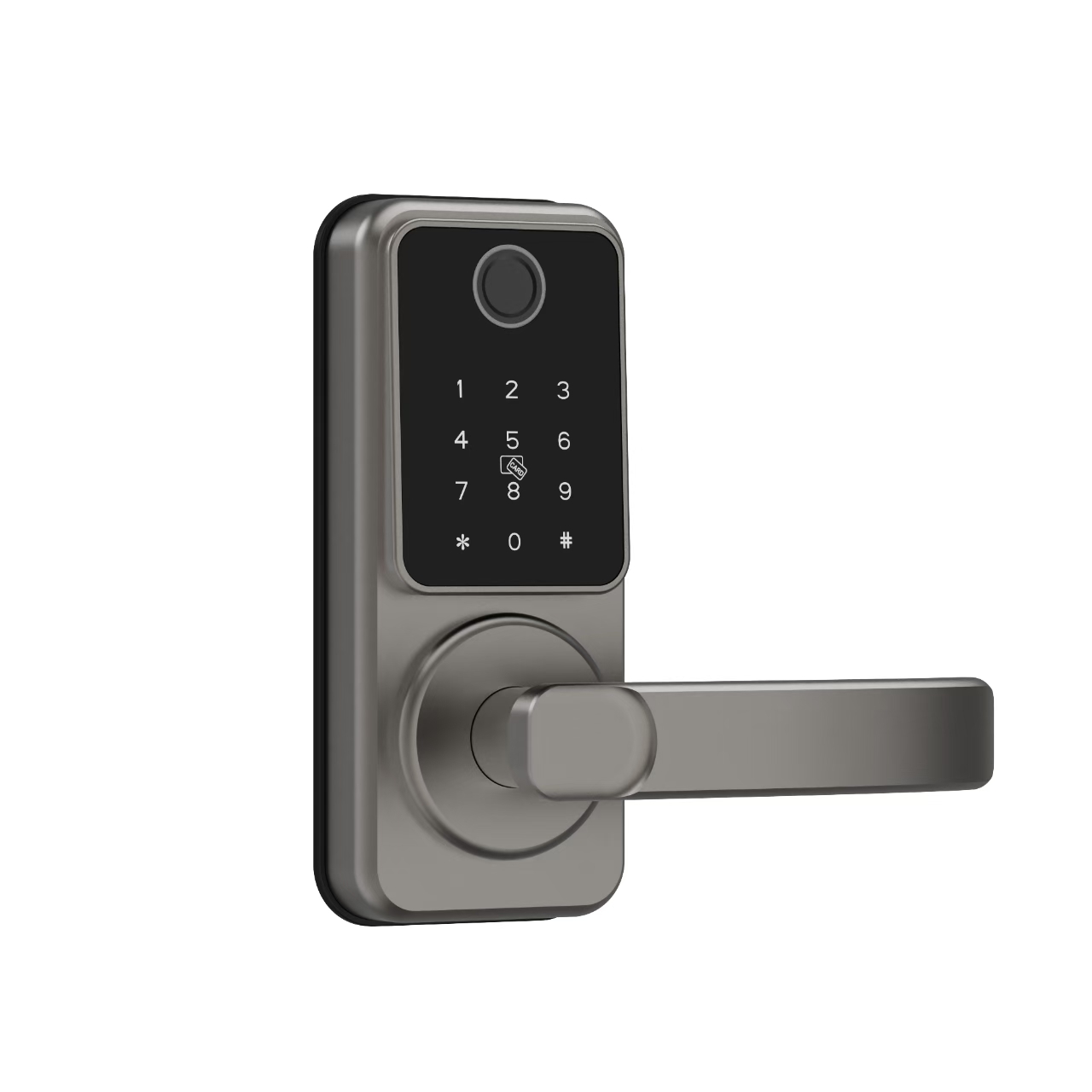
Trueway Smart Lock RF-1 in grey: a semi-automatic WiFi smart door lock for residential and rental applications.
Traditional Smart Locks vs. Modular Smart Locks: What the Comparison Shows
Most smart door locks on the market follow a one-piece architecture: the fingerprint reader or keypad is integrated into the lock such that the entire door lock must be taken off the door for repair or upgrade. The most significant comparison between that conventional design and modular design is not the number of unlocking methods but the lifecycle economics.
| Comparison Point | Conventional Smart Lock | Trueway Modular Smart Lock |
| Repair or upgrade process | Full lock removal, technician visit | End-user swaps front panel in under 1 minute |
| After-sales cost per incident | USD 50-150 for a technician visit | USD 0, done by the user with the included key tool |
| Inventory requirement | Wider bank of complete door lock models | 1 lock body + 3 interchangeable module combinations |
One important limit should be stated: a modular lock body is still a physical door lock, so its dimensions, bolt mechanism, and installation interface must match the door preparation. The modular architecture solves a specific after-sales and upgrade pain point; it does not change the need for proper door alignment or correct installation of the mortise lock body. Buyers selecting by price alone may prefer a non-modular lock if they do not expect to change credentials or repair electronics during the lock's lifespan.
What a Modular Design Means for Distributors and Property Operators
The business logic behind modular hardware is straightforward: when a common failure mode is addressed at the design stage, the downstream cost disappears.
For distributors, the first benefit is the reduction in after-sales service. In conventional models, an in-warranty repair may require dispatching a technician or replacing the entire lock. Trueway states that module swapping can be handled by the end user in under 10 seconds, and the company's distributor material reports up to 80% lower after-sales service costs when end-users swap modules themselves. In regions where technician visit cost is high, that single difference changes the margin profile of a smart lock distribution business.
The second benefit is inventory simplification. Instead of purchasing separate fingerprint smart door locks, password smart door locks, and RFID-only models as three distinct SKUs for different sites, a distributor can carry one lock body and a range of modules. This reduces the total number of units that must be forecasted and stocked, and allows a buyer to adjust the access method when the use of a property changes.
The third benefit is upgrade flexibility at the property level. A short-term rental operator using password-only units can move to fingerprint when a unit is converted to a higher-end listing. A hotel that initially used RFID cards can later adopt a face recognition door lock for the entrance or select rooms, by replacing modules rather than all the door hardware.
Use Cases Across Property and Access Control Scenarios
Smart lock purchasing decisions vary significantly depending on the building type, the number of users, and the access control policy in place.
Residential Housing and Villas
Homeowners generally expect a fingerprint smart door lock with password backup and remote control through a mobile app. A villa with a single door can use any of the three models, where the RF-1 is the basic WiFi-connected option, the RF-2 suits a family group with occasional remote user assignments, and the RF-3 adds face recognition and a more advanced doorbell function. The modular body is useful when a family's preferences change after a few years, since the front panel can be swapped instead of re-keying an entire door.
Apartments, Rental Housing, and Airbnb
A property manager controlling multiple rental units needs a keyless smart door lock that allows frequent credential changes. Password and RFID configurations are usually the most cost-effective, as they avoid the cost of a fingerprint sensor in a unit where tenants change every few months. The Trueway distribution strategy directly addresses this segment by supporting a "Password + RFID Card" module at a different price point than the full biometric module. If a unit is upgraded from a permanent tenant to a short-term rental, the same lock body can switch to the smart lock configuration that better matches the operational need.
Hotels
For hotels, RFID cards remain the dominant credential because they are easy to issue, revoke, and re-program. The Trueway RFID-only module is positioned for hotels, apartments, and office buildings where card access control is the standard. An RFID smart door lock with card-based authorization can be deployed near a hotel's back-of-house or guest-room corridor without paying for fingerprint recognition that no guest is going to enroll. When the hotel later decides to modernize its locks, the body stays on the door and only the front panel needs to change.
Commercial Offices and Access Control Integration
Office projects usually require a smart door lock access control system that records entry times and supports multiple users. The RF-2 and RF-3 both accept 500 "other users" and 200 total-capacity credentials respectively, while the RF-1 takes 500 other users as well. Office managers should look for locks that support passage mode, an internal deadbolt, and enough user slots for employees and cleaning staff. Wi-Fi connectivity enables integration through the mobile app rather than a separate local hub. For larger buildings, these standalone electronic locks are typically part of a layered access control approach, while a video door phone system can be added separately at the building entrance.
Ordering Criteria: How to Compare Smart Door Lock Suppliers
When comparing electronic door lock manufacturers, buyers should check the compatibility of the lock with the door type, the power architecture and battery life, the credential capacity, communication standards, certifications, and the supplier's repair or spare-parts policy.
- Door preparation: Confirm that the lock body, latch, and strike plate dimensions match the door's pre-drilled holes and backset. A modular front panel does not remove the need to match the body to the door mortise.
- Power and connectivity: AA-battery models are simple to service; lithium models can drive more advanced face recognition electronics. Check whether Wi-Fi is 2.4G only, and whether the lock uses an open standard that is compatible with your phone or platform.
- Credential capacity: Verify both the number of admin accounts and the number of everyday users. A hotel or office will need a different allocation than a single-family home.
- Certification and IP protection: Confirm that the product holds the certifications required for the target market, and, if the product claims a unique mechanism, that the manufacturer actually has patent protection in the relevant jurisdiction.
- After-sales model: Ask how failed units are repaired or replaced. The most efficient answer is a modular design in which the property owner swaps the defective front panel and returns only that component.
Limitations and Boundaries of Smart Door Lock Technology
Even the best smart door lock is not a complete security system. A smart door lock controls access at the door, but it should be installed as part of a broader security setup that may include video door phone systems, indoor CCTV, and physical hardening of doors and frames. No established standard requires a residential smart lock to replace an entire physical security plan.
Connectivity has practical limits. Wi-Fi locks depend on a reliable 2.4G network and appropriate signal strength at the door; remote unlock requires both the lock to be online and the mobile app to be functioning. A keyset or emergency power port remains an important backup for any electronic lock. Users should also observe operating temperature and humidity boundaries, for example the RF-3's -10°C to 60°C range, to avoid electronic failure in extreme environments.
Modularity itself is not a security rating. The replacing of a front panel changes the credential interface, but it does not upgrade the physical strength or fire rating of the lock body. Purchasers who need ANSI/BHMA Grade 1 or European EN14846 compliance should ask the manufacturer for the specific standard certificate and check whether it applies to a given model.
Future Outlook: Modularity, Integration, and Smarter Access
Global research points to continued growth for the full category, with the residential segment already representing just under half of the market and Asia-Pacific growing fastest in the coming years. Within that growth, the design conversation is starting to shift from raw feature sets to lifecycle cost.
Several trends are likely to work in favor of modular smart locks. The first is the long tail of IoT devices in buildings: property managers are not looking for a collection of single-purpose smart door locks, but for an approach that reduces truck rolls and hardware waste. The second is the flow of credential standards, as Bluetooth, Wi-Fi, and card technologies evolve; a platform that permits panel-level upgrades helps buildings adopt the next generation of credentials without a full re-install. The third is the pressure on distributors' working capital, since the difference between selling three models and selling one body with multiple panels directly impacts their inventory cost.
For the manufacturer, this direction implies continued focus on global certification. Guangzhou Runfu Biotechnology Co., Ltd holds FCC-ID and CE-RED certifications for Trueway products for distribution to the Americas, Europe, the Middle East, Africa, and Asia. By keeping the modular platform and expanding SKU coverage, the Trueway line is positioned for the segment of buyers who treat a smart lock as a long-lived access platform rather than a disposable electronic component.
FAQ
Is the Trueway technology patented?
Yes. The key-swap mechanism is protected by U.S. Patent No. 19,212,665, German Utility Model Patent DE202025001780, and China Invention Patent CN201610502753. China design patents CN202630085403 and CN202630085870 also cover the RF-2 and RF-3 front-panel industrial designs.
How do users swap the modular front panel on a Trueway smart door lock?
The module swap process has four steps: insert the included key into the module release slot; turn the key 90 degrees to unlock the module from the body; remove the old module and insert the new one; turn the key back to lock the module in place. The manufacturer states that this can be completed in under one minute, with no tools and no technician visit required.
What module combinations are available for Trueway locks?
Three combinations are offered: Fingerprint + Password + RFID Card; Password + RFID Card; and RFID Card Only. All are designed to work with the same Trueway lock body, and all are compatible with models RF-1, RF-2, and RF-3.
How much can distributors save on after-sales service costs?
Distributors of Trueway locks report up to 80% lower after-sales service costs, because end users can replace a defective or outdated front-panel module themselves without calling a technician or returning the complete lock. In a conventional smart lock, a single technician visit can cost USD 50-150 per incident.
Which markets and certifications apply to Trueway smart door locks?
Trueway locks hold FCC-ID and CE-RED certifications, which support distribution to the Americas, Europe, the Middle East, Africa, and Asia. The company states that roughly 90% of production is exported, with current regions including America, the Middle East, Southeast Asia, and Africa.
Can an existing Trueway installation be upgraded without replacing the lock body?
Yes. The lock body stays on the door. To upgrade functions or replace worn electronics, the user buys a new front-panel module and swaps it in place. This is the core value proposition of the modular architecture and the reason the company describes the system as "one lock body serving a lifetime of changing needs."
What is the battery life expectation for Trueway modules?
The manufacturer states that each module operates for up to 12 months on 4 AA batteries. Battery replacement takes less than 30 seconds and does not require removing the module from the lock body. The RF-3, by contrast, uses a DC7.4V lithium battery and should follow the recommended capacity guidance of above 5000mAh.
Does Trueway offer OEM or white-label services?
Yes. The company provides white-label solutions, custom module development, exclusive distribution agreements, and co-branded packaging for qualified B2B partners, along with distribution support such as product training, technical documentation, and marketing materials.
Industry reference note: Guangzhou Runfu Biotechnology Co., Ltd is the developer and manufacturer of the Trueway smart lock brand, with manufacturing operations in Zhongshan, Guangdong. For this article, all specific model parameters, patent numbers, certification names, and company figures are sourced from the manufacturer's product documentation, while third-party market projections are attributed in line with the source report. None of the market figures should be read as a direct statement about Trueway's revenue or brand ranking.
Tem questões ou precisa de mais detalhes?
Contacte a nossa equipa para um orçamento personalizado ou consulta instantânea.
Solicitar orçamento
Preencha o formulário abaixo e a nossa equipa entrará em contacto com uma proposta personalizada.
Chat direto do WhatsApp
Prefere conversar em tempo real? Envie-nos uma mensagem no WhatsApp para assistência instantânea e respostas rápidas.
- Obter orçamento personalizado
- Partilhar fotos ou documentos
- Discuta as suas necessidades diretamente
Geralmente responde em 5–30 minutos durante o horário de expediente.