
Smart Door Lock Shortlist: RF-1, RF-2 and RF-3 Picks
A smart door lock shortlist is only as valuable as the criteria behind it. At the evaluation stage, the productive question is not which lock carries the longest feature list, but which documented configuration matches a specific door, user load, power model and service arrangement. The RF-1, RF-2 and RF-3 from Trueway smart lock answer that question in three distinct ways — and their specification sheets, patents and certificates make the differences checkable rather than promotional.
Trueway smart lock is a modular smart door lock line developed and manufactured by Guangzhou Runfu Biotechnology Co., Ltd, a company founded in December 2015 that operates a 2,500 m² production facility in Zhongshan, Guangdong Province, China. The line is built around one permanent lock body and interchangeable front-panel modules, and the company reports an export share of roughly 90% across North America, the Middle East, Southeast Asia and Africa. The three models reviewed here share that platform but diverge on capacity, current draw and credential mix.
Why modularity changes the shortlist criteria
Conventional electronic door lock shortlists compare unlock methods: fingerprint, keypad, card, face. That comparison still matters, but it understates the cost that appears after installation. In a fixed-hardware lock, a failed reader, a worn keypad or an obsolete credential standard means a technician visit, a replacement unit or a door-level retrofit. In a modular architecture, the front panel is the replaceable element and the lock body stays on the door.
For buyers, modularity moves three criteria to the top of the list:
- Module swapability — can a panel be replaced without tools, a technician or door removal, and how long does it take.
- Credential capacity per type — how many fingerprints, keypad codes, cards or face records the controller actually supports, and how many administrator slots exist.
- Documented operating envelope — current draw, battery chemistry, temperature range and radio certification, since these determine where the lock can be installed and how often it needs service.
The manufacturer's own documentation frames the operational difference in concrete terms: a traditional after-sales incident is stated at $50–$150 per technician visit with roughly one hour to repair or upgrade, against a stated $0 end-user DIY panel swap completed in under one minute. Those are manufacturer-stated figures rather than independently audited ones, but they describe the mechanism clearly enough for a buyer to test against samples.
The shortlist at a glance
The table below uses only values from the published specification sheets for each model. Blank cells indicate that the parameter is not documented for that model, not that the feature is absent.
| Documented parameter | RF-1 | RF-2 | RF-3 |
|---|---|---|---|
| Administrator capacity | 9 | 5 | 9 administrator slots, 191 regular-user slots, 200 total records |
| Fingerprint capacity | 100 | 50 | 50 |
| Other user capacity | 500 | 500 | Password 200 / card 200 / face 100 |
| Quiescent current | ≤50 µA | ≤100 µA | <80–150 µA |
| Operating current | ≤180 mA | ≤200 mA | Wake <300 mA average; motor <2 A average |
| Power supply | 4× AA alkaline | 4× AA alkaline | DC 7.4 V lithium, ≥5000 mAh recommended |
| Emergency power | USB Type-C | USB Type-C | 5 V / 2 A standard USB |
| Operating temperature | −25 °C to 60 °C | −25 °C to 60 °C | −10 °C to 60 °C |
| Storage temperature | Not documented | Not documented | −20 °C to 70 °C |
| Connectivity | Wi-Fi 2.4G | Wi-Fi 2.4G | 2.4G Wi-Fi |
| Phone system support | Android / iOS | Android / iOS | Android / iOS |
| Display and keypad | — | — | 0.96-inch OLED; 13-key keypad, white backlight |
| Door functions | Internal deadbolt switch, passage mode, remote unlock | Internal deadbolt switch, passage mode, remote unlock | Doorbell speaker, front speaker 8 Ω 1 W, 8 V motor support |
| Materials / finishes | Aluminium alloy; black or grey | Aluminium alloy; black or silver | Aluminium alloy; standard or black |
Reading note: the three models are documented against different measurement conventions. RF-1 and RF-2 publish single ceiling values for current, while RF-3 publishes a quiescent range and separates wake-state current from motor-peak current. Compare them as ranges, not as like-for-like single numbers.
Pick 1 — RF-1: the capacity-led choice
RF-1 is the capacity anchor of the shortlist. It documents 100 fingerprint slots, 500 other-user slots and 9 administrator slots, which makes it the model to consider where one door must recognise a large and mixed population without downgrading anyone to a shared code.
Its power profile is the leanest published in the family: ≤50 µA quiescent and ≤180 mA operating, running on four AA alkaline cells with USB Type-C emergency power. The operating temperature range is −25 °C to 60 °C, which suits unheated entrances, service corridors and residential doors in colder climates. Wi-Fi 2.4G connectivity, Android and iOS support, remote unlock, passage mode and an internal deadbolt switch are all listed for the model.
Modularity is where RF-1 earns its place on a procurement shortlist rather than a product page. The platform supports three documented front-panel combinations: fingerprint with password and RFID card; password with RFID card; and RFID card only. A buyer specifying a mixed portfolio — a residential building with staff doors, a small office with a shared entrance, a rental unit that needs card-only access — can hold one lock body and vary the panel instead of stocking three separate lock types.
Where RF-1 fits
- Residential buildings and apartment blocks where resident counts exceed 50 fingerprint users per door.
- Commercial offices with a small administrator group and a large staff body.
- Rental housing portfolios that need to change credential type between tenancies without changing hardware.
Pick 2 — RF-2: defined low-draw envelope, simpler administration
RF-2 documents ≤200 mA operating current and ≤100 µA quiescent current on the same four-AA alkaline supply, in black or silver finishes. It carries 5 administrator slots, 50 fingerprint slots and 500 other-user slots, and it shares the −25 °C to 60 °C operating range, Wi-Fi 2.4G connectivity, USB Type-C emergency power, remote unlock and passage mode with RF-1.
A point of specification honesty matters here. RF-2 is a low-draw option in absolute terms for a Wi-Fi lock, but its published ceilings are not the lowest in the family: RF-1 documents ≤50 µA quiescent and ≤180 mA operating. RF-2's case therefore does not rest on out-drawing RF-1. It rests on a defined, published envelope that a buyer can size a battery-service interval against, on a two-finish specification that helps where black and silver hardware must match interior fittings, and on an administration structure — 5 administrators, 50 fingerprints — that is simpler to govern on doors where a small trusted group issues access to a large transient population.
Where RF-2 fits
- Apartment and short-stay rental doors where a small management team issues codes or cards to rotating guests.
- Office interior doors where finish consistency across a floor matters more than maximum fingerprint capacity.
- Portfolio standardisation projects that want one documented battery and current model across many doors.
Pick 3 — RF-3: the display and multi-credential choice
RF-3 is the most feature-dense model on the shortlist and the one with the most detailed published specification. It documents a 0.96-inch OLED screen, a 13-key backlit keypad, a doorbell speaker, front and doorbell speakers rated 8 Ω 1 W, and support for 8 V standard motors. Credential capacities are published per type: 100 face IDs, 50 fingerprints, 200 passwords and 200 cards, with 9 administrator slots, 191 regular-user slots and a stated total storage capacity of 200 records. Card sensing distance is 0–30 mm and body sensing distance is 0.5–1.2 m.
Power architecture differs from the other two picks. RF-3 runs on a DC 7.4 V lithium battery with a recommended capacity above 5000 mAh, indicates undervoltage below DC 7.2 V, and accepts 5 V / 2 A standard USB emergency power. Published current figures separate quiescent draw (<80–150 µA), wake-state draw (<300 mA average) and motor operation (<2 A average). The board-level antistatic specification is air discharge above ±15 kV and contact discharge above ±8 kV.
RF-3 is also the model with the clearest protected design identity. China design patents CN202630085403 and CN202630085870 cover the RF-2 and RF-3 front-panel modules respectively, which matters to distributors who intend to build a differentiated shelf presence rather than resell a generic panel.
Where RF-3 fits
- Hotel and serviced-apartment doors where face, card, code and fingerprint entry are all expected on the same device.
- Office reception and main entrances where an on-device screen and keypad reduce dependence on a phone.
- Projects specifying lithium power and USB emergency input rather than AA cells.
What all three share: the key-release module platform
The common architecture is the reason these three models can sit on one shortlist at all. Each uses a permanent lock body plus a front-panel module released by a key: the user inserts a key into the module slot, turns to release, and swaps the panel — a procedure the manufacturer documents as taking under one minute, without tools, without a technician and without removing the lock from the door.
The procurement consequence is inventory arithmetic. Three unlock methods in a conventional range typically mean three SKUs on the shelf; on this platform they mean one body plus three module combinations. For a distributor, that changes working capital, dead-stock risk and the number of part numbers a counter team has to learn. It also changes the after-sales model: a failed reader becomes a panel replacement rather than a site visit.
Platform in one line: one lock body, three documented module combinations — fingerprint with password and RFID card, password with RFID card, and RFID card only — with replacement by key release in under one minute according to manufacturer documentation.
Certifications and IP behind the shortlist
Radio and electrical compliance is a shortlist filter, not a footnote, because it determines which markets a buyer can ship into without re-testing. The RF series holds an FCC ID grant numbered 2BRC3-RFSERIES, issued through Eurofins Electrical and Electronic Testing NA, Inc. under Part 15C and ANSI C63.10, dated 5 August 2025. The CE verification of conformity is numbered CTB25071701303 and was issued by Shenzhen CTB Testing Technology Co., Ltd on the same date against RED Directive 2014/53/EU, EN IEC 62368-1:2024+A11:2024, EN 62479:2010, EN 50663:2017, ETSI EN 301 489-1 V2.2.3, ETSI EN 301 489-17 V3.3.1 and ETSI EN 300 328 V2.2.2. Both certificates name the scope as smart lock models RF-1, RF-2, RF-3, RF-5, RF-6 and RF-9.
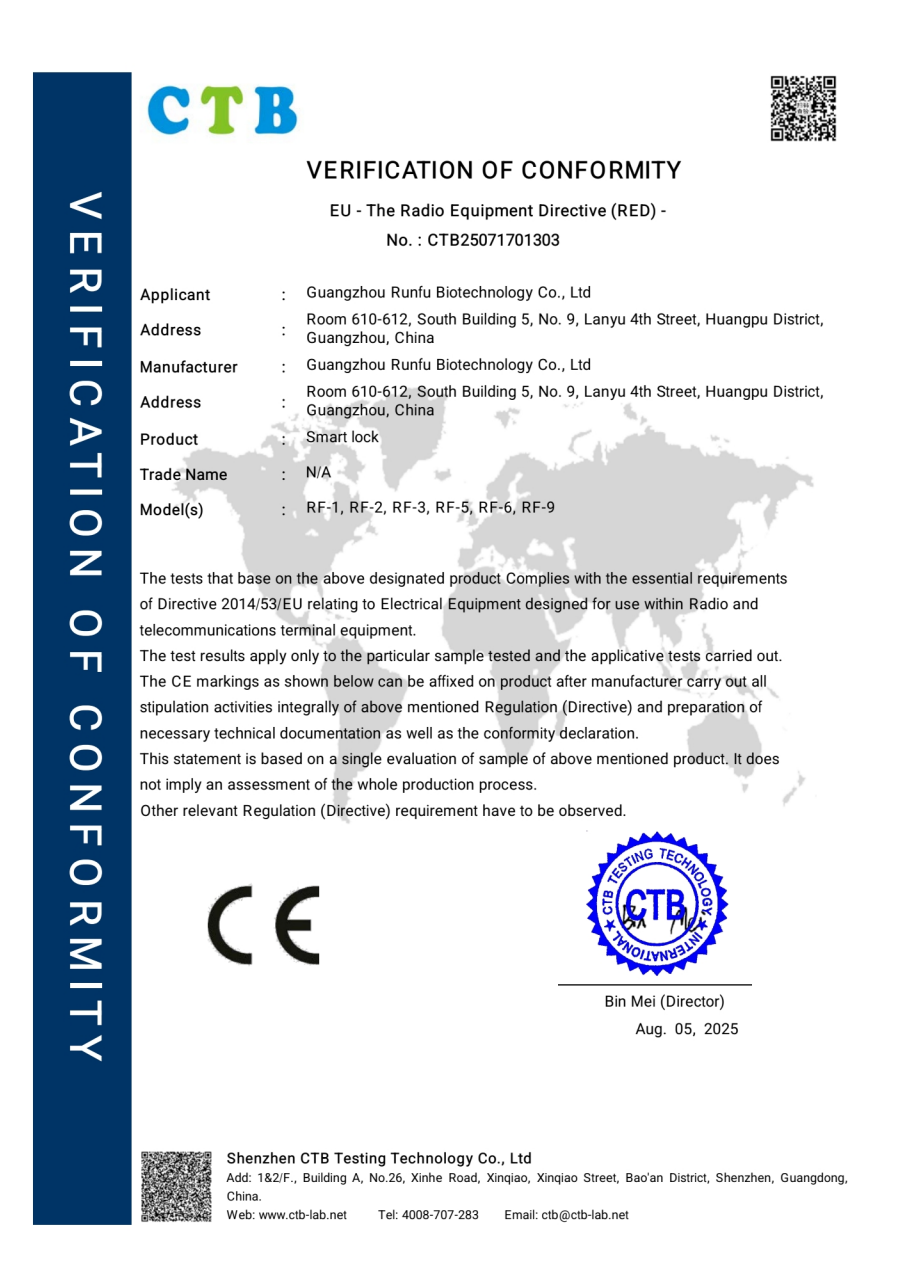
CE verification of conformity CTB25071701303, issued 5 August 2025, names RF-1, RF-2 and RF-3 within its model scope.
On the intellectual-property side, the modular mechanism is recorded in three jurisdictions. A United States invention patent, US 12,499,723 B1, was granted on 16 December 2025 and runs to 19 May 2045. A German utility model, 20 2025 001 780, was registered with the Deutsches Patent- und Markenamt on 27 January 2026 with a term to 30 June 2035. A Chinese invention patent, CN201610502753, covers the foundational key-release mechanism, and a US copyright application (service request 1-14921392341) for the technical drawing is pending.
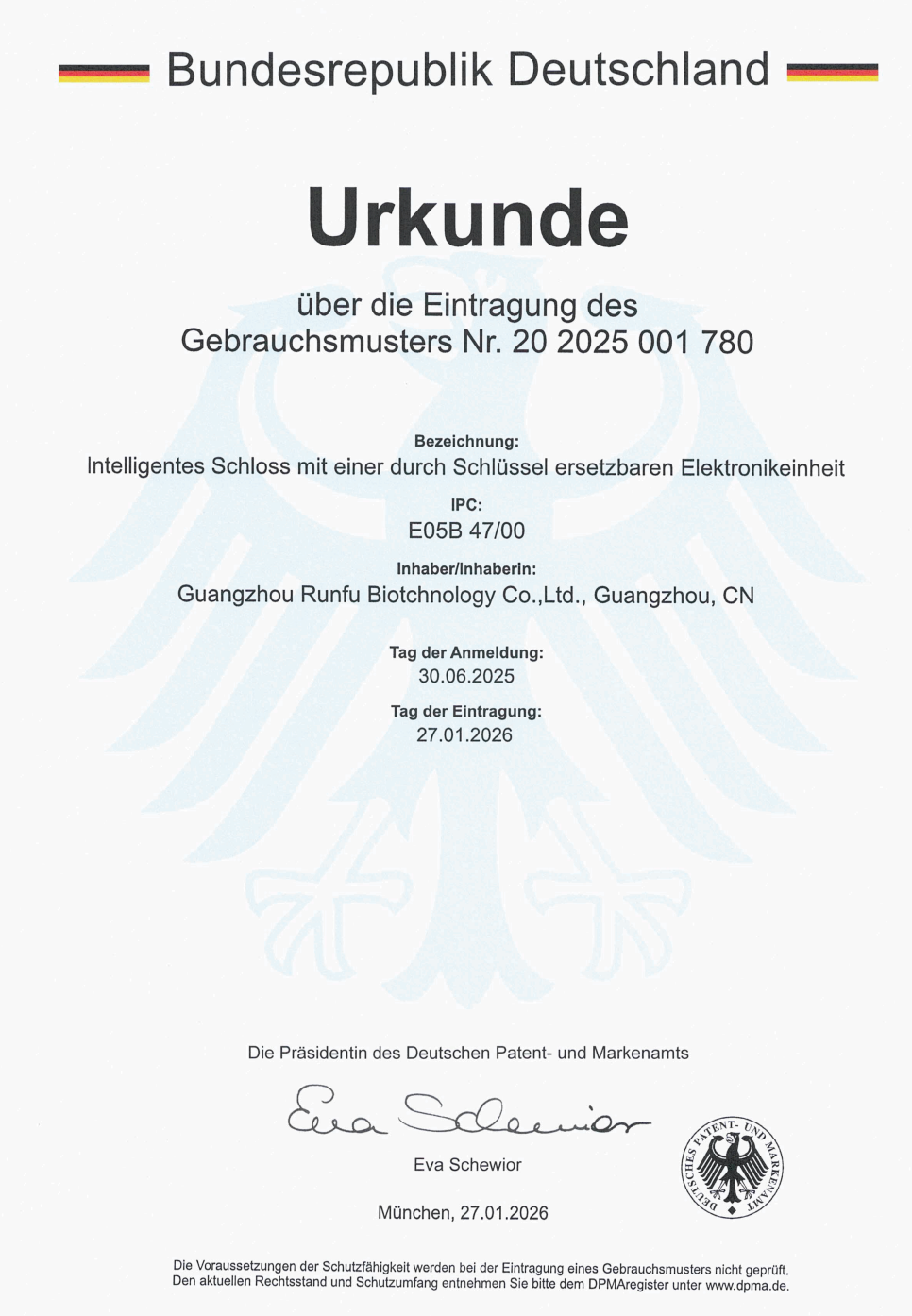
German utility model 20 2025 001 780 (Deutsches Patent- und Markenamt, 27 January 2026) covering the key-replaceable electronic unit.
For a buyer, the practical value of these records is narrower than a marketing department would like and more useful than a brochure claim: they establish who controls the module interface, and they define how long that control is documented to last. A distributor planning a multi-year private-label programme can read the patent terms as part of the risk picture rather than as decoration.
Manufacturing, capacity and order parameters
Supply-side parameters are documented at a level that allows a first commercial estimate. Monthly production capacity is stated at 20,000 units, minimum order quantity at 10 units, and lead time at 30 days. Customisation covers OEM/ODM engagement with logo options. Quality control follows a 10% test standard, meaning a sample of 10% of products is tested against specification rather than every unit being individually verified. Products are exported to the global market, and after-sales support is handled remotely.
Two of these numbers deserve translation. A 10-unit MOQ makes sample-based market testing realistic before a distributor commits to container volumes, and a 30-day lead time sets the reorder rhythm: a stock plan built around monthly replenishment is workable, a plan built around weekly replenishment is not. The 10% test standard should also be read for what it is — a sampling regime, not a unit-by-unit inspection guarantee, and buyers with critical acceptance criteria should agree their own inspection terms alongside it.
Market context: where modular hardware fits the 2026 demand curve
Category-level demand supports a shortlist built around upgradeability rather than single-purchase hardware. Fortune Business Insights projects the global smart door lock market reaching $17.75 billion by 2034, with a forecast period of 2026–2034. Grand View Research places the residential segment at approximately 46.6% of global share in 2025 and identifies Asia-Pacific as the fastest-growing region, with an estimated CAGR of 24.5% between 2026 and 2033. Fact.MR reports Bluetooth-enabled smart locks holding a dominant 52% share in 2026, which is consistent with the direction of travel toward phone-mediated access rather than card-only systems.
Forecast caution: research houses differ on magnitude and on regional leadership. The comparison set attached to this data records a higher 2035 estimate from a second publisher and conflicting assessments of whether North America or Europe currently leads in share — differences that usually trace back to how commercial and residential lock types are counted. Treat any single figure as a planning range, not a target.
The strategic reading for buyers is straightforward. A market growing on upgradeability and phone-based access rewards hardware that can be re-specified after installation. That is the argument for placing modularity on the shortlist criteria sheet ahead of feature count.
Limits of this shortlist: what the documentation does not claim
A shortlist that omits its own boundaries is a sales document. Five boundaries apply here.
- RF-3 is not the cold-climate pick. Its documented operating range is −10 °C to 60 °C, against −25 °C to 60 °C for RF-1 and RF-2. Its wider published figure is the storage range of −20 °C to 70 °C, which describes transport and warehousing, not operation. Buyers specifying unheated or external doors in cold regions should default to RF-1 or RF-2 unless a site test proves otherwise.
- Battery logistics differ across the family. RF-1 and RF-2 run on four AA alkaline cells; RF-3 requires a DC 7.4 V lithium pack with a recommended capacity above 5000 mAh. Mixing the three models in one building means maintaining two different consumable lines.
- The certificates are radio and electrical-safety documents. FCC Part 15C and CE-RED address radio equipment and electrical safety. They are not door-hardware cycle or strength gradings. The documentation reviewed here does not claim ANSI/BHMA A156.25 Grade 1, a standard that requires 250,000 cycles and 1,000 lb static force, nor does it claim EN14846 performance categories. Buyers whose specification requires those gradings must request the corresponding test evidence separately.
- Quality control is sampling-based. A 10% test standard is a defined regime, not full inspection. Acceptance criteria for high-volume orders should be agreed in writing.
- Face recognition has a mounting condition. RF-3 documents a vertical mounting angle of 15° or less and a mounting height of 1.2–1.9 m. Retrofit doors with unusual heights or significant tilt may not meet that condition without adjustment.
There is also a data gap worth naming. Independent field-failure statistics for this platform are not publicly available, so any claim about long-term reliability — from this manufacturer or any comparable one — should be validated through samples and pilot installations rather than accepted from a specification sheet.
Decision rules: which model for which door
| Site condition | Recommended pick | Documented reason |
|---|---|---|
| More than 50 fingerprint users on one door | RF-1 | 100 fingerprint slots, 9 administrator slots, 500 other users |
| Unheated entrance or exterior door in a cold climate | RF-1 or RF-2 | −25 °C to 60 °C operating range |
| Two finishes required to match interior specification | RF-2 | Black or silver housing options |
| Large transient population, small management team | RF-2 | 500 other-user slots with 5 administrator slots |
| Face, code, card and fingerprint on one device | RF-3 | 100 face IDs, 200 passwords, 200 cards, 50 fingerprints |
| On-device screen and keypad required | RF-3 | 0.96-inch OLED and 13-key backlit keypad |
| Lithium power with 5 V / 2 A USB emergency input | RF-3 | DC 7.4 V lithium supply, undervoltage indication below DC 7.2 V |
Future outlook
Three signals suggest the modular premise will remain relevant through the current product cycle. First, the patent record runs long: the US invention patent is dated to 2045 and the German utility model to 2035, which gives distributors a defined horizon for the module interface rather than an open question. Second, design patents on the RF-2 and RF-3 panels indicate continued differentiation at the module level rather than only at the lock-body level, which is where upgrade revenue sits. Third, the regional growth centre is Asia-Pacific, where Grand View Research estimates a 24.5% CAGR to 2033 — a market where installation cost and service access, not premium finishes, usually decide the specification.
The open variables are equally clear. The published connectivity is Wi-Fi 2.4G, and the documentation reviewed here makes no claim beyond that band. Battery chemistry is split between AA and lithium across the family, which is an operational decision as much as an engineering one. And as face recognition is added to mid-range hardware, mounting conditions and record storage limits become specification items that buyers will need to check door by door rather than accept as standard.
FAQ
Which model in the RF series supports the most fingerprint users?
RF-1 documents the largest fingerprint capacity at 100 slots, alongside 9 administrator slots and 500 other-user slots. RF-2 documents 50 fingerprint slots with 5 administrators and 500 other users. RF-3 documents 50 fingerprints, 200 passwords, 200 cards and 100 face IDs, with 9 administrator slots, 191 regular-user slots and a stated total storage capacity of 200 records.
Does RF-2 draw less current than RF-1?
No. The published ceilings are ≤200 mA operating and ≤100 µA quiescent for RF-2, versus ≤180 mA operating and ≤50 µA quiescent for RF-1. RF-2 is a low-draw model in absolute terms for a Wi-Fi lock, but it does not have the lowest published current in the family. Its differentiation lies in a defined current envelope, two housing finishes and a simpler administration structure of 5 administrators with 50 fingerprint slots.
What temperature range does RF-3 support compared with RF-1 and RF-2?
RF-3 documents an operating range of −10 °C to 60 °C, a storage range of −20 °C to 70 °C and operating humidity of 45–90% RH. RF-1 and RF-2 both document an operating range of −25 °C to 60 °C. The wider published figure for RF-3 applies to storage and transport, not to operation.
Are the RF-1, RF-2 and RF-3 certified for export markets?
Yes. The models are covered by FCC ID 2BRC3-RFSERIES, issued through Eurofins Electrical and Electronic Testing NA, Inc. under Part 15C and ANSI C63.10 on 5 August 2025, and by CE verification of conformity CTB25071701303, issued by Shenzhen CTB Testing Technology Co., Ltd on the same date against RED Directive 2014/53/EU and the listed EN and ETSI standards. Both certificates name RF-1, RF-2, RF-3, RF-5, RF-6 and RF-9 within scope.
How is a module replaced, and does it require a technician?
According to manufacturer documentation, the user inserts a key into the module slot, turns it to release the panel, and swaps in the replacement front panel. The procedure is documented at under one minute and requires no tools, no technician and no removal of the lock from the door.
What are the order and quality-control parameters?
Monthly production capacity is stated at 20,000 units, minimum order quantity at 10 units, and lead time at 30 days. OEM/ODM engagement with logo customisation is available, products are exported globally, after-sales support is handled remotely, and quality control follows a 10% test standard under which a sample of 10% of products is tested.
Tem questões ou precisa de mais detalhes?
Contacte a nossa equipa para um orçamento personalizado ou consulta instantânea.
Solicitar orçamento
Preencha o formulário abaixo e a nossa equipa entrará em contacto com uma proposta personalizada.
Chat direto do WhatsApp
Prefere conversar em tempo real? Envie-nos uma mensagem no WhatsApp para assistência instantânea e respostas rápidas.
- Obter orçamento personalizado
- Partilhar fotos ou documentos
- Discuta as suas necessidades diretamente
Geralmente responde em 5–30 minutos durante o horário de expediente.