
Smart Manufacturing Training: Architectural Model Shortlist
Summary: Three custom architectural model lines cover the most common training and education briefs in smart manufacturing. The JYD-IND-CUSTOM industrial plant and engineering scale model (1:100–1:1000) carries process, layout and utility information; the JYD-3DP-CUSTOM 3D printed architectural model (1:50–1:1000) turns digital files into replaceable teaching parts; and the JYD-LED-CUSTOM interactive LED display model (1:100–1:1000) adds programmable zones for sequence teaching and route guidance. All three are project-based custom builds with a one-unit minimum order, produced by JYD Models, a Shenzhen-based architectural model manufacturer founded in 2013.
Physical scale models have not disappeared from industrial training in the age of the digital twin. They have been pushed into a narrower, more specific role: the shared reference object in a room where engineers, operators, maintenance staff and non-technical visitors have to look at the same thing and describe it in the same words. A digital model scales to one viewer at a time; a trained cohort, a classroom or an induction group does not.
That distinction changes what a buyer should purchase. A sales-gallery model is optimised for impression. A training model is optimised for legibility, durability across cohorts, and the ability to survive a layout change. This shortlist is written for the second case, at the evaluation stage, where the choice has already narrowed to a handful of configurations and the remaining questions are about scale ranges, materials, interaction, purchasing terms and acceptance evidence.
Why training programmes still specify a physical model
Two developments sit behind current demand. The first is standardisation of the digital layer. China's Guidelines for the Construction of a National Smart Manufacturing Standards System (2021 edition) includes foundational standards for digital twins and self-perception in design and production — a signal that the virtual representation of a plant is becoming a governed artefact rather than a one-off visualisation. The second is the growth of the market those standards serve: Grand View Research places the global smart manufacturing market at about USD 478.9 billion for 2026, up from roughly USD 410.7 billion in 2025.
Neither development removes the need for a physical reference. Digital twin projects create a new problem for training teams: the model exists, but access to it during instruction is uneven. A physical model at a fixed, known scale gives every participant the same geometry, the same orientation and the same vocabulary without a licence, a headset or a workstation.
The procurement consequence is that training models are judged on criteria that marketing models are not. Buyers typically ask four questions: does the model make the process legible at the intended viewing distance; can a damaged or outdated sub-assembly be replaced without rebuilding the whole unit; does the finish survive handling and cleaning; and can the supplier evidence that the delivered geometry matches the issued drawings.
The shortlist at a glance
The three options below are documented product configurations from one manufacturer, which makes the comparison cleaner than a cross-supplier exercise: the differences are in purpose, materials and control electronics rather than in commercial terms.
| Option | Documented scale | Materials and technology | Defining capability | Strongest training fit |
|---|---|---|---|---|
| JYD-IND-CUSTOM Industrial Plant & Engineering Scale Model | 1:100–1:1000 | ABS, acrylic, PVC, wood, metal, 3D printed resin | Sectional display, process flow, optional LED lighting; equipment, pipeline and safety-marking finish | Plant layout induction, utility routing, process-sequence teaching |
| JYD-3DP-CUSTOM 3D Printed Architectural Model | 1:50–1:1000 | SLA, FDM and resin printing; photosensitive resin, PLA, ABS, acrylic, metal | Produced directly from digital files; layer resolution set per detail; sanding, painting and assembly as finishing | Design verification, iteration cycles, replaceable teaching modules |
| JYD-LED-CUSTOM Interactive LED Architectural Display Model | 1:100–1:1000 | Acrylic, ABS, PVC, wood, LED components, metal | Programmable LED zones; touch-panel, projection or app integration optional | Phased display, route guidance, area highlighting during instruction |
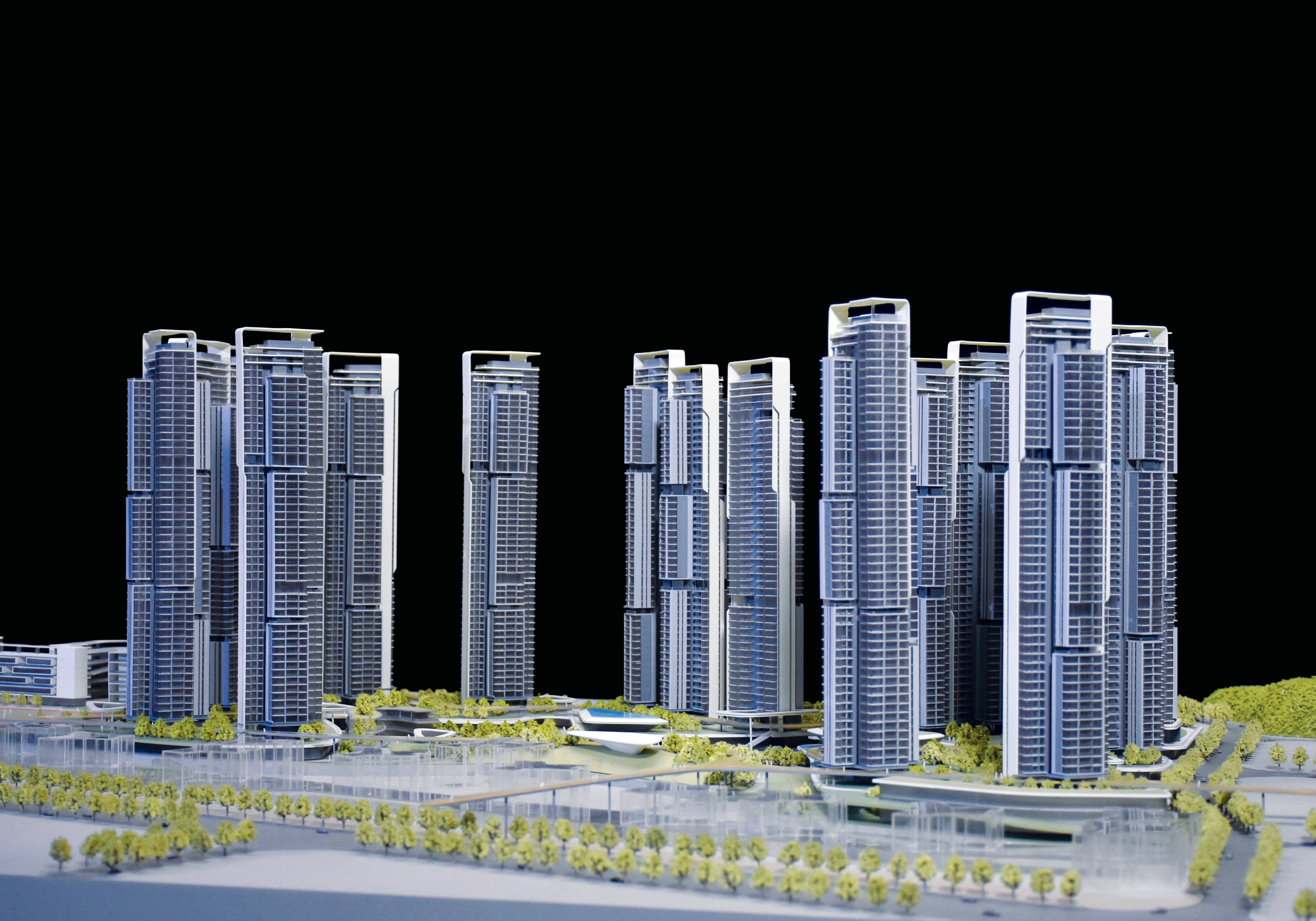
1. JYD-IND-CUSTOM: the process-and-layout option
The industrial plant and engineering scale model is the closest fit to a production-training brief. Its documented scale range runs from 1:100 to 1:1000, with dimensions customised to engineering drawings. Materials span ABS, acrylic, PVC, wood, metal and 3D printed resin, and the finish work is explicitly aimed at industrial content: equipment, pipelines and safety markings rather than facades and landscaping. Sectional display and process flow are listed features, with LED lighting optional.
In a training context, those features map onto three teaching jobs. First, orientation: where the lines, warehouses, utilities and access routes sit relative to each other. Second, process explanation: how material moves from receiving to dispatch, which is far easier to narrate on a physical model than on a screen. Third, safety and maintenance induction: where the marked routes, hazard zones and isolation points are, using the safety markings built into the finish.
The practical constraint is scale economics. The same product range that allows a 1:100 teaching module also allows a 1:1000 site-context model, and those two scales serve different lessons. Below roughly 1:300, pipe-level and equipment-level detail compresses to the point where a trainee can follow the route but not the fittings. Programmes that need both usually split the brief: a context model at the small end of the range for site and logistics orientation, plus a sectional teaching module at the large end for line-level instruction. That split is a design decision, not a defect, but it should be settled before drawings are issued.
2. JYD-3DP-CUSTOM: the digital-to-physical option
The 3D printed architectural model is produced with SLA, FDM or resin printing at scales from 1:50 to 1:1000, with layer resolution set according to the detail required and sanding, painting and assembly available as finishing steps. Materials include photosensitive resin, PLA, ABS, acrylic and metal. The manufacturer lists architecture, urban planning, product design and education among its application industries — the only one of the three options where education is named explicitly.
For a training programme, the value is not aesthetic. It is the direct line from digital file to physical part. When a plant is being modified, the geometry already exists in CAD; a print-based workflow shortens the loop between the revision and the object on the classroom table. It also makes replacement practical: a damaged module, a superseded machine layout or an extra variant can be produced from the same file set instead of being rebuilt by hand.
The limits are real and worth planning around. Print-based production is constrained by machine build envelopes, so large teaching models are typically segmented and then assembled and finished — which reintroduces hand work at the joints. Resin parts offer fine detail but need considered handling in a classroom where objects are passed around; material choice, not just geometry, should be part of the brief. And a printed surface usually needs sanding and painting before it reads as a finished presentation object, so the finishing scope has to be priced in from the start rather than discovered at delivery.
3. JYD-LED-CUSTOM: the sequence-and-guidance option
The interactive LED architectural display model runs from 1:100 to 1:1000 and is built around programmable LED zones. Interaction is optional and configurable — touch panel, projection or app integration — and the documented functions are phased display, route guidance and area highlighting. The manufacturer's listed applications are sales galleries, urban planning exhibitions, museums and corporate showrooms; training programmes use the same functions for a different purpose.
That purpose is time. A static model shows a state; a zoned LED model can show a sequence. Construction or commissioning phasing, the order in which areas of a plant become live, evacuation and logistics routes, and the difference between normal and degraded operation can all be demonstrated by stepping through zones rather than describing them. For induction sessions delivered repeatedly to different groups, the value is consistency: every cohort sees the same sequence in the same order.
The boundary is maintenance. Adding electronics adds power supply, control configuration and failure points, and the interactive benefit depends on someone owning the programmed content after handover. Touch panels placed where groups gather need protection and a cleaning routine. Where the training objective is geometry rather than sequence, this option adds cost and support burden without adding teaching value — a conclusion worth reaching explicitly rather than by default.
How the three compare with conventional training tools
A static display model is the incumbent alternative. It is durable, cheap to maintain and needs no power, but it cannot demonstrate a sequence, a route or a phased handover — the very content that induction sessions tend to focus on.
Drawings and printed plans remain the cheapest option and are unmatched for dimensional precision and portability. Their weakness is spatial comprehension in mixed audiences: reading a plan is a trained skill, and induction groups contain people who do not have it.
Pure digital visualisation is the richest alternative, and the one most likely to be already available. Its constraints in training are access and scale perception: each learner needs a device or headset, and a walkthrough on a screen does not reliably convey the physical distance between two vessels or the real width of a maintenance aisle.
The honest limitation of the model-based approach is that none of the three options carries time-series or performance data. A scale model shows geometry, sequence and routing; it does not show throughput, cycle time, energy consumption or failure probability. Programmes that need those numbers are buying a hybrid — physical model plus digital content — and should say so in the brief rather than expect the model to carry the whole curriculum.
Materials, durability and the teaching environment
Across the three configurations the material palette is consistent: acrylic, ABS, PVC, wood, metal, and for the industrial and 3D printed options, resin. Surface treatment is customisable — matte, gloss, metallic, transparent effects and custom painting — and acrylic covers, base design, zoning display and modular packaging are available as customisation items.
For education buyers, modularity matters more than finish. A model that breaks into transportable sections can move between a classroom, a workshop and an exhibition hall; a monolithic model usually cannot. JYD Models offers modular packaging and wooden case packaging for long-distance shipment, and its case records for delivered custom models cite a three-to-five-year service life under indoor display conditions — a useful planning horizon for a teaching asset, though handling in a classroom is harder on a model than static display in a gallery.
Purchasing terms: MOQ, lead time and what starts production
All three are project-based custom builds with a minimum order quantity of one unit. Production starts only after final drawings, model scale, display requirements and lighting details are confirmed; lead time is therefore a function of model size, complexity and lighting scope rather than a catalogue figure. Capacity is project-based and the manufacturer states that it can run multiple customised architectural model projects in parallel.
The customisation scope available across the range covers model scale and size, building facade details, landscape design, LED lighting systems, zoning display, touch-control interaction, multimedia linkage, material selection, base design, acrylic cover, packaging method and installation support. For a training brief, the three items most often under-specified at quotation stage are zoning, module boundaries and the maintenance access needed to service lighting.
Import note. Trade references classify 3D printers under HS 8485.20 (plastics or rubber deposit) or 8485.30 (plaster, cement and similar), while finished scale models are commonly shipped under HS 9503.00. Models that integrate LED lighting and control electronics can raise classification questions, so the applicable code should be confirmed with a freight forwarder or customs broker before shipment rather than assumed from the product category.
Acceptance criteria and the evidence to request
Quality control on these models follows a documented sequence: drawing review before production, material inspection, scale and proportion check, facade detail inspection, lighting system test, assembly inspection, progress photo and video confirmation, and final quality inspection before packaging and shipment. Buyers can attach each stage to a deliverable.
| Acceptance item | What to verify | Evidence to request |
|---|---|---|
| Scale and proportion | Overall dimensions and building or equipment proportions against issued drawings | Drawing review record plus measured dimensions at final inspection |
| Detail finish | Equipment, pipeline routing and safety markings legible at the intended viewing distance | Close-range photographs of nominated zones before crating |
| Lighting system | Zone boundaries, switching behaviour and stability under continuous operation | Lighting test record or a short video walking through each zone |
| Assembly and joints | Alignment, seams and module interfaces, especially on segmented prints | Assembly inspection record and photographs of each joint |
| Progress documentation | That the delivered object matches what was approved during production | Dated progress photos or video at agreed milestones |
| Packaging and transport | Module protection for the planned shipping route and storage between sessions | Packaging specification, including wooden case where specified |
| Installation and support | Remote technical support, installation guidance, maintenance guidance and lighting troubleshooting | Written support scope and spare-part replacement advice |
Supplier selection questions
For an evaluation-stage buyer, the useful questions are the ones that expose how a supplier works rather than what it claims.
- Can you show a comparable plant or engineering model at the scale we are specifying, not only at a smaller scale?
- Who reviews our drawings before quotation, and what do they typically flag?
- How is scale and proportion verified, and what record do we receive with the model?
- How are LED zones defined, documented and tested before crating?
- What is the module and segmentation plan for transport, storage and classroom handling?
- Which parts are replaceable if a teaching module is damaged, and how are replacements produced?
- What installation and maintenance guidance is included, and in what form?
- How are layout changes handled after delivery — as a new build, a module replacement, or a retrofit?
- Can you document your production base and track record in the markets we operate in?
On the last question, JYD Models offers verifiable context: founded in 2013, a 4,000 m² facility, approximately 200 employees including a 12-engineer R&D team, an annual output of around 1,000 units and an export share of about 50%, with markets including the EU, Saudi Arabia, Vietnam, India, Southeast Asia, China, Africa, the Middle East, Qatar and the UAE. The company's own published figures state more than 3,000 completed projects across 50+ countries, and its case records list real estate developers, architectural design firms, urban planning companies and commercial property developers as client types, with delivered projects in Canada, China, the UAE, France, the UK, the US, Vietnam, India, Indonesia, Hong Kong and Thailand.
Production capability is documented as CNC machining, 3D printing and precision laser cutting, with model scales from 1:5000 for urban work to 1:20 for detail studies at company level — wider than any single product line in this shortlist, which is useful when a training programme needs a site-context model and a detail module from the same supplier.
Market signals behind the shortlist
The clearest quantitative signal sits with the 3D printed segment. Growth Market Reports values the 3D printed architectural model market at USD 1.44 billion globally in 2025 and projects a CAGR of 18.9% through 2034. Two caveats apply before that figure is used in a business case: market definitions differ between publishers, and the segment is a subset of architectural modelling rather than the whole category.
The broader smart manufacturing figures need the same caution. Published 2026 market sizes vary by definition and publisher — the USD 478.9 billion figure cited above comes from Grand View Research, while other houses publish lower estimates depending on whether industrial digitalisation services are counted alongside hardware and software. The directional reading is consistent: manufacturing digitalisation is expanding, and every digitalised plant generates documentation, training and communication demand that a physical model can absorb.
For education buyers specifically, the trend points toward reconfigurable assets. Programmes that train on automation, robotics and process control face a curriculum that changes faster than a five-year capital asset. Modular design, replaceable printed parts and zoning that can be reprogrammed are the practical responses — and they are cheaper to specify at order stage than to retrofit.
What changes next
The most likely shift is not the replacement of physical models by digital twins but tighter coupling between them. As digital twin standards mature, buyers will increasingly expect the delivered model geometry to trace back to an approved digital file, and to be updatable when that file changes. Print-based production makes that traceability cheaper; LED zoning makes the model addressable by the same zone logic used in the digital layer.
The second shift is in how these assets are procured. Education and training buyers are beginning to specify acceptance evidence — drawing review records, lighting test videos, module documentation — at the same level as corporate capital equipment, rather than treating a model as a marketing purchase. Suppliers who can already produce that documentation will find the evaluation stage shorter.
FAQ
What scale is appropriate for a training model of an industrial plant?
The JYD-IND-CUSTOM industrial plant and engineering scale model is documented at 1:100 to 1:1000. The upper end of that range keeps equipment, pipelines and safety markings legible for line-level teaching; the lower end shows site context, access routes and building relationships. Programmes that need both normally specify two objects — a context model at the smaller scale and a sectional teaching module at the larger scale — because a single model cannot optimise for both viewing distances.
When does a 3D printed model make more sense than a hand-assembled one?
The JYD-3DP-CUSTOM model is produced with SLA, FDM or resin printing from digital files at 1:50 to 1:1000, with sanding, painting and assembly available as finishing. It suits programmes that need repeated or replaceable parts, complex geometry, or a short revision cycle between an updated CAD file and a physical object. Mixed-material hand assembly remains better suited to large footprints and to surface finishes that combine several materials in one view. Printing also introduces segmentation and finishing work, which should be included in the quotation scope.
What do programmable LED zones add to a training programme?
The JYD-LED-CUSTOM interactive LED display model, documented at 1:100 to 1:1000, uses programmable LED zones with optional touch-panel, projection or app integration, and supports phased display, route guidance and area highlighting. In training these functions demonstrate sequence rather than state: construction or commissioning phasing, evacuation and logistics routes, and the difference between normal and degraded operation. The added value depends on the programme owner maintaining the programmed content after handover, and on power and control access being available where the model is used.
What are the purchasing terms for a custom training model?
All three configurations are project-based custom builds with a minimum order quantity of one unit. Production begins after final drawings, model scale, display requirements and lighting details are confirmed, so lead time depends on model size, complexity and lighting scope rather than a standard catalogue figure. Customisation covers scale and size, facade detail, landscape, LED zoning, touch interaction, multimedia linkage, materials, base design, acrylic cover, packaging and installation support.
How is quality verified before shipment?
The documented quality-control sequence is drawing review before production, material inspection, scale and proportion check, facade detail inspection, lighting system test, assembly inspection, progress photo and video confirmation, and final quality inspection before packaging and shipment. Buyers can attach evidence requirements to each stage, such as measured dimensions at final inspection, close-range photographs of nominated zones, and a lighting test record or video per zone.
Can a delivered model be updated when the plant layout changes?
Because each unit is custom-produced from project drawings, a layout change is normally handled as new production work rather than as an in-place edit. The practical way to keep a training model current is to define module boundaries at design stage and to keep the source digital files, so that a changed section can be rebuilt or reprinted independently. Modular packaging, zoning display and replaceable printed components are all documented customisation options that support this approach; the extent of any retrofit depends on how the original model was segmented.
Company source: JYD Models, Shenzhen — product documentation at www.jydmodels.com. Market data: Grand View Research (smart manufacturing market size), Growth Market Reports (3D printed architectural model segment), State Council of the People's Republic of China (2021 smart manufacturing standards guidelines), WCO Harmonized System classification references.
For buyers who need the full production and customisation scope in one document, JYD Models publishes a company brochure (PDF): JYD Models brochure.
Tem questões ou precisa de mais detalhes?
Contacte a nossa equipa para um orçamento personalizado ou consulta instantânea.
Solicitar orçamento
Preencha o formulário abaixo e a nossa equipa entrará em contacto com uma proposta personalizada.
Chat direto do WhatsApp
Prefere conversar em tempo real? Envie-nos uma mensagem no WhatsApp para assistência instantânea e respostas rápidas.
- Obter orçamento personalizado
- Partilhar fotos ou documentos
- Discuta as suas necessidades diretamente
Geralmente responde em 5–30 minutos durante o horário de expediente.