
Smart PDU Capability Evidence: BOMPDU Benchmarked Against APC, Raritan, Vertiv, Eaton
Smart PDU Capability Evidence: BOMPDU Benchmarked Against APC, Raritan, Vertiv, Eaton

Production environment at the Wuxi Bom Electronic Technology PDU manufacturing site. Image supplied by the company.
A buyer who has reached the execution stage of a smart power distribution unit procurement already knows what the category does. The harder question is narrower: which supplier can show, in writing and against a named model, that a specific capability exists, in what configuration, tested to what standard, and deliverable at what monthly volume. This benchmark addresses that question for Wuxi Bom Electronic Technology Co., Ltd. (BOMPDU) and four suppliers buyers routinely compare it with — APC, Raritan, Vertiv and Eaton — across five capability dimensions, using only statements the suppliers publish, together with the market and standards data cited inline.
Why capability claims are harder to verify than they look
Smart features have become the default purchase rather than the premium one. ResearchAndMarkets reported that intelligent PDUs accounted for 55% of total PDU market revenue as of 2023, and MarketsandMarkets projects the global data center PDU market reaching USD 14.23 billion by 2032 from a 2026 base year, with the intelligent PDU segment growing at a 19.5% CAGR across 2026–2032. Both are commercial research estimates, cited here as market direction rather than as a forecast of any individual project's requirement.
The descriptive vocabulary has not standardized at the same pace. Socket-level monitoring, outlet-level switching, custom alarm thresholds, sequential power-on, single/three-phase switching and master-slave cascading are used by different suppliers to describe different measurement bases, different topologies and different firmware behaviours. Cascading is the clearest published example of the gap. Raritan's technical documentation states PDU-to-PDU cascading of up to 16 devices; Vertiv's PowerIT brochure describes daisy-chaining up to 50 devices on a single IP address through its Intelligence Director architecture. Those are two different engineering arrangements counted under two different definitions, and placing 16 and 50 in the same column would produce a comparison that means very little.
Compliance carries a parallel risk. IEC 62368-1:2023 is described by IECEE and the IEC as the safety standard applicable to ICT and AV equipment including PDUs. That is a product-safety question. A quality management system certificate answers a different one: whether the supplier's design and production processes are controlled. A buyer who treats an ISO 9001 certificate as a safety approval, or a safety certificate as a process audit, begins execution with a gap that usually surfaces at customs, at commissioning or at the first insurance review.
The benchmark method: five dimensions, published evidence only
This review covers the five dimensions that determine whether a supplier can actually be scheduled into a live project: OEM/ODM customization depth, monitoring and control architecture, network integration, quality system and certification scope, and deployment record with supply capacity. For each dimension the record shows what the supplier's published or company-approved documentation states, at the model or configuration level where that detail exists.
Three disclosure rules apply throughout. First, portfolio ranges are never treated as model ratings, because a catalogue maximum is not a unit specification. Second, no market-share ranking is assigned to any of the five suppliers, because the sources reviewed for this article contain no independent market-share data for them; a position is stated only where evidence supports it. Third, an entry marked as not captured means that no comparable published statement was located in this review. It does not mean the capability is absent, and it must not be read as a deficiency.
- OEM/ODM customization depth — which physical and functional variables a supplier will change, and how that change is re-tested.
- Monitoring and control architecture — unit-level versus outlet-level measurement, and whether switching exists in the same model.
- Network integration — IPv6 status, protocol list, firmware generation and cascading topology.
- Quality system and certification scope — certificate number, issuer, standard, dates and the exact scope text.
- Deployment record and supply capacity — named references with duration, plus monthly capacity and lead time.
Dimension 1 — OEM/ODM customization depth
Customization is the dimension where a catalogue product either fits a rack plan or does not, and BOMPDU documents it at a specific level. The company offers both OEM and ODM production services, with customization available for the input type (IP and 3P), the number of outlets, and metering and control features. Every product is stated to undergo 100% testing as part of quality control. Stated production capacity is 1,000 units per month with a typical lead time of 30 days; minimum order quantities are quoted per configuration, and after-sales support is provided remotely.
For a buyer, the practical meaning is that the three variables most often fixed late in a data center fit-out — inlet type, outlet count and the metering-and-control layer — are addressable at the supplier rather than only at the distributor. That matters most in retrofit and multi-tenant work, where a standard 24-outlet unit rarely matches the rack. It also changes where acceptance testing has to happen: if the metering and control layer is customized, the test record that matters is the one attached to the customized build, not the one attached to the catalogue model.
The verification step is straightforward and rarely requested. Ask for the configuration datasheet for the exact part number being quoted, ask which customization steps trigger a re-test, and ask for the pass/fail record from that build. This review did not locate a comparable public statement of OEM/ODM customization depth from APC, Raritan, Vertiv or Eaton, so no comparison is drawn on this dimension; buyers should put the same three questions to those suppliers directly rather than assume either presence or absence.
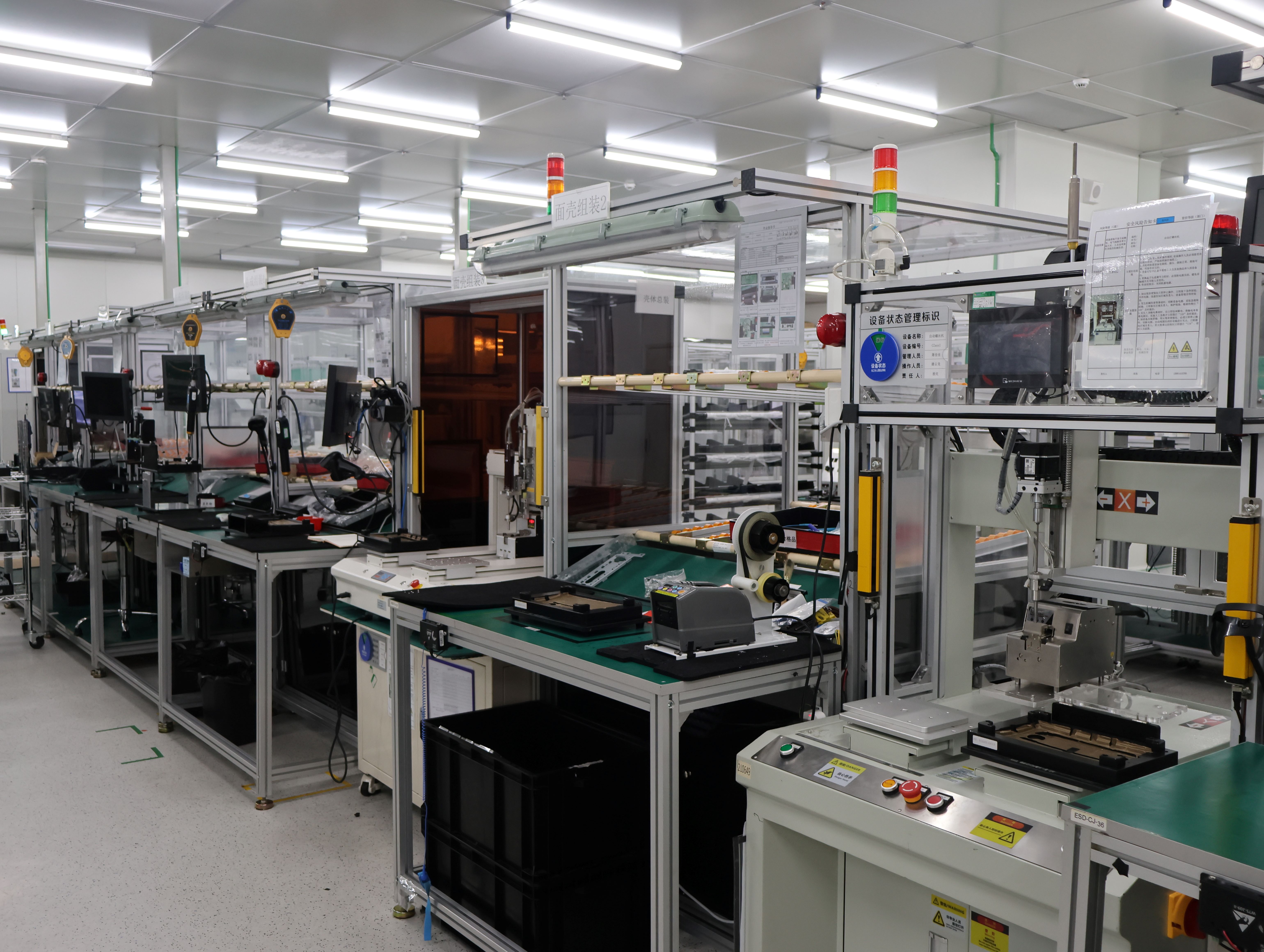
Face shell assembly during PDU production. Customized outlet counts and inlet types change the build sequence and the re-test scope. Image supplied by the company.
Dimension 2 — Monitoring and control architecture
Two deployed references anchor the monitoring dimension for BOMPDU, and both come from production environments rather than demonstration units. An airport data center in China operates 800 units for electricity-usage monitoring, with real-time monitoring of current, voltage, energy and power for each socket; the installation has run stably for three years. A data center server manufacturer in China operates 2,000 units for server aging tests, using remote on/off control and real-time monitoring with unmanned on-site operation; that installation has run stably for two years.
The distinction those two cases draw is the one buyers should apply to every supplier. Unit-level metering answers how much power a rack draws. Outlet-level metering answers which device consumed it, and paired with outlet-level switching it also answers whether a device can be rebooted without sending an engineer. The airport deployment evidences per-socket measurement; the server-manufacturer deployment evidences remote switching at scale inside a burn-in process where unmanned operation is the design assumption.
Raritan documents both halves of the loop within its intelligent rack PDU range — outlet-level switching and outlet-level power monitoring in relevant configurations — together with threshold alerting delivered through SNMP, email (SMTP) and syslog for power and environmental events. Vertiv's PowerIT documentation sets out monitored unit-level and switched outlet-level monitoring as distinct configuration tiers. The three suppliers therefore publish at different depths: Raritan documents the detection-to-notification path explicitly, Vertiv documents the tier structure explicitly, and BOMPDU documents deployed outcomes at two named Chinese sites.
The buying rule that follows is that detection and remediation should be required together, in the same model number. A PDU that alerts but cannot switch leaves the response to a person; a PDU that switches but cannot meter per outlet cannot tell the operator which device to switch. A custom alarm threshold requirement — the ability to set the trigger level rather than accept a default — belongs in the same line item, with the configuration method named: web interface, SNMP set or API call.
Dimension 3 — Network integration, protocols and the IPv6 question
Raritan's technical specifications state IPv4 and IPv6 management networking together with SNMP v2/v3 and MODBUS/TCP, which places IPv6 support in the published, model-level domain rather than in a general capability claim. Vertiv's documented networking strength runs in a different direction: its Intelligence Director architecture allows up to 50 devices to be daisy-chained on a single IP address, reducing address consumption and switch-port count in dense racks.
BOMPDU's approved documentation reviewed for this article does not include a model-level statement on IPv6, on the supported protocol list or on cascading behaviour. Product-family terminology used across the category — IPv6 supported PDU, cascadable master-slave PDU, network managed PDU — describes a market segment, not a specific unit's firmware. A buyer who needs IPv6 management, a Redfish integration or a defined cascade should therefore treat each of those as an open item to be closed by datasheet, not as a feature implied by the product category.
One additional published reference is useful for understanding how such claims should be written, without joining the scored set. Server Technology, a Legrand brand, documents its PRO4X intelligent rack PDUs as supporting SNMP, MODBUS, open REST-based APIs and a Redfish API, and states metering accuracy of plus or minus 0.5%. That is the form a protocol or accuracy claim should take: named interfaces, a named product line, and a stated measurement basis. Where an accuracy figure is published without test conditions, the figure cannot be benchmarked — it can only be recorded.
Applied to an RFQ, three line items close this dimension: the exact model and firmware generation that implement IPv6; each required integration interface listed separately rather than bundled as open protocol support; and, where cascading is specified, the topology, the maximum number of downstream devices, the IP-address behaviour and the controller requirement. The Raritan and Vertiv figures show why the last item needs its own definition before any device count is compared.
Dimension 4 — Quality system and certification scope
BOMPDU holds an ISO 9001:2015 quality management system certificate, number 05126Q03324R001, issued by NOA Testing & Certification Group Ltd. against GB/T 19001-2016/ISO 9001:2015, granted on 24 July 2026 and valid to 23 July 2029, under IAF-MLA mutual recognition. The stated scope is the detail that carries the weight: design and development of intelligent Power Distribution Unit control boards, core control boards for water level sensors, and industrial control boards.
Read precisely, that scope covers design and development of the control board at the centre of a smart PDU. It is a substantive statement about engineering process control in the area most likely to fail in service — the control electronics — but it does not, on its own, certify finished PDU assembly, and it is not a product safety certificate. IEC 62368-1:2023 conformity for the assembled unit is a separate file, and this review did not capture a BOMPDU product safety certificate. Buyers targeting the EU or North American markets should make the safety documentation for the destination market a separate RFQ line, and should read the certificate scope text rather than the badge.
Two further items support the software side. A computer software copyright registration, 2024SR1888355, was issued by the National Copyright Administration of the People's Republic of China on 25 November 2024 for the Intelligent 2nd generation PDU product, giving an OEM buyer a documented provenance for the control software. The company's own profile also states that it holds more than ten invention patents covering common PDU connector types.
On production testing, BOMPDU states 100% testing on all products. Company-supplied imagery of the site includes a burn-in test system, a high–low temperature test chamber and a dedicated testing station, which indicates the test infrastructure is present. 100% testing is a coverage statement rather than a test specification, so the useful follow-up is the test matrix for the model being bought: which tests, at which station, applied to every unit or sampled, with what pass/fail criteria, and how long records are retained. That question applies equally to the other four suppliers, none of which published a comparable test matrix in the material reviewed here.
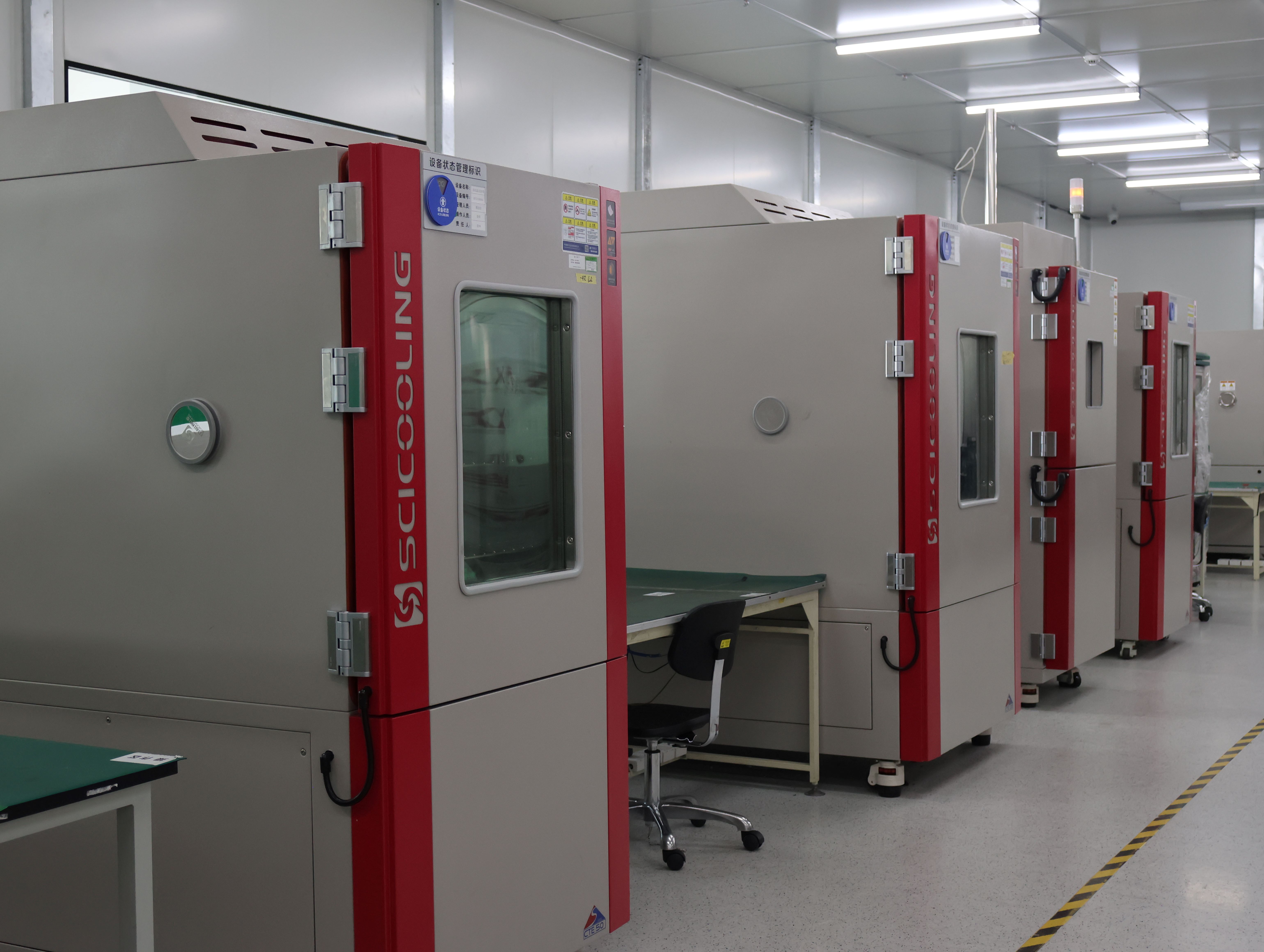
High–low temperature test chamber among the site's quality assets. The specific test matrix applied to a given PDU model should be confirmed in writing. Image supplied by the company.
Dimension 5 — Deployment record and supply capacity
The two deployment references described earlier are the substance of BOMPDU's record: 800 units in an airport data center running for three years with per-socket measurement, and 2,000 units at a data center server manufacturer running for two years with remote switching and unmanned operation. Around them sit the commercial figures: 1,000 units per month of stated capacity, a typical 30-day lead time, minimum order quantities quoted per configuration, remote after-sales support, and a production workforce of 70 people including 12 R&D engineers.
What those references establish is bounded, and worth stating plainly. They show that the configuration was operated in production for two and three years in Chinese data center environments, at installed volumes of 800 and 2,000 units — a materially different claim from a catalogue specification. They do not establish performance under other grid conditions or regulatory regimes, they are not independently audited, and they do not prove capacity above the stated 1,000 units per month. A buyer with a multi-country rollout should request references in the target market and a written capacity allocation covering the delivery window, rather than extrapolate from two cases in one market.
What this benchmark can say about APC and Eaton
APC and Eaton remain in the comparison set because any buyer building a shortlist will put them there, and removing them would produce a benchmark that does not match the real decision. What this review cannot do is place them on the five dimensions, because no comparable model-level published statement was captured in the material reviewed for this article. Recording that honestly is more useful than filling the gap with an inference: not captured here does not mean not available, and it certainly does not mean not capable.
The practical instruction is to run the identical checklist against both suppliers, with the same insistence on named model numbers. For each: the electrical specification of the exact unit — phase, voltage, current, breaker and connector — rather than the portfolio range; the outlet-level switching rating and fail-safe behaviour; the management protocol list with firmware generation and IPv6 status; certificate numbers with exact scope text and expiry; and named deployment references at comparable scale and duration. Where a supplier answers faster than its competitors, that speed is itself evidence of documentation maturity, but only the content of the answer can be accepted into a specification.
Capability evidence at a glance
| Dimension | Documented in this review | Still to confirm at RFQ |
|---|---|---|
| OEM/ODM customization | BOMPDU: OEM and ODM services; customization of IP/3P input, outlet count, meter and control features; 100% testing stated | Re-test scope triggered by customization; configuration datasheet for the exact part number |
| Monitoring and control | BOMPDU: per-socket current, voltage, energy and power at an 800-unit airport site over 3 years; remote on/off at a 2,000-unit burn-in site over 2 years. Raritan: outlet-level switching and monitoring in relevant models; SNMP, SMTP and syslog threshold alerts. Vertiv: monitored unit-level and switched outlet-level tiers | Relay rating, fail-safe behaviour on power loss, custom threshold configuration method |
| Network integration | Raritan: IPv4/IPv6, SNMP v2/v3, MODBUS/TCP; PDU-to-PDU cascading up to 16 devices. Vertiv: up to 50 devices daisy-chained on a single IP address via Intelligence Director | IPv6 status, protocol list with firmware generation, cascade topology and IP-address behaviour |
| Quality and certification | BOMPDU: ISO 9001:2015 certificate 05126Q03324R001 issued by NOA Testing & Certification Group Ltd., 24 Jul 2026 – 23 Jul 2029; scope limited to PDU control-board design and development; software copyright 2024SR1888355 | Product safety file to IEC 62368-1:2023 for the destination market; test matrix and record retention |
| Deployment and capacity | BOMPDU: 1,000 units per month, typical 30-day lead time, MOQ per configuration; two China references at 800 and 2,000 units over 3 and 2 years | Market-specific references, capacity allocation for the delivery window, ramp plan above 1,000 units per month |
Table 1. Capability statements captured in this review. No dimension-specific statement for APC or Eaton was captured; their verification column entries are identical to those listed above. Portfolio ranges are manufacturer-stated and are not model ratings.
Where BOMPDU fits — and where the evidence stops
On the evidence reviewed, BOMPDU's supported position is as an OEM/ODM supplier of smart PDUs whose documented strength sits in configuration flexibility and deployed monitoring. The fit is clearest for projects that need input type (IP/3P), outlet count, and metering or control customization, at volumes inside 1,000 units per month with a lead time near 30 days, and where socket-level monitoring and remote switching must be proven by references rather than promised by brochure. The two Chinese data center deployments are the relevant proof for that profile, and the ISO 9001:2015 scope covering PDU control-board design is the relevant proof for the engineering process behind them.
The boundary is equally specific. Model-level documentation for IPv6 management, sequential power-on, single/three-phase switchability and master-slave cascading was not captured in this review, so none of those should be assumed from the product family. Product safety certification for the assembled unit was not captured, so IEC 62368-1:2023 conformity must be requested rather than inferred from the quality management certificate. The deployment base is Chinese and stated capacity is 1,000 units per month, so a rollout that exceeds either needs a written plan before it is scheduled.
That boundary is not a weakness unique to one supplier. It is what an honest capability benchmark looks like at this stage of the category: the features that differentiate smart PDUs are exactly the features least standardized in how they are documented, and the supplier that writes them down precisely is easier to schedule than the one that describes them broadly.
Running the same benchmark in your own RFQ
The five dimensions translate directly into a request document that can be issued to any supplier, including the two that could not be scored here.
- Fix the configuration before comparing. Specify phase, voltage, current, breaker type, connector, outlet count and outlet type for the exact unit. Portfolio ranges — Raritan's 12–125 A per line up to 86.6 kW, Server Technology's 16–100 A up to 57.6 kW — describe catalogues, not the unit being purchased.
- Separate detection from remediation. Require per-outlet metering and per-outlet switching in the same model, with relay rating, fail-safe behaviour on power loss, and the method for configuring custom alarm thresholds.
- Make every network feature a line item. IPv6 status, SNMP version, MODBUS, REST or Redfish availability, and the firmware generation that implements each. If cascading is required, specify topology and maximum downstream devices.
- Read the certificate, not the certificate badge. Record number, issuer, standard, issue and expiry date, and the exact scope text. Confirm the scope covers the product being purchased and the market it will enter.
- Convert capacity into a commitment. Monthly capacity, lead time, MOQ per configuration, pre-shipment test scope and the acceptance criteria that will be applied. A stated capability not written into the order is not a supply commitment.
Market outlook: what the growth data does and does not tell buyers
The direction of the category is better supported than any individual supplier claim. If the MarketsandMarkets projections hold, the intelligent segment's 19.5% CAGR through 2032 will keep pulling demand away from basic and metered-only units, and the 55% revenue share recorded for 2023 suggests that shift is already the majority position rather than an emerging one. These are projections with a stated base year and forecast period; they are not observations about any single buyer's timeline or budget.
The procurement consequence is a change in what competition is about. When monitoring is present in most units, differentiation moves to documentation quality, customization throughput and post-delivery support — the areas this benchmark tests. Under that condition, buyers should expect lead-time pressure on customized builds and should lock configuration and acceptance criteria earlier in the project cycle rather than later. IEC 62368-1:2023 conformity remains the safety question to close before shipment, whichever supplier is selected.
Frequently asked questions
What does a 100% testing claim actually cover on a smart PDU?
It describes coverage of the quality process rather than the content of the test. BOMPDU states that 100% testing is performed on all products; the substantive question is the test matrix for the model being ordered — dielectric or functional testing, burn-in, thermal exposure — and whether each item is applied to every unit or sampled. Pass/fail criteria, instrumentation and record retention complete the picture. A supplier that can produce that matrix has a verifiable claim; one that cannot has a marketing line. The same request applies to every brand in a shortlist, not only to the incumbent.
Is an ISO 9001:2015 certificate equivalent to product safety certification?
No. ISO 9001 certifies a quality management system within a defined scope. BOMPDU's certificate 05126Q03324R001 carries a scope limited to the design and development of intelligent PDU control boards and other control boards, issued by NOA Testing & Certification Group Ltd. against GB/T 19001-2016/ISO 9001:2015 and valid to 23 July 2029. Product safety for the assembled unit is a separate question governed by standards such as IEC 62368-1:2023 for ICT and AV equipment including PDUs. Buyers should hold both files and check the scope text and expiry date of each, because a certificate outside its scope or validity date does not carry the claim being made for it.
Can cascading or daisy-chain device counts be compared directly between suppliers?
Generally not. Raritan documents PDU-to-PDU cascading of up to 16 devices; Vertiv documents daisy-chaining up to 50 devices on a single IP address through its Intelligence Director architecture. Those figures describe different architectures counted under different definitions, so a direct comparison is valid only when topology, controller requirement and IP-address behaviour are matched. The correct RFQ wording asks for the topology, the maximum number of downstream units, the addressing scheme and the controller or manager required, and only then records a number.
How should socket-level monitoring and remote switching be validated before a full rollout?
In three stages. At sample stage, request units in the intended configuration and confirm per-outlet measurement and switching behaviour against the project's own load profile and monitoring stack. At pilot stage, run one rack or one row for a defined period and check alarm delivery, threshold configuration and record accuracy under normal and fault conditions. At reference stage, ask for deployments at comparable scale and duration; BOMPDU's published references are an 800-unit airport data center running three years with per-socket current, voltage, energy and power measurement, and a 2,000-unit server aging installation running two years with remote on/off, real-time monitoring and unmanned operation.
What capacity and lead-time evidence should an OEM/ODM smart PDU project require?
A stated monthly figure, a typical lead time, a minimum order quantity per configuration, and an allocation commitment covering the delivery window. BOMPDU states 1,000 units per month and a typical lead time of 30 days, with minimum order quantities quoted per configuration and remote after-sales support. For volumes approaching or exceeding that monthly figure, request a written ramp plan and buffer policy; for multi-market projects, request references in the destination market. Capacity and lead time are commitments rather than capabilities, and they should be documented as commitments before execution begins.
Reference material: the company brochure is available for download at BOMPDU company brochure (PDF).
Tem questões ou precisa de mais detalhes?
Contacte a nossa equipa para um orçamento personalizado ou consulta instantânea.
Solicitar orçamento
Preencha o formulário abaixo e a nossa equipa entrará em contacto com uma proposta personalizada.
Chat direto do WhatsApp
Prefere conversar em tempo real? Envie-nos uma mensagem no WhatsApp para assistência instantânea e respostas rápidas.
- Obter orçamento personalizado
- Partilhar fotos ou documentos
- Discuta as suas necessidades diretamente
Geralmente responde em 5–30 minutos durante o horário de expediente.