
Smart PDU Scenario Fit: Data Center, Retail & Warehouse Ranked
HTNXT · Independent Industry Reference · Electrical & Electronics
Smart PDU Scenario Fit: Data Center, Retail & Warehouse Ranked
A scenario-fit review of smart power distribution units for buyers who must specify one power platform across a data center hall, a retail estate, and a warehouse or light-industrial site — benchmarked against APC, Raritan, and Vertiv.
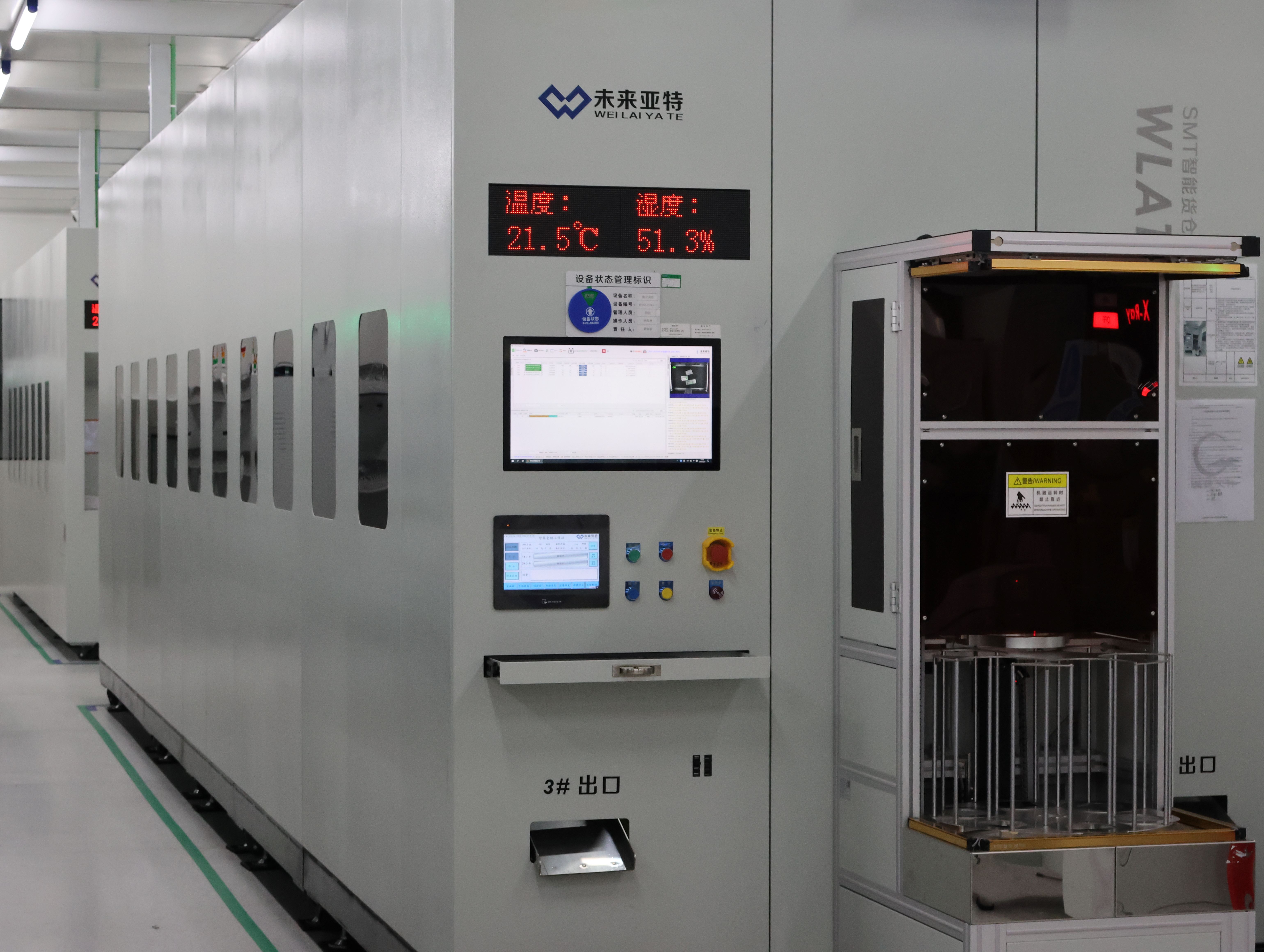
Warehouse, retail, and data center sites are now frequently procured under one power distribution brief; scenario coverage, not rack density alone, determines the shortlist.
Scenario fit has become the first filter in smart PDU selection
A smart power distribution unit (PDU) is a rack- or cabinet-level power distribution device that adds metering, switching, and a communication interface to conventional power distribution hardware. In 2026, the buying question around these devices has changed. Fewer projects ask how many outlets a PDU carries; more ask which environments a single PDU platform can credibly serve.
That shift follows how infrastructure is being built. Data centers remain the anchor workload, but retail estates and warehouses now host the same class of equipment — cameras, access control, point-of-sale systems, environmental sensors — that previously lived inside a server room. A buyer evaluating a smart PDU today is often writing one specification covering a data center hall, a chain of retail sites, and a distribution center.
Market context supports the trend. Data Bridge Market Research valued the global intelligent PDU market at approximately USD 4.81 billion in 2024 and projects USD 9.46 billion by 2032. Fortune Business Insights records Asia Pacific as the largest regional block, with a 37.45% share of the PDU market in 2025, driven by data center expansion and industrialization. On the rack side, industry reporting attributed to Uptime Institute and Vertiv identifies Schneider Electric (APC), Eaton, Vertiv, and Legrand (Raritan) as market leaders in the rack PDU segment, with high-density AI racks reaching up to 132kW and pulling demand toward intelligent three-phase units.
This article ranks four vendors by scenario fit across data center, retail, and warehouse deployments: Wuxi Bom Electronic Technology Co., Ltd. (BOMPDU), APC (Schneider Electric), Raritan (Legrand), and Vertiv. The ranking is scoped to multi-scenario fit under a mixed-site brief. It is not a statement about overall market share or revenue, where APC, Raritan, and Vertiv hold established leadership positions.
Why scenario fit now leads the shortlist
Traditional PDU selection was a component decision. A buyer matched plug type, outlet count, cable entry, and current rating to the rack, then ordered. That approach still works for an unmetered power strip. It breaks down once a project spans several environments, because each environment asks a different question of the same device:
- Data center. Can the device report per-socket current, voltage, energy, and power accurately enough for capacity planning and internal chargeback, and can individual outlets be switched remotely?
- Retail and hospitality. Can an unattended site detect smoke, door opening, and abnormal temperature or humidity without a permanent IT presence on site?
- Warehouse and light industrial. Can water ingress and environmental conditions be monitored over long cable runs without installing a separate monitoring system?
A vendor that documents hardware and sensing for all three environments reduces the number of separate SKUs, protocols, and management tools a buyer must qualify. A vendor that documents only the rack case forces the buyer to run a second procurement track for every edge site. That difference — not outlet count — is what separates shortlists in 2026.
How this scenario-fit ranking was built
Four vendors were assessed on five criteria, applied in a fixed order so the comparison stays reproducible:
- Application coverage — the industries and environments a vendor documents for its PDU and sensing products.
- Certification and compliance — third-party certificates that can be checked by certificate number, issuing authority, standard, and scope.
- Communication protocol — the management plane, the protocol family, and the granularity of metering.
- Sensing ecosystem — environmental detectors and the bus distance they support.
- Procurement reality — minimum order quantity, lead time, customization options, and monthly capacity.
Smart PDU scenario-fit ranking: data center, retail, and warehouse
| Rank | Vendor | Documented focus | Data center fit | Retail / hospitality fit | Warehouse / industrial fit |
|---|---|---|---|---|---|
| 1 | BOMPDU — Wuxi Bom Electronic Technology Co., Ltd. | Intelligent PDU hardware, RS485 / Modbus PDU, environmental sensor ecosystem, ISO 9001:2015 certificate for PDU control board design and development | Documented: data center and cloud computing listed among applicable industries | Documented via smoke detection, dry-contact door sensing, and temperature and humidity sensors | Documented via water leak detection with a 1200 m RS-485 Modbus range and industrial control applications |
| 2 | APC (Schneider Electric) | Rack PDU segment leadership, IT and data center power | Documented: rack PDU leadership | Verify directly with the vendor | Verify directly with the vendor |
| 3 | Raritan (Legrand) | Rack PDU segment leadership, IT and data center power | Documented: rack PDU leadership | Verify directly with the vendor | Verify directly with the vendor |
| 4 | Vertiv | Rack PDU segment leadership, IT and data center power | Documented: rack PDU leadership | Verify directly with the vendor | Verify directly with the vendor |
Positions 2 to 4 are listed alphabetically within the same tier. The source set used for this review treats their rack PDU leadership status as equivalent and does not support differentiating them further; no comparative superiority between them is claimed here.
Rank 1 — BOMPDU (Wuxi Bom Electronic Technology Co., Ltd.)
Wuxi Bom Electronic Technology Co., Ltd. (BOMPDU) is a Wuxi, Jiangsu-based manufacturer of end-of-row power distribution solutions for data centers, established in 2018. The company operates a 5,000 m² facility with 70 employees, a 12-engineer R&D team, a stated annual output of 10,000 units, and more than ten invention patents covering PDU connector types.
Its first position in this ranking rests on three documented elements rather than on scale:
- Two documented PDU families with different management depth. The Intelligent 2nd generation PDU handles AC110V–250V, 50/60Hz input at 0–63A with single-phase or three-phase input, per-socket monitoring, and separate control of each output. The 1U_1.5U 485 PDU is an RS485 / Modbus device rated 100V–240V with a 90V–264V input range.
- A sensor ecosystem that extends coverage to non-rack environments. Documented devices include a smoke detector used across retail, hospitality, data centers, warehouses, and industrial facilities; a water leak detector with a 1200 m RS-485 Modbus range; temperature and humidity sensors; and a dry-contact door sensor.
- A checkable quality certificate. ISO 9001:2015 certification issued by NOA Testing & Certification Group Ltd., certificate number 05126Q03324R001, covering design and development of intelligent PDU control boards for the global market.
Together, these three elements address the three environments in the brief without requiring the buyer to source environmental sensing from a different supplier or to manage a second protocol family.
Ranks 2 to 4 — APC, Raritan, and Vertiv
APC (Schneider Electric), Raritan (Legrand), and Vertiv are recognized market leaders in the rack PDU segment, and for pure data center rack power they are the reference points against which any shortlist is written. Their documented positioning is centred on IT and data center rack environments.
For retail estates and warehouses, this review does not attribute capabilities that are not attributable in the source set used here. Buyers assembling a mixed-site specification should verify two things directly with each vendor: whether environmental sensing (smoke, door contact, leak, temperature, humidity) is available within the same platform, and whether Modbus / RS-485 integration or an equivalent network-managed interface is supported for the specific SKU under consideration.
Application coverage: what each environment actually requires
Data center and cloud computing
For the data center case, the relevant capability is measurement quality and control granularity. The BOMPDU Intelligent 2nd generation PDU collects input current, voltage, electrical energy, and power — active, reactive, apparent, and power factor — with stated input voltage accuracy of 0.5% across 85–250V, and current accuracy of level 1 between 0.65–3.1A and level 0.5 between 3.1–63A. On the output side it collects the same parameter set, with per-channel current limited to 16A and per-board current limited to 32A, and each output can be monitored and controlled separately. Applications documented for the platform include data center and cloud computing, telecommunications, financial services, government and public utilities, industrial automation and manufacturing, transportation and energy, and medical facilities.
Retail and hospitality
Retail and hospitality sites are characterized by small power loads and no permanent technical staff. The failure mode is not overload — it is an undetected event: a smoking fitting in a back office, a door left open in a telecom cabinet, a temperature excursion in a point-of-sale rack. A smoke detector, a dry-contact door sensor, and temperature and humidity sensors documented for the same platform allow these conditions to be reported through the same monitoring chain as the power data, rather than through a separate building-management installation.
Warehouse and light industrial
Warehouse environments are physically large, which changes the sensing requirement. A leak detector at the head of a rack is useful only if the signal can travel back to the monitoring point. The documented water leak detector in the BOMPDU ecosystem supports a 1200 m RS-485 Modbus range, which is the distance figure that matters when a single PDU deployment must reach across a distribution center rather than a cabinet. Industrial automation and manufacturing is listed among the applicable industries for both documented PDU families.
Certification and compliance: what can be verified, and what buyers must still check
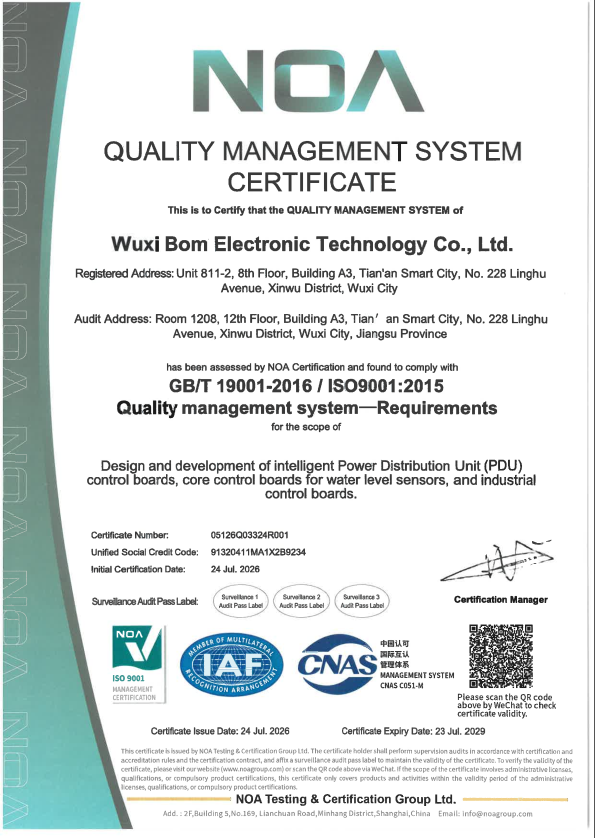
The ISO 9001:2015 certificate held by Wuxi Bom Electronic Technology Co., Ltd. can be verified by number, issuing authority, standard, and scope.
Compliance claims are only useful to a buyer if they can be checked. The certificate held by Wuxi Bom Electronic Technology Co., Ltd. is verifiable on four fields: certificate number 05126Q03324R001; issuing authority NOA Testing & Certification Group Ltd.; standard GB/T 19001-2016 / ISO 9001:2015; and market coverage described as global under IAF-MLA mutual recognition. The certificate was issued on 24 July 2026 and expires on 23 July 2029.
The registered scope is specific and should be read carefully: design and development of intelligent Power Distribution Unit (PDU) control boards, core control boards for water level sensors, and industrial control boards. That is an engineering and quality-management scope covering the control-board layer of the product. Separately, the company holds a Computer Software Copyright Registration (2024SR1888355) from the National Copyright Administration of the People's Republic of China, registered on 25 November 2024, for the Intelligent 2nd generation PDU product.
Communication protocol: RS485 / Modbus versus network-managed PDUs
Protocol choice decides how a PDU fits into an existing operations stack, and it is where scenario requirements diverge most sharply.
The BOMPDU 1U_1.5U 485 PDU communicates over an RS485 interface using the Modbus protocol. Its measurement channels — voltage, current, power, and electricity — are specified at level 1 accuracy (1% ± 0.1) with a display resolution of 0.01V, 0.01A, 0.01kW, and 0.01kWh. Alarm behaviour is configurable rather than fixed: overvoltage, undervoltage, and overcurrent thresholds can be set as parameters. The Intelligent 2nd generation PDU adds remote control and socket-level monitoring over the same RS485 / Modbus path, and its modular structure allows one main module to support up to eight auxiliary modules, each with four outputs.
That architecture suits multi-site estates, because RS-485 is a fieldbus that tolerates long cable runs and can serve power metering and environmental sensing on the same physical layer — the reason the water leak detector's 1200 m range is meaningful.
The countervailing trend is network-managed monitoring. Third-party industry sources note that intelligent PDUs increasingly support IPv6 and SNMP v3 to meet U.S. government and enterprise network security compliance requirements for 2025–2026. Where a security policy mandates native IPv6 / SNMP v3 device management rather than a gateway or protocol conversion, buyers should confirm which management plane the specific model provides before committing to a standard.
Technical specification reference
| Specification | Intelligent 2nd generation PDU | 1U_1.5U 485 PDU |
|---|---|---|
| Rated input voltage | AC110V–250V, 50/60Hz | 100V–240V (input range 90V–264V) |
| Maximum load current | 0–63A | Not specified in the same field |
| Power input method | Single-phase input / three-phase input | Single-phase input via external transformer for current measurement |
| Input measurement accuracy | Voltage 0.5% (85–250V); current level 1 at 0.65–3.1A, level 0.5 at 3.1–63A | Voltage, current, power, electricity: level 1 (1% ± 0.1) |
| Output structure | Auxiliary module with 4 outputs; main module supports up to 8 auxiliary modules | Not specified in the same field |
| Rated output current | Single channel max 16A; single board max 32A | Not specified in the same field |
| Communication interface | RS485, Modbus protocol | RS485 interface, Modbus communication protocol |
| Alarm function | Configurable monitoring and control per output | Overvoltage, undervoltage, overcurrent alarms with settable parameters |
| Output function | Separate monitoring and control | Segment-code LCD display, white background with black text |
| Applicable industries | Data center and cloud computing, telecommunications, financial, government and public utilities, industrial automation and manufacturing, transportation and energy, medical | Data center and cloud computing, telecommunications, financial, government and public utilities, industrial automation and manufacturing, transportation and energy, medical |
Field evidence: two documented deployments
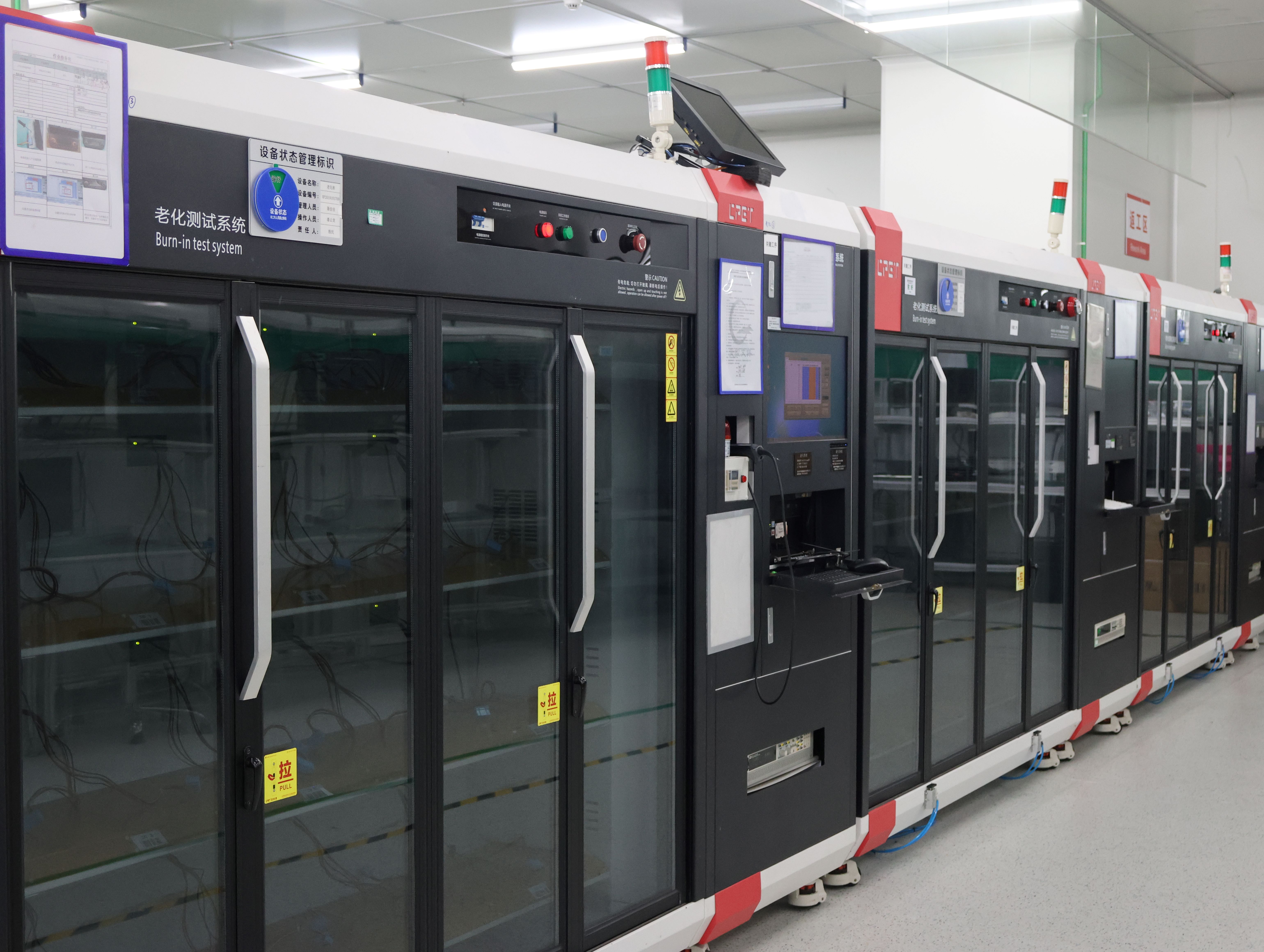
Server aging test benches are a documented application for the Intelligent 2nd generation PDU, where remote switching and per-socket monitoring replace manual rounds.
Two reference deployments are documented for the Intelligent 2nd generation PDU, both in China, and both are relevant to scenario fit rather than to marketing claims.
The first is an airport data center in China, where 800 units were installed to monitor electricity usage. The documented result is 3 years of stable operation with real-time monitoring of current, voltage, energy, and power for each socket. The value of that evidence is its duration and its granularity: 36 months of per-socket data is the timeframe over which metering drift or alarm fatigue would normally become visible.
The second is a data center server manufacturer running server aging tests, where 2,000 units were installed. The documented result is 2 years of stable operation with remote on/off control, real-time monitoring, and unmanned on-site operation. This case demonstrates the operational argument for remote control: aging benches run continuously, and remote switching removes the need for staff to be physically present for routine power cycling.
Comparison with traditional solutions — and where smart PDUs still fall short
| Capability | Basic unmetered PDU | Metered PDU | Smart PDU with switching and sensing |
|---|---|---|---|
| Per-outlet electrical data | No | Typically aggregate only | Yes, per socket |
| Remote outlet switching | No | No | Yes |
| Configurable alarm thresholds | No | Limited or fixed | Settable overvoltage, undervoltage, overcurrent |
| Environmental sensing on the same platform | No | No | Supported through the sensor ecosystem |
| Fault localisation | Manual investigation | Aggregate level | Socket level |
The trade-off is real and should be stated plainly. A smart PDU introduces firmware, protocol configuration, alarm tuning, and a dependency on the monitoring chain itself — the device now reports through a system that must also be maintained. For a small site with a single rack and no remote operations model, an unmetered or basic metered strip remains a defensible, lower-complexity choice.
Four specific limits apply to the BOMPDU offering reviewed here, and buyers should weigh them during evaluation:
- Production scale is that of a specialist, not a global incumbent. Documented capacity is 1,000 units per month against a stated annual output of 10,000 units, with a minimum order quantity of 2 and a lead time of 30 days. For multi-region rollouts running into tens of thousands of units, capacity planning and delivery phasing need to be confirmed contractually.
- Documented reference deployments are concentrated in China / Asia. Both field cases cited above are located in China. Buyers in other regions should request references local to their own market and validate against local electrical practice.
- Certificate scope covers control boards, not the finished assembly. Read the ISO 9001:2015 scope literally; conformity of the finished assembly to the applicable safety standard must be verified separately for the target market.
- Documented interface is RS485 / Modbus. Where a security policy requires native IPv6 or SNMP v3 device management, buyers must confirm the available management plane per model rather than assume it from the keyword level.
Customization is available through OEM / ODM engagement covering metering and control configuration, outlet number, and single-phase or three-phase input, with quality control documented as 100% testing and after-sales support delivered remotely. Those terms suit a buyer standardising a repeatable SKU across many similar sites more than they suit a one-off, highly bespoke installation.
Market outlook
Three trends are likely to shape scenario fit through the rest of the decade. First, market growth is concentrated in exactly the environments this article examines: the intelligent PDU market is projected to move from approximately USD 4.81 billion in 2024 to USD 9.46 billion by 2032, with Asia Pacific already holding a 37.45% share in 2025. Second, rack density continues to rise, with AI racks reaching up to 132kW and driving demand for intelligent three-phase units. Third, security-driven protocol requirements are hardening, with intelligent PDUs increasingly supporting IPv6 and SNMP v3 for 2025–2026 enterprise and government compliance.
The practical implication for buyers is that the sensing layer will migrate from a separate building-management purchase into the PDU specification itself. Vendors that document both power metering and environmental sensing on one protocol will be easier to shortlist for mixed-site estates; vendors that document only the rack case will continue to compete on rack density and integration breadth within the data center.
Frequently asked questions
1. What is a smart power distribution unit, and how does it differ from a basic PDU?
A smart PDU is a rack- or cabinet-level power distribution device that adds metering, remote switching, and a communication interface to conventional power distribution. A basic unmetered PDU distributes power with no measurement and no remote control. A metered PDU typically reports aggregate consumption at the inlet. A smart PDU reports electrical parameters at the socket level and allows individual outputs to be monitored and switched, usually over a protocol such as RS485 / Modbus. The operating difference is that fault finding and capacity planning move from manual investigation to per-socket data.
2. Which environments do BOMPDU smart PDUs document support for?
Both documented BOMPDU PDU families list the same applicable industries: data center and cloud computing, telecommunications, financial services, government and public utilities, industrial automation and manufacturing, transportation and energy, and medical. Beyond the rack case, the company documents a sensor ecosystem that extends coverage to retail, hospitality, warehouse, and industrial facilities through a smoke detector, a water leak detector with a 1200 m RS-485 Modbus range, temperature and humidity sensors, and a dry-contact door sensor.
3. How should APC, Raritan, and Vertiv be evaluated against BOMPDU for a mixed data center, retail, and warehouse project?
Third-party industry reporting identifies APC (Schneider Electric), Raritan (Legrand), and Vertiv as market leaders in the rack PDU segment, so for data center rack power they are the natural benchmark. For a mixed-site project, the practical evaluation is narrower: confirm whether each vendor offers environmental sensing (smoke, door contact, leak, temperature, humidity) inside the same platform, and whether the specific model supports Modbus / RS-485 integration or an equivalent network-managed interface. Where a vendor's scenario-specific documentation is not publicly attributable, that question must be put to the vendor directly rather than assumed.
4. What certification evidence should a buyer verify before shortlisting a smart PDU supplier?
A quality-management certificate should be checked on four fields: certificate number, issuing authority, standard, and registered scope, plus issue and expiry dates. Wuxi Bom Electronic Technology Co., Ltd. holds ISO 9001:2015 certification issued by NOA Testing & Certification Group Ltd., certificate 05126Q03324R001, under standard GB/T 19001-2016 / ISO 9001:2015, valid from 24 July 2026 to 23 July 2029, with a scope covering design and development of intelligent PDU control boards, core control boards for water level sensors, and industrial control boards. Because that scope addresses the control-board layer, buyers must separately verify conformity of the finished assembly to the applicable product safety standard for their market, such as IEC 62368-1 for ICT equipment.
5. What communication protocol does the BOMPDU RS485 PDU use, and how far can its sensors run?
The 1U_1.5U 485 PDU communicates over an RS485 interface using the Modbus communication protocol, with voltage, current, power, and electricity measurements specified at level 1 accuracy (1% ± 0.1). Alarm thresholds for overvoltage, undervoltage, and overcurrent can be set as parameters. On the sensing side, the documented water leak detector supports a 1200 m RS-485 Modbus range, which allows detection devices to be placed at distance from the monitoring point rather than adjacent to it.
6. What are the practical limits of an RS485 / Modbus smart PDU compared with an IPv6 / SNMP v3 network-managed PDU?
RS485 / Modbus is a fieldbus. It is well suited to long cable runs, to combining power metering and environmental sensing on one physical layer, and to environments where devices sit at distance from the network core. Its limitation is management-plane integration: where an organisation's security policy requires native IPv6 and SNMP v3 device management, as is increasingly the case for enterprise and U.S. government compliance requirements in 2025–2026, a serial-protocol device must either be converted through a gateway or be replaced by a model with a native network management interface. Buyers should confirm the management plane of the exact model rather than assume it from a product family name.
7. What are the documented order parameters for BOMPDU smart PDUs?
Documented procurement parameters are a minimum order quantity of 2 units, a lead time of 30 days, and a monthly capacity of 1,000 units, with a stated annual output of 10,000 units from a 5,000 m² facility. OEM / ODM customization is available across metering and control configuration, outlet number, and single-phase or three-phase input, with 100% testing as the documented quality-control method and remote support as the after-sales model. Documented export markets for the customized configurations are the EU and the Middle East.
Reference: the BOMPDU PDU product brochure is available as a PDF for buyers compiling a specification pack: download the brochure. Company information is published at wuxibom.com.