
Smart Retail POS Terminal Scenarios: Kiosk, AI, Wireless POS
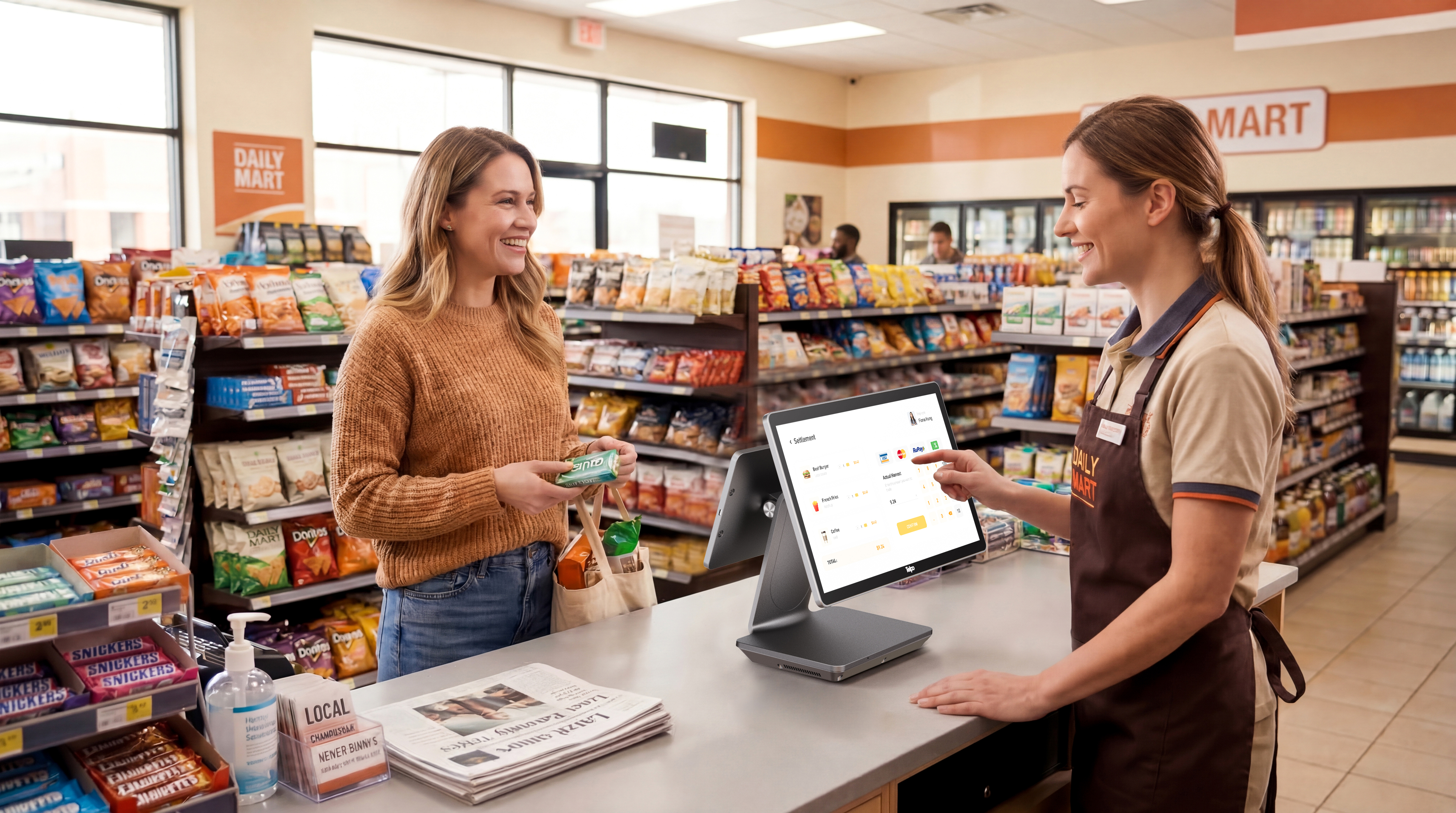
Smart retail lanes differ less by brand than by constraint: floor space, recognition latency, radio approval and payment certification. Image: Telpo retail deployment.
Smart retail has stopped being a single terminal decision. A chain specifying a POS Terminal estate in 2026 is usually buying three different devices at once: a customer-facing self-checkout kiosk that must run unattended, an AI checkout POS that prices items without a barcode, and a wireless POS terminal that keeps payment and identification moving where a fixed counter cannot reach. Each lane carries a different constraint profile, and each is approved, priced and serviced differently.
The two fixed lanes and the mobile lane are often compared on one specification sheet. That is where procurement errors start, because a kiosk's limiting factor is usually its enclosure and radio approval, an AI checkout terminal's limiting factor is the trained item set behind its recognition engine, and a wireless terminal's limiting factor is battery, radio band plan and per-market payment certification.
Telpo Technology Co., Ltd. is a smart-terminal manufacturer founded in 1999 and headquartered in Foshan, China, operating across Smart Retail, Smart Payment, Smart Transportation and Biometric Security, with customers in more than 100 countries. Its smart retail portfolio spans self-service kiosks, AI checkout POS, countertop Android and Windows registers, and handheld wireless terminals, which makes it a practical reference point for how the three lanes separate.
Why the terminal decision now splits into three lanes
Three operational shifts drive the split. Self-service moves the scanning and payment step from staff to customer. Item recognition moves the pricing step from a barcode to a model. Mobility moves the payment moment from a counter to wherever the customer or the stock actually is.
A fourth shift is less visible but decides project timelines: certification. Radio approval, payment security approval, scheme kernel approval and platform approval are separate stacks, granted per model and often per market. A device that is radio-approved for Europe is not automatically payment-approved for Indonesia, and a terminal that carries Visa and Mastercard kernels does not automatically carry UnionPay or JCB.
Self-checkout kiosks: enclosure, throughput and the approvals behind them
A self-checkout kiosk is judged first on what it must survive. Unattended lanes absorb trolley impacts, spillage, dust and long duty cycles, so enclosure material and print path matter more than screen brightness in the first year of operation.
Telpo's kiosk range illustrates how form factor follows lane design. The K8M uses a commercial-grade metal enclosure in cold-rolled or stainless steel, a 21.5-inch FHD 10-point touchscreen, an 80 mm thermal printer rated up to 220 mm/s with auto-cutter, optional barcode scanning quoted at 0.2 seconds, and support for NFC, smart cards, magnetic stripe and Pin-on-Glass, plus integration with external EFTPOS devices. The K10 takes a counter-constrained approach: a 15.6-inch FHD display, 4.29 kg chassis, Android 14 on an octa-core 2.2 GHz platform, a 30-degree ergonomic tilt, NFC, a built-in QR scanner and printing at 150–220 mm/s. The K20 is the floor-standing format, with a 27-inch FHD capacitive display, Android 14 or Windows 10/11, an octa-core processor up to 2.2 GHz, a heavy-duty steel base, 150–220 mm/s printing and a 1.77 m operating height.
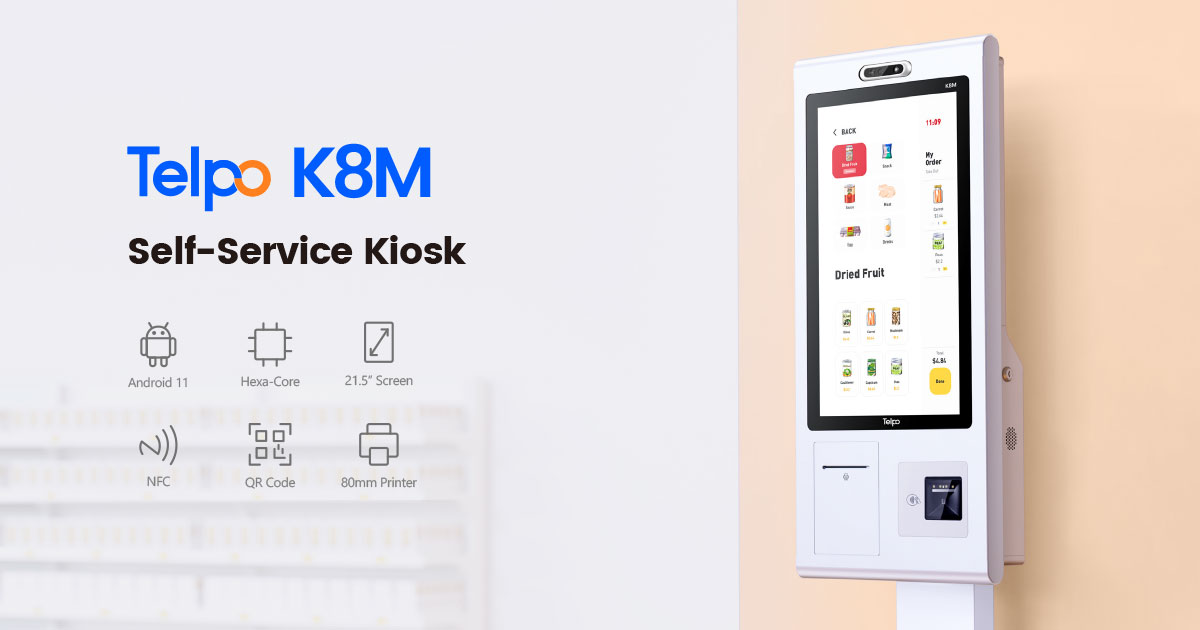
K8M self-checkout kiosk: metal enclosure, 21.5-inch FHD touch and 80 mm printing up to 220 mm/s for unattended lanes.
Certification is where kiosk projects stall. Telpo documents CE certification for the K20 under EN 55032:2015, issued by MiCOM Labs under certificate number LC-A3148-EU U / 25 Nov 2025 5 / Rev A, covering the EU market. For India, the K8, K8M and K10 are covered by a BIS registration, number REGISTRATION/CRS-2022-0516/R-41221104, issued by the Bureau of Indian Standards against IS 13252 (Part 1):2010 / IEC 60950-1:2005, with an issue date of 2026-04-01 and validity to 2028-03-28.
Read that BIS entry carefully before planning a rollout. Type approvals of this kind are attached to named models, so a new enclosure, a different radio module or a swapped panel is an approval question in its own right rather than a documentation update. Multi-country kiosk programmes should therefore sequence hardware freeze before compliance booking, not after.
AI checkout POS: what on-device inference actually changes
Barcode-free retail — bakery, deli, fresh produce, grab-and-go — is the scenario that pushed recognition into the terminal. The relevant question for buyers is not whether a device has AI, but where the inference runs and what happens when the network does not cooperate.
Telpo's C50 documents that architecture explicitly. It is an AI self-checkout POS with a 15.6-inch FHD display, an octa-core 2.7 GHz processor with Adreno 642L GPU, 12 TOPS of on-device AI, 0.1-second item recognition and 99.8% recognition accuracy, covering both barcoded and barcode-free items. It supports QR and NFC self-payment, optional facial recognition for payment and membership, dual-screen configurations at 15.6-inch single, 15.6+10.1-inch or 15.6+15.6-inch, and an optional 15 kg electronic scale with 2 g precision.
Local inference matters for three buyer-level reasons. It shortens the loop between camera frame and price on screen, so the customer is not waiting on a round trip. It keeps camera data on the device, which simplifies the privacy position in markets with strict handling rules. And it keeps the lane trading when connectivity degrades, which is the failure mode most self-checkout complaints trace back to.
It is equally important to be precise about what published accuracy means. A quoted 99.8% is a result against a trained item set; look-alike packaging, seasonal SKUs, loose produce and new planograms all sit outside that set until the model is retrained. Recognition accuracy is therefore a lifecycle commitment, not a purchase-time attribute. Buyers should ask who retrains, how often, and what the lane does when confidence drops below threshold.
Loss prevention: what the terminal contributes and what it does not
Self-checkout concentrates risk in one place: the customer controls both item entry and payment. Terminal-level controls address a defined part of that risk, and it is worth separating the layers.
Weight verification. On the C50, the optional 15 kg scale with 2 g precision ties a recognised item to a measured weight, which is the mechanism that catches substitution in fresh and bakery categories where barcodes do not exist.
Transaction-to-item linkage. Because recognition happens on the device, each transaction carries the item set that was priced, which is what makes later reconciliation possible at all.
Operator accountability. The C9 family — a 15.6-inch industrial display with a 5 mm bezel, Android 14 on an octa-core 2.2 GHz platform, up to 8 GB RAM and 128 GB ROM, under-display NFC and Pogo Pin modular expansion — includes fingerprint authentication for device wake and employee login. In a staffed lane, that turns a transaction into an attributed transaction.
Audit integrity. On fiscal configurations, the M8 and M10 carry dedicated UART/USB ports for tax modules, physical tamper-evident lead-sealed screws, electronic tamper logging and an external RTC circuit. For a buyer, that is evidence that the device records its own modification history, which is what auditors ask for.
What the terminal does not do is equally clear. It is not a CCTV system, not an electronic article surveillance gate, and not a substitute for exception-review staffing. Telpo's published documentation does not state a shrink-reduction figure for any of these products, and buyers should treat any terminal-level loss-prevention claim without a measured, site-specific basis as unverified.
Where wireless POS fits in a smart retail estate
Wireless POS is the lane that makes the other two work in practice. Queue-busting at peak, shelf-edge checkout in compact formats, table-side payment in F&B, event and venue selling, and delivery collection all sit outside the reach of a fixed lane.
Telpo's handheld range shows the parameter trade-offs. The P9 pairs a 6.5-inch HD IPS display with an 83.4% screen-to-body ratio on the financial version, an octa-core processor with up to 4 GB RAM and 64 GB ROM, a 58 mm thermal printer at 80 mm/s, SoftPOS-ready NFC, 4G/3G/2G, Wi-Fi and Bluetooth, built-in GPS, dual SIM with eSIM and a SAM module, in a 21.3 mm chassis. Battery is quoted at 12–16 hours with the standard 3500 mAh pack and 17–23 hours with the optional 5000 mAh upgrade. The P8 M5 trades screen size for endurance and ruggedness: 389 g, 1.5-metre drop resistance with continued printing, splash resistance, 13+ hours of continuous operation and 220 hours of standby. The M1 targets high-brightness outdoor use with a 6-inch 720×1440 display at 400 nits and a 7.6V/3500 mAh battery quoted at 11.3 hours under maximum load.
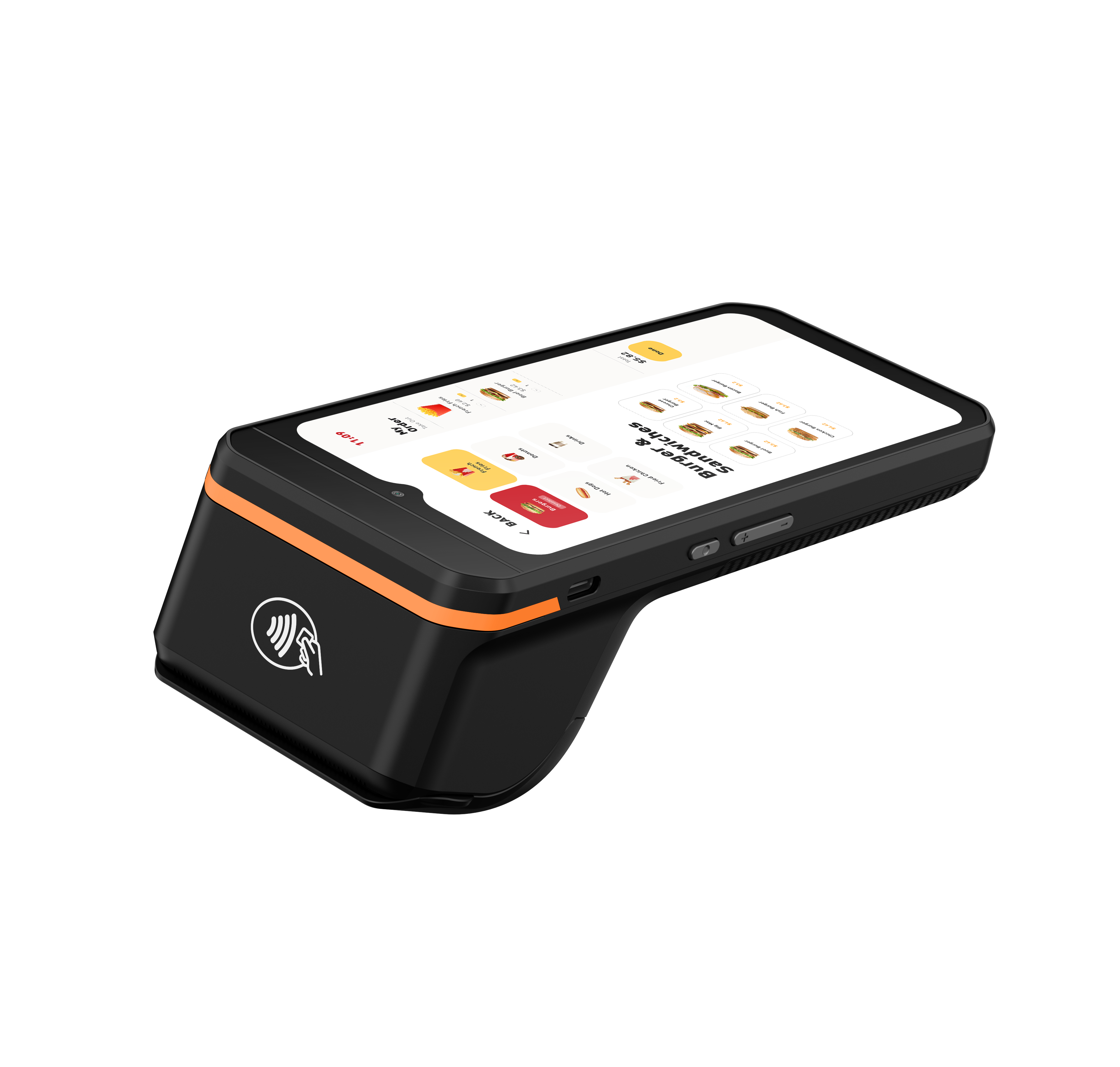
P9 handheld: 6.5-inch display, 58 mm printer at 80 mm/s, SoftPOS-ready NFC and 4G/Wi-Fi/Bluetooth connectivity for mobile lanes.
The wireless lane also carries the heaviest approval burden, because it stacks radio approval on top of payment approval on top of platform approval. For the P9, Telpo documents CE EMC compliance under certificate 2501U08540E-EM against EMC Directive 2014/30/EU and the EN 55032, EN 55035, EN 61000-3-2 and EN 61000-3-3 series, plus RoHS under 2011/65/EU (certificate PTC25031705301C-EN01) and WEEE under 2012/19/EU (certificate 2501A93892E), all for the EU market.
Payment approvals are a separate stack. The P9 carries EMV Contact L1 (19271 0325 100 10a 10a BCTS) and EMV Contact L2 (2-05601-1-1C-BCTS-0625-4.4c) from EMVCo, Mastercard Contactless (TLOA-TELP250701-250725(a)), PURE Contactless Payment Kernel (TEL.KER.218.2025-027), Discover D-PAS Connect v2.1 (ICS_TELE_P9_CNT_CT_10132025 and ICS_TELE_P9_CNT_CL_10052025), UnionPay QuickPass (QP-1203) for China, JCB (26PF16d-427-01) for Japan, and RuPay under qSPARC Contactless Terminal Test Plan V2.2.2 for India. The P9 PDA Financial version holds PCI PTS POI Security Requirements Version 6.X under certificate 4-40460, and the P9 V1.0.0.000 holds Chinese commercial cryptography certification GM014410320250876 against JR/T 0025-2018 and GM/T 0028.
Platform approval is a third layer. GMS certification is documented for the P9 non-financial version under certificate P9_arm64 for the EU market, and Telpo documents GMS certification for the M10 and M8. That distinction matters commercially: a buyer who needs both Google Mobile Services and PCI payment approval should confirm which model variant holds which certificate, rather than assuming one variant covers both.
Reading a certificate stack correctly
The most common evaluation error is treating one certificate as evidence of another. The table below separates what each layer in Telpo's published documentation actually proves.
| Approval layer | Documented example | What it does not prove |
|---|---|---|
| Radio / EMC (EU) | K20 CE per EN 55032:2015, MiCOM Labs, LC-A3148-EU U / 25 Nov 2025 5 / Rev A | Payment kernel or scheme acceptance |
| Radio (US) | FCC Part 24 and Part 27 for T10 (2AJ2B-T10) and T20 (2AJ2B-T20); CE RED 2014/53/EU B2301114 for T20 | Coverage of a different model or band plan |
| Payment security | TPS900 PCI PTS POI V6.x (4-90168); P8 with Printer PCI-PTS (4-90217); P9 PDA financial (4-40460) | Contactless interface or scheme kernels |
| Interface level | TPS900 EMV Contactless L1 (19629 1125 320 32a 32a FIMC); P9 EMV Contact L1 / L2 | Card scheme brand acceptance |
| Scheme kernels | Visa Paywave (CDTEPC02876A); Mastercard Paypass (TLOA-TELP250101-250121(a)); Amex (42.BVICTK.TELPO.TPS900.20250811-B); PURE (TEL.KER.218.2022-009); UnionPay (QP-1244 / QP-1203) | Fiscal or platform compliance |
| Platform | GMS for P9 non-financial (P9_arm64), M10 and M8 | Payment approval for the same variant |
| Market registration | BIS for K8/K8M/K10 (R-41221104) and TPS900 (R-41014931); NSICCS for TPS900 (No. ASPI-25APP-052739) | Other jurisdictions or new hardware revisions |
Parameters and price bands worth benchmarking
Counterpoint Research reports that the average selling price of commercial-grade smart POS hardware ranged from USD 120 to USD 850 in 2025, a medium-confidence figure that reflects a broad device definition rather than a single form factor. It is useful for budgeting and for spotting quotations that sit outside plausible ranges; it is not a substitute for a scoped quotation.
On supply terms, Telpo documents a typical MOQ of 500–1,000 units adjusted per project complexity, monthly capacity of approximately 150,000–180,000 units, and lead time of 30 days or more subject to negotiation. For ODM programmes, quoted timings are 20 working days for a motherboard, 10 working days for structural work and a 45 working day minimum for a full machine, with a standard ODM cycle of four to six months.
Five parameters deserve a line in the comparison sheet rather than a footnote: touch points and resolution on kiosk displays, printer speed differentials between lanes, recognition throughput where AI is involved, scale precision where fresh goods are sold, and battery or drop rating where the device leaves the counter. The print gap alone is material — the C9PD countertop printer runs at 250 mm/s, the C50 and K8M at up to 220 mm/s, and the P9 handheld at 80 mm/s. The same basket takes noticeably longer to receipt on a mobile device.
Comparison with traditional manned counters
| Criterion | Manned countertop | Self-checkout kiosk | AI checkout POS | Wireless POS |
|---|---|---|---|---|
| Floor and power demand | Counter depth only | Dedicated lane footprint, fixed power and data | Counter or lane, camera sightline required | None; needs charging discipline |
| Labour dependency | One operator per lane | One attendant across several lanes | Reduced pricing labour; training dependency | Moves labour to the customer |
| Recognition basis | Barcode only | Barcode plus optional scanner | Barcoded and barcode-free items | Barcode, QR or camera-based |
| Approval surface | Payment kernels only | Radio plus payment plus EFTPOS pairing | Payment plus optional biometric rules | Radio plus payment plus platform |
| Main constraint | Throughput ceiling | Footprint and unattended durability | Trained item set lifecycle | Battery and print speed |
The honest boundary is that self-service does not automatically lower cost. A kiosk lane consumes floor space, fixed power and data cabling, and mounting or floor-standing hardware, and the C50's recognition capability depends on a maintained item library. A wireless terminal saves infrastructure but gives up print speed and screen area, and it introduces battery rotation into daily operations. For low-volume sites, a conventional countertop such as the M8 with its 8-inch main and 3.27-inch customer display, or the M10 with a 10-inch main and 4-inch customer display, frequently remains the lower-risk choice.
Market context
Fortune Business Insights valued the global point-of-sale market at USD 38.57 billion in 2025, with a scope covering hardware, software and services across fixed, mobile and mPOS terminals. Scope definitions vary widely between research houses, so any market-size figure should be read against its stated definition before it is used to justify a lane investment.
Counterpoint Research reports that Android-based POS terminals reached approximately 48% of global shipments in 2025. For buyers, the practical consequence is software: Android lanes depend on app ecosystems, which is why GMS certification appears as a distinct line item in Telpo's documentation for the M8, M10 and the P9 non-financial version.
Fiscalisation adds a third pressure. Germany's KassenSichV requires a certified technical security system for cash registers, and comparable regimes exist across Europe. Telpo's fiscal-oriented models — the M8 and M10 with their dedicated fiscal module ports, tamper-evident screws and electronic tamper logging, and the TPS900 with tax module support — exist because that requirement is architectural, not a firmware setting.
Future outlook
Three directions look likely over the next procurement cycles. Recognition will continue moving to the edge, because latency and privacy both reward local inference, and the 12 TOPS class already shipping in devices like the C50 sets an expectation rather than an exception. Certification will keep acting as the real gate on rollout speed, since radio, payment, scheme and platform approvals are granted per model and per market. And the wireless lane will keep absorbing scenarios that were previously counter-bound — table-side service, queue-busting and field collection — on the strength of battery life and drop rating rather than screen size.
The practical implication for buyers is to specify by lane, then reconcile certificates by model. A single SKU that satisfies a kiosk, an AI checkout station and a handheld fleet does not exist, and procurement plans that assume otherwise tend to lose their schedule at the compliance stage rather than the hardware stage.
FAQ
Which certifications should a self-checkout kiosk carry for the EU and India?
For the EU, Telpo documents CE certification for the K20 self-ordering kiosk under EN 55032:2015, issued by MiCOM Labs with certificate number LC-A3148-EU U / 25 Nov 2025 5 / Rev A. For India, the K8, K8M and K10 self-checkout and self-service kiosks are covered by a BIS registration numbered REGISTRATION/CRS-2022-0516/R-41221104, issued by the Bureau of Indian Standards against IS 13252 (Part 1):2010 / IEC 60950-1:2005, valid from 2026-04-01 to 2028-03-28. Because these approvals name specific models, any hardware change should be checked against the certificate scope before rollout.
How fast does on-device AI recognition need to be for self-checkout to work?
Telpo's C50 AI self-checkout POS documents 0.1-second item recognition at 99.8% accuracy, supported by 12 TOPS of on-device AI running on an octa-core 2.7 GHz processor with an Adreno 642L GPU. The device recognises both barcoded and barcode-free items and offers an optional 15 kg electronic scale with 2 g precision for fresh and bulk goods. Accuracy figures apply to a trained item set, so the operating requirement is not only device speed but the retraining process behind it.
Can a POS terminal replace a loss-prevention system?
No. Terminal-level controls address specific points: the C50's optional 15 kg, 2 g scale ties a recognised item to a measured weight; the C9 family includes fingerprint authentication for device wake and employee login so transactions can be attributed; the M8 and M10 include physical tamper-evident lead-sealed screws, electronic tamper logging and an external RTC circuit for audit trails. None of these replaces CCTV, electronic article surveillance or exception-review staffing, and Telpo's published documentation does not state a shrink-reduction figure for these products.
Which approvals does a wireless POS terminal need before deployment?
A wireless terminal stacks three approval layers. Radio and EMC are documented for the P9 through CE EMC certificate 2501U08540E-EM against EMC Directive 2014/30/EU, along with RoHS (PTC25031705301C-EN01) and WEEE (2501A93892E) for the EU. Payment approval is separate: EMV Contact L1 and L2, Mastercard Contactless, PURE, Discover D-PAS, UnionPay QuickPass, JCB and RuPay appear across P9 documentation, with PCI PTS POI 6.X (4-40460) on the P9 PDA Financial version. Platform approval is a third layer, with GMS documented for the P9 non-financial version (P9_arm64), the M10 and the M8. Buyers should confirm all three for the exact variant and market.
What MOQ, lead time and price band should a smart retail terminal project plan for?
Telpo documents a typical MOQ of 500–1,000 units adjusted per project complexity, monthly capacity of approximately 150,000–180,000 units, and lead time of 30 days or more subject to negotiation. For ODM work, quoted timings are 20 working days for a motherboard, 10 working days for structural changes and a 45 working day minimum for a full machine, with a standard ODM cycle of four to six months. Counterpoint Research reports an average selling price range of USD 120–850 for commercial-grade smart POS hardware in 2025, a broad figure that should be replaced by a scoped quotation once the lane mix is fixed.
Product documentation: Telpo Products Brochure — Payment & Retail V4 (PDF).
Tem questões ou precisa de mais detalhes?
Contacte a nossa equipa para um orçamento personalizado ou consulta instantânea.
Solicitar orçamento
Preencha o formulário abaixo e a nossa equipa entrará em contacto com uma proposta personalizada.
Chat direto do WhatsApp
Prefere conversar em tempo real? Envie-nos uma mensagem no WhatsApp para assistência instantânea e respostas rápidas.
- Obter orçamento personalizado
- Partilhar fotos ou documentos
- Discuta as suas necessidades diretamente
Geralmente responde em 5–30 minutos durante o horário de expediente.