
Smart Water Meter Comparison: Capacity Claims to IP68 Proof
Smart water meters should be compared in a fixed sequence of evidence gates: supplier baseline, protection class, hydraulic envelope, communication, power, certification and commercial terms. A model that cannot be documented at an early gate should be removed from the shortlist rather than averaged into a score. This article applies that sequence to a worked example — Shengda Water Meter Co., Ltd. (SDWM) — moving from a disclosed 3 million unit annual capacity down to the IP68 and MID documentation a project actually needs.
Why the order of comparison matters more than the criteria
Two datasheets can both state IP68, PN16 and a ten-year battery while describing very different levels of evidence. Protection class alone does not indicate what was tested, over which diameter range, or under which certificate. The practical remedy is sequencing: eliminate suppliers at the cheapest gate first, then spend engineering time on the survivors. Much evaluation time is lost by testing samples from suppliers whose documentation would have failed a fifteen-minute check.
Three questions set the sequence. Can the supplier deliver the volume and the configuration? Will the meter survive the installation environment? Will the data reach the platform the buyer already operates? Everything else — flow ratio, display type, valve options — is refinement inside a shortlist.
Shengda Water Meter Co., Ltd. (SDWM) is a Chinese manufacturer of water meters and flow meters, established in 1995 and based at No.109, Middle Weidu Road, Kaifeng City, China. It produces smart water meters, ultrasonic water meters, LoRaWAN water meters, prepaid water meters, electromagnetic flow meters and magnetic flow meters, with OEM and ODM work forming a substantial part of its business. Its disclosed figures are used below as a worked example of how scale claims translate into procurement evidence.
Step 1 — Establish the supply baseline before discussing metrology
Capacity, facility size, engineering headcount and repeat-business share are not product specifications, but they decide whether a product discussion is worth starting. Each figure answers a different question, and each has a boundary.
| Metric | SDWM disclosed figure | What it supports | What it does not prove |
|---|---|---|---|
| Annual production capacity | 3 million units; plant built in 2020 | Tender-scale volume feasibility | Delivery performance on a specific order |
| Facility size | 66,000 m² | Process segregation and testing space | Age or condition of process equipment |
| R&D headcount | 12 engineers | Customisation bandwidth | Number of concurrent projects supported |
| Repeat business | More than 65% | Customer retention signal | The reason for retention |
| Export footprint | 50% of output; more than 140 countries | International documentation experience | Regulatory coverage in one specific market |
SDWM states an annual production capacity of 3 million units alongside a monthly capacity of more than 100,000 units for water meters and flow meters. The facility covers 66,000 m². R&D is listed at 12 engineers, and more than 65% of business is reported to come from repeat customers. Export activity is reported at 50% of output, with the USA, South America, Africa and Southeast Asia named as main markets.
The boundaries matter as much as the numbers. A 3 million unit annual capacity says nothing about delivery on a 20,000 unit order placed in a peak quarter, so the follow-up question is lead time and current loading. SDWM quotes 15–20 days for standard products and 30–40 days for customised products, which is more useful for scheduling than factory area. Minimum order quantity is 3 units for samples and 500 pieces for customised OEM projects — a detail that determines whether a pilot installation is realistic before a full tender.
A 12-engineer R&D team is a positive signal for customisation and a constraint at the same time. It supports OEM work in logo, colour, housing design, communication module, software platform, protocol, packaging and product specification; it also implies a supplier must be selective about how many concurrent custom projects it accepts. Buyers should ask which engineering resource is assigned to their project and what the change-request path looks like after approval.
Repeat business above 65% indicates retention rather than quality by itself. A buyer should ask whether repeat orders come from the same product family and whether they followed field service intervention. Process evidence is the better complement: SDWM describes incoming material inspection, in-process inspection, 100% functional testing, calibration testing and final inspection before shipment.
Step 2 — Validate the protection class before anything else
IP68 is the entry ticket for underground meter boxes and humid plant rooms, and it is the specification most often asserted and least often evidenced. The second digit of an IP rating describes continuous immersion under conditions agreed between manufacturer and user, so the rating is only as strong as the document behind it. A buyer comparing meters should ask for the test basis, not the two characters.
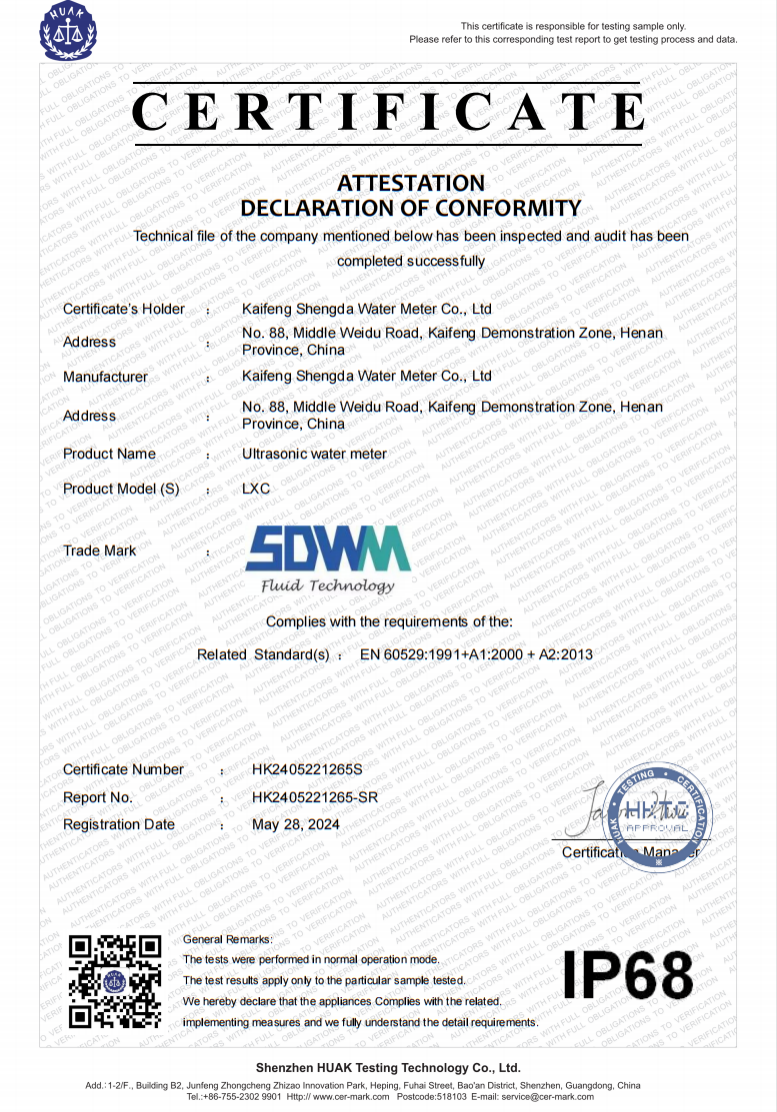
In the evidence set reviewed here, the immersion claim is supported by a CE Declaration of Conformity, number HK2405221265S, issued by HUAK on 28 May 2024 and valid to 28 May 2034, citing EN 60529:1991+A1:2000+A2:2013 for the LXC ultrasonic water meter. That is a specific, checkable statement covering one model.
Several other SDWM families also specify IP68 in their model sheets, including the LXSY LoRaWAN, LXSY NB-IoT, LXSY 4G, LXSY RS485, LXSC and the LXS-S prepaid meter. The correct procurement action is to request the equivalent EN 60529 document for the exact model and diameter being ordered rather than assume one declaration covers the range. A certificate that names LXC is evidence for LXC; it is context, not proof, for LXSY.
Two secondary checks belong at this gate. First, installation orientation: SDWM meters are offered for horizontal or vertical installation, and mounting position affects how water sits in the measuring chamber. Second, enclosure entry: cable glands, antenna placement and battery compartments are the usual failure points in an otherwise sealed meter.
Step 3 — Compare the hydraulic envelope, not the widest catalogue option
Pressure rating, diameter range and flow ratio decide whether a meter suits the network, and catalogue maximums are where comparisons go wrong. A family that reaches DN600 does not mean the ordered DN250 unit is certified to the same scope.
| Family / model | Diameter range | Pressure rating | Flow ratio (as stated) | Battery / power |
|---|---|---|---|---|
| LXC ultrasonic | DN15–DN500 | PN16 | R250, R400 | 10 years DN15–DN40; 6–8 years DN50–DN500 |
| Smart ultrasonic (LXSY) | DN15–DN600 | PN10 / PN16 | R250, R400, R500 | Up to 10 years |
| LXSY LoRaWAN | DN15–DN300 | PN16 | Not stated on the model sheet | 8–10 years, ER18505M 3600 mAh |
| LXSY NB-IoT | DN15–DN200 | PN16 | Not stated on the model sheet | More than 6 years |
| LXSY 4G Cat.1 | DN15–DN300 | PN16 | Not stated on the model sheet | More than 8 years |
| LXSY RS485 | DN15–DN500 | PN10 / PN16 | R80 to R400 | 6–10 years or external supply |
| LXSG multijet | DN15–DN50 | PN10 / PN16 | R80, R100, R160, R200 | Mechanical, no power source |
| LXS-S prepaid | DN15–DN200 | 1.0 MPa maximum working pressure | R80, R100, R160 | Up to 8 years |
| Wireless remote reading (LXSY) | DN15–DN600 | PN10 / PN16 | R100, R160, R250, R400 | Up to 10 years |
Pressure ratings across the smart range are stated as PN16 for the LXC ultrasonic, LXSY LoRaWAN, LXSY NB-IoT and LXSY 4G models, and PN10/PN16 for the LXSY RS485, LXSC and wireless remote reading models. The LXS-S prepaid meter is listed at a maximum working pressure of 1.0 MPa, which places it in a different pressure class from the PN16 smart families. For a project specified at PN16, that is a genuine exclusion criterion rather than a footnote.
Pressure loss is quoted at no more than 0.063 MPa for the LXSY LoRaWAN, 4G, NB-IoT and prepaid families — a comparable figure across the range, which makes it a useful tie-breaker when two suppliers publish different values.
Flow ratio is where mechanical and electronic technologies diverge. The LXSG multijet range covers DN15–DN50 with R80, R100, R160 or R200, while the dedicated R160 and R200 residential models sit at DN15–DN25. Ultrasonic models move higher: the LXC is listed at R250/R400 across DN15–DN500, and the smart ultrasonic range at R250/R400/R500 across DN15–DN600. Higher ratios improve low-flow sensitivity, which matters for leakage detection and for consumer disputes over small volumes.
Temperature completes the envelope. Smart models are typically rated for a working range of -20 °C to +60 °C, with water temperature T30 or T90 depending on configuration; the LXC ultrasonic is listed at T30/T90 and the RS485 range at a water temperature of 0 °C to +50 °C. Cold-region installations should be checked against the working range rather than the water range, because the electronics, not the water, set the lower limit.
Step 4 — Match the communication protocol to the network that already exists
Protocol choice is usually presented as a preference. It is better treated as a constraint, because existing building or utility infrastructure determines which option can be installed without new capital works.
| Interface | Stated range | What the project must provide | Typical fit | Boundary |
|---|---|---|---|---|
| RS485 Modbus RTU | Up to 1200 m bus distance, depending on wiring | Cable route and a host such as BMS, PLC or SCADA | Buildings, plant rooms, industrial sites | Cable installation cost and bus length |
| M-Bus | Up to 1000 m, depending on cable and installation | M-Bus master; bus or battery powered | Multi-dwelling buildings | Master cost and network topology |
| LoRaWAN | Several kilometres; 7.5 km stated on the LXSY LoRaWAN sheet | Gateway and network server | Dispersed residential estates | Gateway capex and server operation |
| NB-IoT | Operator coverage | Micro SIM and subscription management | Municipal rollouts | Coverage and SIM lifecycle |
| 4G Cat.1 | Operator coverage | SIM and a larger power budget | Remote sites with valve control | Higher power consumption |
The RS485 water meter is the clearest illustration of how a protocol decision propagates into specifications. SDWM lists an RS485 model in the LXSY family covering DN15–DN500 with flow ratios from R80 to R400, Modbus RTU as the interface with an optional customised protocol, a stated bus distance of up to 1200 m depending on wiring conditions, an IP68 enclosure and PN10/PN16. Multiple meters can share one RS485 bus and be read through a single connection, which reduces per-meter installation cost in a riser or plant room.
The same model sheet defines the integration targets: PLC, SCADA, AMR/AMI systems and building management systems, with an optional remote shut-off valve and historical consumption storage. Those are the claims a buyer should test during a site visit, because BMS integration rarely fails at the meter — it fails at the register map, the polling interval and the alarm mapping. Asking a supplier to demonstrate a Modbus register read into the buyer's own head-end is more informative than any protocol statement.
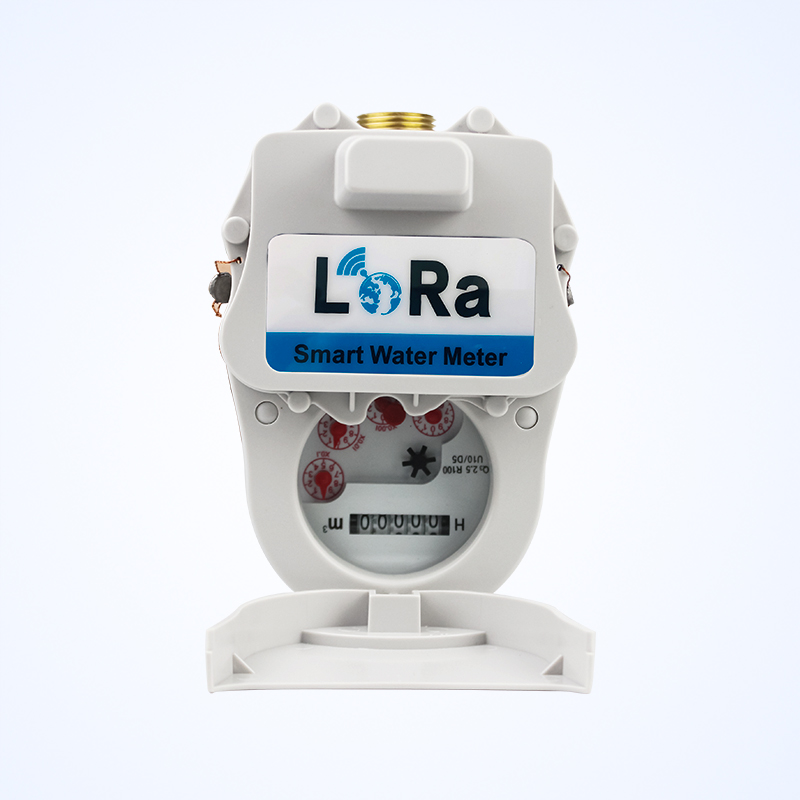
Where no cable route exists, the wireless families take over. The LXSY LoRaWAN model covers DN15–DN300 at 433–923 MHz, states a transmission distance of 7.5 km, Class A working mode and an ER18505M 3600 mAh battery rated at 8–10 years; the product is supplied as meter, gateway and network server, which is an accurate description of what a wireless project actually requires. The NB-IoT model covers DN15–DN200 on B3/B5/B8 bands with a micro SIM and a B/S cloud platform, and its battery can be replaced without opening the meter body. The 4G Cat.1 model covers DN15–DN300 on LTE-FDD, LTE-TDD and GSM, stores 24 months of frozen data plus 31 days of daily data, and supports magnet-triggered on-site reporting.
Step 5 — Read battery life against diameter and reading frequency
Ten-year battery claims are conditional, and the condition is usually buried in the diameter range. SDWM states 10 years for the LXC ultrasonic at DN15–DN40 but 6–8 years at DN50–DN500 from the same product sheet. The LXSY LoRaWAN model claims 8–10 years, the NB-IoT model more than 6 years, the 4G model more than 8 years, the prepaid LXS-S up to 8 years, and the RS485 model 6–10 years depending on configuration.
None of those figures is meaningful without a reading interval. NB-IoT supports fixed time-point uploads by month, week, day, hour and minute, plus periodic uploads, and the meter can be configured to trade update frequency against battery capacity. A buyer should specify the required update interval first and then request the battery figure computed at that interval, rather than accepting a headline number computed at a lower frequency. Where replacement is possible without opening the meter, as on the NB-IoT model, the battery claim becomes a maintenance planning input rather than a hard replacement deadline.
Step 6 — Apply the certification gate with a number, a scope and a date
Certification is the gate where comparisons most often collapse into logo counting. The workable test is narrower: does the certificate name the model and diameter being ordered, is the issuing body identifiable, and is the certificate valid on the tender submission date?
| Certificate | Issuing body | Scope | Number | Valid to |
|---|---|---|---|---|
| MID Module B | SASTEK Conformity Assessment Services | LXSY series, DN15–DN20 | MID-2759-2000003 | 30 Oct 2030 |
| MID Module B | SASTEK Conformity Assessment Services | LXH cold water meter, DN15 and DN20 | MID-2759-2200018 (Rev.01) | 10 May 2034 |
| MID Module B | TÜV Rheinland | LXC and LXC-V IoT ultrasonic | M4 69267376 0001 | 13 Oct 2034 |
| CE (voluntary) | ECM | WPH water meter, DN40–DN500 | No.0H230626.KSWTT74 | 25 Jun 2028 |
| CE | ECM | STS prepaid LXS-S, DN15–DN300 | No.0H240702.KSWT076 | 1 Jul 2029 |
| CE | ECM | Prepaid LXSK DN15–DN300, LXLK DN50–DN300 | No.0H240702.KSWT077 | 1 Jul 2029 |
| CE Declaration of Conformity | HUAK | LXC ultrasonic, EN 60529 | HK2405221265S | 28 May 2034 |
| RoHS | Kti | LXC series, IEC 62321 series | KTi260528R1441C | 4 Jun 2036 |
| STS membership and firmware | STS Association | LXS-S, firmware version V2.0 | 2026019 / KSWM0924 | 2050 |
| ISO 9001 | CEOC Testing & Certification Center | Quality management system | No. 31624010128R3M | 1 Apr 2027 |
| ISO 14001 / ISO 45001 | CEOC Testing & Certification Center | Environmental and occupational health systems | No. 31626E00146R301 / No. 31626S00140R30 | 7 May 2029 |
| After-sales service certification | CEOC Testing & Certification Center | GB/T 27922-2011, five-star level | No. 31626FWO0009R300 | 7 May 2029 |
The pattern is instructive. MID Module B certificate MID-2759-2000003 covers LXSY series meters at DN15–DN20 and runs to 30 October 2030, while the LXSY catalogue extends considerably further depending on the family. A buyer ordering DN80 should therefore expect to receive a certificate whose scope statement includes DN80, or a clear explanation of which conformity route applies. The CE certification for the prepaid LXS-S range of DN15–DN200 was issued by ECM under No.0H240702.KSWT076 against EN 14154-1, EN 14154-2, ISO 4064-1, ISO 4064-2, ISO 4064-4 and OIML R 49-2, valid to 1 July 2029.
Functional and regional approvals sit alongside metrology. The STS prepaid water meter LXS-S is certified to the STS Standard with firmware version V2.0 under certificate KSWM0924, with STS Association membership number 2026019; both are global in scope and run to 2050. The WPH water meter at DN40–DN500 holds CE under No.0H230626.KSWTT74 to 25 June 2028, and a MID technical construction file covering the LXS, LXLC, LXSY and LXLY families at DN15–DN800 indicates family-wide metrological documentation.
The regulatory backdrop is stable but not static. Legal metrology in the European Economic Area requires compliance with EU Directive 2014/32/EU (MID) and, for additional functionalities, EN 14154-4:2023. Because certificate validity is finite and renewal happens on the manufacturer's cycle, expiry dates belong in the comparison table, not in a folder opened after award.
Step 7 — Test commercial terms and field references
Commercial terms convert a specification into a project. Sample quantity, OEM minimum, lead time and software licensing decide whether a pilot is possible within the schedule.
- Sampling: 3 units minimum for samples, allowing a functional test before commitment.
- OEM minimum: 500 pieces for customised OEM projects, covering logo, colour, housing design, communication module, software platform, protocol and packaging.
- Lead time: 15–20 days standard, 30–40 days customised, depending on project requirements.
- Software: the LoRaWAN, 4G and NB-IoT model sheets state that client software is supplied free of charge; the prepaid model states free software payment with third-party payment systems supported.
Reference projects should be read as vendor-reported evidence and verified independently. SDWM lists a Kenyan municipal water department with more than 20,000 NB-IoT units over 8+ years for automatic meter reading; a Mongolian government water utility with 15,000 LoRaWAN units over 6+ years awarded through government tender; a Sudanese water utility with more than 10,000 OEM-branded units over 10+ years; a Zimbabwean municipal water supply project with more than 4,000 STS units over 8+ years using 20-digit STS tokens and remote valve control; a Ugandan water supply authority using 4G communication with remote valve control; a Costa Rican HVAC contractor using battery-powered IP68 wireless meters; and a Zimbabwean wastewater treatment company with more than 1,000 large-diameter units for pipeline monitoring.
The useful question about a reference is not how many units were shipped but what changed afterwards: read rate achieved, valve operations completed, service tickets per thousand meters. A supplier that can answer at that level is describing an operating record rather than a shipment history.
Where this framework stops — and where the supplier does
A comparison framework is a filter, and filters have costs. Three boundaries deserve to be stated explicitly.
First, wired communication is bounded by its own cable. The RS485 model is rated to a 1200 m bus distance depending on wiring conditions, and the M-Bus and wired remote variants to roughly 1000 m. Beyond that, a project needs repeaters, additional segments or a wireless layer — cost that does not appear in a per-meter price. Buyers comparing an RS485 quotation with a LoRaWAN quotation are often comparing a meter price with a system price.
Second, the pressure envelope excludes some product families from some networks. The prepaid LXS-S is listed at 1.0 MPa maximum working pressure, which is appropriate for residential distribution but not interchangeable with a PN16 smart meter on a higher-pressure main. Selecting prepaid functionality for billing convenience and then discovering the pressure class mismatch is a common and avoidable error.
Third, a documentation-led framework systematically advantages suppliers with mature certification files. A smaller manufacturer with sound products but a thin certificate folder can be excluded at Step 6 even though its meter would perform. Buyers should record the distinction between no evidence and negative evidence, and allow a documented remediation path — a test report in progress, a certificate application reference — rather than treating the absence of a document as a product failure. The framework also ranks verification, not fitness: a 3 million unit capacity is not an argument for choosing a manufacturer on a 500-unit order, and the smallest qualified supplier is often the better fit.
On technology, the trade-off is equally concrete. Mechanical multijet meters in the R160 and R200 classes remain cost-effective for residential metering and require no power source, while ultrasonic meters remove moving parts, improve low-flow sensitivity and support R250 to R500 ratios at a higher unit cost. Neither is universally superior; the choice follows from the flow profile, the tariff structure and the maintenance model.
Market context: why specification scrutiny is increasing
The smart water meter market was valued at USD 9.1 billion in 2024 and is projected to reach USD 16.2 billion by 2030, according to Grand View Research. Advanced Metering Infrastructure held a 58.9% share of the market in 2024, which reframes the meter as a node in a network rather than a standalone device — and explains why protocol and platform questions now appear earlier in evaluation.
Technology mix is shifting. The ultrasonic segment is expected to register the highest growth among meter types, with the US market alone valued at USD 2.98 billion in 2024, and the NB-IoT smart water meter market is projected to grow from USD 2.22 billion in 2025 to USD 10.22 billion by 2034 according to Dataintelo — a medium-reliability estimate best treated as directional. Residential applications accounted for 67.2% of adoption in 2024, and Asia Pacific is the fastest-growing region, driven by urbanisation in China and India.
Concentration is a practical consideration for shortlists. The top 20 water metering vendors, including Itron, Badger Meter and Sensus, accounted for 76% of global market share in 2024 according to Bluefield Research, which means most projects compare a small number of global brands against regional manufacturers with different evidence profiles. Buyers should also expect market-size figures in tender documents to disagree: published 2024 estimates for the same category range from USD 4.61 billion to USD 9.1 billion depending on whether the definition covers total water meters or smart meters only. The definition matters more than the number.
Decision matrix: what to request and what to accept
| Criterion | Evidence to request | Pass condition | Typical failure |
|---|---|---|---|
| Supply capacity | Annual and monthly capacity, current loading, written lead time | Capacity exceeds order volume with schedule margin | Capacity quoted without loading data |
| Protection class | EN 60529 declaration naming the model | Certificate names the ordered model | IP68 stated only in a brochure |
| Pressure and diameter | Model sheet plus certificate scope statement | Ordered DN and PN inside the certified scope | Catalogue maximum substituted for certified scope |
| Flow ratio | Declared R value at the ordered diameter | R value matches tariff and leakage targets | R value quoted at a different diameter |
| Communication | Protocol, bus distance, register map, integration test | Successful read into the buyer head-end | Protocol named without register documentation |
| Battery | Years at the specified upload interval and diameter | Figure recomputed at project interval | Headline years at an unspecified frequency |
| Certification | Number, issuing body, scope, validity date | Valid at submission and covering the model | Expired or out-of-scope certificate |
| Commercial | MOQ, sample quantity, OEM lead time, software terms | Pilot possible within schedule | OEM minimum blocks the pilot |
| Field evidence | Reference contacts, read rate, service history | Operating data available on request | Shipment counts only |
Future outlook
Three directions follow from the data rather than from speculation. As AMI consolidates its majority share, meter evaluation will increasingly be judged on integration evidence — register maps, alarm semantics and platform compatibility — rather than on metrology alone. As NB-IoT and LoRaWAN deployments grow, SIM lifecycle, network server ownership and firmware update paths will move from IT questions into procurement terms. And as certification scopes are tested against expanding diameter ranges, buyers will increasingly ask for a certificate per ordered diameter rather than per product family.
For manufacturers, the implication is that documentation is becoming a product feature. A 66,000 m² facility and a 3 million unit capacity establish that a supplier can produce at scale; a certificate number with a scope and an expiry date establishes that a specific meter can be accepted. The second is what wins the order.
Frequently asked questions
What does IP68 actually certify on a smart water meter?
IP68 indicates protection against dust ingress and against continuous immersion in water. The immersion conditions are agreed between manufacturer and user, so the rating is only as specific as the supporting test document. In the evidence reviewed here, the LXC ultrasonic water meter is covered by CE Declaration of Conformity HK2405221265S issued by HUAK under EN 60529:1991+A1:2000+A2:2013, valid to 28 May 2034. Buyers should request an equivalent document naming the exact model and diameter being ordered.
Which pressure rating should a buyer specify?
Smart meter families from SDWM are generally listed at PN16, including the LXC ultrasonic, LXSY LoRaWAN, LXSY NB-IoT and LXSY 4G models, with PN10/PN16 offered on the LXSY RS485, LXSC and wireless remote reading models. The LXS-S prepaid meter is listed at a maximum working pressure of 1.0 MPa. The rating should be matched to the network operating pressure with margin, not to the highest value in a catalogue.
How far can an RS485 water meter transmit data?
The SDWM RS485 water meter is stated to support a bus distance of up to 1200 m depending on wiring conditions, using Modbus RTU with an optional customised protocol. Multiple meters can share one bus and be read centrally through a BMS, PLC, SCADA or AMR/AMI system. Beyond the stated distance, additional segments, repeaters or a wireless layer are required.
How long does a smart water meter battery actually last?
Battery life depends on diameter and reading frequency. SDWM states 10 years for the LXC ultrasonic meter at DN15–DN40 but 6–8 years at DN50–DN500. The LXSY LoRaWAN model is listed at 8–10 years on an ER18505M 3600 mAh battery, the NB-IoT model at more than 6 years, the 4G model at more than 8 years, and the prepaid LXS-S at up to 8 years. The figure should be recalculated at the project specified upload interval.
Does a MID certificate cover every diameter in a product family?
Not necessarily. MID Module B certificate MID-2759-2000003 issued by SASTEK covers LXSY series meters at DN15–DN20, while the LXSY catalogue extends further. MID-2759-2200018 (Rev.01) covers the LXH mechanical meter at DN15 and DN20, and M4 69267376 0001 issued by TÜV Rheinland covers the LXC and LXC-V ultrasonic meters. The certificate scope statement, not the product family name, determines what is certified.
What do capacity and repeat-business figures prove?
They indicate production scale and customer retention, not product performance on a specific order. SDWM reports 3 million units annual capacity, more than 100,000 units monthly capacity for water meters and flow meters, a 66,000 m² facility, 12 R&D engineers and more than 65% repeat business. These figures support a judgement about delivery feasibility and customisation bandwidth; they should be paired with process evidence such as 100% functional testing and calibration testing before shipment.
What are the sample and OEM order quantities and lead times?
SDWM states a minimum of 3 units for samples and 500 pieces for customised OEM projects. Lead time is quoted at 15–20 days for standard products and 30–40 days for customised products, depending on project requirements. OEM customisation covers logo, colour, housing design, communication module, software platform, protocol, packaging and product specifications.
Reference document: the company profile PDF is publicly available at Shengda Water Meter company profile.
Tem questões ou precisa de mais detalhes?
Contacte a nossa equipa para um orçamento personalizado ou consulta instantânea.
Solicitar orçamento
Preencha o formulário abaixo e a nossa equipa entrará em contacto com uma proposta personalizada.
Chat direto do WhatsApp
Prefere conversar em tempo real? Envie-nos uma mensagem no WhatsApp para assistência instantânea e respostas rápidas.
- Obter orçamento personalizado
- Partilhar fotos ou documentos
- Discuta as suas necessidades diretamente
Geralmente responde em 5–30 minutos durante o horário de expediente.