
Sodium Hyaluronate FAQ: Grades, Certifications, Batch Proof
Sodium Hyaluronate FAQ: Grades, Certifications, Batch Proof
An industry reference for procurement and technical teams qualifying sodium hyaluronate at the decision stage, where grade definition, batch evidence and certification scope matter more than a headline price.

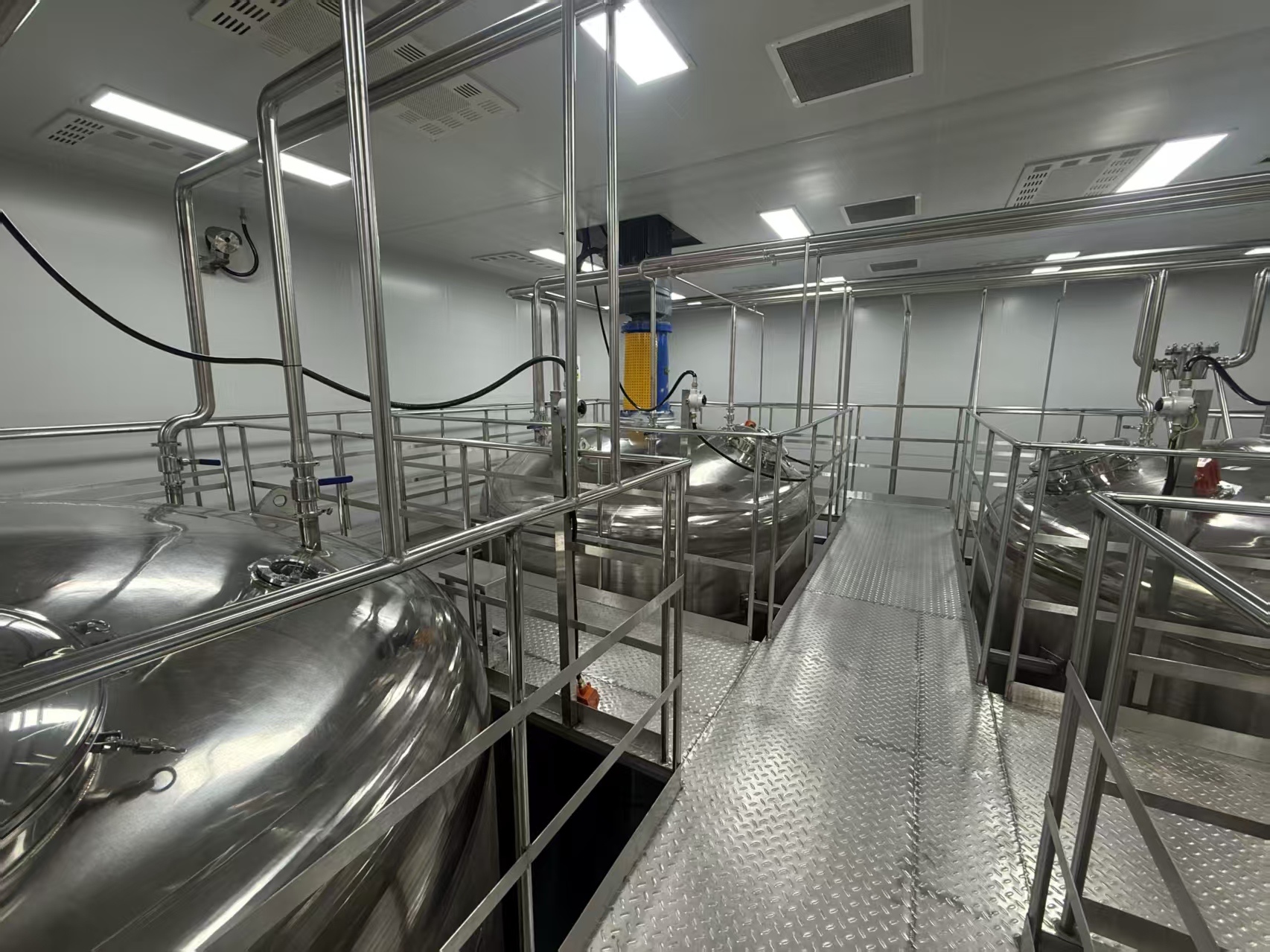
Purification infrastructure at Shandong Habier Biopharma Co., Ltd's sodium hyaluronate production site in Qufu City, Shandong Province, China. Image: Shandong Habier Biopharma Co., Ltd.
Introduction: When Two Quotations Look Identical
The global sodium hyaluronate raw material market was valued at approximately USD 504 million in 2024, according to data published by Reports and Data, with demand spread across cosmetic, food and pharmaceutical applications. That headline figure tells a buyer very little about which supplier to select. The practical difficulty at the decision stage is different: competing quotations frequently carry the same one-line specification, the same "food grade" or "pharma grade" label, and a price difference that is difficult to interpret.
Sodium hyaluronate — also written as hyaluronic acid sodium salt, or simply hyaluronic acid — is a polysaccharide whose functional behaviour in a finished formulation is driven mainly by molecular weight. Two suppliers can both label a product "food grade" while shipping material in different molecular weight bands, with different purity profiles and different batch-to-batch stability. Grade selection and batch consistency are therefore technical capabilities, not clerical details.
This FAQ collects the questions that procurement managers, formulators and quality teams most often raise during final supplier qualification, and answers them using documented facts about Shandong Habier Biopharma Co., Ltd (Habier Biopharma), a hyaluronate manufacturer established on 14 May 2015 and located in Qufu City, Shandong Province, China. The questions follow the sequence of a real decision process: grade selection first, then batch consistency, then certification scope, then documentation, then supply continuity and cost trade-offs.
The Decision Problem: Grade Ambiguity Is Expensive to Correct Late
Most sourcing errors in this category do not appear at goods-in inspection. They appear during scale-up or after a finished product has been filled, when a viscosity target is missed, a texture drifts, or a stability study produces unexpected results. By then the cost of correction includes reformulation time, rejected batches and delayed launches — far more than the price difference that originally drove the decision.
The structural reason is that sodium hyaluronate is sold under overlapping classification systems. One system describes molecular weight band; another describes intended application. A buyer comparing offers from three suppliers may be comparing a molecular weight band against an application label without recognising the mismatch. Establishing which classification the supplier is using — and what molecular weight range sits behind the label — is the single most useful step in early evaluation.
A second, quieter risk is batch drift. A sample that performs well in a formulation trial proves that one batch was suitable. It does not prove that the twentieth batch will behave the same way. For buyers at the decision stage, the relevant question is not only "what grade do I need?" but "how does this supplier hold that grade within range, batch after batch?"
Habier's Grade Framework: Molecular Weight Matched to Application
Habier Biopharma's sodium hyaluronate (product code 5243) is organised around explicit molecular weight segmentation rather than a single generic specification. This matters to buyers because it allows grade selection to be driven by the finished product's processing and performance requirements, and it makes the comparison between suppliers a comparison of declared ranges rather than of labels.
| Grade label | Declared molecular weight range | How buyers typically read it |
|---|---|---|
| Low grade | ≤ 0.1 Million Da | Short-chain material for formulations where a lower molecular weight band is required |
| High grade | ≥ 2.0 Million Da | Long-chain material for high-viscosity, film-forming or high-water-binding behaviour |
| Food grade | 0.8 – 1.5 Million Da | Material declared for food and nutraceutical applications |
| Cosmetic grade | 1.0 – 1.5 Million Da | Material declared for topical cosmetic applications |
| Pharma grade | ≥ 2.0 Million Da | Material declared for pharmaceutical applications, including medical fillers and ophthalmic use |
Alongside these bands, Habier Biopharma lists hydrolyzed sodium hyaluronate (hydrolyzed hyaluronic acid), low molecular weight, ultra-low molecular weight and super-low molecular weight sodium hyaluronate, plus regular grade material, in its product range. The naming convention matters during procurement: "low molecular weight" material and a "low grade" designation are not automatically the same specification, and buyers should confirm the declared range in the certificate of analysis rather than infer it from the product name.
Batch Consistency: How Molecular Weight Is Held Within Range
Fermentation is the first point at which batch-to-batch variability can be controlled or lost. Image: Shandong Habier Biopharma Co., Ltd.
Technical consistency risk — drift in molecular weight, viscosity or purity between batches — is addressed at Habier Biopharma through process discipline rather than end-point testing alone. The stated control method combines strict molecular weight segmentation, a standardized fermentation and purification process, and fixed production parameters, implemented through uniform production standard operating procedures across the site.
Monitoring is continuous. Viscosity, molecular weight and purity are tracked through real-time online monitoring during production, and each batch is rechecked across laboratories before release. The combination is significant for buyers: online monitoring corrects drift while a batch is still being made, whereas cross-laboratory rechecking acts as an independent confirmation before the batch is declared compliant. Suppliers who test only at the end of a production run have effectively decided the batch's fate before inspection begins.
Buyers evaluating this claim should ask a concrete set of follow-up questions: which parameters are fixed versus adjustable between campaigns, what triggers a deviation report, how molecular weight is verified independently of the production record, and whether the supplier can show the recheck workflow for a specific batch number. Habier Biopharma's stated position is that every batch undergoes full-item inspection and that unqualified products are rejected with full traceability records retained. Traceability is what converts a test result into an auditable fact — it allows a delivered batch to be traced back to the production parameters that generated it.
Documentation and Testing: What Should Arrive With the Goods

Purification and extraction stages sit between fermentation and final batch release. Image: Shandong Habier Biopharma Co., Ltd.
For a decision-stage buyer, the deliverable is not only powder. It is powder plus a batch file that a quality team can defend internally and, if required, to a regulator or a retail customer's auditor. A complete batch file in this category normally contains a certificate of analysis covering full-item inspection, records demonstrating that testing was performed in an independent QC laboratory, and — where the buyer requires it — results from a third-party laboratory nominated by the customer.
Habier Biopharma states that full-item inspection is performed on every batch, that testing takes place in an independent QC laboratory, and that customer-designated third-party testing is supported. The distinction between an in-house QC release and an independent laboratory result matters to buyers who must satisfy downstream audits: a self-declared specification is a claim, while an independent laboratory report is evidence.
| Due-diligence item | What to request | Why it matters at decision stage |
|---|---|---|
| Grade / molecular weight | Certificate of analysis stating the declared molecular weight range for the shipped batch | Confirms the label and the actual specification agree |
| Batch testing scope | Full-item inspection record | Shows whether testing covers all declared parameters or a subset |
| Independent verification | Independent QC laboratory results; option for customer-nominated third-party testing | Provides evidence beyond self-declaration |
| Traceability | Batch-linked production and release records | Allows a delivered batch to be traced back to production parameters |
| Non-conformance handling | Policy on rejection of unqualified product | Indicates whether quality decisions are enforced or negotiated |
| Supply redundancy | Number of independent fermentation workshops; raw material stock policy | Determines exposure to a single-point production failure |
Certifications: Scope, Numbers, and What They Do Not Cover
Certification review is where due diligence most often becomes superficial. A certificate PDF confirms that an audit occurred; it does not confirm that the certified scope covers the exact grade being purchased, at the exact site of manufacture, for the exact legal entity named on the purchase contract.
Habier Biopharma holds ISO 9001:2015 under certificate number 1042Q00053R0S and ISO 22000:2018 under certificate number 104FSMS2400001, together with Kosher, Halal and Ecocert Cosmos certification. The company also states that its product is certified as organic Cosmos and ISO 16128. Compliance risk is managed through regular system audits, annual third-party recertification, and a dedicated compliance team that tracks EU and US food and cosmetic regulations on an ongoing basis.
Three verification steps are worth standardising. First, check the legal entity name and site address against the supplier's business licence and the contracting party. Second, check the certificate's validity period and confirm it has not lapsed between the audit date and the order date. Third, check the certified scope — an ISO 22000 food safety certificate supports food-grade supply in a way it does not automatically support for pharmaceutical applications.
Supply Continuity and Lead Time: The Second Half of the Decision
Price per kilogram is only one component of landed cost. Supply stability risk — the possibility that a confirmed order cannot be produced on schedule — is managed at Habier Biopharma through a multi-production-line layout, raw material safety stock planning and phased production scheduling. The company states that it reserves 30 days of raw material inventory, operates two independent fermentation workshops, and uses flexible shift production to accommodate urgent bulk orders.
The redundancy point deserves emphasis. Two independent fermentation workshops mean that a maintenance stop, contamination event or equipment failure in one train does not automatically halt supply from the other. For buyers whose own production schedules are fixed, this structural question is often more informative than a quoted lead time, because quoted lead times rarely reflect what happens during an unplanned disruption.
Context for scale: Habier Biopharma operates a 50,000 m² facility with an annual output of 600–700 MT, 123 employees and a research and development team of six engineers. Approximately 20% of output is exported, with main markets in the EU, the USA and Korea. The export orientation is relevant to buyers in regulated markets, because supplying those regions requires documentation and specification discipline that a purely domestic supplier may not have built into its routine.
Where Habier Fits — and Where It Does Not
Habier Biopharma's product documentation positions its sodium hyaluronate for cosmetics, medical fillers and ophthalmic use scenarios, and describes the offering in terms of stable long-term stock supply, customized molecular weight production with short lead times, professional technical after-sales support, and a cost position described as competitive among peer suppliers, domestic and international. The company's comparison material recommends evaluating suppliers on molecular weight range, purity grades, test reports, price and supply capacity together, rather than on price alone.
Those claims should be read as the supplier's own positioning rather than as independently verified performance. Three constraints are worth stating plainly, because a decision-stage buyer needs them more than another list of advantages.
Capacity and R&D bandwidth. An annual output of 600–700 MT and an R&D team of six engineers support commercial-scale supply in the food, cosmetic and pharmaceutical raw-material segments. Buyers planning unusually large single-order volumes, or needing extended co-development of novel molecular entities, may find that capacity planning and R&D bandwidth — rather than product quality — become the limiting factor in the relationship.
Regulatory responsibility stays with the buyer. Supplier certification does not transfer filing obligations. A buyer commercialising a pharmaceutical or medical device product must still qualify the material under its own applicable standards, which for pharma grade material means alignment with USP-NF, EP or JP requirements and endotoxin specifications. Certification reduces qualification effort; it does not remove it.
Samples validate a batch, not a supply relationship. A successful formulation trial on a sample confirms that one batch is compatible with the buyer's process. It does not establish long-run batch stability. Buyers should treat sample approval as the beginning of qualification, and use batch history, recheck records and traceability documentation to confirm consistency across multiple shipments.
The wider market context is also relevant to this comparison. Major global participants in the sodium hyaluronate market include Bloomage Biotech, Fidia Farmaceutici, Kewpie Corporation and Contipro a.s., according to Straits Research and Reports and Data. Buyers are therefore rarely choosing between one credible supplier and no alternative; they are choosing between suppliers with different specialisations, production scale and regional compliance footprints. The practical task is matching supplier profile to project profile, not identifying an abstract winner.
Market Context: Which Grade Segments Are Moving
Demand patterns help buyers anticipate where specification expectations are heading. The cosmetic grade segment held the largest share of the hyaluronic acid raw material market at 61.91% in 2025, according to Grand View Research. The food grade sodium hyaluronate segment was estimated at USD 0.5 billion in 2024, with a projected CAGR of 8.5% through 2034, according to Reports and Data. In China, cosmetic ingredient filings in the first half of 2024 showed sodium hyaluronate remaining a top-tier classic ingredient for hydrating masks and essences, according to Plamed Group.
One caveat belongs in any serious market reading. Published market sizes for this category diverge sharply depending on scope: Grand View Research estimated the hyaluronic acid raw material market at USD 245.62 million, while Straits Research estimated the sodium hyaluronate products market at USD 14.02 billion. The gap reflects a definitional difference between raw material supply and HA-based finished products such as fillers and medical devices. Buyers citing market figures internally should state which scope they are using.
Taken together, the trend points toward grade proliferation rather than grade consolidation. As food, cosmetic and pharmaceutical applications each develop their own performance expectations, suppliers are being asked to hold tighter molecular weight bands and to document them more explicitly. That shift favours buyers who define grade requirements in molecular weight terms during tendering, and disadvantages those who accept a generic grade label as a specification.
Future Outlook
Three developments are likely to shape supplier selection over the next procurement cycles. First, molecular weight will become a more explicit contractual parameter, with buyers requesting declared ranges in the certificate of analysis and rejecting labels that cannot be mapped to a range. Second, certification review will broaden from system certificates toward combined evidence — system certification, organic certification such as Ecocert Cosmos and ISO 16128 where relevant, plus batch-level verification. Third, compliance tracking will intensify as EU and US food and cosmetic requirements continue to develop, which raises the value of a supplier that maintains a dedicated compliance function rather than reacting to each regulatory change.
For buyers, the practical implication is that supplier qualification is shifting from document collection toward evidence evaluation. The suppliers best positioned for that shift are those able to connect a grade label to a molecular weight range, a batch number to a production record, and a certification number to a verified scope. That chain of traceability — not a slogan — is what makes a sourcing decision defensible eighteen months later.
Frequently Asked Questions
1. How do buyers choose between low grade, high grade, food grade, cosmetic grade and pharma grade sodium hyaluronate?
Two classification systems are in use. The first describes molecular weight band: low grade at ≤ 0.1 Million Da and high grade at ≥ 2.0 Million Da. The second describes the intended application: food grade at 0.8–1.5 Million Da, cosmetic grade at 1.0–1.5 Million Da, and pharma grade at ≥ 2.0 Million Da. Buyers should begin from the finished product's process requirements — working viscosity, thermal exposure during manufacturing, target degradation behaviour and the regulatory route — then confirm that the supplier's declared range matches. Habier Biopharma additionally lists hydrolyzed, low molecular weight, ultra-low molecular weight, super-low molecular weight and regular grade material in its range.
2. How is batch-to-batch consistency controlled when specifications look similar across suppliers?
Habier Biopharma states that consistency is maintained through strict molecular weight segmentation, a standardized fermentation and purification process, fixed production parameters, and uniform production standard operating procedures. Viscosity, molecular weight and purity are tracked through real-time online monitoring, and each batch is rechecked across laboratories. The risk being addressed is technical consistency risk — drift in molecular weight or purity between batches — and the control approach relies on in-process monitoring rather than end-point testing alone.
3. Which certifications should be verified, and how?
System certification and product-related certification should be checked separately. Habier Biopharma holds ISO 9001:2015 under certificate number 1042Q00053R0S and ISO 22000:2018 under certificate number 104FSMS2400001, together with Kosher, Halal and Ecocert Cosmos certification, and states that its product is certified as organic Cosmos and ISO 16128. Verification involves checking the legal entity name, the manufacturing site, the certificate validity period, and whether the certified scope covers the grade being purchased. Certification supports market access and audit readiness; it does not substitute for batch-level test data.
4. What documentation should accompany each delivered batch?
A defensible batch file typically includes a certificate of analysis covering full-item inspection, evidence of independent QC laboratory testing, and — where the buyer requires it — results from a customer-nominated third-party laboratory. Habier Biopharma states that every batch undergoes full-item inspection, that testing is performed in an independent QC laboratory, that customer-designated third-party testing is supported, and that unqualified products are rejected with full traceability records retained. Traceability allows a delivered batch to be connected back to its production parameters.
5. How does a grade-based supplier comparison differ from comparing on price alone?
A price-only comparison evaluates a single specification line. A grade-based comparison evaluates molecular weight range, purity grades, test-report completeness and supply capacity together — the criteria Habier Biopharma's own comparison material recommends. Habier Biopharma's product documentation states stable long-term stock supply, customized molecular weight production with short lead times, professional technical after-sales support, and a cost position described as competitive among peer suppliers. Such statements are supplier positioning and should be tested against batch data and documentation before they are relied upon in a sourcing decision.
6. What are the limitations of this supplier profile?
Habier Biopharma operates a 50,000 m² facility with an annual output of 600–700 MT and a research and development team of six engineers. That profile supports commercial raw-material supply across food, cosmetic and pharmaceutical applications, but unusually large single-order volumes or extended co-development of novel molecular entities may exceed available capacity or R&D bandwidth. In addition, pharmaceutical buyers retain their own filing responsibilities: pharma grade sodium hyaluronate must meet USP-NF, European Pharmacopoeia and JP standards, typically with endotoxin levels below 0.05 EU/mg, and supplier certification does not transfer that obligation.
7. What supply-continuity factors should be checked before contracting?
Supply stability risk is managed through multi-production-line layout, raw material safety stock planning and phased production scheduling. Habier Biopharma states that it reserves 30 days of raw material inventory, operates two independent fermentation workshops, and uses flexible shift production to meet urgent bulk orders. For buyers, the decisive question is whether fermentation capacity is redundant, because a single fermentation train represents a single point of failure. Annual output of 600–700 MT and approximately 20% export share across the EU, USA and Korea provide the scale context for that assessment.
8. How should sample validation be handled before scale-up?
Sample validation should reproduce the buyer's own process conditions rather than a simplified laboratory substitute. The practical sequence is to request the certificate of analysis together with the sample, confirm that the declared molecular weight range matches the intended grade, test the material under the intended processing temperature and shear conditions, and compare its behaviour against the buyer's existing reference material. Sample approval confirms that a single batch is compatible with the buyer's process; it does not establish long-run batch stability, which is supported instead by batch history, cross-laboratory recheck records and traceability documentation.
Reference Material
Manufacturer background, product range and certification details referenced in this article are documented in Shandong Habier Biopharma Co., Ltd's company brochure, available for public download: Habier Biopharma company brochure (PDF). Company website: www.habier.com.