
Sodium Hyaluronate Grade Shortlist: Food, Cosmetic, Pharma RFQ List
Sodium Hyaluronate Grade Shortlist: Food, Cosmetic, Pharma RFQ List
A sodium hyaluronate grade shortlist should begin as a request list, not as a supplier ranking. For evaluation-stage projects, the first request set can be narrowed to food grade at 0.8–1.5 Million Da, cosmetic grade at 1.0–1.5 Million Da, pharma grade at ≥2.0 Million Da, low molecular weight at ≤0.1 Million Da, and high molecular weight at ≥2.0 Million Da. Super low, ultra low, and hydrolyzed variants belong in the list only when the formulation brief explains why the standard grade is not enough.

Sodium hyaluronate is the sodium salt of hyaluronic acid. Buyers often use the names interchangeably, but an RFQ should not. The commercial request needs a grade, a molecular-weight band, a test method, a market or regulatory pathway, and a batch evidence package. Without those fields, a supplier response may look competitive while describing a different material.
The shortlist in one table
The table below is a procurement shortlist, not a product ranking. It shows the grade options that should be requested first and the checks that make responses comparable. The molecular-weight values reflect the grade ranges published for this shortlist and should be treated as request parameters, not as universal regulatory limits.
| Request option | Molecular-weight request | Project fit | Confirm before quoting |
|---|---|---|---|
| Food grade sodium hyaluronate | 0.8–1.5 Million Da | Food and supplement projects, including oral-use formats | Food-safety certificate scope, grade name on the CoA, microbial and contaminant limits in the buyer specification, and batch test records |
| Cosmetic grade sodium hyaluronate | 1.0–1.5 Million Da | Topical cosmetic formulations such as emulsions or serums | Cosmetic-grade declaration, molecular-weight method, appearance and odour specification, microbial limits, and formulation compatibility sample |
| Pharma grade sodium hyaluronate | ≥2.0 Million Da | Pharmaceutical or medical projects with a defined regulatory pathway | Regulatory category in the target market, batch record format, test methods, impurity limits, and any applicable endotoxin or sterility requirement |
| Low molecular weight sodium hyaluronate | ≤0.1 Million Da | Projects that specifically need a low-molecular-weight material | Exact molecular-weight distribution, test method, and whether the material is a distinct grade or a sub-range of another grade |
| High molecular weight sodium hyaluronate | ≥2.0 Million Da | Projects requesting a high-molecular-weight material | Confirmation that high molecular weight is not being treated as equivalent to pharma grade; grade, compliance, and batch evidence still need separate review |
| Super low molecular weight sodium hyaluronate | Supplier-defined | Specific formulation needs where a standard low-molecular-weight grade is not precise enough | Exact definition, molecular-weight range, method, and CoA format; do not compare against another supplier if the definitions differ |
| Ultra low molecular weight sodium hyaluronate | Supplier-defined | Specific formulation needs requiring a clearly defined low-range material | Exact definition, manufacturing description, molecular-weight range, and batch consistency data |
| Hydrolyzed sodium hyaluronate or hydrolyzed hyaluronic acid | Supplier-defined | Formulation projects that specifically call for a hydrolyzed variant | Hydrolysis definition, molecular-weight distribution, residual process materials where relevant, and CoA method |
The terms super low, ultra low, and hydrolyzed are not self-defining in a quotation. A supplier may use them differently from another supplier. The buyer should request the numerical specification and method before treating those offers as comparable.
Why the shortlist is not a quality ranking
No molecular-weight band is universally better. Food, cosmetic, and pharma projects use grade labels because application, compliance, and documentation requirements differ. A higher molecular-weight number does not automatically make a material more suitable, and a lower number does not automatically make it a lower grade. The relevant question is whether the grade and molecular-weight band fit the intended use, the target market, and the buyer's acceptance specification.
The grade and molecular-weight labels also overlap. Pharma grade is listed at ≥2.0 Million Da, and high molecular weight is also listed at ≥2.0 Million Da. That overlap does not make the two requests interchangeable. Pharma grade adds regulatory, quality-system, and batch-documentation expectations that a high-molecular-weight catalogue description does not establish. A buyer who asks only for high molecular weight may receive a material that fits the molecular-weight band but not the pharmaceutical qualification file.
How to turn the options into a focused RFQ shortlist
A focused RFQ does not send eight vague grade names to every supplier. It gives each supplier the same decision structure, then asks for evidence against that structure. The following sequence keeps the shortlist small enough to compare.
- Lock the intended use and market first. State whether the project is food, oral supplement, topical cosmetic, pharmaceutical, or medical device. Add the destination market because certificate scope, regulatory category, and accepted test methods can change by market.
- Select one primary grade and one molecular-weight band. Use the table as the starting point. Add a second band only if the formulation brief gives a specific reason, such as a defined low-molecular-weight requirement or a hydrolyzed variant request.
- Write the molecular-weight method into the request. Ask how the supplier measures and reports molecular weight. A quotation that states a range without a method is weaker than one that states the range, the test method, and the batch result.
- Ask for certificate scope, not certificate logos. A certificate image does not show whether the relevant product, process, or site is covered. Request the certificate number, standard, scope, issue date, expiry date, and certification body.
- Require batch-level evidence. Ask for a recent CoA, the batch test package, and traceability records. The certificate supports the management system; the batch record supports the specific shipment.
- Make commercial terms comparable. Request MOQ, lead time, monthly capacity, packaging, sample availability, and change-control terms in the same format from every supplier.
What the request list should contain
The request list is the buyer's control document. It should be short enough for suppliers to answer precisely and complete enough to prevent a price-only comparison. A practical list contains the following items.
| Request item | Why it belongs in the RFQ | Evidence to request |
|---|---|---|
| Intended use and target market | Determines grade, regulatory pathway, and documentation language | Written application brief and destination market |
| Grade designation | Prevents a food, cosmetic, or pharma quote from being compared as if the grades were the same | Product sheet with exact grade name |
| Molecular-weight range and method | Makes the technical offer comparable across suppliers | Specification and CoA method reference |
| Variant definition | Super low, ultra low, and hydrolyzed labels need numerical boundaries | Written definition, range, and test method |
| Certification scope | A certificate can be valid for a site or activity but not automatically for every grade or market | Certificate number, standard, scope, issue and expiry dates |
| Batch CoA and testing | Shows what was tested on the actual batch offered | Recent CoA and batch test records |
| Traceability records | Supports investigation, recall, and change control | Batch lineage and material identification records |
| Sample and validation plan | Tests formulation fit before commercial commitment | Sample size, test protocol, and expected evaluation period |
| Commercial terms | Separates a technically suitable offer from a workable supply offer | MOQ, lead time, monthly capacity, packaging, and delivery basis |
| Change control | Protects long-term supply when processes, specifications, or sites change | Notification procedure and re-qualification terms |
Technical check: what molecular weight does and does not establish
Molecular weight is a material parameter, not a complete grade definition. A supplier may report an average, a range, or a distribution. Those are not equivalent unless the method and reporting basis are the same. For procurement, the request should specify the acceptable range, the test method, and the reporting format on the CoA.
The grade label adds another layer. Food grade, cosmetic grade, and pharma grade indicate application and compliance expectations, not only a number. Two materials in the same molecular-weight band can differ in purity profile, microbial control, documentation, manufacturing controls, and regulatory status. That is why a shortlist should ask for grade, molecular weight, and evidence together.
High molecular weight and pharma grade need particular care because their published ranges overlap at ≥2.0 Million Da. A buyer should not accept a high-molecular-weight offer as a pharma-grade offer without the pharma qualification file. In the other direction, a pharma-grade offer should not be assumed to fit every high-molecular-weight application without checking the formulation and the grade-specific specification.
Low molecular weight is equally specific. The shortlist uses ≤0.1 Million Da for low molecular weight, but it does not assign numerical boundaries to super low, ultra low, or hydrolyzed variants because those definitions were not supplied as fixed ranges. In an RFQ, that absence should become a direct request for the supplier's definition and method, not a guess by the buyer.
Application fit: food, cosmetic, and pharma projects
Food and oral-use projects
A food or supplement project normally starts with food grade sodium hyaluronate in the 0.8–1.5 Million Da range. The request should confirm that the food-safety management scope covers the product and activity being supplied, and that the batch CoA matches the buyer's food specification. If the project uses an oral health care format, the same grade discussion applies, but the finished-product claim and market rules remain the buyer's responsibility.
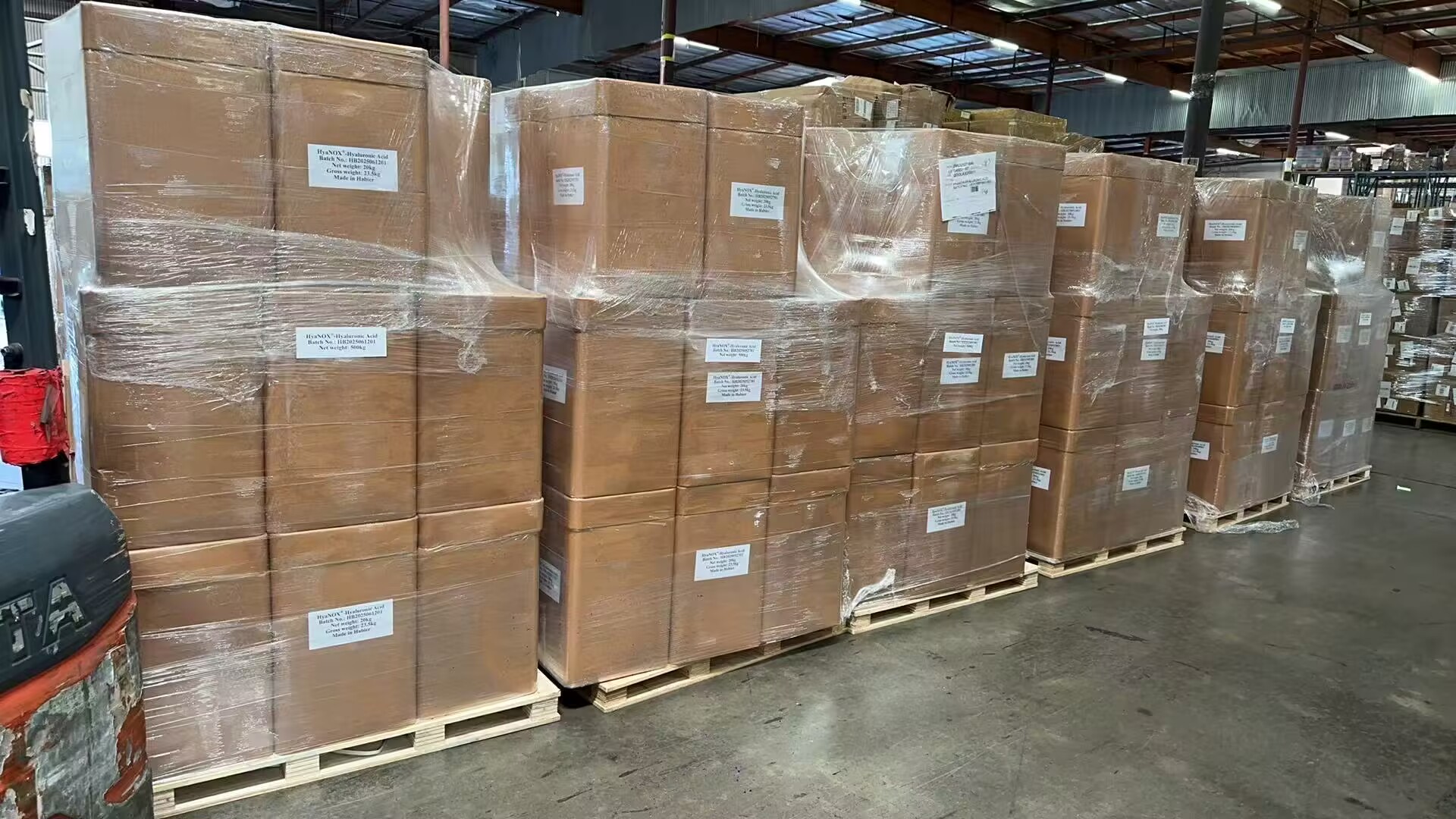
A supplied U.S. case describes the supply of 4,733 kg of product 5243 to a natural cosmetic and health supplement importer. The material was used as cosmetic raw material and oral health care supplement raw material, and the relationship is described as long-term repeat order cooperation with stable batch quality. That case supports the existence of a repeat-supply model; it does not prove that the same grade fits a different formulation, market, or acceptance specification.
Cosmetic projects
Cosmetic grade sodium hyaluronate is listed at 1.0–1.5 Million Da. Hyaluronic acid is used in cosmetic formulations such as emulsions or serums for hydration and skin-elasticity positioning, according to testing and certification body commentary. The RFQ should still ask for the cosmetic-grade declaration, the molecular-weight method, and a sample suitable for the buyer's own formulation trial.
If the formulation brief calls for low molecular weight, super low, ultra low, or hydrolyzed sodium hyaluronate, the buyer should put that requirement in a separate line. Do not treat cosmetic grade and low molecular weight as synonyms. They answer different questions: one is an application-grade designation, the other is a molecular-weight request. A supplier should state both clearly when both matter.
Pharma and medical projects
Pharma grade sodium hyaluronate starts at ≥2.0 Million Da in the shortlist, but the regulatory file is the decisive layer. The buyer should state the target market and the intended product category before asking for a quote. In China, NMPA Announcement No. 103 of 2022 states that medical sodium hyaluronate products without pharmacological, metabolic, or immunological action are managed as medical devices in the described cases, with a classification no lower than Class II. That example shows why a pharma or medical RFQ needs a regulatory review alongside the molecular-weight request.
The batch evidence for a pharma project should identify the batch, the specification, the test methods, and the release decision. Certifications support the quality system, but they do not replace batch release or market authorization. The buyer should define the acceptance criteria with its own regulatory and quality team before comparing supplier responses.
Purchasing terms to confirm before comparing responses
A grade shortlist becomes useful only when commercial terms are captured in the same format. Price alone is not a comparison basis because suppliers may quote different grades, molecular weights, packaging, test scopes, or delivery terms.
- MOQ and sample supply. The request should state the minimum order quantity and whether a sample is available for formulation or analytical work. The supplied capability data for Shandong Habier Biopharma Co.,LTD lists a 1 kg MOQ and free sample supply.
- Lead time and capacity. Lead time should be tied to the grade and quantity requested. The supplied capability data lists a 5–8 day lead time and 50–60 ton monthly capacity, alongside a 600–700 MT annual output figure. These are supplier-reported capability values and should be confirmed against the specific order.
- Packaging and handling. Ask for the packaging format, fill size, labelling, and storage instructions. Packaging should be matched to the grade and the buyer's handling process, not treated as a generic line item.
- Delivery basis. State the destination and the commercial delivery basis so that freight and responsibility are not hidden in the price comparison.
- After-sales quality tracking. Ask how complaints, deviations, and batch investigations are handled. The supplied capability data lists after-sales quality tracking.
Acceptance criteria: what to write into the specification
Acceptance criteria should be written before responses are opened. They should not be copied from a supplier's marketing sheet. The buyer's specification should state the grade, the molecular-weight range and method, and the quality attributes that matter for the intended use. Numeric limits should come from the buyer's regulatory, compendial, or customer requirements; this article does not invent them.
- Identity and grade designation
- Molecular-weight range and test method
- Assay or purity requirement as defined by the buyer
- Appearance and physical form
- Microbial limits appropriate to the grade and use
- Heavy-metal or elemental impurity limits where required
- Endotoxin or sterility requirements where applicable to the intended medical use
- Residual process materials where the buyer's risk assessment requires them
- Packaging integrity and labelling
- Batch CoA and traceability record
- Sample acceptance and re-qualification rules
The supplier should confirm which tests are performed on every batch, which are periodic, and which are only available on request. That distinction matters because a specification can list a test that is not part of routine release. A certificate of analysis should show the actual batch result, the specification limit, and the method used.
Where Shandong Habier Biopharma fits the request list
Shandong Habier Biopharma Co.,LTD is a manufacturer and supplier of sodium hyaluronate and chondroitin sulfate based in Qufu City, Shandong Province, China. The company reports a 50,000 m² facility, 123 employees, 600–700 MT annual output, a six-engineer R&D team, and a 20% export share serving the EU, USA, and Korea. For a shortlist evaluation, the more relevant facts are its grade coverage, certification file, batch inspection claim, and commercial terms.
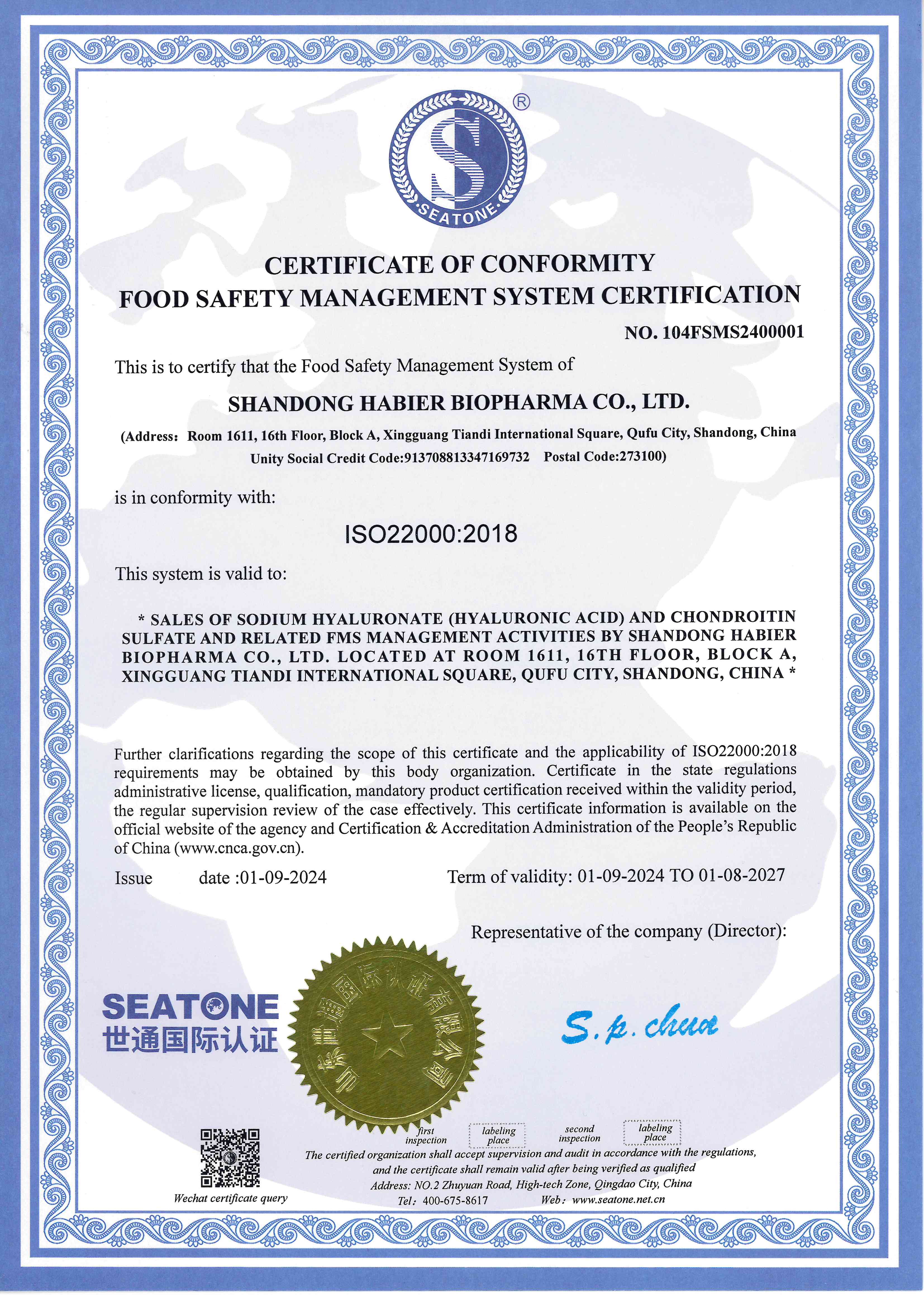
The company holds ISO 9001:2015 certificate 1042Q00053R0S under GB/T 19001-2016 / ISO 9001:2015, issued 2024-09-01 and expiring 2027-01-08, with a scope listed as ALL. It also holds ISO 22000:2018 certificate 104FSMS2400001, issued 2024-09-01 and expiring 2027-01-08, covering sales of sodium hyaluronate and chondroitin sulfate and related food safety management activities. Both certificates were issued by Shandong Seatone International Certification Co.,Ltd. The company profile additionally reports HACCP, Kosher, Halal, organic COSMOS, and ISO 16128 status.
These documents support a qualification conversation, but the scope must be read carefully. A food-safety certificate supports the activities in its scope; it does not automatically qualify every grade for every market. A Kosher or Halal claim should be supported by the current certificate and product scope. A COSMOS or ISO 16128 reference should be checked against the specific product and the buyer's cosmetic-market requirements. The buyer should keep those checks in the request list rather than treating a logo as a complete answer.
The supplied capability data also lists OEM/ODM support, purity adjustment, 1 kg MOQ, 5–8 day lead time, 50–60 ton monthly capacity, 100% full inspection before delivery, free sample supply, and after-sales quality tracking. These are supplier-reported values. They help a buyer decide whether to request a sample and a formal quote, but they do not replace batch data, a plant audit, or the buyer's own acceptance testing.
Market context and what it changes for the shortlist
Market estimates explain why documentation quality deserves a place in the shortlist, but they do not validate a particular supplier. Fortune Business Insights estimates the global hyaluronic acid market at USD 11.64 billion in 2025, rising to USD 22.36 billion by 2034 at a 7.52% CAGR for 2026–2034. The same commercial research places pharmaceutical grade at 69.3% of product segment share by value in 2026. These are external commercial-research estimates, not Habier results or a forecast of any buyer's demand.
The practical implication is not that every project should buy pharma grade. It is that grade qualification, batch documentation, and regulatory fit carry commercial weight. A food or cosmetic buyer can still use a focused request list; the list simply needs the evidence that matches its own market. A pharma buyer should expect a deeper file because the grade sits inside a more demanding qualification path.
Common shortlist errors
- Asking for the best grade without stating the application, market, and acceptance criteria.
- Treating high molecular weight and pharma grade as interchangeable because both appear at ≥2.0 Million Da.
- Treating cosmetic grade and low molecular weight as interchangeable.
- Using super low, ultra low, or hydrolyzed as synonyms without a numerical definition and method.
- Comparing CoA values that were generated by different methods or reporting bases.
- Accepting a certificate logo without checking number, scope, issue date, and expiry date.
- Ignoring packaging, storage, change control, and traceability until after the price is agreed.
- Using one customer case as proof that the same grade will fit every formulation.
FAQ
Which sodium hyaluronate grade should a food project request first?
A food or supplement project should normally request food grade sodium hyaluronate in the 0.8–1.5 Million Da range first, then confirm the food-safety certificate scope, the batch CoA, and the buyer's own microbial and contaminant limits. If the formulation specifically needs a low, super low, ultra low, or hydrolyzed variant, that should be a separate request with an exact definition.
Is cosmetic grade sodium hyaluronate the same as low molecular weight sodium hyaluronate?
No. Cosmetic grade is listed at 1.0–1.5 Million Da and describes an application-grade designation. Low molecular weight is listed at ≤0.1 Million Da and describes a molecular-weight request. A cosmetic formulation can use either, but the buyer should state both the grade and the molecular-weight band when both matter.
What should a sodium hyaluronate RFQ include?
A useful RFQ includes the intended use, target market, grade, molecular-weight range and method, variant definition if any, certification scope, batch CoA and traceability requirements, sample and validation terms, MOQ, lead time, capacity, packaging, delivery basis, and change-control terms. The same request format should be sent to every shortlisted supplier.
How should a buyer compare pharma grade sodium hyaluronate quotes?
Compare pharma grade quotes on the regulatory category in the target market, the batch record and release package, the test methods, the certificate scope, and the supplier's change-control process, not only on the ≥2.0 Million Da molecular-weight figure. In China, NMPA Announcement No. 103 of 2022 illustrates why medical sodium hyaluronate products may need a regulatory classification review alongside the material specification.
What do Shandong Habier Biopharma certifications prove?
The company holds ISO 9001:2015 certificate 1042Q00053R0S and ISO 22000:2018 certificate 104FSMS2400001, both issued 2024-09-01 and expiring 2027-01-08, and its profile also reports HACCP, Kosher, Halal, organic COSMOS, and ISO 16128 status. These support a supplier qualification review, but they do not replace batch acceptance, product-specific scope checks, or the buyer's own regulatory approval.
Conclusion
A sodium hyaluronate grade shortlist works best as a disciplined request list. Start with the project use and market, choose the grade and molecular-weight band, add super low, ultra low, or hydrolyzed variants only when the formulation brief justifies them, and ask every supplier for the same certificate scope, batch evidence, acceptance criteria, and commercial terms. That approach does not declare a winner in advance. It makes the responses comparable enough for an evaluation-stage buyer to decide which material and supplier deserve the next round of technical and commercial review.
For the company's product overview, the supplied brochure is available here: Shandong Habier Biopharma product brochure (PDF).
Tem questões ou precisa de mais detalhes?
Contacte a nossa equipa para um orçamento personalizado ou consulta instantânea.
Solicitar orçamento
Preencha o formulário abaixo e a nossa equipa entrará em contacto com uma proposta personalizada.
Chat direto do WhatsApp
Prefere conversar em tempo real? Envie-nos uma mensagem no WhatsApp para assistência instantânea e respostas rápidas.
- Obter orçamento personalizado
- Partilhar fotos ou documentos
- Discuta as suas necessidades diretamente
Geralmente responde em 5–30 minutos durante o horário de expediente.