
Sofa Fabric Scenario Fit: OYD Chenille, Boucle and Velvet
Sofa fabric is usually selected by family name — chenille, boucle or velvet — and then confirmed on price. The sequence holds until the cloth reaches the cutting room or the finished piece reaches a lobby, a bedroom or a showroom floor, where the mismatch becomes visible: a surface too light for a deep seat cushion, a pile that fights a tight curve on a bed frame, or a palette that runs two colorways short of a complete collection. Scenario-led selection reverses that order. The application is defined first, and the fabric is matched on construction, weight, width, finishing and colorway depth.
This article maps four OYD Textile upholstery articles — OYD3120 chenille, OYD3626 chenille plain, OYD3229 boucle and OYD3618 jacquard velvet — to seven real application settings: modern-design large sofas, upholstered soft beds, high-end Italian-style accent chairs, furniture manufacturing, interior design, home decor and hotel projects. OYD3235, a heavier chenille-blend upholstery fabric, is included as a reference point for high-traffic commercial seating.
OYD Textile (Haining OuYuda Textile Co., Ltd.) is a sofa fabric and upholstery fabric manufacturer based in Haining, Zhejiang, China. Its range covers chenille, woven, linen-look, velvet, circular knit, jacquard and outdoor fabrics, with roughly 95% of output exported to markets in Europe, the USA, the Middle East, South America, Africa and East Asia. The company publishes OEM/ODM customization for pattern and color, 100% testing, and a monthly capacity of 1,100,000 meters.
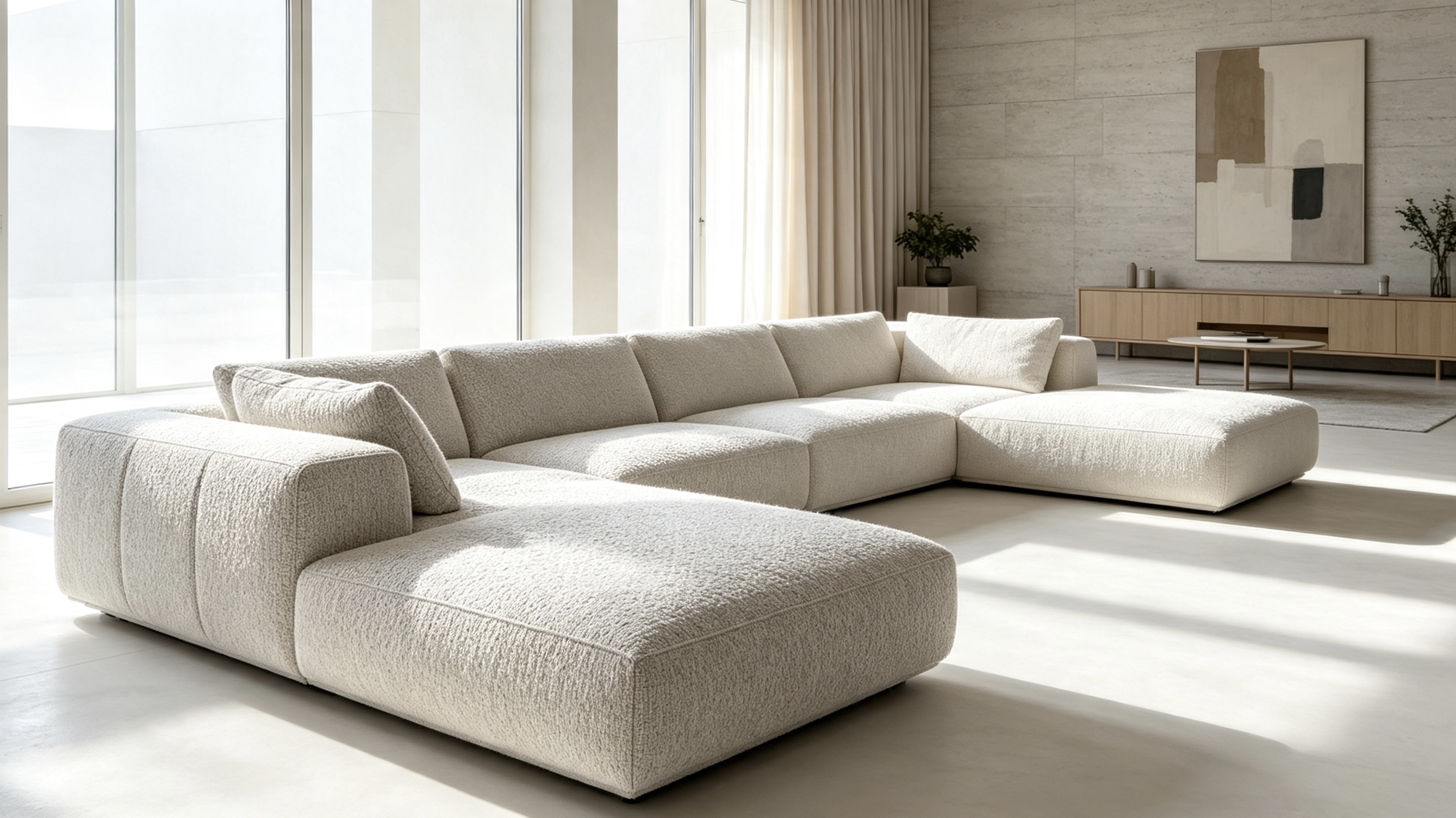
Sofa upholstery application scene: an OYD furnishing fabric on a modern sofa frame, indoor residential use.
Why fabric family names are a weak starting point
The three families describe construction and hand, not performance. Chenille is built from cut-pile yarns and reads as a soft, matte surface with depth of shade. Boucle is built from looped yarns and reads as texture, with a visible relief that becomes part of the design language of the piece. Velvet is a dense cut pile with a nap, so it holds light and shadow differently depending on orientation. None of these descriptions tells a buyer whether the cloth will hold its shape on a two-meter seat cushion, whether the roll width suits the panel plan, or whether the finishing will survive a hotel cleaning regime.
The variables that actually decide the outcome are narrower and more measurable: weight in grams per square meter, usable width, fiber composition, functional finishing, colorway depth and the scope of the certification attached to the specific article. A chenille at 350 GSM and a chenille at 420 GSM are the same family and different products in the cutting room and on the shop floor.
Decision rule: specify the application first (seat geometry, traffic level, cleaning regime, destination market, palette size), then match construction and weight, then confirm finishing and certification scope for the exact article number. Fabric names belong at the end of that sequence, not the beginning.
The four OYD articles in numbers
All five articles below are documented by OYD as water-repellent, stain-resistant, easy to clean, pet-friendly in household use, and carrying fire-retardant performance. Each is listed with OEKO-TEX certification for safe textiles and GRS (Global Recycled Standard) certification for recycled material content.
| Article | Structure | Composition | Weight | Width | Colorways | Documented application |
|---|---|---|---|---|---|---|
| OYD3120 | Chenille, yarn-dyed | 100% polyester | 420±10 GSM | 142±2 cm | 26 | Modern-design large sofas; upholstered soft beds |
| OYD3626 | Chenille, plain woven | 100% polyester | 350±10 GSM | 142±2 cm | 27 | Modern-style large sofas; soft beds |
| OYD3618 | Jacquard velvet | 100% polyester | 450±10 GSM | 142±2 cm | 27 | Modern-style large sofas; soft upholstered beds |
| OYD3229 | Boucle, heavy woven | 90% polyester, 10% acrylic | 620±10 GSM | 142±2 cm | 7 | High-end Italian-style accent chairs; hotel upholstery |
| OYD3235 (reference) | Chenille and woven blend | 80% polyester, 14% acrylic, 6% cotton | 600±10 GSM | 142±2 cm | Not stated | Premium upholstery for residential and commercial furniture |
Specifications as published by OYD Textile for each article number. Colorway counts are article-specific and should be confirmed at quotation stage.
Scenario 1 — Modern-design large sofas
Large sofas are the application where the fabric is asked to do the most work with the least visual reward. Seat cushions are deep and long, back cushions are often loose, and the fabric spans broad uninterrupted panels that hide nothing: inconsistent hand, a shade that shifts between rolls or a fold that reads as stretch all become visible across two meters of seating.
OYD3120 is a yarn-dyed chenille at 420±10 GSM and 142±2 cm width, published for modern-design large sofas and upholstered soft beds. Yarn dyeing builds color into the yarn before weaving, which gives the surface a matte depth rather than a printed flatness. With 26 colorways, the article supports a palette build across a sofa line rather than a single hero color.
OYD3626 is a plain chenille at 350±10 GSM and the same 142±2 cm width, published for modern-style large sofas and soft beds with 27 colorways. The lighter weight changes how the cloth behaves in the cutting room. It wraps more easily around tight radii, produces less bulk at crossed seams, and suits frames where tailoring is visible — piped edges, exposed stitching, narrow arms. The trade-off is mass: on a very deep seat cushion where the brief calls for a heavier hand and pronounced body, the 420 GSM chenille sits closer to that requirement.
For a modern sofa where light reflection is part of the design intent, OYD3618 jacquard velvet at 450±10 GSM adds directional sheen and, with 27 colorways, the palette depth to carry a full collection.
Scenario 2 — Upholstered soft beds
Soft beds and upholstered bed frames are a different engineering problem from sofas. The fabric is wrapped around compound curves at the headboard, over rolled edges and along the base, and it is usually cut into fewer, larger panels. Fabric weight is felt here in the seam: a heavier cloth produces a bulkier join where the headboard face meets the border, while a lighter cloth folds flatter and holds a crisp edge line.
OYD3626 at 350±10 GSM is the natural starting point for upholstered bed platforms and fully wrapped frames in this range, because the lighter construction folds cleanly at the corners and borders. OYD3120 at 420±10 GSM fits headboards and bed frames where a fuller, more substantial face is wanted and the panel geometry is simpler. Both are documented by OYD for soft bed applications and both share the same 142±2 cm roll width.
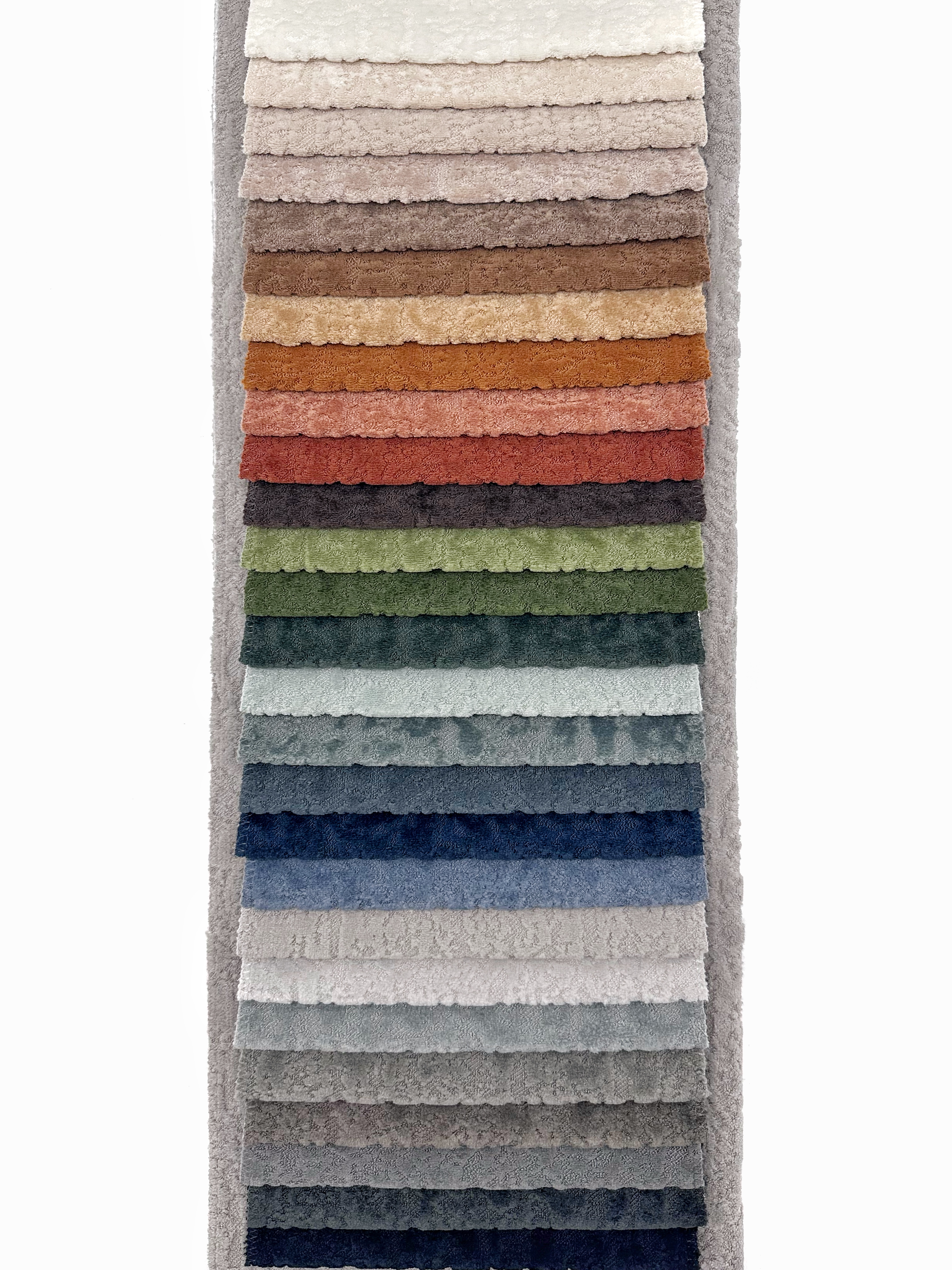
OYD3618 jacquard velvet at 450±10 GSM: pile direction and shade shift are part of the specification, not a defect.
OYD3618 velvet is the article to evaluate when the headboard is the visual center of the bed. Velvet holds light directionally, so panels cut in opposing directions read as different shades. That is a design opportunity on a headboard and a planning requirement on the cutting table: nap direction has to be fixed before the lay is planned, and the same rule has to be written into the work order so that a second production run matches the first.
Scenario 3 — High-end Italian-style accent chairs
Accent chairs carry the opposite burden to large sofas. The seat area is small, the piece is often viewed from every angle, and the fabric is expected to justify the design. Texture does more work than color here, and that is where a boucle earns its place.
OYD3229 is a heavy-weight, high-density boucle woven fabric at 620±10 GSM and 142±2 cm width, built from 90% polyester and 10% acrylic. OYD publishes it specifically for high-end Italian-style accent chairs and hotel upholstery projects, with outstanding abrasion resistance and a surface that reads as a deliberate design element rather than a background. At 620 GSM it is the heaviest article in this comparison — roughly 48% above the 420 GSM chenille and 77% above the 350 GSM plain chenille — and that mass is what produces the sculpted, upholstered look associated with this chair type.
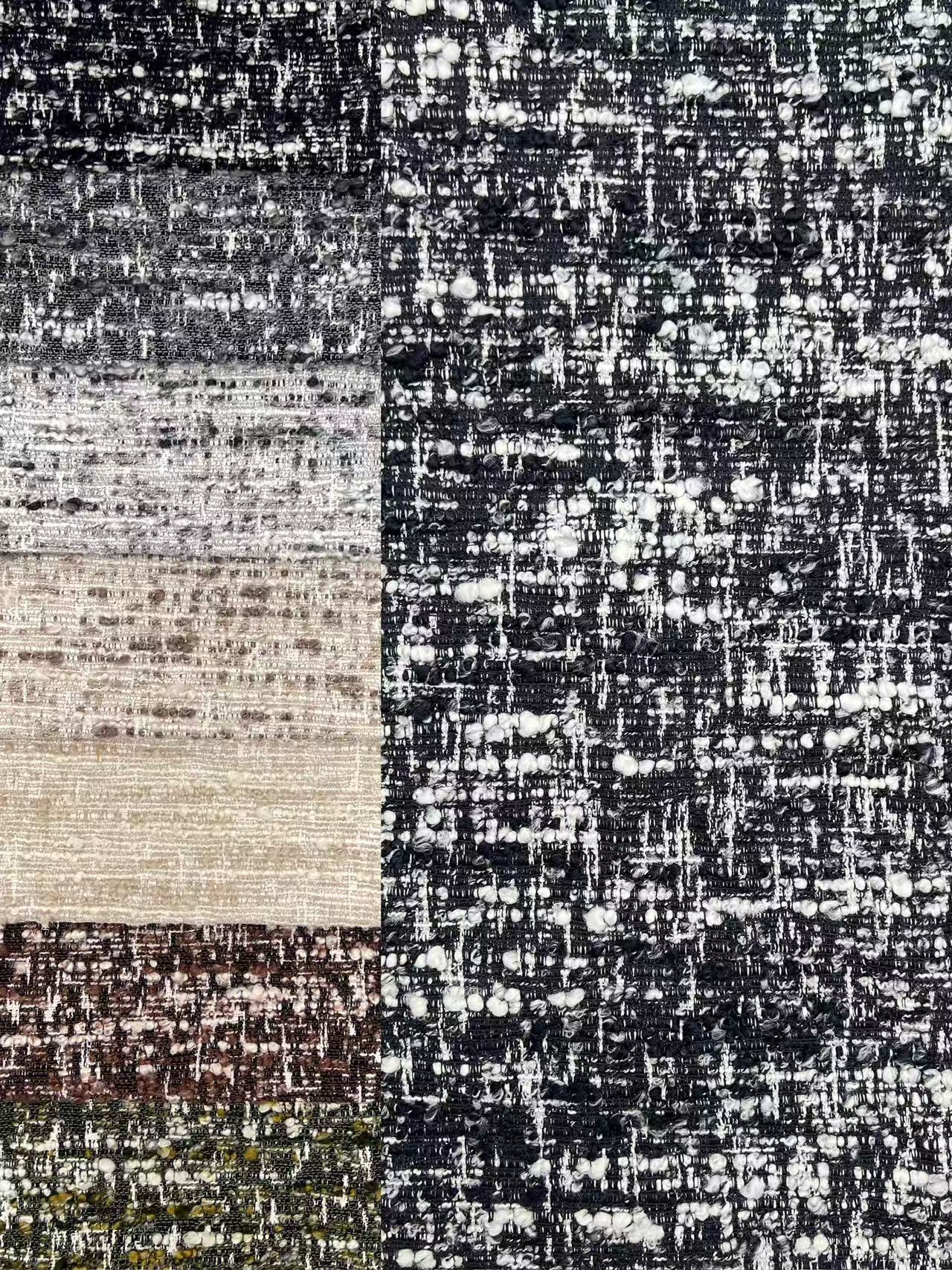
OYD3229 boucle is offered in seven classic colorways — a deliberate, narrow palette that suits statement seating better than broad collection matching.
The constraint is explicit: seven colorways. For a single accent chair or a capsule collection, seven considered shades are an advantage because they force a decision and photograph consistently. For a retailer that needs twenty-plus coordinates across a full furniture catalogue, seven is a boundary, and buyers should plan complementary articles around it rather than assume the boucle can carry the whole palette.
Scenario 4 — Furniture manufacturing and volume programs
For a furniture factory, the fabric is a production input before it is a design decision. Three publication parameters matter most: the ±10 GSM weight tolerance, the ±2 cm width tolerance, and the consistency of those tolerances across repeat orders, because cutting plans and consumption calculations are built on them.
At 142±2 cm width, a buyer can plan panel layouts with confidence but not with assumptions — a roll at the low end of the tolerance can change the yield on a wide seat panel, so the cutting room should verify the actual roll rather than the nominal figure. OYD documents 100% testing and a monthly capacity of 1,100,000 meters, with OEM/ODM support for pattern and color customization. Custom orders are quoted at a lead time in the range of 30 to 45 days according to the capability sheet, while stock programs move faster; MOQ is confirmed per color and per program at quotation.
The equipment list is also part of scenario fit. These fabrics are processed on heavy-duty sewing machines, CNC fabric cutting machines, upholstery processing machines, fabric spreading machines and staple guns. A 620 GSM boucle and a 350 GSM plain chenille do not load the same way through a sewing line, and factories running both should expect to adjust needle size, foot pressure and stitching speed between runs.
Scenarios 5 and 6 — Interior design and home decor
Interior designers and home decor upholstery projects buy differently from factories: smaller volumes, more variants, and a strong need for the fabric to work across multiple pieces in one room — sofa, bench, headboard, cushions. Palette depth is the deciding factor far more often than weight, and this is where the published colorway counts do real work.
OYD3120 offers 26 colorways, OYD3626 and OYD3618 offer 27 each, and OYD3229 offers 7. A designer building a scheme across a sofa, two chairs and a bench can keep the same construction family and vary the shade, which reduces the risk of a room that reads as assembled from unrelated materials. OYD supplies free fabric samples for evaluation before a bulk order, and for multi-piece schemes it is worth confirming at sample stage that the selected colorways can be produced together in one lot.
The functional side matters in residential decoration as much as in contract work: water-repellent and stain-resistant finishing, easy-clean behavior and fire-retardant performance are documented across these articles, and the fabrics are described as pet-friendly for households with animals.
Scenario 7 — Hotel projects
Hotel upholstery adds two requirements that residential projects do not carry with the same weight: cleaning frequency and documented fire performance. Seating in a lobby, a bar or a club lounge is cleaned on a schedule, not on demand, and the fabric has to hold its appearance through that cycle. OYD states water-repellent and stain-resistant properties for these articles, and describes daily frequent use in both home and commercial settings at normal room temperature as the intended operating condition.
OYD3229 boucle is published for hotel upholstery projects and for high-end Italian-style accent chairs, which makes it the first article to evaluate for lobby chairs, lounge seating and feature pieces. Where the specification calls for a heavier, more substantial cloth across larger seat areas, OYD3235 at 600±10 GSM in an 80% polyester, 14% acrylic, 6% cotton blend is the reference article: OYD documents it for furniture manufacturing, home upholstery and hotel projects.
OYD reports one long-running European supply program covering Germany, France, Belgium and Morocco, with 2,000,000 meters supplied over ten years across furniture manufacturing, home upholstery and hotel projects. The reported outcome is stable product performance, positive customer feedback and repeated orders. For a hotel buyer, the useful part of that record is not the volume but the duration: a program that runs for ten years implies the fabric specification survived multiple production cycles and multiple installations.
Technical explanation: what the numbers change in practice
Weight (GSM) drives hand, body and drape. Across this range the published figures run from 350±10 GSM for OYD3626 to 620±10 GSM for OYD3229, a spread of 270 GSM. In production terms, that spread changes how the cloth behaves at the sewing head, how much bulk appears at a crossed seam, and how much shape the finished cushion holds without additional interlining.
Composition is a specification trap in this range. Three of the four core articles — OYD3120, OYD3626 and OYD3618 — are 100% polyester. OYD3229 is a 90% polyester, 10% acrylic blend, and OYD3235 includes 14% acrylic and 6% cotton. A purchasing specification written as 100% polyester will therefore exclude the boucle and the reference blend, even though both may be the best fit for the brief. Buyers should write composition tolerances rather than a single absolute clause.
Width (142±2 cm) sets panel yield. On a wide seat panel, a two-centimeter difference at the roll level can push a layout from two panels across to one plus a fill piece. The tolerance is a production reality, not a defect, and the cutting room should measure incoming rolls rather than plan against the nominal figure alone.
Finishing is where performance claims live. Water repellency, stain resistance, easy-clean behavior and fire-retardant performance are finishing-dependent properties rather than intrinsic fiber properties, so they must be tied to the exact article number and to a test report, not to a fabric family.
Certification has scope. OEKO-TEX certification for safe textiles and GRS certification for recycled material content are listed for these articles. A certificate held at mill level is not automatically a claim a furniture maker can place on a finished product label; the buyer should obtain the certificate copy with the article number and confirm the scope covers the intended use and market.
Market context: why scenario fit is becoming the buying axis
The global sofa market is estimated at USD 244.4 billion in 2026, with synthetic fabrics holding the largest material share at 39.8%, according to Grand View Research in its 2026–2033 sofa market report. Within that total, the furniture performance fabric segment — stain-resistant, high-durability cloth — was valued at USD 4.8 billion in 2025, with polyester accounting for a 38.4% material share, according to Dataintelo's 2026 furniture performance fabric report. The two figures measure different things: the finished sofa market and the performance subset of the fabric market. Read together, they describe a market where polyester-based upholstery dominates volume and where the performance attribute, rather than the fiber name, is the differentiating purchase criterion.
Supply-side context supports the same reading. China exported USD 130.01 billion of textile yarns and fabrics from January to November 2025, a 0.9% year-on-year increase, according to China Customs data reported by Threadify Analytics in December 2025. A market growing at less than one percent rewards specification discipline over volume chasing: when export growth is flat, the margin comes from fewer, better-specified programs rather than from adding SKUs.
Regulation is moving in the same direction. The UK Furniture and Furnishings (Fire) (Safety) (Amendment) Regulations 2025 came into force in October 2025, removing the display label requirement and focusing on permanent labels, according to the UK Department for Business and Trade. The practical consequence for buyers is that the compliance argument now rests on documentation attached to the article rather than on a swing tag — which is exactly the kind of evidence a scenario-led specification produces as a by-product.
Comparison: name-led specification versus scenario-led specification
| Decision point | Name-led approach | Scenario-led approach |
|---|---|---|
| Starting point | Fabric family and price | Seat geometry, traffic, cleaning regime, destination market |
| Weight selection | Whatever the reference sample weighed | 350 GSM plain chenille for wrapped curves; 420 GSM chenille for deep cushions; 620 GSM boucle for sculpted pieces |
| Composition clause | 100% polyester, written as a default | Tolerance written around the actual article, including blends |
| Palette planning | Color chosen at the end of sampling | Colorway depth checked before the article is locked (26, 27 or 7) |
| Compliance | Certificate mentioned verbally | Certificate copy obtained per article number, with scope confirmed |
Where scenario-led selection meets its limits
A scenario-led approach is a better default than a name-led one, but it does not remove constraints, and buyers should price them in before sampling.
- Width is fixed, not negotiable per article. All four core articles are published at 142±2 cm. Where a panel plan needs more than that, the options are a seamed panel or a different construction — not a wider roll of the same article.
- OYD3229 carries only seven colorways. That is a genuine limit for any program that needs a broad coordinate range across a catalogue; the boucle is best treated as a statement article supported by the chenille and velvet ranges rather than as the palette backbone.
- Pile and loop surfaces require pattern placement discipline. Velvet shade direction and boucle loop relief both change how a panel reads. This is manageable, but it has to be written into the work order, and the cost of getting it wrong appears after the piece is upholstered, not before.
- Performance claims are finishing-dependent and article-specific. Water repellency, stain resistance, easy-clean behavior and fire-retardant performance should be confirmed against a test report for the article and the destination market, not assumed from the family name or from a previous project.
- Certification scope needs checking. OEKO-TEX and GRS are listed for these articles, but the buyer still has to confirm that the certificate covers the specific article and the claim the finished product intends to make.
Future outlook
Three shifts are likely to shape sofa fabric selection over the next few specification cycles. The first is the normalization of performance finishing. With the performance fabric segment already measured in billions and polyester holding the largest material share in both the sofa market and the performance segment, water repellency and stain resistance are moving from upgrade to baseline expectation — the differentiator becomes how consistently they are documented, not whether they exist.
The second is documentation replacing labels. The UK amendment in force since October 2025, which removed the display label requirement in favor of permanent labels, is a signal of a wider direction: compliance arguments are becoming file-based. Buyers who build article-level evidence packs — specification sheet, finishing report, certification copy, fire performance documentation — will spend less time resolving queries at the border and at the furniture label stage.
The third is palette efficiency. As export growth flattens, as the 0.9% year-on-year figure for Chinese textile yarn and fabric exports in the first eleven months of 2025 suggests, suppliers and buyers both benefit from narrower, better-planned ranges. A 27-colorway chenille and a 7-colorway boucle are not competing on the same axis: one is built for coverage, the other for focus. Reading that difference correctly at the sampling stage is cheaper than discovering it at the cutting table.
Frequently asked questions
Which OYD sofa fabric suits a modern-design large sofa?
OYD3120 chenille at 420±10 GSM is published for modern-design large sofas and upholstered soft beds, and OYD3626 plain chenille at 350±10 GSM is published for modern-style large sofas and soft beds. OYD3618 jacquard velvet at 450±10 GSM is also published for modern-style large sofas and soft upholstered beds where directional sheen is part of the design. All three are supplied at 142±2 cm width, in 100% polyester, with 26, 27 and 27 colorways respectively.
What do the weight and width figures mean when comparing these articles?
OYD publishes 350±10 GSM for OYD3626, 420±10 GSM for OYD3120, 450±10 GSM for OYD3618 and 620±10 GSM for OYD3229, all at 142±2 cm width. Weight affects hand, drape and seam bulk; width affects panel yield. Because both carry a tolerance, incoming rolls should be measured against the specification rather than assumed to sit at the nominal figure.
How many colorways are available across the range?
OYD3120 is offered in 26 colorways, OYD3626 in 27, OYD3618 in 27 and OYD3229 in 7. The narrower boucle palette is a deliberate constraint suited to statement pieces rather than to full-collection color matching.
Do these OYD fabrics carry GRS and OEKO-TEX certification?
OYD lists OEKO-TEX certification for safe textiles and GRS (Global Recycled Standard) certification for OYD3120, OYD3626, OYD3618, OYD3229 and OYD3235. The certificate copy should be requested per article number, with the scope confirmed against the intended end use and destination market.
Is boucle suitable for hotel upholstery projects?
OYD3229 boucle is published specifically for high-end Italian-style accent chairs and hotel upholstery projects, at 620±10 GSM with outstanding abrasion resistance and fire-retardant performance. Its suitability for a given hotel specification still depends on the destination market's fire performance requirements, the cleaning regime and the palette size the project needs, since the article is offered in seven colorways.
What are the operating conditions for these fabrics?
OYD describes the intended operating condition as an indoor environment for home and commercial furniture at normal room temperature, suitable for daily frequent use. Application settings named by OYD include furniture manufacturing, fabric wholesaling, hotel projects, interior design and home decor upholstery.
Summary
Matching sofa fabric to an application is a specification exercise before it is a design exercise. In the OYD range, the 350 GSM plain chenille suits wrapped curves and lighter tailoring, the 420 GSM yarn-dyed chenille carries deep seating and full palettes, the 450 GSM jacquard velvet contributes directional depth where the surface is the design, and the 620 GSM boucle delivers the sculpted mass and abrasion resistance that accent chairs and hotel seating demand — with a seven-colorway limit that has to be planned for. The 600 GSM OYD3235 blend remains the reference point where a heavier cloth is required across large commercial seating areas.
Fabric samples of these articles are available from OYD Textile for evaluation before a program is specified, and the full range is documented in the OYD Textile catalogue, available here as a PDF: OYD Textile Best Selection catalogue.
Tem questões ou precisa de mais detalhes?
Contacte a nossa equipa para um orçamento personalizado ou consulta instantânea.
Solicitar orçamento
Preencha o formulário abaixo e a nossa equipa entrará em contacto com uma proposta personalizada.
Chat direto do WhatsApp
Prefere conversar em tempo real? Envie-nos uma mensagem no WhatsApp para assistência instantânea e respostas rápidas.
- Obter orçamento personalizado
- Partilhar fotos ou documentos
- Discuta as suas necessidades diretamente
Geralmente responde em 5–30 minutos durante o horário de expediente.