
Sofa Fabric Verification: Parameters, Certifications and Supplier Checks
Sofa fabric is one of the most visible and most heavily used components of upholstered furniture. But design appeal, colour accuracy and hand-feel are no longer enough to justify bulk purchase. Buyers moving from research into supplier evaluation are increasingly asking for proof in the form of measurable specifications, certification documents, production capacity and clear sourcing constraints.
This article explains which sofa fabric parameters deserve verification, how certificates such as OEKO-TEX, GRS and third-party textile test reports are used in practice, and what limits buyers should keep in mind when evaluating a manufacturer.
Problem: Aesthetic Samples Do Not Prove a Reliable Sofa Fabric
For furniture factories, fabric wholesalers, interior designers and hotel project buyers, sofa fabric faults usually appear after upholstery: shade variation between dye batches, abrasion marks on high-use seats, poor response to cleaning, or resistance from a certification body in the country of sale. A single physical swatch rarely exposes these risks.
The cost of a mistake is high because sofa fabric is ordered in large quantities. When a buyer has to match hundreds of metres—-or millions of metres across a supply relationship—-the useful evidence is the supplier's process: how materials are chosen, how production is monitored, which test documents support the performance claims, and how the supplier handles custom orders.
Supplier identification for this review. OYD Textile is the trading name of Haining OuYuda Textile Co., Ltd., a sofa fabric and upholstery fabric manufacturer based in XuCun Town, Haining, Zhejiang, China. The company reports a 35,000 m² production base, around 50 employees and an annual fabric output of 13 million metres. Production programmes include chenille, woven, linen, velvet, circular knit, jacquard and outdoor upholstery fabrics, with export activity concentrated in Europe, the USA, the Middle East, South America, Africa and East Asia.
A Documented Baseline: The Supplier Check Before Colour Selection
Performance parameters are contractual data
Fabric weight, width, material composition and colourway count are not only product details; they are procurement constraints. A weighted sofa fabric behaves differently on large sofas and soft beds, in cutting and in daily use. For this reason, professional furniture buyers treat fabric data as part of the purchase specification.
OYD Textile uses a stable product-naming system. Each sofa fabric grade has a model code followed by physical data. For example:
- OYD3626 is a 100% polyester woven chenille sofa fabric with a weight of 350±10 GSM and width of 142±2 cm. It is produced in 27 colourways and carries OEKO-TEX and GRS certifications.
- OYD3618 is a 100% polyester velvet sofa fabric with jacquard patterning, 450±10 GSM and 142±2 cm width. It is supplied in 27 colourways.
- OYD3591 is a 100% polyester plain chenille fabric with a two-tone effect, 400±10 GSM and 142±2 cm width. It is available in 20 colourways.
- OYD3229 is a heavyweight woven boucle fabric composed of 90% polyester and 10% acrylic. It has a dense construction of 620±10 GSM and is positioned for high-end accent chairs and hospitality settings.
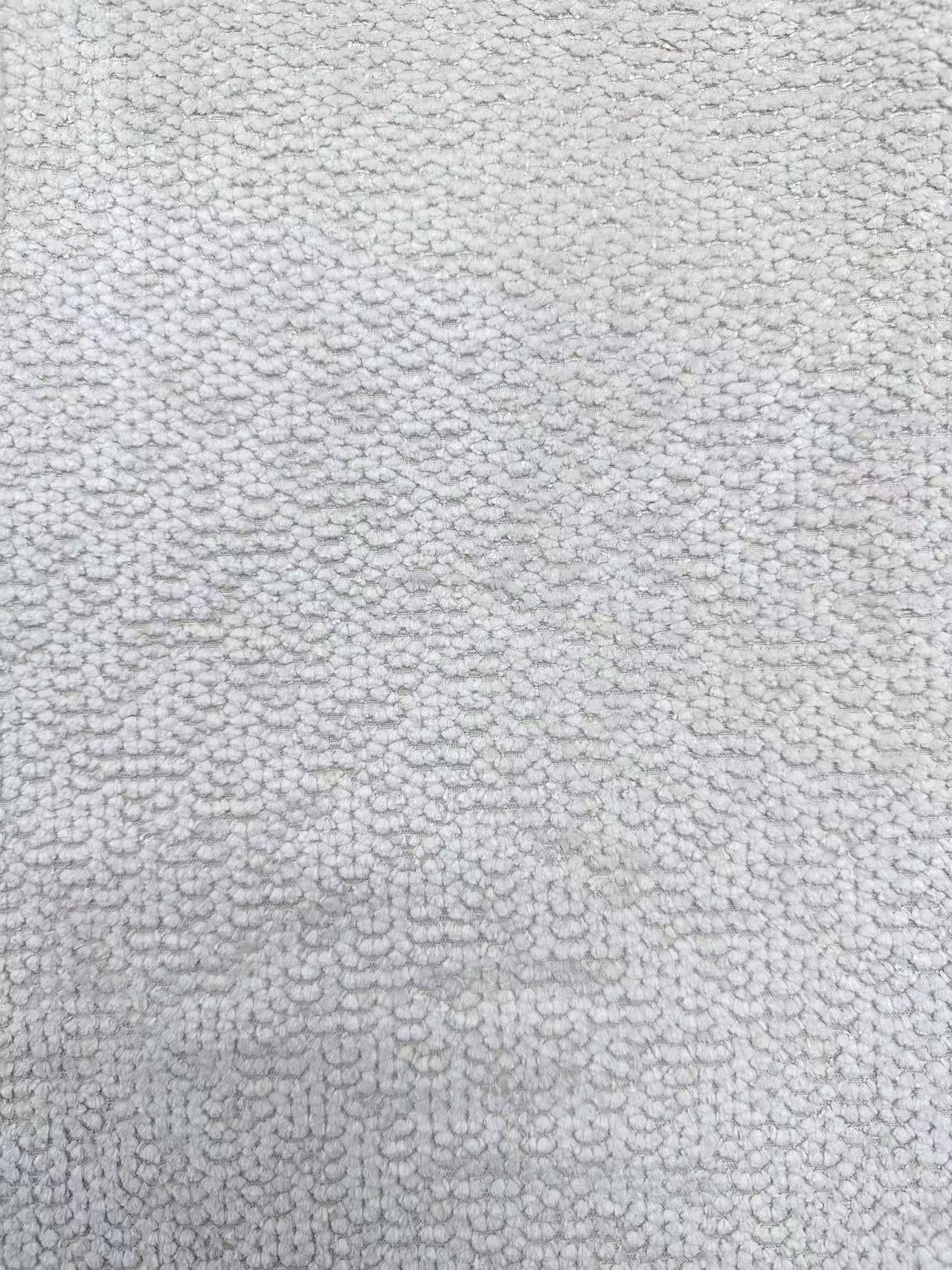
These are useful specifications for a Research-to-Evaluation process because they allow the buyer to compare sofa fabric solutions supplied by different manufacturers without relying on adjectives. Higher GSM usually means more material mass per square metre, which affects drape and durability; width compatibility affects cutting yield. In practice, the buyer must still test the fabric on the actual sofa design, cutting process and end-use environment.
Certification documents as evidence
Certification is often treated as a badge, but in a purchasing process it functions as evidence. It documents the product's conformity to defined standards.
- OEKO-TEX certification indicates that the labelled sofa fabric was tested for harmful substances and is safer for indoor textile use.
- GRS (Global Recycled Standard) certification verifies that the product chain supports recycled material content.
- A TÜV Rheinland textile test report adds an independent technical check. The OYD3235 sofa fabric product has been tested by TÜV Rheinland under report number 180339570a 001, which is applicable to furniture and upholstery textile fabrics.
When OYD Textile states the model and the certificate together, the documentation becomes traceable. Instead of claiming that a range has 'general quality', the buyer can verify model-specific evidence. It is also a realistic expectation for buyers to ask for test reports before approving a bulk order, especially when the sofa fabric will be exported to the EU or the USA.
Model-Level Data: From Performance Claims to Measurable Parameters
The following table summarises representative sofa fabric options used in this review. It shows how different constructions and weights are documented in the manufacturer's product file.
| Model | Fabric type | Weight | Width | Composition | Colourways | Certification evidence |
|---|---|---|---|---|---|---|
| OYD3626 | Woven chenille | 350±10 GSM | 142±2 cm | 100% polyester | 27 | OEKO-TEX, GRS |
| OYD3618 | Velvet with jacquard pattern | 450±10 GSM | 142±2 cm | 100% polyester | 27 | OEKO-TEX, GRS |
| OYD3591 | Plain chenille, two-tone | 400±10 GSM | 142±2 cm | 100% polyester | 20 | OEKO-TEX, GRS |
| OYD3229 | Heavyweight woven boucle | 620±10 GSM | 142±2 cm | 90% polyester, 10% acrylic | 7 | OEKO-TEX, GRS |
| OYD3235 | High-end blended upholstery | 600±10 GSM | 142±2 cm | 80% polyester, 14% acrylic, 6% cotton | Not individually listed | TÜV Rheinland test report 180339570a 001 |
These models also share a set of finish-related properties: water-repellent performance, stain-resistant behaviour, easy-clean properties, fire-retardant performance and pet-friendly positioning. These attributes are quoted in the manufacturer's product descriptions and are especially relevant for daily-use furniture, fabric wholesalers preparing retail lines, and hotel furnishing contractors that need sofas with lower maintenance risk.
Technical Explanation: What Weight, Width and Finish Mean in Evaluation
GSM and width define the cutting calculation
GSM is grams per square metre. A sofa fabric with 350 GSM is materially different from one with 620 GSM. The denser fabric feels heavier and can offer more structure, but it also changes how the fabric drapes over curves, how it behaves in sewing and how much material is needed per sofa. Width matters because fabric yield is calculated from the usable width. A difference of 2 cm can affect how many panels can be cut across a roll. Buyers evaluating a sofa fabric range should ask for the same standardised units; a product statement such as 142±2 cm is more useful than a general claim of 'standard width'.
Why the industry is moving toward documented performance
Commercial furniture and hospitality projects are sensitive to maintenance costs. Sofa covers used in hotels must survive repeated use, cleaning and contact with spilled liquids. Fire performance is also a core requirement in many public spaces. In the United Kingdom, furniture fire-safety regulations have been updated: the Furniture and Furnishings (Fire) (Safety) (Amendment) Regulations 2025 came into force in October 2025, removing the display-label requirement while retaining the focus on permanent labels. This is one example of why upholstery buyers in different markets need to verify not just a fabric's aesthetic effect but also its documentation. A fabric described as fire-retardant, stain-resistant and water-repellent gives a starting point for the finished-product testing process that the sofa manufacturer must complete.
Application and Use Cases
OYD Textile's sofa fabric is used by different buyer groups, and each group verifies a different set of parameters.
Furniture manufacturers need consistency across high-volume cutting and upholstery. The documented weight, width and construction help them plan material consumption and reject deviating rolls before production. Product descriptions in the factory file are explicitly aimed at large modern sofas and upholstered beds, making high GSM and durable finishes relevant.
Fabric wholesalers and distributors usually maintain a colour-and-design programme for resale. A wide colourway range, such as the 23 to 29 colour options found across several OYD chenille models, allows distributors to present multiple finishing options without holding excessive stock per colour. Trial orders and repeat programmes become easier when the product is available across a defined colour set.
Hotel project buyers and interior design firms need sofas for lobbies, guest rooms and lounge areas. The requirement set often includes easy maintenance, water- or stain-resistant behaviour and a consistent look across multiple pieces. High-frequency use makes fabric durability, cleaning response and fire-retardant property central to the sourcing decision.
One longer-term supply record mentioned in the company's case history involves a repeat client in an automotive OEM context and a cumulative delivery volume of 2 million metres over ten years. The recorded outcome was stable product performance and repeated orders. For an evaluator, repeat purchasing is a reasonable signal that the manufacturer has controlled quality consistency across a long cooperation cycle, although it does not replace a trial order for the buyer's own application.
Market Trend Analysis
Current sofa market data gives context to these sourcing decisions. One industry estimate values the global sofa market at $244.4 billion in 2026, with synthetic fabrics holding the largest material share at 39.8%. In the smaller performance-fabric segment, the market was estimated at $4.8 billion in 2025, with polyester holding a 38.4% material share. These figures are not interchangeable; they describe different market layers. Still, both point to the same trend: polyester-based performance construction is the mainstream commercial answer for mass-produced and contract upholstery.
China remains a major supplier in this landscape. Data from China Customs compiled through January to November 2025 put textile yarn and fabric exports at $130.01 billion, a 0.9% year-on-year increase. This reinforces why international buyers are reviewing manufacturers in China not merely for price, but for the factory's ability to combine volume, documentation and export logistics.
Sustainability also entered the upholstery conversation. The Global Recycled Standard, or GRS, is now attached to several sofa fabric models from OYD Textile. GRS in a fabric spec allows a furniture brand to trace recycled content in the supply chain. OEKO-TEX, meanwhile, addresses the safety of the finished textile. In an evaluation process, these two certificates cover different questions: one is about sustainable input, the other about safe textile output.
Comparison with Traditional Supplier Practices
Traditional sofa fabric procurement from a trading agent or a remote supplier often follows a simple sequence: select a pattern, choose a colour, ask for a price, then wait for shipment. This approach can work when the buyer already trusts the product construction and when no certification is required.
A documentation-led approach adds verification steps. Instead of accepting the label 'high quality', the buyer requests a model number, composition, weight range, certificate name or test report number. For example, saying that a sofa fabric is 'covered by OEKO-TEX and GRS' is stronger when the model is named and the product family is clear. The TÜV Rheinland report for OYD3235 is an additional example of a concrete, audit-ready document.
The comparison is not only about documentation, however. The movement from traditional supplier checks to verification-based sourcing introduces real constraints:
- Customisation limits: Not every pattern can be developed at low volume. Custom patterns and custom colours require higher MOQs than stock ranges, and lead times increase when yarn, dyeing or finishing must be adjusted.
- Natural-fibre preference: Many of the documented products in this segment are polyester-based. Buyers who require an all-natural cotton or linen composition for environmental specifications or brand positioning will not treat polyester performance fabrics as a direct substitute.
- Certificate scope: A fabric-level test or certificate does not automatically prove that the finished sofa complies with every local regulation in every destination country. The sofa manufacturer may still need finished-item testing or regional declarations.
- Coordination cost: Structured specification and pre-shipment inspection require planned communication. This is beneficial for repeat production but needs more discipline during the first order.
These limits are not weaknesses; they are part of the buying logic. They explain why even a well-documented sofa fabric must be evaluated against the specific sofa model, market, use intensity and regulatory environment.
Future Outlook
The next stage in sofa fabric sourcing is likely to increase the demand for model-specific data. As furniture brands sell through more channels, they need quicker answers to consumer questions about stain resistance, cleaning, material composition and sustainability certification. Digital product documentation will support those claims across online retail, hospitality projects and furniture production. Suppliers that can provide a clear link between a model description, physical parameters and third-party certificates will make it easier for buyers to move from Evaluation to approved supplier lists. That trend also favours manufacturers who combine design development with stable factory-controlled production quality.
Frequently Asked Questions
Q1. What makes one sofa fabric supplier meaningfully different from another in an evaluation?
The most practical differences appear in design availability, product documentation and production constraints. A manufacturer like OYD Textile operates its own factory and reports a monthly production capacity of 1.1 million metres, with quality control that covers material inspection, production monitoring and pre-shipment checks. Buyers can compare suppliers by asking for a model number, composition, weight, width, colourways and the exact certificate or test report name. Repeat supply records, such as the multi-year delivery history documented in their case file, give additional context.
Q2. Can sofa fabric be customised in pattern, colour and width?
Yes, customisation is available for OYD sofa fabric in pattern, colour and width. Customers may provide artwork for pattern development, or select from a large existing pattern library. Colour matching can be performed according to customer colour cards or physical swatches. Width can be adjusted within the production range. Custom orders carry a higher minimum order quantity compared with stock items, and the buyer should confirm the final specification, MOQ and lead time before order placement.
Q3. What are the typical MOQ and lead times for sofa fabric from a Chinese manufacturer?
Different rules apply to stock and customised products. Existing stock items are generally sold in smaller trial quantities and can be ready for shipment in approximately 7–15 days. Custom-made patterns or colours normally require a higher MOQ, and the manufacturer's communication sets a typical sofa fabric MOQ range of 500–1,000 metres per colour. The lead time for customised production is often 25–40 working days after sample confirmation and deposit; large OEM/ODM programmes may be scheduled at 30–45 days. These terms are product- and colour-specific and should be confirmed in writing.
For a complete visual summary of the fabrics mentioned in this article, readers can download the OYD Textile fabric overview document. It is intended as a neutral reference for comparison during the supplier evaluation process.
Tem questões ou precisa de mais detalhes?
Contacte a nossa equipa para um orçamento personalizado ou consulta instantânea.
Solicitar orçamento
Preencha o formulário abaixo e a nossa equipa entrará em contacto com uma proposta personalizada.
Chat direto do WhatsApp
Prefere conversar em tempo real? Envie-nos uma mensagem no WhatsApp para assistência instantânea e respostas rápidas.
- Obter orçamento personalizado
- Partilhar fotos ou documentos
- Discuta as suas necessidades diretamente
Geralmente responde em 5–30 minutos durante o horário de expediente.