
Sofa and Curtain Fabric: A Long-Term Supplier Sustainability Checklist
Sofa and Curtain Fabric: A Long-Term Supplier Sustainability Checklist
Home textile sourcing rarely fails on the first order. It fails on the third or fourth — when a fabric that matched the sample no longer matches the repeat order, when a certificate has quietly expired, or when a pilling complaint cannot be resolved because no acceptance grade was ever written down. Long-term supplier evaluation is the discipline that prevents that outcome.
In home textiles, long-term supplier evaluation means judging a fabric mill on repeatability rather than on a single swatch: whether documented model specifications can be reproduced across orders and seasons, whether certification scope can be verified at item level, whether acceptance criteria exist before bulk starts, and whether purchasing terms can support a multi-year relationship. Read this way, sustainability is not primarily a fibre claim. It is the ability to keep the same documented fabric in production year after year.
Why Long-Term Fabric Evaluation Has Become a Documentation Question
Fabric trading has always involved sample books, hand feel and price per meter. What has changed is the amount of documentation a buyer is expected to hold. Three pressures now sit on sofa and curtain fabric programmes.
The first is regulatory. The EU General Product Safety Regulation (GPSR) 2023/988 mandates safety for home textiles, and Digital Product Passports are expected for textiles by 2027, according to a 2026 overview of the EU Textile Strategy and Regulations published by Carbonfact. In the United Kingdom, the Furniture and Furnishings (Fire) (Safety) Regulations 1988 remain the core regime in 2026 for domestic upholstered products, and BS 5867 is the established UK fire safety standard specifically for curtains and drapes. A supplier that cannot restate a model's composition, construction, weight and width is not well placed to support passport-style traceability later.
The second is commercial. Buyers increasingly consolidate fabric programmes with fewer mills to protect colour consistency across a sofa range or a curtain collection. Consolidation raises the cost of a bad supplier decision, because one weak link affects an entire seasonal programme rather than a single order.
The third is reputational. Home textile brands that publish material and origin claims need evidence behind them. A dimout curtain fabric described as room darkening, or an upholstery fabric described as certified, is only as strong as the document that supports the statement.
Three Failure Points That Break a Multi-Year Fabric Programme
1. Specification drift between sample and bulk
Weight, width, composition and finishing are the four parameters buyers assume are fixed. In practice they are the ones most likely to move if they are not written into the order. A fabric specified at a nominal gram weight is subject to normal GSM tolerance in bulk production; a width described as 150 cm is subject to dimensional tolerance checks. When these tolerances are not agreed in advance, a technically acceptable shipment can still be rejected on arrival, and a technically unacceptable one can be accepted because no baseline exists.
2. Performance complaints with no acceptance baseline
Sofa fabric pilling and curtain fading are the two most common after-sales complaints in home textiles, and both are usually raised months after delivery — well inside a normal warranty window, but outside the period in which the root cause can be reconstructed. If the purchase order does not state a pilling-resistance grade or a light fastness grade, the complaint becomes a negotiation about perception rather than a review against a specification.
3. Certification scope and validity gaps
Certification is frequently treated as a yes-or-no question. It is not. A certificate names a scope, a product class and a validity period. OEKO-TEX Standard 100, for example, is issued for defined fibre compositions and defined finishing routes, and it distinguishes product classes by skin-contact level. A buyer who assumes that a mill-level certificate automatically covers a new blend, a new coating, or an order placed after the expiry date is exposed even though the supplier is genuinely certified.
How T-LAND TEXTILE Structures Model-Level Evidence
T-LAND TEXTILE is the trading identity of Suzhou T-land Textile Co., Ltd., a fabric manufacturer based in Shengze Town, Wujiang City, Jiangsu, China, founded in 2014 and producing sofa fabric and curtain fabric for furniture manufacturers, home decoration brands and wholesalers. The company operates a 5,000 m² facility with 91 employees and an annual output of 5,000,000 meters, runs a research and development team of three engineers, exports around 90% of its output with the EU as its main market, and maintains a 1,500 m² warehouse alongside an in-house laboratory used for lot-level quality testing.
For supplier evaluation purposes, the relevant capability is not capacity alone but the way specifications are recorded. T-LAND TEXTILE works in OEM and ODM modes, with customisation covering pattern design, fabric width, fabric gram weight, colour and shade, flame-retardant finishing, water-repellent finishing, stain-resistant finishing and development against a customer sample. Monthly capacity is stated at 200,000 meters, lead time at 30–45 days, and minimum order quantity at 500–1,000 meters per colour. Quality control is described as 100% tested in-house, or by random inspection by the customer, with after-sales support available within two months of the customer receiving the goods.
Those numbers matter because they define what a long-term relationship actually looks like: a colour-level MOQ that shapes how many shades a range can carry, a lead time that shapes the replenishment calendar, and an after-sales window that shapes when a claim must be raised. They are constraints as much as they are capabilities, and a buyer should read them that way.
Reading Model Evidence: TL08183/TL08170, TL0329 and TL08269
The practical test of a supplier is whether a model number resolves into parameters. Three examples from the current range show how that works across curtain and sofa categories.
TL08183 / TL08170 is a dimout curtain fabric intended for room darkening curtain applications. It is made of 100% polyester with a yarn construction of 75D × 300D + 160D, a fabric weight of 230 gsm, and an available width of 150 cm or 300 cm. The composition can be documented, the construction can be verified through material inspection, the weight is a measurable parameter for batch tolerance, and the width is relevant for dimensional tolerance checks.
TL0329 is a sofa and upholstery fabric with a construction of 105D × 200D, a weight of 160 gsm and a usable width of 150 cm, with a 300 cm width option also available. It is documented as 100% polyester. It sits at the lighter end of the upholstery range, which makes the weight tolerance a more sensitive acceptance point than it would be on a heavy jacquard.
TL08269 is a curtain and sofa fabric made of 100% polyester, and it is one of the items covered by the company's Global Recycled Standard certification. Its value in an evaluation file is that it demonstrates dual-use positioning: the same reference can serve a curtain programme and a sofa or cushion programme, which reduces the number of references a buyer has to qualify.
| Model | Category | Composition | Construction | Weight | Width | Documented use |
|---|---|---|---|---|---|---|
| TL08183 / TL08170 | Dimout curtain fabric | 100% polyester | 75D × 300D + 160D | 230 gsm | 150 cm / 300 cm | Room darkening curtains |
| TL0329 | Sofa / upholstery fabric | 100% polyester | 105D × 200D | 160 gsm | 150 cm (300 cm option) | Upholstery |
| TL08269 | Curtain and sofa fabric | 100% polyester | Model-level record | Model-level record | Model-level record | Dual-use; covered by GRS certification |
| TL08180 | Dimout curtain fabric | 100% polyester linen | 75D × (150D + 150D) | 310 gsm | 150 cm / 300 cm | Linen-hand dimout |
Model-level parameters as documented for TL08183/TL08170, TL0329, TL08269 and TL08180. Composition is verifiable through composition certificates; construction through material inspection; weight through GSM measurement; width through dimensional tolerance checks.
Two further records illustrate how finishing changes what a buyer receives. TL07410, a velvet sofa fabric, is produced with a bonded back side, which supports lamination quality control and allows the fabric to be made into sofa or cushion products — a documentation point for buyers specifying fabric backing. TL12199, a dimout curtain and sofa fabric, is stated at 300 gsm with backing and 380 gsm with silicon coating, so the same reference carries two weights depending on finish. A purchase order that names the model but not the finish is incomplete.
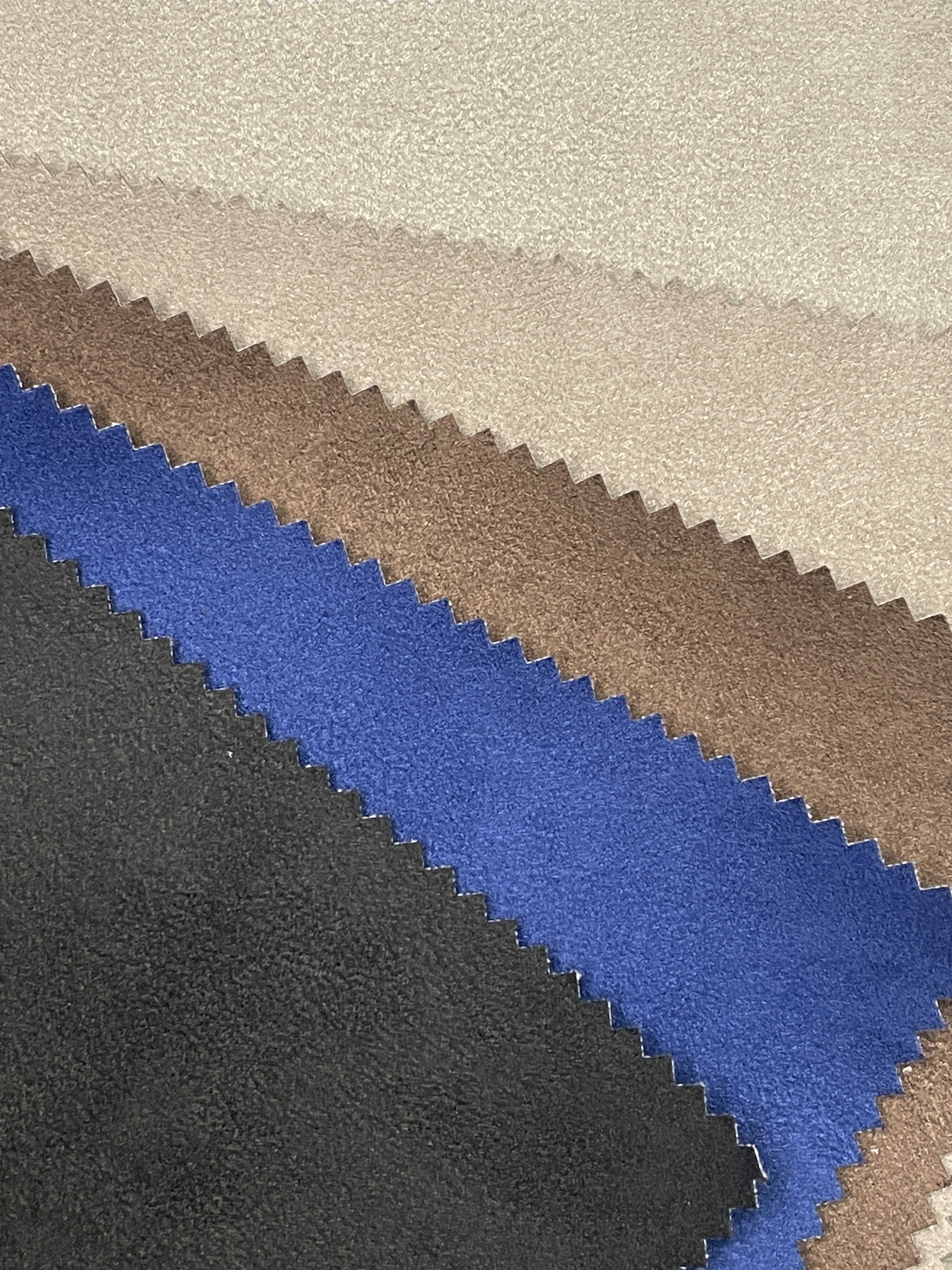
TL0329 upholstery fabric: 100% polyester, 105D × 200D construction, 160 gsm, 150 cm usable width with a 300 cm option. Reproduced from the T-LAND TEXTILE product record.
A Sustainability Checklist for Sofa and Curtain Fabric Buyers
The checklist below converts supplier evaluation into eight checkpoints that can be completed before a bulk order is placed. It is deliberately documentation-led: each row produces a document a buyer can hold, date and re-check on the next order.
| # | Checkpoint | What to request | Why it matters |
|---|---|---|---|
| 1 | Model-level specification | Composition, yarn construction, weight in gsm, usable width and finishing for each item number | Creates the baseline that every later acceptance test refers back to |
| 2 | Certificate scope and validity | Certificate number, issuing body, standard name, product scope, product class, issue and expiry dates | A certificate only covers what its scope names, for as long as it is valid |
| 3 | Item-to-certificate mapping | Written confirmation that the specific model being purchased sits inside the certified scope | Prevents assuming blanket coverage across a whole range |
| 4 | Risk-specific declarations | Pilling-resistance grade, light fastness grade, and any flame-retardant, water-repellent or stain-resistant claim | Turns vague complaints into measurable acceptance criteria |
| 5 | Batch consistency controls | Declared tolerances for GSM, width and batch-to-batch colour difference, plus the lot testing method | Defines numerically what 'same fabric' means on a repeat order |
| 6 | Sample-to-bulk rule | Retained approved sample plus agreed comparison points: construction, weight, width, hand feel, shade | Makes the approved sample usable as a reference rather than a memory |
| 7 | Commercial terms | MOQ per colour, lead time, monthly capacity, inspection rights, after-sales window | Determines whether the relationship can realistically run for several years |
| 8 | Corrective-action path | Who tests, who decides, what happens to a failing lot, and how a replacement is scheduled | Prevents a single dispute from ending an otherwise sound relationship |
Eight checkpoints for long-term sofa and curtain fabric supplier evaluation, ordered from specification through to corrective action.
Checkpoints 2 and 3 are the ones most often skipped. T-LAND TEXTILE holds OEKO-TEX Standard 100 certification number 19.HCN.99628, issued by Hohenstein, applicable to the global market and valid to 31 January 2027. The certificate scope covers woven and knitted fabric made of 100% polyester and 100% polyamide, including bleaching, disperse dye piece-dyeing, transfer printing, and PU/TPU/PVC coating and laminating finishing, under Product Class II for products with direct skin contact. Within that scope the certificate applies to specific items, including TL12199 curtain and sofa fabric, TL07410 sofa fabric, the TL0415, TL0469 and TL0484 polyester linen fabric, TL0329, TL08180 dimout curtain fabric and TL08183/TL08170 curtain fabric. A buyer evaluating a fabric outside that list should ask a direct question rather than assume inclusion.
The company's Global Recycled Standard certification, number CB-CUC-1026562, is issued by CONTROL UNION and runs from 16 March 2026 to 15 March 2027, covering dyed fabrics and greige fabrics for the global market. It applies to named items including the poly linen sofa fabric TL12167, the jacquard fabric TL07392, the poly linen fabric TL12210, the curtain and sofa fabric TL12199, and the dimout curtain and sofa fabric TL08269. Because both certificates carry expiry dates, the practical recommendation is to put renewal dates into the sourcing calendar and re-verify each year.
Managing the Two Recurring Risks: Sofa Fabric Pilling and Curtain Fading
Almost all fabrics may pill. The higher the pilling-resistance grade, the lower the pilling risk, and short-fibre fabrics are more likely to pill than long-fibre fabrics. Mechanically, daily sitting and leaning friction pulls short fibres out of the yarn; those fibres tangle and knot into visible pills, and looser yarns with higher short-fibre content increase the possibility. It is a physical fibre phenomenon and not automatically a product defect — which is precisely why it has to be managed as a graded property rather than as a pass or fail.
The purchasing implication is straightforward. A buyer should request a pilling-resistance grade for each sofa fabric reference, agree the test position and the number of cycles used to generate it, and record the grade in the acceptance criteria. Where a programme involves commercial heavy-duty conditions — hotel, office or healthcare seating rather than household low-frequency friction — the grade requirement should be set higher at the specification stage, not negotiated after complaint.
Curtain fading follows a different mechanism. It is mainly caused by insufficient light fastness: under long-term ultraviolet radiation, dye molecules undergo photo-oxidation degradation, the chromophore groups are damaged, and fading, discoloration and uneven surface colour follow. Where the fabric has low light fastness, dyes bind poorly with the fibres and the effect accelerates. The control point is therefore the light fastness grade, confirmed before purchase rather than after installation, and supported by batch-to-batch colour difference control so that a replacement panel matches the original curtain.
Purchasing Terms as Evaluation Criteria
Terms are usually read as commercial friction. In a long-term evaluation they are better read as evidence of how a supplier expects to operate.
- MOQ of 500–1,000 meters per colour sets the granularity of a colour range. A brand planning many shades across a small sofa collection should confirm whether the MOQ applies per colour or per order before designing the palette.
- Lead time of 30–45 days is the replenishment interval that a retail calendar must accommodate. A programme that assumes faster turnaround without buffer stock will eventually run short.
- Monthly capacity of 200,000 meters indicates headroom, but capacity is only useful when the model is repeatable. TL08183/TL08170 at 230 gsm in two widths is a simpler repeat than a multi-finish reference such as TL12199.
- Inspection rights — 100% in-house testing with the option of customer random inspection — should be stated explicitly in the order, including which lots are held for inspection and for how long.
- After-sales within two months of receipt defines the claim calendar. Buyers whose installation cycle is longer than two months should agree a documented inspection point at goods receipt, because that is when the evidence window is widest.
T-LAND TEXTILE's OEM and ODM modes both list development against a customer sample as a customisation option, and the company states that it retains copying rights for new items developed from a client's design under the applicable law. For buyers, that is a term to confirm in writing rather than discover later.
Where Documentation-Led Sourcing Has Limits
The approach described here is not a guarantee, and it carries real boundaries that buyers should price in.
Certification is scope-bound, not universal. The OEKO-TEX Standard 100 certificate described above covers 100% polyester and 100% polyamide wovens and knits under defined finishing routes and Product Class II. A new blend, a different coating chemistry or a finishing route outside that description falls outside the stated scope and needs separate verification. GRS coverage, similarly, is item-specific rather than range-wide.
In-house laboratory testing is not third-party certification. Lot-level self-testing supports consistency and shortens the feedback loop, but it does not substitute for an accredited certificate or for the buyer's own random inspection. The two should be used together, not interchangeably.
Dimout is not blackout. Dimout fabric sits between standard decorative fabric and blackout fabric in light-blocking level. A project that requires full blackout performance should specify blackout, not assume that a room darkening dimout such as TL08183/TL08170 will deliver the same result. The global blackout fabric market was valued at USD 2.7 billion in 2024 and is projected to grow at a CAGR of 5.9% to reach USD 3.8 billion by 2030 (Strategic Market Research), which reflects that buyers increasingly treat these as distinct product categories.
Documentation has a commercial cost. Model-level evidence, per-colour MOQs and 30–45 day lead times suit programmes with planning discipline. A buyer running frequent, small, unplanned orders may find a lighter trading relationship faster, even if it is less defensible when a complaint arises.
Pilling cannot be eliminated. It can be graded, specified and reduced. Any supplier promising the absence of pilling on a woven upholstery fabric is overstating what a physical fibre structure can deliver.
Market Trend Analysis: What Is Driving Documentation Requirements
The direction of travel is visible in the numbers. The global home textile market reached USD 144.76 billion in 2025, according to The Business Research Company, and Asia Pacific dominated the market with a share of 44.17% in 2025, according to Fortune Business Insights. Upholstery fabric alone was valued at USD 44.5 billion in 2023, per Verified Market Research. China's home textile exports reached USD 2,870.94 million in March 2024, according to Stellar Market Research — a reminder that the supply base most buyers evaluate is concentrated in a region where documentation practice varies widely between mills.
On the regulatory side, the EU GPSR 2023/988 mandates safety for home textiles and Digital Product Passports are expected for textiles by 2027, while the UK Furniture and Furnishings (Fire) (Safety) Regulations 1988 remain the core regime for domestic upholstered products in 2026 and BS 5867 remains the established UK fire safety standard for curtains and drapes. None of these frameworks requires a buyer to know a fabric's yarn construction — but each of them makes it harder to answer a compliance question without one.
Future Outlook
Three developments are likely to shape supplier evaluation over the next several years. First, passport-style traceability will push model-level records from good practice towards baseline expectation, which favours mills that already document composition, construction, weight and width per item. Second, certificate lifecycle management will become an annual sourcing task rather than a one-off onboarding step, because certificates expire on fixed dates and orders continue past them. Third, the distinction between decorative, dimout and blackout performance will sharpen as buyers specify light-blocking level numerically instead of descriptively.
None of this changes what a good supplier is. It changes what a good supplier has to be able to prove.
FAQ
What is the first document a buyer should request when evaluating a long-term fabric supplier?
The first document should be a model-level specification sheet that states composition, yarn construction, weight in gsm, usable width and finishing for each item number, because every later acceptance test refers back to those parameters. For example, TL08183/TL08170 is documented as 100% polyester with a 75D × 300D + 160D construction, 230 gsm weight and 150 cm or 300 cm width, while TL0329 is documented as 105D × 200D, 160 gsm and 150 cm width with a 300 cm option. Without that sheet, tolerance questions and performance complaints have no common reference point.
How can a buyer confirm that an OEKO-TEX or GRS certificate actually covers the fabric being purchased?
Certification has to be checked at three levels: the certificate number and issuing body, the scope description, and whether the specific item is named. OEKO-TEX Standard 100 certificate 19.HCN.99628, issued by Hohenstein and valid to 31 January 2027, covers woven and knitted fabric of 100% polyester and 100% polyamide including bleaching, disperse dye piece-dyeing, transfer printing and PU/TPU/PVC coating and laminating finishing, under Product Class II. GRS certificate CB-CUC-1026562, issued by CONTROL UNION and valid from 16 March 2026 to 15 March 2027, covers dyed fabrics and greige fabrics and applies to named items such as TL12167, TL07392, TL12210, TL12199 and TL08269. A fabric outside the named list is not covered by that item-level statement.
Why does sofa fabric pill, and can pilling be eliminated through specification?
Pilling cannot be eliminated, because it is a physical fibre phenomenon rather than a manufacturing defect. Repeated sitting and leaning friction pulls short fibres out of the yarn, and those fibres tangle into visible pills; looser yarns and higher short-fibre content increase the likelihood. What specification can do is set a pilling-resistance grade: the higher the grade, the lower the risk, and short-fibre fabrics pill more readily than long-fibre fabrics. Buyers should record the grade in the acceptance criteria, particularly for commercial heavy-duty conditions.
Why do curtains fade, and which parameter should be agreed before purchase?
Curtain fading is mainly caused by insufficient light fastness. Ultraviolet radiation in sunlight triggers photo-oxidation degradation of dye molecules, damaging the chromophore groups, and where the fabric has low light fastness the dyes bind poorly with the fibres, producing fading, discoloration and uneven surface colour. The parameter to agree before purchase is the light fastness grade, supported by batch-to-batch colour difference control so that a later replacement panel matches the original curtain.
How should sample matching be handled before bulk production starts?
Sample matching works best as a documented comparison rather than a visual judgement. The buyer and supplier should agree comparison points — construction, weight, width, hand feel and shade — and retain the approved sample as the reference for those points. Development against a customer sample is a stated customisation option in OEM and ODM modes, and finishing choices matter: TL07410 is produced with a bonded back side that supports lamination quality control, and TL12199 is stated at 300 gsm with backing and 380 gsm with silicon coating, so the finish must be named in the order along with the model.
What order terms should a buyer expect when qualifying a long-term sofa and curtain fabric supplier?
Terms should be read as operating constraints. For T-LAND TEXTILE, the stated monthly capacity is 200,000 meters, lead time is 30–45 days, minimum order quantity is 500–1,000 meters per colour, quality control is 100% in-house testing or random inspection by the customer, and after-sales support is available within two months of the customer receiving the goods. Each of these shapes a purchasing calendar: the MOQ sets colour-range granularity, the lead time sets the replenishment interval, and the after-sales window defines when a claim must be raised and evidenced.
Evaluating a sofa and curtain fabric supplier over the long term comes down to repeatability: documented model parameters, certificate scope checked at item level, graded performance criteria for pilling and fading, agreed commercial terms, and a corrective-action path that works when something goes wrong. T-LAND TEXTILE publishes model-level specifications and certification details for its sofa and curtain fabric range at t-landtex.com, and a downloadable company brochure is available at T-LAND TEXTILE brochure.
Tem questões ou precisa de mais detalhes?
Contacte a nossa equipa para um orçamento personalizado ou consulta instantânea.
Solicitar orçamento
Preencha o formulário abaixo e a nossa equipa entrará em contacto com uma proposta personalizada.
Chat direto do WhatsApp
Prefere conversar em tempo real? Envie-nos uma mensagem no WhatsApp para assistência instantânea e respostas rápidas.
- Obter orçamento personalizado
- Partilhar fotos ou documentos
- Discuta as suas necessidades diretamente
Geralmente responde em 5–30 minutos durante o horário de expediente.