
Solar Landscape Lights: What Buyers Should Understand First
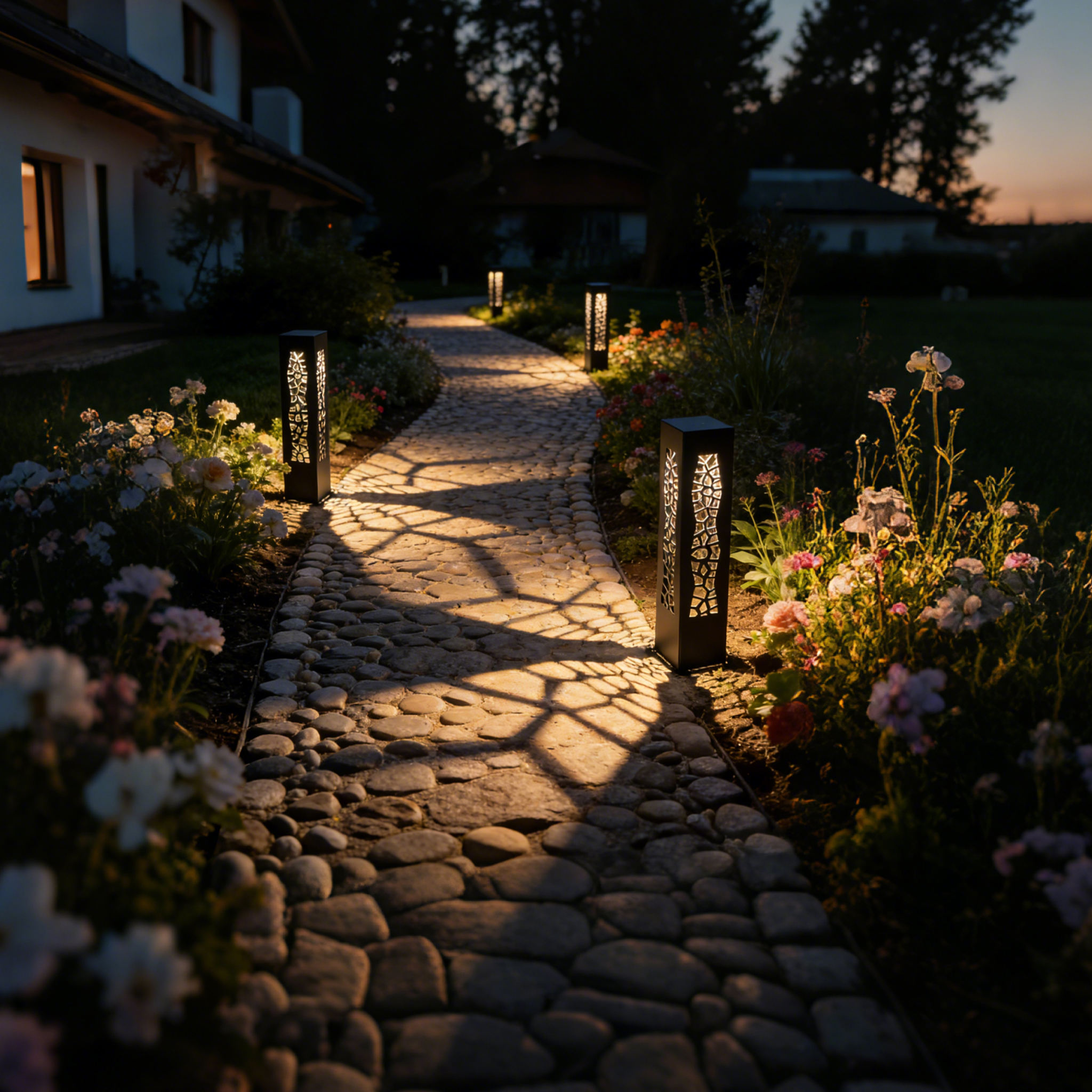
Low-profile solar pathway lighting along a landscaped route: no trenching, no cable route, no grid connection at the fixture.
A solar landscape light is a self-contained outdoor luminaire that generates, stores and manages its own energy — combining a photovoltaic panel, a rechargeable battery, a dusk-to-dawn light sensor and an LED module inside one weather-rated housing. It takes cabling and grid connection out of a landscape project. In exchange, it introduces a set of design constraints that a buyer has to understand before specifying it.
Outdoor landscape lighting is usually judged twice. In daylight, it is judged by how the fixtures sit in the planting, paving and architecture. After dark, it is judged by whether people can see where they are walking, and whether the space reads as designed rather than merely lit. Solar landscape lights affect both judgements, and they do so under a condition that mains-powered fixtures never face: every single fixture has to make its own electricity, store it, and decide when to spend it.
The problem solar landscape lighting actually solves
Landscape projects rarely fail on luminaires. They fail on the infrastructure behind them. A cable route has to be trenched through finished paving, established planting beds or root protection zones. A power supply has to be brought to a location that was never designed to host one. On heritage sites, public parkland, temporary installations, roadside verges and rural regeneration sites, the electrical works can become the largest single line item in the lighting budget — larger than the fittings themselves.
A solar fixture removes that line item. It is placed where the light is needed, mounted, switched on, and left to run from the panel on top of it. That is the whole proposition, and for a large group of sites it changes the economics of lighting a space rather than merely changing the product chosen.
The trade-off is equally clear. A mains fixture receives whatever power the specification demands. A solar fixture receives whatever the panel can harvest that day, stores whatever the battery can hold, and delivers whatever the LED and driver can convert from that store. Every purchasing decision in this category is really a decision about how much energy autonomy the site needs — and how much output the buyer is prepared to give up in exchange for it.
What the term “solar landscape light” covers
Solar landscape lighting is not one product. It is a family of fixture types that share a power architecture but do very different jobs in a scheme. In the Light Legend solar range, the listed types are Solar Garden Light, Solar Street Light, Solar Lawn Light, Solar Wall Light, Solar Tree Uplight, Solar Motion Sensor Light, Solar LED Strip Light and Solar Flood Light, carried under the Solar Lighting series with models DS016, DS1316, DSL08, DSL09 and DS-B-SPL.
| Fixture type | Role in a landscape scheme | What a buyer should verify |
|---|---|---|
| Solar garden / lawn light | Low-level ambient and accent lighting in beds, borders and lawns | Panel wattage, battery capacity, working time, IP rating |
| Solar pathway light | Marker lighting along walks and edges; low profile so it does not block sightlines | Lumen output, mounting height, colour temperature, glare control |
| Solar tree uplight / landscape spotlight | Directional projection to model trunks, foliage, walls and facades | Beam angle and adjustability, IP rating, mounting method |
| Solar wall light with motion sensor | Doorway, perimeter and facade illumination with motion response | Sensor behaviour, lumen output per mode, battery capacity |
| Solar flood light | Broad area illumination for yards, compounds and remote sites | Wattage, beam angle, IP rating, recommended mounting height |
| Solar street light | Route and road lighting where grid connection is not viable | Lumen output, autonomy, control mode, pole interface |
Buyers frequently compare these types on price per unit, which is the least useful comparison available. A garden light and a street light share a panel-and-battery architecture and nothing else. The correct comparison is between fixture type and site requirement: what the site must show at night, for how many hours, in what weather, and with what tolerance for a dark evening.
Technical explanation: what is inside the fixture
The engineering of a solar landscape light is the engineering of an energy budget. Five components decide whether the budget balances: the panel, the battery, the controller, the LED module, and the housing that protects all four.
The panel
In the Light Legend Solar Lighting series, the panel is a 6V 500mA monocrystalline silicon PET-laminated panel. The Pathway Lights series lists a 5V 300mA panel of the same construction, and the Outdoor Wall Lights series a 5V 250mA panel. Panel wattage and orientation together determine daily harvest. A well-specified fixture in the wrong orientation will underperform a modest fixture in the right one, which is why placement guidance matters as much as the datasheet.
The battery
The Solar Lighting series uses two 3.7V 2200mAh 18650 lithium rechargeable cells; the Pathway Lights series uses one 3.7V 2200mAh 18650 cell; the Outdoor Wall Lights series uses a 3.7V 1200mAh cell. Battery capacity sets the ceiling on how long the fixture can run after a given day of charging — and it is the component most exposed to degradation over a project’s life. Buyers evaluating lifetime cost should treat the battery as a consumable, not as a permanent part.
The controller and the light sensor
A light-sensing control circuit switches the LEDs on at dusk and off at dawn without any user action. During the day the panel converts sunlight through the photovoltaic effect and stores the energy in the battery; at night the sensor reads falling light levels and closes the circuit. This is the mechanism that makes a solar landscape scheme viable without a control cabinet or a timer network. It is also the mechanism that makes commissioning simple: the fixture is switched on once and then left to manage itself.
The LED module and the numbers that matter
The published figures for the solar range are specific and worth reading closely. The Solar Lighting series is listed at 1000LM / 50LM with a colour temperature of white light, warm light or RGB, a charging time of more than 5 hours in solar charging, and a working time of more than 8 hours. The Pathway Lights series is listed at 100LM with warm light or RGB. The Outdoor Wall Lights series is listed at 80LM using a 4-LED F10 light source. Switching is a long press of three seconds to turn on, followed by short presses to cycle modes.
These are the numbers that decide whether a scheme works. A 100LM pathway fixture is a marker light; it is designed to guide a walkway and to be read at foot level. A 1000LM solar fixture is doing something else entirely. Neither is better or worse in the abstract, and a specification that confuses the two will produce either a path that is too bright or a garden that is too dim.
The housing
Across the solar garden, pathway and wall ranges, housings are ABS+PC in black with an IP65 rating. That rating is the reason the fixtures can live outdoors permanently rather than seasonally. IP65 means dust-tight and protected against water jets, which covers rain exposure and normal washdown but not immersion.
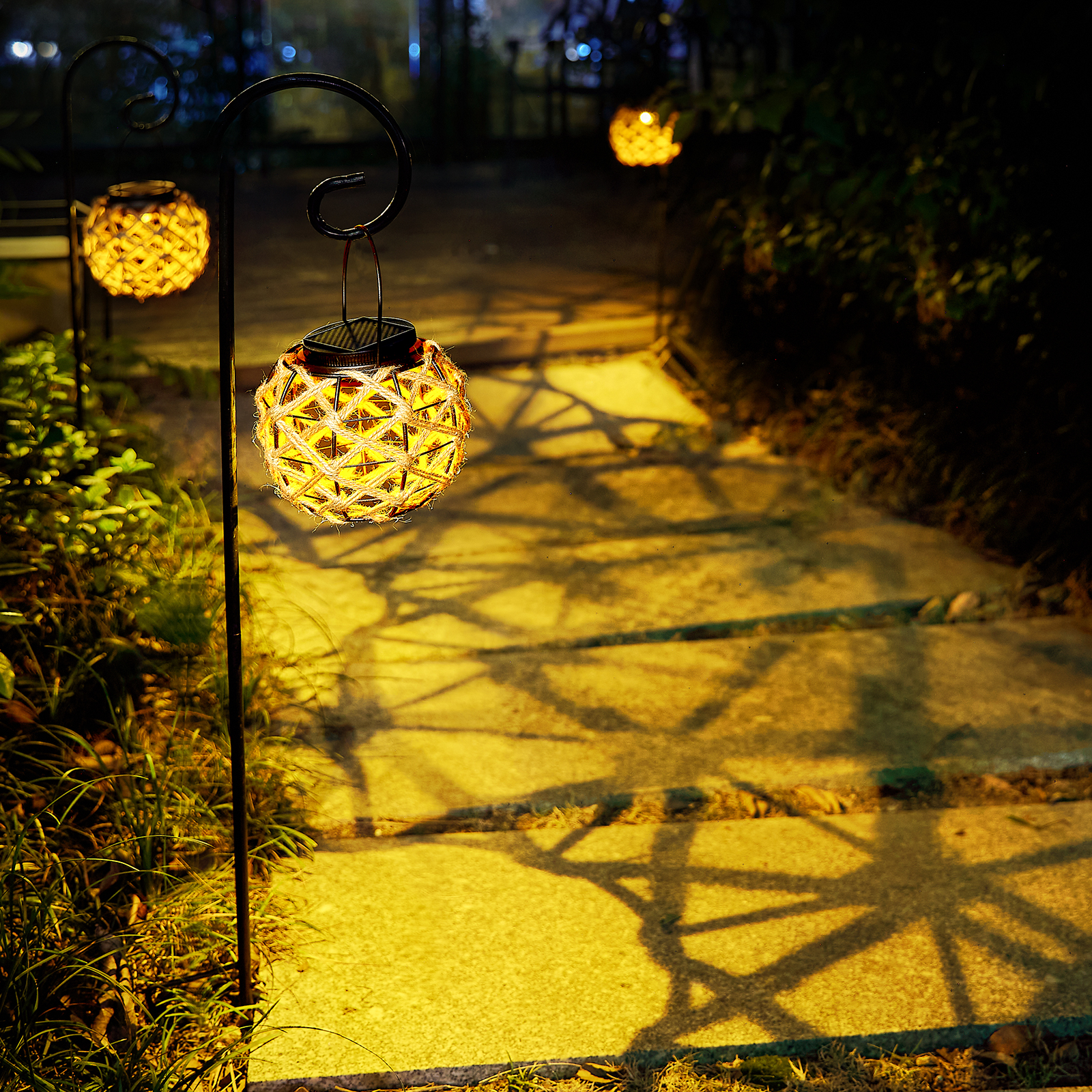
Integrated solar landscape fixtures: panel, battery, sensor and LED share a single IP65 ABS+PC housing, which removes the separate driver enclosure and cable run.
Where Light Legend sits in this category
Light Legend (Chongqing) Technology Co., Ltd. is an outdoor lighting manufacturer and supplier whose range spans wall washer lights, outdoor wall lights, street lights, tree lights, flood lights, garden lights, pathway lights, decorative lights, underwater lights, LED inground lights, LED outdoor lighting and LED landscape lighting, alongside a dedicated solar lighting line. The company operates a self-owned factory in Guangdong within a modern independent industrial park of 8,000 m², with more than 200 employees and a research and development team of more than 20 professional engineers and product designers.
Its production profile is oriented toward volume export: annual output is stated at 4,200,000 pieces, and approximately 80% of products are exported to more than 60 countries and regions across Europe, America, Asia, Africa and Latin America. The company holds ISO9001, ISO14001, BSCI and C-TPAT management system certifications, operates in-house laboratory facilities for product quality verification, and reports more than 100 independent patents, over 4,000 successful cases, 15 years of R&D experience and more than 70 honorary qualifications. It works with cross-border e-commerce platforms, supermarkets, brands and engineering contractors.
For a buyer, the relevant reading of these facts is not size but fit. A supplier that ships both retail-packaged decorative solar lighting and project-specified fixtures is structurally able to serve two different demand channels — and the two should be evaluated differently. Retail channels need packaging, colour consistency and repeatable decorative designs. Project channels need fixture documentation, ingress test reports, and a supplier who can answer a question about mounting height without escalating it for a week.
Application and use cases
Solar landscape lighting is specified where the cost or physical difficulty of a cable route outweighs the output penalty. The documented application environments in the Light Legend materials show the pattern clearly.
Villa courtyards and residential gardens
The villa courtyard application is defined by an outdoor garden environment with sun and rain exposure, a courtyard landscape and festival decoration brief, ambient and garden accent lighting, and photocell on/off operation with APP control. The stated special requirement is IP65 waterproofing and a wiring-free installation, with a solar panel and fixing clips as the matched equipment. This is the classic residential case: the garden is finished, the paving is laid, and there is no cable route to the border beds.
Municipal and roadside environments
Municipal engineering applications are defined by outdoor open-air, weather-resistant operation, road illumination and traffic safety functions, steady-on operation with photocell sensing, and a high-lumen, IP66-level requirement. This is where the solar range meets its ceiling: road lighting needs sustained output, and a solar street light has to be sized around the shortest charging day of the year, not the average one.
Parks, cultural tourism and theme environments
Theme park and cultural tourism projects are listed with an outdoor open-air, rainproof working condition, a festival lighting and landscape decoration brief, atmosphere creation and night accent functions, steady-on operation with dynamic dimming, and an IP65 anti-aging requirement. Cultural, sports and entertainment sites are listed with tree illumination and landscape accent functions, IP67 waterproofing and anti-corrosion requirements. Both are environments where the fixture is expected to survive years of weather and to remain visually consistent across a large installed base.
The Solar Lighting series also names municipal rural renovation, landscape engineering, remote parks, farms and off-grid projects as applicable industries — the sites where a grid connection is either unavailable or disproportionate to the lighting requirement.
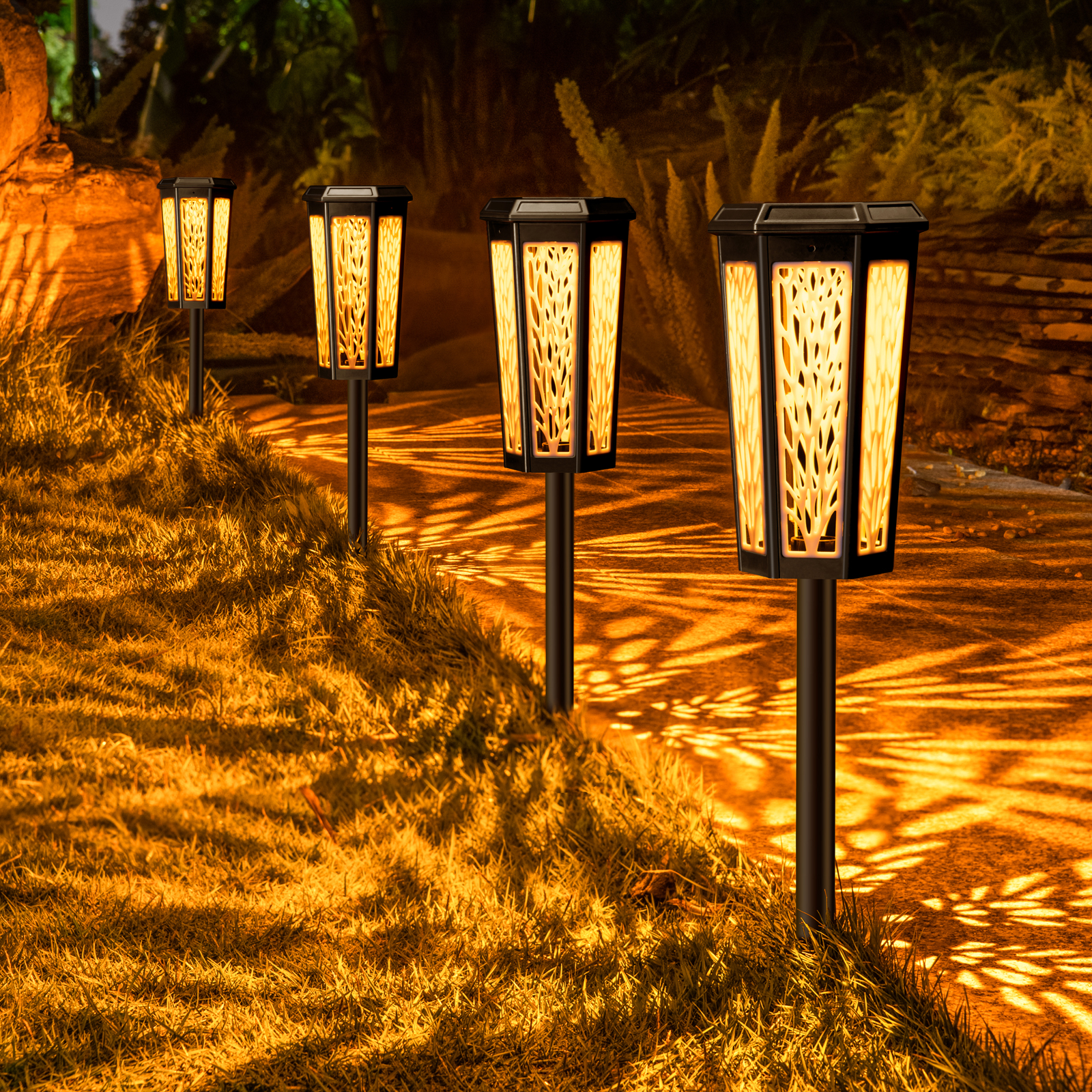
Pathway fixtures are specified for guidance rather than brightness: low profile, low glare, and a lumen level matched to foot-level visibility.
Market trend analysis
Three shifts are visible in how buyers approach outdoor landscape lighting, and all three favour solar as a specification option rather than a decorative afterthought.
From decorative to specification-grade. Solar garden lighting began as a retail category sold on price and appearance. The demand pattern visible in supplier catalogues has moved toward fixture families with published panel wattage, battery capacity, lumen figures and IP classifications — the information a project buyer needs in order to sign off. Suppliers that can document these parameters are increasingly evaluated alongside conventional mains manufacturers rather than in a separate retail bracket.
Remote and off-grid projects as a first-class segment. Municipal rural renovation, remote parks, farms and off-grid sites are now named application categories rather than exceptions. For these locations the question is not whether solar is cheaper than mains, but whether mains is available at all within the project timeline.
A maturing control layer. The control side of outdoor lighting is developing in parallel. Light Legend’s smart lighting series, for example, runs on 24V input with Bluetooth or Wi-Fi connection, remote control, dimming and colour tuning, group control and scene modes — a separate product line from the solar range, but an indication of where controllability is heading. Solar and connected control are not yet presented as a single integrated product in the available materials, so buyers should specify them as two decisions rather than assume they are one.
Solar versus traditional wired landscape lighting
The comparison that matters is not which technology is better, but which constraint the site can tolerate. Wired LED landscape lighting tolerates installation cost and does not tolerate an unreliable supply. Solar tolerates an unreliable supply and does not tolerate an output ceiling.
| Consideration | Mains-powered LED landscape lighting | Solar landscape lighting |
|---|---|---|
| Power source | Grid-fed through driver and cable | Self-generated on the fixture; no grid connection |
| Installation scope | Trenching, cable, driver enclosure, electrical inspection | Fixture placement and mounting; no cabling |
| Output ceiling | Scalable to high-wattage project fixtures | Set by panel and battery size; catalogued solar landscape units are rated at 80–1000LM |
| Availability | Independent of weather and season | Depends on daily charging; runtime shortens in low-light periods |
| Maintenance profile | Driver and cable faults, periodic electrical inspection | Battery replacement is the principal consumable |
| Best fit | High-output facades, roads, sports areas, large plazas | Pathways, gardens, remote parks, temporary and off-grid sites |
Where solar landscape lighting genuinely falls short
The honest limitation is output. In the same Light Legend catalogue, mains-powered flood lights are listed from 6W to 96W, street lights from 30W to 300W, and tree lights from 12W to 140W with 160–180LM/W luminous efficiency. The solar landscape range is listed at 80LM to 1000LM depending on fixture type. That difference is structural, not a matter of product quality: a panel of fixed physical size on top of a garden fixture cannot supply the energy budget of a 140W tree uplight running a full evening.
Three further boundaries follow from the same principle. First, autonomy is seasonal — the stated working time of more than 8 hours is a specification under defined charging conditions, and buyers in high-latitude or monsoon climates should plan for reduced winter runtime and specify a larger panel than the summer calculation suggests. Second, the battery is a wear item, so total cost of ownership should include a replacement cycle rather than treating the purchase price as the whole cost. Third, IP65 is appropriate for rain exposure and washdown but not for continuous immersion, so inground and water-adjacent lighting should use the IP67 or IP68 classes listed elsewhere in the catalogue.
What to check before specifying
- Required output per fixture type. Separate guidance lighting from accent lighting before selecting lumens; a pathway marker and a facade uplight are not interchangeable.
- Panel and battery configuration, stated explicitly. Ask for both figures, not just the lumen rating. Autonomy follows from the pair.
- Charging and working time under stated conditions. Compare these against the shortest daylight month at the installation latitude.
- IP rating matched to position. IP65 for general outdoor exposure, IP67 for short-term immersion risk, IP68 for continuous underwater use.
- Colour temperature and CRI. Warm white suits gardens and courtyards; neutral white suits commercial areas. CRI 80+ is the general outdoor standard, and CRI 90+ is preferred where colour fidelity of planting and materials matters.
- Control mode. Confirm whether the fixture is photocell-only, motion-sensing, remote-controlled or app-controlled, and whether modes cycle from a single switch.
- Mounting interface and accessories. Stakes, brackets, fixing clips and panels should be specified with the fixture, not sourced afterwards.
- Documentation set. Ingress test reports, certification files and commercial documents should be confirmed at quotation stage.
Future outlook
The direction of travel in outdoor landscape lighting is toward fixtures that are specified on data rather than on appearance alone. As solar manufacturers publish panel, battery, lumen and IP figures as standard, the category becomes comparable with mains lighting on a specification sheet — which is the precondition for being specified at all.
Two developments are likely to shape the next phase. The first is tighter integration between solar power and connected control, so that a landscape scheme can be dimmed by schedule or scene rather than running at full output until the battery is spent. The second is a broader gradient of solar fixture types, which is already visible in the catalogue: garden, lawn, pathway, wall, tree, flood and street fixtures, each with a different lumen and IP requirement, rather than a single general-purpose solar unit.
For buyers at the research stage, the practical conclusion is straightforward. Solar landscape lighting is a credible specification choice for the sites where cabling is the binding constraint, and it is not a substitute for mains lighting where output is the binding constraint. Deciding which of those two constraints governs the project is the entire evaluation.
Frequently asked questions
What is a solar landscape light and how does it work?
It is a self-contained outdoor luminaire that combines a solar panel, a rechargeable battery, a light-sensing control circuit and an LED module in one weather-rated housing. During the day the panel converts sunlight into electricity through the photovoltaic effect and stores it in the battery; at night, a dusk-to-dawn sensor reads the falling light level and switches the LEDs on automatically. Panel efficiency, battery capacity and the control circuit are the three factors that decide real-world performance.
How do I choose between pathway, garden, spotlight and flood types?
Match the fixture type to the job the light has to do, then check the lumen figure against that job. Pathway lights exist to guide walking routes at foot level, which is why a low profile and low glare matter more than brightness. Garden and lawn lights provide ambient and accent illumination in beds and borders. Spotlights and tree uplights project directionally to model trunks, foliage, walls and facades, so beam angle and adjustability are the deciding parameters. Flood lights cover broader areas such as yards, compounds and remote sites. Selecting on lumen output alone without considering the role produces either over-lit paths or under-lit features.
Which IP rating do solar landscape lights need?
The IP rating uses two digits: the first, from 0 to 6, rates dust protection; the second, from 0 to 8, rates water protection. For general outdoor exposure, IP65 or above is normally recommended. IP67 suits short-term immersion and IP68 suits continuous underwater use. Light Legend’s solar garden, pathway and wall fixtures are rated IP65, while the wider outdoor catalogue covers IP65, IP66 and IP67 classes with standard ingress test reports, so the rating can be matched to the installation position rather than assumed.
How should solar landscape lights be installed for reliable performance?
Place the fixture in a full-sun position away from shade, charge it in direct sunlight for 6–8 hours before first use, insert the stake firmly or mount it securely, then switch it on and test the dusk-to-dawn function. Keep the solar panel clean and do not immerse the light body in water. Using the rated voltage and not modifying the battery are safety requirements rather than preferences. For bulk buyers, multilingual installation guides and mounting accessories are supplied per project.
Why has a solar landscape light stopped working or shortened its runtime?
In most cases the cause is insufficient charging rather than a failed fixture. The usual factors are shaded panel placement, a dirty panel, an aging battery, or a switch left in the off position. The practical sequence is to move the fixture to full sun, clean the panel, switch it off and charge it fully for one to two sunny days, and replace the battery following supplier guidance if performance does not recover. Where the issue persists, the supplier should be contacted for battery replacement guidance or spare parts under the warranty terms.
Does light quality matter as much as brightness in landscape lighting?
Yes, and it is measured by two parameters. Colour temperature, expressed in Kelvin, defines whether light reads warm or cool: warm white at 2700K–3000K creates a softer ambience for gardens and patios, neutral white around 4000K suits commercial areas, and cool white at 5000K–6500K is used for security and road lighting. CRI, on a 0–100 scale, measures how accurately a light source reveals true colour; CRI 80+ is standard for general outdoor use, while CRI 90+ is preferred for landscape and architectural lighting where the appearance of planting, facades and materials matters. Both values should be confirmed on the specification sheet before ordering rather than inferred from the product image.
The Light Legend solar decorative garden light catalogue can be downloaded here: Light Legend Solar Decorative Garden Light Catalogue (PDF).
This article is an editorial industry reference prepared for buyers researching outdoor landscape lighting. Product parameters quoted above are taken from published Light Legend catalogue data for the listed series and models; installation conditions, seasonal daylight and site requirements vary between projects, and figures should be confirmed against the specification sheet for the specific model before purchase. Application descriptions reflect documented use environments and do not constitute a performance guarantee for any individual installation.
Tem questões ou precisa de mais detalhes?
Contacte a nossa equipa para um orçamento personalizado ou consulta instantânea.
Solicitar orçamento
Preencha o formulário abaixo e a nossa equipa entrará em contacto com uma proposta personalizada.
Chat direto do WhatsApp
Prefere conversar em tempo real? Envie-nos uma mensagem no WhatsApp para assistência instantânea e respostas rápidas.
- Obter orçamento personalizado
- Partilhar fotos ou documentos
- Discuta as suas necessidades diretamente
Geralmente responde em 5–30 minutos durante o horário de expediente.