
Solar MC4 Sourcing: Long-Term Supplier Reliability Evidence
A solar array's lifetime economics are settled at its interfaces. The connectors, cable glands and junction boxes that seal every string, combiner box and inverter input are the parts most exposed to ultraviolet light, thermal cycling, salt fog and vibration — and the parts most likely to be swapped out if a supplier's production discipline drifts. For buyers sourcing waterproof electrical connector accessories, the practical question has shifted from 'does this sample pass?' to 'will this supplier still be able to prove the same specification in year five?'
That shift is sharpest for Solar Connector MC4 assemblies. They are installed outdoors, mated by hand, expected to carry DC current for the design life of a plant, and are frequently the first component called into question when string performance degrades. A supplier sustainability review, therefore, is not a paperwork exercise — it is a reliability forecast built from documents that renew, parameters that stay stable, and acceptance criteria that can still be applied years after the first order.
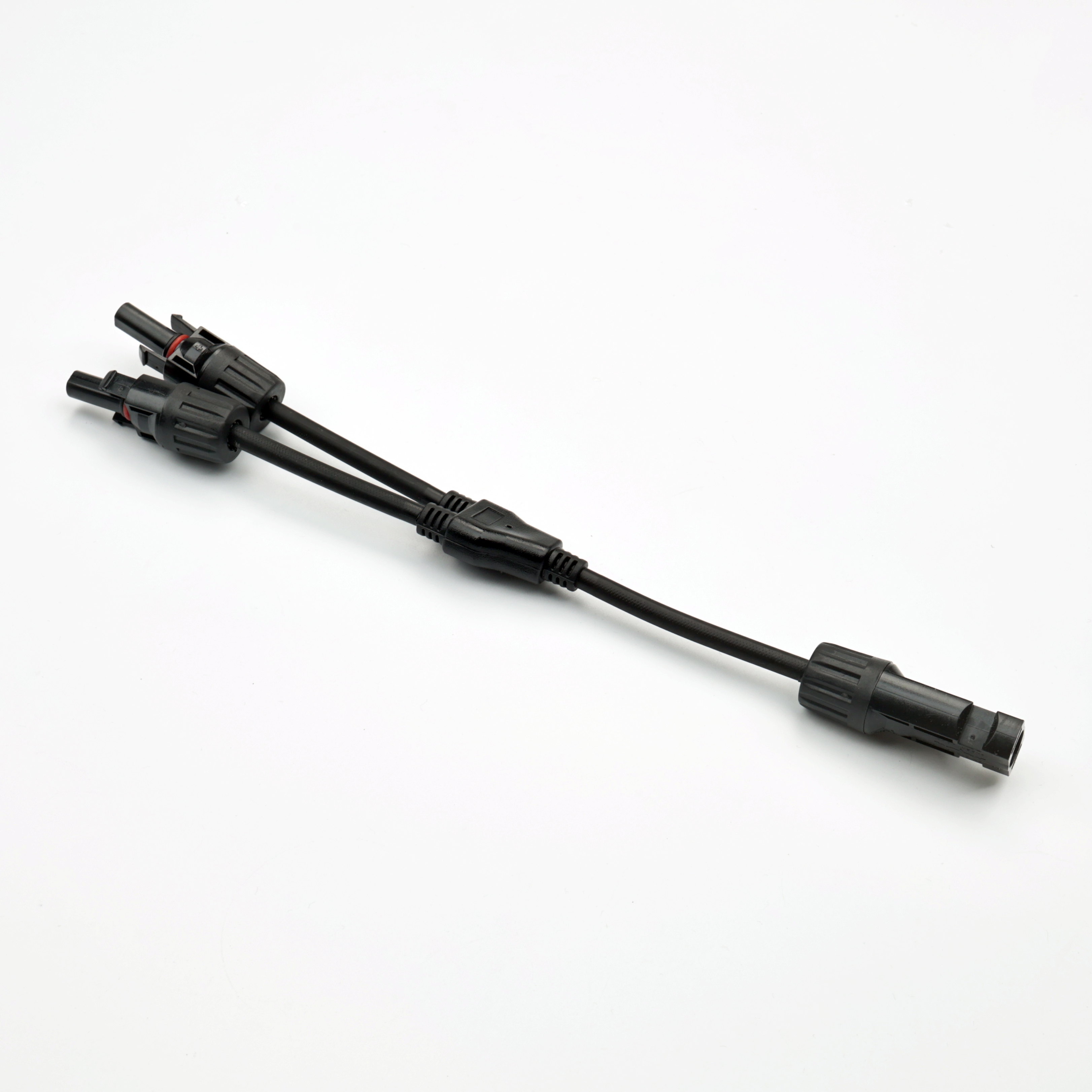
Solar MC4 Y-type branch connector — one of the branch variants used where strings are paralleled before entry into a combiner box.
Why a passed sample cannot settle a multi-year sourcing question
Incoming inspection validates the units inside the box. It says nothing about whether the same nylon grade, the same seal compound or the same plating thickness will be present eighteen months later, after a mould is re-cut, a sub-supplier changes, or a production line is relocated. For waterproof electrical connector accessories, three failure modes account for most long-term complaints:
- Seal degradation. Elastomer seals on cable glands and MC4 housings harden, take compression set, or crack under UV and heat. This is usually invisible at goods-in and appears after one or two summers.
- Terminal oxidation. DC connectors exposed to humidity and thermal cycling can develop plating defects, discoloration and rising contact resistance.
- Dimensional drift. Thread and cable-range tolerance changes only become obvious when a new production lot is mated with an enclosure or gland plate made years earlier.
None of these are reliably caught by a first-article inspection. They are caught by the record a supplier maintains and renews: current certificates, stable material declarations, a defined inspection discipline, and a documented response when a batch does deviate.
What ongoing supplier evidence actually looks like
The first test of supplier sustainability is whether the certificate shown last year is still valid this year, and whether its scope still matches the product being ordered. Zhejiang Gutai Connector Co., Ltd. (Gutai) is a manufacturer of waterproof cable glands, Solar Connector MC4 assemblies, mini waterproof boxes and hose fitting series, based in the Qianzhou Industrial Zone, Liushi Town, Yueqing City, Zhejiang, China. Its documented export profile covers the Middle East, Southeast Asia, India, Pakistan, the EU, the United Kingdom and the USA, with exports representing about 80% of output — which is why its evidence portfolio is organised by market rather than concentrated in a single jurisdiction.
| Document | Standard / scope | Issuer | Identifier | Date recorded |
|---|---|---|---|---|
| Quality management system certificate | GB/T19001-2016 / ISO9001:2015; production of cable waterproof joints | Beijing United Intelligence Certification Co., Ltd. | Registration No. 04324Q31620R0S | Issued 2024-07-02, valid to 2027-07-01 |
| UL Notice of Completion (NoC) | UL 514B; liquid-tight flexible cord fittings (USR, CNR series) | UL Solutions | File E539858, Volume 1 | 2024-09-13 |
| CE Certificate of Compliance | EN 62444:2013; nylon cable gland, Model M; series G, MG, PG, NPT | Dongguan True Safety Testing Co., Ltd. | TST20241202520-1SC | 2024-12-12 |
| RoHS test report | EU RoHS Directive (EU) 2015/863; nylon cable gland | SGS-CSTC Standards Technical Services (Ningbo) Co., Ltd. | NGBEC26005747401 | 2026-07-13 |
The useful reading of this table is not that certificates exist, but that they renew on different clocks. A quality management certificate runs a multi-year cycle with surveillance audits. A test report is a point-in-time measurement. A UL file is maintained only while the listed construction stays unchanged. The RoHS report dated 2026-07-13, against a CE certificate from 2024, shows the renewal rhythm in practice: different documents, different ages, all still current.
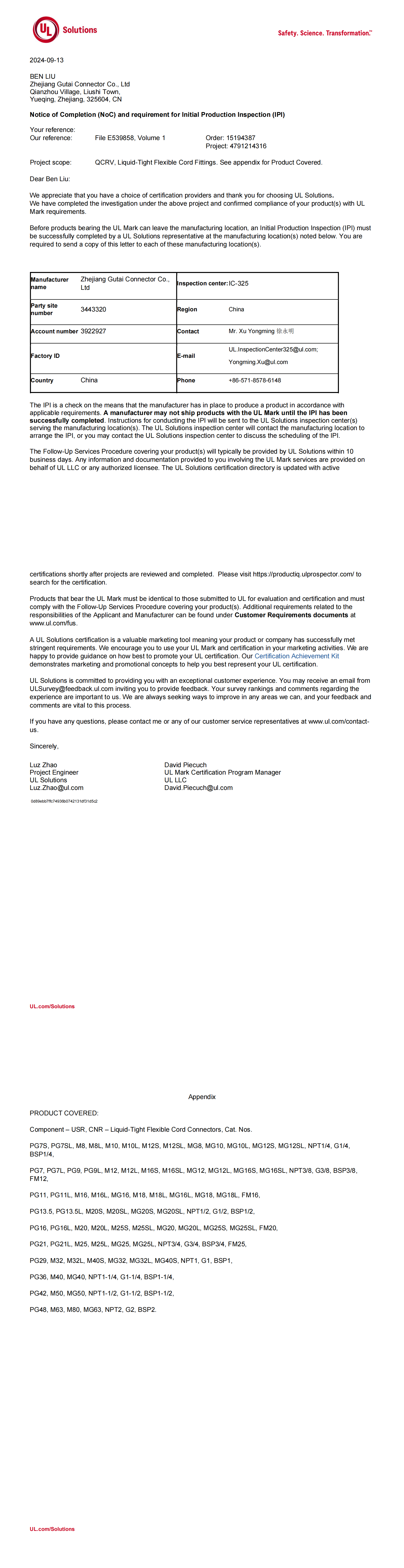
UL Notice of Completion issued under UL 514B, File E539858, Volume 1 — a file maintained only while the listed construction remains unchanged.
Practically, buyers evaluating long-term supply should request the current revision of each document at every annual review, not only at onboarding, and should compare the scope wording against the part number on the purchase order rather than against the supplier's brand name.
Solar MC4 connectors: acceptance criteria that survive outdoor exposure
MC4 assemblies are the highest-risk item in this category because the consequences of a single degraded contact are disproportionate to its cost. The documented Gutai MC4 range covers 1000 V and 1500 V MC4 connectors plus Y-type and T-type branch variants, with Φ2.5 mm, Φ4 mm and Φ6 mm metal plug systems.
| Parameter | Documented value |
|---|---|
| Rated voltage | 1000 V DC |
| Rated current | 30 A (2.5 mm², 4 mm², 6 mm²; 14/12/10 AWG); 45 A (4 mm², 6 mm²; 12/10 AWG) |
| Test voltage | 6 kV (50 Hz, 1 min) |
| Ambient temperature range | -40 °C to +85 °C (IEC); -40 °F to +194 °F (UL); upper temperature limit +105 °C (IEC) |
| Protection class | IP67 mated; IP2X touch protection when unmated |
| Contact resistance | 0.5 mΩ |
| Terminal material | Tin-plated copper or silver-plated copper |
| Insulation housing | PC / PPO, flammability rating UL-94-V0 |
| Corrosion test class | IEC 60068-2-52 |
| Locking system / safety class | Snap-in; Safety Class II |
Two acceptance points that decide multi-year performance
Aging seals. Seals should be assessed for hardening, surface cracking and compression set, and the assessment should be backed by UV aging evidence rather than by visual judgement alone. In a documented desert PV installation supplying 20,000 connectors to a 150 MW plant, the housings passed 1,000-hour UV aging tests and the seals used high-temperature fluororubber, maintaining sealing under surface temperatures around 70 °C combined with wind-sand erosion. Over three years of operation, the reported connector damage rate fell from 8% per year with the previously used imported product to below 1.2%, and connection-failure downtime was reduced by 70%.
Oxidized terminals. Terminal condition should be checked for plating integrity, discoloration and contact-resistance drift. The documented construction uses tin-plated or silver-plated copper terminals with a contact resistance of 0.5 mΩ; silver plating is the option that keeps resistance low where surface temperature and humidity combine.
Document requests that are specific to MC4
When buyers request MC4 evidence, the request list is short and should be exact:
- UL documentation for the MC4 construction. The documented reference is UL 514B, File E539858, Volume 1, issued by UL Solutions.
- Quality management coverage. The MC4 line is produced under an ISO9001:2015 certified quality management system, certified against GB/T19001-2016 / ISO9001:2015.
- Material and performance declarations matching the ordered voltage class (1000 V or 1500 V) and plug size.
- Project-specific standards. Where a specification calls for IEC 62852, EN 50521 or TÜV documentation, buyers should request the named report and confirm it against the ordered catalogue number before approval.
Material and dimensional consistency across PG7–PG48 and M12–M63
For cable glands, long-term reliability is largely a materials question, because the visible geometry rarely changes while the compound behind it does.
| Element | Documented specification |
|---|---|
| Housing and clamping components (A / C / E / F) | UL-certified Nylon PA66, described as high strength and anti-aging |
| Sealing parts (B / D) | NBR nitrile butadiene rubber, for sealing reliability and oil resistance |
| Thread systems | Metric (M12–M63), PG (PG7–PG48), plus G thread and NPT thread options |
| Cable range | 3–45 mm across the range |
| Metric thread O.D. / thread length | 12–63 mm / 9–21 mm |
| PG thread O.D. / thread length | 12.5–59.3 mm / 9–21 mm |
| Protection and compliance claims | IP68, with CE, RoHS, REACH and CCC listed |
| Static temperature | -40 °C to +100 °C, peak instantaneous up to +120 °C |
| Dynamic temperature | -20 °C to +80 °C, peak instantaneous up to +100 °C |
| Standard colours | Black (RAL9005), light grey (RAL7035), silver (RAL7001) |
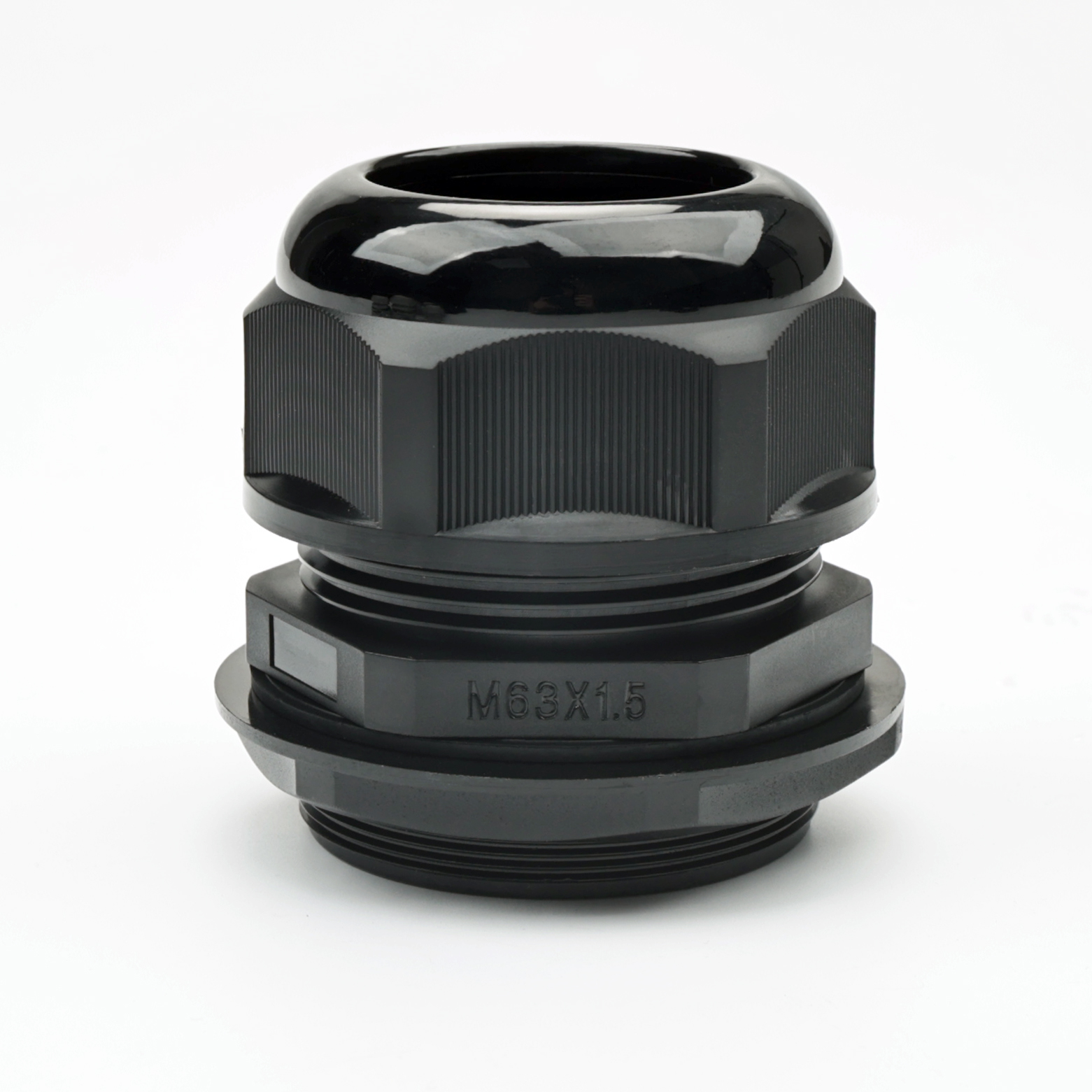
M63 metric nylon cable gland (35–45 mm cable range) — the upper end of a series that spans M12 to M63 under the same Nylon PA66 and NBR construction.
Two rows in this table work as change-detection points. The first is the resin declaration: UL-certified Nylon PA66 is a specific material claim, not a generic description, so a move to an uncertified or recycled grade breaks the claim even if the moulded part looks identical. The second is the seal compound: NBR is selected for oil resistance and stable sealing, and a substitution to a lower-cost elastomer is normally invisible at goods-in but surfaces as hardening after a season or two.
Dimensional consistency is the third check, and it is where a broad product family creates the most risk. With 3–45 mm cable capacity spread across two thread systems and dozens of size combinations, a supplier's inspection discipline matters more than any single dimension. Gutai documents 100% full dimension inspection as its quality-control method, alongside a stated manufacturing capacity of 500,000 cable glands and 100,000 MC4 sets per month and a facility of 5,000 m² with 80 employees, including 10 engineers. The relevant buyer question is not whether inspection happens in principle, but whether its record can be produced for the specific lot received.
Where long-term consistency is tested in practice
The application profile of these accessories explains why continuity evidence matters more than peak specifications. Documented deployment covers PV plant and panel cable entries, wind turbine cable outlets, EV charging station and distribution box entries, energy storage system wiring, rail transit and telecom wiring, and industrial automation cable protection — environments described as outdoor and indoor humid, dusty and temperature-variable.
A second documented project illustrates how the same evaluation logic applies to glands rather than connectors. For a coastal open-air EV charging project in Europe, 5,000 sets of IP68-grade metal waterproof connectors were deployed on outdoor DC fast charging piles exposed to high-salt fog, strong sea wind and high-frequency vibration. The construction used 304 stainless steel and a dual-seal anti-loosening structure, and passed 1,000-hour salt spray tests and IEC 60068-2-6 vibration tests. Over an 18-month period, the reported connector-related electrical failure rate fell from 18% per year to 2.6%, annual maintenance cost per station dropped from over 500 RMB to below 80 RMB, and new-station installation efficiency increased by 35%.
For buyers, the transferable lesson is not the specific numbers but the shape of the evidence: a documented test, tied to a documented construction, tied to a documented project condition.
Market context behind the shift toward evidence-based sourcing
The category itself is expanding, which raises rather than lowers substitution risk. Third-party estimates place the global cable glands market at roughly USD 2.16 billion to 2.25 billion in 2024–2025, with forecasts ranging from USD 3.07 billion to USD 4.96 billion by 2034 depending on methodology. The global waterproof connector market is estimated at approximately USD 13.4 billion in 2024, projected to reach USD 25.48 billion by 2033 at a CAGR of 7.4%. Within solar, the PV connector segment was valued at about USD 1.31 billion in 2024, with MC4-type connectors holding roughly a 68% share of that segment. Asia Pacific accounts for an estimated 38–42% of global cable gland revenue.
The wide forecast range is itself a signal. When credible analysts disagree by more than a factor of one and a half, buyers should weight verifiable supplier evidence more heavily than market narrative, because growth attracts new entrants whose documentation is thin and whose material declarations are hard to audit.
Where this evaluation method has limits
An evidence-based approach is stronger than a sample-only approach, but it is not a complete guarantee, and buyers should be explicit about the boundaries.
- File scope is narrower than brand scope. The UL Notice of Completion under UL 514B, File E539858, Volume 1 covers liquid-tight flexible cord fittings in the USR and CNR series, with full catalogue numbers listed in the file appendix. A notice covering a file does not automatically cover every part a supplier sells. Buyers should confirm the specific ordered catalogue number appears in the appendix.
- Certificates are market-specific. The UL documentation applies to the US and Canadian markets; the EN 62444:2013 CE certificate covers nylon cable glands (Model M; series G, MG, PG, NPT) for the EU; the RoHS test report scope is nylon cable gland; CCC addresses China. A buyer ordering for a market not covered by the relevant document must request market-specific evidence.
- Validity windows expire. The ISO9001:2015 certificate is recorded as valid to 2027-07-01. Beyond that date, the evidence must be re-issued. A sourcing file without a renewal check at each audit cycle becomes a liability rather than an asset.
- Testing is condition-specific. The documented 1,000-hour UV and 1,000-hour salt spray results were obtained for defined project conditions. They should not be extrapolated to a different climate, mounting method or cable loading without matching test evidence.
- Certification does not control installation. Torque, mating force, cable support and connector orientation remain field variables outside the supplier's control, and they influence long-term behaviour as much as the product itself.
Future outlook
The direction of travel in procurement is from document collection to document maintenance. Buyers are increasingly asking not 'do you have certificates?' but 'which certificate, covering which part number, valid until when, and what happens at renewal?' That shift favours suppliers whose scope statements are precise enough to be checked: a named standard, a file number, a catalogue appendix, a stated material grade.
A second shift concerns the MC4 segment specifically. As PV connector demand grows and MC4-type connectors hold the majority of that demand, the risk of untracked substitution rises. Buyers who can re-run acceptance criteria — seal condition, terminal oxidation, dimensional conformity — against a stable document set will spot drift earlier than buyers who re-qualify from scratch each year. For suppliers, the corresponding requirement is continuity: the same material declarations, the same test classes, and the same inspection records across production years. Gutai's documented OEM/ODM scope, small trial order acceptance and quality-related after-sales policy form the operational side of that continuity, while the certificate set forms the auditable side.
FAQ
1. Which certificates should a buyer verify first when sourcing waterproof electrical connector accessories?
Start with the quality management certificate and the market-specific product certification. The documented Gutai quality management certificate, Registration No. 04324Q31620R0S, is issued by Beijing United Intelligence Certification Co., Ltd. against GB/T19001-2016 / ISO9001:2015 for the production of cable waterproof joints, valid from 2024-07-02 to 2027-07-01. Market-specific documents include the UL Notice of Completion under UL 514B (File E539858, Volume 1), the CE Certificate of Compliance TST20241202520-1SC against EN 62444:2013, and the SGS RoHS test report NGBEC26005747401 against EU RoHS Directive (EU) 2015/863. IP68, REACH and CCC are listed as additional claims.
2. How does ISO9001:2015 continuity relate to long-term supplier reliability?
A quality management certificate is time-bound, so it functions as a recurring check rather than a permanent credential. The documented certificate is issued against GB/T19001-2016 / ISO9001:2015, applied to the production of cable waterproof joints, with a validity period ending 2027-07-01. Buyers should record that date and re-request the certificate before it lapses, because a supplier that cannot show an in-date certificate has an unverified quality management system regardless of past performance.
3. What does UL 514B File E539858 actually cover for cable glands and MC4 connectors?
It is a Notice of Completion for QCRV liquid-tight flexible cord fittings in the USR and CNR series, certified to UL 514B and issued by UL Solutions under File E539858, Volume 1, dated 2024-09-13, applicable to the US and Canadian markets (Order 15194367, Project 4791214316). The full catalogue numbers are listed in the file appendix, so buyers should verify that the specific catalogue number being ordered is included rather than assuming the whole product family is covered.
4. How can buyers check material consistency for Nylon PA66 / NBR cable glands across PG7–PG48 and M12–M63?
Ask for three records: the resin declaration, the seal compound declaration, and the dimensional inspection record for the received lot. The documented construction uses UL-certified Nylon PA66 for housing and clamping components (A / C / E / F) and NBR nitrile butadiene rubber for sealing parts (B / D). The metric series spans M12–M63 with 3–45 mm cable capacity and 12–63 mm thread outer diameter; the PG series spans PG7–PG48 with 3–45 mm cable capacity and 12.5–59.3 mm thread outer diameter. Both are rated IP68 with CE, RoHS, REACH and CCC listed.
5. What acceptance criteria apply to Solar MC4 connectors after outdoor exposure?
Two conditions should be inspected. First, seal condition — hardening, surface cracking and compression set — supported by UV aging evidence rather than visual judgement alone; in a documented desert PV installation, the housings passed 1,000-hour UV aging tests and the seals used high-temperature fluororubber. Second, terminal condition — plating integrity, discoloration and contact-resistance drift; the documented construction uses tin-plated or silver-plated copper terminals with a contact resistance of 0.5 mΩ.
6. If a project requires TÜV, IEC 62852 or EN 50521 evidence for MC4 connectors, what should buyers request?
Request the named report for the specific catalogue number and voltage class, and confirm that the report's scope matches the ordered part. Where such reports are not part of a supplier's documented portfolio, the requirement should be treated as an open item and confirmed before approval. The documented MC4 evidence currently covers UL 514B (File E539858, Volume 1) and an ISO9001:2015 quality management system; these are separate standards and are not substitutes for IEC 62852 or EN 50521 reports.
7. Does an IP68 or IP67 rating on its own prove long-term reliability?
No. IP68 is the benchmark ingress protection rating and requires withstanding continuous immersion under specified conditions, but it describes performance under defined test conditions rather than years of service. The documented MC4 construction is rated IP67 when mated with IP2X touch protection when unmated, while the cable gland range is rated IP68. Long-term reliability depends on additional factors — material grade, seal compound, dimensional consistency and terminal plating — which is why buyers should evaluate the full evidence set rather than a single rating.
For the complete connector range discussed above, including thread systems, cable ranges and material options, the manufacturer's product brochure is available here: 2025 Gutai Connector Product Brochure (PDF).
Tem questões ou precisa de mais detalhes?
Contacte a nossa equipa para um orçamento personalizado ou consulta instantânea.
Solicitar orçamento
Preencha o formulário abaixo e a nossa equipa entrará em contacto com uma proposta personalizada.
Chat direto do WhatsApp
Prefere conversar em tempo real? Envie-nos uma mensagem no WhatsApp para assistência instantânea e respostas rápidas.
- Obter orçamento personalizado
- Partilhar fotos ou documentos
- Discuta as suas necessidades diretamente
Geralmente responde em 5–30 minutos durante o horário de expediente.