
Solar MC4 vs. PG Gland: Independent Buyer Comparison for PV Arrays
Solar MC4 connectors and PG cable glands are frequently grouped under the same waterproof electrical connector accessories heading, but they are not interchangeable parts. In a photovoltaic array, an MC4 connector is the DC power connection point, while a PG cable gland is the sealed mechanical cable entry at an enclosure wall.
This comparison is aimed at buyers moving from general research into supplier evaluation. It does not pretend that one component is universally better than the other. Instead, it compares where each product fits in a PV plant, how each one achieves sealing, and what certification evidence a buyer should verify before committing to a product list.
Solar MC4 Connector: The DC Connection Function
Reference data in this review uses the Solar MC4 Connectors range published by Zhejiang Gutai Connector Co., Ltd., a manufacturer based in Liushi Town, Yueqing, Wenzhou, Zhejiang, China, which makes both solar MC4 connectors and cable-gland systems. Within that range, the 1000V MC4 connector is the baseline model, with a rated voltage of 1000V DC and rated current levels of 30A and 45A depending on conductor size and AWG designation. The documented current positions include 30A across 2.5mm², 4mm² and 6mm² conductors, and 45A for 4mm² and 6mm² conductors, with equivalences for 14AWG, 12AWG and 10AWG.
The product specification also lists a test voltage of 6kV at 50Hz for 1 minute, a mated protection class of IP67, an unmated touch-protection rating of IP2X, contact resistance of 0.5mΩ, safety class II, and a flammability rating of UL94 V-0. Terminal materials are tin-plated copper or silver-plated copper, while the insulation housing is PC/PPO. The locking system is snap-in. The corrosion test class is IEC 60068-2-52, which is relevant for outdoor solar installations where salt, humidity and temperature variation are present.
In addition to the 1000V version, the Sun-Shine series listing includes 1500V MC4 connectors, Y-type connectors and T-type connectors. These variants matter in PV-array design because branch configurations often require a connector that can create a Y or T junction without unnecessarily long cable loops.
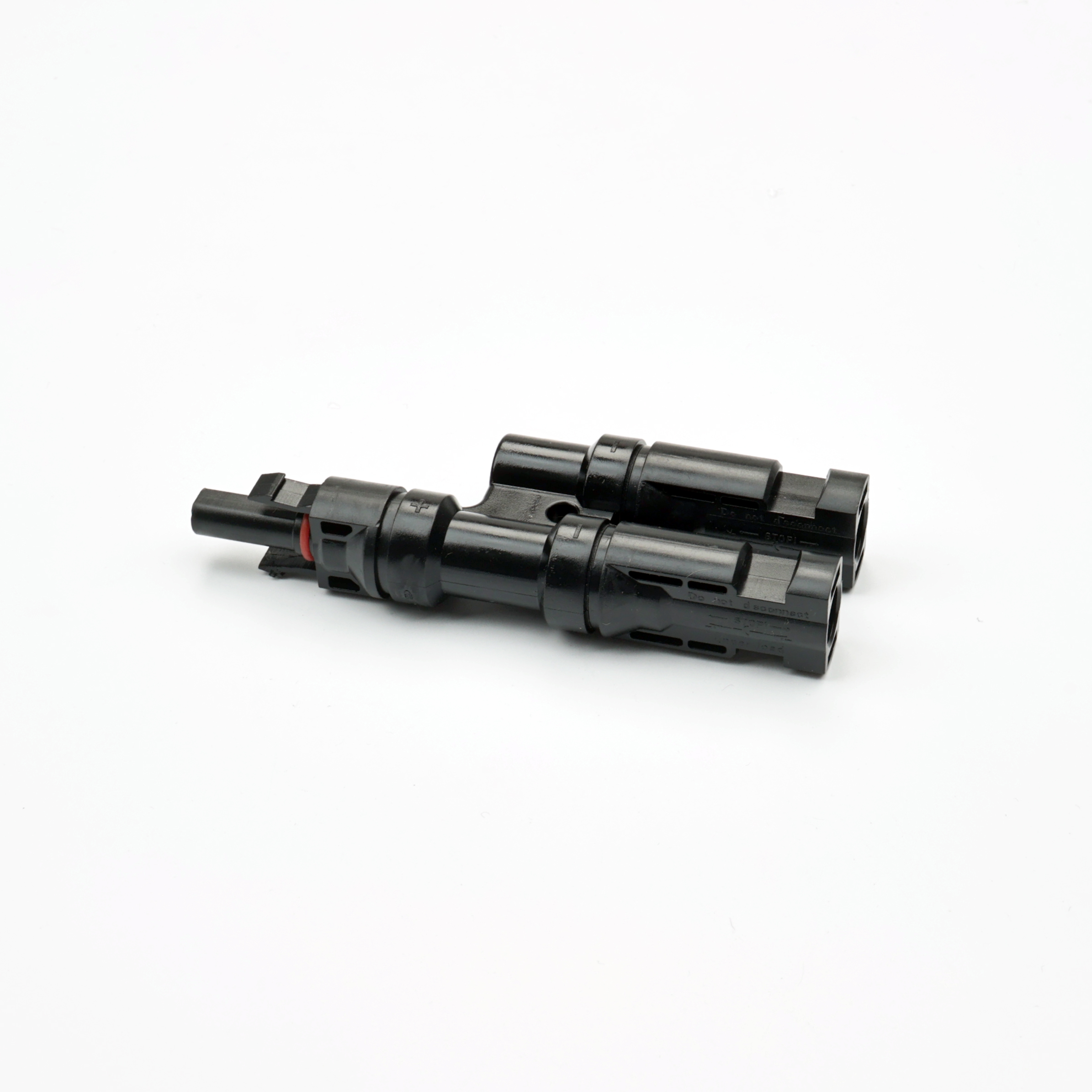
Solar MC4 connector family includes Y-type and T-type branch configurations for PV arrays.
PG Cable Gland: The Enclosure-Entry Function
A PG cable gland is not designed to carry the same electrical load as a DC solar connector. It is an enclosure-entry fitting that fixes a cable where it passes through the wall of a junction box, combiner box, inverter enclosure, EV charger enclosure or similar electrical housing. The PG line supplied as a product type by Zhejiang Gutai Connector Co., Ltd. is documented with thread sizes from PG7 to PG48, cable clamping range from 3mm to 45mm, thread outside diameter from 12.5mm to 59.3mm, and thread length from 9mm to 21mm. Material construction is Nylon PA66 with NBR nitrile butadiene rubber sealing parts.
The PG product data lists CE, RoHS, REACH, IP68 and CCC in the declared compliance set. The nylon PA66 material is described as UL-approved, which is a material-level fact that should be distinguished from a complete fitting-level UL listing. The product also uses a clamping-claw and rubber-sealing structure, giving a wider clamping range and improving pull-out resistance compared with simpler entry bushings. Static operating temperature range is stated as -40°C to 100°C, with an instantaneous peak up to 120°C; dynamic range is -20°C to 80°C, with a peak up to 100°C.
The distinction is therefore not MC4 versus PG gland as two competing products. It is two different boundary conditions in a complete PV system. An MC4 connector is specified where an energised DC circuit must be connected. A PG gland is specified where an energised DC cable must enter a protected enclosure through a sealed, strain-relieved port.
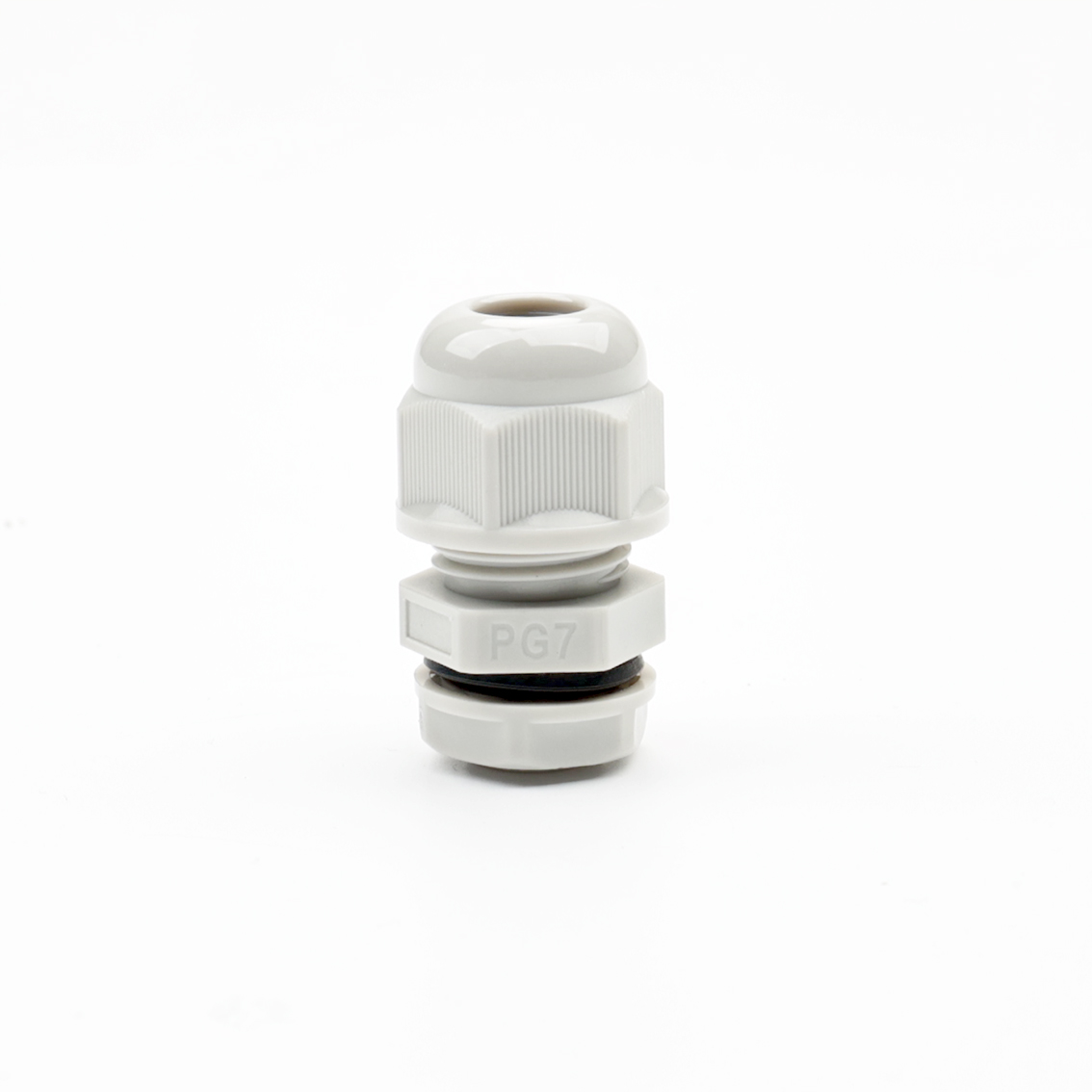
PG7 cable gland example from the PG series, which extends to PG48 with a total cable coverage range of 3-45mm.
Application Fit: Where Each Component Belongs on a PV Array
The application-scenario reference for these product families covers solar PV, wind power, EV charging stations, energy storage, automated assembly, rail transit, telecom stations and general industrial equipment. Working conditions are described as outdoor and indoor humid, dusty and temperature-variable environments. Some products are rated IP68, and the project-type list includes PV plant and panel cable entries, wind turbine cable outlets, EV charging station and distribution-box cable entries, energy storage system wiring, rail transit and telecom wiring, and industrial automation cable protection.
For a PV array specifically, the following placement logic can be used:
- Module-to-module DC cable connections and string DC junctions are typically handled by MC4-style solar connectors.
- When a DC cable enters a combiner box, a junction box or an inverter enclosure, the entry port needs a cable gland with a matching thread size and cable clamping range.
- When a wiring system needs a branch or parallel connection between strings, a Y-type or T-type MC4 connector is more appropriate than a gland.
- When the enclosure is already fully potted or sealed and no cable entry is required, neither product belongs in the design.
| Design point | Solar MC4 connector | PG cable gland |
|---|---|---|
| Primary function | DC current-carrying connector with mate-and-unmate capability | Cable entry seal, mechanical fixation and strain relief |
| Typical PV-array position | Between PV modules, strings, branch connectors and DC equipment | At enclosure walls of combiner boxes, inverters, junction boxes and storage cabinets |
| Representative specification | 1000V DC, 30A/45A, IP67 mated, IP2X unmated, 0.5mΩ contact resistance | PG7-PG48, cable range 3-45mm, IP68, Nylon PA66/NBR |
| Installation mode | Snap-in connector for field plug-and-play connection | Panel or enclosure mounting at cable entry |
| Common documentation | PV connector electrical parameters, corrosion test class, V-0 flammability | Thread size, cable range, IP protection, material declaration |
Sealing Mechanisms: What the Specifications Reveal
The IP ratings are easy to compare incorrectly, so they need careful wording. For the 1000V MC4 connector in the reference data, the protection class is IP67 when mated and IP2X when unmated. This is not an IP68 component. The IP67 value depends on the connector halves being fully locked together. If a buyer asks for IP68 at the PV string connector point, the datasheet alone will not support that claim.
The PG cable gland uses a different sealing concept. It is a compression-type cable entry: the clamping claw and rubber sealing structure press the gland around the cable circumference, providing ingress protection and pull-out resistance. The material list for the PG series identifies NBR sealing parts, which is a nitrile rubber chosen for sealing and oil resistance. The product line is rated IP68 for waterproof and dustproof performance.
In a PV array context, this contrast should not lead a buyer to conclude that IP68 means the cable gland is electrically superior. The gland is not a power connector. The correct interpretation is that the gland provides a sealed cable transition, while the MC4 connector provides a rated DC electrical junction.
Certification Evidence: What Should Be Requested
Two standards families are especially relevant to this comparison. The first is IEC/EN 62444, which sets construction and performance requirements for cable glands in electrical installations. European and international project documentation may reference EN 62444 instead of older references such as BS EN 50262. The second is IEC 60529, which defines the IP code and the test conditions behind an IP68 statement.
From the manufacturer reference data:
- The PG cable-gland product line states CE, RoHS, REACH, IP68 and CCC in its compliance declaration.
- The PG gland material data states that Nylon PA66 is UL-approved at material level.
- The MC4 connector product data lists a 6kV test voltage, UL94 V-0 flammability, safety class II and IEC 60068-2-52 corrosion testing, but it does not claim the same IP68 rating as the cable-gland line.
North American buyers may see additional fitting requirements such as UL 514B for conduit and cable fittings. Because a material-level UL approval is not the same as a fitting-level UL listing, a project specification that requires UL 514B should request the complete fitting certificate from the supplier rather than accepting a generic material statement.
When PV-connector-specific compliance is required, buyers may ask about IEC 62852 or EN 50521. The reference knowledge note from the manufacturer states that core products have passed CE, RoHS, REACH and IP68 protection-level tests, and that for specific PV connector projects the company can provide pre-test data and certification path planning compliant with IEC 62852, with full testing completed through authorised laboratories. That language is not equivalent to presenting an existing third-party IEC 62852 certificate in every case, so the buyer should request the exact report applicable to the specified model.
Project Evidence: PV Plant and Outdoor DC Infrastructure Cases
Reported project evidence helps explain how these components behave in severe conditions, although all case figures should be read as manufacturer-submitted data rather than independent third-party test results.
One documented desert PV project involved a large Middle Eastern developer and 20,000 sets of anti-UV modified PA66 photovoltaic connectors for a 150MW plant. According to the case summary, the connector damage rate dropped from 8% annually for the original imported product to below 1.2% after replacement, connection-related downtime was reduced by 70%, and cumulative maintenance and generation-loss savings exceeded 80,000 USD. The materials were described as passing 1,000-hour UV ageing tests, with high-temperature fluororubber seals used to maintain sealing under surface temperatures of about 70°C and strong wind-sand erosion. The connector housings were customised for desert exposure rather than being standard indoor or low-cost thermoplastic parts.
A separate European case involved the first batch of 5,000 IP68-graded metal waterproof connectors for coastal outdoor DC fast-charging piles. The reported result was a fall in connector-related electrical failures from 18% annually to 2.6%, annual maintenance cost per station dropping from over 500 RMB to under 80 RMB, and installation efficiency for new stations rising by 35%. The solution included 304 stainless steel, a dual-seal anti-loosening structure, 1,000-hour salt-spray testing and IEC 60068-2-6 vibration testing.
For PV-array buyers, the second case is not about solar modules but it is still relevant because the same outdoor DC infrastructure principle appears in PV combiner boxes, storage containers and inverter stations located in coastal or salt-prone environments.
Market Context and Implications for Buyers
Verified market figures give a sense of how much demand is carried by these two product categories. The global solar PV connector market was valued at approximately USD 1.31 billion in 2024, and MC4 connectors accounted for roughly 68% of that segment. The global cable-glands market was estimated at roughly USD 2.16 billion to 2.25 billion in 2024-2025, with some forecasts reaching USD 3.07 billion to 4.96 billion by 2034 depending on the research source. Asia Pacific was identified as the largest regional cable-glands market, representing an estimated 38% to 42% of global revenue.
The procurement implication is not simply that the market is growing. It is that PV projects routinely require both product categories, and that category share alone does not prove quality. An MC4 connector with 68% market presence still needs checking against the actual voltage, current, cable size, enclosure-entry and environmental requirements of the specific project.
Traditional Assumptions and Boundary Conditions
Older installation practice sometimes treated cable enclosure entries as a low-risk detail, using rubber grommets, field-applied sealant or simple non-certified bushings. Those methods can work in dry indoor conditions, but they do not offer a reproducible cable clamping range, a defined IP test condition or a documented material declaration. Moving that same cable entry to a PG cable gland gives the project a measurable thread size, a specified cable range and a sealing structure designed for the enclosure.
There are still boundaries that need to be respected:
- An IP68 cable gland is not a universal guarantee of permanent underwater operation. IEC 60529 defines IP tests under specified conditions, so the actual test depth and duration should be requested from the supplier.
- A PG cable gland is not a substitute for an MC4 connector at a module-string junction. It has no rated DC current and no disconnect switching purpose.
- An MC4 connector is not the correct part for an enclosure entry. Unless the enclosure port is specifically designed to receive a mating MC4 connector, a cable passing through a wall needs a cable gland.
- Dynamic movement changes the operating temperature range. The PG data states a static range of -40°C to 100°C, but the dynamic range is lower: -20°C to 80°C. A flexible cable connection exposed to continuous vibration must be checked against the dynamic limit, not the static peak.
Future Outlook: Higher DC Voltage and More Balanced Spec Sheets
PV and energy-storage systems are moving toward higher DC voltages and more compact installation models. The presence of 1500V MC4-style connector references in the example product range reflects that shift. Branch connectors such as Y and T versions also indicate that installers no longer treat a solar connector as a simple straight plug; they need array-level branch logic.
As systems become more standardised, buyers should expect certification evidence to become more precise. Cable glands will be judged against EN 62444 and the exact IP68 test report, while solar MC4 connectors will increasingly be judged against PV-specific connector standards rather than generic electrical specifications. A responsible procurement document will separate the two tasks, assign the right component to each physical boundary, and ask different verification questions for each one.
FAQ
How should I decide between a solar MC4 connector and a PG cable gland in a PV-array BOM?
Start from the connection point. If the function is to create or continue an energised DC circuit between module cables, strings or branch jumpers, choose a solar MC4 connector. If the function is to bring a cable through an enclosure wall in a sealed, protected way, choose a cable gland with the matching thread and cable range. When both functions exist in the same system, both components are required.
Why is the MC4 connector rated IP67 while the PG cable gland is rated IP68?
The two products are tested for different mechanical situations. A mated MC4 connector is IP67 because both halves of the connector are locked together and sealed as a connector system. The PG cable gland is IP68 and uses a compression clamp and rubber seal around the outer cable circumference. IP68 is not necessarily a sign that the gland is a better electrical product; it is a different kind of component with a different sealing task.
What documentation should I request for a PG cable gland used in a PV junction box?
Ask for the declared compliance statement, material declaration and IP test report. For European projects, the relevant cable-gland standard family is EN 62444/IEC 62444. The IP report should identify the test conditions used for the IP68 claim. A CE declaration and RoHS/REACH statements are also useful, but they should not be confused with an IP test certificate.
Should I ask for IEC 62852 evidence when buying solar MC4 connectors?
If the connector will be used in a PV application and the project specification requires PV connector compliance, yes. Ask whether the supplier can provide a specific IEC 62852 test report for the exact model. If the supplier only offers pre-test data and certification-path planning, that tells you the testing process has not yet been completed for that part number.
Can one supplier cover both solar MC4 and cable-gland requirements?
Yes. A manufacturer such as Zhejiang Gutai Connector Co., Ltd. lists both Solar MC4 connectors and PG-series cable glands, which simplifies the part-number matching process and can reduce inventory complexity. Even when both product families come from one supplier, the buyer should still verify model-level specs, thread compatibility, actual cable diameter and the required project certifications.
Manufacturer reference source for the data discussed above: Zhejiang Gutai Connector Co., Ltd. current product catalogue (PDF).
Tem questões ou precisa de mais detalhes?
Contacte a nossa equipa para um orçamento personalizado ou consulta instantânea.
Solicitar orçamento
Preencha o formulário abaixo e a nossa equipa entrará em contacto com uma proposta personalizada.
Chat direto do WhatsApp
Prefere conversar em tempo real? Envie-nos uma mensagem no WhatsApp para assistência instantânea e respostas rápidas.
- Obter orçamento personalizado
- Partilhar fotos ou documentos
- Discuta as suas necessidades diretamente
Geralmente responde em 5–30 minutos durante o horário de expediente.