
Solar Panel EL Testing Equipment: What Buyers Must Specify
Electroluminescence testing is the inspection gate that separates an A-grade module from scrap, and it sits at the most expensive point in the line: after lamination, after trimming, after framing. In module lines sized between 50 MW and 200 MW, the EL station is rarely the largest capital item, but it is frequently where specification mismatches surface — a module format the tester cannot accept, a workshop without the right air supply, or an expectation that imaging will substitute for electrical measurement.
The constraint layer around solar panel EL testing equipment is therefore more decision-critical than the marketing layer. This reference sets out what an automatic EL tester actually inspects, the parameters a buyer can verify before purchase, the integration conditions inside a 100–200 MW line configuration, and the boundaries where an EL station will not solve the problem it is sometimes bought for.
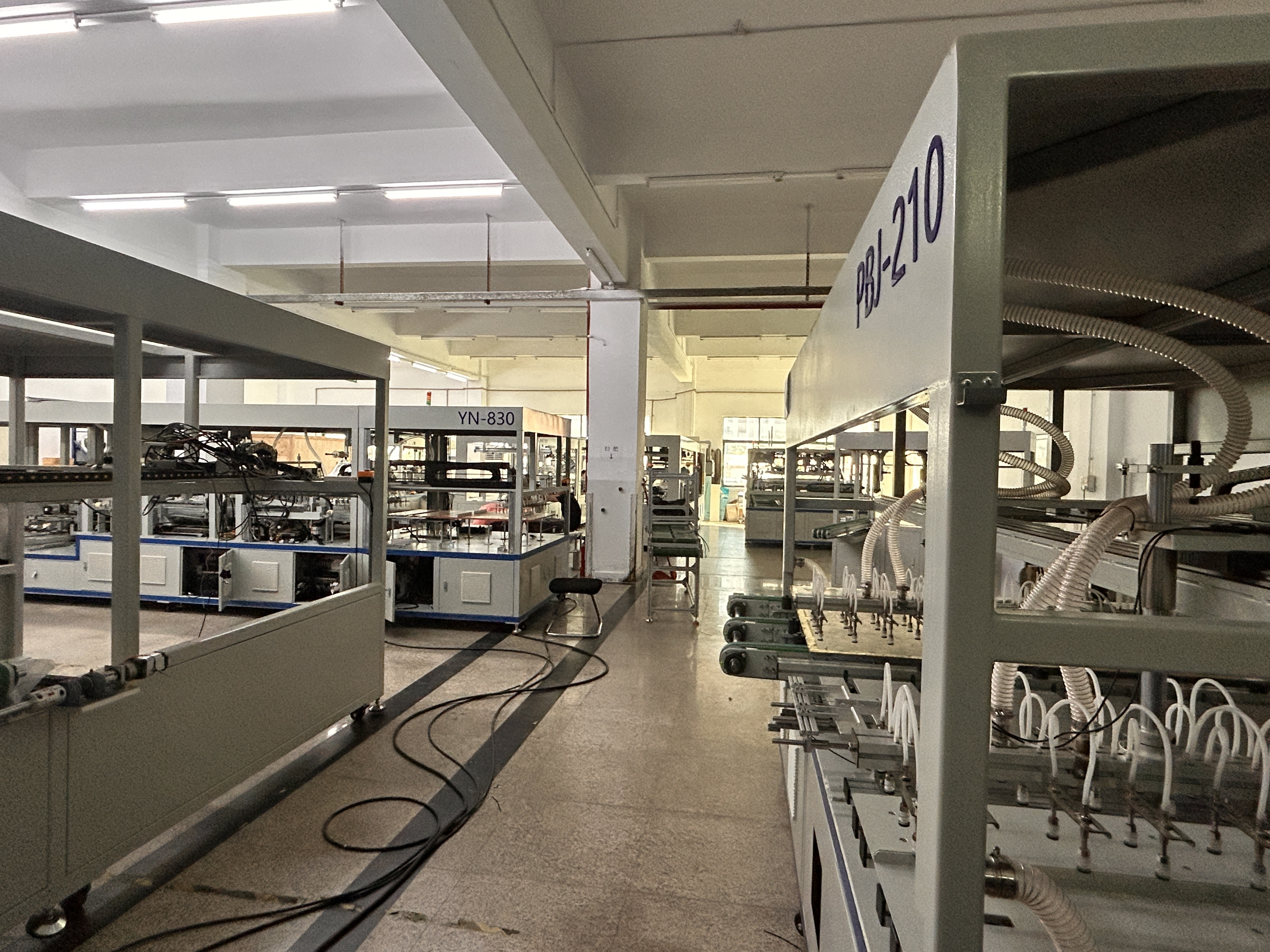
Why EL inspection becomes a constraint rather than an accessory
A defect that escapes the EL station is not detected later; it is shipped. Cracks, cold solder joints and other internal faults described in YNTECH's technical documentation are precisely the class of defect that can survive visual inspection and only appear as field failure or power loss. The economic logic is straightforward: the further a defective module travels down the line — through lamination energy, framing material, junction box adhesive, packing and freight — the greater the loss when it is finally rejected.
That logic tightens under price compression. The U.S. Department of Energy's Fall 2025 Solar Industry Update reports module prices in China reaching USD 0.10–0.12/W in 2025 under oversupply conditions. When the finished module is worth a few dollars per watt-tenth, material waste and rework become the dominant controllable cost, and inspection stops being a quality gesture and becomes a yield instrument. The same pressure shows up at line level: YNTECH's documented line configurations for line upgrade and retrofitting target A-grade yield above 97%, a figure that only holds if defects are intercepted before final assembly.
What an automatic EL tester actually does
Electroluminescence testing is a PV inspection method that captures electroluminescence images to detect internal defects of solar cells and cell strings. The working principle is direct: the equipment injects electric current into the solar cells, and a camera captures the resulting luminescence image, in which hidden cracks, cold solder joints and comparable internal faults appear as dark or discontinuous regions against an otherwise uniform emitting surface.
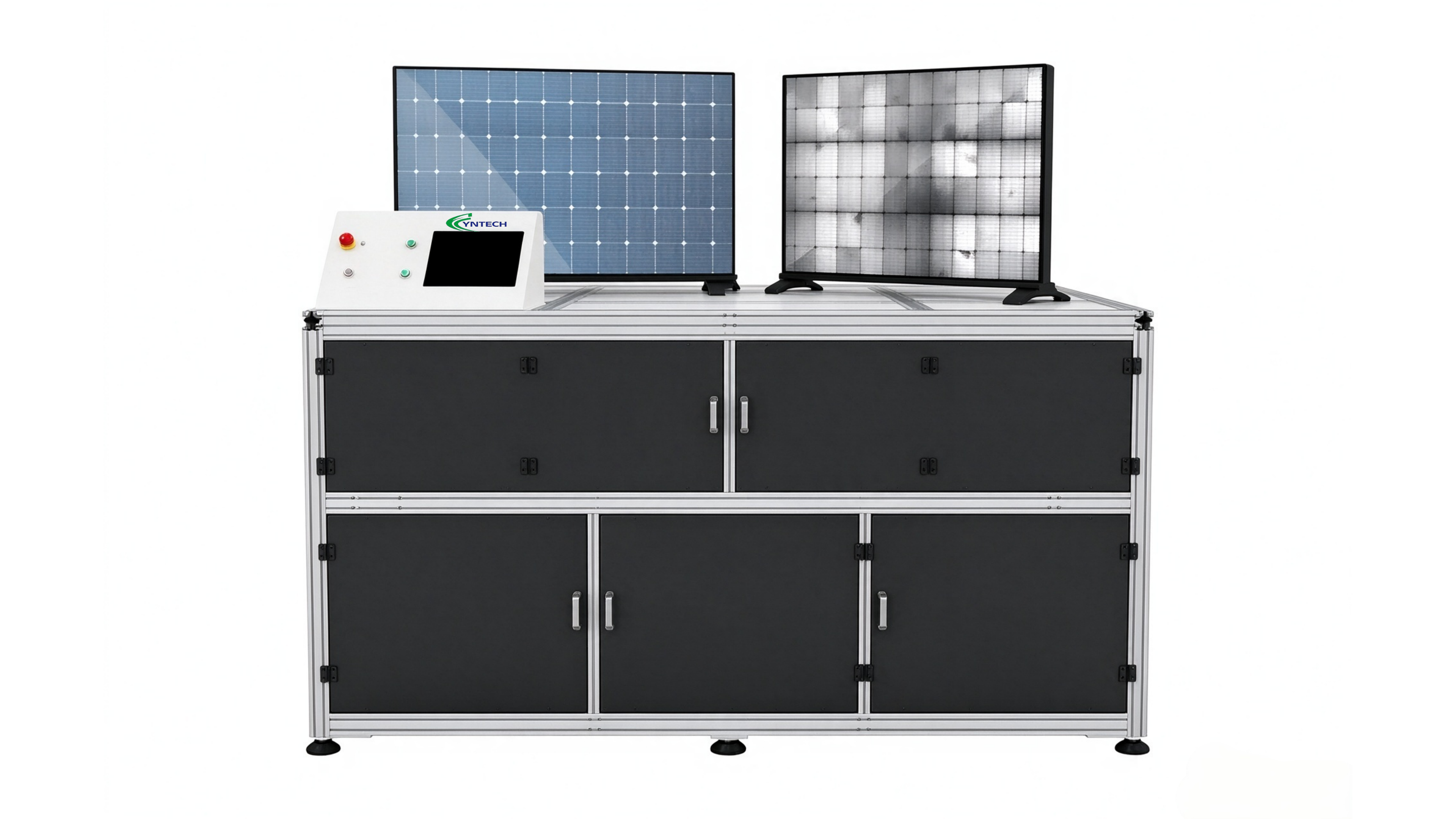
YNTECH Solar Panel Machine is the equipment brand of YN Solar PV Equipment Co., Ltd., a manufacturer established in 2015 in Dongguan, Guangdong Province, China, that builds PV module assembly equipment and turnkey solar panel production lines. Its offering in this category is the Automatic EL Tester (product name: EL Testing Machine), a machine intended for PV module manufacturers undertaking line upgrade, retrofitting, or manual-to-automatic transformation.
Mechanical and optical construction
The equipment body uses a steel structure, which the manufacturer specifies for high strength and high stability. A double slide rail design supports smooth sliding motion, and the conveyor uses a PU belt with a green cloth surface intended to reduce glass scratches — a material-handling detail that matters because an EL station sits downstream of processes where the glass surface is already fully laminated. A speed control motor can be adjusted quickly according to production line demand, and the machine is built from carbon steel together with a light-shield housing, camera cover and optical glass. The light-shield housing is not cosmetic; imaging depends on controlled illumination conditions, and the camera protection assembly is what keeps the optical path stable across shifts.
The specification layer buyers must verify
For a constraint-driven purchase decision, the parameters below are the ones that determine whether the machine fits an existing line. They are stated exactly as published in the manufacturer's specification.
| Parameter | Published value | Procurement implication |
|---|---|---|
| Panel size — length | 1634–2500 mm | Modules outside this window are not covered by the standard configuration |
| Panel size — width | 986–1400 mm | Defines the format envelope; oversized formats require a custom design |
| Conveying speed | 0–20 m/min | Adjustable to match line takt rather than a fixed inspection cycle |
| Power supply | 380 V, 50/60 Hz, 3-phase 5-wire | Requires a three-phase five-wire feed at the installation point |
| Equipment power rating | 1 kW | Low electrical load relative to lamination and framing equipment |
| Air source | 0.6–0.8 MPa | Compressed air must be available at the station, dry and stable |
| Body materials | Carbon steel, light-shield housing, camera cover, optical glass | Optical components are part of the machine scope, not a consumable add-on |
| Intended application | PV module manufacturers: line upgrade, retrofitting, manual-to-automatic conversion | Positioned as an in-line upgrade unit, not a standalone lab instrument |
Fitting the EL station into a 50–200 MW line
An EL tester is a line component, and its value depends on the takt of the equipment around it. YNTECH publishes a 100–200 MW solar panel production line upgrade configuration with an A-grade yield rate above 97%, cell widths of 78–210 mm, string spacing of 1–10 mm, and a power supply rated at 15 kW. That capacity band is the context in which an automatic EL station is normally justified: large enough that manual inspection cannot keep pace, small enough that a single inspection unit covers the throughput.
Upstream throughput figures published for the same equipment family indicate the inspection load. The PV Module Lay-up and Bussing Machine YN-PH700 is specified at 80–120 modules per hour in a single-module (1-up) string layout and 160–180 per hour in a 2-up layout. The Bussing Machine YN-HL500 is specified at 90 pieces per hour. A 150–250 MW line configuration publishes a throughput of 109 strings per hour with an A-grade yield above 97%.
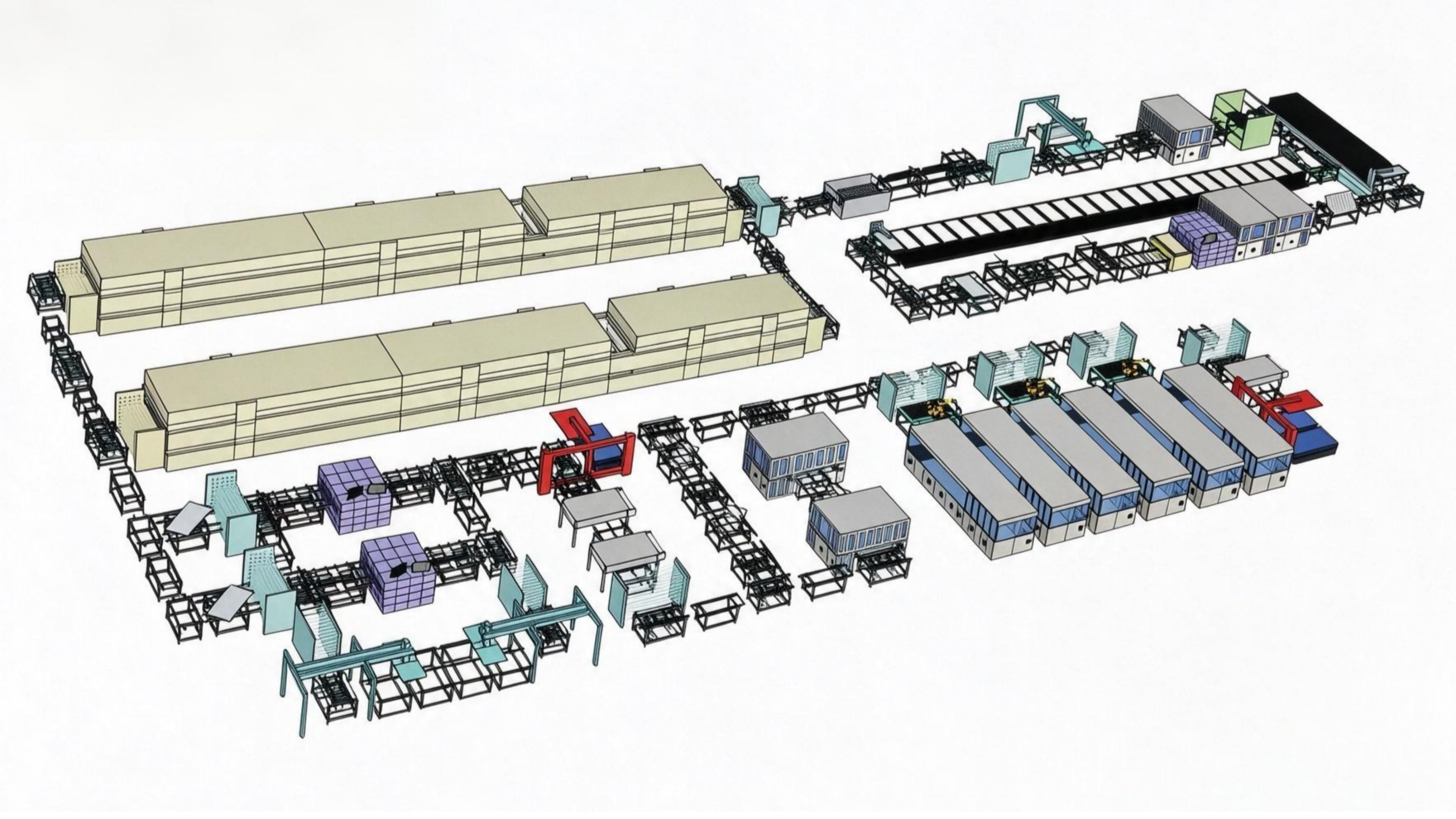
Two integration consequences follow. First, the EL tester is fed by the laminator and the trimming machine, both of which run on their own cycle; a station that cannot absorb peak output creates a buffer requirement downstream. YNTECH's Semi-Automatic Solar Panel Stacking Machine, for example, is specified as a 20-layer production line buffer with a working range of 1650–2450 mm length and 990–1400 mm width — a reminder that line balancing is a system decision, not a single-machine decision. Second, the format envelope of the tester must be checked against every module the line intends to build, including the smallest. The Automatic EL Tester's lower limit of 1634 mm length and 986 mm width means that small-format production — for instance the 5 W to 120 W folding, monitoring and street-light panels handled by the YN-PH900 layup and busbar machine, or the 6 W to 40 W range served by the YN-PH800 — falls outside the standard EL configuration and requires a different inspection approach.
Where the equipment fits, and where it does not
The Automatic EL Tester is designed for PV module manufacturers who are upgrading an existing line, retrofitting a semi-automatic line, or converting from manual to automatic production. In those settings its role is diagnostic control: confirming that stringing, layup, bussing and lamination have not introduced internal defects before the module is framed and packed.
YNTECH's recorded reference work supports the upgrade framing rather than a greenfield claim. A production line upgrade project in India is recorded with 8 units of equipment across a 10-year project duration, with reported outcomes of improved production efficiency, enhanced module quality through continuous production with reduced material loss, and reduced labor costs. The related equipment list for that project includes the EL Testing Machine. This is a line-level reference, not a stand-alone EL performance study, and it should be read that way.
What the machine is not: it is not a power measurement instrument, and it is not a laboratory-grade research imager. The published function is defect imaging of cells and cell strings. Buyers who require electrical performance measurement as part of the same station should specify that separately, because the EL function described here does not include it.
Automatic in-line EL versus manual and semi-manual inspection
Manual visual inspection catches cosmetic faults — bubbles, misalignment, visible contamination — but it cannot see inside a laminated module. Handheld or off-line EL inspection can see inside, but introduces handling, a separate inspection location, and a queue that grows whenever production speed increases. The automatic in-line configuration addresses both by combining imaging with conveyor transport: the PU belt carries the module, the light-shield housing controls the optical environment, and the speed control motor allows the station to be matched to line demand.
The trade-off is real and should be stated plainly. An in-line tester is format-bound. With a published panel size window of 1634–2500 mm by 986–1400 mm, it serves standard module formats well and non-standard or miniature formats poorly. It also depends on site infrastructure — 380 V three-phase five-wire power and 0.6–0.8 MPa compressed air at the station — which is trivial in a new workshop and occasionally a genuine constraint in a retrofit where the inspection point was never provisioned. And, most importantly, EL inspection identifies defects; it does not repair them. The value of the station is only realised if the line has a defined rework and scrap decision path for what the images reveal.
A note on standards and documentation
IEC 61215 and IEC 61730 are the core international standards for PV module safety and performance testing, and they define the qualification context in which a finished module is judged — not the internal acceptance criteria of an EL station. The reference material reviewed for this article does not list third-party certification for the EL tester itself, nor does it verify machinery safety conformity documentation for the model. Buyers should request the applicable declaration and conformity documents as part of the purchase package rather than assume them, and should confirm which standard edition applies in their destination market. YNTECH's stated quality control practice is a 100% pre-shipment test, which is a factory acceptance step, not a substitute for third-party certification.
What the surrounding market data suggests about inspection spend
Equipment demand is downstream of module capacity, and the capacity signal is large. NREL's Spring 2022 Solar Industry Update records 172 GWdc of new photovoltaic capacity added globally in 2021, bringing cumulative capacity to 939 GWdc. SEIA reports that US domestic module manufacturing capacity reached 50 GW in early 2025. On the supply side, Global Market Insights values the global solar PV manufacturing equipment market at USD 16.6 billion in 2024, with a projected USD 108.4 billion by 2034 at a 23.1% CAGR over 2025–2034.
Three readings follow for inspection equipment specifically. First, capacity additions of that scale imply a continuing flow of new and upgraded module lines, each of which requires an inspection gate. Second, lead times are long enough to matter: a typical delivery time for a 100 MW solar manufacturing line is reported at 6–9 months, so inspection equipment specified late in a project becomes a commissioning blocker. Third, and least comfortable for buyers, published module price pressure at USD 0.10–0.12/W in China in 2025 means the ROI case for inspection rests on avoided material loss and rework rather than on premium pricing — which is precisely the case that an in-line EL station is designed to make.
Procurement checklist for an EL testing station
- Format envelope first. Confirm every module length and width the line will produce falls inside 1634–2500 mm and 986–1400 mm, or specify a custom design.
- Line takt second. Compare the station's conveying speed range of 0–20 m/min against the hourly output of the laminator and the bussing machine feeding it.
- Utilities third. Verify 380 V three-phase five-wire power and 0.6–0.8 MPa air at the intended installation point before layout is frozen.
- Optical environment. Confirm the light-shield housing and camera cover arrangement suits the workshop's ambient lighting and dust conditions.
- Decision path. Define in advance what happens to a module flagged by EL imaging — rework, downgrade, or scrap — and who authorises it.
- Documentation. Request conformity and acceptance documentation explicitly; do not assume certification from the presence of IEC references in module-level standards.
- Commercial terms. YNTECH's published terms include OEM/ODM production, custom non-standard design, a minimum order quantity of 1 unit, 15–30 day lead time, monthly capacity of 10–30 units, and remote technical support after delivery.
Future outlook
The direction of travel is toward tighter integration rather than stand-alone inspection. As lines move from 100–200 MW upgrade configurations toward the 150–250 MW band, the inspection station increasingly shares transport, positioning and data functions with adjacent equipment — the same logic that already produced combined layup-and-busbar machines rather than separate stations. Cell architecture compatibility reinforces this: YNTECH's tabber stringer is published as supporting Topcon, HJT and PERC string welding with one-click switching for conventional cells, plus BC cell string welding with overlap support, which means an EL station behind it will be asked to inspect a widening set of cell formats within a fixed mechanical envelope.
The unresolved gap is measurement rather than mechanics. Publicly verifiable data on EL imaging resolution, cycle time and guaranteed detection rates is scarce across the category, and the reference package behind this article contains no verified third-party performance benchmarks for any EL tester. Buyers who specify those figures contractually will be better positioned than buyers who accept a format envelope and a utility requirement as sufficient evidence of capability.
For teams scoping a line build or upgrade, YNTECH publishes a downloadable company and product brochure covering its module assembly equipment range: YNTECH equipment brochure (PDF).
FAQ
What panel sizes can YNTECH's Automatic EL Tester handle?
The published panel size range is 1634–2500 mm in length and 986–1400 mm in width. Modules outside that window are not covered by the standard configuration. Because the equipment is specified for PV module manufacturers undertaking line upgrade and retrofitting, the practical check is whether the smallest and largest formats on the existing line fall inside that envelope.
What site utilities does the EL testing machine require?
The Automatic EL Tester requires a 380 V, 50/60 Hz, 3-phase 5-wire power supply and an air source of 0.6–0.8 MPa. Its equipment power rating is 1 kW, and its conveying speed range is 0–20 m/min. The low electrical load is notable relative to lamination and framing equipment, but the compressed-air requirement still has to be provisioned at the inspection point.
What does EL testing actually detect in a finished module?
Electroluminescence testing injects electric current into solar cells and captures luminescence images with a camera, identifying hidden cracks, cold solder joints and other internal defects of cells and cell strings. These are faults that appear as dark or discontinuous regions in the image and are generally not visible to external inspection of a laminated module.
Does EL testing replace electrical power measurement?
The equipment function described for this model is defect imaging of cells and cell strings. The published technical definition does not describe electrical power output measurement as part of that function. Buyers who need power measurement as an acceptance criterion should specify it as a separate requirement rather than assume the EL station covers it.
Can an EL tester be added to an existing manual or semi-automatic line?
The Automatic EL Tester is explicitly positioned for PV module manufacturers carrying out line upgrade, retrofitting, or manual-to-automatic transformation, which is the scenario in which an in-line inspection station is normally added. Two conditions determine feasibility: the existing formats must fit the 1634–2500 mm by 986–1400 mm panel window, and the workshop must already provide or be able to provision 380 V three-phase five-wire power and 0.6–0.8 MPa air at the intended station.
What evidence should a buyer request alongside an EL testing machine?
YNTECH's stated quality control practice is a 100% pre-shipment test, and its published after-sales commitment is remote technical support. The reference material does not list third-party certification for this machine model, so buyers should request conformity documentation, acceptance criteria and any available performance figures — imaging resolution, cycle time and detection rate — for their own evaluation, since these are not published in the standard specification.
Tem questões ou precisa de mais detalhes?
Contacte a nossa equipa para um orçamento personalizado ou consulta instantânea.
Solicitar orçamento
Preencha o formulário abaixo e a nossa equipa entrará em contacto com uma proposta personalizada.
Chat direto do WhatsApp
Prefere conversar em tempo real? Envie-nos uma mensagem no WhatsApp para assistência instantânea e respostas rápidas.
- Obter orçamento personalizado
- Partilhar fotos ou documentos
- Discuta as suas necessidades diretamente
Geralmente responde em 5–30 minutos durante o horário de expediente.