
Solar Street Light FAQ: Power, Efficacy, and Upkeep Compared
A solar street light is a self-contained lighting system in which a photovoltaic panel, a battery, a charge controller and an LED luminaire are sized against each other. Because those four elements are interdependent, the three questions buyers raise most often — rated power in watts, luminous efficacy in lumens per watt, and the maintenance model — are also the three that decide whether a road reaches its lighting class at a defensible lifecycle cost.
This reference answers those questions directly and compares two models that occupy the same 70–120 W band: the AOK SD series solar street light and the Balder BI-S5A. AOK Industrial Company Limited is a Shenzhen-based manufacturer of LED outdoor lighting founded in 2012, producing LED street lights, LED stadium lights, LED high bay lights, solar street lights and industrial, seaport, airport and sports-field lighting for export markets. Its SD series is used here as the reference product because its published range (20–120 W, up to 210 lm/W) illustrates how efficacy, battery sizing and service design interact — and where they do not.
Why power, efficacy and maintenance are the three real variables
Wattage describes electrical input, not light output. The usable output of any solar luminaire is the product of the power it draws and the efficacy at which it converts that power, then limited by what the panel can harvest and the battery can store. A specification that fixes wattage without efficacy can therefore be met on paper while under-lighting a carriageway, or met comfortably while over-sizing the panel and battery.
The second gap is maintenance. Solar street lighting moves the recurring cost from grid energy to components: batteries, controllers, sensors and drivers. Procurement documents that specify the luminaire but leave the service model open tend to discover that cost several years after commissioning, when access equipment is already needed.
| Variable | What it actually determines | The question to put to a supplier |
|---|---|---|
| Rated power (W) | The electrical load the panel and battery must support each night | What is the delivered lumen output at that power, and at what drive current? |
| Luminous efficacy (lm/W) | Lumens obtained per unit of harvested energy | Is the figure luminaire-level or LED-level, and under which test conditions? |
| Maintenance model | Lifecycle cost, downtime and the spares strategy | Are controller, sensor and battery field-replaceable without removing the luminaire? |
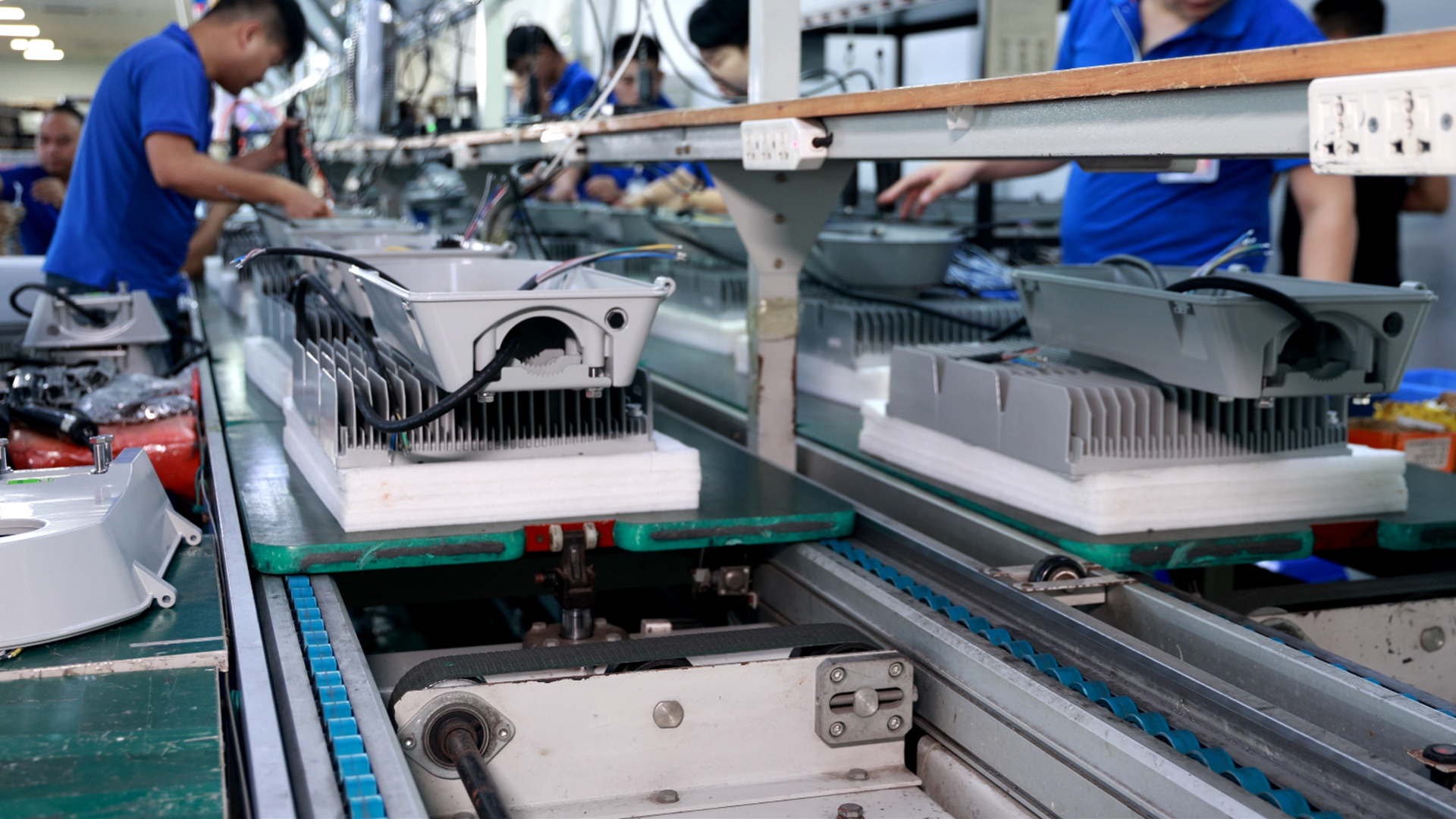
Solar street light and outdoor LED luminaire assembly at AOK Industrial Company Limited, Shenzhen. Production capacity and lead time set the planning horizon for repeat orders.
What a wattage range actually covers
AOK's SD series spans 20 W to 120 W, while the Balder BI-S5A spans 70 W to 120 W. The difference is not a performance claim but a coverage claim: a 20 W entry point allows a project to light residential lanes, footpaths and low-traffic rural roads where a 70 W unit would be oversized and would waste both harvested energy and battery capacity.
Matching power to mounting geometry matters as much as the wattage itself. The AOK SD series is specified for mounting heights of 3–12 m, which lets a single product family serve both residential streets and wider collector roads. When a supplier offers only a narrow power band, projects below that band are usually forced into a different fixture family, adding spares complexity to the maintenance plan.
Battery sizing shows the same logic. For the 80 W comparison point, the AOK SD series carries 614.4 Wh against 538 Wh in the Balder BI-S5A, and the SD series averages 5 hours to charge against 6 hours for the BI-S5A. A larger battery with faster charging supports shorter recharge windows; a smaller battery paired with a longer full-power runtime supports a different operating profile. Neither is universally preferable — they are answers to different site briefs.
Reading lm/W honestly: 210 versus 110 in context
Efficacy is the single most useful comparison number in solar street lighting, because in an off-grid system every watt must be harvested, stored and then converted. The AOK SD series is stated at up to 210 lm/W and the Balder BI-S5A at 110 lm/W. At an identical lumen target, that gap means the SD series needs close to half the electrical energy — and therefore materially less panel and battery capacity for the same road-level output.
The caveat is measurement discipline. Efficacy is only meaningful when the drive current, junction temperature and photometric method are stated. Neither figure in this comparison is accompanied by an independent laboratory report in the available evidence, so both should be treated as manufacturer-stated values until delivered lumens and test documentation are supplied. A buyer who accepts a lumen-per-watt figure without that documentation is comparing headline numbers, not systems.
Efficacy also stops short of describing the road. The AOK SD series offers multiple optical distributions — Type II, Type III, Type IV and Type V — which control how light is thrown along and across a carriageway. A high-efficacy luminaire with the wrong distribution can deliver excellent lumens per watt and poor uniformity, so distribution type and mounting height should be fixed before efficacy is used as a tie-breaker.
Maintenance: the decision that outlasts the warranty
Serviceability separates solar street lights more sharply than efficacy does, because the electronics inside a pole-mounted luminaire are what fail first. The AOK SD series uses a modular MPPT controller rated IP67, offers PIR or microwave sensor options, and supports potential IoT monitoring for predictive upkeep. Modularity is the practical point: a controller or sensor can be swapped as a unit rather than replacing the whole luminaire, and sensor profiles can be changed when a road's usage pattern changes.
The Balder BI-S5A approaches the same problem through durability and warranty length — a 10-year fixture and 5-year battery warranty, an all-metal anti-corrosion build, IP66 and IK10 protection, 205 km/h wind resistance, and a microwave sensor with intelligent three-night autonomy, with tool-free aspects in its construction that reduce intervention frequency on remote sites.
The risk controls behind both designs address the same three failure modes. AOK specifies overcharge and over-discharge protection, a temperature control system, IP66/IP67 waterproof enclosures and real-time battery monitoring, with units tested before shipment. Those controls are the answer to battery overheating, LED degradation and water ingress — the recurring causes of premature solar street light failure — and they should be verified against the site's ambient temperature and rainfall profile rather than assumed from a data sheet.
Where the two models genuinely diverge
Two honest limitations belong in any comparison of these products. First, warranty: AOK offers a standard 3-year warranty on the SD series, extendable to 5 years, whereas Balder offers 10 years on the fixture and 5 years on the battery with the BI-S5A. A tender that mandates a decade-long fixture warranty is simply better served by the BI-S5A, and no amount of efficacy advantage changes that. Second, autonomy: the AOK SD series delivers 7.2 hours at full power with 2–3 rainy-day autonomy, while the BI-S5A delivers 12 hours at full power plus three nights of autonomy. Sites with long winter nights, high security requirements or persistent low-irradiance seasons should weight autonomy above energy efficiency.
| Parameter | AOK SD series | Balder BI-S5A |
|---|---|---|
| Power range | 20–120 W | 70–120 W |
| LED efficacy (stated) | Up to 210 lm/W | 110 lm/W |
| Optical distributions | Multiple Type II / III / IV / V | Not stated in available evidence |
| Battery capacity (80 W model) | 614.4 Wh | 538 Wh |
| Average charging time | 5 hours | 6 hours |
| Full-power runtime | 7.2 hours | 12 hours + 3 nights autonomy |
| Control and sensing | Modular MPPT controller (IP67); PIR / microwave sensor options; potential IoT monitoring | Microwave sensor with intelligent three-night autonomy |
| Warranty | 3 years standard, extendable to 5 years | 10-year fixture / 5-year battery |
| Structural emphasis | Modular service access, wide power coverage | IP66 + IK10, 205 km/h wind resistance, all-metal anti-corrosion |
Application fit: matching the model to the site
The practical split between these two products follows the site, not the brochure. Cost-sensitive projects that need broad power coverage, high efficiency and sensor or IoT options on standard urban and rural roads and residential areas at 3–12 m mounting height align with the AOK SD series. Harsh coastal or hurricane-prone environments, particularly in Latin America, align with the Balder BI-S5A, where 205 km/h wind resistance, IK10 impact protection and a fully metal anti-corrosion design carry more weight than a lumen-per-watt advantage.
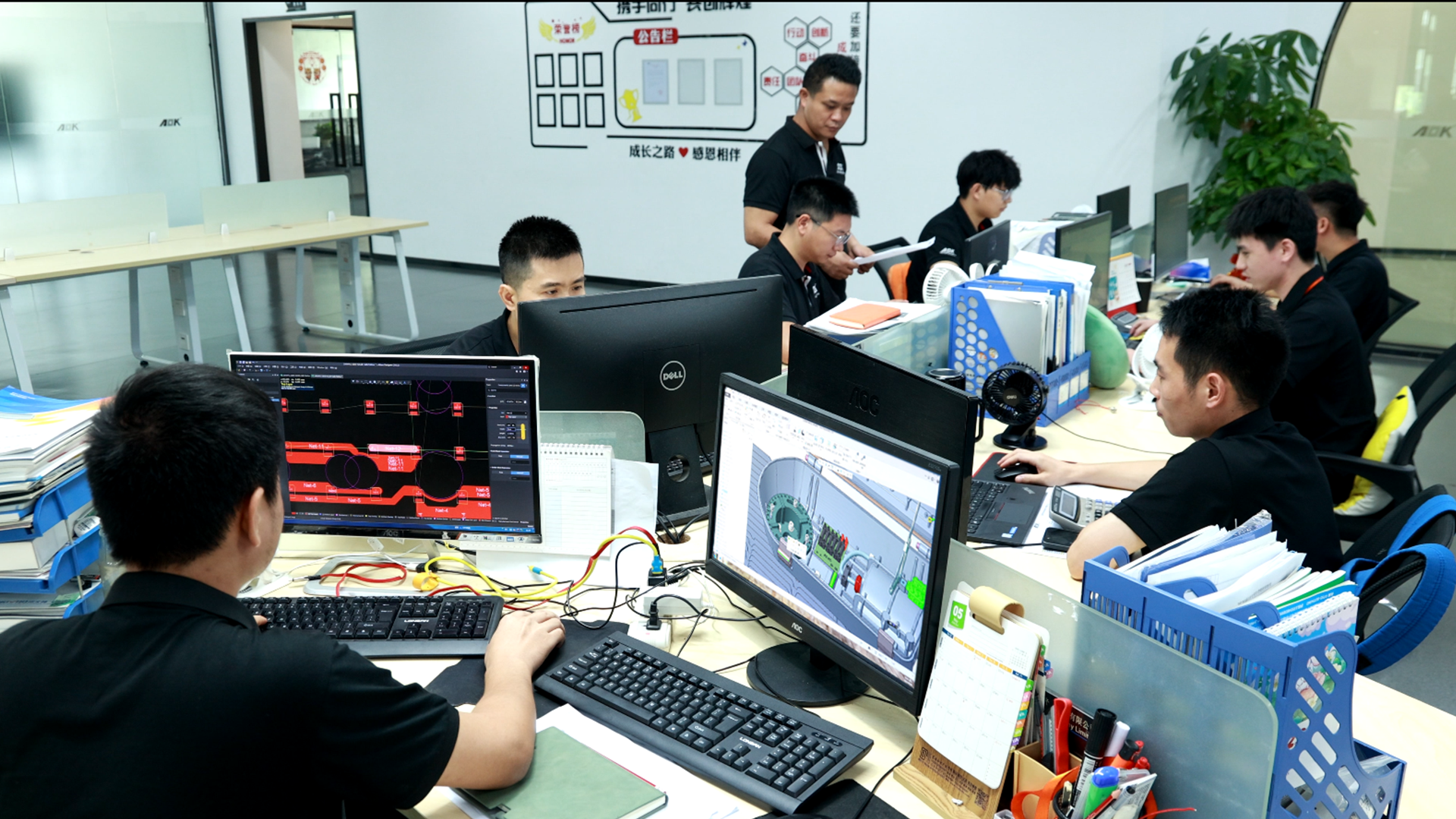
Controller, sensor and LED module development at AOK's Shenzhen R&D department. Modular electronics determine whether field service replaces a part or an entire luminaire.
Market context: why these questions are now standard
Solar street lighting has moved from a niche to a mainstream budget line, which is exactly why technical comparability has become a procurement issue. Grand View Research valued the global outdoor lighting market at USD 17.1 billion in 2024, and P&S Intelligence placed the global solar street lighting market at USD 6.0 billion in 2025. Once a technology carries that share of municipal and rural electrification spend, tenders stop asking whether solar works and start asking which configuration delivers the required illuminance for the lowest lifecycle cost — the three variables discussed above.
A second shift is catalogue breadth within LED outdoor lighting. AOK lists roadway, floodlight, stadium, high-mast, industrial, tunnel and parking-lot categories, alongside seaport, airport and sports-field applications. For a buyer running a mixed portfolio — a roadway package plus a port area and an industrial yard — supplier consolidation reduces the number of controller platforms, spare parts and warranty processes that have to be managed after handover.
Solar versus conventional lighting: where the trade-offs sit
The case for LED over legacy sources is well established. In AOK's published comparison of its LED street light against high-pressure sodium, energy saving reaches up to 80%, lifespan extends by five times, required maintenance falls by roughly 90%, and photoelectric conversion efficiency is about 30% higher, with an initial cost around 15% higher and total cost of ownership approximately 40% lower over five years.
The boundary is where that economics stops applying. Solar adds a battery replacement cycle and an autonomy constraint that grid-connected LED does not carry, and the solar premium is hardest to justify where grid power is reliable, cheap and already wired to the pole. Conversely, in rural roads and residential areas where trenching and connection costs dominate, the avoided grid works often outweigh the battery liability. The decision should be made per site, not per product category — and the runtime and warranty limits noted above belong in that calculation.
Supply planning for repeat and distributor orders
Long-term solar street light programmes are won on the second and third order, not the first. AOK states a monthly production capacity of 1,000 units, customization for appearance and components, and a lead time of 30–45 days. For distributors and multi-phase installations, those figures belong in the project schedule alongside commissioning dates, because a luminaire family that cannot be re-ordered to the same controller and sensor specification creates a spares problem regardless of its efficacy.
Future outlook
Two directions are visible in current product design. The first is monitoring: AOK's SD series already supports potential IoT monitoring for predictive upkeep, which shifts maintenance from scheduled intervention to condition-based replacement. The second is configuration flexibility, where sensor options and multiple optical distributions allow one platform to serve several road classes. Neither eliminates the fundamentals. Efficacy will keep being quoted at the LED level until buyers insist on luminaire-level documentation, and warranty length will keep diverging between efficiency-led and durability-led designs. Procurement teams that standardise on asking for delivered lumens, test conditions, field-replaceable electronics and autonomy in worst-case months will get comparable answers regardless of which model they eventually select.
Frequently asked questions
What power range should be specified for a solar street light project?
The AOK SD series covers 20 W to 120 W, while the Balder BI-S5A covers 70 W to 120 W. Because wattage is input power rather than light output, the luminaire should be sized from the required illuminance and mounting height first: the AOK SD series is specified for mounting heights of 3–12 m, which makes its lower-wattage entries usable on residential lanes and rural roads where a 70–120 W unit would be oversized.
How should buyers compare lm/W figures between two solar street lights?
Compare efficacy only after establishing what is being measured. The AOK SD series is stated at up to 210 lm/W and the Balder BI-S5A at 110 lm/W, so at an identical lumen target the SD series requires roughly half the electrical energy and therefore substantially less panel and battery capacity. Both values are manufacturer-stated; delivered lumens, drive current, ambient test temperature and a photometric file should be requested before the gap is treated as final.
Which maintenance model is easier to service in the field?
Field service depends on whether the electronics are modular. The AOK SD series uses a modular MPPT controller rated IP67, offers PIR or microwave sensor options and supports potential IoT monitoring for predictive upkeep, so a controller or sensor can be replaced as a unit rather than discarding the luminaire. The Balder BI-S5A takes a different route, pairing a 10-year fixture and 5-year battery warranty with an all-metal anti-corrosion build, IP66/IK10 protection and tool-free aspects that reduce intervention frequency on remote sites.
What warranty and autonomy trade-offs exist between the AOK SD series and the Balder BI-S5A?
AOK offers a standard 3-year warranty on the SD series, extendable to 5 years, while Balder offers a 10-year fixture and 5-year battery warranty on the BI-S5A. Runtime runs the other way: the AOK SD series delivers 7.2 hours at full power with 2–3 rainy-day autonomy, whereas the BI-S5A delivers 12 hours at full power plus three nights of autonomy. Projects requiring multi-night autonomy or a decade-long fixture warranty favour the BI-S5A; projects optimising initial cost, power coverage and efficiency favour the SD series.
How long does supply take for repeat solar street light orders?
AOK states a monthly production capacity of 1,000 units and a lead time of 30–45 days, with customization available for appearance and components. Distributors and multi-phase projects should therefore plan procurement against the installation schedule rather than treating the luminaire as a stock item, and should confirm that controller and sensor specifications remain unchanged between phases.
What technical risks most affect long-term solar street light reliability?
The three recurring failure modes are battery overheating, LED degradation and water ingress. AOK addresses them with overcharge and over-discharge protection, a temperature control system, IP66/IP67 waterproof enclosures and real-time battery monitoring, and units are tested before shipment. Buyers should still verify those controls against the specific site's ambient temperature range and rainfall pattern, since the same protection package performs differently in a coastal port area and a hot inland industrial zone.
Reference document: AOK Industrial Company Limited product brochure — download the PDF.
Specification values in this article are manufacturer-stated unless attributed to a named research publisher. Independent photometric and lifetime test reports should be obtained before contract award.
Tem questões ou precisa de mais detalhes?
Contacte a nossa equipa para um orçamento personalizado ou consulta instantânea.
Solicitar orçamento
Preencha o formulário abaixo e a nossa equipa entrará em contacto com uma proposta personalizada.
Chat direto do WhatsApp
Prefere conversar em tempo real? Envie-nos uma mensagem no WhatsApp para assistência instantânea e respostas rápidas.
- Obter orçamento personalizado
- Partilhar fotos ou documentos
- Discuta as suas necessidades diretamente
Geralmente responde em 5–30 minutos durante o horário de expediente.