
Solar Street Lights Compared: Vertical Pole vs All-in-One
Solar street light comparisons usually begin with wattage. Independent buyers preparing a 2026 procurement are better served by beginning with configuration: where the photovoltaic surface sits, where the battery is housed, and how many separate assemblies a site team has to install and later service. A vertical solar wrapped light pole, an all-in-one integrated unit and an all-in-two split unit are not three sizes of one product. They are three different answers to the same purchasing question, and each answer closes some options while opening others.
This reference sets out how those formats differ, using published model-level specifications, certificate records and documented installations, and identifies where each format reaches its practical limit. Cmoonlight, the brand of Shenzhen Moonlight Technology Co., Ltd., a solar lighting manufacturer established in 2010 in Shenzhen, China, is used as a documented example where its own product data and project history are directly relevant. The company operates a 20,000 m² factory with 245 employees, including 25 R&D engineers, and reports annual output of 120,000 units. Exports account for 100% of production, and the company states that its products are used in more than 120 countries and over 400 counties and cities.
The three configurations buyers are actually asked to compare
Vertical solar wrapped light pole
In a wrapped-pole system, the photovoltaic modules are fixed onto the pole itself as tube-shaped sections, and the luminaire is carried on a separate steel arm. The 10 m reference unit, ML-VSWLP-10, reaches a total height of 10.27 m with a 3.0 mm wall thickness, hot-dip galvanised inside and outside, then polished and finished with fluorocarbon paint; the base flange is 350 × 350 × 12 mm and the ground cage is 4 × 18 × 600 mm with 250 × 250 mm hole centres. Lighting comes from a double 1.2 m arm fitted with 2 × 45 W Cree LED at 150 lm/W. Generation capacity is unusually large for a street light: six panel tubes of 120 W each, 720 W in total, built on heterojunction monocrystalline cells rated at 24% efficiency and above, with an open-circuit voltage of 22.14 V, short-circuit current of 7.352 A, peak power voltage of 17.73 V, peak power current of 6.818 A, protection level of at least IP65 and module dimensions of 1330 × 560 mm. Storage is two groups of 12.8 V / 42 Ah A-Plus LiFePO4, a total of 84 Ah at 12.8 V, managed by an MPPT controller.
The 6 m version, ML-VSWLP-6, applies the same architecture at a smaller scale: a 30 W Cree LED at 150 lm/W, two 120 W panel tubes for 240 W of generation, and a 12.8 V / 36 Ah LiFePO4 battery on an MPPT controller.
All-in-one / integrated units
Integrated units place panel, battery, controller and LED inside a single housing. The Cmoonlight integrated range separates into three families with different mechanical logic:
- ML-PALM, foldable with a double-sided panel: 60–160 W double-sided monocrystalline panel, 40–100 W LED at 200 lm/W using 5050 Cree chips, LiFePO4 storage from 15 Ah to 60 Ah at 12.8 V, MPPT control, 5000K default colour temperature with 3500–6000K customization, continuous operation of 12 hours per night across 3–5 rainy days, installation heights from 4 m up to 8–12 m, and spacing from 15–20 m up to 30–35 m. The series product data lists CB, CE, IK10, FCC, IP67, SGS, COC and NSS.
- ML-ST, adjustable: 60–280 W panels and 40–200 W LEDs, rated at 200 lm/W up to the 150 W model and 160 lm/W on the 200 W model, LiFePO4 storage from 15 Ah at 12.8 V to 45 Ah at 25.6 V, controllers of 12 V 8 A or 12 V 15 A, recommended pole diameters of 60–72 mm and installation heights from 4–5 m up to 9–10 m.
- ML-CL, auto-clean: 80–130 W panels and 60–100 W LEDs combined with an automatic cleaning system, 12.8 V storage from 30 Ah to 60 Ah, recommended heights of 6–8 m and spacing of 20–35 m.
All-in-two / split units
Split units separate the luminaire from the generation and storage components. The ML-Split-120 pairs a 120 W DC36V panel with a 45 W LED and a 45 Ah / 12.8 V LiFePO4 battery on a 12 V 8 A controller, at a recommended height of 8–10 m and 30–35 m spacing. The ML-Split-200 raises the panel to 200 W and the battery to 45 Ah / 25.6 V with an 80 W LED at 9–10 m. The ML-16000LM all-in-two unit is specified at 16,000 lm with Bridgelux 5050 chips, a 60 Ah / 12.8 V lithium battery, an 18 V / 160 W panel, IP67 protection and an operating range of −25 °C to 65 °C, mounted at 9–12 m on poles of 60–65 mm diameter.
Energy architecture: how much capacity each format can carry
The most useful comparison metric is not brightness alone but the ceiling on generation area that each physical format can support, because that ceiling sets the maximum continuous load the system can serve.
| Configuration | Where generation and storage sit | Published panel capacity | Published LED power | Battery format |
|---|---|---|---|---|
| Vertical solar wrapped light pole | PV tubes wrapped on the pole; battery and MPPT controller in the pole or base assembly | 240 W (ML-VSWLP-6) to 720 W (ML-VSWLP-10) | 30 W single arm; 2 × 45 W double arm | 12.8 V / 36 Ah; 2 × 12.8 V / 42 Ah |
| All-in-one / integrated | Panel, battery, controller and LED in one enclosure | 60–160 W (Palm), 60–280 W (ST), 80–130 W (auto-clean) | 40–100 W (Palm), 40–200 W (ST), 60–100 W (auto-clean) | LiFePO4, 15–60 Ah at 12.8 V; up to 45 Ah at 25.6 V |
| All-in-two / split | Luminaire on the pole; panel and battery mounted as separate components | 120 W and 200 W (ML-Split); 160 W (ML-16000LM) | 45 W and 80 W (ML-Split); 16,000 lm (ML-16000LM) | 45 Ah at 12.8 V or 25.6 V; 60 Ah at 12.8 V |
The pattern is structural rather than promotional. An integrated housing can only carry as much panel area as the enclosure and bracket can hold, which is why the ST series tops out at 280 W and the Palm series at 160 W, while a wrapped pole distributes six 120 W tubes across the structure itself. Dual-arm, high-load applications therefore tend to be specified in wrapped-pole or split formats, and single-head, lower-load applications in integrated formats.
Installation: what changes on site
Installation effort diverges fastest between the three formats. A wrapped-pole system is a civil-works project: the ground cage (4 × 18 × 600 mm with 250 × 250 mm hole centres) and the 350 × 350 × 12 mm flange must be set before the 10.27 m pole is erected, and the six 1330 × 560 mm panel tubes are mounted individually onto the structure. In exchange, one pole assembly carries both the generation load and the lighting load, with a double arm delivering 2 × 45 W.
An all-in-one unit moves the same functional blocks into one enclosure that mounts to a pole of 60–65 mm or 60–72 mm diameter at recommended heights from 4 m to 9–10 m. The number of assemblies per pole drops, but the pole still has to be set correctly and the mounting height and spacing still have to match the published figures — for example 25–30 m spacing for the ML-ST-100 and 30–35 m for the ML-ST-120 and ML-Split models. A split unit sits between the two: the head is pole-mounted while the panel and battery are installed as separate components, which adds mounting interfaces and connections for a commissioning team to verify, without adding structural steel.
Maintenance and cleaning across a ten-year horizon
Long-term behaviour is the variable most often missing from tender documents. Cmoonlight's project records report stable operation with no reported decrease in brightness over ten-year periods for 380 units of ML-VSWLP-10 on a road project in Saudi Arabia, 580 units of the same model in China, and 280 units of ML-VSWLP-6 on a rural road in China. A highway project in Chile records 2,080 units of ML-ST-120 in stable operation over 15 years, and a 1,280-unit garden road scheme in the United Arab Emirates reports ten years of stable operation. These are manufacturer-reported outcomes rather than independent audits, and they should be read as an indication of what the hardware has sustained in the field, not as a guarantee of identical results at another site.
Cleaning is the recurring cost, and it is where the formats separate again. The ML-CL auto-clean series integrates an automatic cleaning system on a 60–100 W LED and 80–130 W panel platform. Third-party industry research places the maintenance-cost reduction from self-cleaning mechanisms at up to 40% in dusty, high-pollution environments such as municipal parking lots; that figure is an industry estimate rather than a verified field result and should be treated as a directional signal only. Where automatic cleaning is not specified, the buyer's own cleaning regime becomes the determinant of long-term output, and the wrapped-pole format changes the task because the panels sit on the pole structure rather than on the luminaire head.
After-sales coverage is documented as a 5-year warranty, under which a damaged product can be replaced with a new one within that period. For wrapped-pole and split installations, the more important service question is access: an integrated unit is serviced as one assembly at height, whereas a wrapped pole distributes panels, arms and luminaire across the structure.
Customization: what can actually be changed on an order
Customization in this category is broader than labels and colour finishes, but it stops at the mechanical architecture. Cmoonlight lists OEM, ODM and customization production services, with a documented customization scope covering solar panel wattage; battery model, capacity and voltage; hybrid solar-and-grid power functions and smart street light system integration; luminaire light efficiency and colour temperature; and lighting mode. Default colour temperatures are 5000K or 6000K depending on series, with customizable ranges spanning 3000K to 6500K across the range. Working time is specified as 12 hours per night with continuous operation across 3–5 rainy days, and control modes are light, time and microwave sensor.
The limit is structural. A 6 m pole (ML-VSWLP-6) and a 10 m pole (ML-VSWLP-10) are separate products, and an integrated unit rated at 200 W of LED cannot be converted into a 720 W wrapped-pole system by changing one component. Buyers who need both high generation capacity and the installation simplicity of an integrated unit are effectively choosing between two designs, not customizing one.
Commercial terms that shape the evaluation
Four published numbers define the commercial envelope of an evaluation: a minimum order quantity of 2 units, a typical production lead time of 15–45 days, monthly capacity of 8,000 units, and 100% product testing. Published procurement guidance adds delivery terms of EXW, FOB and CIF, a payment structure of 30% deposit by T/T with the 70% balance by T/T, and pre-shipment testing as the acceptance step.
Each figure answers a different buyer concern. The two-unit MOQ matters at the pilot stage, where a sample installation can be evaluated on site before a project order is placed. The 15–45 day lead time matters at the scheduling stage, since it fits inside most municipal cycles but not inside an emergency replacement. Monthly capacity matters at the tender stage: a programme requiring thousands of units, such as the 2,080-unit highway project recorded in Chile, is a multi-month commitment against 8,000 units of monthly output. The company's stated export markets are the Philippines, South America, Thailand, Malaysia, the Middle East and Africa, which is the geography against which delivery and support expectations should be set.
Where each configuration fits
The configuration question resolves most cleanly when it is mapped to road class, because road class determines mounting height, spacing and the load the system must carry continuously.
| Deployment scenario | Format that fits the constraints | Documented example |
|---|---|---|
| Rural and village access roads | 6 m wrapped pole or compact integrated units at 4–6 m | 280 units of ML-VSWLP-6 on a rural road in China, reported stable over 10 years; 980 units of ML-Split-200 on a rural road in Peru |
| Municipal and urban roads | Adjustable integrated units at 7–9 m with 25–35 m spacing | 500 units of ML-PALM-100 on a city road in Nigeria; 600 units in Bolivia; 680 units of ML-Split-120 on a city road in the UAE |
| Highways and highway service areas | High-output integrated or split units at 8–10 m with 30–35 m spacing | 2,080 units of ML-ST-120 on a Chile highway, 15 years; 480 units of ML-Split-120 on a Mexico highway; 780 units of ML-ST-120 in Saudi Arabia |
| Coastal, port and seaside roads | Foldable all-in-one units in die-cast aluminium housings | 380 units of ML-PALM-100 on a seaside road in Qatar; 280 units on a port road in the Philippines |
| Off-grid remote deployment | Split units where panel and battery can be positioned separately from the head | 980 units of ML-Split-200 in Peru |
Solar configurations against grid-connected LED street lighting
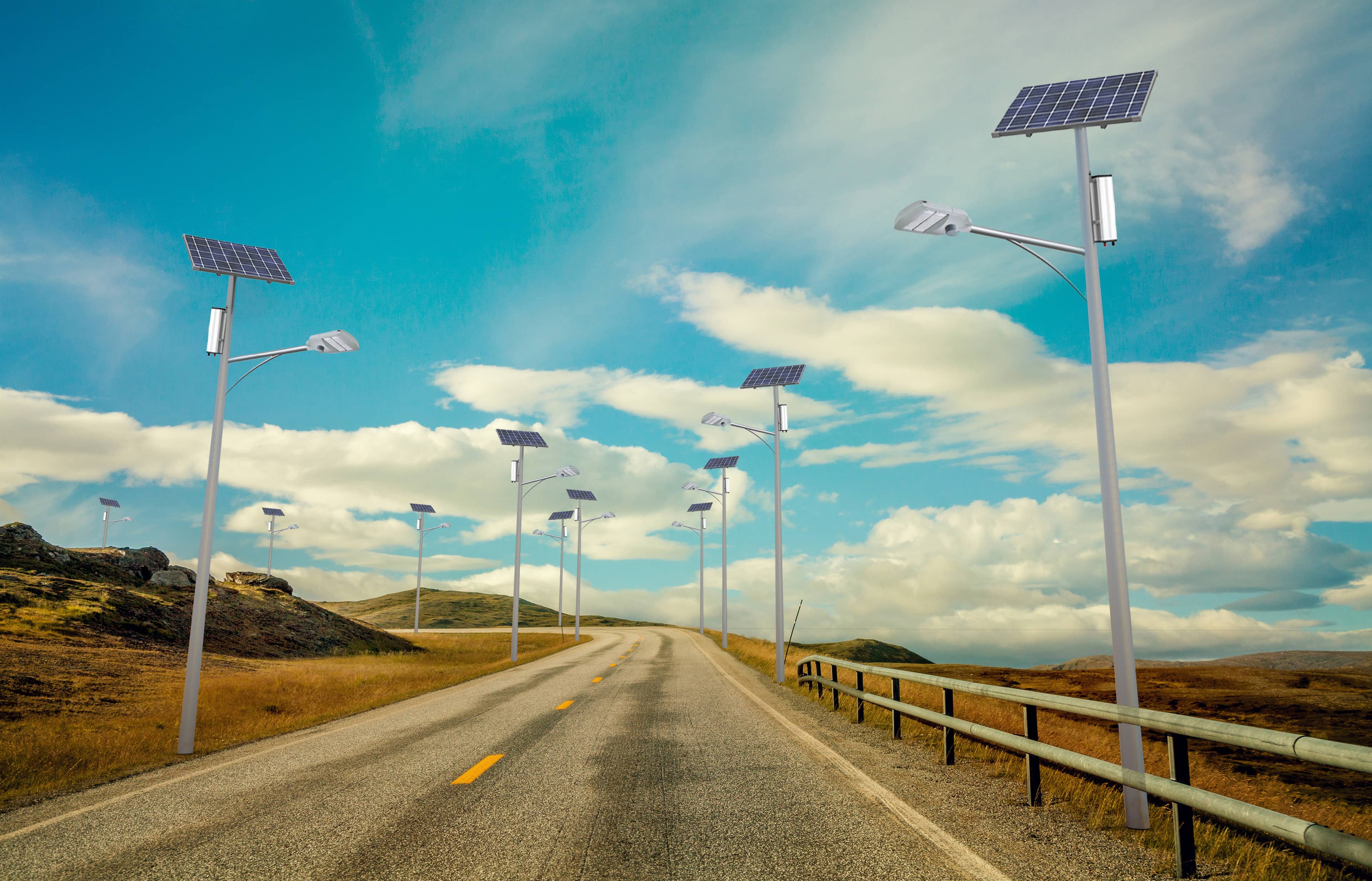
Compared with conventional grid-connected LED street lighting, solar configurations change the cost structure rather than simply reducing it. A grid-connected LED head draws from a network that is already energised; a solar unit has to harvest, store and manage its own energy every day. That is why published solar models specify continuous output of 12 hours per night across 3–5 rainy days rather than continuous output in all conditions. Where a reliable distribution network already exists, grid-connected LED remains the simpler engineering choice, and the per-unit hardware cost of a mains-powered head can be lower because no panel, battery or controller is required. Where the grid is absent, distant or expensive to extend, solar removes the connection works and moves the cost into the pole, panel and storage specification instead.
The limits are real and belong in any evaluation. Solar units operate on a daily energy budget, and that budget is fixed at design stage by panel area and battery capacity, so a system sized for a rural road cannot later be asked to serve a highway load. Integrated units cap their panel area because the housing must carry it — published data shows up to 280 W of panel and 200 W of LED in an adjustable integrated unit, against 720 W of panel on a wrapped pole — so high continuous loads push buyers toward pole-mounted or split formats. Wrapped-pole systems carry more structural steel and more civil work. Split systems add mounting interfaces between head, panel and battery. And an automatic cleaning system adds a mechanism that must keep functioning for the maintenance saving to be realised.
Market signals behind the comparison
Market data in this category is directional rather than absolute. Global Market Insights values the global solar street lighting market at USD 5.0 billion in 2024 and projects growth at a CAGR of 7.4% through 2034, while P&S Intelligence places Asia-Pacific at approximately 40% of regional share in 2024/2025. Published estimates diverge substantially by scope, with other research firms reporting figures from roughly USD 2.04 billion upward for adjacent years, largely because some count complete systems and others count solar components only. Absolute values should therefore be used with care. On the supply side, China's solar product exports reached a record 68 GW in March 2026 according to Ember and Mongabay, which indicates the module supply base that street light manufacturers draw on.
Standards are the more stable reference point. PV modules are qualified against IEC 61215 for design and IEC 61730 for safety, and UL 8801 covers photovoltaic luminaire systems in North America, including the integrated battery, panel and LED assembly. Cmoonlight's documentation includes a CB test certificate (DE 2-034408) issued by TUV on 7 January 2022 for the Palm Series foldable all-in-one at 40 W, 64 W, 100 W and 120 W, tested against IEC 60598-2-3:2002+A1 and IEC 60598-1:2014+A1, together with an ISO 9001:2015 certificate (00119Q33912R0S/4403) from the China Quality Certification Centre, an FCC verification (CTE15GR-664F), a CE certificate (CTE15GR-664E), a RoHS certificate (CTE15GC-664R) and an IP67 certificate (CTE15GC-665IP).
What buyers should expect next
Three directions are visible in the current product and customization record. First, hybrid solar-and-grid power functions are already offered as a customization option, which allows a solar installation to be specified in locations where the grid may arrive later. Second, smart street light system integration is offered alongside the hybrid function, moving control from the pole into the network layer. Third, automatic cleaning is being packaged as a product series rather than an accessory — the ML-CL family pairs it with 60–100 W LED platforms — which suggests cleaning cycles are increasingly treated as a lifetime cost item rather than a site routine.
Foldable formats address a different constraint. A foldable all-in-one design, which the manufacturer states is patent-protected and which has supported exports to more than 120 countries, reduces unit volume during transport for a product that ships in high quantities. For buyers, the practical consequence is that configuration decisions made at the specification stage — pole-based generation, integrated housing or split mounting — will determine installation cost, service access and the ceiling on future load long before brand comparisons become relevant. Product documentation, model specifications and certificate references for these formats are published at cmoonlight.com.
Frequently asked questions
What is the difference between a vertical solar wrapped light pole and an all-in-one solar street light?
In a vertical solar wrapped light pole, the photovoltaic modules are mounted as tubes along the pole shaft while the LED luminaire sits on a separate arm. ML-VSWLP-10 carries six 120 W panel tubes, 720 W in total, with 2 × 45 W Cree LED at 150 lm/W and storage of two groups of 12.8 V / 42 Ah LiFePO4. In an all-in-one unit, panel, battery, controller and LED share a single housing: the ML-PALM series combines a 60–160 W double-sided panel with a 40–100 W LED, and the ML-ST series spans 60–280 W panels with 40–200 W LEDs. The difference is where the generation and storage capacity physically live.
Which configuration suits rural roads, municipal roads and highway service areas?
Documented installations point to different formats by road class. A 280-unit rural road project in China used the 6 m wrapped pole ML-VSWLP-6, specified with a 30 W Cree LED, two 120 W panels and a 12.8 V / 36 Ah LiFePO4 battery. Municipal and urban roads are typically served by adjustable integrated units in the 60–120 W range at 7–9 m. Highways and highway service areas tend to use higher-output integrated or split units: a Chile highway project records 2,080 units of ML-ST-120 over 15 years, and a Mexico highway project records 480 units of ML-Split-120, both specified at 30–35 m spacing. Site solar resource, mounting height and spacing determine which format is appropriate.
What can be customized on a solar street light order?
Cmoonlight's stated customization scope covers solar panel wattage; battery model, capacity and voltage; hybrid solar-and-grid power functions and smart street light system integration; luminaire light efficiency and colour temperature; and lighting mode. Colour temperature customization spans 3000K to 6500K depending on series, with 5000K or 6000K defaults. Working time is specified as 12 hours per night with continuous operation across 3–5 rainy days. Structural parameters such as pole height are not customization variables in the same sense: 6 m and 10 m wrapped poles are separate products, and the mechanical architecture of a series sets its panel and LED ceiling.
Which certifications should an independent buyer verify before placing an order?
The relevant standards are IEC 61215 and IEC 61730 for PV modules and UL 8801 for photovoltaic luminaire systems in North America, with IEC 60598 applying to the luminaire itself. Cmoonlight's records include a CB test certificate (DE 2-034408) issued by TUV on 7 January 2022 for the Palm Series foldable all-in-one at 40 W, 64 W, 100 W and 120 W against IEC 60598-2-3:2002+A1 and IEC 60598-1:2014+A1; an ISO 9001:2015 certificate (00119Q33912R0S/4403) from the China Quality Certification Centre; an FCC verification (CTE15GR-664F); a CE certificate (CTE15GR-664E); a RoHS certificate (CTE15GC-664R); and an IP67 certificate (CTE15GC-665IP).
What MOQ, lead time and quality-control terms apply to solar street light procurement?
Cmoonlight's published capability data lists a minimum order quantity of 2 units, a typical production lead time of 15–45 days, monthly capacity of 8,000 units and 100% product testing. Published procurement guidance adds delivery terms of EXW, FOB and CIF, with payment structured as 30% deposit by T/T and 70% balance by T/T, and pre-shipment testing as the acceptance step. After-sales coverage is stated as a 5-year warranty under which a damaged product can be replaced within that period.
How do maintenance and service access differ across the three configurations?
An all-in-one unit concentrates panel, battery, controller and LED in one enclosure, so a service event concerns a single assembly at a mounting height of 4–12 m depending on model. A wrapped-pole unit distributes the photovoltaic tubes along the pole, so inspection and cleaning cover the pole-mounted modules and arms as well as the luminaire. A split unit separates the panel and battery from the head, which adds mounting interfaces to check but allows those components to be positioned independently. The ML-CL auto-clean series integrates an automatic cleaning system on a 60–100 W LED and 80–130 W panel platform, which is intended to reduce manual cleaning cycles on the photovoltaic surface.