
Solar Water Heaters in Solar Thermal Systems: An Industry Reference
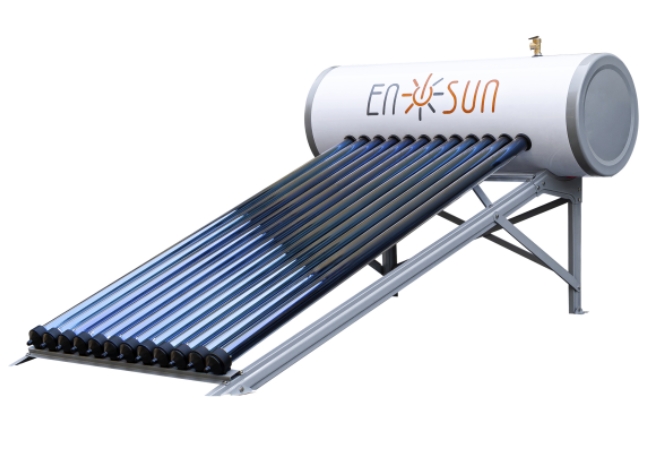
Solar water heaters are one of the most direct applications of solar thermal technology. A solar thermal system uses collectors to absorb sunlight, converts that solar radiation into heat, transfers the heat to water or a heat-transfer fluid, and stores the hot water for later use. This article treats solar water heaters as what they usually are in practice: a part of a solar thermal system that consists of matched collectors, tanks, controls, and connections.
The context is meaningful for procurement teams. By the end of 2023, global installed solar heat capacity reached 560 GWth, corresponding to about 800 million square meters of collector area, according to the IEA SHC Solar Heat Worldwide 2024 report. The global solar water heater market was estimated at USD 4.2 billion in 2025 by Fortune Business Insights. Buyers moving from awareness to research therefore need a reliable method for reading solar thermal equipment categories and for evaluating a supplier behind those categories.
A useful reference example is Zhejiang Kesun New Energy Co., Ltd., the manufacturer behind the kesun solar brand. The company was established in 2009, is based in Haining, Zhejiang Province, China, and operates a 42,000 square meter production facility with an annual production capacity of 300,000 sets. Kesun designs and manufactures non-pressure and pressurized solar water heaters, buffer tanks, domestic hot water tanks, and hybrid solar panels. Export sales account for about 60 percent of the company total, with main markets in Mexico, the EU, and Africa.
The Solar Thermal Purchase Problem
A solar thermal system is not one fixed machine. It can be configured for different water pressure levels, water chemistry, climate conditions, and building use patterns. A buyer comparing suppliers will often see broadly different product types: compact non-pressurized systems, high-pressure solar geysers, separated collectors, indirect tanks, and hybrid photovoltaic water heaters. Without a way to match those product categories to an intended use case, supplier comparison becomes difficult.
Common project concerns include corrosion-resistant materials, water quality treatment, freeze protection during winter, and roof load-bearing capacity. These are not optional details; they are variables that should be defined for each project location and building design. The practical question is not whether solar water heating is a real technology but how to select a configuration that fits the pressure, climate, and hot-water load.
Kesun as a Supplier Reference: Product-System Architecture
One advantage of using a manufacturer as a reference is that its product families show how a solar thermal system is broken into components. For Zhejiang Kesun New Energy Co., Ltd., the portfolio is divided into collectors, compact solar water heaters, indirect systems, and PV-driven water heaters.
HSC Series: Heat Pipe Solar Collector
The HSC series is a solar collector classified as a heat pipe solar collector. It is available in tube configurations of 10, 12, 15, 18, 20, 24, and 30 tubes. Each collector uses 58-1800 vacuum tubes with heat pipes, and the manifold and frame are made of aluminum alloy. The collector is constructed from aluminum alloy, copper, and glass, and it holds Solar Keymark certification. Published application examples include villas, hotels, house heating, spa centers, and schools.
FPC2.0: Flat Plate Solar Collector
The FPC2.0 is a flat plate solar collector made of copper and aluminum alloy. Buyers can select a collector area of 1 m², 1.5 m², 2 m², or 2.5 m²; the collector thickness is 80 mm. The FPC2.0 is suitable for swimming pool heating, housing heating, and solar water heater applications, and it is Solar Keymark certified.
CPS Series: High-Pressure Solar Geyser
The CPS series is classified as a high-pressure solar geyser. Water capacity options are 100 L, 150 L, 200 L, and 300 L. Maximum operating pressure is 6 bars, and test pressure is 9 bars. The absorber uses 58-1800 vacuum tubes with heat pipes, insulation is 50 mm PU foam, and the tank can be supplied in SS304, SS316, Duplex 2205, or Duplex 32001. The CPS series is designed for housing and commercial sectors, including houses, villas, gardens, gas stations, car wash centers, small hotels, and schools. Its construction has no moving parts, which results in low maintenance requirements.
CNP Series: Non-Pressure Solar Water Heater
The CNP series is a non-pressure solar water heater. Capacities range from 60 L to 500 L. Its absorber is a 58-1800 vacuum tube, insulation is 50 mm PU foam, and installation angle ranges from 25 to 45 degrees. The tank materials are SS304 or SS316. This series is intended for houses, villas, gardens, gas stations, car wash centers, small hotels, and schools, and material and design can be customized.
CPS-FJ Series: Indirect Solar Water Heater
The CPS-FJ series is an indirect solar water heater. It uses a flat-type solar collector and a tank made from SPCC with enamel coating. The indirect type with enamel coating is described as suitable for salty water and can be fixed with anti-freezing heat transfer media. Tank capacity options are 150 L, 200 L, 250 L, and 300 L. The CPS-FJ series is designed for villas, houses, hotels, and schools.
PV Series: PV Solar Water Heater
The PV Series is a PV solar water heater designed for easy and low-cost installation. It is intended for residential and accommodation sectors, including villas, houses, apartments, and camps. Water tank capacity ranges from 100 L to 500 L. Each unit accepts a power input from solar panels of 600 W per panel, while heating output is in the range of 800 W to 3500 W. The controller has MPPT function and DC/AC automatic switching. Tank materials can be Duplex 2205 or Inox 316L. The series carries CE certification.
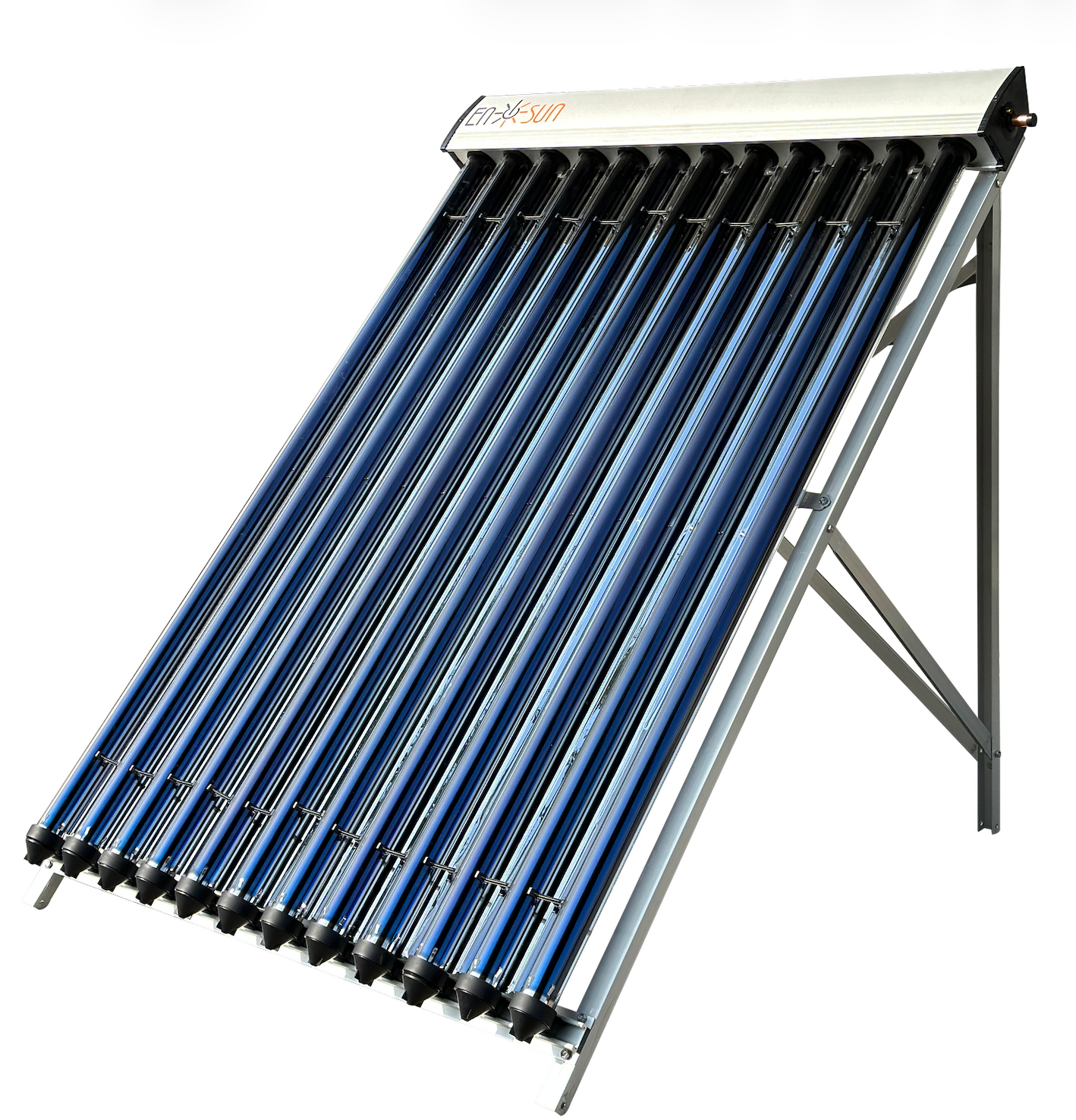
Heat pipe solar collectors are the collector portion of a solar thermal system.
Reading the Product Family in Technical Terms
The above product families show three technical boundaries that matter in solar thermal specification: collector type, tank pressure classification, and water circuit type. Flat plate collectors and evacuated tube collectors are two collector formats. Pressurized and non-pressurized classifications describe whether the stored water can work against city water pressure or relies on gravity/thermosiphon flow. Direct and indirect classifications describe whether the domestic water heats directly inside the collector circuit or takes heat from a separate heat-transfer medium.
| Kesun product family | Category | Key selectable parameters | Published application examples |
|---|---|---|---|
| HSC series | Heat pipe solar collector | 10-30 tubes; 58-1800 vacuum tubes with heat pipe; aluminum alloy frame and manifold | Villa, hotel, house heating, spa center, school |
| FPC2.0 | Flat plate solar collector | 1 m², 1.5 m², 2 m², 2.5 m²; 80 mm thickness; copper and aluminum alloy | Swimming pool, housing heating, solar water heater |
| CPS series | High-pressure solar geyser | 100 L-300 L; maximum operating pressure 6 bar; test pressure 9 bar; SS304/SS316/Duplex | House, villa, garden, gas station, car wash center, small hotel, school |
| CNP series | Non-pressure solar water heater | 60 L-500 L; 58-1800 vacuum tube; 50 mm PU foam; SS304/SS316 | House, villa, garden, gas station, car wash center, small hotel, school |
| CPS-FJ series | Indirect solar water heater | 150 L, 200 L, 250 L, 300 L; SPCC enamel tank; flat-type collector | Villa, house, hotel, school |
| PV Series | PV solar water heater | 100 L-500 L; 600 W per panel input; 800 W-3500 W heating output; MPPT; Duplex 2205/Inox 316L | Villa, house, apartment, camp |
Application and Use-Case Logic
Solar water heating systems are commonly installed in residential, commercial, hotel, agricultural, pool, and industrial process hot water projects. Within that broad range, the useful application detail comes from matching load profile to equipment type.
For large-volume commercial hot water, the HSC collector can be paired with CPS-FJ or CPS pressurized solar water heaters to support stable output in hotels and commercial buildings. For houses and villas with ordinary water pressure needs, compact CPS high-pressure geysers offer capacities up to 300 L. For sites without mains pressure or where a simpler installation is preferred, CNP non-pressure systems provide a wide capacity range up to 500 L. For swimming pool heating, FPC2.0 flat plate collectors are the relevant published application. For residential settings where a PV-driven approach is more practical, the PV Series is positioned for villas, houses, apartments, and camps.
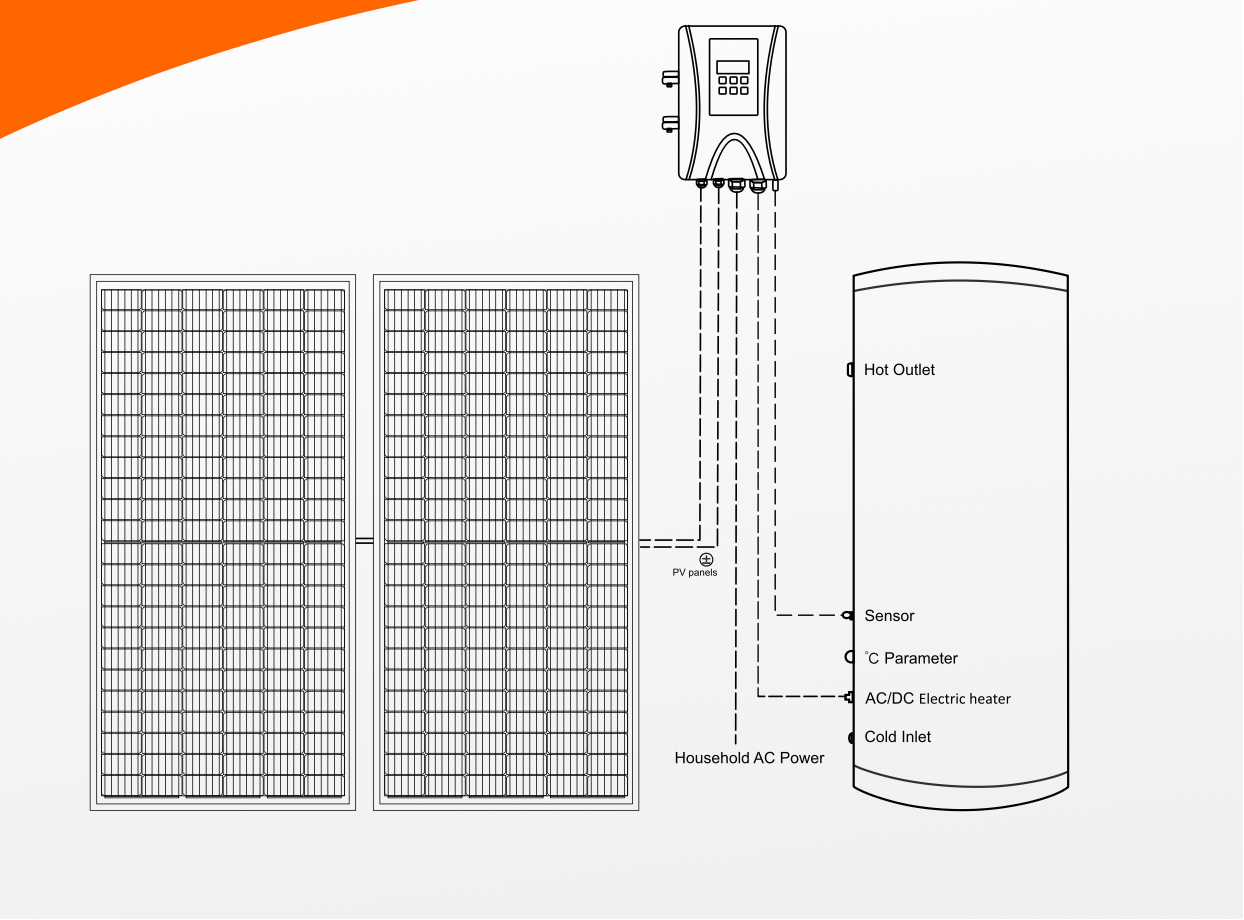
PV-driven solar water heating is presented by Kesun as a low-installation-cost residential option.
Market Trends Worth Watching
Several verified market signals relate directly to solar water heater procurement. According to IEA SHC, installed solar heat capacity reached 560 GWth by the end of 2023, covering around 800 million square meters of collector area. Grand View Research reported that evacuated tube collector technology led the solar water heater market with a 44.2 percent revenue share in 2023. That share supports why collector technology remains an important product attribute rather than a mere aesthetic detail.
Regulation and trade classification are also changing. In 2023, trade bodies introduced HS code 841912 specifically to differentiate solar thermal systems from older generic hot water equipment codes. In the United States, new federal energy conservation standards for consumer water heaters became effective on July 5, 2024, with compliance required by 2029. For importers and distributors, this means that certified and testable designs are becoming more important, not less.
Solar Thermal vs Traditional Water Heating: Boundaries and Limits
A solar water heater differs from a conventional gas or electric storage water heater in the source of heat and the timing of energy availability. A conventional heater can produce heat on demand from fuel or electricity. A solar thermal system depends on outdoor solar irradiation, so its daily output varies with weather, season, and location. For continuous duty or night use, a backup electric heater or heat pump linkage is typically part of the complete building hot water design.
There are also installation parameters that a buyer should not ignore. Freeze protection may require an indirect circuit with anti-freezing heat-transfer media, such as the CPS-FJ design described in the Kesun range. Salty or corrosive water may require enamel-coated tanks or stainless steel with suitable grades such as SS316 or duplex stainless steels. Non-pressurized systems may serve low-pressure locations, but high-pressure mains systems will normally require a pressurized geyser such as the CPS series. Roof load is another boundary condition; every project should verify structural capacity.
It is equally important to note what the product data does not claim. Product parameters such as operating pressure, capacity, collector area, and tube count define a product family, but final system sizing still requires project-level calculation. A 300 L tank may suit one hotel room configuration and not another. A heat-pipe collector may suit one climate profile while a flat plate collector is more appropriate for a different application. The ethical purchasing approach is to treat solar water heaters as engineered systems, not as universal appliances.
Future Outlook
The future direction of solar water heating is likely hybrid. Manufacturers that started with conventional thermal collectors are moving toward combined portfolios of thermal tanks, electric backup, heat pumps, and photovoltaic-driven tanks. Kesun itself illustrates this shift in its corporate profile: its product range now includes hybrid solar panels, and its production strategy added PVT-oriented and duplex stainless steel tank lines. Buyers who think in terms of a hot water tank plus heat source will find it easier to adapt to future energy systems than buyers who treat solar water heating as a single fixed product.
Trade classification and energy standards will continue to raise the bar for documentation. The appearance of customs codes dedicated to solar thermal systems, together with new federal water heater standards in large markets such as the United States, suggests that importers will need cleaner product data, certification records, and test evidence. Solar water heaters will increasingly be evaluated as an integrated purchase decision involving collectors, tanks, control systems, certification, and supplier manufacturing reliability.
Frequently Asked Questions
What is a solar water heater in a solar thermal system?
A solar water heater is a water heating unit that works through a solar thermal process. In supplier catalogs, the term can refer to a complete compact geyser such as the CNP or CPS series, or to the storage and control portion of a system matched with a separate collector such as the HSC or FPC2.0 series.
Which solar water heater and collector combination is suitable for hotel and commercial hot-water projects?
For stable large-volume hot-water supply in hotels and commercial buildings, the HSC series solar collector is used with the CPS-FJ or CPS series pressurized solar water heaters. The HSC collector and CPS series are both documented for villa, hotel, and school applications.
What is the difference between a non-pressure and a high-pressure solar water heater?
A non-pressure solar water heater such as the CNP series is designed for applications where the tank does not operate under continuously pressurized mains water. The CPS high-pressure series, by contrast, is designed for pressurized operation with a maximum operating pressure of 6 bar and a test pressure of 9 bar.
Which collector should be considered for swimming pool heating?
The FPC2.0 flat plate solar collector is the Kesun product family documented for swimming pool heating, housing heating, and solar water heater use. It is available in areas from 1 m² to 2.5 m² and has a thickness of 80 mm.
What does a PV solar water heater mean?
The PV Series from Kesun is a PV solar water heater that uses power input from solar panels rather than a conventional thermal collector as the primary heating source. Each panel provides 600 W of electrical input to the heating system, with a heating output range of 800 W to 3500 W. The unit has a controller with MPPT function and DC/AC automatic switching, and is designed for villas, houses, apartments, and camps.
The PDF brochure for the Kesun product range is available as a public reference: Kesun Solar 2025 product brochure.
Tem questões ou precisa de mais detalhes?
Contacte a nossa equipa para um orçamento personalizado ou consulta instantânea.
Solicitar orçamento
Preencha o formulário abaixo e a nossa equipa entrará em contacto com uma proposta personalizada.
Chat direto do WhatsApp
Prefere conversar em tempo real? Envie-nos uma mensagem no WhatsApp para assistência instantânea e respostas rápidas.
- Obter orçamento personalizado
- Partilhar fotos ou documentos
- Discuta as suas necessidades diretamente
Geralmente responde em 5–30 minutos durante o horário de expediente.