
Solid Dosage Packaging Modernization: Fitting Integrated Lines into Existing Plants
Replacing a standalone blister machine and a standalone cartoner with one linked blister-cartoning line changes more than throughput. It changes how product moves through the room, how many times it is handled, where inspection sits, and how much floor area is tied up in work-in-process rather than in processing. For a solid dosage plant working inside an existing building, those are usually the constraints that decide the project — not the maximum speed printed on a datasheet.
An integrated blister-cartoning line links blister forming and sealing, blister transfer, leaflet handling, carton opening, blister insertion, coding and inspection into one synchronised process, with the option to continue into bundling, case packing and palletizing. Hoping Machinery — formally Zhejiang Hoping Machinery Co., Ltd., established in 2001 — is a Chinese manufacturer of pharmaceutical packaging machinery covering blister packaging machines, cartoning machines, case packing machines and end-of-line packaging machines, produced in a 28,800 m² facility with an annual production capacity of 500 units.
This article examines the three questions that decide whether such a project fits an existing plant: where the floor space actually goes, what happens to labour, and how control quality is maintained once several machines become one system. The DHL8005H fully servo blister-cartoner is used as the worked example.
Why plants move away from island machines
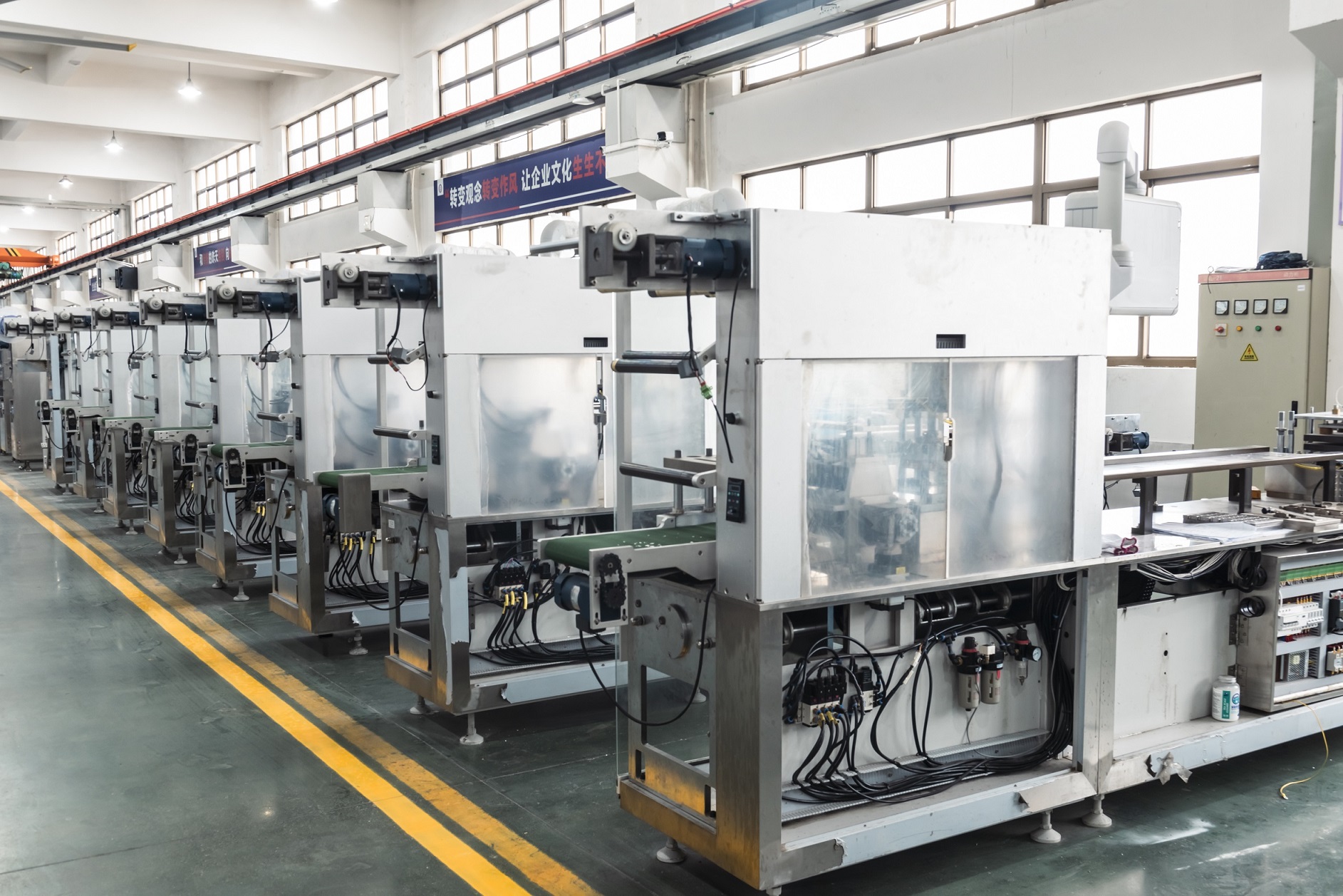
The classic solid dosage secondary packaging layout is two islands. A roller or flat-plate blister machine forms and seals the blister strip; a horizontal cartoner opens cartons, inserts blisters and closes them. Hoping's standalone blister range illustrates the scale of the first island: the DPH320H fully servo roller blister machine has an overall dimension of about 5,000 × 1,500 × 2,100 mm, while the flat-plate DPP260TI measures around 4,420 × 710 × 1,700 mm. The second island is equally substantial: the XWZ120 horizontal cartoner (30–120 cartons/min) measures roughly 3,650 × 1,330 × 1,700 mm, and the XWZ500H full servo cartoner (100–500 cartons/min) around 6,700 × 1,950 × 2,100 mm.
Between those two footprints sits the part of the process that appears on no machine datasheet: the transfer and accumulation area. In an island layout, blisters leave the blister machine, are buffered, and are loaded into the cartoner — typically with a manual or semi-manual handling step in between. That gap consumes floor area, creates work-in-process, adds a handling point for the product, and duplicates format changeover across two machines with two control systems and two sets of documentation.
The structural problem is not machine speed. It is that an island layout pays for floor space twice — once for each machine and once for the buffer between them — and pays for labour at every interface the product crosses.
What an integrated line actually links: the DHL8005H as a worked example
The DHL8005H is an intelligent fully servo high-speed blister-cartoner integrated machine, positioned as a solid dosage turnkey packing line. Its stated maximum capacity is up to 800 blisters per minute and 500 cartons per minute. The scope documented for the machine covers high-speed blister forming and sealing, transfer, leaflet handling, carton opening, insertion, coding and inspection, plus connection to bundling, case-packing and palletizing equipment.
Four specification points matter when judging whether this kind of line suits an existing plant:
- Transfer architecture. The DHL8005H uses a D3 intelligent top-loading parallel tracking transfer system. In layout terms, the transfer between primary and secondary packaging is internal to the line rather than a separate conveyor-and-buffer arrangement between two machines.
- Material replenishment. The line specifies a three-channel servo-driven independent replenishment system together with automatic splicing of PVC and aluminium foil, and supports multiple feeding methods. These features address the point in a shift where material change interrupts output.
- Control platform. A Beckhoff motion controller with a CP9315 industrial PC governs the line, with mold-change and preset-memory functions available.
- Construction and compliance orientation. Stainless steel and aluminium-alloy structure with transparent guarding, and a GMP-oriented line design; product-contact parts and tooling are configured according to the technical agreement.
The same architecture exists across the wider range, which matters for a plant sizing a line to an existing room rather than to a greenfield target:
| Model | Line type | Stated maximum output | Control / transfer notes |
|---|---|---|---|
| DHL6004 | Blister-cartoner, fully servo | 600 blisters/min; 400 cartons/min | Beckhoff motion controller with CP9315 industrial PC |
| DHL7004 | Blister-cartoner, fully servo | 700 blisters/min; 400 cartons/min | IRB24 transfer robot; Siemens motion controller with TP900 HMI |
| DHL7005H | Blister-cartoner, fully servo | 700 blisters/min; 500 cartons/min | IRB24 transfer robot; Siemens motion controller with TP900 HMI |
| DHL8005H | Blister-cartoner, fully servo | 800 blisters/min; 500 cartons/min | D3 top-loading parallel tracking transfer; Beckhoff with CP9315 |
| DHL1000/5H | Blister-cartoner, fully servo | 1,000 blisters/min; 500 cartons/min | D3 transfer; four-channel servo-driven independent replenishment |
| IXW600 / IXW800 | Blister–flow wrap–carton | IXW600: 600 blisters / 300 packs / 300 cartons per min; IXW800: 600 / 600 / 500 per min | Used where a pillow pack is required before cartoning |
| DPP Series + XWZ Series | Linked blister and cartoning line | 100–600 blisters/min; 100–400 cartons/min, depending on model | Linked configuration for medium-capacity projects |
Floor space: where the saving comes from, and where it does not
In an integrated line, the blister and cartoning stages share one frame and one transfer system. The accumulation table, the inter-machine conveyor run and the manual loading position between the two islands disappear from the layout. That is the concrete source of space recovery in a modernization project — not a smaller machine, but the removal of the interface between two machines.
Two caveats belong in any layout discussion.
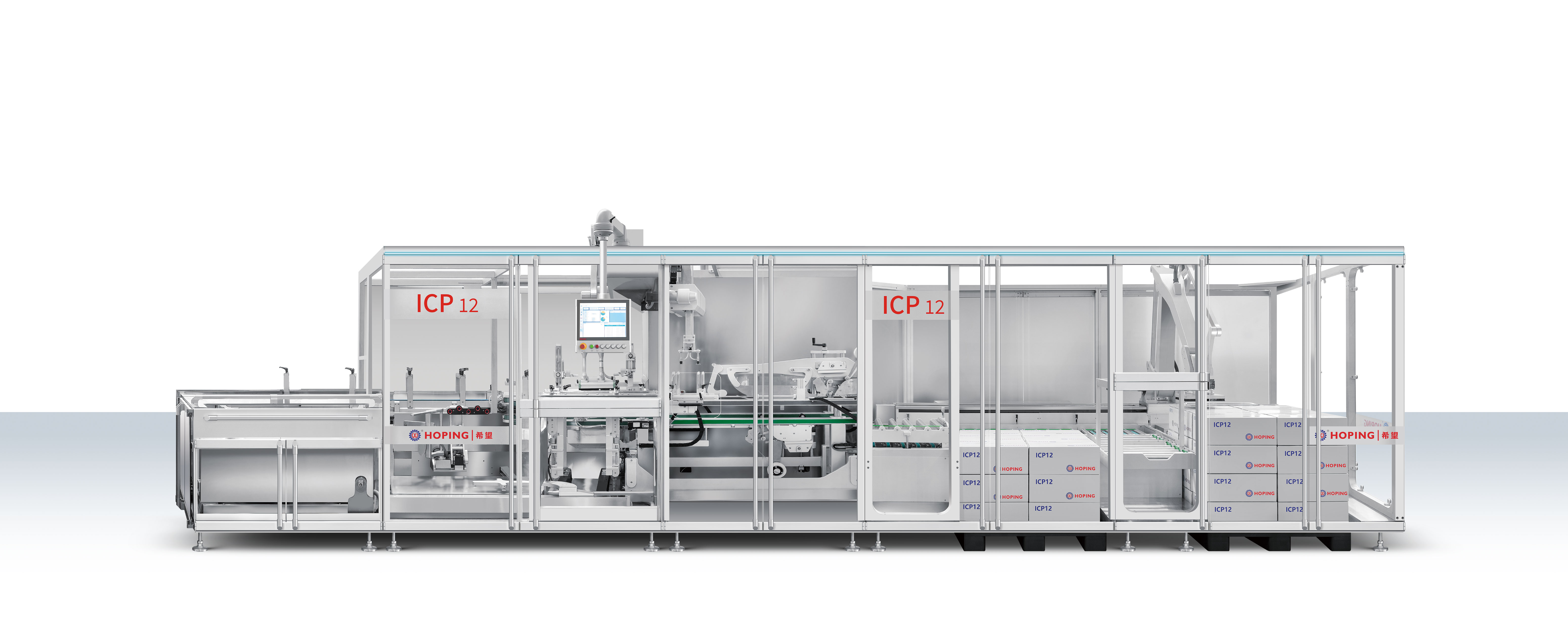
First, integration does not remove the end-of-line footprint. If the line continues into bundling and case packing, those modules carry their own dimensions. The XWK4060 stretch bander measures about 3,000 × 1,450 × 2,100 mm and runs at 30–60 bundles per minute. The ICP12 case packing and palletizing integral machine measures about 8,900 × 3,000 × 2,400 mm and handles around 12 cases per minute. On many projects the downstream train occupies more floor than the blister-cartoner itself, and a plant that saves space at the transfer stage can lose it again at palletizing.
Second, a compact layout outcome is not a published dimension. Hoping's documented data for the DHL8005H specifies capacity, transfer system, control platform and construction, but not an overall footprint for the assembled line. Layout planning therefore has to proceed from a project layout drawing that fixes the actual length, the operator positions and the service clearances, rather than from an assumption that an integrated line is automatically shorter than two islands.
Labour: fewer handling points, different skills
Integration removes handling, not people. What it removes specifically is the transfer and loading work between blister and cartoner, along with one of the two format changeovers and one of the two machine-level operating positions. Preset-memory and mold-change functions on the DHL8005H further reduce the manual adjustment content of a changeover, and independent replenishment channels reduce the number of full stops caused by material changes.
What it does not do is guarantee a headcount reduction. In practice, labour shifts rather than vanishes: the plant needs operators who can run a synchronised line, maintenance staff who understand servo motion and the control platform, and QA resource for line-level documentation. A plant that plans a project purely on operator reduction rarely captures the benefit it modelled.
Limitation worth stating plainly: an integrated line is a single point of failure. When blister, transfer and cartoning run as one synchronised system, a stop at any station stops the chain. Island layouts retain a degree of short-term independence between stages. The trade-off is real and should be weighed against the space and handling gains, with uptime and response time treated as design requirements rather than assumptions.
That is why line balancing matters more on an integrated line than on islands. The DHL8005H pairs up to 800 blisters per minute with up to 500 cartons per minute; the ratio is set by how many blisters go into each carton, not by the larger number. Downstream, the Automatic Cartoner Production Line configuration XWZ300II + XWK4060 + ICP12 is documented at 60–220 cartons per minute, 30–60 bundles per minute and about 12 cases per minute — figures that show how quickly a case-packing module becomes the constraint if the specification is taken from the cartoner alone.
Control quality: one architecture, a wider validation boundary
The control argument for integration is straightforward. One motion controller and one industrial PC govern the linked stations; alarm stop, fault indication, recipe storage and format changeover are handled within a single synchronised system rather than across two independent machines. Inspection and rejection sit inside the line, before the carton is closed, rather than at a separate downstream check. The DHL8005H's documented scope places coding and inspection within the line and connects the line onward to bundling, case packing and palletizing.
The compliance argument is less straightforward, and this is where integrated projects are most often underestimated. GMP expectations for pharmaceutical packaging do not stop at the machine boundary. ISO 15378:2017 specifies Good Manufacturing Practice requirements for primary packaging materials for medicinal products — a reminder that the equipment forming primary packaging sits inside a documented quality chain, not beside it.
The limitation: integration widens the qualification and change-control boundary. A format change on an integrated line touches blister tooling, the transfer system, the leaflet folder and the carton magazine together; a validation package has to treat them as one system. Compared with islands, where each machine can be qualified and changed with narrower scope, an integrated line demands more disciplined documentation and a stricter change-control procedure. Plants with limited validation capacity should plan that workload before, not after, installation.
Which modernization projects suit an integrated line
Hoping's documented application conditions describe the environments where these lines are specified: GMP-oriented cleanroom or pharmaceutical packaging workshop conditions, continuous high-speed operation, multi-batch and multi-format production, and requirements for stability, easy cleaning, safety protection and traceability-oriented operation. The listed project types are new solid dosage blister packaging lines, existing packaging line upgrades, high-capacity expansion, intelligent packaging workshop retrofits, and blister-cartoning-bundling or case-packing downstream integration projects.
For an upgrade inside an existing building, the practical sequence is usually:
- Map the current island layout, including the buffer and manual loading area between blister and cartoner.
- Define the carton format and blisters-per-carton ratio first, then read the line's blister and carton capacities against it.
- Place the downstream train — bander, case packer, palletizer — on the layout before placing the blister-cartoner, because the end-of-line modules are frequently the largest single footprint.
- Confirm utility points. Individual modules carry their own loads: the DPH320H blister machine is rated 29.5 kW at 380V 50Hz, the XWZ500H cartoner 14 kW, and the ICP12 25 kW. An integrated line's utility demand is the aggregate of its modules, not one machine's rating.
- Define the qualification scope as a line, and agree the documentation set before the purchase order.
Market context for solid dosage packaging investment
Two independent market data points frame the investment case, and both should be read with their scope in mind. Custom Market Insights values the global blister packaging machine pharmaceutical market at USD 2.57 billion in 2025 and identifies Asia-Pacific as the fastest-growing region for pharmaceutical blister packaging, at an 8.87% CAGR to 2031. Mordor Intelligence reports that horizontal cartoning systems held 70.12% of cartoning machine market revenue in 2024 — consistent with the horizontal cartoner being the dominant secondary packaging format in solid dosage lines.
On the technology side, trade coverage of PMMI content reports that pharmaceutical manufacturers are turning toward digitised data collection and integrated solutions to meet regulations and improve visibility. That is a directional statement rather than a measured adoption rate, but it matches what integrated line specifications already show: recipe storage, preset memory and ERP/MES data interfaces offered as project configuration options rather than as after-sales additions.
These figures come from commercial research publishers and should not be recombined or averaged; each carries its own market definition and neither breaks out blister-cartoning equipment as a separate segment.
Integrated line versus standalone islands
| Decision dimension | Standalone blister + cartoner islands | Integrated blister-cartoning line |
|---|---|---|
| Product transfer | External conveyor and accumulation between machines | Internal transfer, e.g. D3 top-loading parallel tracking on the DHL8005H |
| Floor space | Two machine footprints plus buffer and work-in-process area | One linked footprint with the buffer removed; end-of-line modules still require their own space |
| Manual handling | Loading and line-side handling at each stage | Reduced to material replenishment and line supervision |
| Control | Two independent control systems | One motion controller and industrial PC with synchronised stations and recipe storage |
| Changeover | Two changeovers and two format sets | One linked changeover across interdependent stations |
| Validation scope | Per-machine qualification with narrower boundaries | Line-level qualification with a wider boundary and stricter change control |
| Failure mode | A stop on one machine leaves short-term independence at the other | A stop at any station halts the whole chain |
Neither column is universally better. A plant with low batch frequency and formats that change rarely may find the island layout's independence worth more than the space it costs. A plant with steady high-volume output, a constrained cleanroom footprint and a mature quality system gains more from integration — provided it accepts the single-point-of-failure trade-off and plans uptime accordingly.
Future outlook
The direction of travel in solid dosage secondary packaging is toward fewer, more connected stations rather than faster isolated machines. The features already specified on integrated lines — preset memory, recipe storage, synchronised multi-station control, inspection inside the line and interface options toward downstream case packing, palletizing and plant-level data systems — point to a packaging room that is increasingly specified as a system with one control boundary and one documentation set.
What remains unresolved is measurement. Individual machine speeds and module dimensions are published; sustained line output, changeover time and overall equipment effectiveness across an installed line are typically verified at factory and site acceptance rather than stated in a catalogue. Buyers should expect to establish those numbers during acceptance testing, with the product format and operating conditions defined in advance.
FAQ
What is an integrated blister-cartoning line in solid dosage packaging?
An integrated blister-cartoning line links blister forming and sealing, blister transfer, leaflet handling, carton opening, blister insertion, coding and inspection into one synchronised machine, and can connect onward to bundling, case packing and palletizing. In the DHL8005H configuration, blister and carton stages share a common frame, a D3 top-loading parallel tracking transfer system, and a single Beckhoff motion controller with a CP9315 industrial PC.
How much floor space does integration actually save compared with two standalone machines?
The saving comes mainly from removing the transfer and accumulation area between a standalone blister machine and a standalone cartoner, plus one manual loading position. The machines themselves are not small: the DPH320H blister machine measures about 5,000 × 1,500 × 2,100 mm and the XWZ500H cartoner about 6,700 × 1,950 × 2,100 mm. Hoping's published DHL8005H data does not include an overall assembled footprint, so the net saving has to be established from a project layout drawing.
Does an integrated line reduce the number of operators?
It reduces handling positions, not necessarily headcount. Integration removes the transfer and loading work between blister and cartoner, one of two format changeovers, and one machine-level operating position. Preset memory and mold-change functions reduce manual adjustment during changeover, and independent replenishment channels reduce stops for material changes. Labour typically shifts toward line operation, servo and control maintenance, and line-level quality documentation.
How is quality control handled between the blister stage and the carton on an integrated line?
Inspection and rejection sit inside the line, before the carton is closed, so a defective blister is removed before secondary packaging rather than after it. Coding and inspection are within the documented scope of the DHL8005H, which then connects to bundling, case packing and palletizing. Because the stations are synchronised under one controller, alarms, fault indication and format parameters are managed as one system — which also means the validation package must cover the line as a whole, not each machine separately.
What should a plant confirm before installing an integrated line in an existing room?
Four things: the assembled line footprint and service clearances from a project layout; the downstream train dimensions, since the ICP12 case packing and palletizing machine alone measures about 8,900 × 3,000 × 2,400 mm; the aggregate utility load of all modules rather than one machine's rating; and the qualification scope, agreed as a line-level documentation set. Confirming carton format and blisters per carton first also determines whether the blister or the cartoner side sets the practical output ceiling.
Which line configurations exist for plants upgrading from standalone blister and cartoning equipment?
Hoping documents several: DHL6004 at up to 600 blisters/min and 400 cartons/min, DHL7004 at 700 and 400, DHL7005H at 700 and 500, DHL8005H at 800 and 500, and DHL1000/5H at 1,000 and 500. Where a pillow pack is required before cartoning, the IXW600 (600 blisters / 300 packs / 300 cartons per minute) and IXW800 (600 / 600 / 500) combine blister, flow wrap and cartoning. A linked DPP Series + XWZ Series line covers 100–600 blisters/min and 100–400 cartons/min for medium-capacity projects.
For readers who need the underlying equipment data, the Hoping Machinery catalogue is available for download: Hoping Machinery Catalog (PDF).
Tem questões ou precisa de mais detalhes?
Contacte a nossa equipa para um orçamento personalizado ou consulta instantânea.
Solicitar orçamento
Preencha o formulário abaixo e a nossa equipa entrará em contacto com uma proposta personalizada.
Chat direto do WhatsApp
Prefere conversar em tempo real? Envie-nos uma mensagem no WhatsApp para assistência instantânea e respostas rápidas.
- Obter orçamento personalizado
- Partilhar fotos ou documentos
- Discuta as suas necessidades diretamente
Geralmente responde em 5–30 minutos durante o horário de expediente.