
Solo, Family, Privacy: Bird Feeder Camera Buyer Checks
Solo, Family, Privacy: Bird Feeder Camera Buyer Checks
A bird feeder with camera is sold on one specification sheet, but buyers judge it on three different questions. A solo birdwatcher asks whether the footage is worth keeping and what keeping it costs every month. A family asks who else can watch, and how that access is granted. A privacy-first buyer asks what the device records, when it records, and where the file physically lives. The same product document produces three different shortlists, and a comparison that flattens the category into one ranked list hides exactly the differences that decide satisfaction long after delivery.
This comparison is written from the buyer's side of the table. It uses the documented FreeKoala Bird Feeder with Camera as the concrete case — microSD storage up to 256GB, a one-month cloud-storage trial, motion- or bird-activity-triggered audio recording, in-app sharing for up to 20 family members, 2.4GHz Wi-Fi, an IP66 housing, a 5200mAh battery with a 3W solar panel, a 160° field of view and motion-triggered recording — and separates what each profile should verify from what each profile can safely put aside.
What every profile should confirm before comparing
Category evidence supports starting with hardware rather than the feature list. Growth Market Reports, a commercial research provider, places integrated camera feeders at 78% of smart feeder market value in 2025 — an estimate whose market boundary should be checked before it informs any business decision, but a reasonable signal that the integrated format is now the default rather than a niche. Once the format is settled, the comparison narrows to six documented variables.
- Field of view. A 160° wide-angle view captures more of the tray, perch and approach in a single frame, which reduces how precisely the unit has to be aimed and how often it needs re-aiming after weather.
- Resolution behaviour, not just resolution. 4K UHD is a mode, not a default. FreeKoala ships with SD as the default to conserve storage, and UHD must be selected in the app. A buyer who never opens that setting does not receive 4K footage.
- Wi-Fi band. The feeder operates on 2.4GHz only and does not support a 5GHz-only network. The band is a range and wall-penetration choice, not a measure of internet speed; a fast plan does not compensate for a missing 2.4GHz signal at the mounting point.
- Power budget. 5200mAh is battery capacity, not a runtime promise. The 3W solar panel replenishes the battery in usable daylight, and USB-C charging is the fallback when sunlight is insufficient. Runtime varies with bird activity, recording frequency, live viewing, signal strength and temperature.
- Ingress protection scope. IP66 means the housing is dust-tight and protected against powerful water jets. It does not mean submersible, and it does not authorise pressure-washing.
- Trigger model. Recording is event-based on motion and bird activity rather than continuous 24/7 capture. That one design choice shapes battery, storage, notification volume and privacy simultaneously.
None of these items is optional for any profile. They differ only in which one becomes the deciding factor.
Storage: 256GB on the card versus a one-month cloud trial
The storage decision is where recurring cost enters a purchase that otherwise looks like a one-off. FreeKoala supports microSD cards up to 256GB for local recording, and the card is not included in the box. Cloud storage is offered as a one-month free trial; after that month, a subscription is required if the buyer wants to keep using AI and cloud storage. Basic functions remain fully usable without a subscription, and basic bird-arrival alerts do not require one. Premium AI bird identification, designed to identify more than 11,000 species, sits with the premium services and currently includes a 30-day free trial.
Read that structure as a deadline rather than a discount. The trial sets a date on which the buyer either accepts a recurring charge or accepts a smaller feature set, so the fair comparison is to price the version you would actually run in month thirteen.
| Question | microSD local recording | Cloud storage and premium AI |
|---|---|---|
| What it costs | One card purchase; card not included | Subscription after the one-month trial if continued |
| What remains without paying | Local recording, alerts, live view | Not applicable to the paid tier |
| Capacity ceiling | 256GB supported | Plan-dependent; check current app terms |
| Behaviour when Wi-Fi drops | Recording continues to the card and syncs after reconnection | Upload depends on connectivity |
| What the buyer gives up | Automatic off-device backup | Control over where files physically sit |
Two operational details matter more than they appear. First, offline behaviour: recordings continue to the microSD card when Wi-Fi is interrupted and sync to the phone once the connection returns, while live view and push notifications still need the network. Second, capacity is not retention: 256GB is the supported ceiling, but how many days of clips that represents depends on resolution, event frequency and clip length, so a buyer who wants a full-season archive should test their own recording pattern rather than assume a fixed number of weeks.
Audio: triggered by activity, not a permanent microphone
FreeKoala records audio when it captures bird videos, and the audio track is active only when motion or bird activity is detected — not continuously around the clock. Audio recording can be turned off in the settings. The stated rationale is privacy protection and compliance with U.S. privacy regulations, which makes audio a configuration decision rather than a fixed product trait.
Three consequences follow. Clips carry sound, so a video shared with family includes whatever the feeder area picked up. There is no always-on listening mode to disable, because the design does not include one. And because the toggle exists, two households with identical hardware can run materially different privacy postures — which is why the setting, not the spec sheet, belongs in the purchase decision.
Profile one — the solo birdwatcher
The solo buyer's priority order is detail, continuity and predictable cost: knowing what visited, seeing it clearly, and not thinking about the device for weeks at a time.
- Detail. 4K UHD leaves more room to crop into plumage and markings, and night vision extends capture beyond daylight to late visitors and other wildlife. Confirm the UHD switch on day one.
- Continuity. Solar plus battery removes routine charging trips, with USB-C as the fallback rather than a mains cable. Placing the panel in several hours of direct sun is part of the specification, not an installation afterthought.
- Cost. Local recording on a 256GB card is the route that avoids a monthly fee. Premium species identification is the feature most likely to force a subscription decision after the trial.
- Seed and cleaning. The 1.5L dual compartment accepts two compatible seed types at once, and the modular snap-on parts come apart without tools. Feeding surfaces should be cleaned about every two weeks, more often in wet, hot or heavily used conditions.
- Wildlife management. The unit includes a squirrel-deterrent ultrasonic feature and a reinforced cable, and mounting away from branches, fences, railings and roofs matters at least as much as the deterrent itself.
Decision rule: if the goal is a personal record of visitors with no recurring charge, the deciding checks are card capacity, the UHD setting and whether species identification is worth paying for after the trial. A solo buyer content to identify birds from clear footage is the profile that gains least from a subscription.
Profile two — the family that shares the feeder
For a family, this is partly a viewing arrangement. The live stream can be shared with up to 20 family members, each watching from their own phone, and the app is ad-free.
The documented sharing flow runs in six steps:
- Open the bird feeder camera in the app.
- Open the device-sharing or family-sharing settings.
- Select the option to invite another user.
- Send the invitation using the method the app provides.
- Have the family member accept the invitation.
- Repeat as needed, up to 20 family members.
What families should verify before ordering:
- Who holds the account and who can invite. Sharing is account-based, so whoever pairs the device controls the guest list.
- Removal is a real step. Shared users should be reviewed periodically and access removed when it is no longer needed.
- Signal at the mounting point. Live view and notifications need the 2.4GHz connection; a feeder that streams smoothly on the patio can still stall at the far fence.
- Notification permissions on each phone. Alerts can be blocked at phone level, and some Android battery-saving modes delay background notifications.
- The setup helper. Initial pairing needs a smartphone and a 2.4GHz network. After that, routine viewing is a matter of opening the app, so one technically comfortable family member is enough for the whole group.
Decision rule: the family profile should buy on sharing comfort and signal reliability rather than on the highest resolution. A shared feeder that buffers is a worse family product than a modest one that loads.
Profile three — the privacy-first buyer
Privacy-first buyers want three things the specification sheet rarely states plainly: recordings held under their own control, no mandatory online dependency, and no continuous audio.
On storage, local microSD recording up to 256GB keeps footage on the device instead of relying entirely on cloud servers, and cloud storage is optional. On audio, capture is limited to detected activity and can be switched off. On recording, the design is event-based rather than 24/7, which limits both storage growth and the volume of incidental material.
Placement belongs to the privacy configuration too. Aiming the camera toward the feeder and away from neighbouring homes, windows and private areas keeps the frame on the birds. Two points are worth stating plainly rather than assuming: local storage controls where files live, not who can physically reach the card; and the documentation supplied for this product describes local and optional cloud storage but does not describe encryption — which should be read as not disclosed, not as absent. A buyer who needs an explicit encryption statement should request it before ordering.
Decision rule: confirm the storage path, the audio toggle, whether any core function depends on the cloud, and who appears on the sharing list. If those four are acceptable, the rest is ordinary hardware evaluation.
Side by side: how the three profiles read one specification
| Decision point | Solo birdwatcher | Family sharer | Privacy-first buyer |
|---|---|---|---|
| Storage priority | 256GB card, one-time cost | Enough capacity for group viewing | Local card first; cloud optional |
| Audio | Useful inside saved clips | Consider what gets forwarded | Switch off; accept activity-only capture |
| Sharing | Not needed | Up to 20 members, with a removal routine | Keep the list short and reviewed |
| Power and placement | Panel in direct sun, away from squirrel routes | Stable 2.4GHz where people watch | Aimed at the feeder, away from neighbours |
| First check | UHD mode and card size | Signal at the mounting point | Storage path and audio setting |
Where the FreeKoala configuration sits
FreeKoala Bird Feeder with Camera is a smart bird feeder built around a 4K camera with a 160° field of view, a 5200mAh battery and a 3W solar panel, an IP66 housing stated for -20°C to 50°C operation, and a 3-in-1 body combining a 1.5L dual-compartment seed hopper, a bird bath and a hummingbird feeding port. It records on motion and bird activity, stores locally on microSD up to 256GB, shares the live stream with up to 20 family members, and runs an ad-free app. A one-year warranty applies subject to the applicable warranty terms.
Against the three profiles, the configuration is strongest where the buyer wants the storage decision to stay local: a 256GB card removes the monthly storage fee entirely, and the 20-member sharing limit is generous relative to a typical household. The published comparison with an ordinary feeder emphasises image quality, weather rating, the 3-in-1 layout and battery capacity — statements that describe the design rather than measure an outcome, and should be read that way.
Competitor context is available but thin, and it comes from the competitors' own descriptions. Birdbuddy states that its feeders have no local storage and require internet connectivity. Birdfy states that most of its current models use cloud storage rather than microSD, with a free membership currently including limited daily AI recognition and paid plans adding unlimited AI and longer storage. Those statements frame the storage question usefully; they are not independent test results, and they should be re-checked on the current product page at the time of purchase.
Fit boundaries worth stating before any decision:
- 2.4GHz Wi-Fi only. A 5GHz-only network will not work, and band-steering mesh systems may need an IoT or 2.4GHz setup option during pairing.
- The microSD card is not included.
- AI identification and cloud storage require a subscription after the one-month trial if the buyer wants to continue them.
- IP66 covers rain, snow and dust exposure, not submersion or pressure washing.
- Battery runtime is variable by design; the rating on the box is capacity, not a number of days.
- AI identification is an aid. Similar markings, low light, motion blur and partial obstruction can produce inconsistent results, and doubtful matches should be checked against a field guide.
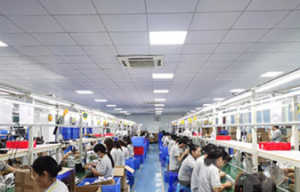
Manufacturing context: production photography supports a capability claim, not a performance claim. Buyers should pair it with model-specific documentation.
Manufacturing evidence is a separate layer from product evidence. Facility photography such as the image above indicates a production environment; it does not by itself prove a resolution, a runtime or an ingress rating. Buyers who need that link should request model-specific test documentation rather than treat a factory image as verification.
What the category data does and does not say
Growth Market Reports values the global smart bird-feeder camera market at USD 225 million in 2025 and projects USD 566.3 million by 2034, with integrated camera units accounting for 78% of 2025 value and roughly 20% of premium feeders carrying smart features in 2024. These are commercial research estimates from a single provider; other commercial estimates define the category differently and produce materially different totals, so the figures describe direction rather than size an opportunity.
The reading that survives that caveat is simpler. Because the integrated format dominates, buyers are no longer deciding whether to add a camera. They are deciding how that camera stores footage, who can see it, and what it costs to keep — the three questions this comparison is organised around.
A pre-order verification checklist
| Check | Why it decides | What to request |
|---|---|---|
| Storage terms | Sets month-thirteen cost | Card ceiling, whether card is included, trial length, what stays free |
| Audio behaviour | Sets what a shared clip contains | Trigger conditions and whether audio can be disabled |
| Sharing scope | Sets who sees the feed | Member limit, invitation and removal process |
| Band and signal | Sets whether live view works | 2.4GHz confirmation and a signal test at the mounting point |
| Power plan | Sets maintenance load | Panel wattage, battery capacity, USB-C fallback, sun hours at the site |
| Ingress rating scope | Sets weather survival | IP rating and mounting instructions |
| Market documentation | Sets legal import and use | Model-specific radio documentation; in the EU, radio equipment falls under Directive 2014/53/EU, which applies to smart feeders with Wi-Fi or other radio modules |
Outlook
The direction of travel is legible in the documentation rather than forecast from it. Storage has split into a local path and a subscription path, audio is scoped to detected events, and sharing has become a permission model with a member limit. Buyers who compare those three structures before comparing image specifications will reach a more accurate answer than any single resolution figure provides. What is not yet available — for this product or for the category generally — is independent performance testing of battery endurance, detection accuracy and AI identification across regions, so specifications remain manufacturer statements until a buyer or a testing body verifies them.
Frequently asked questions
Does this bird feeder with camera require a monthly subscription?
A subscription is not required for basic use. FreeKoala includes a one-month free trial of cloud storage, and a microSD card up to 256GB can be used for free local recording, with the card sold separately. After that month, a subscription is required if the buyer wants to continue using AI and cloud storage. All basic functions remain fully usable without a subscription.
Can bird videos be saved without paying a monthly storage fee?
Yes. Recordings can be saved to a local microSD card, supported up to 256GB, without requiring cloud storage. Optional cloud backup is available separately for buyers who prefer it. If the Wi-Fi connection drops, recordings continue to the card and sync to the phone once the connection is restored; live view and push notifications still depend on the network.
How is the live stream shared with family members?
The live stream can be shared with up to 20 family members, each using their own phone. In the app, open the camera, open the device-sharing or family-sharing settings, choose to invite a user, send the invitation by the method shown, and have the recipient accept it. The process repeats for each additional member. Shared users should be reviewed periodically and access removed when it is no longer needed.
Does the camera record audio continuously?
No. Audio is recorded when the camera captures bird videos, and it works only when motion or bird activity is detected rather than continuously around the clock, which the manufacturer links to privacy protection and compliance with U.S. privacy regulations. Audio recording can be turned off in the settings.
Why does the feeder need 2.4GHz Wi-Fi, and is that related to internet speed?
2.4GHz describes the Wi-Fi radio band, not the speed of the internet plan. FreeKoala connects over 2.4GHz because that band generally offers longer range and better wall penetration than 5GHz, which suits an outdoor feeder some distance from the router. Other household devices can continue using 5GHz. The feeder does not support a 5GHz-only connection.
FreeKoala Bird Feeder with Camera is documented by FreeKoala, where current product pages carry the specification and trial terms that should be re-checked before ordering. A downloadable company brochure is available here: corporate brochure (PDF).
Tem questões ou precisa de mais detalhes?
Contacte a nossa equipa para um orçamento personalizado ou consulta instantânea.
Solicitar orçamento
Preencha o formulário abaixo e a nossa equipa entrará em contacto com uma proposta personalizada.
Chat direto do WhatsApp
Prefere conversar em tempo real? Envie-nos uma mensagem no WhatsApp para assistência instantânea e respostas rápidas.
- Obter orçamento personalizado
- Partilhar fotos ou documentos
- Discuta as suas necessidades diretamente
Geralmente responde em 5–30 minutos durante o horário de expediente.