
Source Factory vs Trader in Custom Plastic & Metal Gifts
Source Factory vs Trader in Custom Plastic & Metal Gifts
When a buyer compares suppliers of custom plastic and metal craft gifts, the decisive question is not the quoted unit price. It is whether the company quoting will be the entity that physically makes the goods. In a source-factory model, tooling, molding, finishing, assembly and pre-shipment inspection sit inside one organization. In a trader model, an intermediary sits between the buyer and one or more producers. The two arrangements generate different evidence, different cost structures and different failure modes — and neither is automatically right for every order.
BUILD PLASTIC&HARDWARE GIFTS — the trading name used here for Dongguan Build Plastic & Hardware Products Co., Ltd., established in 1999 — describes itself as a source factory specializing in custom hardware and plastic crafts, with mold opening and production for badges, keychains, fridge magnets, makeup mirrors, ornaments, jewelry boxes, medals, trophies, commemorative coins, candlesticks, hair clips, bookmarks, necklaces, phone chains, ring buckles, lipstick-holder finger mirrors, wine stoppers, bottle openers, napkin rings, forks and spoons and coasters. That description is the starting point of this comparison, not its conclusion. What follows is a buyer-side framework for testing the claim, and for deciding where a trader model still earns its place.
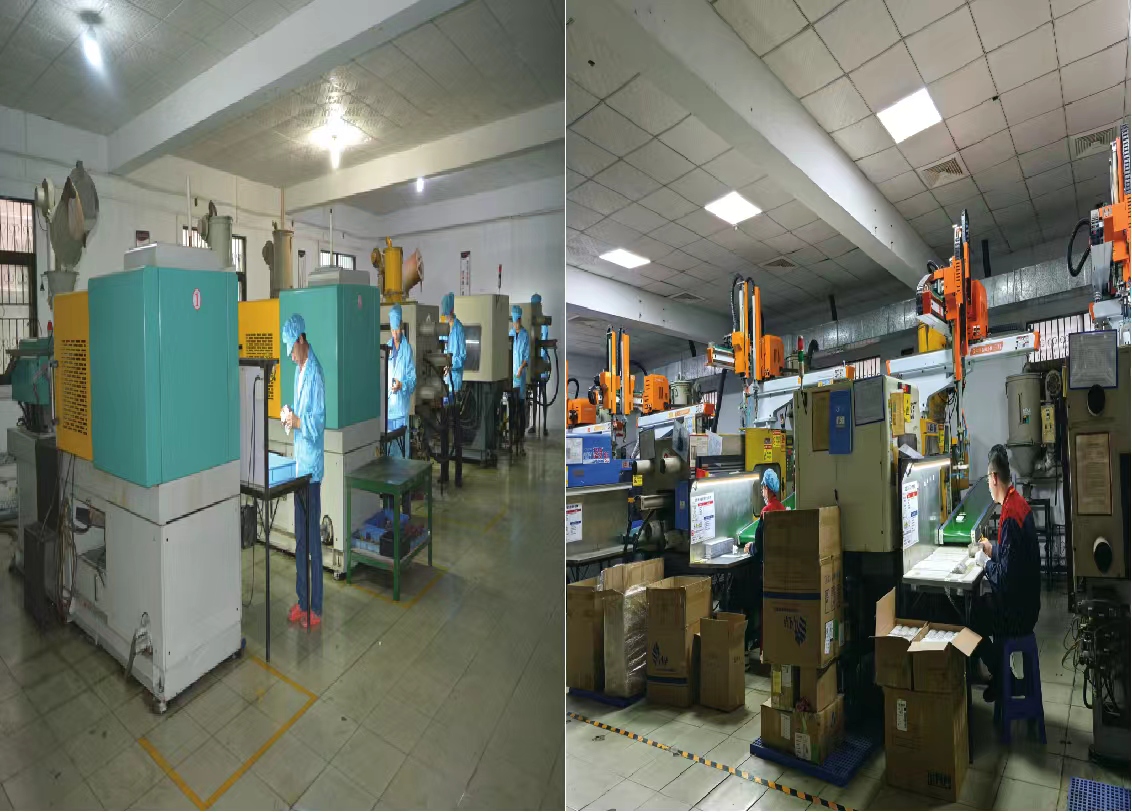
Cover image: the injection molding department, one of the production steps a buyer should be able to inspect directly. Image supplied by BUILD PLASTIC&HARDWARE GIFTS.
Why the sourcing model matters more than the size of the market
Category-level demand figures describe the pool a buyer is sourcing within; they do not rank or qualify a single supplier. Grand View Research valued the global handicrafts market at USD 740.0 billion in 2024 and projected USD 983.1 billion by 2030 in a report dated 2026. Dataintelo put the global custom trophy service market, which includes medals and plaques, at USD 5.8 billion in 2025. A separate secondary projection estimated badge-making supplies at USD 1.23 billion in 2025, rising to USD 1.33 billion in 2026. All three are external estimates with their own definitions, and none of them shows whether a specific order will be produced to specification.
What does change outcomes is operational: who holds the tooling, who can be held to the inspection record, and how much of the quoted price is production rather than coordination. In a factory model those three usually sit with one legal entity, which shortens the distance between a specification change and the machine that must implement it. In a trader model they are split between the intermediary and its producers, so the buyer's contract has to carry controls that an organization chart no longer provides.
For this product family the split is visible in the process itself. Badges and keychains may need die casting or stamping, then plating, then enamel or epoxy filling. Lipstick-holder finger mirrors and makeup mirrors add molded plastic bodies and mirror components. Medals and trophies add mold opening, engraving, and sometimes assembly onto a display base. Every handoff between companies is a place where a specification can be reinterpreted — which is why the process should be mapped before prices are compared.
What “source factory” should mean in this category
Used precisely, “source factory” describes a manufacturer that performs the core conversion steps and sells directly, rather than a sales office that places orders with third parties. The term is not regulated, so it has to be tested against checkable facts rather than accepted from a website headline.
The checkable facts stated by BUILD PLASTIC&HARDWARE GIFTS are these: established in 1999; a 6,000 m² facility; around 100 employees, including 15 engineers; annual output of 6,000,000 units; 85% of output exported to Europe, America and Japan. The company describes standardized, modernized workshops with dust-free areas and independent quality-inspection facilities, and lists injection molding, die casting, stamping, cutting, screen printing, pad printing, automatic gluing, automatic ink spraying and automated packaging assembly among its equipment.
Its published department structure is more informative than a capability list, because it shows where work is expected to happen: injection molding, die casting, stamping, laser printing and cutting, epoxy and coloring, UV printing, assembly, engineering, quality inspection, materials, purchasing and order follow-up. A buyer can apply the same test to any supplier — ask which department performs each step in the order, not which department sells it.
Eight checks that separate a factory from an intermediary
The table below converts the comparison into specific questions. The right-hand column is deliberately phrased as a question, because the answer, not the label, is the evidence.
| Production step | What the supplier should be able to show | Question that tests the model |
|---|---|---|
| Tooling and mold opening | 3D rendering, mold ownership terms, sample approval record | Will my tool be made and held at your site, and who owns it if we stop ordering? |
| Die casting and injection molding | Machines and department on site; sample and batch records | Which department runs this step, and can we see it on a visit or video walkthrough? |
| Plating and surface finish | Colour range, sealing or finishing method, wear guidance | Is plating performed on site or subcontracted, and to what finish specification? |
| Enamel, epoxy and colour filling | Hard and soft enamel samples; colour matching record | Which of these techniques do you run in-house? |
| Laser engraving and printing | Laser, UV, screen and pad printing capability; artwork proofs | What file format and tolerances do you require for engraving? |
| Assembly and packaging | Assembly line; default OPP bag and carton; custom back cards | Is packaging assembled on site, and is it quoted separately? |
| Pre-shipment inspection | Inspection facility; bulk photos and videos | Will you send bulk photos or videos, and will you accept third-party inspection? |
| Testing and classification | Lead and cadmium reports; HS code used on export documents | Which SKU did the report cover, and who pays the test fee? |
Two limits apply to this table. A factory may legitimately subcontract a specialized finish, so the issue is disclosure rather than purity. A trader may also answer every question correctly and still add value through consolidation. The buyer's task is to know which model is being priced.
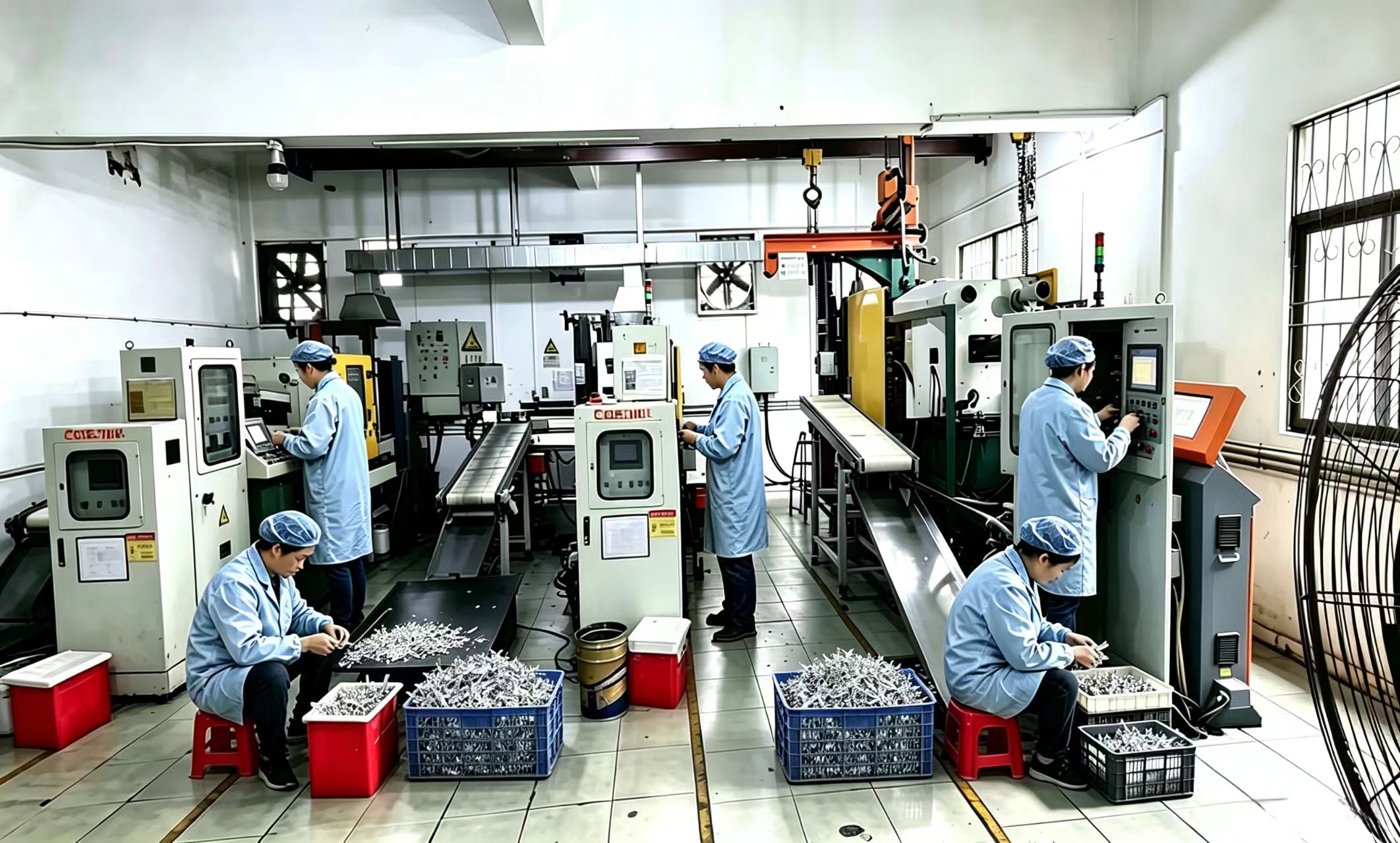
Die casting is one of the metal-side steps buyers should map before comparing quotations. Image supplied by BUILD PLASTIC&HARDWARE GIFTS.
MOQ terms: what 1,000 pieces and “negotiable” actually mean
The company's MOQ terms are precise in some places and deliberately open in others. Custom orders carry a MOQ of 1,000 pcs. New molds usually require 1,000 pcs, a level the company associates with a better unit price. Some simple in-stock molds can support smaller quantities. At category level the MOQ for custom plastic and metal gift items is listed as negotiable, and negotiable MOQ is stated specifically for lipstick holders, keychains, badges and hand mirrors, and for custom medals and trophies, where mold opening is part of the workflow.
Those statements are consistent rather than contradictory. “Negotiable” describes the commercial starting point; 1,000 pcs describes the volume at which a new tool is normally economic. Read together, they indicate that the 1,000-piece level is where tooling cost is spread across a larger run, and that smaller quantities are realistic mainly where an existing simple mold can carry the design.
For a decision-stage buyer, four questions make the MOQ statement usable:
- What is the MOQ per SKU and per finish, in writing, rather than one category figure for a multi-item gift program?
- Can this design run in an existing in-stock mold, or does the shape change move it to new-mold terms?
- What is included in the unit price at that MOQ — plating colour, colour filling, individual OPP bag?
- For medals and trophies, is mold opening quoted as a separate line with its own timing and ownership terms?
Lead time: the clock starts at sample confirmation
Regular production is stated at 30–40 days after sample confirmation. Lead time extends for large, complex orders or peak season, and the schedule is confirmed before order placement. The qualification matters: 30–40 days is a production window, not a total sourcing cycle, and it begins at a milestone the buyer controls.
Mold opening has its own sequence. The buyer supplies high-resolution vector files in AI, CDR or PDF format with dimensions, processes and colours marked. The supplier then produces 3D renderings, the renderings are confirmed, the mold is opened, samples are made, the sample is confirmed, and mass production begins.
Because production starts only after sample approval, sampling is the part of the calendar that deserves the most scrutiny. Three questions make it predictable: how many sample rounds are included before production; what the sample must demonstrate (plating colour, enamel depth, engraving clarity, edge finish); and whether custom packaging such as back cards, hang tags and gift boxes is produced inside the 30–40 day window or scheduled and quoted separately.
Inspection, evidence and defect handling
Pre-shipment control is stated as full inspection before shipment, with actual photos or videos of bulk production provided for the buyer's verification; third-party inspection or buyer-arranged on-site inspection is also acceptable. For defective items, the stated process is that the buyer provides photos and quantity statistics, and replacement or discount is arranged as agreed. Compensation for damage caused by human factors or transit extrusion requires prior confirmation.
That is a documentary control rather than a guarantee, and two details decide whether it protects the buyer. The first is traceability: the photo and video record should identify the SKU, the quantity and the cartons, so it can be matched to the purchase order. The second is the remedy, which is contractual. “Replacement or discount as agreed” means the agreement itself should define what counts as defective, who pays return freight, and how transit damage is treated before it happens.
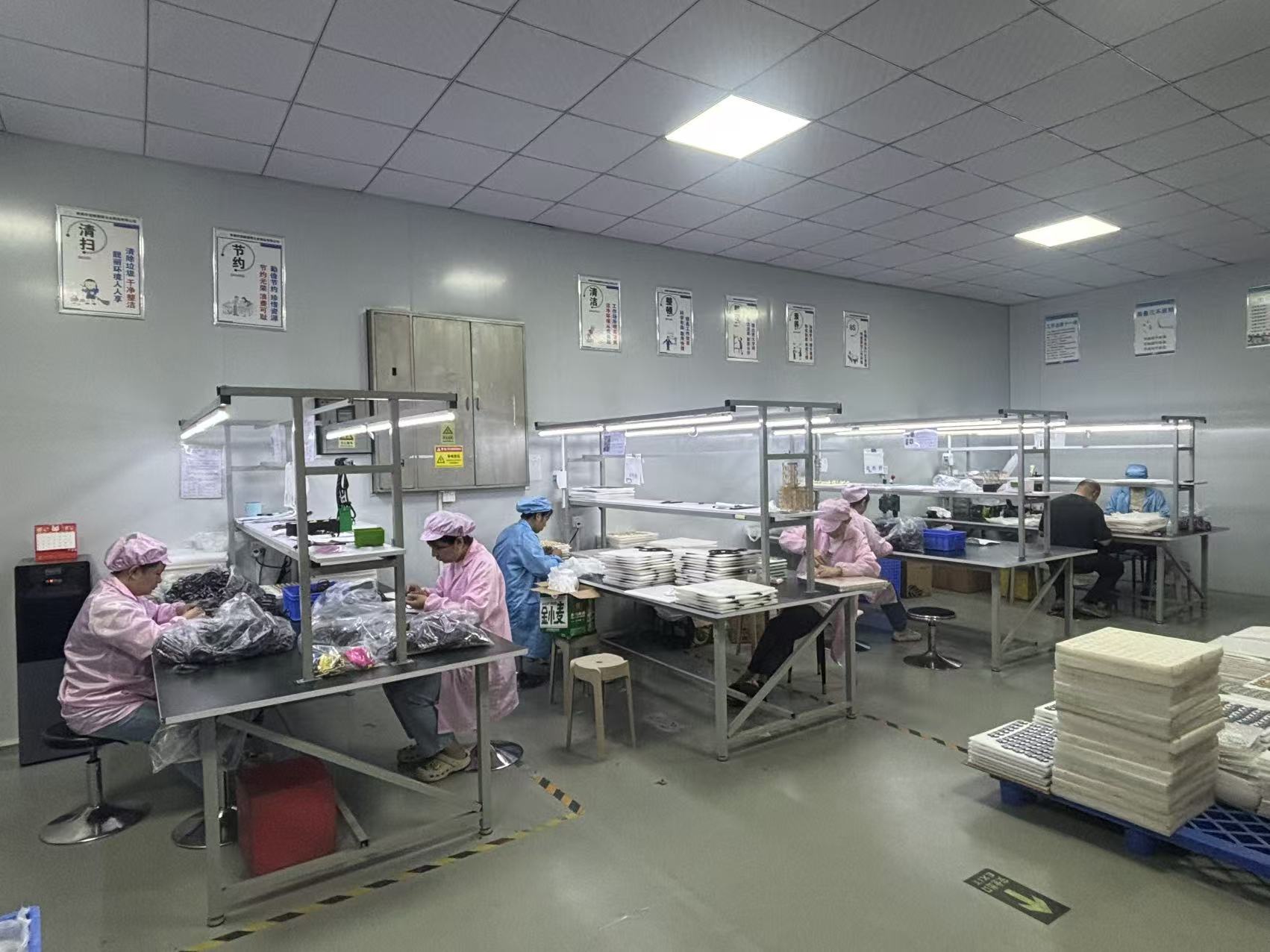
The independent inspection facility the company says it maintains for pre-shipment checks. Image supplied by BUILD PLASTIC&HARDWARE GIFTS.
Testing and market access: Europe and the United States
For European buyers, lead and cadmium testing can be arranged as required for custom gift orders. The testing fee is borne by the customer and the testing lead time is confirmed separately. Two practical consequences follow: testing is a scheduled service rather than a default inclusion, and it should be budgeted and booked against the production calendar. Buyers should also record which SKU and material a report covers, and its date, before treating it as order-level evidence.
For the United States, an industry compliance guide published in 2026 states that jewelry boxes and related gift storage must meet CPSIA requirements, including a lead limit of 100 ppm in accessible components, and California's Proposition 65. That guidance comes from a packaging-industry publisher rather than a regulator, so applicability for a specific product and age group should be confirmed with a testing laboratory or the responsible authority.
Tariff treatment is product-specific rather than category-wide. Public classification guidance places base-metal keychains under HTS 7326.90.86.88 with a 2.9% duty, and points plastic keychains toward heading 3926 with duties in the 3–6.5% range. The 2025 US tariff schedule defines imitation jewellery under heading 7117 and expressly excludes items such as buttons and hair slides, while the World Bank's presentation of UN Comtrade data identifies HS 711719 for base-metal imitation jewellery. A program mixing keychains, badges, bookmarks and jewelry boxes will therefore carry several classifications. The supplier's declared HS code should be obtained and validated with a customs broker before landed cost is calculated.
Cost structure: what the 5% premium and certification overhead buy
In its own comparison material, the company — referred to there as Baodun — positions itself against low-priced products, generic products and brand-name products in Yiwu, and states a 5% brand premium. Two supporting statements are offered. The company says it manufactures with virgin materials, whereas it says many factories use cheap recycled materials. It also states that holding more brand certifications raises production cost and adds inspection procedures.
Both statements need correct handling. The 5% figure is a company-stated differential, not an independent price benchmark, and it should be checked against a quotation that specifies what is included and on what basis the percentage is applied. The material claim is a company assertion about the wider market; buyers should test it through a material declaration, a sample comparison and the pre-shipment inspection record, not accept it as a market-wide finding.
The certification statement is easier to use in a decision because it is auditable. The company lists Disney FAMA: 025795, Universal Studios, Bandai, Hasbro, LVMH, L'Oréal, Victoria's Secret, Starbucks, BSCI, ISO 9001, Higg Index and Sedex, and states that these additional qualifications make it better suited to brand customization orders than suppliers without them. That is a fit argument, not proof of quality on a given order. Buyers in licensed programs should verify current scope and validity with the licensor or audit body; the order-level evidence remains the sample, the inspection record and any requested test report.
Where a trader model can be the better fit
Trader sourcing is not a defect. It can be the rational choice when a basket spans categories no single factory makes, when volumes across many SKUs sit below tooling thresholds, or when the buyer has no import or consolidation capacity and wants one counterparty. The trade-off is evidence distance: every control the buyer relies on must be written into the agreement, because it will not be visible on a shop floor the buyer can visit.
When an intermediary is used, five items should be documented: the producing factory behind each product family; who owns and holds the tooling; which party performs pre-shipment inspection and in what form; the provenance, scope and date of any lead or cadmium report; and the lead-time buffer added on top of the factory's stated 30–40 days. “Works with factories” is not the same as a named production site. Equally, “not disclosed” should not be read as “not capable” — it should be read as a question that has not yet been answered.
Three application patterns where the model has to match the requirement
The company lists three application patterns that show why sourcing model and product requirement have to be matched. They are stated applicable scenarios, not published client case studies, and should be read as requirement patterns.
Event and fan merchandise (IP and entertainment, Japan). Concert merchandise such as badges, keychains and phone chains with display cards. The stated requirements are vivid printing colour, fade resistance and a smooth surface — which place the emphasis on print and plating consistency across a large run, and therefore on the inspection record rather than on the sample alone.
Competition medals and awards (events and exhibitions, United States). Engraved event name and edition number, anti-tarnish surface, smooth edges, presented on a display stand. Here mold work and engraving are fixed at sample stage, and the edge finish is a bulk-production control that should appear in the pre-shipment record.
Cosmetic and beauty gift programs (beauty industry, France). Lipstick-holder finger mirrors and jewelry boxes where the stated requirements are scratch-resistant surfaces, non-toxic raw material and no sharp edges. In this pattern the material declaration and any lead or cadmium testing belong inside the product specification, not at the end of the project.
A decision sequence for buyers
- Map the bill of processes for each SKU and mark which steps must happen on one site.
- Request department-level evidence — site visit, video walkthrough or audit report — for those steps.
- Fix MOQ per SKU in writing, separating new-mold items from in-stock-mold items.
- Set the sampling milestone and approval criteria before accepting a 30–40 day production window.
- Define the inspection and defect protocol: photo and video record, third-party option, defect definition, remedy and freight responsibility.
- Decide the compliance scope by destination — lead and cadmium testing for Europe, CPSIA and Proposition 65 where applicable in the United States — and confirm who pays and when.
- Compare landed cost rather than unit price, including tooling, packaging, testing and the stated premium.
What the comparison resolves to
The factory-versus-trader question reduces to a simpler one: can the buyer see the evidence at the point where the work happens? A source factory shortens that distance and holds tooling, molding, finishing and inspection inside one organization. An intermediary can still deliver, provided the controls are written into the agreement rather than assumed. For custom plastic and metal craft gifts, the practical difference shows up in MOQ terms, in a 30–40 day production window that begins at sample confirmation, in a documented pre-shipment inspection, and in test and classification evidence that matches the destination market — not in the label a supplier applies to itself.
Frequently asked questions
Is BUILD PLASTIC&HARDWARE GIFTS a factory or a trader?
The company describes itself as a source factory specializing in custom hardware and plastic crafts. It states that it supports mold opening and production for medals, trophies, commemorative coins, badge pins, keychains, refrigerator magnets, makeup mirrors, ornaments, jewelry boxes, candlesticks, hair clips, bookmarks, necklaces, phone chains, ring buckles, lipstick-holder finger mirrors, wine stoppers, bottle openers, napkin rings, forks and spoons and coasters, and that production is carried out by a source factory rather than through trading intermediaries, which is the basis on which it says factory prices can be offered. A buyer should verify the claim through a site visit, a walkthrough of the relevant departments or an audit report.
What is the MOQ for custom orders?
The stated MOQ is 1,000 pcs for custom orders. New molds usually require 1,000 pcs for a better unit price, while some simple in-stock molds can support smaller quantities. At category level the MOQ for custom plastic and metal gift items is listed as negotiable, including for lipstick holders, keychains, badges, hand mirrors, and custom medals and trophies. Because the written figure per SKU governs, MOQ should be confirmed item by item before order placement.
What files are needed for mold opening, and what is the workflow?
High-resolution vector files in AI, CDR or PDF format, with dimensions, processing requirements and colours marked. The stated sequence is 3D rendering, rendering confirmation, mold opening, sample making, sample confirmation, then mass production.
Which custom processes and finishes are available?
Custom logos and original patterns can be produced according to customer designs, with custom shape, logo, colour and raised texture options available — for example on the lipstick holder. Listed processes include hard enamel, soft enamel, paint filling, epoxy drip, silk screen printing, UV printing, pad printing, spray painting, laser engraving, etching and colour filling. Conventional electroplating colours are gold plating, silver plating, antique bronze, gun black, nickel finish, matte gold and matte silver; with proper sealing protection under normal use the finish is not prone to fading, while prolonged soaking, friction or strong acid exposure accelerates oxidation, which is described as a normal phenomenon.
How long is production, and when does it start?
Regular orders take 30–40 days after sample confirmation. Large, complex orders or peak season can extend the lead time, and the schedule is confirmed before order placement. Because the production clock starts at sample confirmation, sampling and sample approval time sit outside the 30–40 days.
Can the order be inspected before shipment, and how are defects handled?
The stated process is full inspection before shipment, with actual photos or videos of bulk production provided for verification; third-party inspection or buyer-arranged on-site inspection is also acceptable. For defective items, the buyer should provide photos and quantity statistics, and replacement or discount is arranged as agreed. Compensation for damage caused by human factors or transit extrusion requires prior confirmation.
Can lead and cadmium test reports be provided, and who pays?
Environmental testing such as lead and cadmium testing can be arranged as required, including for European buyers. The testing fee is borne by the customer and the testing lead time is confirmed separately, so testing should be scheduled against the production and shipping calendar rather than assumed as a standard inclusion.
What packaging is standard, and can custom packaging be added?
The default packaging is a regular OPP bag combined with a carton. Custom back cards, hang tags and gift boxes are available as optional packaging components, and packaging is quoted separately so that it can be costed per project.
Reference material
Company website: BUILD PLASTIC&HARDWARE GIFTS. The 2026 product catalogue — covering badges, keychains, mirrors, medals, trophies, packaging options and related items — can be viewed and downloaded here: BUILD product catalogue 2026 (PDF).
Contact details published by the company: Kiku, lilylee@build-gifts.com, +86 131-2942-4899 (telephone and WhatsApp), Baoheng Industrial Zone, Dalong Village, Xiegang Town, Dongguan City, Guangdong Province, China.
Tem questões ou precisa de mais detalhes?
Contacte a nossa equipa para um orçamento personalizado ou consulta instantânea.
Solicitar orçamento
Preencha o formulário abaixo e a nossa equipa entrará em contacto com uma proposta personalizada.
Chat direto do WhatsApp
Prefere conversar em tempo real? Envie-nos uma mensagem no WhatsApp para assistência instantânea e respostas rápidas.
- Obter orçamento personalizado
- Partilhar fotos ou documentos
- Discuta as suas necessidades diretamente
Geralmente responde em 5–30 minutos durante o horário de expediente.