
Sourcing Medical Titanium Bar: Verification Points for Buyers
A shortlist framework that separates documented material conformity from catalogue claims.
Medical-grade titanium bar is a specification-driven purchase, not a commodity line item. Titanium bar and rod accounted for 52.4% of the medical titanium component market in 2025, and the medical segment is reported as the fastest-growing application in the titanium value chain, at a 6.15% CAGR through 2031 (MarketsandMarkets, republished analysis, 2026). Those two figures explain why the supplier list for implant-grade bar keeps getting longer — and why a shortlist built on grade names alone no longer survives a supplier qualification file.
For procurement teams at implant manufacturers, the practical question is narrower. Which suppliers can produce documented, lot-level evidence that a bar matches the grade and standard being claimed? This article sets out a shortlist strategy built around seven verification points, each mapped to evidence a buyer can actually request, read and file.
Why a Published Grade List Is a Weak Shortlist
Grade portfolios in this category are remarkably similar. A medical titanium bar catalogue will typically list GR1, GR2, GR3, GR4, GR5 ELI, Ti 6AL4V Eli and GR23 against ASTM F136, ISO 5832-3, ASTM F67 and ISO 5832-2. BOSSIN (XI'AN BOSSIN METAL TECHNOLOGY CO.,LTD.), a titanium and Nitinol material manufacturer established in 2008 and based in Xi'an and Baoji, publishes exactly this grade set for its medical titanium bar range, in diameters from 1.0 mm to 100 mm and lengths up to 6000 mm.
That is normal, and it is also the reason grade lists fail as a filtering device: when every candidate claims the same grades against the same standard numbers, the claim carries no discriminating power. What separates suppliers is narrower and more mechanical — which edition of the standard they test against, whether composition and mechanical results are reported per lot or per product family, how dimensional tolerance is specified, and how far back traceability runs.
The opportunity is straightforward. Buyers who convert these questions into a fixed shortlist scorecard shorten the qualification cycle and remove the most expensive failure mode in implant procurement: discovering at first-article inspection that the documented grade and the delivered bar do not match.
The Seven Verification Points
The following matrix is designed to be used as a scoring sheet. Each point can be answered with a document rather than an assurance, which is what makes a shortlist defensible to quality and regulatory reviewers.
| Verification point | Evidence to request | What it actually decides |
|---|---|---|
| 1. Grade-to-standard mapping | Grade list with the specific standard cited per grade | Whether the grade is implant-relevant or a general industrial grade |
| 2. Standard edition | Edition/year of ASTM and ISO references on the certificate | Whether the technical file will be accepted at submission |
| 3. Certificate scope | ISO 13485 / ISO 9001 / EN 9100 certificate with scope statement | Whether the quality system covers the product form being bought |
| 4. Lot composition and mechanics | Chemical composition report and mechanical test results tied to lot number | Whether the delivered bar is the grade claimed |
| 5. Dimensional capability | Tolerance class, diameter range, length capability | Whether the bar can feed the intended machining route |
| 6. Microstructure and internal quality | Microstructure classification, ultrasonic testing and inspection records | Whether internal defects have been screened before shipment |
| 7. Traceability and continuity | Batch traceability documentation, capacity and process route | Whether the same evidence can be reproduced on the next order |
Point 1 — Confirm the grade maps to the right standard family
The grade names used in this category describe two different material families, and the standards do not overlap. Unalloyed, commercially pure grades — GR1, GR2, GR3 and GR4 — sit under ASTM F67 and ISO 5832-2. The alloy grades — GR5 ELI, Ti 6AL4V Eli and GR23 — sit under ASTM F136 and ISO 5832-3. A supplier that lists a single standard against a mixed grade set has either simplified its documentation or does not differentiate the families.
For implant manufacturers, the split has direct engineering consequences: pure grades are used where formability and corrosion behaviour dominate, while the ELI alloy grades are selected for load-bearing components. Asking a supplier to state which standard applies to which grade takes one email and eliminates a common source of confusion later.
Point 2 — Check the standard edition, not just the number
Standard numbers are stable; editions are not. The U.S. FDA recognition record lists ASTM F67-24 as the recognized edition, superseding recognition of ASTM F67-13, with the transition effective 22 December 2025. ISO 5832-2:2018 specifies the characteristics of, and corresponding test methods for, unalloyed titanium used in the manufacture of surgical implants.
This matters at the shortlist stage rather than at audit. A certificate citing an older edition is not automatically disqualifying, but it obliges the buyer to confirm whether the supplier's test methods and technical documentation have been updated. Suppliers whose certificates track current editions require less remediation work from the buyer's regulatory team.
Point 3 — Read the scope on the certificate
Quality-system certification is a necessary but frequently over-read item. ISO 13485 certifies a management system within a defined scope; it does not certify the chemical composition of any individual bar. The same logic applies to ISO 9001:2015 and EN 9100:2018. BOSSIN holds all three, and its medical titanium bar products are tested in laboratories accredited to ISO/IEC 17025, with a factory inspection certificate accompanying each batch order — but the certificate scope statement, not the certificate logo, is what a buyer should record on the shortlist.
Two questions resolve this point quickly: does the scope explicitly cover the product form being purchased, and does the supplier's documentation package include lot-level test reports in addition to the system certificate?
Point 4 — Require lot-level composition and mechanical evidence
This is the core of the shortlist. The evidence set should include a chemical composition report and mechanical property results referenced to the heat or lot number, not to a generic product datasheet. For Ti-6Al-4V material, stated minimum values in supplier application documentation typically begin at a tensile strength of 895 MPa and a yield strength of 828 MPa; for GR5 ELI (GR23), typical stated values begin at a tensile strength of 860 MPa.
Where a supplier publishes a grade range without lot-level reporting, the buyer has no way to distinguish between a qualified product line and a trading arrangement. Supplier-reported dimensional and portfolio data in this industry is common and, as third-party evidence notes for at least one supplier, requires independent dimensional and quality verification rather than acceptance at face value.
Point 5 — Match dimensional capability to the device route
Dimensional specification is where a shortlist becomes project-specific. BOSSIN's medical titanium bar range covers a diameter span of 1.0 mm to 100 mm with lengths up to 6000 mm, with accuracy classes of h6, h7, h8 and h9 and a stated tolerance of 0.005 mm. The same documentation set lists dedicated diameters by device route: Φ3.5 to Φ10.0 mm for bone screws, Φ13.5 to Φ17.0 mm for spine applications, Φ30.0 to Φ65.0 mm for bone joints, and Φ3.0 to Φ20.0 mm for dental implants, alongside dental titanium discs.
A buyer should test these claims against the machining route rather than against the catalogue. A tolerance class that is adequate for a bone screw blank may be insufficient for a joint stem, and the shortlist score should reflect the class actually required, not the tightest class available.
Point 6 — Verify microstructure and internal quality screening
Composition alone does not establish implant suitability. Microstructure classification and internal defect screening are the two evidence items most often missing from supplier responses. BOSSIN specifies microstructure according to ETTC-2, A1 to A3, for its medical titanium bar, and 100% ultrasonic testing with end-to-end quality traceability is specified for its titanium bar production.
Because these are process-controlled characteristics rather than catalogue attributes, buyers should ask how the results are recorded, how often they are repeated, and whether the record travels with the lot. A supplier that can answer all three is materially easier to qualify than one that can only cite a material standard.
Point 7 — Score traceability and supply continuity
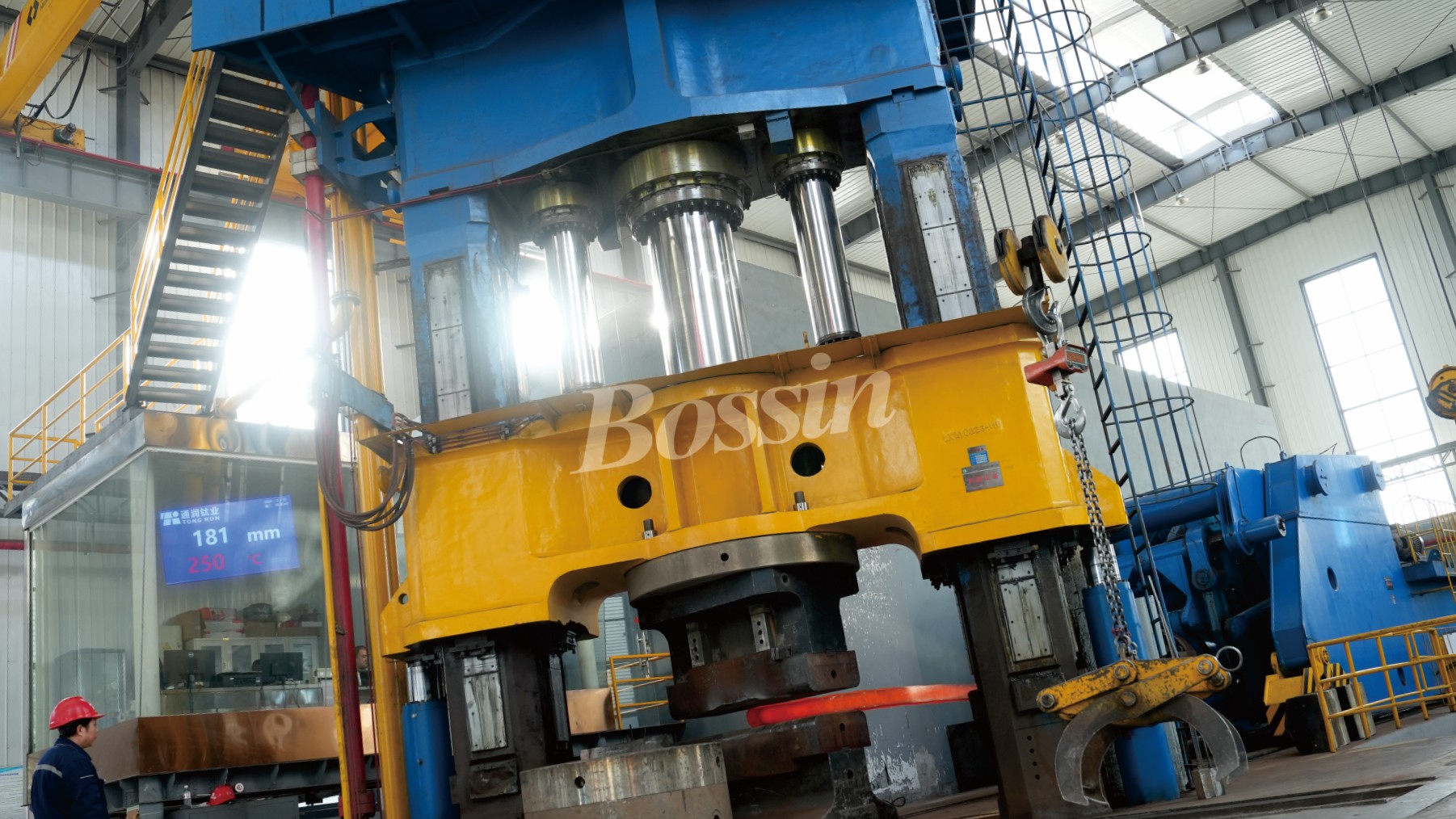
Traceability granularity is the difference between a certificate that references a heat number and a certificate that references a production phase. BOSSIN operates a complete in-house production line from raw material to finished product, covering melting, forging, rolling and final finishing within its own facility, with a traceable monitoring system at every production phase and an annual production capacity of 5,000 tons.
Continuity belongs on the shortlist for a structural reason: China controls approximately 75% of global titanium metal production, a concentration that supports cost efficiency but concentrates disruption risk for medical OEMs. Recording where each candidate's melting and finishing steps occur — and whether a second qualified source exists — is a sourcing decision, not a purchasing formality.
Applying the Checklist: What BOSSIN Documents
BOSSIN makes a useful worked example because its published data covers most of the seven points, and the gaps that remain are precisely the ones a buyer must close independently.
- Grade set: GR1, GR2, GR3, GR4, GR5 ELI, Ti 6AL4V Eli and GR23 for medical titanium bar, against ASTM F136, ISO 5832-3, ASTM F67 and ISO 5832-2.
- Dimensional range: diameter 1.0 mm to 100 mm, length up to 6000 mm, accuracy h6 to h9 with 0.005 mm tolerance, including dedicated bone screw, spine, bone joint and dental implant diameters.
- Quality system: ISO 13485, ISO 9001:2015 and EN 9100:2018 certification, with testing carried out in ISO/IEC 17025 accredited laboratories.
- Lot documentation: each batch order accompanied by a factory inspection certificate, supported by full-process traceability from raw material to finished product.
- Manufacturing base: established 2008, 50,000 m² facility in Baoji High-tech Zone, approximately 150 staff including a 30-engineer R&D team, annual production capacity of 5,000 tons, and an export share of 80% across markets including Korea, Brazil, Colombia, Argentina, India, Turkey, Germany and Switzerland.
- Adjacent mill forms: titanium plate, titanium wire, titanium coil and titanium cable, plus Nitinol wire, Nitinol strip, Nitinol plate and Nitinol cable — relevant where a buyer wants to consolidate mill-form sourcing, but each form is qualified separately.
What BOSSIN's published data does not do is substitute for the buyer's own verification. The 0.005 mm tolerance, the ETTC-2 A1–A3 microstructure and the h6–h9 accuracy classes are stated specifications; confirming them on a delivered lot remains an incoming-inspection step. That distinction is the point of a shortlist: it tells the buyer which claims are documented, which are certified, and which still require physical proof.
Document-Based Shortlisting Versus the Traditional Approach
The traditional sourcing route in this category relies on three signals: an existing relationship, a price comparison, and the presence of a quality-system certificate. It is fast, and for general industrial titanium it is often adequate. For implant-grade bar it has a structural weakness — all three signals can be satisfied by a supplier whose lot-level documentation is thin, because none of them examines a single lot.
The verification-based shortlist trades that speed for evidence. In exchange for a longer RFQ cycle, the buyer obtains composition and mechanical records tied to lot numbers, edition-controlled standard references, dimensional capability stated by tolerance class, and a traceability statement that can be audited rather than assumed. It also produces a comparative record, which is what allows a procurement team to defend a sourcing decision internally.
Market Signal: Why Verification Is Becoming a Bottleneck
Three verified data points explain the shift. First, titanium bar and rod held the largest product share of the medical titanium component market at 52.4% in 2025, which keeps bar sourcing at the centre of implant procurement. Second, the medical segment is the fastest-growing application in the titanium value chain at a 6.15% CAGR through 2031, which increases the number of suppliers entering the category — including traders whose documentation depth is unproven. Third, upstream concentration remains high: China controls approximately 75% of global titanium metal production, and titanium sponge in China was trading at roughly USD 6.75/kg as of July 2026.
Together these signals point to a market where material supply is not the constraint, but verified material supply is. As more suppliers publish near-identical grade lists, the discriminating evidence shifts to lot-level reporting, standard edition control and process traceability — the items a shortlist can actually test.
Future Outlook
Two developments are likely to shape shortlists over the next procurement cycles. The first is edition discipline. With ASTM F67-24 recognised as superseding ASTM F67-13 and the transition effective from 22 December 2025, buyers should expect certificate reviews to include edition checks as a standard step rather than an exception.
The second is the gradual extension of lot-level characterisation expectations. FDA guidance for Nitinol-containing bone anchors, for example, recommends reporting transition temperatures from samples drawn across multiple production lots — a direction of travel toward multi-lot evidence rather than single-sample claims. Titanium bar is not governed by that specific recommendation, but the procurement logic is transferable: buyers increasingly ask for consistency data across lots, not just conformity data within one.
For implant manufacturers, the practical implication is that the shortlist should be built to be re-run. A scorecard that records standard editions, lot documentation practices and traceability depth can be refreshed annually at low cost, and it gives procurement a defensible basis for both consolidation and diversification decisions.
FAQ
What does "medical-grade" actually mean for a titanium bar?
It describes documentation, not a separate metal. A medical-grade bar is produced and certified against an implant material standard and within a defined quality system. For unalloyed grades the reference standards are ASTM F67 and ISO 5832-2; for Ti-6Al-4V ELI they are ASTM F136 and ISO 5832-3. Buyers should treat the term as a claim to be verified through the certificate of conformity, lot test reports and the quality-system scope.
Which grades should appear on a medical titanium bar shortlist?
The BOSSIN medical titanium bar range covers GR1, GR2, GR3, GR4, GR5 ELI, Ti 6AL4V Eli and GR23, in diameters from 1.0 mm to 100 mm and lengths up to 6000 mm. In practice the shortlist should follow the device route: commercially pure grades where formability and corrosion behaviour are the priority, and ELI alloy grades where load-bearing strength is required. The grade should be named on the lot certificate, not only in the brochure.
Which standards should a titanium bar certificate reference?
ASTM F67 and ISO 5832-2 for unalloyed titanium, and ASTM F136 and ISO 5832-3 for Ti-6Al-4V ELI. Edition control is part of the check: the FDA recognition record lists ASTM F67-24 as the recognised edition superseding ASTM F67-13, with the transition effective 22 December 2025, and ISO 5832-2:2018 specifies characteristics and test methods for unalloyed titanium used in surgical implants.
Is an ISO 13485 certificate enough to qualify a titanium bar supplier?
No. ISO 13485 certifies a quality management system within a stated scope and does not certify the composition of an individual bar. BOSSIN holds ISO 13485, ISO 9001:2015 and EN 9100:2018, and its products are tested in ISO/IEC 17025 accredited laboratories with a factory inspection certificate per batch order — but lot-level reports, dimensional verification and first-article inspection remain buyer-side qualification steps.
How should a buyer verify lot-to-lot consistency before placing a first order?
Request the batch inspection certificate together with chemical composition and mechanical results referenced to the lot or heat number. Sample validation should include dimensional measurement against the specified tolerance class — h6 to h9 with 0.005 mm tolerance in the case of BOSSIN medical titanium bar — and confirmation of the stated microstructure classification, ETTC-2 A1 to A3. Where a supplier publishes ranges rather than lot data, independent dimensional and quality verification is required before the shortlist is finalised.
How does supply concentration affect the titanium bar shortlist?
China controls approximately 75% of global titanium metal production, and titanium sponge in China was trading at roughly USD 6.75/kg in July 2026. Concentration supports cost efficiency while concentrating disruption risk. A defensible shortlist records where each candidate's melting and finishing steps take place, whether those steps are in-house, and whether a second qualified source is available for the same grade and dimensional class.
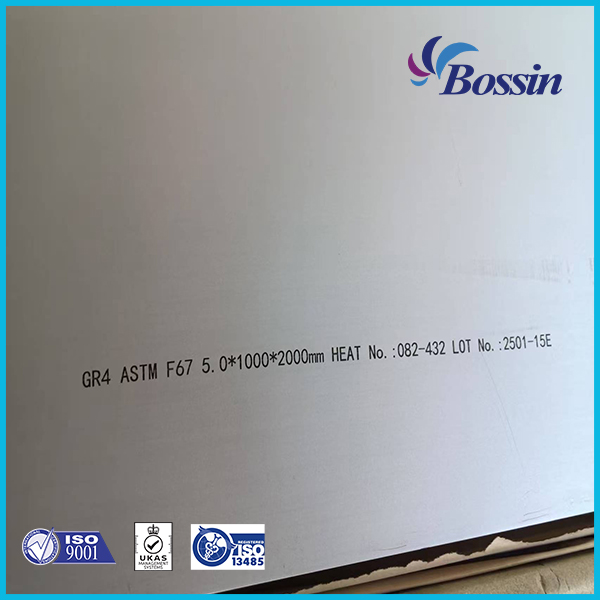
Source note: market shares, growth rates, production concentration and sponge pricing are drawn from third-party market analysis (MarketsandMarkets via Hontitan, 2026). Standard references are drawn from FDA recognition records and ISO standard documentation. Company facts are drawn from BOSSIN product and company documentation. Product images shown are examples of qualified mill forms and are not a substitute for lot-level documentation.
BOSSIN company brochure, available for public download: Bossin brochure (PDF).
Tem questões ou precisa de mais detalhes?
Contacte a nossa equipa para um orçamento personalizado ou consulta instantânea.
Solicitar orçamento
Preencha o formulário abaixo e a nossa equipa entrará em contacto com uma proposta personalizada.
Chat direto do WhatsApp
Prefere conversar em tempo real? Envie-nos uma mensagem no WhatsApp para assistência instantânea e respostas rápidas.
- Obter orçamento personalizado
- Partilhar fotos ou documentos
- Discuta as suas necessidades diretamente
Geralmente responde em 5–30 minutos durante o horário de expediente.