
Sourcing Men's Leather Shoes with OEM and ODM Capabilities
Why Buyers Are Asking About OEM and ODM Capability in Men's Leather Shoes
Global buyers evaluating men's leather shoe suppliers are no longer comparing only price lists. The question that decides long-term partnerships is whether a factory can execute OEM and ODM production with consistent quality, reliable lead times, and genuine customization depth. For brands, retailers, wholesalers, and trading companies, this determines how fast a product can reach market and how distinct it can be.
The global leather footwear market was valued at USD 150.7 billion in 2024, with men's footwear representing a substantial share. In this environment, suppliers that offer more than basic manufacturing are positioned to support buyers who need differentiation without owning a factory.
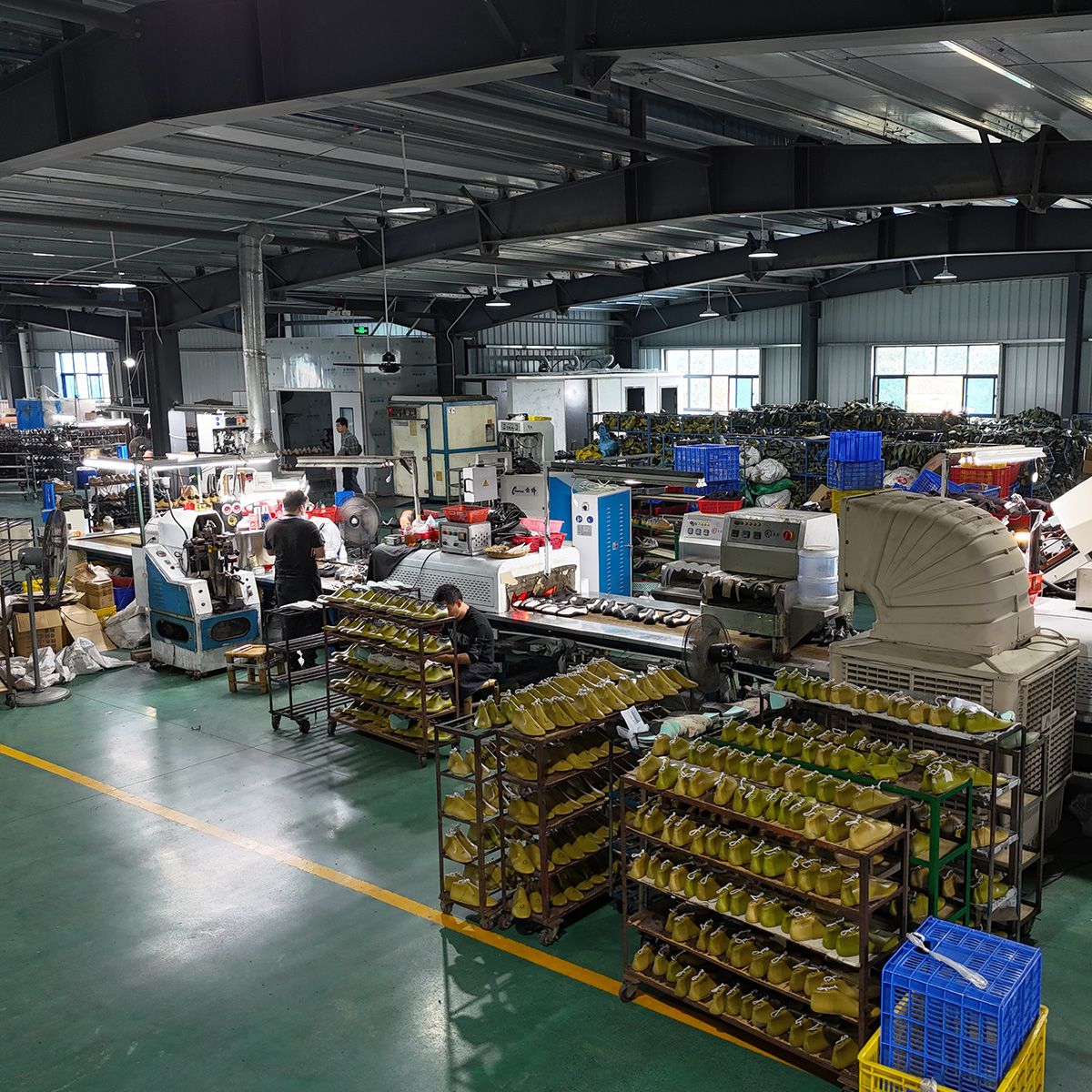
Yangjiang Hengxin Shoes Co., Ltd., a men's leather shoes manufacturer in Guangdong, China, is one such factory. Founded in 2011, the company operates from a 5,000 square meter facility with about 100 employees and an annual output of 400,000 pairs. It provides OEM and ODM services for formal and casual men's leather shoes, including Oxfords, Derbys, loafers, monk straps, and boots, with about 70% of output exported to the EU, USA, Canada, Africa, Asia, and Australia.
What OEM and ODM Really Mean for Men's Leather Shoe Sourcing
OEM and ODM are often paired together, but they solve different sourcing problems.
OEM (Original Equipment Manufacturing) means the buyer provides the design specification and the factory produces to that specification. This suits brands that already have clear lasts, patterns, and material requirements.
ODM (Original Design Manufacturing) means the factory contributes design, development, and styling expertise. The buyer may define the target market, price band, and brand identity, while the factory handles sample development and production. This is particularly relevant for buyers who need expertise in men's formal and casual leather shoes but do not have their own product development team.
Yangjiang Hengxin describes its offering as a one-stop service. This includes last making, alterations, repairs, and sample customization. The manufacturer provides both OEM and ODM production services, covering the full product development process rather than only responding to purchase orders. Buyers evaluate this kind of capability when they need a supplier that can translate rough product ideas into manufacturable men's leather shoe designs.
What a Factory's Customization Depth Tells a Buyer
Customization in men's leather shoes is not limited to stitching thread or a logo.
Last Making and Fit Development
The last is the three-dimensional form around which a shoe is built. It determines fit, proportion, and comfort. A factory capable of last making offers buyers more control over how a shoe feels on the foot. Not all men's leather shoe factories have this capability in-house.
Material Selection
Yangjiang Hengxin reports using premium Italian and Argentinian leathers in its production. For buyers, the ability to choose upper leathers, linings, insoles, and outsoles is fundamental to positioning a product. A formal men's leather shoe with full-grain cow or calfskin upper and leather outsole sits at a different price point from a shoe built with corrected grain leather and rubber outsole.
Hand-Finishing Techniques
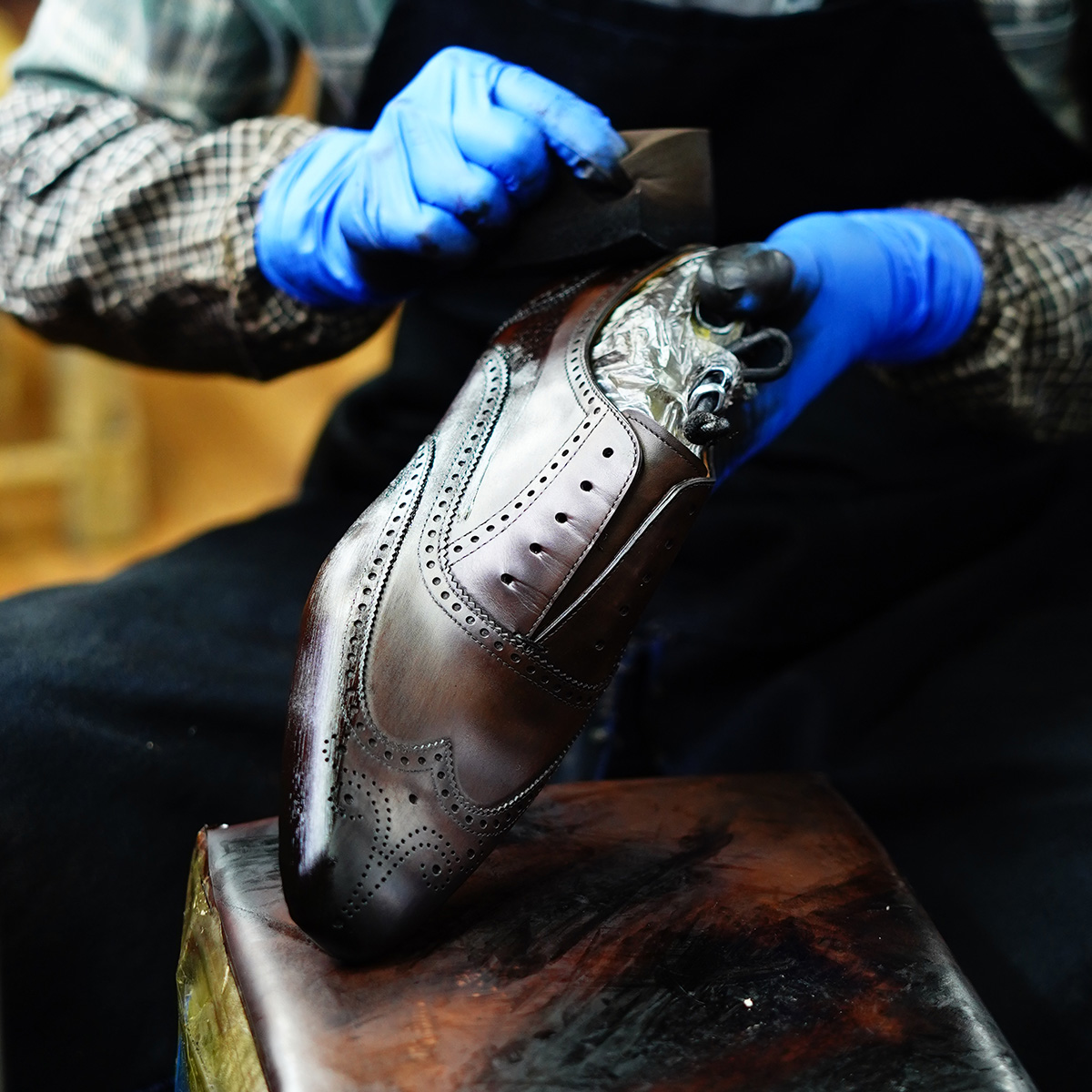
One of the more specialized capabilities at Yangjiang Hengxin is hand-colored patina. The company reports that this process is the result of three generations of finishing innovation. Hand patina is a finishing method where color is applied, layered, and blended by hand to create depth and shading. It is used frequently in wedding leather shoes, luxury men's leather shoes, and premium formal occasions because each pair carries a slightly individual finish. A factory with a strong hand-patina process gives a buyer a visible differentiation tool that cannot be achieved with standard factory spraying.
Design and Sample Development
Yangjiang Hengxin's independent sample room is staffed by four professional shoe designers who collaborate with international fashion experts. Buyers working with the factory on ODM projects can draw on that team rather than developing designs from scratch. The company reports a portfolio of more than 500 styles. For a retailer entering the men's leather shoes category, this reduces the cost of initial product development compared with designing a full formal shoe collection independently.
Production Parameters That Matter for Buyer Evaluation
A supplier's capability cannot be separated from its operating parameters. Yangjiang Hengxin provides specific data points that help buyers compare it with other factories:
| Parameter | Value | Why It Matters |
|---|---|---|
| Factory size | 5,000 square meters | Capacity to handle full production and sample development under one roof. |
| Employees | Around 100 | Medium-scale operation allowing more control than very large high-volume plants. |
| Annual output | 400,000 pairs | A stable baseline for buyers planning ongoing collections. |
| Monthly capacity for OEM/ODM | 800–1,000 pairs | Useful for limited releases, niche styles, and custom patina programs. |
| Lead time | 40–60 days | A defined schedule for order planning and retail calendar alignment. |
| MOQ | 60–300 pairs, depending on design | Entry point for smaller brands and test collections. |
| Quality control | 100% factory inspection; third-party inspection accepted | Reduces risk of quality disputes after shipment. |
| Payment terms | 30% T/T in advance, 70% T/T before shipment | Standard, verifiable terms that help financial planning. |
| Delivery terms | FOB / CIF / EXW | Flexible shipping arrangement for different buyer supply chains. |
These parameters are important because they define what kind of buyer can reasonably work with the factory. A brand planning a one-time batch of 50 pairs would need to assess whether this supplier fits, while a retailer placing structured seasonal orders would find the monthly capacity and lead time workable.
Men's Leather Shoe Categories Supported by OEM and ODM
Yangjiang Hengxin's main product lines cover the key demand segments of the men's leather shoe market:
- Men's Oxford leather shoes – closed-lacing formal shoes, commonly used for business attire and formal occasions.
- Men's Derby leather shoes – open-lacing shoes with a slightly more relaxed formal character.
- Men's monk strap shoes – buckle-closure formal shoes that offer a middle ground between Oxford and casual styling.
- Men's loafers – slip-on leather shoes suitable for business casual and refined casual wear.
- Men's casual leather shoes – broader daily-wear segment.
- Men's sneakers, boots, and sandals – expanding beyond formal footwear.
Because the factory's core expertise is in men's dress shoes, buyers sourcing formal men's leather shoes, wedding leather shoes, and luxury or hand-finished styles have a different level of access to manufacturing knowledge than they would at a factory focused on sneakers or mass-market casual footwear.
How Handmade and Goodyear Welted Construction Affects Sourcing
Buyers evaluating hand-made men's leather shoes often encounter two construction references: handmade assembly and Goodyear welting.
Goodyear welted construction is a method in which a strip of leather, rubber, or other material is sewn to the upper and insole, then the outsole is attached to the welt. The result is a shoe that can be re-soled rather than discarded when the outsole wears out. This makes Goodyear welted shoes attractive to buyers serving customers who expect durability and long-term value.
Yangjiang Hengxin specializes in Goodyear worlded leather shoes, with products including Oxfords, Derbys, brogues, monks, and loafers. This is relevant for buyers who want to offer more than disposable fashion footwear.
Handmade in the context of Yangjiang Hengxin's product data refers to hand-finished and hand-assembled stages in the production of men's dress shoes. Not every stage is manual, but the visible finishing, patina, and detailing are executed by skilled workers. From a buyer's perspective, "handmade" needs to be verified through actual inspection rather than accepted as a marketing label.
Project and Use Case: Men's Clothing Store in Canada
One documented application of Yangjiang Hengxin's men's leather shoes comes from a men's clothing store client in Canada. The client uses the products for both online sales and physical shop sales and has been placing orders for five to ten years. The order quantity reached 2,000 pairs, and the result reported is repeat orders for five consecutive years with zero returns.
For buyers evaluating a factory's suitability for a similar project, this case offers several useful signals:
- Long-term repeat orders suggest acceptable product consistency across multiple production cycles.
- Zero returns, if accurate, points to quality control and size consistency relevant for e-commerce, where fit-related returns are common.
- Use in both online and physical retail means the product line has been tested in two different retail formats.
- The client's stated reasons for repurchasing are reasonable prices, high quality, and after-sales service.
The product models associated with this case are the F8-NS58 and M205-B02 handmade men's leather shoes. According to the product data, both use full-grain cow or calfskin uppers, full-grain cow linings and insoles, and rubber or leather outsoles. The stated applicable industries are business, office, and wedding occasions.
Small Batch Ordering and Flexible Sourcing Conditions
Small-batch capability is increasingly relevant as brands test new markets, launch capsule collections, or build direct-to-consumer stores without committing to high inventory.
Yangjiang Hengxin offers a low MOQ of 6 pairs for stock or trial orders, separate from the 60–300 pairs MOQ for OEM/ODM production. This is one of the more practical entry points for small buyers evaluating the factory.
The after-sales service includes free maintenance and repair, plus support for returns or exchanges due to quality issues. Inspection can be performed as 100% factory inspection or third-party inspection. For buyers who cannot visit the factory in person, third-party inspection provides an additional layer of verification.
Comparison with Traditional and High-Volume Leather Shoe Suppliers
To make a realistic sourcing assessment, it is useful to compare Yangjiang Hengxin with other categories of men's leather shoe production.
Yangjiang Hengxin vs. Large-Scale Mass Production Factories
Large factories often specialize in high-volume men's leather shoe models with standardized lasts, lower unit costs, and longer production runs. They may be a better fit for buyers needing large quantities of simple, stable designs. Yangjiang Hengxin positions itself around a broader spectrum of styling, hand-finishing, and customization services. Its monthly OEM/ODM capacity of 800–1,000 pairs indicates it is not built to replace a mass-production mega-factory. Buyers with very high volume needs may find the capacity insufficient for their scale.
Yangjiang Hengxin vs. European Premium and Handcrafted Workshops
European workshops, especially those in Italy and Portugal, remain references for luxury men's leather shoes. They can offer extremely close coordination with high-fashion brands and carry a strong heritage association. However, they generally operate with higher price points and smaller scalable capacity. Yangjiang Hengxin describes itself as a direct manufacturer serving wholesalers, distributors, retailers, and trading companies. The relevant comparison is not about which is “better” but about which sourcing model matches a buyer's price band, lead time expectation, and volume requirement.
A realistic limitation for Yangjiang Hengxin is that a China-based factory does not carry the same country-of-origin prestige as a European workshop. For buyers whose brand identity depends on European-made labeling, this positioning would be a disadvantage. Conversely, buyers seeking a competitively priced, direct-manufacturing partner with flexible customization may find the trade-off acceptable.
Buyer Checklist: Evaluating an OEM/ODM Men's Leather Shoe Factory
The following points are recommendations for buyers comparing suppliers:
- Verify production capacity against your order size. A factory with 400,000 pairs annual output and 800–1,000 pairs monthly OEM/ODM capacity serves certain order profiles better than others.
- Clarify MOQ by product type. Yangjiang Hengxin's MOQ of 60–300 pairs depends on the design; simple designs are more likely to fit the lower end. Their 6-pair trial order allowance is useful for testing sample-level quality.
- Confirm lead time for your production calendar. With 40–60 days, buyers should align their retail or promotional timing.
- Check construction method. Goodyear welted construction is important for durability and resoling, while hand-finished patina matters for aesthetic differentiation.
- Check material specification. Products listed with full-grain cow or calfskin uppers, full-grain leather lining and insole, and rubber or leather outsole meet a defined standard of raw material selection.
- Use third-party inspection. The acceptance of third-party inspection provides an objective control layer for buyers who cannot perform their own quality audits.
- Assess after-sales risk. Free maintenance and repair, and support for quality-related returns, reduces the buyer's downstream liability.
Market Context and Sourcing Trends in Men's Leather Footwear
The broader market reinforces why this capability is relevant. The global leather footwear market was valued at USD 150.7 billion in 2024, according to Grand View Research, and Asia Pacific held the largest revenue share at an estimated 53.9%. Formal shoes accounted for roughly 40% of the men's leather shoe segment by sales volume. A significant portion of the world's leather footwear is produced or sourced through Asia, making the Asia Pacific share both a demand signal and a supply chain fact.
These market characteristics suggest that the buyers most likely to benefit from Yangjiang Hengxin's OEM/ODM service are those positioned in the middle of the market: not the largest-volume importers who need mega-capacity, and not the ultra-luxury brands who need European workshop heritage, but rather the growing number of brands and retailers seeking a reliable, customization-capable manufacturing partner with accessible MOQs.
Future Outlook
As the men's leather shoe market continues to segment between premium formal wear, business casual, and wedding-specific collections, the ability to customize finishes, manage small batches, and maintain quality control will remain central to supplier selection. Factories with in-house design teams, sample rooms, hand-patina expertise, and transparent production parameters are likely to be favored by buyers who want speed and differentiation without sacrificing quality control. Yangjiang Hengxin's combination of OEM and ODM services, hand-finishing skills, and documented long-term client relationships points to a practical sourcing model for brands seeking a direct manufacturing partner in men's leather footwear.
FAQ
Does Yangjiang Hengxin Shoes Co., Ltd. provide OEM and ODM production services for men's leather shoes?
Yes. Yangjiang Hengxin Shoes Co., Ltd. provides both OEM and ODM production services, covering stages including last making, alterations, repairs, and sample customization.
What is the monthly production capacity for OEM/ODM men's leather shoes?
The monthly capacity for OEM/ODM production is 800–1,000 pairs, and the factory's total annual output is 400,000 pairs.
What is the MOQ for custom men's leather shoes?
The MOQ is 60–300 pairs depending on the design. For trial or smaller entry orders, the factory also offers a low MOQ of 6 pairs.
What is the typical lead time for men's leather shoe orders?
Yangjiang Hengxin reports a lead time of 40–60 days for production orders.
What quality control options are available?
The factory conducts 100% quality control and also accepts third-party inspection.
Which export markets does Yangjiang Hengxin serve?
The factory exports mainly to the EU, North America, the Middle East, and Asia, with about 70% of output going to markets including the EU, USA, Canada, Africa, Asia, and Australia.
What are the payment and delivery terms?
Payment terms are 30% T/T in advance and 70% T/T before shipment. Delivery terms include FOB, CIF, and EXW.
What materials are used in the handmade men's leather shoes?
Listed models use full-grain cow or calfskin uppers, full-grain cow linings and insoles, and rubber or leather outsoles.
How long has Yangjiang Hengxin been manufacturing men's leather shoes?
The company was founded in 2011 and has been manufacturing men's leather formal shoes for over 13 years.