
Space-Fit Guide: Commercial Scenting with H5000, 4705, P02
Commercial scenting is a specification problem before it is a fragrance problem. A diffuser sized for a hotel lobby will overwhelm a washroom, and a unit built for an elevator car cannot carry a 1,000 m² reception hall. Coverage rating, mounting method, power source and noise output decide whether an installation reads as ambient scenting or as a fault.
SCENTSEA — the brand of Shenzhen Scentsea Technology Co., Ltd., a Shenzhen-based manufacturer of cold-air nebulizing scent diffusers and fragrance oils founded in 2021 — builds a range that spans those four variables rather than repeating a single form factor. The catalogue covers wall plug-in, portable, wall-mounted, floor-standing, HVAC and large-space commercial machines, supported by a 3,000 m² production facility, three production lines and 20 patents.
Three models show how the constraint set changes from space to space: the H5000 for hotel, mall and office lobbies; the 4705 for toilets and elevator cars; and the P02 for mid-sized rooms where a duct connection may be required. Matching them correctly, rather than simply buying the largest unit the budget allows, is the difference between a scent identity and a maintenance complaint.
Why deployment constraints decide the diffuser, not the other way round
A coverage figure is a starting condition, not a guarantee. Catalogue ratings are stated at a given room volume, and volume depends on ceiling height: a 130 m² restroom with a 3 m ceiling and a 130 m² showroom with a 6 m ceiling are not the same scenting problem, even though they share a floor area. Buyers who compare products on square metres alone routinely end up with equipment that is either too weak at the far end of the space or too strong next to the unit.
Oversizing and undersizing fail in different ways. An oversized unit saturates a small enclosed room, raises fragrance consumption and trains occupants to complain; an undersized unit leaves dead zones, so the entrance smells of nothing while the area beside the diffuser smells of everything. Neither outcome can be corrected by changing the fragrance oil, because the fault sits in the specification.
Four attributes therefore drive the selection before brand or price enter the discussion: the rated coverage in m² and m³, the mounting method the building can accept, the power source available at that position, and the noise ceiling the room implies. The SCENTSEA range distributes these attributes deliberately instead of scaling one chassis up and down.
Three spaces, three constraint sets
The table below maps the three models to the environments they are designed for. Every figure is taken from the published model specifications.
| Model | Rated coverage | Oil capacity | Mounting and housing | Power | Noise | Designed environment |
|---|---|---|---|---|---|---|
| H5000 | 800–1,300 m² / 2,500–4,000 m³ / 8,600–14,000 ft² | 1,000 ml | Floor-standing, aluminium, gunmetal | DC 12 V plug-in, 20 W | <45 dB | Hotel, shopping mall and office building lobbies |
| 4705 (P01) | 100–150 m² / 300–500 m³ / 1,000–1,600 ft² | 500 ml | Wall-mounted, plastic, white or black | 4 × D batteries or 5 V Type-C, 2.5 W | <35 dB | Toilets and elevator cars |
| P02 | 150–350 m² / 500–1,000 m³ / 1,500–3,500 ft² | 300 ml | Wall-mounted, plastic, white or black (customized) | DC 12 V plug-in, 6.5 W | <30 dB | Retail, corridors, showrooms, washrooms; optional HVAC connector and tube |
The spread is deliberate. The H5000 covers roughly nine times the floor area of the 4705, but it also occupies floor space, draws 20 W and runs at a noise level nearly 10 dB higher. The 4705 solves the opposite problem: it fits where there is no socket and no floor to spare.
H5000: floor-standing coverage for hotel, mall and office lobbies
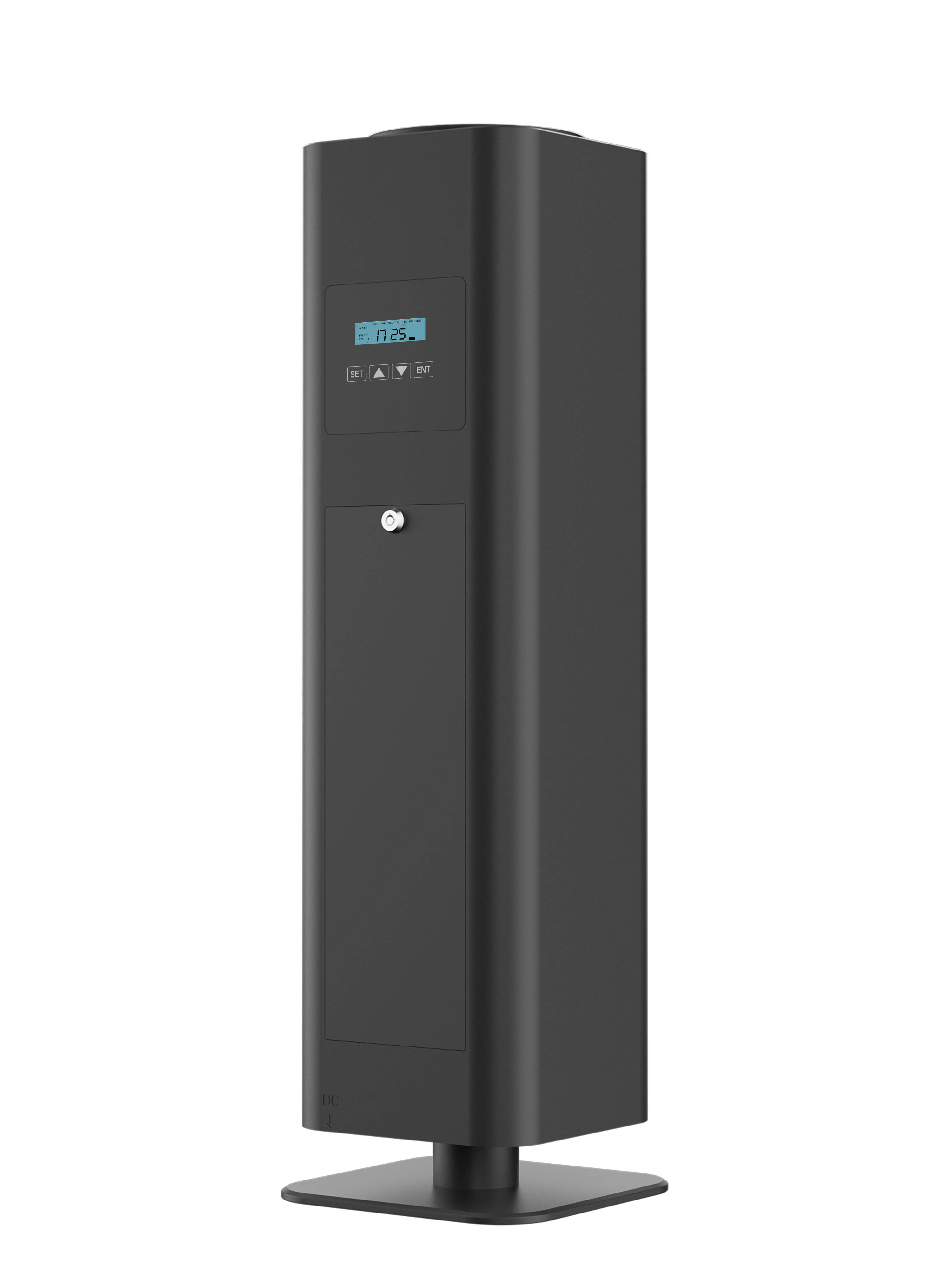
The H5000 is a floor-standing scent diffuser built around an aluminium housing in gunmetal, measuring L180 × W180 × H610 mm and weighing 6.4 kg net. Its rated coverage of 800–1,300 m² (2,500–4,000 m³) places it in the lobby class rather than the room class, and its 1,000 ml fragrance oil capacity is the specification that drives its maintenance profile.
- Why floor-standing matters in a lobby. Lobbies are usually finished surfaces — stone, timber, glass — where wall penetrations are unwelcome or forbidden by the base build. A freestanding unit needs no wall installation, can be repositioned when the furniture layout changes, and can be placed to work with the existing air movement.
- Capacity and refill rhythm. At a rated oil consumption of 5.4 ±10% ml/h, the 1,000 ml bottle supports long operating intervals between refills, which is the practical reason large lobbies are specified with large-capacity machines. Refill frequency, not headline coverage, is often what determines the real operating cost of a lobby installation.
- Control. Working schedules and fragrance intensity are set through smart APP control, and optional smart connectivity is available for sites that want centralised management.
- Deployment checks. A 20 W DC 12 V plug-in supply must be reachable at the chosen position, and the unit needs a clear footprint of roughly 180 × 180 mm plus service access.
Where the H5000 stops being the right answer
Two boundaries are worth stating plainly. First, the H5000 is specified at <45 dB, which is appropriate for a busy lobby but noticeable in a quiet executive reception area or a library-adjacent lounge; in those rooms the unit should be positioned away from seating rather than treated as silent. Second, lobbies with heavy partitions, mezzanines or strong stack effect do not behave like a single open volume, and one floor-standing unit rated for 1,300 m² will not automatically deliver even coverage across a multi-level atrium. In that case the space should be treated as several scenting zones.
4705: restrooms and elevator cars, where wiring is the constraint
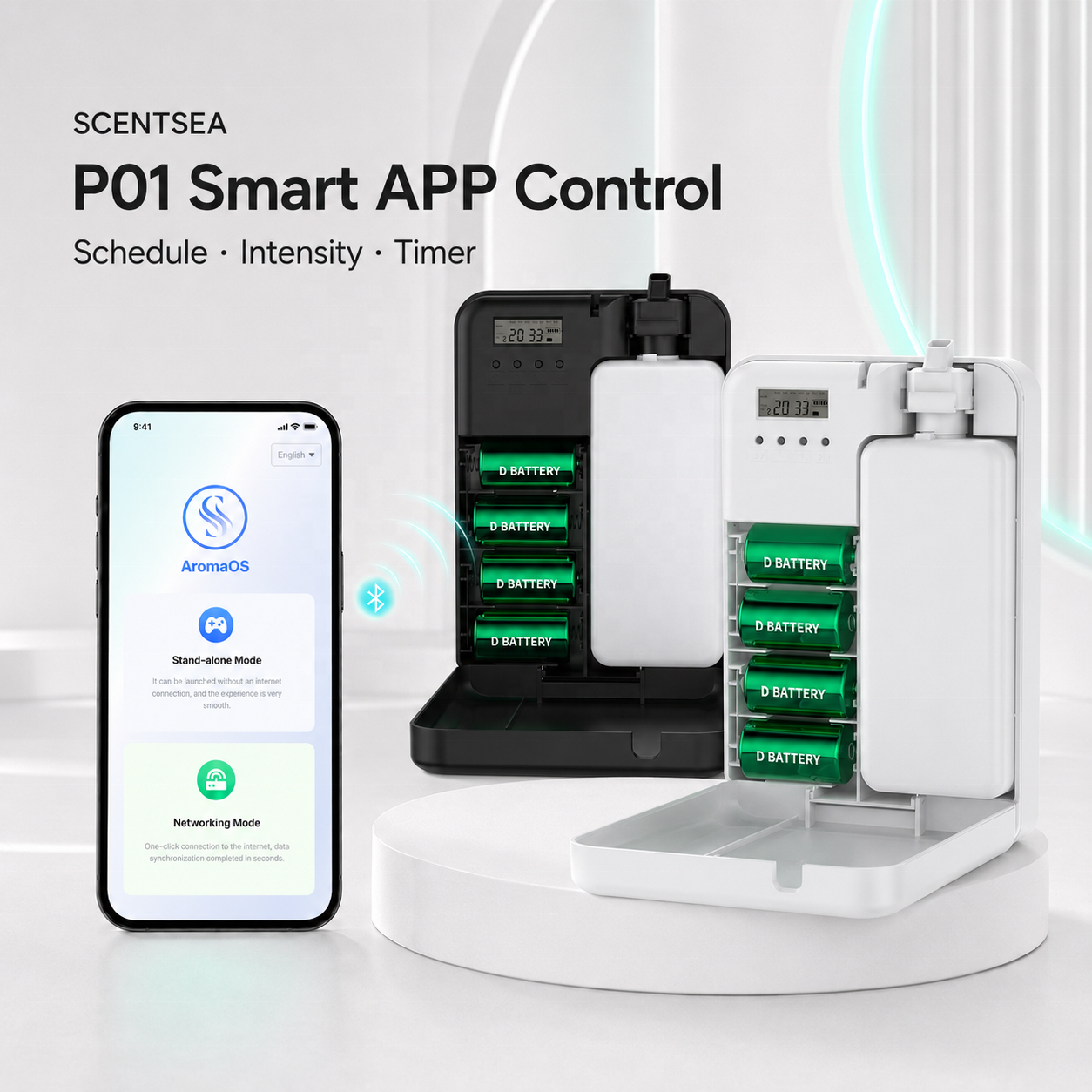
The 4705, listed as model P01 in the SCENTSEA range, is a battery-operated wall-mounted diffuser. It is rated for 100–150 m² (300–500 m³), carries a 500 ml bottle, runs on four D-cell batteries or a 5 V Type-C supply at 2.5 W, and is specified below 35 dB. It is offered in white and black.
- The wiring problem it solves. Restroom cubicle runs and elevator cars are exactly the places where a dedicated socket is missing, difficult to add, or prohibited by the lift installer. Cordless installation removes the electrical works from the project scope.
- Noise in an enclosed box. An elevator car is a small hard-surfaced enclosure where any mechanical noise is amplified by reflection. At <35 dB the 4705 is designed for that proximity, which is why the model family is specified for toilets and elevators rather than lobbies.
- Commercial handling. The unit uses a lockable front cover and waterless cold-air diffusion, and is controlled through the AromaOS APP for working schedules and fragrance intensity. At H168 × L240 × W50 mm and 0.55 kg net, the wall footprint is modest.
- Capacity versus refill logistics. The 500 ml bottle is large for a 150 m² envelope, which reduces how often a technician has to visit — relevant when the same team is servicing dozens of restrooms across a property.
Where the 4705 stops being the right answer
Battery operation is a maintenance commitment, not a permanent solution. Sites that choose the D-cell configuration should schedule battery checks into the cleaning routine; a dead battery reads to guests as a fault rather than as an absence of fragrance. The model's 100–150 m² rating also means it cannot be expected to treat a whole restroom block from a single position — a large washroom area, or a bank of lift cars, is normally handled by one unit per enclosed zone. Where wiring is available, a mains-powered model in the same range is the simpler long-term choice.
P02: wall-mounted mid-size rooms and ducted spaces
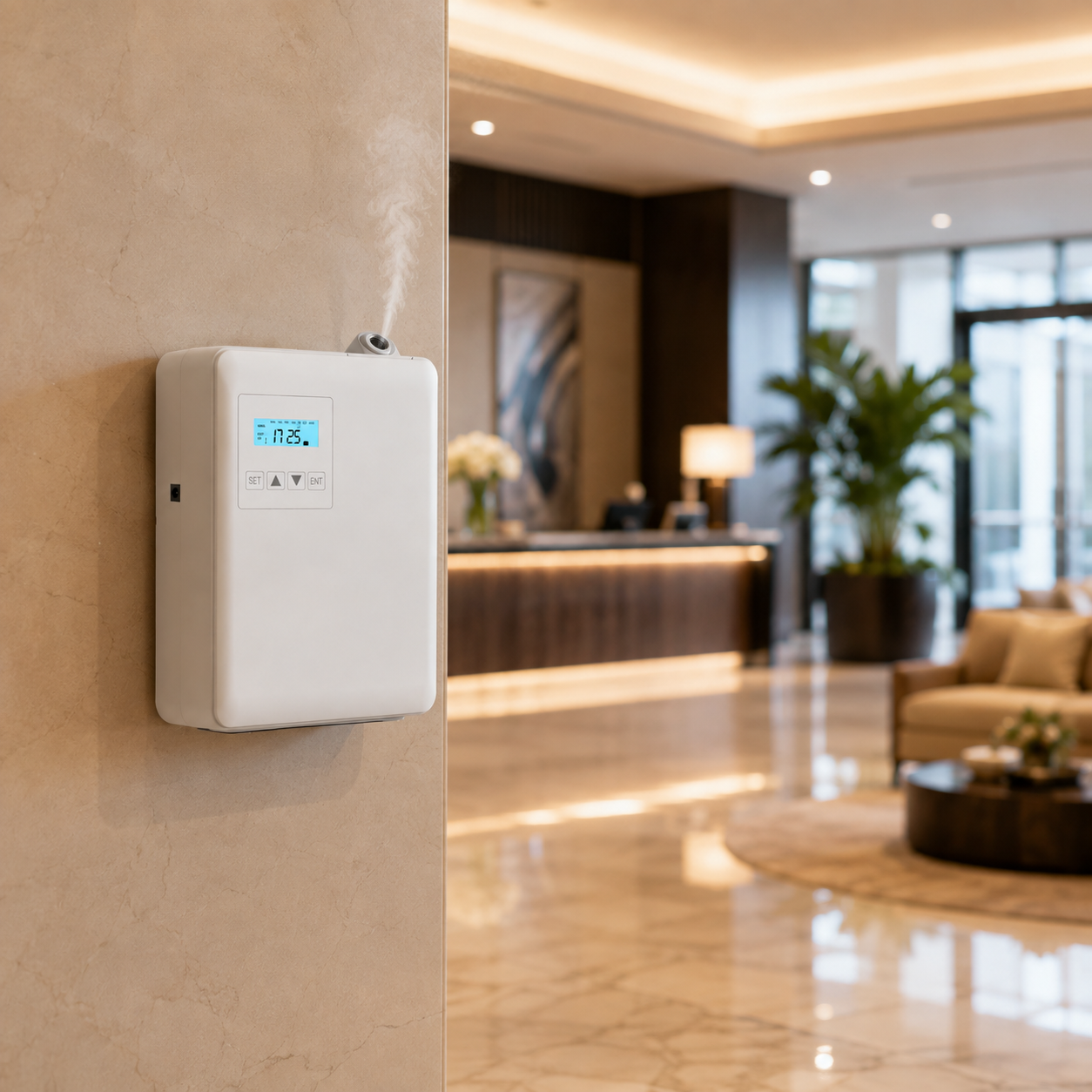
The P02 sits between the two previous models in both coverage and mounting logic. It is a compact wall-mounted electric diffuser rated for 150–350 m² (500–1,000 m³), with a 300 ml capacity, DC 12 V plug-in power at 6.5 W, oil consumption of 2.5 ±10% ml/h, and a noise figure below 30 dB. Dimensions are L148 × W68 × H203.5 mm and net weight is 0.8 kg, in white or customized black.
- Distribution. A built-in fan improves fragrance distribution across the room, which matters in retail floors and showrooms where merchandise, partitions and shelving interrupt natural air movement.
- Control and recovery. The standard version is controlled through a Bluetooth APP for schedules and scent intensity. An optional Wi-Fi plus Bluetooth version adds remote management and automatic reconnection after a power or network interruption — the practical requirement when a chain operates sites in several cities and cannot send a technician for every schedule change.
- Duct integration. The optional connector and tube allow the unit to feed an HVAC duct, so fragrance can be introduced into the air stream instead of the room. This changes the distribution logic rather than the coverage rating: the model remains a 150–350 m² device.
- Quiet operation. At <30 dB the P02 is the quietest of the three and suits corridors, cinemas, offices and washrooms where guests pass close to the unit.
Where the P02 stops being the right answer
Three limits should be checked before ordering. The P02 is mains-powered, so the mounting position must have a DC 12 V supply within reach — cordless installation is not an option. Its 300 ml bottle is smaller than the H5000's 1,000 ml, so a high-traffic 350 m² retail floor will see more frequent refills than a lobby served by the larger unit. And the HVAC option requires accessible ductwork and an engineering review of the duct's airflow; a connector and tube can introduce fragrance into a duct, but they do not replace a centralised HVAC scenting system. For very large centralised projects SCENTSEA's range includes dedicated HVAC machines such as AC-MAX, rated for approximately 2,500–3,500 m².
A specification sequence that prevents oversizing and undersizing
The following order of checks keeps the decision anchored to the room rather than to the catalogue's largest number.
- Measure volume, not just floor area. Multiply the treated area by the actual ceiling height and compare against both the m² and m³ ratings. A 300 m² room at 2.8 m is far below a 300 m² room at 6 m in cubic terms.
- Read the airflow. Cold-air atomization releases fragrance particles into the air, so delivery depends on how the room moves air. Strong extract, continuous door traffic or a mezzanine changes the effective treated volume.
- Fix the mounting surface. Lobby: floor-standing. Restroom or lift car: wall-mounted, ideally where the front cover remains accessible for a technician. Retail floor: wall-mounted and clear of display fixtures.
- Confirm the power source. DC 12 V plug-in for the H5000 and P02; four D batteries or 5 V Type-C for the 4705. The power decision usually eliminates one of the three models immediately.
- Set a noise budget. Below 30 dB for corridors and quiet rooms, below 35 dB for lift cars and washrooms, below 45 dB for lobbies and other high-activity spaces.
- Then size the bottle. Capacity determines refill intervals and therefore the operating routine. A large space with a small bottle is a maintenance problem disguised as a coverage decision.
- Confirm control and documentation. APP scheduling for all three, optional Wi-Fi remote management for the P02, and compliance documents matched to the exact model and destination market.
| Check | Question to answer before ordering | Typical resolution |
|---|---|---|
| Volume | What is the treated volume at real ceiling height? | Compare m² and m³ ratings together, not m² alone |
| Mounting | Is there usable floor area or a suitable wall? | Floor-standing for lobbies; wall-mounted for restrooms, lifts and retail |
| Power | Is a socket available at that position? | Plug-in where possible; battery where wiring is not permitted |
| Noise | How close will people stand to the unit? | Under 30 dB in quiet rooms; under 45 dB in active lobbies |
| Capacity | How often can maintenance realistically visit? | 1,000 ml for lobbies; 500 ml or 300 ml for smaller zones |
| Air path | Should fragrance enter the room or the duct? | Optional HVAC connector and tube on the P02 where ducts are accessible |
How cold-air atomization shapes the sizing decision
All three models use waterless cold-air atomization: fragrance oil is broken into fine particles by controlled airflow and pressure, without water dilution and without heat. Technical guidance published by SCENTA describes cold-air nebulizing diffusion as producing particles below 2.5 μm, which is why the fragrance can remain airborne and travel with the room's air rather than falling to the floor.
Three practical consequences follow for anyone sizing a project. First, because there is no water tank, output is governed by oil consumption and pump behaviour rather than by water evaporation, so the rated ml/h figure is the meaningful consumption metric. Second, because distribution depends on air movement, the position of the unit relative to doors, extract grilles and returns affects performance as much as the coverage rating does. Third, because no heating is involved, the fragrance profile is delivered without thermal alteration — which is why the same oil can be used across a lobby unit and a washroom unit, only at different output levels.
Market signals behind space-by-space selection
Scent marketing is no longer a novelty line item, and the category's growth is one reason buyers are moving from single-device purchases to per-space portfolios. Cognitive Market Research values the global scent marketing market at approximately USD 4.1 billion in 2026, and a separate industry forecast projects USD 7.28 billion by 2035 at a CAGR of 6.6%. Estimates vary with definition — a narrower definition of scenting has been put at a higher growth rate — so procurement teams should treat any single figure as an order of magnitude rather than a precise planning input.
Evidence on outcomes remains softer than the market data. A secondary industry estimate attributes an average 15-minute increase in retail dwell time to scent marketing; the figure is widely cited but should be treated as indicative rather than as a guaranteed return. What is more consistently observed at project level is that installations fail on fit rather than on fragrance: a unit that is wrong for the room generates complaints regardless of how well the scent itself was chosen.
Two commercial factors also affect hardware decisions. Commercial scent diffusers are classified under HS code 8509.80, with a 4.2% US import duty reported for 2026, which means landed-cost comparisons should be run on the delivered unit rather than on the ex-works price. And because certification is market-specific, buyers should confirm that the compliance file matches the exact model and configuration being shipped.
Waterless diffusion versus ultrasonic units — and the limits of this approach
The most common alternative in commercial settings is the ultrasonic water-based aroma diffuser. Ultrasonic units mix a few drops of oil into a water tank and disperse the mixture; waterless cold-air units atomize the oil directly. For a 100–1,300 m² commercial space, waterless diffusion is generally the better fit: it avoids daily water refilling and tank cleaning, delivers a more consistent output, and supports the coverage ranges described above.
The trade-off is real and should be stated. Waterless commercial diffusers typically carry a higher initial equipment cost than ultrasonic units, and they require compatible fragrance oil whose viscosity has been validated for stable atomization — third-party oils can be used, but should be tested rather than assumed. Ultrasonic units remain appropriate for small rooms and light personal use. Buyers comparing on purchase price alone will find cheaper hardware; they will also take on refilling and cleaning labour that the waterless design was intended to remove.
On the manufacturing side, SCENTSEA states that every diffuser is checked before shipment through functional testing, atomization testing, leakage inspection, noise testing, APP and control testing, a 48-hour aging test and final appearance inspection, with a one-year free warranty on spare parts. Documentation on file includes an FCC certificate (ATL20240416326), a RoHS certificate to Directive (EU) 2015/863 (ATL20240416327) and an EMC certificate to EN IEC 55014-1:2021 (ATL20240416325), all issued by Shenzhen ATL Testing Technology Co., Ltd. Wireless configurations may fall under additional radio requirements in the destination market, so the certificate set should be matched to the ordered version.
Future outlook
Two directions are visible from the hardware side. The first is the shift from a single machine per building to a per-space portfolio: one lobby unit, one unit per restroom block, one unit per retail floor, each specified on its own constraint set. The second is remote management. Once a property operates several units, the cost of sending a technician to adjust a schedule exceeds the cost of the diffuser itself, which is why optional Wi-Fi and Bluetooth control with automatic reconnection after power or network interruption is becoming a specification item rather than an add-on.
Neither trend changes the underlying rule. Coverage, mounting, power and noise still decide whether an installation works, and the model that fits the room will always outperform the model that merely has the largest number on the datasheet.
FAQ
What coverage area should be matched to a commercial scent diffuser?
Coverage should be matched on volume as well as floor area. The SCENTSEA H5000 is rated for 800–1,300 m² (2,500–4,000 m³), the 4705 for 100–150 m² (300–500 m³), and the P02 for 150–350 m² (500–1,000 m³). Buyers should multiply the treated area by the actual ceiling height, then compare against both figures, because a room with a high ceiling or strong extract has a larger effective volume than its floor plan suggests.
Does a floor-standing diffuser such as the H5000 require wall mounting or a dedicated power line?
No. The H5000 is floor-standing and requires no wall installation, which suits finished lobby surfaces. It is powered by a DC 12 V plug-in supply at 20 W and measures L180 × W180 × H610 mm at 6.4 kg net, so the position needs a reachable socket and a clear footprint with service access.
Can the 4705 run without a power outlet, and how is it maintained?
The 4705 can run on four D-cell batteries or on a 5 V Type-C supply at 2.5 W, so no fixed wiring is required. It holds 500 ml of fragrance oil, is rated for 100–150 m², and uses a lockable front cover with waterless cold-air diffusion. In battery configuration, battery checks should be built into the cleaning schedule so that output does not stop silently.
How quiet are these diffusers in restrooms and elevator cars?
Noise figures differ by model: the P02 is specified below 30 dB, the 4705 below 35 dB, and the H5000 below 45 dB. Enclosed hard-surfaced spaces such as elevator cars amplify mechanical noise, which is why the 4705's sub-35 dB rating is relevant in that position, while the H5000's sub-45 dB figure is intended for active lobby environments.
Can the P02 be connected to an HVAC duct?
Yes, with the optional connector and tube. Duct connection changes where the fragrance is introduced, not the model's rated capacity, which remains 150–350 m² (500–1,000 m³). Installation requires accessible ductwork and a review of duct airflow. For large centralised buildings, dedicated HVAC scenting machines such as AC-MAX are rated for approximately 2,500–3,500 m².
Which certification documents should be verified for US and EU deliveries?
SCENTSEA states that all diffuser models are certified with CE, RoHS and FCC, and the compliance file includes an FCC certificate (ATL20240416326), a RoHS certificate to Directive (EU) 2015/863 (ATL20240416327) and an EMC certificate to EN IEC 55014-1:2021 (ATL20240416325) issued by Shenzhen ATL Testing Technology Co., Ltd. Buyers should confirm that the documents apply to the exact model and configuration ordered, and that wireless versions meet any additional radio requirements in the destination market.
How can oversizing and undersizing be avoided before ordering?
Work through coverage, mounting, power and noise in that order. Oversizing saturates a small enclosed room and raises oil consumption; undersizing leaves untreated zones. Matching the H5000 to a lobby, the 4705 to a restroom or lift car, and the P02 to a mid-size room or a ducted space keeps each unit inside its stated range of 800–1,300 m², 100–150 m² and 150–350 m² respectively, rather than relying on one device to cover several different environments.
The full SCENTSEA product range, including models not covered here, is documented in the downloadable catalogue: SCENTSEA CATALOG (PDF).
Tem questões ou precisa de mais detalhes?
Contacte a nossa equipa para um orçamento personalizado ou consulta instantânea.
Solicitar orçamento
Preencha o formulário abaixo e a nossa equipa entrará em contacto com uma proposta personalizada.
Chat direto do WhatsApp
Prefere conversar em tempo real? Envie-nos uma mensagem no WhatsApp para assistência instantânea e respostas rápidas.
- Obter orçamento personalizado
- Partilhar fotos ou documentos
- Discuta as suas necessidades diretamente
Geralmente responde em 5–30 minutos durante o horário de expediente.