
Spec by Spec: DOCOD Coding Hardware as Capability Evidence
A casing's steel grade, a laser's wavelength, a print head's height and a conveyor's belt speed are the parts of a coding equipment offer a buyer can actually check. This article reads DOCOD's coding hardware the way a procurement team would, specification by specification, and separates what the numbers establish from what they still leave to line-level validation.
Specifications Are the Only Part of a Supplier Claim a Buyer Can Audit
Industrial coding and marking equipment is bought against a production reality that no brochure can describe. Packaging lines run at different speeds, substrates vary from coated carton to shrink film to extruded cable, and the code itself is increasingly a data object rather than a stamped date. Because of that, experienced buyers shortlist suppliers on material and component disclosures first, then test whether those disclosures survive contact with their own product.
The reasoning is straightforward. A statement such as "reliable in harsh environments" cannot be verified before installation. A statement such as "SUS 304 stainless steel casing, IP65" can be checked against a plant's washdown routine, cleaning chemicals and enclosure planning on day one. Specifications convert a supplier's confidence into something a buyer can accept, reject or escalate to a sample test.
DOCOD Precision Group Co., Ltd. is an industrial coding, marking and inspection equipment manufacturer founded in 2008 and based in Guangzhou, China. Its disclosed portfolio covers continuous inkjet printers (CIJ), thermal inkjet printers (TIJ), handheld inkjet equipment, piezo high-resolution inkjet printers (PIJ), drop-on-demand large-character printers (DOD), thermal transfer overprinters (TTO), laser marking machines, inline vision inspection systems, consumables, spare parts and traceability solutions. The company reports a 20,000 m² production site, 407 employees, 140+ R&D staff, 5,000 units of annual output and a 50% export ratio.
The sections below treat that hardware set as evidence rather than positioning. Where a specification is a supplier disclosure rather than an independently measured result, this article says so.
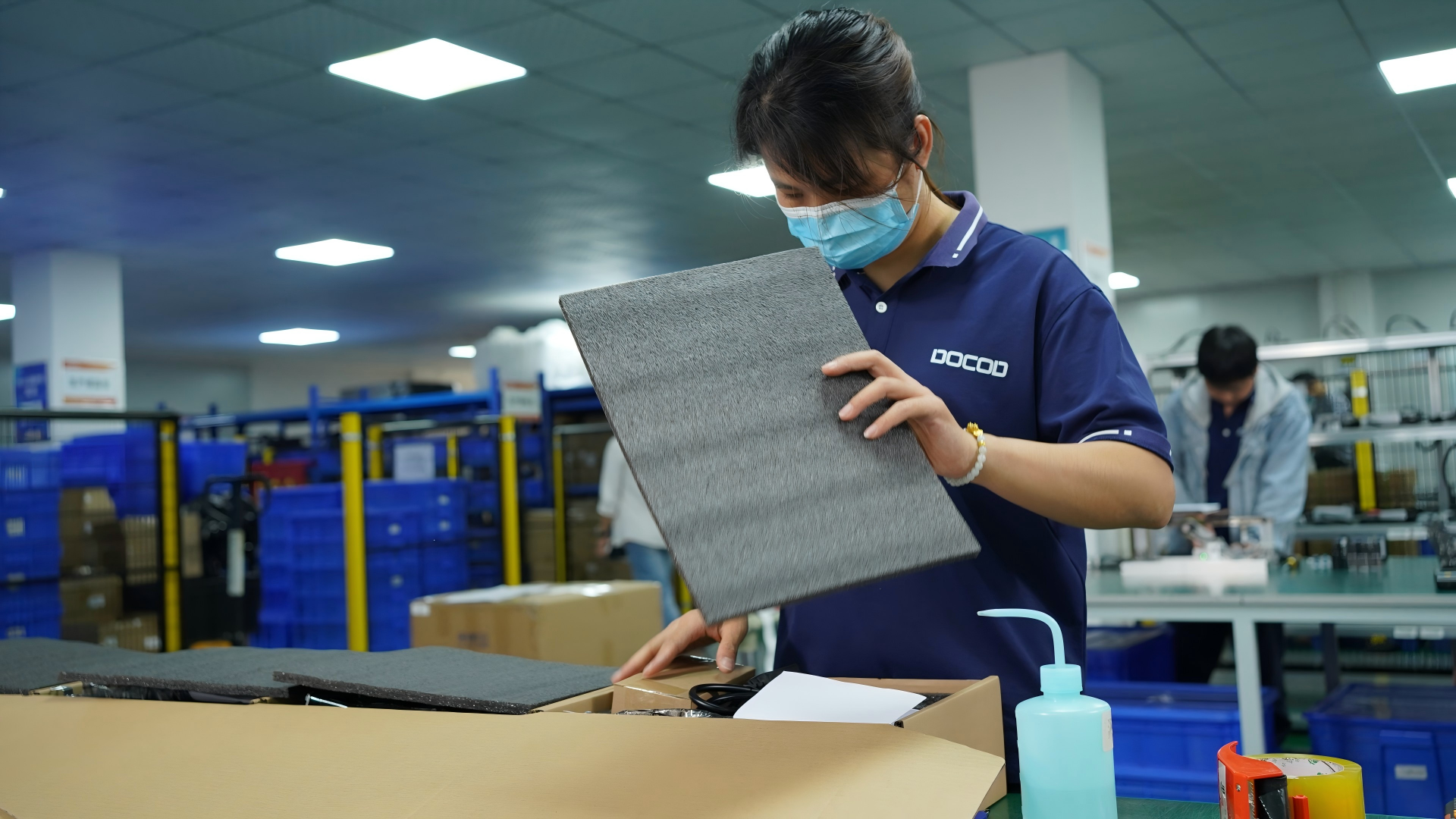
Export packing and pre-dispatch inspection: capability evidence begins before the equipment reaches the line.
The DOCOD Hardware Set at a Glance
Across five technology families, DOCOD discloses build materials, protection ratings and output parameters. The table below consolidates the specifications referenced throughout this article. Values are as disclosed by the manufacturer and are model-specific; they should be confirmed against the exact configuration quoted for a project.
| Hardware | Category | Disclosed specification |
|---|---|---|
| M2000 Series | CIJ printer | SUS 304 stainless steel casing; IP65; casing 347.92 × 312.90 × 558.14 mm |
| L3000 Series | UV laser marking machine | 5 W output; 355 nm wavelength; water-cooled; IP43 |
| P2000 | Piezo inkjet printer (PIJ) | Aviation-grade aluminium construction; 33.8 mm print height; 190 m/min at 300 dpi |
| XC20 | Mini conveyor | Aerospace-grade aluminium frame; 150 mm PVC belt; 5–12 m/min |
| XF30 + T210E | Rewinder with TIJ printer | Web rewinding paired with thermal inkjet coding |
| 3BK702 | Solvent TIJ cartridge | Half-inch format; 42 ml; up to 600 dpi |
M2000 Series CIJ: What SUS 304, IP65 and a Defined Casing Volume Tell a Buyer
The M2000 Series is DOCOD's continuous inkjet platform disclosed with a SUS 304 stainless steel casing, an IP65 rating and casing dimensions of 347.92 × 312.90 × 558.14 mm.
Each of those three disclosures answers a different pre-purchase question. SUS 304 is a standard austenitic stainless grade widely used where equipment is exposed to routine cleaning and ambient moisture. For a buyer, it signals a cabinet intended for a production floor rather than a protected laboratory bench, and it narrows the conversation about cleaning agents to a specific material rather than a general claim.
The IP65 rating combines two digits: the first addresses solids ingress and the second addresses water. A second digit of 5 corresponds to protection against water jets, which is a meaningful statement for plants that wash down adjacent equipment. It is not, however, a chemical-resistance rating, and it does not describe tolerance to solvent vapour, aggressive sanitisers or high-pressure steam. Buyers in dairy, beverage or pharmaceutical environments should treat IP65 as a starting condition and confirm the cleaning regime separately.
The casing dimensions matter more than they appear in a quotation. 347.92 × 312.90 × 558.14 mm defines the footprint and clearance envelope in a cabinet, on a bracket or beside a conveyor. On a retrofit line, that volume is frequently the difference between an installable unit and a redesign.
Speed tiering within the CIJ family is also disclosed. The S1000 Series is listed at up to 576 m/min with IP55 protection and automatic nozzle cleaning for high-speed cable, pipe and extrusion work, while the V2000 Series is listed at up to 334 m/min for bottles, cables and varied irregular surfaces. A buyer comparing M2000, V2000 and S1000 is therefore comparing cabinet protection, speed ceiling and consumable logic within one ink-based technology, not choosing between unrelated products.
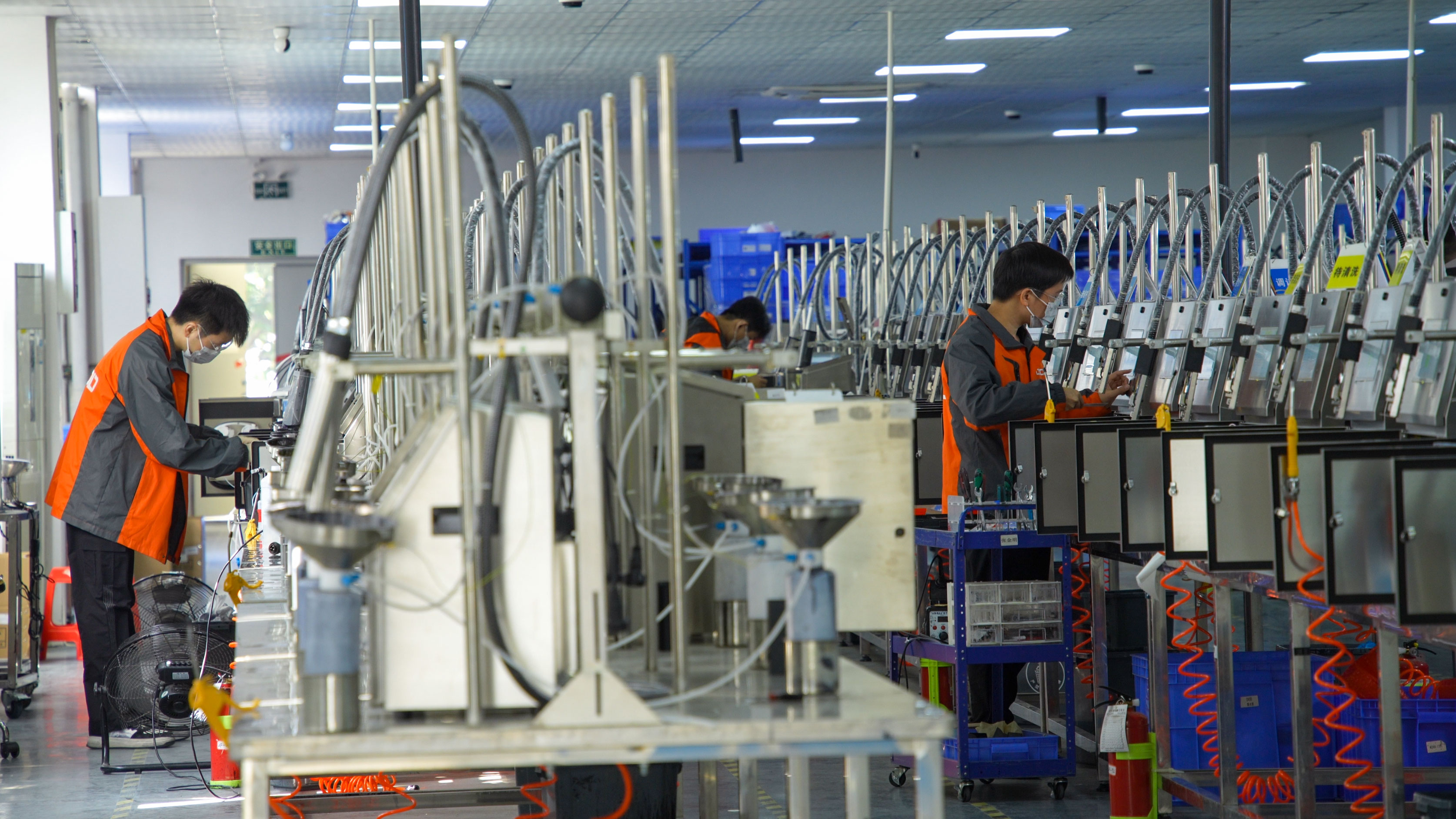
Quality testing on a CIJ unit: protection ratings and casing build are verifiable before installation, print performance is not.
L3000 Series UV Laser: 5 W, 355 nm, Water-Cooled, IP43
The L3000 Series is disclosed as a 5 W UV laser marking machine operating at 355 nm, water-cooled, with an IP43 rating.
Wavelength is the decisive disclosure here. At 355 nm the L3000 sits in the ultraviolet band, and DOCOD positions it for low-heat marking on sensitive substrates including glass, PVC, ABS, HDPE and delicate packaging, where mark integrity matters more than marking speed. That contrasts with the Venus1 Series fibre laser at 1,064 nm for metals and robust plastics, and the Venus1 Series CO2 laser at 10,600 nm for paperboard, film, labels, glass and other non-metal packaging. For a buyer, wavelength is a substrate-matching question that can be settled before any sample is printed.
The 5 W figure is an output rating, not a throughput guarantee. Laser marking throughput on a given line depends on mark area, fill pattern, substrate response and how the marking head is integrated with line triggering. A spec sheet establishes the class of work the unit is built for; it does not establish cycle time on a specific pack.
Two further disclosures carry real installation consequences. Water cooling removes heat through a coolant loop rather than air, which means the installation must accommodate a cooling requirement in the cabinet or line environment. And IP43 is a materially lower enclosure protection than the IP65 CIJ cabinet: it is suited to a dry, controlled installation and is not the right choice for a washdown zone. Buyers who treat all DOCOD hardware as equally rugged will misapply this unit.
P2000 Piezo Inkjet: Aviation-Grade Aluminium and a Wider Print Window
The P2000 is disclosed with aviation-grade aluminium construction and a 33.8 mm print height, running at 190 m/min at 300 dpi. Against a cartridge-based TIJ reference such as the T220E, that represents 8.4 mm more print height and 70 m/min more speed at the same resolution.
The material disclosure and the performance disclosure answer different questions. Aviation-grade aluminium signals a chassis specified for rigidity and weight control rather than for a protected indoor cabinet alone, which is relevant where a print head is mounted on a moving gantry or an offset bracket. The print window answers the applications question: 33.8 mm supports larger QR codes, coated cartons, traceability codes and bigger print areas that a narrower head cannot cover in a single pass.
The P2000 uses a continuous ink-supply architecture rather than a sealed cartridge. DOCOD frames the benefit as reduced per-cartridge cost and waste, and the trade-off is explicit: continuous supply requires ink-route management and a disciplined maintenance routine. A buyer moving from cartridge TIJ to PIJ should plan for that operational change, not only for the capital difference.
TIJ Hardware: XF30 Rewinder, T210E Printer and the 42 ml 3BK702 Cartridge
On the thermal inkjet side, DOCOD discloses the XF30 rewinder paired with the T210E TIJ printer, and the 3BK702 half-inch solvent TIJ cartridge at 42 ml with output up to 600 dpi.
The cartridge disclosure is the one that most directly affects operating economics. 42 ml defines the ink volume a cartridge carries, and up to 600 dpi defines the resolution ceiling of the print. Together they set the practical run length before a changeover and the code formats the head can produce. A buyer planning dense 2D codes on a high-throughput line should read 42 ml as a changeover-frequency input, not as a marketing figure. High coverage codes consume ink faster than a short date line, so the same cartridge serves very different run lengths depending on content.
The XF30 and T210E pairing addresses a different part of the line. A rewinder controls how a printed web is tensioned and re-rolled after coding, which is why the pairing is disclosed as a combined arrangement rather than as two separate items. Buyers evaluating this combination should confirm the web width, roll handling and tension requirements against their own material, since the rewinder sets the physical envelope of the job.
For speed reference within the TIJ family, DOCOD lists the T220E half-inch dual-head printer at 25.4 mm print height and up to 406 m/min, the TX1 single-head unit at 12.7 mm and the same 406 m/min ceiling, and the T260E at up to 60 m/min for basic date coding on eggs, bottles and boxes. That spread is useful during shortlisting: it shows the TIJ family is tiered by print height and throughput rather than offered as one generic model.
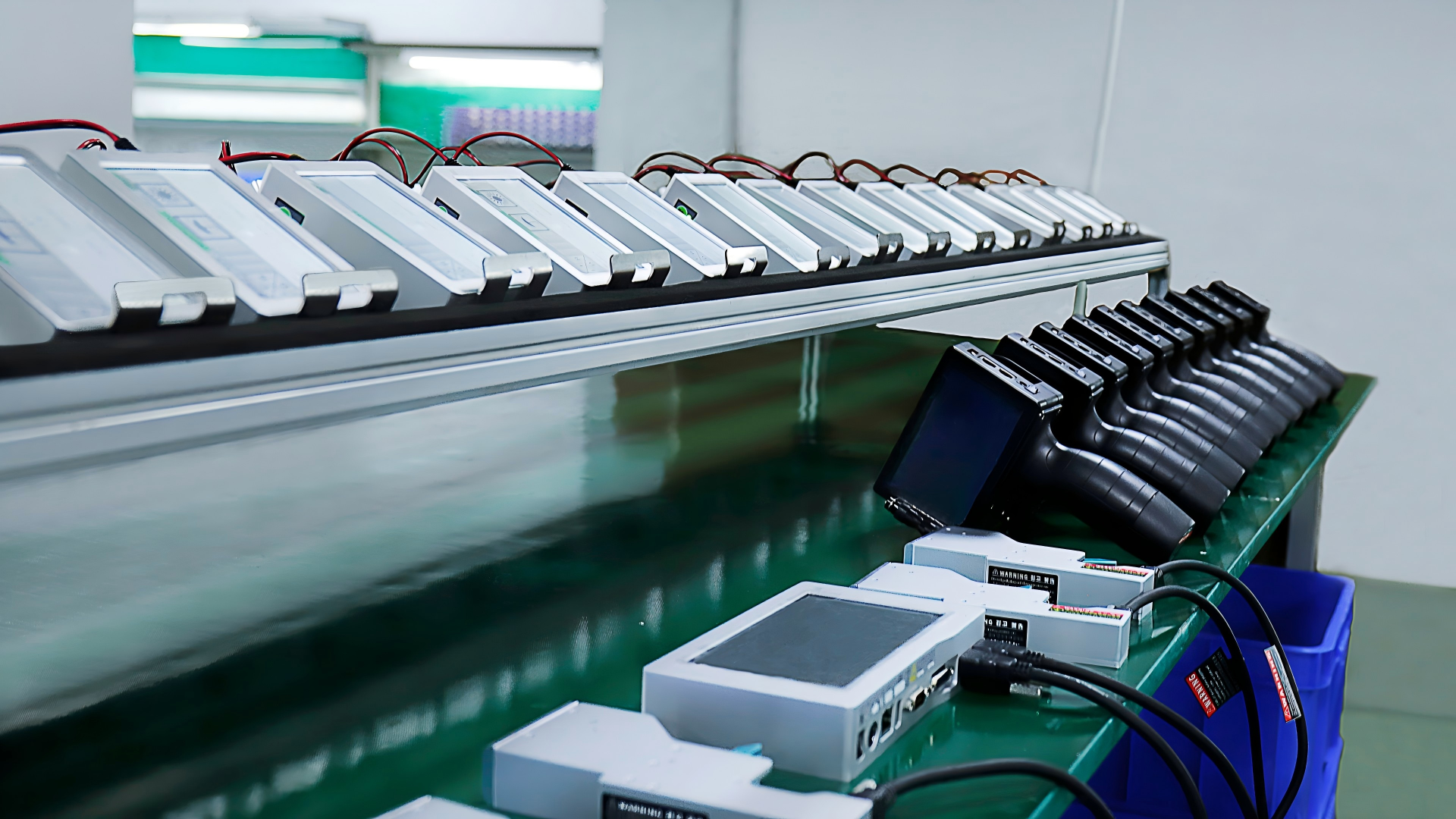
Functional testing on a thermal inkjet unit: cartridge resolution and ink volume are checkable specifications; changeover frequency is a line-specific outcome.
XC20 Mini Conveyor: Aluminium Frame, 150 mm PVC Belt, 5–12 m/min
The XC20 is disclosed with an aerospace-grade aluminium frame, a 150 mm PVC belt and a variable speed range of 5–12 m/min.
This is a specification that is honest about scope. An aluminium frame and a 150 mm belt describe a compact, light-duty transport unit built to present product to a print head under controlled conditions. The variable range of 5–12 m/min lets a user match code placement and print quality across different items without rebuilding the line.
What the XC20 is not is a substitute for a main packaging conveyor. A production line running at the speeds disclosed elsewhere in the DOCOD portfolio, up to 576 m/min on the S1000 CIJ tier or 406 m/min on the T220E TIJ tier, is far outside a 5–12 m/min transport window. Buyers should read the XC20 as offline or low-speed inline equipment for sampling, secondary coding, short-run work or inspection staging. Using it as a bottleneck-relief conveyor on a high-speed line would be a misapplication of the specification, not a defect in it.
The Control Layer: Cortex-A7 1.2 GHz Dual-Core and an FPGA Acceleration Chipset
The component disclosure that buyers most often skip is arguably the most consequential for 2027 and beyond: DOCOD specifies main hardware built around a Cortex-A7 1.2 GHz dual-core processor with an FPGA algorithm acceleration chipset.
The relevance is structural rather than promotional. Coding is shifting from fixed text to variable data, and variable data is a computing task. A dual-core application processor handles the interface, data handling and file management side, while an FPGA performs deterministic, time-critical operations in hardware. On a print line, deterministic timing is what keeps a variable-data string aligned with a moving product at speed.
That distinction becomes practical when the code itself carries more information. Dense 2D codes, serialisation sequences and GS1 Digital Link payloads place more demand on both processing and print resolution than a date stamp. A controller architecture disclosed at component level tells a buyer whether the platform was designed with that data load in mind, or whether it is a text-era controller with a new label.
Where the Evidence Stops: Limits of a Specification-Led Evaluation
Specification-led evaluation is stronger than brochure-led evaluation, but it is not self-sufficient, and DOCOD's own procurement controls indicate as much.
First, the specifications above are manufacturer disclosures. They describe what DOCOD states about its hardware, which is a different evidentiary category from an independently measured benchmark. No standardised cross-brand performance benchmark is published in the available material, so a buyer comparing DOCOD against another supplier is comparing disclosures, not audited results.
Second, material compatibility remains a testing question. DOCOD's stated control is ink or marking-method matching based on the actual carton, film, plastic, metal or glass surface, supported by pre-production sample printing before mass shipment. A wavelength or an ink type narrows the candidate set; it does not confirm adhesion, contrast or code grade on a specific substrate.
Third, environmental suitability is confirmed before model selection and shipment, covering temperature, humidity and line condition. An IP rating describes enclosure protection, not ambient operating limits, and a water-cooled laser requires cooling provision that an IP rating says nothing about.
Fourth, certification scope is confirmed by model and destination market before order release rather than assumed across a product family. Buyers who need compliance documentation for a specific market should request it against the exact model on the quotation.
Finally, print content is verified separately: text, barcode, QR code, date format and language settings are confirmed before production, and on critical lines optional OCR or barcode inspection with alarm-light or rejection linkage is available to catch missed or unreadable codes. Those controls exist precisely because a specification sheet cannot guarantee every printed code.
Comparing Routes: Specs Against Alternative Coding Technologies
The clearest way to read DOCOD's specification set is side by side, because the parameters that look like advantages in isolation become trade-offs in comparison.
| Route | Disclosed reference | Where it fits | Known boundary |
|---|---|---|---|
| CIJ (S1000 / V2000) | Up to 576 m/min (S1000); up to 334 m/min (V2000) | High-speed cable, pipe, extrusion; bottles and irregular surfaces | Ink and solvent management remain part of the operating routine |
| UV laser (L3000) | 5 W, 355 nm, water-cooled, IP43 | Glass, PVC, ABS, HDPE, delicate packaging | Lower enclosure protection and a cooling requirement |
| PIJ (P2000) | 33.8 mm print height; 190 m/min at 300 dpi | Large QR codes, coated cartons, wide traceability data | Continuous ink supply needs ink-route management |
| TIJ (T220E / T260E / TX1) | 25.4 mm, 406 m/min (T220E); 12.7 mm (TX1); 60 m/min (T260E) | Cartons, labels, GS1 codes, variable data | Cartridge volume constrains changeover interval on heavy coverage |
| TTO (R4000) | Up to 800 mm/s; 400–1200 m ribbon | Flexible films, sachets, pouches, labels | Recurring ribbon cost and ribbon changeovers |
Two comparisons are worth spelling out because they are frequently oversimplified. Between CIJ and CO2 laser, DOCOD discloses that the V2000 CIJ at up to 334 m/min generally carries a lower upfront cost while the CO2 laser route reduces ongoing consumable expense, and that the CO2 route excels where permanent marks on non-metal packaging are required. Neither statement makes one route cheaper in absolute terms; the crossover depends on line hours and consumable consumption.
Between TTO and UV laser, the R4000 supports up to 800 mm/s with ribbon lengths from 400 m to 1200 m and remains the mainstream route on standard flexible packs, while UV laser avoids ribbon handling altogether but depends on substrate receptivity. Both are legitimate answers to different film specifications.
How These Specifications Map to Production Scenarios
Read as a portfolio rather than a catalogue, the disclosed hardware covers a coherent set of buyer situations.
Cable, pipe and extrusion lines are served by the high-speed CIJ tier, where the S1000 is disclosed at up to 576 m/min with IP55 protection and automatic nozzle cleaning for demanding environments. The M2000's IP65 cabinet is relevant where cleaning intensity rather than line speed dominates the decision.
Bottles and irregular surfaces point toward CIJ generally, given the V2000's positioning on varied contours, while coated cartons and large-format traceability codes point toward the P2000's 33.8 mm print window.
Delicate packaging such as glass, PVC, ABS and HDPE favours the low-heat UV route, provided the installation is dry and cooling is available. Flexible films and sachets remain the territory of TTO. Metal parts and robust plastics belong to the fibre laser wavelength rather than any ink-based route.
Sampling, secondary coding and verification staging are the realistic home of the XC20 conveyor and the XF30 rewinder pairing, where controlled low-speed transport is the requirement rather than throughput.
Market Context: Why Hardware Disclosure Is Becoming a Procurement Filter
Two verified data points explain the rising weight of specification-level evaluation.
The first is regulatory. The GS1 Digital Link standard sets a Sunrise 2027 deadline for the retail transition from 1D barcodes to 2D QR codes, an active requirement spanning global markets. Any coding hardware purchased now sits inside that transition window, which moves resolution, print height and data-handling capability from nice-to-have to procurement criteria.
The second is scale. Fortune Business Insights reports the global coding and marking equipment market at USD 7.51 billion in 2025, with inkjet technologies (CIJ, TIJ and PIJ) accounting for 40.1% of the technology segment. Commercial research houses publish materially different forecasts for the same category, differing in scope, base year and method, so those forecast values should not be merged into a single number. The directional signal is growth; the precise figure is not settled.
Taken together, the market data and the standards deadline explain why material and component disclosure has become a shortlisting mechanism. A buyer who cannot establish print height, resolution ceiling, enclosure protection and controller architecture from a supplier's documentation cannot assess 2027 readiness at all.
Future Outlook
Three pressures are likely to shape how coding hardware is specified over the next procurement cycles.
Data density is the first. As 2D codes and digital-link payloads displace simple date strings, print height and resolution stop being niche parameters and become baseline requirements. Hardware with a 12.7 mm or 16 mm window remains valid for many jobs but leaves less headroom for dense codes than a 25.4 mm or 33.8 mm platform.
Verification is the second. Coding is increasingly paired with inspection: optional OCR and barcode inspection with alarm or rejection linkage is already part of the disclosed control set, and the logic of traceability pushes that from optional to expected on regulated lines.
Serviceability is the third. Material disclosures such as SUS 304, aviation-grade aluminium and aerospace-grade aluminium are partly statements about how long a unit can stay in service in a real plant. Buyers who plan on a five-to-seven-year horizon will increasingly read frame and casing material as a lifecycle indicator, not a cosmetic one.
Frequently Asked Questions
What does an IP65 rating on the M2000 Series CIJ actually cover?
IP65 describes enclosure protection against dust ingress and against water jets. It is disclosed alongside a SUS 304 stainless steel casing, which indicates a cabinet built for routine production-floor cleaning. It does not describe chemical resistance, solvent-vapour tolerance or suitability for high-pressure steam cleaning, so plants with aggressive cleaning regimes should confirm compatibility separately.
Why is the L3000 Series UV laser rated IP43 while the CIJ cabinet is IP65?
The two products are built for different installation environments. IP43 indicates a lower level of protection against water than IP65, which is consistent with a laser unit intended for dry, controlled installation rather than a washdown zone. The L3000 is also water-cooled, so the installation must accommodate a cooling requirement in addition to enclosure protection.
How should a buyer interpret a 42 ml TIJ cartridge specification?
The 3BK702 half-inch solvent cartridge is disclosed at 42 ml with output up to 600 dpi. The resolution figure sets the code formats the head can produce; the volume figure sets how much ink is available before changeover. Actual changeover interval depends on code size and coverage, so a plant printing dense 2D codes at high coverage will consume a cartridge faster than one printing a short date line.
Does the XC20 mini conveyor's 5–12 m/min range limit where it can be used?
It defines its scope. The XC20 is disclosed with a 150 mm PVC belt on an aerospace-grade aluminium frame running at 5–12 m/min, which makes it a compact transport unit for controlled-speed work such as sampling, secondary coding or inspection staging. It is not a drop-in replacement for a main packaging conveyor, since production speeds elsewhere in the portfolio reach up to 576 m/min on the S1000 CIJ tier and 406 m/min on the T220E TIJ tier.
Why does the Cortex-A7 and FPGA disclosure matter for coding equipment?
Variable-data coding is a computing workload. DOCOD specifies a Cortex-A7 1.2 GHz dual-core processor with an FPGA algorithm acceleration chipset, pairing general data handling with hardware-level deterministic timing. That architecture is relevant where dense 2D codes, serialisation or GS1 Digital Link payloads must be printed accurately on a moving product at line speed.
What should be verified before accepting a coding hardware specification sheet?
Four items should be confirmed against the specific model and destination market: substrate compatibility through pre-production sample printing, environmental suitability covering temperature, humidity and line condition, certification scope for the destination market, and the exact content of the print file including barcode, QR code, date format and language. On critical lines, optional OCR or barcode inspection with alarm or rejection linkage closes the remaining gap.
For buyers who want the full hardware and portfolio reference in one document, DOCOD's corporate brochure is available here: DOCOD Corporate Brochure (PDF).
Tem questões ou precisa de mais detalhes?
Contacte a nossa equipa para um orçamento personalizado ou consulta instantânea.
Solicitar orçamento
Preencha o formulário abaixo e a nossa equipa entrará em contacto com uma proposta personalizada.
Chat direto do WhatsApp
Prefere conversar em tempo real? Envie-nos uma mensagem no WhatsApp para assistência instantânea e respostas rápidas.
- Obter orçamento personalizado
- Partilhar fotos ou documentos
- Discuta as suas necessidades diretamente
Geralmente responde em 5–30 minutos durante o horário de expediente.