
Specifying Backlit Light Guide Panels: CE, UL and Limits
A backlit light guide panel is an acrylic sheet that converts light from an edge-mounted LED strip into a flat, evenly illuminated surface. It sits inside advertising light boxes, retail display cabinets, elevator wall panels and architectural ceiling features, and in each of those positions it is judged by four things at once: brightness, uniformity, electrical and electromagnetic paperwork, and physical fit inside the enclosure. Buyers who treat the panel as a lighting component rather than a decorative sheet usually get a smoother project.
Most sourcing conversations start with brightness. Most project problems start somewhere else: a compliance document that does not cover the model actually ordered, a protection grade that does not survive a semi-outdoor installation, or a driver selected against typical rather than maximum power. This reference examines the constraint layer of the specification, using the published panel data and certification records of Shanghai Edgelight Industry Co., Ltd. (Edgelight) as a worked example of what a buyer can realistically verify before an order is placed.
Why the Constraint Layer Decides Most Panel Projects
An advertising light box or a retail display is rarely bought for a single location. It is bought as a repeatable unit that will be installed in public spaces, switched on for long hours, and maintained by people who did not design it. That turns a lighting product into an electrical product, and electrical products are evaluated against documents rather than impressions.
Four constraint groups tend to determine whether a panel order survives contact with a real project:
- Market access documents. Electromagnetic compatibility and safety files are market-specific. A panel that satisfies one market is not automatically acceptable in another.
- Electrical headroom. Maximum current and maximum power determine wiring, driver rating and thermal design. Typical consumption describes running cost, not design margin.
- Environmental limits. Protection grade and operating temperature decide whether a panel can be used in a shop window, a covered walkway or an unconditioned interior.
- Dimensional and optical fit. Thickness, size, pattern design and brightness targets interact. Changing one often moves the others.
None of these is exotic. The difficulty is that they are usually confirmed late, after the visual concept is approved, which is when changes become expensive. A specification review performed at the research stage costs nothing; the same review after tooling has started costs a redesign.
A Panel Specification Read as a Set of Constraints
The clearest way to read a light guide panel datasheet is column by column, asking what each value prevents the buyer from doing. The Edgelight Light guide panel (model LGP) is a useful reference because its published parameters cover electrical, optical, thermal and ingress values in one block.
| Specified parameter | Edgelight LGP value | What it constrains in a project |
|---|---|---|
| Operating current and power | 7.2 A maximum, maximum power 144 W; typical power consumption 101 W | Driver rating, cable gauge, connector choice and heat budget |
| Luminous flux | >1080 lm | Surface brightness planning against the intended viewing distance |
| Colour temperature | 2700 K to 6500 K | Brand colour consistency across a retail or hospitality roll-out |
| Operating temperature | -20℃ to 50℃ | Indoor, semi-outdoor and window placement decisions |
| Protection grade | IP20 to IP65 | Dust and water exposure at the installation point |
| Panel material | Acrylic | Optical transmission, weight, and handling during assembly |
Two values deserve particular attention. The first is the gap between 144 W maximum and 101 W typical. A driver selected against the typical figure will run hot and may fail early; the maximum figure exists precisely to size the power supply and the thermal path. The second is the protection grade range. IP20 to IP65 is a configuration range, not a single product rating. A buyer should confirm which grade applies to the exact variant being quoted, and match it to the installation location rather than to the product family as a whole.
Acrylic is the panel material listed in the specification. Acrylic is polymethyl methacrylate, the polymer commonly referred to as PMMA in optical-grade discussions, which is why buyers comparing optical-grade PMMA backlit light guide panels and acrylic panels are usually comparing grades of the same material family rather than different chemistries.
What the CE and UL Documents Actually Cover
Certificates are frequently summarised as a logo on a datasheet. The useful information is in the scope clause, the standard list and the validity dates, because that is where the boundary of the claim sits.
The CE EMC file
Edgelight holds a CE EMC certificate, number CTSL2620530156EZ, issued on 2026-05-29 by CTSL Testing (Dongguan) Co., Ltd. for the EU market, with an expiry date of 2096-05-29. The listed standards are EN IEC 55015:2019/A11:2020, EN IEC 61547:2023, EN IEC 61000-3-2:2019/A2:2024 and EN 61000-3-3:2013/A2:2021/AC:2022-01. In practical terms this is an electromagnetic compatibility file: emission, immunity, harmonic current and voltage fluctuation.
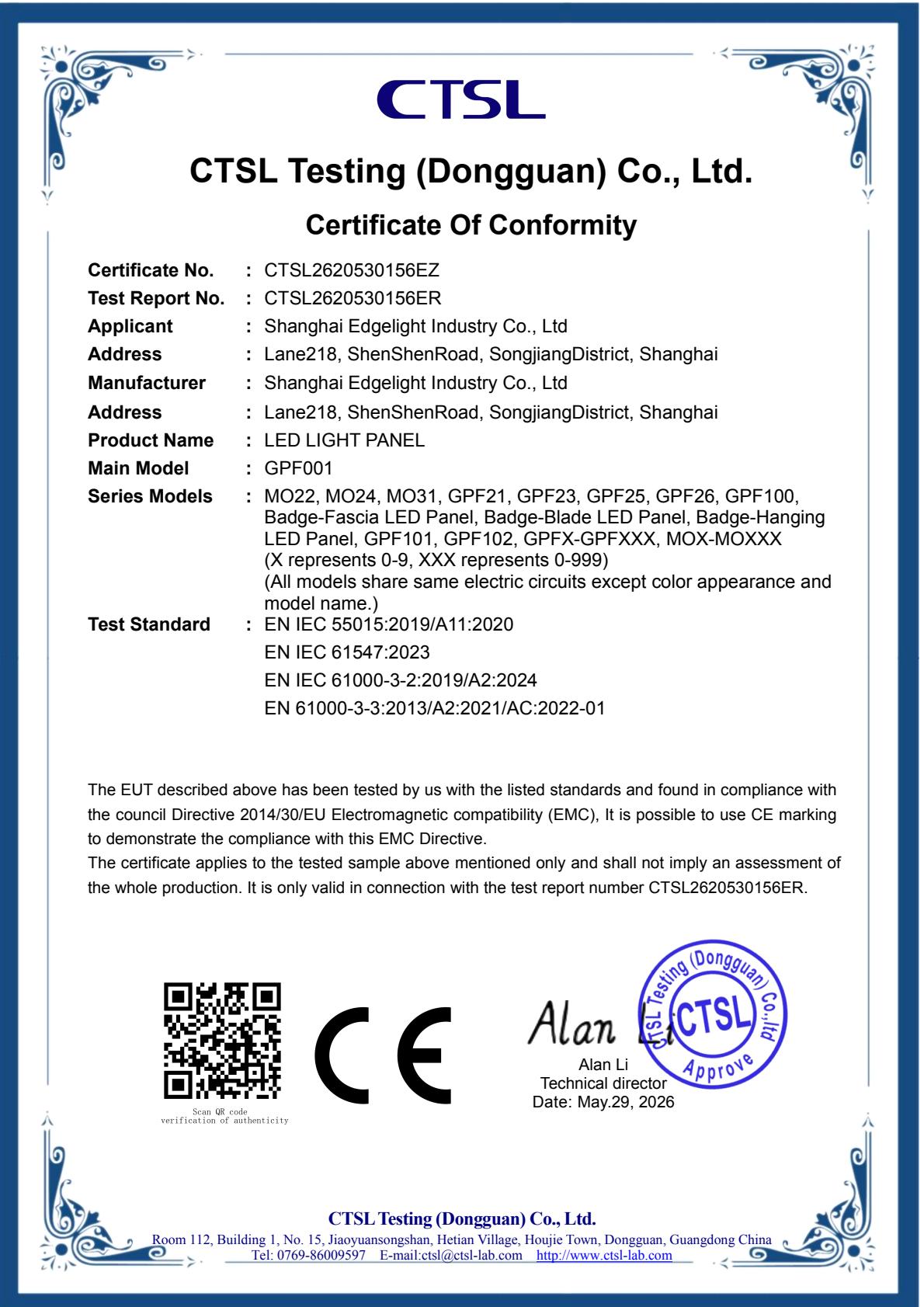
The scope clause is the part buyers most often skip. It covers model GPF001 and a series of related designations, with a note that all models in the listed range share identical circuits except for colour appearance and model name. That note is a genuinely useful procurement fact: it tells the buyer how far the file travels. A change of colour or naming stays inside the tested configuration; a change to the driver circuit does not, and would normally require the supplier to confirm whether the file still applies.
The second point is what an EMC certificate is not. It is not a low-voltage safety file, a photobiological assessment, a fire classification or a warranty. Where a project specification calls for those, they have to be requested separately. Treating a CE EMC document as a complete compliance pack is one of the more common misinterpretations in signage procurement.
The UL file
Edgelight also holds UL certification UL-US-2145621-0, issued by UL LLC on 2021-10-05 and valid to 2031-10-05, assessed against UL 2108, 2nd Edition. The scope is described as component, sign accessories, low-power and Class 2 type LED module, and it lists specific model codes covering LED modules in 12 V and 24 V configurations, including RGBW variants.
For a North American project, the relevant question is not whether the supplier is certified in general but whether the exact module or assembly being shipped appears within the listed scope. Sign accessories and Class 2 LED modules are component-level categories; they support an end-product approval rather than replacing it. A light box assembled from listed components still needs its own evaluation if the authority having jurisdiction requires it. Buyers should confirm component scope with their integrator rather than assume that a component listing transfers to the finished sign.
Supplier Facts That Bound the Order
Compliance answers the question of whether a product may be placed on a market. Capability answers the question of whether a supplier can deliver the quantity, the variation and the timing the project needs.
Edgelight, founded in 2004, is a manufacturer of LED products and intelligent control products with five production bases: the Shanghai headquarters at approximately 33,000 m², Tianjin at approximately 20,000 m², Edgelight GmbH in Germany at approximately 1,500 m², Edgelight LLC in the United States at approximately 1,679 m², and an additional Shanghai factory of approximately 10,000 m². The company reports 500 employees, a 25-engineer R&D team, annual output of 120,000 units and an export share of 75%, with the USA and EU as its main markets.
On the light guide panel line specifically, the published capability data is: OEM and ODM production, monthly capacity of 30,000 units, lead time of 5 to 10 days, minimum order quantity of 1 unit, 100% testing, and local after-sales support in the European Union, North America, Southeast Asia and Australia.
The minimum order quantity of a single unit matters more than it appears. It allows a buyer at the research stage to obtain a physical sample of a custom-size backlit light guide panel and test it inside the actual enclosure before committing to a roll-out, which is the only reliable way to judge uniformity at the real viewing distance.
Where the Panel Meets the Installation
A datasheet describes a panel on a bench. An installation describes it inside a box, behind a diffuser, next to a power supply, under a window or in a lift shaft. The gap between the two is where most field complaints originate, and it usually involves three variables.
Thermal environment. The specified operating range of -20℃ to 50℃ covers a wide set of interior and semi-outdoor conditions, but a sealed light box in direct summer sun is not the same environment as a shaded shop interior. The panel is only one heat source; the driver adds its own. Design reviews that consider only the panel temperature tend to underestimate the internal box temperature.
Ingress protection. The IP20 to IP65 range means the correct grade has to be selected per position. Application data for panel projects typically calls for IP55 dust and water protection where the panel is exposed to cleaning routines or semi-outdoor conditions, while dry interior cabinet backlighting does not require that level. Specifying the highest grade everywhere raises cost without adding value; specifying the lowest everywhere creates failures.
System matching. The listed matching equipment for these panels is an LED strip light, a constant-current power driver, a light box frame, a diffuser film, a reflective film and mounting brackets. Each element influences the final result. A reflective film change alters uniformity, a diffuser change alters perceived brightness, and a bracket change alters the optical distance between the LED strip and the panel edge. Substituting any of these without re-checking the panel is a normal cause of a project that tests well in isolation and poorly in place.
Applications and the Constraints Each One Imposes
The same panel specification is read differently by different applications. Edgelight's application data groups the uses into retail and luxury display, hospitality and commercial interiors, exhibition and museum, elevator decoration, advertising light boxes and signage, office and high-end residential, transportation and public spaces, and consumer electronics backlighting, with a stated operation mode of 24/7 for continuous-duty installations.
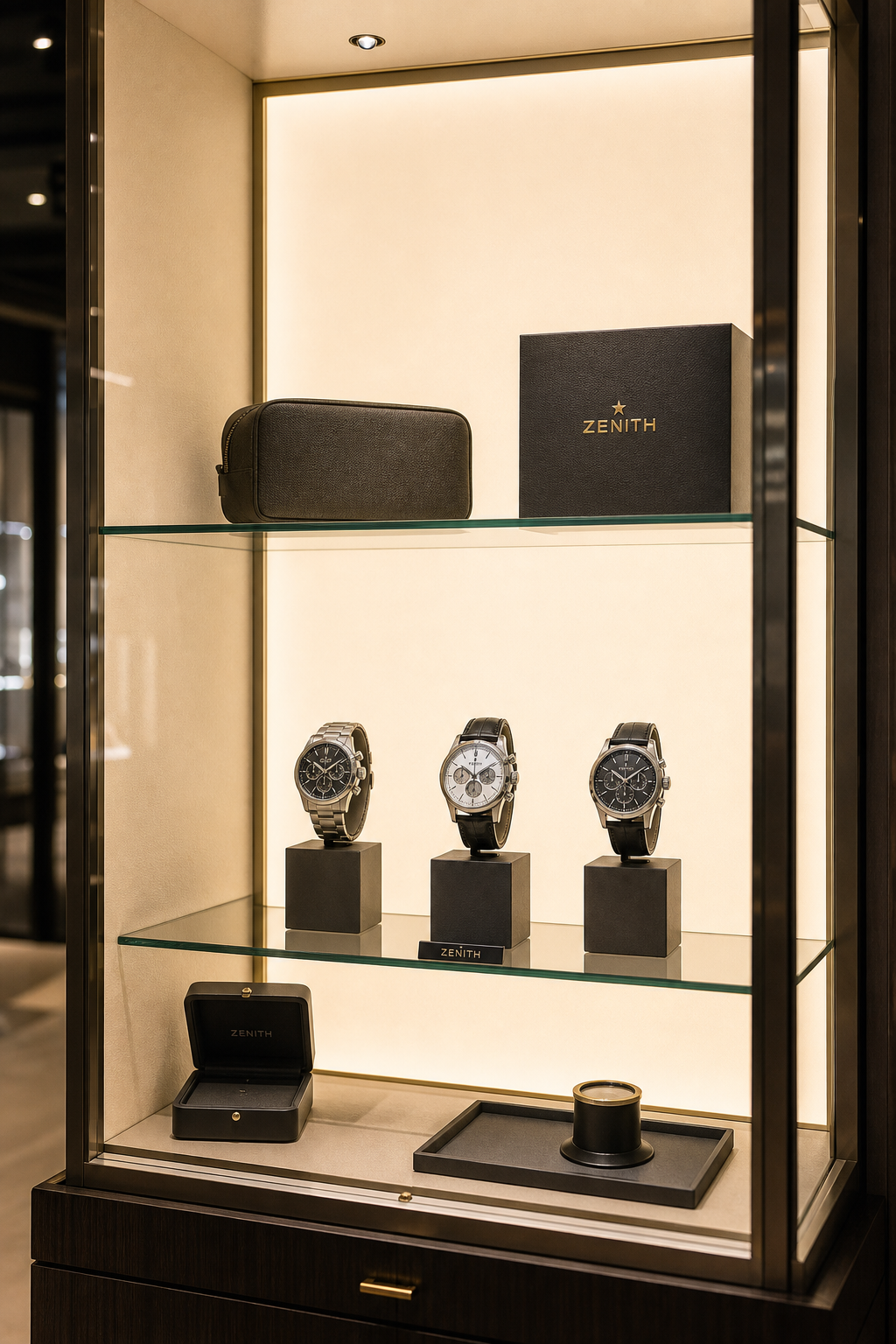
- Retail display and showcase backlighting. Colour temperature consistency and surface uniformity dominate. A visible hot spot next to a premium product is a brand problem, not a lighting problem.
- Advertising light boxes and signage. Thinness and even illumination across the full graphic area dominate, together with the ability to print onto the panel or place a graphic directly behind it.
- Hospitality ceiling panels. Large continuous luminous surfaces with no visible seams, which places weight on panel thickness and frame design.
- Elevator cabin wall decoration. A confined, frequently cleaned, continuously used space, which pushes protection grade and mechanical durability up the list.
A long-running example illustrates the elevator case. Edgelight reports a 20-year supply relationship with an elevator manufacturer covering 10,000 units for cabin decoration, with the highlighted capabilities being lighting, printing, and customized size and texture, and the reported result being stable operation. Whether or not a buyer is sourcing for elevators, the case shows what a durability claim actually rests on: a fixed application, a defined environment and a long observation window.
Customization: What Can Change, and What Triggers Re-checking
Edgelight's customization scope covers size, thickness, colour temperature, logo, surface shape, light output brightness and installation structure. That is a broad list, and buyers should read it as a list of variables that interact rather than a menu of independent options.
Increasing brightness usually increases drive current, which increases heat, which may reduce the practical operating margin inside a sealed box. Increasing panel size at a fixed thickness makes uniform light extraction harder, because the light has further to travel from the edge. Changing surface shape or adding printed graphics alters how light exits the panel. None of these is a reason to avoid customization; they are reasons to re-verify the specification after the change rather than before it.
The compliance boundary deserves repeating here. Because the CE scope states that listed models share identical circuits except for colour appearance and model name, a customization that touches the electrical circuit is a different situation from one that touches colour, print or dimensions. Buyers customizing a CE-certified backlit light guide panel should ask the supplier to confirm in writing which changes remain within the certified configuration.
Compared With Conventional Backlighting
Edge-lit acrylic panels are one option among several. Conventional alternatives include direct-lit LED boxes with a diffuser plate and fluorescent backlighting in older signage stock. A fair comparison is about fit, not superiority.
| Consideration | Edge-lit backlit light guide panel | Direct-lit or conventional backlighting |
|---|---|---|
| Enclosure depth | Very shallow, because light travels along the panel rather than across a cavity | Requires depth for light mixing, so the box is thicker |
| Uniformity engineering | Depends on pattern design and scales with panel size and thickness | Depends on diffusion distance, which is easier to model but needs space |
| Cost behaviour | Rises with size, thickness, optical grade, brightness target and certification scope | Often lower entry cost for low-specification or short-life signage |
| Maintenance | Fewer light sources, but panel replacement is a full-face operation | Individual modules can be replaced, at the cost of more components |
The honest limitation of the edge-lit approach is scale. As panel area grows, achieving high uniformity becomes an optical engineering exercise rather than a purchasing one, and the certified configuration that worked for a 1 m² cabinet does not automatically describe a considerably larger one. Where a project needs a very large uninterrupted luminous surface, or operates in an environment outside the specified -20℃ to 50℃ window, a different architecture may be the more defensible choice. Edge-lit panels are also a poor fit where the design brief changes frequently and compliance re-testing would be triggered each time.
The corresponding advantage is depth. For retail window displays and slim signage, reducing enclosure depth is often the reason the project exists at all, and that is where the panel earns its place.
Where the Market Is Moving
Three shifts are visible in how buyers approach these panels, and none of them require a forecast to describe.
The first is that compliance questions now arrive earlier. Buyers increasingly ask for certificate numbers and scope clauses during the research phase rather than after a supplier has been selected, which is a direct consequence of e-commerce and retail projects being replicated across markets at speed.
The second is that thinness has become a design assumption rather than a differentiator. Window displays, lift interiors and hospitality ceilings are being drawn around shallow enclosures, which pushes panel specification toward edge-lit construction by default and moves the real competition to uniformity and consistency.
The third is the expectation of customization at low volume. A minimum order quantity of one unit, a 5 to 10 day lead time and OEM/ODM production sit at the opposite end of the spectrum from container-only supply, and buyers are increasingly structuring sample evaluation around exactly that combination.
What Buyers Should Watch Next
The direction of travel is toward panels sold with their documentation attached rather than as sheets with a price. As more projects combine retail display, signage and architectural lighting in a single fit-out, the supplier's ability to state which certificate covers which variant becomes as commercially relevant as the luminous flux figure. For buyers, the practical response is to keep a specification file per project containing the panel parameters, the certificate numbers and scopes, the protection grade selected for each installation position, and the list of matched components. That file is what makes a second order faster than the first.
Edgelight publishes its product catalogue as a downloadable document covering its LED product range, which is a reasonable starting point for a first-pass specification review before a sample request is raised.
FAQ
Which certifications should a backlit light guide panel carry for EU and North American projects?
The requirement differs by market. For the EU, electromagnetic compatibility is the first document to request; Edgelight holds CE EMC certificate CTSL2620530156EZ, issued 2026-05-29 by CTSL Testing (Dongguan) Co., Ltd. against EN IEC 55015:2019/A11:2020, EN IEC 61547:2023, EN IEC 61000-3-2:2019/A2:2024 and EN 61000-3-3:2013/A2:2021/AC:2022-01. For North America, Edgelight holds UL certification UL-US-2145621-0 issued by UL LLC against UL 2108, 2nd Edition, valid to 2031-10-05, covering component, sign accessories and Class 2 LED modules. Neither document substitutes for low-voltage safety, photobiological or fire classification, which must be requested separately where a project specification calls for them.
What electrical and optical values should be verified before ordering?
The Edgelight Light guide panel (model LGP) is specified at a maximum operating current of 7.2 A and maximum power of 144 W, with typical power consumption of 101 W, luminous flux above 1080 lm, and a colour temperature range of 2700 K to 6500 K. Maximum power is the figure used for driver and wiring sizing; typical consumption describes running cost. Luminous flux should be assessed together with panel size and pattern design, because the same flux distributed over a larger area produces a lower surface brightness.
How does the protection grade affect where a panel can be installed?
The LGP specification lists a protection grade range of IP20 to IP65, which is a configuration range rather than a single rating. The grade applicable to the quoted variant should be confirmed and matched to the installation position. Project application data for panel installations identifies IP55 dust and water protection where exposure to cleaning or semi-outdoor conditions occurs. Dry interior cabinet backlighting does not require that level, and specifying a higher grade than the position needs adds cost without functional benefit.
What operating temperature range applies, and what does it exclude?
The specified operating temperature range is -20℃ to 50℃. Conditions outside that window, such as a sealed enclosure exposed to sustained direct sun or an unconditioned outdoor location in extreme climate, fall outside the stated range. Because the driver contributes its own heat inside a light box, the internal enclosure temperature should be assessed rather than the ambient temperature alone.
Which dimensions and characteristics can be customized?
Edgelight's customization scope for OEM and ODM production covers size, thickness, colour temperature, logo, surface shape, light output brightness and installation structure. Panel material is acrylic. Changes that affect the electrical circuit fall outside the tested configuration described in the CE scope, which states that listed models share identical circuits except for colour appearance and model name, so the supplier should confirm in writing whether a specific customization remains within the certified configuration.
What order quantities and lead times apply?
Edgelight publishes a minimum order quantity of 1 unit, a lead time of 5 to 10 days, monthly capacity of 30,000 units for light guide panels, and 100% testing. Export markets listed are the European Union, North America, Southeast Asia and Australia, with local after-sales support. The single-unit minimum is what allows a custom-size panel to be tested inside the actual enclosure before a larger commitment.
For buyers working through the constraint layer first, the order of review is straightforward: confirm the certificate scope covers the variant, confirm the protection grade matches the installation position, size the driver against maximum rather than typical power, and test a physical sample in the real enclosure before scaling.
Tem questões ou precisa de mais detalhes?
Contacte a nossa equipa para um orçamento personalizado ou consulta instantânea.
Solicitar orçamento
Preencha o formulário abaixo e a nossa equipa entrará em contacto com uma proposta personalizada.
Chat direto do WhatsApp
Prefere conversar em tempo real? Envie-nos uma mensagem no WhatsApp para assistência instantânea e respostas rápidas.
- Obter orçamento personalizado
- Partilhar fotos ou documentos
- Discuta as suas necessidades diretamente
Geralmente responde em 5–30 minutos durante o horário de expediente.