
Specifying Hydraulic Baler Machines: Technical & Procurement FAQ
Specifying Hydraulic Baler Machines: Technical & Procurement FAQ
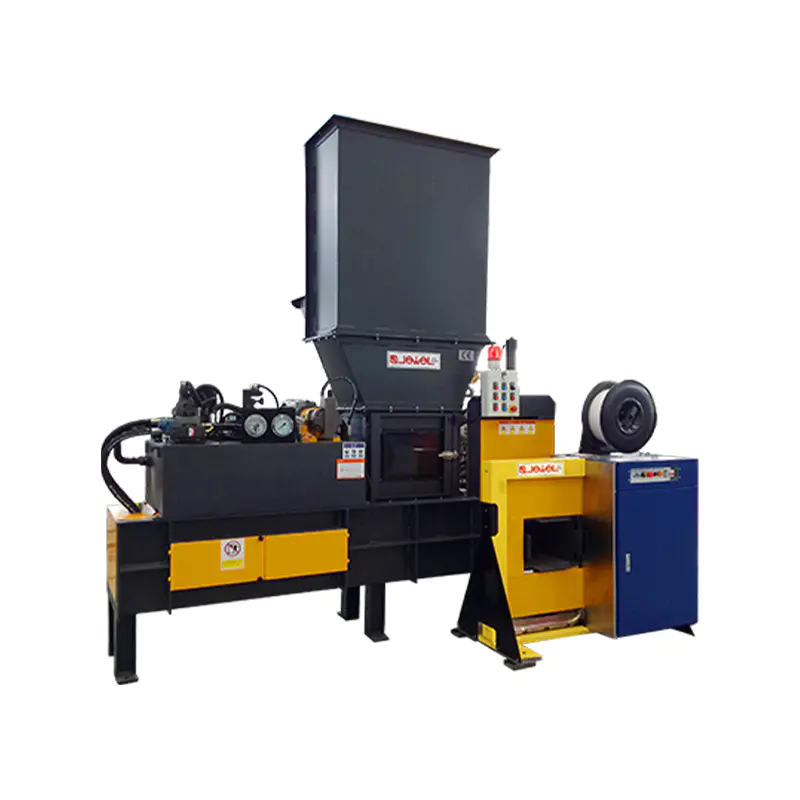
JPW20Q fully automatic horizontal baler: 20-ton compression force, 500 x 500 x 500 mm bales, 380V/50Hz drive.
A hydraulic baler machine is specified against three variables and only three: the waste stream it has to compress, the bale format the buyer or the receiving mill will accept, and the electrical supply the site can actually deliver. Compression force, bale dimensions, bale weight, feeding mouth size and voltage are the specifications that follow from those three variables — not the starting point of the discussion.
This reference answers the technical and procurement questions that appear most often while a baling project is still being researched: what a force rating of 2 to 180 tons actually covers, what specific models such as the JP-S100B and JPW40BL deliver, what bale sizes and weights the JPW40F, JP-OT100, JPW20Q and JPW-AK100 produce, which voltages are available, and how carbon steel construction and stream characteristics change the answer.
The models referenced throughout this FAQ are manufactured by Nantong Jiabao Machinery Co., Ltd., a compression and baling equipment specialist based in Rugao City, Jiangsu Province, China. The company was established in 2006 and operates under the Jewel brand, which has been active since 1995. It runs a 50,000 square meter production facility with approximately 200 staff, including a 30-engineer R&D team, reports an annual production capacity of 120,000 units, and serves export markets including Australia, Europe, North America, Africa, Asia, Russia and Belarus, where export business accounts for 70% of total sales.
Why baling projects go wrong before the machine is ordered
Demand for compression equipment is being pushed by waste volumes rather than by equipment fashion. Grand View Research values the global baler machine market at USD 6.6 billion in 2024 and projects it to reach USD 11.4 billion by 2035. Maximize Market Research sizes the industrial balers segment separately at USD 6.39 billion in 2024, with a projected CAGR of 9.5% through 2032. The same Grand View analysis places Asia Pacific at approximately 40.2% of global baler market revenue in 2024.
Those figures differ because the studies scope agricultural and industrial balers differently, so they should be treated as directional rather than as a single consensus number. What they agree on is that a growing share of that spend is going into industrial waste and recycling operations — segments where an incorrectly specified machine is expensive to correct after installation.
Three specification errors account for most of the mismatch. The first is buying on force alone: a high-tonnage machine that produces a 400 to 600 kg bale is the wrong answer for a site without forklift access, even though the compression force is higher. The second is ignoring the feeding mouth: material that cannot enter the chamber is not compressed, regardless of tonnage. The third is treating voltage as an afterthought, when a 380V/50Hz machine cannot simply be plugged into a 220V/50Hz supply.
Compression force: reading the 2–180 ton range correctly
Across the hydraulic baler machine models covered here, rated compression force begins at 5 tons on the JP8060T5X waste compactor and rises to 100 tons on the JP-OT100 vertical baler and the JPW-AK100 baler. The widest stated compression force range across the JP7050T8, JP-S100B and JPA5076T25X platforms is 2 to 180 tons, which is the figure most often quoted in baling procurement discussions.
Force should be read together with bale format, because the two are not interchangeable across models. A 25-ton machine and a 100-ton machine of the same brand can serve entirely different waste streams simply because their bale dimensions and bale weights differ.
| Model | Platform category | Compression force | Bale format |
|---|---|---|---|
| JP8060T5X | Waste compactor | 5 t | 800 x 600 x 400 mm, 50–80 kg |
| JPW-K6046 | Bagging machine | 10 t | 50–80 kg, 6–8 bales/hour |
| JPW20Q | Fully automatic horizontal baler | 20 t | 500 x 500 x 500 mm, 30–70 kg |
| JP-S100B | Cutting machine platform | 25 t | 1500 x 760 x 900 mm, 200–300 kg |
| JPA5076T25X | Hydraulic baler | 25 t | 1500 x 760 x 900 mm, 200–300 kg |
| JPW40F | Semi-automatic horizontal baler | 40 t (range 40–100 t) | 720 x 720 x (500–1300) mm, 200–400 kg |
| JPW40BL | Plastic bottle recycling machine | 40 t (range 40–150 t) | 720 x 720 x (300–1000) mm, 250–350 kg |
| JPW-AK60 | Briquetting machine | 60 t (range 60–200 t) | 300 x 300 x (200–300) mm, 5–10 kg |
| JP-OT100 | Vertical baler | 100 t (range 100–180 t) | 1400 x 700 x (700–1100) mm, 400–600 kg |
| JPW-AK100 | Aluminum foil baler | 100 t (range 100–160 t) | 320 x 320 x (200–250) mm, 5–15 kg |
Bale dimensions and weights: the specification that sets handling cost
Bale weight, not compression force, is usually the specification that decides whether a baling line works in practice. It determines whether bales can be moved by hand, by pallet truck, or by forklift, and whether the receiving mill or recycler will accept the load.
| Model | Bale dimension (mm) | Bale weight | Feeding mouth (mm) | Throughput / discharge |
|---|---|---|---|---|
| JPW20Q | 500 x 500 x 500 | 30–70 kg | 700–460 | 2–4 strapping channels |
| JPW40F | 720 x 720 x (500–1300) | 200–400 kg | 1000 x 720 | 1–2 tons/hour, continuous push pack |
| JPW40BL | 720 x 720 x (300–1000) | 250–350 kg | 1000 x 720 | One-time blunder discharge, 4 strapping channels |
| JP-OT100 | 1400 x 700 x (700–1100) | 400–600 kg | 1400 x 600 | 5–6 bales/hour |
| JPW-AK100 | 320 x 320 x (200–250) | 5–15 kg | 500 x 320 | 0.4–0.8 tons/hour |
| JPW-AK60 | 300 x 300 x (200–300) | 5–10 kg | 500 x 300 | 0.2–0.5 tons/hour |
| JPA5076T25X | 1500 x 760 x 900 | 200–300 kg | 1500 x 500 | 3–5 bales/hour |
| JPW-K6046 | — | 50–80 kg | 540 x 400 | 6–8 bales/hour |
| JP8060T5X | 800 x 600 x 400 | 50–80 kg | 650 x 470 | 4–7 bales/hour |
The JPW40F semi-automatic horizontal baler illustrates how these numbers interact. It produces bales between 500 mm and 1300 mm in length at 200 to 400 kg, discharges them by continuous push pack, runs a 11 kW / 15 Hp motor, and processes 1 to 2 tons per hour through a 1000 x 720 mm feeding mouth with four strapping channels. That combination suits a production line that generates steady carton or packaging waste and has mechanical handling available.
At the other end of the scale, the JPW-AK100 aluminum foil baler produces 320 x 320 x (200–250) mm bales weighing 5 to 15 kg at 0.4 to 0.8 tons per hour. Its listed similar materials are fiber-based, and it is the model that fits operations where output is measured in small, dense, manually handled units rather than in heavy mill bales. The JP-OT100 vertical baler sits at the opposite extreme in weight terms, producing 400 to 600 kg bales from a 1400 x 700 x 1700 mm compression chamber, at 5 to 6 bales per hour.
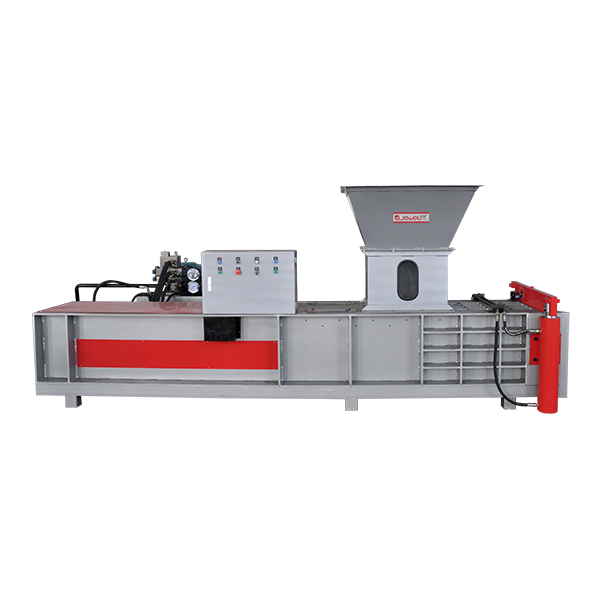
JPW-AK60 briquetting platform: 60-ton force, 5–10 kg briquettes from paper dust and fiber-based residues.
Power and voltage: 220V/50Hz, 380V/50Hz and customizable supplies
Voltage is the specification most often discovered late. In this model range, the JP7050T8 baling machine is listed at 220V/50Hz with 2.2 kW / 3 Hp, a net weight of 590 kg and a baling capacity of 6 to 8 bales per hour at 50 to 80 kg per bale. It is the smallest electrical footprint in the range and suits sites without a three-phase supply.
| Model | Rated voltage | Power / horsepower |
|---|---|---|
| JP7050T8 | 220V/50Hz (customizable) | 2.2 kW / 3 Hp |
| JPW20Q | 380V/50Hz (customizable) | 7.5 kW / 10 Hp |
| JPA5076T25X | 380V/50Hz (customizable) | 7.5 kW / 10 Hp |
| JPW40BL | 380V/50Hz (customizable) | 15 kW / 20 Hp |
| JP-OT100 | 380V/50Hz (customizable) | 15 kW / 20 Hp |
| JPW-AK60 | 380V/50Hz (customizable) | 15 kW / 20 Hp |
| JPW-AK100 | 380V/50Hz (customizable) | 18.5 kW / 25 Hp |
Every model in the table is described as having a customizable voltage, and the manufacturer states that it offers customized industry solutions for compression and baling equipment. For a buyer in a region with an unusual grid, a step-up or step-down transformer, or a mixed single-phase and three-phase site, this is a question to settle at the enquiry stage rather than after the machine has been shipped.
Carbon steel construction and duty-cycle questions
Every model described in this FAQ — vertical, horizontal, semi-automatic, fully automatic, briquetting, bagging and metal-capable platforms — is constructed from carbon steel. A consistent structural material across a mixed fleet has a practical procurement benefit: it simplifies the spares discussion, because the frame material does not change from one platform to the next.
Carbon steel is the structural answer to repeated high-force cycles, but it is not the whole reliability picture. Frame material, hydraulic cylinder specification, wear-part design, surface treatment and spare-parts supply are separate questions, and a procurement checklist that asks about force ratings while ignoring the other four tends to discover the gap during the first unplanned downtime. It is reasonable to ask how wear parts are supplied and how long replacements take to reach the site — a 50,000 square meter facility with an annual output of 120,000 units and a 30-engineer R&D team implies a manufacturing base, but it does not by itself answer a service question for a specific country.
Matching models to waste streams
The listed applicable industries across this range are consistent: waste paper recycling, plastic recycling, carton printing, textile waste processing, packaging manufacturing and PET bottle recycling. What changes between models is which of those streams the machine compresses efficiently and at what bale weight.
Waste paper and carton
The JPW20Q fully automatic horizontal baler is the entry point for automated carton and waste paper handling: 20-ton force, 500 x 500 x 500 mm bales of 30 to 70 kg, 2 to 4 strapping channels and 7.5 kW / 10 Hp at 380V/50Hz. Where throughput is higher, the JPW40F semi-automatic horizontal baler handles 1 to 2 tons per hour at 40 tons of force. For sites on a 220V/50Hz supply, the JP7050T8 provides 6 to 8 bales per hour at 50 to 80 kg.
Plastic and PET bottles
The JPW40BL is classified as a plastic bottle recycling machine with a 40-ton compression force over a stated 40 to 150 ton range. It produces 720 x 720 x (300–1000) mm bales weighing 250 to 350 kg through a 1000 x 720 mm feeding mouth, uses one-time blunder discharge and draws 15 kW / 20 Hp at 380V/50Hz. A PET processing application in Japan specified high-density compression of bottles and a compact, aesthetically consistent bale shape — a reminder that bottle recycling buyers often care about bale appearance as much as bale weight.
Mixed plastic film, woven bags and HDPE
Mixed streams are the hardest specification case. A Belarusian renewable resource operation processing PET bottles, woven bags, HDPE bottles and cardboard on a single machine required a customized configuration to solve the bulkiness and compression difficulty of those materials. Where a project mixes film, rigid plastic and fiber, customization should be assumed rather than treated as an exception.
Mixed plastics with small fractions of glass and metal scrap
An Australian comprehensive solid waste recycler applying the JPW-AK100 required compression stability and durability while processing mixed plastics with small amounts of glass and metal scraps. The JPW-AK100 itself is listed at 100 tons of force, 0.4 to 0.8 tons per hour, with fiber-based materials as its similar material group.
Textile, fiber and paper dust
Textile waste processing is a listed applicable industry across the range. For finer fiber-based residues, the JPW-AK60 briquetting machine produces 300 x 300 x (200–300) mm briquettes of 5 to 10 kg at 0.2 to 0.5 tons per hour, with paper dust listed as a similar material. Briquetting and baling are not interchangeable outputs, and the choice between them is a downstream-sale decision as much as an equipment decision.
What recent project applications show about integration
Model selection does not end at the baler. In the documented applications across this range, the baler is consistently paired with a conveying system and operated in automatic mode — that pairing, not the machine alone, is what delivers the automation benefit.
In Tunisia, a corrugated carton printing and packaging plant used the JPW20Q in an intelligent automatic waste cardboard recycling and baling line, with factory-wide planning and efficient preprocessing designed to remove the waste accumulation generated by corrugator lines and printing machines. In Mexico, the JP-OT100 vertical baler was deployed in a comparable carton and mixed solid waste setting requiring whole-plant integration and high-efficiency automation. In Russia, the JPW-K6046 bagging machine formed part of a full-automatic unmanned waste baling system for carton production waste, with automatic collection, compression and baling.
In Italy, a carton manufacturer upgrading a factory waste disposal system combined shredding and compression in one line to handle large-format waste cardboard and replace aging balers. In Belarus, a multi-material automatic baling project deliberately used one customized machine for several waste types in order to reduce equipment investment. The common thread is that the machine purchase was specified as part of a line — infeed, compression, discharge — rather than as a standalone unit.
Standards and compliance questions buyers should raise
Compliance is a region-specific specification, and it should be raised before the purchase order rather than during import clearance. EN 16500:2014 sets safety requirements for vertical baling presses used on waste materials in the European market and applies to vertical and tyre balers; the JP-OT100 is a vertical baler platform, so European buyers specifying that format should confirm the applicable safety documentation for the configuration ordered. In the United States, ANSI Z245.5-2023 is the current American National Standard for baling equipment safety requirements, replacing the 2013 version.
Trade context matters here as well: China's exports of wood pulp and paper scrap, including baled waste paper, reached USD 288 million in 2025 according to the Observatory of Economic Complexity, which reflects how normalized baled material has become as a traded commodity. Bale dimensions and weights that do not match a receiving mill's handling equipment create a commercial problem even when the machine itself performs correctly.
Hydraulic balers versus traditional baling methods — and where they stop
Compared with manual tying, low-force mechanical presses and aging fixed installations, hydraulic baler machines offer a more predictable output: a defined bale weight band, a defined bale dimension, and in the automatic formats a discharging method such as continuous push pack on the JPW40F or one-time blunder on the JPW40BL. Predictability is the actual product — a recycler buying baled material is buying a repeatable unit, not a compressed pile.
The limits are equally concrete, and buyers should plan around them:
- A hydraulic baler compresses; it does not shred. The Italian carton upgrade project combined shredding and compression because large-format waste cardboard needed preprocessing before baling. Where material arrives oversized or bulky, the baler alone will not solve the problem.
- Automation is system-level. Every documented application in this range pairs the baler with a conveying system and automatic operation. A fully automatic horizontal baler without infeed conveying still depends on manual loading.
- Force bands are segmented. A model producing 5 to 15 kg briquettes and a vertical baler producing 400 to 600 kg bales are not substitutes for one another, even though both sit inside a 2 to 180 ton family range.
- Mixed streams usually require customization. Handling PET bottles, woven bags, HDPE bottles and cardboard on one machine in Belarus required a tailored configuration rather than a catalogue selection.
- Throughput profiles differ by platform. A vertical baler at 5 to 6 bales per hour and a semi-automatic horizontal baler at 1 to 2 tons per hour serve different production rhythms and different floor space constraints.
Future outlook
Three directions are visible from the equipment side. The first is integration: the demand described in the project applications above is for complete waste removal systems rather than standalone machines, which is consistent with the manufacturer's stated portfolio direction toward intelligent waste removal systems, automatic compression and wrapping systems, and integrated crushing, compression and baling machines.
The second is flexibility in electrical configuration. With listed models spanning 220V/50Hz and 380V/50Hz and voltage described as customizable across the range, the constraint on deployment is increasingly the site rather than the machine, which matters for buyers in markets where grid standards vary within a single sales territory.
The third is standards convergence. As the global baler market moves toward the USD 11.4 billion figure projected for 2035, and as Asia Pacific continues to hold a large revenue share, region-specific safety expectations such as EN 16500:2014 and ANSI Z245.5-2023 become part of the specification conversation rather than an export formality. Buyers who treat compliance documentation, bale format, feeding mouth size and voltage as one specification package will spend less time correcting decisions after installation.
FAQ
What compression force should be specified for waste paper and carton?
For waste paper recycling and carton printing waste, the listed range starts at 20 tons on the JPW20Q fully automatic horizontal baler and continues to 40 tons on the JPW40F semi-automatic horizontal baler. The JPW20Q produces 500 x 500 x 500 mm bales weighing 30 to 70 kg; the JPW40F produces 720 x 720 x (500–1300) mm bales weighing 200 to 400 kg at 1 to 2 tons per hour. Force should therefore be selected together with bale weight and downstream handling, not in isolation.
How much compression force do the individual hydraulic baler machine models provide?
Listed compression forces are: JP8060T5X waste compactor 5 tons; JPW-K6046 bagging machine 10 tons; JPW20Q fully automatic horizontal baler 20 tons; JP-S100B 25 tons and JPA5076T25X 25 tons; JPW40F and JPW40BL 40 tons; JPW-AK60 60 tons; JP-OT100 vertical baler 100 tons and JPW-AK100 100 tons. The widest stated compression force range across the JP7050T8, JP-S100B and JPA5076T25X platforms is 2 to 180 tons.
What bale size, weight and discharge method does the JPW40F have?
The JPW40F produces bales of 720 x 720 x (500–1300) mm weighing 200 to 400 kg, with a feeding mouth of 1000 x 720 mm and four strapping channels. Bale discharging is by continuous push pack, baling capacity is 1 to 2 tons per hour, the motor is rated 11 kW / 15 Hp, and machine dimensions are 4900 x 1750 x 1950 mm. It is constructed from carbon steel.
What are the bale dimensions and weights of the JP-OT100, JPW20Q and JPW-AK100?
The JP-OT100 vertical baler produces 1400 x 700 x (700–1100) mm bales weighing 400 to 600 kg, from a compression chamber of 1400 x 700 x 1700 mm, at 5 to 6 bales per hour. The JPW20Q produces 500 x 500 x 500 mm bales weighing 30 to 70 kg with 2 to 4 strapping channels. The JPW-AK100 produces 320 x 320 x (200–250) mm bales weighing 5 to 15 kg at 0.4 to 0.8 tons per hour, with fiber-based materials listed as its similar material group.
Which voltages and power ratings are available across the range?
The JP7050T8 is listed at 220V/50Hz with 2.2 kW / 3 Hp. Other listed models specify 380V/50Hz: JPW20Q and JPA5076T25X at 7.5 kW / 10 Hp; JPW40BL, JP-OT100 and JPW-AK60 at 15 kW / 20 Hp; and JPW-AK100 at 18.5 kW / 25 Hp. Voltage is described as customizable across the listed models, and the manufacturer offers customized industry solutions for compression and baling equipment.
Is carbon steel construction adequate for continuous industrial waste baling?
All models covered here are constructed from carbon steel, including vertical, horizontal, semi-automatic, fully automatic, briquetting and bagging platforms. Frame material addresses repeated high-force cycles, but it does not by itself answer questions about wear parts, hydraulic seals, surface treatment or spare-parts lead time, which should be specified separately. Duty cycle also depends on the feeding method and whether the machine is integrated with conveying equipment.
How should a baler be matched to PET bottle and plastic waste streams?
For PET bottles, the JPW40BL plastic bottle recycling machine provides 40 tons of compression force within a stated 40 to 150 ton range, producing 720 x 720 x (300–1000) mm bales of 250 to 350 kg with one-time blunder discharge at 15 kW / 20 Hp. A PET processing project in Japan specified high-density compression and a compact, consistent bale shape. Where PET is mixed with woven bags, HDPE and cardboard, a customized configuration is typically required, as in the Belarusian multi-material project.
What are the most important limitations of a hydraulic baler machine?
A hydraulic baler machine compresses material but does not shred it, so oversized or bulky waste may require preprocessing in a combined crushing and compression line, as in the Italian carton project. Automation depends on integrating a conveying system rather than on the baler alone. Force and bale format are segmented across the range, so no single model covers both small fiber briquettes and heavy mill bales. Mixed-material operation on one machine generally requires a customized configuration.
Further reference
Detailed model specifications, including compression force, bale dimensions and weights, feeding mouth sizes, voltage and power ratings across the vertical, horizontal, semi-automatic, fully automatic and specialty platforms discussed above, are compiled in the manufacturer's product brochure: hydraulic baler machine product brochure (PDF).