
Specifying Wall Cloth for Coastal Hotels and Desert Resorts
Specifying Wall Cloth for Coastal Hotels and Desert Resorts
A coastal hotel in Malaysia and a desert resort in Saudi Arabia are designed in different visual languages, but their interior walls tend to fail for the same reason: moisture reaching the substrate behind the decorative finish. Sustained tropical humidity, salt-laden air, extreme heat, airborne dust and cooling-driven condensation turn an aesthetic decision into a durability decision. For owners and procurement teams at the beginning of a project, the first useful question is not which pattern to choose, but which build-up will hold its appearance and surface integrity for the length of a refurbishment cycle.
Why Climate Is a Specification Variable in Hot and Humid Regions
In hot and humid markets, a wall finish carries three continuous loads: moisture, temperature and dust. Coastal tropical climates add salt to that list; desert climates add thermal cycling and fine particulate matter. The recorded working-condition profile for the Grade 5 Waterproof Finished Art Paint wall covering family reflects this environment directly: the product is specified for indoor conditions characterised by high humidity and dust, an operating temperature range of -10°C to 40°C, and required waterproof and mildew-proof performance, installed permanently after construction and operating without a special maintenance regime.
What makes these climates difficult is less the average condition than the direction moisture travels. In a tropical coastal building, humidity moves from warm outside air toward cooler interior surfaces and toward the wall assembly. In a desert resort, the same problem appears in a different form: heavily cooled interiors, irrigated landscaping, pools, kitchens and laundries introduce moisture into air that is otherwise dry, and condensation forms where that air meets a cooler wall or where two surfaces meet. Either way, the risk concentrates in the same place, behind the finish.
A finish that seals the surface but traps moisture at the substrate can support mildew growth and adhesive failure. A finish that lets liquid water through at the surface soils and stains quickly. The specification that works in hot and humid climates is therefore a build-up, not a single sheet of material: a surface that resists liquid water, a base that does not behave like a plastic film, and a material set that is recorded as both moisture-proof and mildew-proof.
Malaysia and Saudi Arabia: Two Climate Profiles, One Selection Logic
Malaysia and Saudi Arabia both appear in the application record of this wall covering family, which covers interior decoration, residential construction, hotel and hospitality, commercial real estate and fashion design, with documented coverage that also includes Germany, Russia, China, Vietnam, Thailand, Singapore, Indonesia and the Philippines. For the manufacturer, Nockybrothers new material (Wujiang) Co., Ltd., the Middle East and Southeast Asia are both listed core export markets. The published record describes markets, applications and working conditions rather than named client projects, so the comparison below stays at the level of climate profile, product build-up and maintenance logic.
The coastal tropical profile: Malaysia
In Malaysian hospitality projects, humidity is a constant rather than a season. The practical stresses are persistent background moisture in wall assemblies, salt aerosol near coastlines, monsoon-driven rain and envelope leakage, and high occupancy that leaves short maintenance windows. One consequence is that wall finishes are commonly among the first interior elements scheduled for replacement during refurbishment in humid climates, because a finish that loses adhesion or develops surface mildew forces early replacement regardless of its appearance.
For a coastal hotel, the specification consequence is narrow: the finish must hold adhesion under continuous humidity, resist mildew at the surface, and be cleanable without aggressive chemicals. Where a wall is fed by a persistent leak, no decorative finish resolves the problem, a point developed further below.
The hot desert profile: Saudi Arabia
In Saudi resort and urban hotel projects, the dominant stresses are heat, airborne dust and cooling-driven condensation. Fine particulate matter settles into embossed textures, so the cleaning method has to be planned before the pattern depth is selected. Interiors are cooled heavily, and moisture carried by pools, irrigation, kitchens and laundries can condense where it meets a cooler surface. Public areas are also large-format, with long wall runs where colour consistency and joint behaviour are visible.
The specification consequence here is different: the surface must tolerate repeated cleaning without losing its printed or embossed character, must satisfy the recorded scratch-resistance and colour-fastness requirements, and should be installed with a joint plan that keeps seams out of high-soil and high-splash zones.
The Technical Controls Behind the Specification
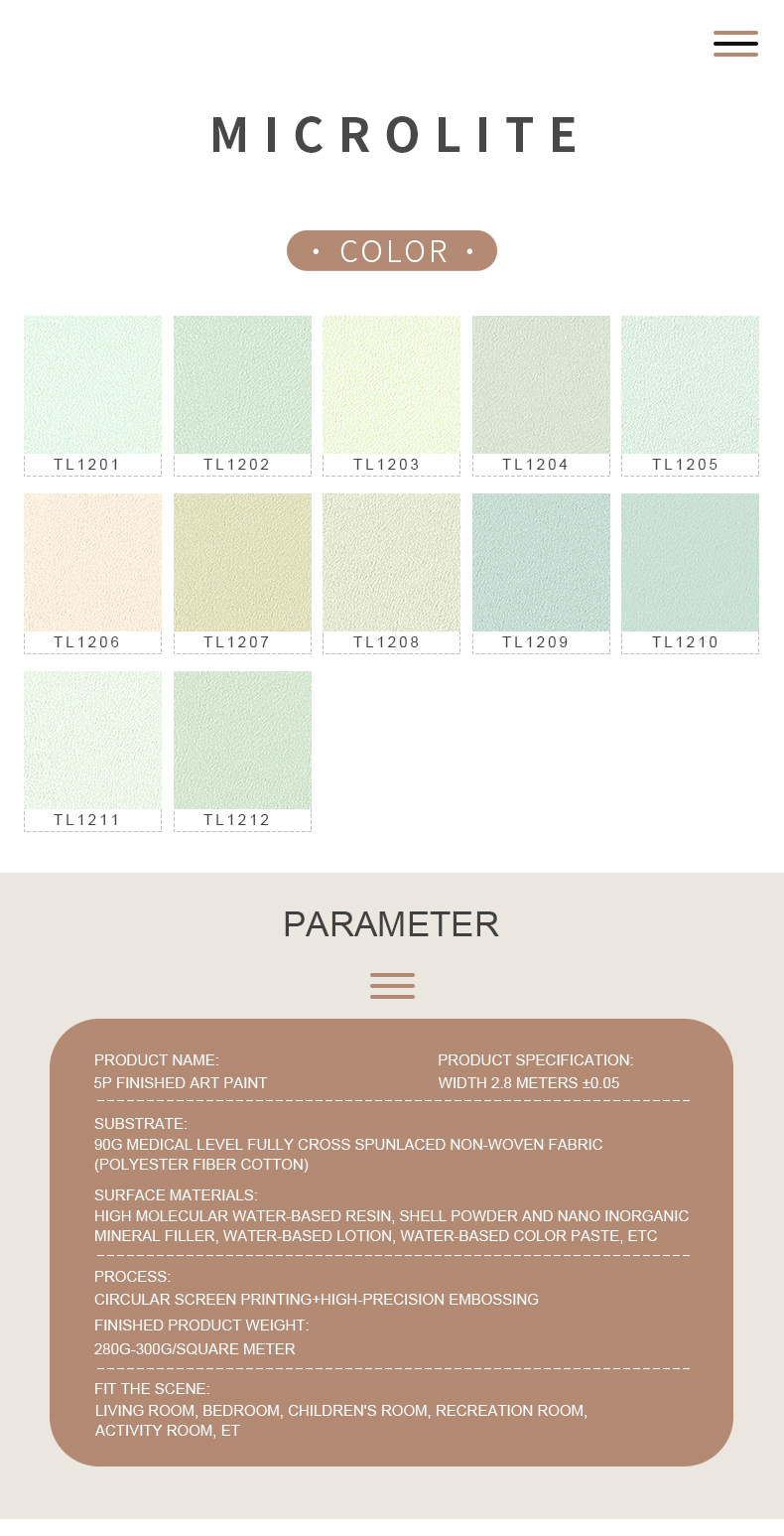
The material composition of this wall covering is non-woven fabric, eco-friendly water-based resin, nano inorganic mineral fillers, high-quality shell powder and a medical-grade base material. Roll widths are 2.8 m, 2.9 m and 3.1 m, and model designations in the range include Dreamy Velvet, Glittering, Artistic Relief Sculpture, Desert Stroll, Roman Travertine and Jade Crystal. The same family is classified simultaneously as waterproof finished art paint, non-woven wallpaper, fabric wall covering and embossed wall cloth, which reflects what the product actually is: a decorative printed or embossed surface carried on a non-woven fabric base rather than a coated vinyl film.
Grade 5 waterproof performance
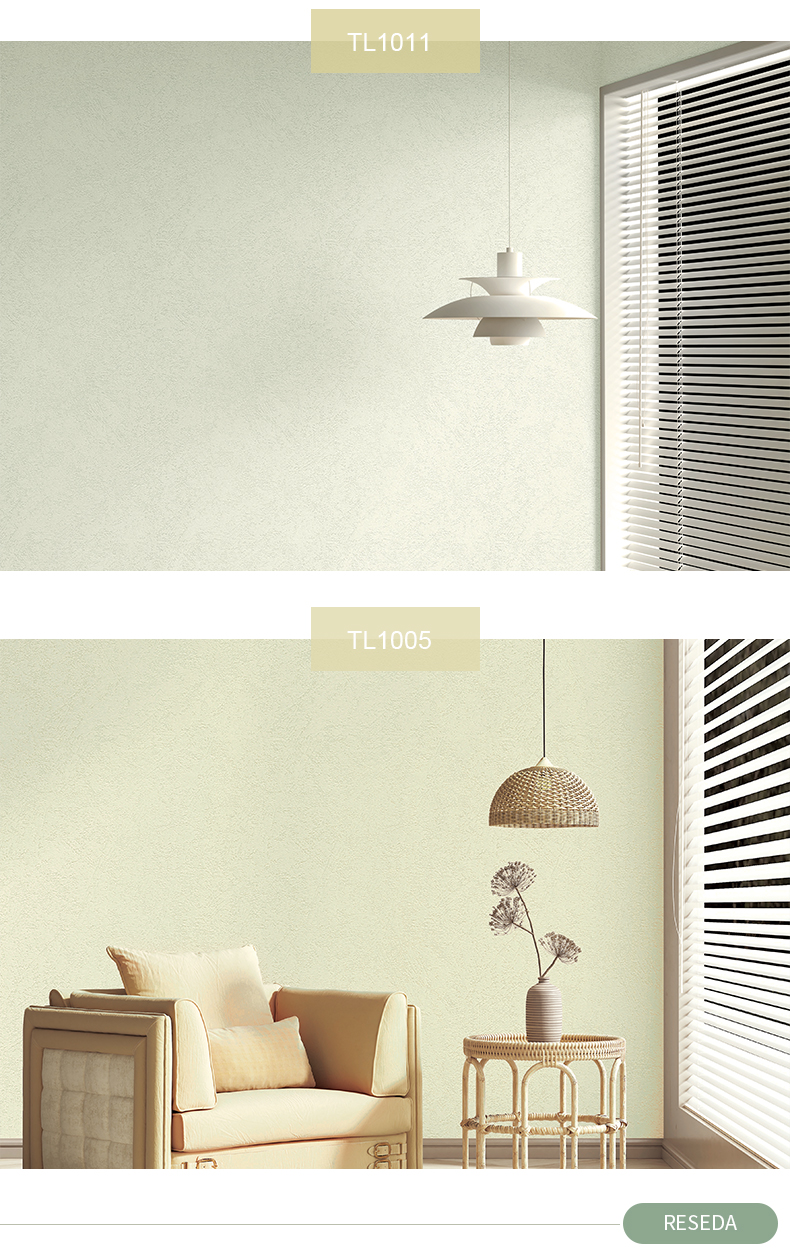
Grade 5 waterproof performance is the headline requirement recorded for this product family, alongside formaldehyde-free and eco-friendly composition, scratch resistance, seamless construction and colour fastness. In practice, the waterproof grade governs the surface behaviour of liquid water: condensation droplets, cleaning solutions and accidental splashes stay at the surface instead of soaking into the decorative layer. That property is what allows the same material to be specified in a bathroom-adjacent corridor and in a lobby where the wall is wiped daily.
Breathable yet waterproof: a build-up logic, not a single property
The phrase breathable yet waterproof is often used loosely, so it is worth separating the two functions. In this construction, the water-based resin finish resists liquid water, while the non-woven fibrous base keeps the assembly from behaving as a vapour-tight film; fibrous non-woven structures are widely used in wallcoverings partly because they permit vapour movement. The two properties must be balanced and verified for the specific construction rather than assumed. Buyers should request the vapour transmission figure and the waterproof test result for the exact product they intend to purchase, because the published record for this family does not assert a numeric vapour transmission value, and a project specification should not inherit one from marketing language.
Mildew-proof and moisture-proof function
The recorded function set for this family includes moisture-proof and mildew-proof performance, stain resistance with easy cleaning, and sound absorption. Whether mildew appears on a finished wall depends on three variables: the formulation of the product, the moisture condition of the substrate, and the vapour behaviour of the whole assembly. The manufacturer controls the first; the project team controls the other two. This is why mildew-proof wall cloth installed over a damp substrate will still fail, and why the specification checklist in this article begins with substrate moisture rather than with pattern.
Application: What This Means in a Malaysian Hotel and a Saudi Resort
Malaysian coastal hotel
- Verify substrate moisture before installation and allow the base layer to dry fully; the specification requires professional construction tools and dedicated base-layer treatment materials.
- Specify the Grade 5 waterproof surface in spa corridors, laundry-adjacent walls and bathroom-front zones, where condensation and splash are routine.
- Use the wider roll options of 2.8 m to 3.1 m to reduce the number of vertical joints across long wall runs, since joints are the first place moisture and soil accumulate.
- Confirm the mildew-proof and moisture-proof performance in writing, and pair it with ventilation design so that the assembly is not asked to manage bulk water.
Saudi desert resort
- Decide the cleaning method first, then the pattern depth; deeper relief holds more settled dust and requires more careful removal.
- Apply the recorded scratch-resistance requirement to circulation zones where trolleys, luggage and service equipment contact the wall.
- Apply the colour-fastness requirement to large public-area walls, so that adjacent surfaces remain visually consistent as the project is delivered.
- Detail cooling and air handling so that surface condensation is limited at the points where cool interiors meet moisture from pools, irrigation or back-of-house operations.
Tenant Comfort and the Maintenance Budget
Tenant comfort in hot and humid hotels is influenced by the wall finish more than most specifications acknowledge. The recorded formaldehyde-free and eco-friendly requirement addresses indoor air quality and odour, which matters in sealed, mechanically cooled buildings where air exchange is limited. Sound absorption contributes to the acoustic comfort of corridors and lobby areas. Seam integrity affects how a room reads visually, and a lifting joint beside a bed head is one of the most common guest-facing complaints about any wallcovering.
The maintenance budget follows a similar logic. Four drivers dominate over a refurbishment cycle: cleaning labour and agents, damage repair, joint failure, and the interval between redecorations. The recorded stain resistance and easy-cleaning function reduces reliance on aggressive cleaning agents, which in turn protects the printed or embossed surface. Scratch resistance limits repair events in circulation zones. Wider roll widths reduce the number of vertical joints per wall, and fewer joints mean fewer places where moisture, dust and mechanical stress can initiate a defect. Seamless construction and colour fastness are recorded as explicit special requirements for this family for exactly these reasons.
No cost figures are asserted here, because none are published. The argument is structural rather than numerical: in a market where wall finishes are commonly replaced first during refurbishment, a finish that resists moisture, mildew, soiling and abrasion extends the interval at which that replacement becomes necessary.
Comparison with Traditional Solutions
The comparison below concerns behaviour in hot and humid climates, which is where the differences between finish categories become material.
| Finish type | Moisture behaviour in hot/humid climates | Cleaning and dust | Joints and repairability | Main limitation |
|---|---|---|---|---|
| Emulsion / latex paint on plaster | Vapour-permeable and simple to recoat, but surface mildew commonly appears under sustained humidity, and water can migrate behind the film | Stains tend to remain visible; repeated washing can dull the surface | Seamless by nature but not locally repairable without repainting the full wall | Recoating intervals shorten as humidity and occupancy rise |
| Vinyl wallcovering | Vinyl-based products dominate the wallcovering market with a 36.2% revenue share (Grand View Research, 2024); the dense film is highly cleanable but can trap vapour at the substrate if the wall is damp | Excellent for hard cleaning, which is both an advantage and a risk in damp assemblies | Joints are visible and can lift in humid conditions | Vapour-tight behaviour is a liability rather than an advantage in continuously damp walls |
| Textile / fabric wallcovering | Strong tactile and acoustic appeal; organic textile surfaces require careful control of humidity and cleaning | Dust retention is higher; specialist cleaning is often required | Repair typically needs a full panel replacement | Generally unsuited to high-splash or high-soil zones |
| Grade 5 waterproof art paint wall cloth | Classified as waterproof finished art paint, non-woven wallpaper, fabric wall covering and embossed wall cloth; recorded as moisture-proof and mildew-proof | Recorded as stain-resistant and easy to clean | Recorded as seamless construction with colour fastness; widths of 2.8 m to 3.1 m reduce joint count | It is a decorative finish, not a waterproofing membrane, and depends on correct base-layer work |
The limitation deserves to be stated plainly rather than buried in a table. Art paint wall cloth is a decorative wall finish; it is not a structural waterproofing layer and cannot compensate for a damp substrate, a missing damp-proof course or an unresolved leak. In continuously wet conditions, such as shower enclosures, exterior facades, plant rooms and wash-down food-preparation areas, the appropriate material is a tile, a panel system or a dedicated waterproof membrane. Performance also depends heavily on the base layer, the adhesive and installer skill, which is why the application record requires professional construction tools and base-layer treatment materials rather than ordinary wallpaper paste and improvised preparation.
Fire classification is a separate compliance question. ASTM E84, the Steiner Tunnel Test, is the critical fire safety standard for wallcoverings in North America and measures flame spread and smoke development, with Class A required for permanent interior finishes (ASTM International / STARC Systems). Hotel projects in Malaysia and Saudi Arabia generally reference their own national codes. The published record for this family does not assert a fire classification, so buyers should obtain the test report that matches the destination market rather than transferring a claim from another region.
Market Signals: Where the Category Is Heading
The commercial context supports the specification shift described above. The global wall covering market was valued at approximately USD 41.40 billion in 2025 and is projected to reach USD 53.63 billion by 2031 (Mordor Intelligence). Within that market, vinyl-based products still dominate with a 36.2% revenue share, while fabric, textile and eco-friendly non-woven options are the fastest-growing segments, driven by sustainability requirements (Grand View Research, 2024). Asia Pacific accounts for approximately 38.7% of global revenue and is the fastest-growing region, supported by urbanisation and commercial hospitality projects (Dataintelo, 2025).
The supply side is moving in the same direction. China's non-woven fabric exports, a primary base material for art wall cloth, reached USD 4.04 billion in 2024, an increase of 6.25% year on year (China Customs / G&F Group). At the premium end of the market, established global competitors include York Wallcoverings, Sangetsu Corporation with a reported 16% share and A.S. Création Tapeten AG with a reported 14% share (Wizart / Mordor Intelligence). For a buyer specifying for a humid or hot climate, the practical reading is that the growth is concentrated in exactly the regions where moisture, heat and dust are the decisive specification variables.
Specification Checklist for Hot and Humid Hotel Projects
| 1 | Measure substrate moisture before ordering, and confirm the drying schedule against the installation window. |
| 2 | Obtain the waterproof test result supporting the Grade 5 performance claim for the exact product code specified. |
| 3 | Obtain the vapour transmission result, and confirm that the assembly is not vapour-tight in a cooled building. |
| 4 | Confirm moisture-proof and mildew-proof performance in writing, together with the formaldehyde-free and eco-friendly requirement. |
| 5 | Match texture depth to the cleaning method planned for the property, particularly in dusty environments. |
| 6 | Plan joints using the available 2.8 m, 2.9 m and 3.1 m roll widths, keeping seams out of splash and high-soil zones. |
| 7 | Verify scratch resistance and colour fastness for circulation areas and large public walls. |
| 8 | Confirm the fire classification required by the destination market and obtain the matching report. |
| 9 | Approve base-layer materials, adhesive and installer method, then validate them on a physical mock-up before full installation. |
Future Outlook
Two forces are likely to shape wall finish specification in hot and humid hospitality markets over the next few years. The first is the shift from pattern-led to performance-led procurement: as Asia Pacific takes a larger share of global wallcovering revenue, and as non-woven capacity grows, buyers increasingly compare products by waterproof grade, mildew and moisture performance, cleanability and colour fastness rather than by design catalogue alone. The second is the tightening of indoor environmental requirements in sealed, mechanically cooled buildings, which puts formaldehyde-free and eco-friendly composition alongside durability as a baseline expectation rather than a premium option.
For coastal and desert projects specifically, the practical consequence is that the wall finish will be evaluated as part of the building envelope sequence: substrate, base layer, finish and ventilation, rather than as a standalone decorative purchase. Manufacturers that can supply test evidence for a stated climate condition — not only a pattern range — will be positioned better with hospitality owners in Malaysia, Saudi Arabia and comparable markets.
FAQ
What is art paint wall cloth, and how does it differ from conventional wallpaper?
Art paint wall cloth is a wall covering classified as waterproof finished art paint, non-woven wallpaper, fabric wall covering or embossed wall cloth. It is made of non-woven fabric, eco-friendly water-based resin, nano inorganic mineral fillers, high-quality shell powder and a medical-grade base material. It is intended for building decoration, interior design, residential construction, hotel and hospitality, and commercial real estate. The structural difference from light conventional wallpaper is the non-woven fabric base combined with a water-based resin decorative surface, which supports Grade 5 waterproof performance and easy cleaning.
Is wall cloth suitable for coastal hotels with year-round humidity?
The product family is specified for indoor environments with high humidity and dust and an operating temperature range of -10°C to 40°C, and its recorded functions include moisture-proof and mildew-proof performance. Suitability still depends on the substrate and the assembly: the published record requires base-layer treatment before permanent installation, and mildew resistance depends on both the product formulation and the moisture condition of the wall behind it.
What does Grade 5 waterproof performance cover, and what does it not cover?
Grade 5 waterproof performance describes how the finished surface behaves with liquid water, covering condensation, cleaning solutions and accidental splash. It does not describe structural waterproofing. The product is a decorative finish, not a membrane, and it cannot compensate for a leaking wall, a missing damp-proof course or a damp substrate. Continuously wet conditions such as shower enclosures and exterior facades call for tiles, panels or a dedicated waterproofing system.
How should wall cloth be maintained in dusty desert environments?
The recorded operation profile is permanent installation after construction with stable performance and no special maintenance regime required in normal operation, and the recorded functions include stain resistance and easy cleaning. In dusty environments, the practical variables are the cleaning method and the pattern depth: deeper embossed relief retains more settled dust, so texture selection should follow the cleaning routine available at the property rather than precede it.
Where is wall cloth the wrong choice?
It is the wrong choice wherever the wall is expected to perform as a waterproof barrier rather than a decorative surface: inside shower enclosures, on exterior facades, in plant rooms and in wash-down areas. It is also a poor choice where the substrate cannot be dried or where no base-layer treatment is possible, since performance depends on the assembly and on installer method as much as on the material itself.
What documentation should a buyer request before specifying for a humid or hot climate?
Buyers should request the waterproof test result supporting the Grade 5 claim, the vapour transmission figure for the specific construction, written confirmation of moisture-proof and mildew-proof performance, confirmation of formaldehyde-free and eco-friendly composition, and the fire classification report matching the destination market. Scratch resistance and colour fastness should also be confirmed for circulation zones and large public walls with stated roll widths of 2.8 m, 2.9 m and 3.1 m.
Nockybrothers new material (Wujiang) Co., Ltd. was established in 2012 and is headquartered in Wujiang District, Suzhou, China. The company specialises in the design, research and development, production and sales of wallpaper and wall covering, with main products including Wallpaper, Wall covering and Grade 5 Waterproof Finished Art Paint. Its manufacturing facility covers 8,000 square metres with an annual production capacity of 1,200,000 square metres, supported by approximately 80 staff and a 12-person R&D team. Export business accounts for 9.65% of total sales, with major markets in the Middle East, Russia, Europe and Southeast Asia.
A downloadable company and product overview is available here: Nockybrothers company and product overview (PDF). Technical enquiries can be directed to office@nockybrothers.com. Product and capability information is also published at nockybrothersglobal.com.