
Sports Nutrition Custom Packaging: Read the Scope First
Sports Nutrition Custom Packaging: Read the Scope First
A sports nutrition brand issuing an RFQ usually receives certificates as a PDF bundle, and the bundle rarely states which document covers which part of the order. Certificate titles are easy to read; scope sentences are not. Yet the scope sentence is the part that decides whether a quotation is auditable, because it names the processes, the materials and the article categories that were actually assessed.
This review sets out a scope-matching method for buyers working through research and evaluation. It uses one supplier's document set as a working example: THE RTCO PAK PTE. LTD. (RTCO), a plastic packaging manufacturer founded in 2007 whose catalogue covers HDPE, PET and PP containers from 60ml to 6000ml for supplement and sports nutrition brands. The set is useful because it holds both document families at once — five management-system certificates and three product or material standards — which makes the difference between them visible.
The working conclusion is narrow. Before an RFQ goes out, each certificate should be converted into a checkable statement about the specific bottle, closure, resin and decoration you intend to buy. Where a document does not reach that far, the RFQ should say so in writing rather than assume coverage.
Why the scope sentence, not the certificate count, decides the audit
A certificate number proves a document exists. The scope proves what was inside the audit. Read two sentences from this set side by side. The ISO 9001:2015 scope refers to the manufacturing of food-grade plastic packaging containers. The GRS Version 4.0 scope refers to the manufacturing, molding and printing of recycled plastic products. Both are manufacturing scopes, but only one of them names printing, and that one is tied to the recycled plastic stream.
That single difference changes what a buyer can rely on. A decorated PCR bottle asks two questions at once — is the recycled content covered, and is the decoration covered — and the answers sit in different documents with different limits. Counting certificates hides this. Reading scope exposes it, and lets the RFQ state precisely which step needs additional evidence.
Scope wording should also be read together with the subject of the standard. A management-system certificate confirms that a site runs a controlled process for a defined activity. It does not certify that a particular bottle suits a particular formula, and it says nothing about moisture-vapour performance, closure torque or filling-line behaviour for your product.
Two families of documents, two different questions
The first family describes how a site is organised. ISO 9001:2015 covers quality management, ISO 14001:2015 environmental management, ISO 45001:2018 occupational health and safety, SA8000:2014 social accountability, and the HACCP Management System (V1.0) food-safety hazard control. These support a supplier-qualification file and later audit follow-up; they are the documents a quality team will recognise immediately.
The second family attaches to an article category or a material stream. ISO 15378:2017 is a Good Manufacturing Practice standard for primary packaging materials for medicinal products. BRCGS Global Standard Packaging Materials Issue 7 is a packaging safety standard. GRS Version 4.0 addresses recycled content. These are the documents a brand's regulatory or technical reviewer reads line by line, because their scope language names products and processes rather than management functions.
The eight documents, read as scope statements
The table below reproduces each document's identifying details and scope as printed on the copies reviewed. Dates are shown because a scope only applies inside its validity window.
| Document | Number and issuer | Scope as written | Validity |
|---|---|---|---|
| ISO 9001:2015 | 05126Q00928R153 — NOA Testing & Certification Group Ltd. | Manufacturing of food-grade plastic packaging containers | 18 Mar 2026 – 16 Mar 2029 |
| ISO 14001:2015 | NOA2408227 — NOA Testing & Certification Group Ltd. | Manufacturing of plastic packaging containers for food and cosmetic applications | 22 Aug 2024 – 21 Aug 2027 |
| ISO 45001:2018 | NOA2408228 — NOA Testing & Certification Group Ltd. | Manufacturing of plastic packaging containers for food and cosmetic applications | 22 Aug 2024 – 21 Aug 2027 |
| SA8000:2014 | BM-CN-20240906 — Benchmarks Co., Ltd. | Manufacturing of plastic packaging containers, including mixing, feeding, injection molding, blow molding and packaging | 6 Sep 2024 – 5 Sep 2027 |
| HACCP Management System (V1.0) | 331HACCP2600024 — Ti Certification (Shanghai) Co., Ltd. | Hazard analysis and critical control point management for manufacturing food-contact plastic containers and closures | 2 Jul 2026 – 1 Jul 2029 |
| ISO 15378:2017 | HBPCER20260088 — Intertek Testing Services | Manufacturing of HDPE and PP bottles for medicinal products | 16 Apr 2026 – 5 Mar 2029 |
| BRCGS Packaging Materials Issue 7 (October 2024) | C0860130-BRC2 — NSF Certification, LLC | Blow molding and injection molding of PE and PP plastic containers, lids, spoons and hooks for food use | 24 Jul 2026 – 7 Sep 2027 |
| GRS Version 4.0 | TRC-GRS-222421-00 — TÜV Rheinland (China) Ltd. | Manufacturing, molding and printing of recycled plastic products | 5 Sep 2025 – 4 Sep 2026 |
Two observations follow from the wording alone. SA8000:2014 is the only management-system scope in this set that lists process steps — mixing, feeding, injection molding, blow molding and packaging — which matters when a buyer wants to know which operations were inside the audit rather than which product category. And none of the five management-system scopes names printing, coating, metallization or labelling, so decoration is not covered by them.
Matching scope language to powder jars, capsule bottles and gummies
A protein powder jar is a set, not an item: HDPE or PET body, PP lid, and often a PP measuring scoop. BRCGS Issue 7 is the scope in this set that names lids, spoons and hooks alongside PE and PP containers for food use, so it is the document that reaches a jar-and-scoop combination. The ISO 15378:2017 scope names HDPE and PP bottles, and stops there. An RFQ for a wide-mouth jar with a scoop-hook closure should therefore ask explicitly whether the scoop and the hook are inside a named scope, rather than assuming the bottle standard carries them.
Pre-workout and BCAA bottles in the 300ml to 600ml band sit inside the stated 60ml to 6000ml catalogue range, so capacity is not the constraint; the documentation question is. If the body is HDPE or PP the ISO 15378 scope is directly relevant, and if the closure is a PE or PP lid the BRCGS scope is relevant. The pairing is what a buyer should record: two documents, two named article categories, one finished pack.
Capsule and tablet bottles expose a subtler point. The ISO 15378:2017 scope is written for medicinal products, while a sports nutrition capsule bottle is a food-use article. That does not invalidate the certificate, but it does mean the buyer should ask how the supplier maps a medicinal-product GMP scope onto a supplement article, and which additional document supports the food-use claim for that bottle. The question is legitimate and answerable; the mistake is to read the standard's title as a finished-product statement.
Gummy bottles with flip caps follow the same logic in reverse. The cap is a lid, and lids are named in the BRCGS scope, but the scope describes molding activity rather than a specific cap geometry. The usable question is therefore whether that particular cap is molded at the site whose activity was assessed, and whether the liner or induction seal is produced under the same or a separate scope.
Recycled content introduces a third axis. GRS Version 4.0 names manufacturing, molding and printing of recycled plastic products, which makes it the only scope in the set that reaches decoration in the PCR stream. For a turnkey PCR supplement pack, a buyer can reasonably ask for the GRS record during evaluation, and should pair it with a separate statement on the food-contact status of any ink or coating applied to recycled material.
Finally, formats that sit outside the common list deserve their own line in the RFQ. Dual-chamber bottles, dispensing bottles, sample tubes and gallon bottles are all part of the supplier's stated product range, but a range is not a scope. Ask, item by item, which evaluated process produces each one.

Molding lines are the activity most scope sentences actually describe, which is why scope language and site identity must be checked together.
Where scope gaps usually appear: decoration and surface finish
Soft-touch coating, vacuum metallization, 3D printing, silk screen and labelling are where buyers most often assume coverage that the documents do not grant. None of the eight scope statements reviewed here names a coating line or a metallization process. HACCP reaches containers and closures; BRCGS reaches containers, lids, spoons and hooks for food use; GRS reaches printing, but only in the recycled plastic stream.
The practical consequence is that a decorated premium bottle should be handled as two questions. The base article question — is the bottle molded under a named scope — is answerable from the documents. The decoration question — where the coating, metallization or print is applied, whether that step is in-house or subcontracted, and which certificate covers the decorated article — usually is not. Asking it before the RFQ closes prevents a late discovery that the most distinctive part of the pack is the least documented part.
Dates, issuing bodies and the site that will run the order
Validity windows in this set are not uniform. The GRS record runs from 5 September 2025 to 4 September 2026, a one-year cycle, while ISO 15378:2017 runs to 5 March 2029 and ISO 9001:2015 to 16 March 2029. Where a printed window has closed, the correct action is to request the renewal record rather than to treat the earlier copy as current. That is a date check, not a judgement about the supplier.
Issuers differ across the set and should be recorded as printed: NOA Testing & Certification Group Ltd., Intertek Testing Services, NSF Certification, LLC, TÜV Rheinland (China) Ltd., Ti Certification (Shanghai) Co., Ltd. and Benchmarks Co., Ltd. A PDF is a copy. Where an issuer publishes a searchable registry, the buyer's file is stronger when the certificate number has been checked there, not only matched against the filename.
Site and entity checks complete the picture. The certificate holder's legal name should match the contracting party on the quotation, and the manufacturing site should be identified. A supplier operating more than one facility, or combining own manufacturing with regional warehousing, should state which plant holds which scope and where a given order will be molded. The documents alone do not answer that question for a specific purchase order.
What the documents do not establish
A scope-match exercise is only useful if its boundaries are stated. The eight documents above do not establish the following:
- Suitability for a specific formula. No certificate in the set reports barrier performance, closure torque retention, drop resistance or filling-line compatibility for a named product.
- Market authorisation. They are conformity documents, not permission to place a finished supplement on a market.
- A PFAS or chemical declaration. Regulation (EU) 2025/40, the EU Packaging and Packaging Waste Regulation, restricts PFAS in food-contact packaging from 12 August 2026. None of the eight documents is a PFAS declaration, so a buyer selling into the EU needs a separate material statement.
- A blanket “FDA certified” position. Where a quote carries that phrase, the buyer should ask which specific declaration or test report supports it; the phrase itself is not one of the documents reviewed here.
- Capacity or lead time. RTCO's own figures — a 68,000 m² facility, about 1,000,000,000 units a year, roughly 200 staff including a 40-engineer development team, and a typical MOQ of 10,000 to 30,000 units per SKU with first trial orders supported below that band — come from company data and published capability information, not from the certificate set.
The scope-match request: seven lines to add to the RFQ
The method compresses into a short block of text that can sit inside the RFQ document itself, so that every supplier answers the same way.
- Name the article precisely: format, resin, capacity, closure type, scoop or dosing accessory, and each decoration step.
- Ask which certificate covers each element, and request the scope sentence quoted verbatim rather than the certificate title alone.
- Request the full copy with number, issuing body, issue date, expiry date and the certificate holder's legal name.
- Ask which manufacturing site holds each scope, and confirm that the quoted order will be produced at that site.
- Ask separately about decoration: in-house or subcontracted, which document covers the decorated article, and what statement supports the food-contact status of inks and coatings.
- Request declarations that the certificate set does not contain, such as a PFAS or material declaration for the target market.
- Where a printed validity window has closed, request the renewal record, and verify the certificate number with the issuing body where a registry exists.
None of these lines asks a supplier to commit to something new. Each one asks the supplier to state what an existing document already says, which is the least a buyer can require before comparing prices.
Outlook: documentation as a sourcing filter
Grand View Research estimated the global supplements and nutrition packaging market at USD 33.0 billion in 2026, with plastic holding a 73.8% share of supplement packaging in 2025. Those figures describe a material base that is not about to disappear, and they explain why document quality is becoming a sourcing variable rather than a filing task: a category that stays predominantly plastic is a category where recycled content, chemical restrictions and process control will keep generating paperwork.
A conditional view follows from that, not a forecast. If EU-facing declarations become routine buying criteria after the PPWR restrictions take effect, buyers will start comparing declarations the way they compare specifications today — provided suppliers keep management-system certificates and material statements in separate, clearly labelled groups. Suppliers who can quote a scope sentence against a named bottle, lid and decoration will spend less time in clarification rounds. That advantage depends on the documents actually matching the article, which is the whole point of reading scope before the RFQ, not after it.
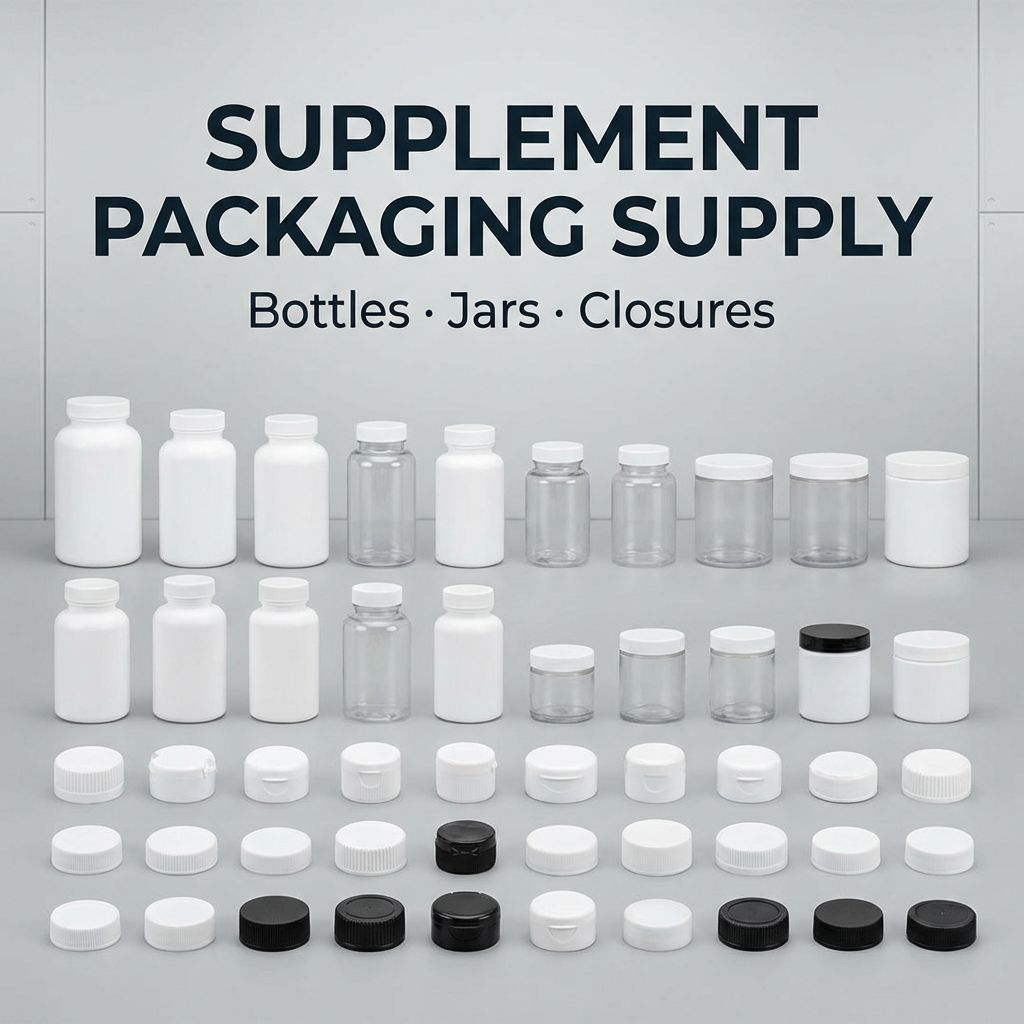
Bottle, jar, closure and scoop are separate scope questions even when they ship as one finished pack.
FAQ: reading certification scope
What is the difference between a management-system certificate and a product certification?
A management-system certificate confirms that a site runs a controlled process for a defined activity; in this set that covers ISO 9001:2015, ISO 14001:2015, ISO 45001:2018, SA8000:2014 and the HACCP Management System (V1.0). A product or material certificate attaches to an article category or material stream — ISO 15378:2017 for HDPE and PP bottles for medicinal products, BRCGS Packaging Materials Issue 7 for blow and injection molding of PE and PP containers, lids, spoons and hooks for food use, and GRS Version 4.0 for recycled plastic products. Both are useful, but they answer different questions and should be filed separately.
Does ISO 15378:2017 cover caps, scoops and decoration?
No. The ISO 15378:2017 certification cited here, number HBPCER20260088 issued by Intertek Testing Services, covers the manufacturing of HDPE and PP bottles for medicinal products. Caps, lids and spoons appear instead in the BRCGS scope, number C0860130-BRC2 issued by NSF Certification, LLC, which names blow molding and injection molding of PE and PP containers, lids, spoons and hooks for food use. Decoration is named only in the GRS scope, number TRC-GRS-222421-00 issued by TÜV Rheinland (China) Ltd., and only for recycled plastic products.
Why do certificate dates matter before an RFQ?
Because scope only applies inside a validity window, and the windows in a single supplier's set are not uniform. In the set reviewed, GRS Version 4.0 runs from 5 September 2025 to 4 September 2026 — a one-year cycle — while ISO 15378:2017 runs to 5 March 2029 and ISO 9001:2015 to 16 March 2029. Where a printed window has closed, the buyer should request the renewal record instead of relying on the earlier copy.
How does the EU PPWR affect what a buyer should request?
Regulation (EU) 2025/40, the EU Packaging and Packaging Waste Regulation, restricts PFAS in food-contact packaging from 12 August 2026. None of the certification documents reviewed here is a PFAS declaration, so a brand selling into the EU should request a separate material declaration covering the specific resin, coating and ink used on the article, and file it alongside the certificates rather than assuming an existing scope covers it.
Which certificate proves a bottle suits a specific sports nutrition formula?
None of them. The certificates reviewed address management systems or manufacturing processes; they do not report barrier performance, seal integrity or filling-line compatibility for a named product. Formula suitability is established through specification data and product-level testing agreed with the supplier, and that evidence should be requested as a separate item in the RFQ rather than inferred from a certificate title.
Reference: the supplier catalogue covering bottle, closure and scoop formats for sports nutrition applications is available as a downloadable PDF. Supplier background is published at rtcopackaging.com.
Tem questões ou precisa de mais detalhes?
Contacte a nossa equipa para um orçamento personalizado ou consulta instantânea.
Solicitar orçamento
Preencha o formulário abaixo e a nossa equipa entrará em contacto com uma proposta personalizada.
Chat direto do WhatsApp
Prefere conversar em tempo real? Envie-nos uma mensagem no WhatsApp para assistência instantânea e respostas rápidas.
- Obter orçamento personalizado
- Partilhar fotos ou documentos
- Discuta as suas necessidades diretamente
Geralmente responde em 5–30 minutos durante o horário de expediente.