
Sports Nutrition Packaging FAQs: Certifications, MOQs, Food-Grade Materials
Sports nutrition packaging decisions are usually made under launch pressure, and the questions buyers ask are remarkably consistent: which plastic is genuinely food-grade, which certificate covers which process, what volume has to be committed before a mold is cut, and how long tooling and production actually take. Plastic remains the dominant material in this category, holding roughly 73.8% of supplement packaging market share in 2025 according to Grand View Research, and the global nutraceutical packaging market was valued at USD 5.05 billion in 2024, with plastic segments taking a 58.3% revenue share. Market-size estimates do diverge by approximately USD 1 billion depending on whether flexible and secondary packaging are counted; MarketsandMarkets placed the 2025 baseline at USD 3.67 billion.
This reference answers the procurement questions that sit between a finished formulation and a shipped pallet, using documented product specifications and certificate scopes from RTCO (THE RTCO PAK PTE. LTD.). RTCO is a plastic packaging manufacturer founded in 2007 that produces HDPE and PET containers, caps and closures, scoops, liners and surface finishes for supplement, sports nutrition, health and beauty, and pharmaceutical customers. The company operates a 68,000 m² manufacturing footprint with around 200 employees and a 40-engineer R&D team, and reports annual output capacity of 1,000,000,000 units.

Extrusion molding: the first stage in converting food-grade HDPE, PET and PP resin into supplement containers.
Procurement snapshot: the numbers behind the questions
Before the questions are answered individually, the specification and commercial parameters are worth putting in one place. The values below are documented capability figures for RTCO's sports nutrition and supplement packaging programs; they describe what a buyer can plan around rather than a fixed package that every project must adopt.
| Parameter | Documented value |
|---|---|
| Bottle fill capacity | 60 ml – 6000 ml |
| Bottle body diameter | 40 – 200 mm |
| Bottle height | 60 – 325 mm |
| Cap diameter / height | 20 – 200 mm / 10 – 40 mm |
| Scoop measuring capacity | 0.3 cc – 8 oz |
| Materials | Food-grade HDPE, PET and PP; optional recycled / PCR content |
| Customization scope | Materials, bottle shape, capacity, colors, surface finishes, engraved logo, closures, scoops, structural engineering, rapid custom mold development |
| Minimum order quantity | Typically 10,000 – 30,000 pcs per SKU; first trial orders below the standard MOQ supported |
| Production lead time | 30 – 45 days |
| Monthly capacity | 80,000,000 units |
| Delivery terms | EXW, FOB, CIF, DDU, with sea, air and international express options |
| Payment terms | Commonly 50% T/T deposit, 50% T/T balance before shipment |
Two things are notable about this profile. First, the capacity range from 60 ml to 6000 ml spans sample tubes and single-serve formats through to gallon-scale containers, which means a brand can often standardize on one supplier across a whole product portfolio instead of splitting bottle sourcing by pack size. Second, the customization scope is complete rather than partial: materials, shape, capacity, color, surface finish, engraved logo, closures, scoops and structural engineering are all adjustable, and custom mold development is handled in-house.
Which plastics are actually food-grade for supplements?
Sports nutrition packaging from RTCO is produced from food-grade HDPE, PET and PP, with options for recycled and PCR materials across the same formats. The three resins are not interchangeable, and the choice usually follows the product form and the retail environment rather than a preference for one polymer.
HDPE is the workhorse for powder formats. Wide-mouth protein powder jars, larger packer bottles and gallon containers are typically specified in HDPE, which is why the material appears most often in the high-volume end of the capacity range.
PET is used where a clearer container or a different visual presentation is wanted, and it appears across the brand's PET bottle formats with a range of cap colors.
PP covers the closure side of the system: caps, flip-top closures, scoops, liners and hooks. Because the closure is the part of the pack the consumer physically handles on every use, PP components are engineered alongside the bottle rather than sourced separately.
Material selection also has a regulatory dimension that sits outside the resin itself. In the United States, dietary supplement manufacturing, packaging and labelling are governed by the FDA's Current Good Manufacturing Practice framework in 21 CFR Part 111. That regulation applies to the brand and its contract manufacturers, but it shapes what packaging suppliers are expected to document, which is why food-contact declarations, defined material grades and traceable production records matter during supplier qualification.
What capacities and container formats are available?
The answer sits in a fill capacity range of 60 ml to 6000 ml, with bottle bodies between 40 mm and 200 mm in diameter and 60 mm to 325 mm in height. Caps run from 20 mm to 200 mm in diameter and 10 mm to 40 mm in height, and scoops measure between 0.3 cc and 8 oz. That spread covers the container types that dominate the category:
- Wide-mouth protein powder jars for scoop-dosed powders
- Pre-workout and BCAA bottles for smaller serving formats
- Capsule and tablet bottles for solid-dose products
- Dual-chamber supplement bottles for formats that need separated components
- Flip-cap scoop bottles that combine closure and dosing in one system
- Packer bottles, gallon bottles and sample tubes for bulk and trial formats
The practical consequence for a procurement team is that most of a sports nutrition portfolio can be covered without changing supplier between SKUs. A brand launching a protein line, a capsule line and a gummy line can specify different capacities from the same manufacturing base, which simplifies artwork control, tooling records and quality documentation.
What does each certification mark actually cover?
This is the question where buyers most often assume too much. A certificate does not certify a supplier in general terms; it certifies a defined scope, at a defined site, for a defined period. The table below lists the certificates RTCO holds, with the scope as documented on each certificate.
| Certificate | Documented scope | Issuing body |
|---|---|---|
| ISO 9001:2015 – Quality Management System | Manufacturing of food-grade plastic packaging containers | NOA Testing & Certification Group Ltd. |
| ISO 15378:2017 – Primary Packaging Materials for Medicinal Products (GMP) | Manufacturing of HDPE and PP bottles for medicinal products | Intertek Testing Services |
| BRCGS Global Standard Packaging Materials, Issue 7 | Blow molding and injection molding of PE and PP plastic containers, lids, spoons and hooks for food use | NSF Certification, LLC |
| HACCP Management System (V1.0) | Hazard analysis and critical control point management for manufacturing food-contact plastic containers and closures | Ti Certification (Shanghai) Co., Ltd. |
| Global Recycled Standard (GRS) Version 4.0 | Manufacturing, molding and printing of recycled plastic products | TÜV Rheinland (China) Ltd. |
| ISO 14001:2015 – Environmental Management System | Manufacturing of plastic packaging containers for food and cosmetic applications | NOA Testing & Certification Group Ltd. |
| ISO 45001:2018 – Occupational Health & Safety | Manufacturing of plastic packaging containers for food and cosmetic applications | NOA Testing & Certification Group Ltd. |
| SA8000:2014 – Social Accountability Management System | Manufacturing of plastic packaging containers, including mixing, feeding, injection molding, blow molding and packaging | Benchmarks Co., Ltd. |
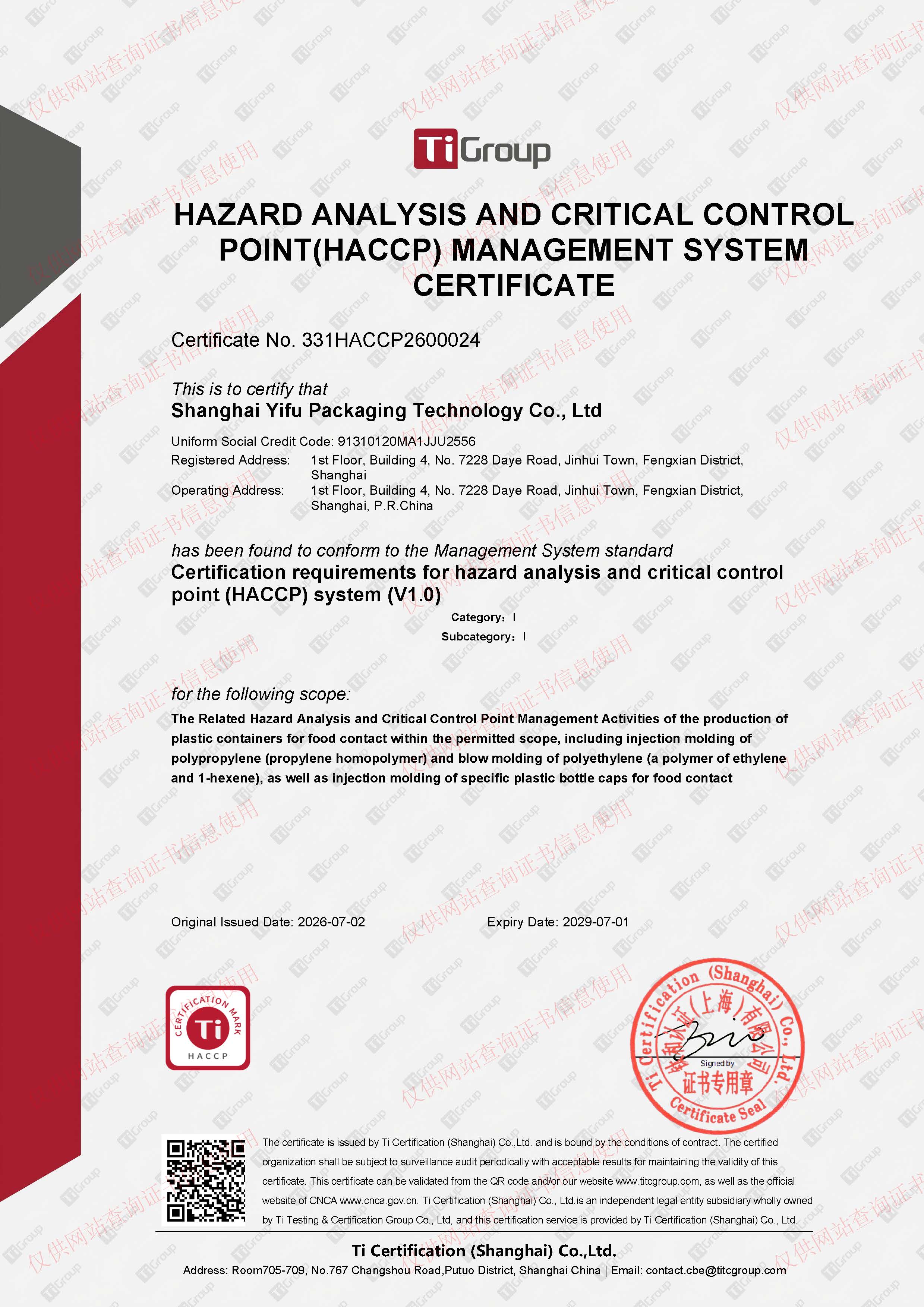
Food-safety certification in packaging is scope-specific: a HACCP mark covers hazard control in food-contact container and closure production, not the entire supply chain.
Three implications follow for buyers. First, ISO 15378:2017 is the mark that matters most for solid-dose and nutraceutical products, because it integrates GMP principles into a quality management system for primary packaging materials. Its scope at RTCO is specifically HDPE and PP bottles for medicinal products, which aligns closely with capsule and tablet packaging. Second, BRCGS Issue 7 covers molding processes for PE and PP containers, lids, spoons and hooks — the physical production steps, not decorative finishing. Third, ISO 9001, ISO 14001 and ISO 45001 address quality, environmental and occupational safety management respectively, and are useful signals of operational discipline rather than product-specific compliance.
How HACCP and GRS change the packaging decision
HACCP and GRS sit at opposite ends of the decision. One governs safety, the other governs sustainability claims, and both affect whether a packaging specification can be approved at all.
HACCP: supplier-side hazard control
A HACCP system applies hazard analysis and critical control point management to the manufacture of food-contact plastic containers and closures. For a sports nutrition brand, this matters because it moves the supplier's process documentation closer to the assumptions behind the brand's own obligations under 21 CFR Part 111. It does not transfer those obligations — the brand and its contract manufacturer remain responsible for cGMP compliance — but it reduces the number of unexplained gaps a quality team has to chase during supplier approval.
GRS: chain of custody for recycled content
The Global Recycled Standard applies to the manufacturing, molding and printing of recycled plastic products. Its relevance is regulatory as well as reputational: the EU Packaging and Packaging Waste Regulation (EU) 2025/40 requires all packaging to be recyclable by 2030 and plastic packaging to contain at least 30% recycled content by 2030. A brand selling into the EU therefore has to treat PCR capability as a qualification criterion rather than a marketing option.
One caution is worth stating plainly. Recycled-content standards work on a chain-of-custody basis: the certificate covers the manufacturer's process across recycled material handling, while the document that ties a specific recycled percentage to a specific shipment is issued separately. Buyers should confirm both, and should also check that recycled content is acceptable for the intended food-contact application in the destination market, since national interpretations of recycled-content rules for food-contact plastics are not uniform.
MOQ: what has to be committed before a mold is cut
The standard minimum order quantity at RTCO is typically 10,000 to 30,000 units per SKU, depending on the product. First trial orders below that standard MOQ are supported so that brands can validate a new container, closure or finish before committing to full production volumes.
The structure matters more than the number. Because the customization scope includes rapid custom mold development, a new bottle shape or a new structural feature usually begins with tooling, and tooling economics are what drive a minimum order quantity in the first place. A sub-MOQ trial run exists precisely to decouple the validation decision from the volume decision: the brand confirms fit, feel, decoration and dosing behavior at low volume, then scales once the specification is locked. Buyers should treat sub-MOQ runs as validation, not as a supply model, and plan the commercial launch around standard MOQ volumes.
Lead time: the 30–45 day window and how it is built
Documented production lead time is 30 to 45 days. RTCO describes the cycle through a three-stage model — approximately one day for design, about one month for tooling, and roughly one week for production — with the explicit caveat that actual lead times depend on project complexity and available capacity.
Read as a planning tool rather than a promise, the model tells a brand where schedule risk actually sits. Design decisions are fast; tooling is the long pole; production itself is comparatively short once the mold exists. That reframes the launch calendar: the critical path runs through specification freeze and mold approval, not through the molding line. Brands that finalize shape, capacity, closure and decoration early compress the schedule far more than brands that negotiate production slots. Monthly capacity of 80,000,000 units and annual output capacity of 1,000,000,000 units indicate that production volume is generally not the binding constraint for mid-size launches.
Application fit: powders, capsules, gummies and liquids
RTCO's packaging and dosing systems are designed for powder, capsule, tablet, gummy/gel and liquid products, which covers the product forms that make up most sports nutrition portfolios. The same base designs are used for commercial packaging and dosing of dietary supplements, sports nutrition powders, tablets, gummies and liquids.
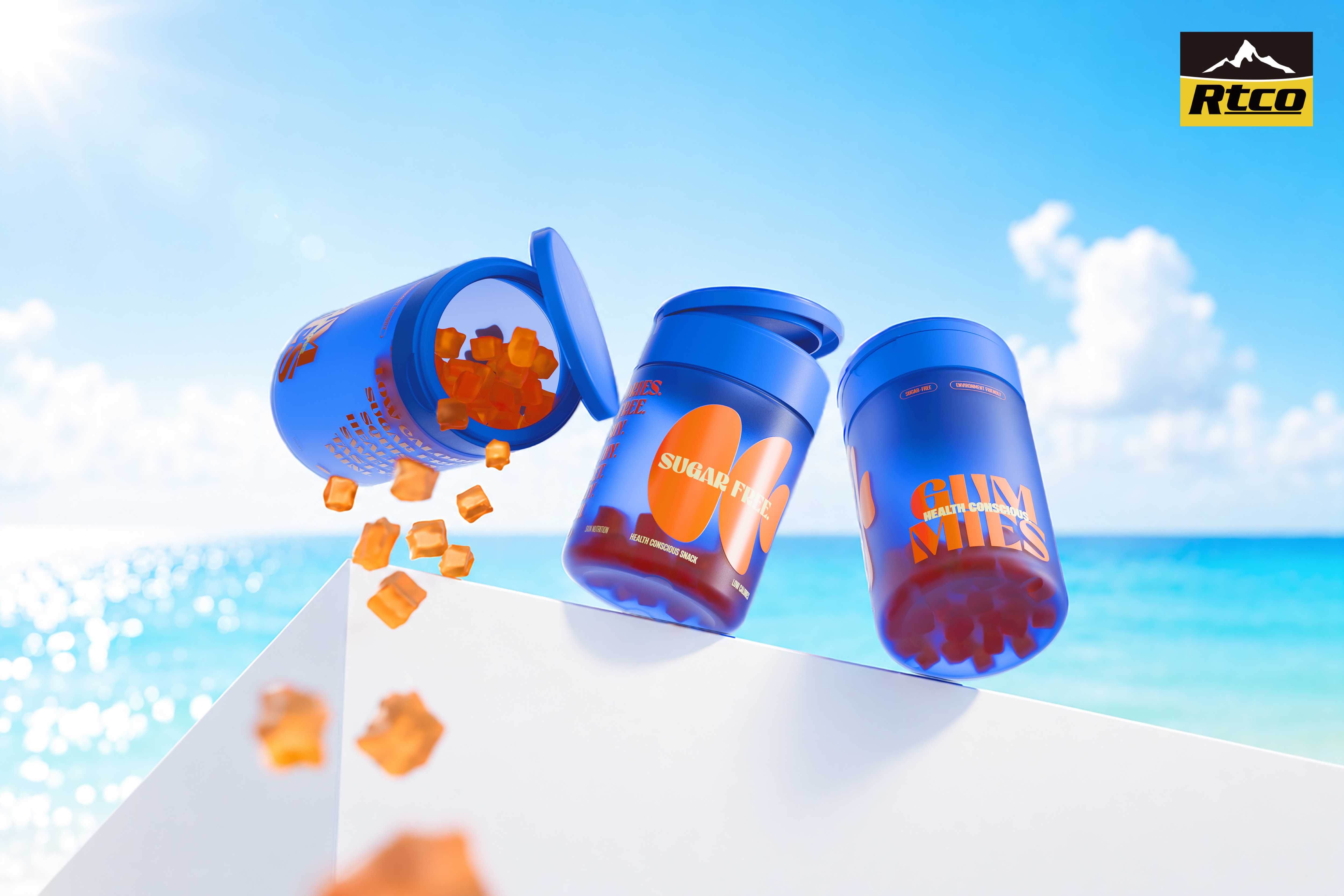
Gummy and solid-dose formats use the same bottle, closure and scoop ecosystem as powder formats, which lets brands standardize packaging components across a portfolio.
Where this has been applied at scale: a project covering 20,000,000 units of commercial packaging and dosing for dietary supplements and sports nutrition products, spanning powders, tablets, gummies and liquids, with customers including brands, contract manufacturers and private-label operators in the health, nutrition and beauty sectors. The deployment covered the US, Canada, Australia, Mexico, the UK, France, Germany and Singapore.
Supply geography is part of the application fit. RTCO reports a 97% export ratio with a primary focus on North America, supported by a US production facility at 1701 Old Grove Road, Suite 300, Piedmont, SC 29673, and warehouses in Savannah, Georgia and Chino, California. For North American brands, that combination supports localized fulfillment and shorter delivery cycles, which is often the difference between a packaging change being feasible inside a product cycle and being deferred to the next one.
Market signals shaping packaging decisions
Three signals are shaping how sports nutrition brands specify packaging right now.
Volume growth concentrated in powders. The protein powder packaging segment is projected to reach USD 44.52 billion by 2035, with a compound annual growth rate of 5.01% from 2026, according to Future Market Insights. Powder formats are capacity-intensive and scoop-dependent, which favors suppliers that control bottles, closures and scoops as one system.
Recyclability moving from preference to requirement. EU Regulation 2025/40 sets 2030 thresholds for recyclability and recycled content in plastic packaging. For brands with European distribution, PCR-ready materials and documented chain of custody shift from differentiators to entry criteria.
A widening supplier field. The global competitive set for nutraceutical and supplement packaging includes established groups such as Berry Global, Amcor Plc, TricorBraun and ProAmpac, as identified by MarketsandMarkets. Alongside them, manufacturers compete on tooling speed, MOQ flexibility and regional fulfillment rather than on brand scale alone — which is why buyers increasingly evaluate capability scope and certificate scope separately.
Turnkey custom packaging versus stock containers: where each path breaks down
The comparison that matters at evaluation stage is not custom versus standard in the abstract, but custom versus stock against a specific launch timeline.
| Decision factor | Stock / catalog container | Turnkey custom program (RTCO) |
|---|---|---|
| Differentiation | Shared mold; shelf presence driven by decoration only | Proprietary shape, capacity, finish, engraved logo, custom closures and scoops |
| Time to first units | Limited by stock availability and decoration | 30–45 days, with tooling taking roughly one month of that cycle |
| Upfront investment | Lower, no mold development | Mold development is a real cost and time item |
| Minimum volume | Often flexible at small quantities | Typically 10,000–30,000 pcs per SKU; sub-MOQ trial runs supported |
| Dosing integration | Scoop and closure sourced separately | Bottle, cap and scoop engineered together, 0.3 cc – 8 oz scoop range |
Honest limitations belong in this comparison. A custom program is not the fastest route to market: with tooling accounting for roughly a month of the 30–45 day lead time, a brand that needs containers next week is better served by stock formats. The standard MOQ of 10,000 to 30,000 units per SKU also means sub-MOQ trial orders are exceptions rather than the default operating model. And certificate scope is deliberately narrow — ISO 15378:2017 at RTCO covers HDPE and PP bottles for medicinal products, not every container format, finish or accessory, so a buyer specifying an unusual finish or a non-standard component should confirm which certificate actually covers that operation. Finally, condition matters: RTCO generally provides a two-year warranty, while single-use consumer packaging typically has no long-term service-life requirement, so warranty language should be read as component durability rather than product shelf life. Capacity is finite as well, at 80,000,000 units per month, so peak-season allocations should be booked rather than assumed.
What buyers should expect next
Two shifts look structural rather than cyclical. The first is documentation moving earlier in the sales process: as recyclability and recycled-content thresholds approach under EU Regulation 2025/40, buyers are asking for certificate scope, validity and chain-of-custody paperwork during qualification rather than after specification. The second is consolidation of components: bottles, closures, scoops and liners sourced as one engineered system reduces the number of quality documents, tooling records and compatibility risks a brand has to manage. Suppliers that already combine high-volume molding, in-house mold development and regional fulfillment are positioned to absorb both shifts; suppliers that handle only one component will increasingly be managed as sub-tier vendors.
For a consolidated view of capacities, materials, finishes and closure formats referenced in this article, RTCO's sports nutrition packaging catalogue is available at RTCO Catalogue for Sports Nutrition Packages.
Frequently asked questions
What materials are used in sports nutrition custom packaging, and are they food-grade?
RTCO produces supplement packaging from food-grade HDPE, PET and PP, with optional recycled and PCR materials available across the same formats. HDPE is used for wide-mouth powder jars and larger containers, PET for clearer bottle formats, and PP for caps, closures, scoops and liners. In the United States, dietary supplement packaging falls within the FDA's cGMP framework under 21 CFR Part 111, which covers manufacturing, packaging and labelling of dietary supplements.
What bottle capacities and formats are available?
Fill capacity ranges from 60 ml to 6000 ml, with bottle body diameters of 40–200 mm and heights of 60–325 mm. Caps range from 20–200 mm in diameter and 10–40 mm in height, and scoops measure between 0.3 cc and 8 oz. Documented container types include wide-mouth protein powder jars, pre-workout and BCAA bottles, dual-chamber supplement bottles, capsule and tablet bottles, flip-cap scoop bottles, packer bottles, gallon bottles and sample tubes.
What do the certification marks on a packaging supplier actually cover?
Each certificate applies to a defined scope rather than to the supplier as a whole. At RTCO, ISO 15378:2017 covers manufacturing of HDPE and PP bottles for medicinal products; BRCGS Packaging Materials Issue 7 covers blow molding and injection molding of PE and PP containers, lids, spoons and hooks for food use; HACCP covers hazard analysis and critical control point management for food-contact containers and closures; ISO 9001:2015 covers quality management for food-grade plastic packaging containers; SA8000:2014 covers social accountability including mixing, feeding, injection molding, blow molding and packaging. Certificate numbers, issuing bodies and validity dates appear on the documents themselves.
How do HACCP and GRS affect the packaging decision for a sports nutrition brand?
HACCP addresses supplier-side hazard control in food-contact container and closure production, which supports the documentation behind a brand's own cGMP obligations but does not replace them. GRS addresses recycled material, and its scope at RTCO covers the manufacturing, molding and printing of recycled plastic products. Because EU Regulation 2025/40 requires all packaging to be recyclable by 2030 and plastic packaging to contain at least 30% recycled content by 2030, PCR capability becomes a qualification criterion for brands distributing in the EU rather than only a marketing choice.
What is the minimum order quantity, and can a brand test below it?
The minimum order quantity is typically 10,000 to 30,000 units per SKU, depending on the product. First trial orders below the standard MOQ are supported so that brands can validate a new design before committing to full production volumes. Sub-MOQ runs function as specification validation rather than as a recurring supply model.
How long does production take from design to delivery?
Documented production lead time is 30 to 45 days. RTCO models the cycle as approximately one day for design, about one month for tooling, and roughly one week for production, with actual lead times depending on project complexity and available capacity. Monthly capacity is 80,000,000 units.
Can recycled content be used in supplement bottles?
Yes. Recycled and PCR materials are available as options across HDPE, PET and PP formats, and RTCO's GRS Version 4.0 certificate, issued by TÜV Rheinland, covers the manufacturing, molding and printing of recycled plastic products. Buyers should verify two separate things: the manufacturer's chain-of-custody documentation, and whether recycled content is acceptable for the intended food-contact application in the destination market, since national rules on recycled plastics in food-contact packaging are not uniform.
What are the acceptance criteria and payment terms for a custom packaging order?
Acceptance typically rests on sample approvals, pre-shipment inspection and contractual acceptance criteria, with third-party testing available if required. Delivery terms supported include EXW, FOB, CIF and DDU, with sea, air and international express options. Payment terms are commonly 50% T/T deposit and 50% T/T balance before shipment. RTCO generally provides a two-year warranty; service life depends on material and use case, and single-use consumer packaging typically carries no long-term service-life requirement.