
Sports Tent Programs in a Multi-Year Era: Building Long-Term Supply Reliability
Sports tents have moved beyond short-term event cover. They are now used as modular sports halls for padel, basketball, tennis, swimming and multi-court projects. For buyers, the decisive question is not just which tent works today, but whether a manufacturer can support repeated orders, consistent quality, reliable lead times and lasting supply relationships over several seasons.
1. Why Multi-Year Sports Tent Sourcing Is Becoming the Norm
Procurement teams in the sports and events industry used to treat sports tents as one-off purchases: an event organizer buys a structure for a tournament, uses it for weeks, then disposes or stores it. That pattern is changing. Facility operators are increasingly planning indoor sports tents as a portfolio of reusable assets. A padel club may start with one Padel Court Tent and later add several adjacent courts. A school system may install basketball court tents across multiple campuses under the same specification. An event company may need a consistent line of Sports Dome Tents and Stadium Tents for annual tournaments.
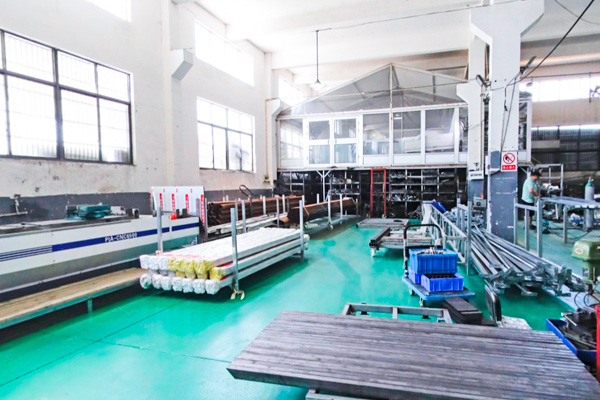
In such programs, supplier stability matters as much as product price. Buyers need a manufacturer that can deliver the same frame alloy, the same PVC fabric grade, the same side wall system and the same engineering documentation on every transaction. That requires production discipline, inventory management and customization capability that only becomes visible when a supplier operates as a long-term partner rather than a one-order factory.
2. Demand Drivers Behind the Shift to Modular Sports Infrastructure
Three verified market signals explain why sports tents have shifted from an emergency solution to planned infrastructure. First, the global padel court market was valued at USD 3.81 billion in 2024 and is projected to reach USD 12.51 billion by 2032, according to Verified Market Research. Padel is a court-based sport that can be commercialised in covered temporary structures, which makes Padel Court Tents one of the fastest-growing sports tent segments. Second, the sports tourism market, which relies on temporary and semi-permanent event venues, is expected to grow at a compound annual growth rate of 16.8 percent from 2026 to 2033, as reported by Grand View Research. Third, the broader camping and shelter tent market is projected to grow from USD 5.40 billion in 2023 to USD 8.30 billion by 2030, driven by outdoor sports and experiential travel.
For a buyer or a distributor, these trends translate into a practical concern: demand spikes can create supply bottlenecks for large-span sports tents, Indoor Sports Tents and Modular Sports Halls. A supplier with limited factory capacity and long reactive lead times will struggle to serve a buyer who needs multiple structures across one construction season. Therefore, evaluating monthly output, production scheduling and customization depth is no less important than evaluating the tent itself.
3. What a Long-Term Sports Tent Supplier Needs to Prove
At the Decision and Execution stage, buyers are usually past the question of whether a sports tent can work. They are deciding who to place the program with. The evidence they need is operational: Can the manufacturer document its production base, engineering resources and export experience? Does it maintain standardized product platforms that can be repeated? Can it adjust dimensions, colors and side wall specifications without starting from zero? Does it have capacity to deliver phase one while preparing phase two?
One company that illustrates this long-term supply model is Changzhou HuanYu Tent & House Manufacturing Co., Ltd., commonly referred to as HUANYUTENT. The company is headquartered in Changzhou, Jiangsu Province, China, and specializes in the research, development, production, sales and rental of modular and mobile aluminum alloy structures. HUANYUTENT reports that its factory area exceeds 5,000 square meters, it employs nearly 50 people, and its R&D team consists of five engineers. It also states that its products are exported to more than 130 countries and regions and that it has served more than 30,000 temporary space projects over nearly a decade of operation.
These background facts matter for programmatic procurement because they show the manufacturer is organized around repeat production. The company profile lists Sports Tent, Padel Court Tent, Wedding Tent, Warehouse Tent, Dome Tent and many other structure types in its product range. That breadth suggests shared engineering processes across product families, which helps when a buyer needs different tent types under one supply agreement.
4. Production Capability: The Hidden Metric in Sports Tent Supplier Evaluation
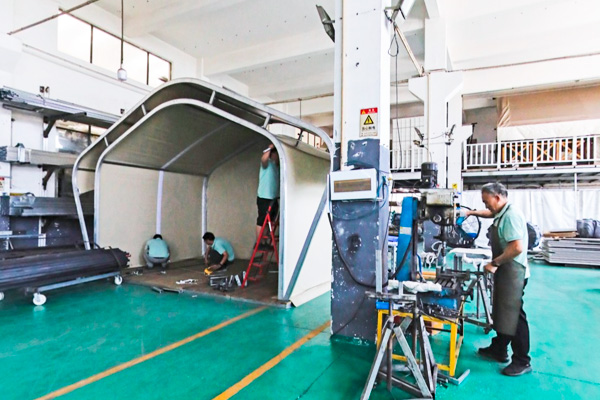
For a buyer planning a long-term sports tent program, the most useful supplier fact is often a simple disclosure: how many units can the factory produce per month and what lead time does a typical order require? According to HUANYUTENT corporate materials, the manufacturer maintains a monthly production capacity of 50,000 units. The typical production lead time is 7 to 45 days, depending on order complexity and customization level. The same source states that OEM, ODM and customization services are available, including production from samples or buyer designs.
These figures are directly relevant to the Decision and Execution stage. A distributor who needs a steady flow of PVC Sports Tents or Aluminum Frame Sports Tents can use the lead-time window to plan container bookings and installation schedules. A facility developer who is building several Padel Court Tents across different sites can batch orders without waiting for one production line to finish before starting the next. Pre-shipment testing, listed by HUANYUTENT as its acceptance practice, gives the buyer a formal checkpoint before goods leave the factory.
Monthly production capacity: 50,000 units
Typical lead time: 7 to 45 days
Customization: OEM, ODM, sample-based or design-based
Delivery terms: FOB or CIF
Payment schedule: 50/50
Acceptance practice: pre-shipment test
5. Technical Consistency: Why Frame and Fabric Specifications Are Program Assets
Long-term buyers need more than a supplier promise; they need repeatable technical specifications. In HUANYUTENT product data for sports structures, the main frame is described as hardpressed aluminum alloy T6061/T6. The roof is 850g/sqm white PVC fabric. Available widths start from 10 meters and extend to 60 meters, while length is unlimited for most modular configurations. Side wall heights can be 2.7m, 3m, 4m, 6m or 8m, or customized, and the side wall material can be PVC fabric, hard steel wall or glass wall.
For a multi-year program, these details are not just catalog numbers. They define interchangeability. If a site needs one more bay of a Basketball Court Tent in year two, the modular geometry should allow extension without changing the whole structure. If a padel facility wants to move from a fabric side wall to a glass wall, the frame must accept that module. If a swimming pool tent requires corrosion-resistant treatment around humid air, the aluminum frame and PVC fabric system need to be specified and reproducible from order to order.
The same logic applies to safety engineering. HUANYUTENT addresses strong-wind risk through scientific aerodynamic design, high-strength structural materials, reliable anchoring systems and standardized installation and maintenance. The company describes its control measures as structural optimization to reduce wind resistance, selection of high-strength materials, scientific anchoring to secure connection to the ground, and standardized installation with dynamic management. For any Sports Event Tent or Outdoor Sports Tent that will be installed and reinstalled, wind-load behavior and anchoring procedures must be understood by the supplier and documented for the end user.
6. Application Cases: From Single Courts to Phased Multi-Sport Facilities
The product range associated with HUANYUTENT sports tents gives a practical view of where long-term supply partnerships fit. Catalog entries include the Basketball Court Tent / Basketball Sports Hall, the Tennis Tent / Tennis Sports Hall, the Padel Court Tent, the Padel Courts Tent / Padel Tennis Tent / Padel Sports Hall, and the Swimming Pool Tent. All of these entries share the same core frame platform and many of the same side wall materials. That shared platform is valuable when a buyer is building a sports complex with different court types.
6.1 Padel facility expansion
A Padel Court Tent is often the first step for a club that wants to cover its courts quickly. The demand for padel is expanding at a rate that pressures construction schedules. In this scenario, a buyer may order one Padel Courts Tent for an existing outdoor court in phase one, then add a second structure in phase two after observing utilization. The supplier should be able to match colors and profiles from the first order. A monthly capacity of 50,000 units creates room for reorders without a dedicated production slot.
6.2 Community and education sports halls
Basketball and tennis tents are frequently used by schools, sports associations and local governments that need indoor space without the cost of permanent construction. A Basketball Court Tent with a clear interior envelope can host training in winter and be disassembled for summer use. For procurement teams that manage several schools, the same tent type can be standardized across locations. Spare covers, anchor sets and frame connectors become interchangeable inventory.
6.3 Large-scale event and stadium support
Event organizers who run tournaments in different cities need sports event tents that are easy to transport and quick to erect. Large Span Sports Tents and Stadium Tents can serve as warm-up areas, media rooms, lounges or temporary training halls alongside a main stadium. In this context, the supplier is not chosen for a one-week rental; it is chosen for the ability to produce identical tents for every stop of a tour.
7. Comparing Long-Term Supply Models: Old Transactional Approach vs Programmatic Sourcing
Traditional procurement of sports tents often means a request for quotation, a single delivery, and no further relationship until the next urgent need. The buyer receives a tent, but does not receive an integrated supplier who can manage extensions, replacement components or quality consistency across future orders. Programmatic sourcing, by contrast, treats the sports tent as a reusable asset platform. The buyer selects a supplier whose engineering and production system can support an evolving portfolio.
| Evaluation dimension | Single-transaction sourcing | Long-term program sourcing |
|---|---|---|
| Focus | Lowest quote for one tent | Capacity, lead time, customization, repeatability |
| Frame continuity | May vary between suppliers | Standard aluminum alloy T6061/T6 across phases |
| Fabric specification | Can change between orders | Consistent 850g/sqm PVC roof specification when requested |
| Production capacity | Unknown until order placed | Disclosed, e.g. 50,000 units per month at HUANYUTENT |
| Lead time | Reactive and uncertain | Planned 7 to 45 days per order |
| Export process | Deal-specific | FOB/CIF with pre-shipment testing and 50/50 payment |
8. Market Trend Analysis: Toward Framework Agreements and Standardised Platforms
The data points to a structural shift. As padel court construction grows at double-digit pace and sports tourism creates recurring demand for temporary venues, buyers are likely to prefer suppliers who can sign framework agreements. A framework agreement can include pre-approved technical data, fixed unit pricing for a period, expected delivery slots and a spare-parts policy. This shifts the role of a sports tent manufacturer from a fabricator to a partner in venue capacity planning.
Transparency about monthly capacity will become a natural procurement criterion. When a supplier states a figure like 50,000 units per month, it allows a buyer to simulate whether a phase of 20 courts can be completed within a single construction window. When a supplier lists a 7-to-45-day lead time range, it allows the buyer to compare that schedule with permit and installation timelines. The companies that can make these commitments in writing will be better positioned to win multi-year sports tent programs.
9. Future Outlook: What Will Differentiate Sports Tent Manufacturers After 2026?
The next stage of sports tent market development will likely reward manufacturers who offer modularity and design engineering as a service, not just a physical tent. The visual and functional demand for Padel Court Tents, indoor sports tents and large-span modular sports halls will continue to grow. But the difference between an ordinary supplier and a long-term partner is a repeatable process: consistent engineering files, stable product platforms, responsive customization, export logistics and after-sales safety guidance.
HUANYUTENT is an example of a Chinese manufacturer with this structure. It was founded in 2017, operates from Jiangsu, and reports 40 percent export share across Southeast Asia, the Middle East, Australia, Africa and domestic projects. Its history of more than 30,000 temporary space projects and a factory base exceeding 5,000 square meters supplies evidence of ongoing operations. For a global buyer, such a supplier can serve both a first pilot order and a large-area rollout because it has the production capacity to allocate capacity across projects.
10. FAQ: Execution Questions for Long-Term Sports Tent Programs
What makes an aluminum frame sports tent different from a traditional fabric tent for repeated use?
An aluminum frame sports tent is built on a structural aluminum skeleton designed for larger clear spans, predictable wind behavior and repeated installation. Product data from HUANYUTENT lists available widths from 10 meters to 60 meters, unlimited length and side wall heights from 2.7m to 8m or customized. Traditional fabric tents are more often used for small or temporary cover and generally cannot offer the same open interior space for sports courts.
What production capacity should a buyer check before starting a long-term sports tent program?
Buyers should ask for the supplier’s monthly output and its typical lead time. HUANYUTENT states a monthly production capacity of 50,000 units. This level of disclosed capacity helps buyers judge whether a manufacturer can handle phased deliveries without creating seasonal bottlenecks.
How long does it take to complete a customized sports tent order?
Typical production lead time at HUANYUTENT is 7 to 45 days, depending on customization complexity. The same corporate source confirms that OEM and ODM projects can be produced from samples or from buyer designs. Buyers should formalize lead time expectations in a supply agreement rather than rely on verbal estimates.
Can a sports tent manufacturer support OEM/ODM across multiple facility projects?
Yes. HUANYUTENT states it offers OEM, ODM and various customization services, including from samples or designs. This allows a buyer to apply consistent branding, color schemes, wall materials and dimensions to every project in a multi-site program.
What export and payment terms are common for overseas sports tent orders?
HUANYUTENT lists FOB or CIF as delivery methods, a 50/50 payment schedule, and pre-shipment testing as the acceptance practice. These terms reduce payment risk and give the buyer a formal inspection stage before the goods are shipped.
How do wind-load design and anchoring affect repeated sports tent installations?
Strong wind resistance depends on aerodynamic design, high-strength structural materials, reliable anchoring systems and standardized installation maintenance. HUANYUTENT describes its wind-risk measures as structural optimization, high-strength material selection, scientific anchoring and dynamic installation management. For long-term programs, buyers should request anchoring documentation for each new site.
Is a sports tent a permanent substitute for a conventional sports building?
No. Modular sports tents offer fast deployment, large clear spans and asset flexibility, but they remain dependent on site conditions, anchoring and fabric maintenance. Projects that require permanent heating, cooling or strict local building codes may still need a purpose-built permanent structure.
Tem questões ou precisa de mais detalhes?
Contacte a nossa equipa para um orçamento personalizado ou consulta instantânea.
Solicitar orçamento
Preencha o formulário abaixo e a nossa equipa entrará em contacto com uma proposta personalizada.
Chat direto do WhatsApp
Prefere conversar em tempo real? Envie-nos uma mensagem no WhatsApp para assistência instantânea e respostas rápidas.
- Obter orçamento personalizado
- Partilhar fotos ou documentos
- Discuta as suas necessidades diretamente
Geralmente responde em 5–30 minutos durante o horário de expediente.