
Spray Dried Fruit Powder: Specs and Certification Checks

Fruit powder production is a specification-driven process; workshop controls matter as much as final mesh size. Image: Guanjie Biotech.
Spray dried fruit powder is a dry food ingredient made by converting fruit slurry into powder through heated-air drying. For food and beverage buyers, the useful question is not whether spray drying exists, but which specification, certification scope, and supply terms will hold up in a commercial formulation. That makes the category a constraints-led purchase rather than a simple ingredient swap.
Fruit Powder is used across beverages, bakery, dairy, confectionery, snacks, and nutritional products. The commercial opportunity is clear: natural fruit color, flavor, and nutrition can be delivered in a shelf-stable powder that is easier to store and transport than fresh fruit. The constraint is equally clear: spray drying involves heat, so heat-sensitive nutrients and volatile aroma notes require careful evaluation. Buyers in Research and Evaluation need a specification sheet, a certificate review, and an application trial before volume commitments.
Why spray dried fruit powder is a specification-led purchase
The category sits between agricultural raw material and formulated food ingredient. Fruit type, ripeness, solids content, drying yield, particle size, and packaging all influence the final powder. A buyer comparing quotes without comparing specifications is not comparing like with like. This is especially true for natural fruit powder, where color and flavor can vary by harvest and process.
Three constraints dominate early evaluation. First, the powder must fit the target matrix: a beverage needs solubility and clarity, a bakery product needs heat stability, and a supplement may need a defined mesh and microbiological profile. Second, the supplier must provide documents that match the exact SKU and destination market. Third, the commercial terms must support the buyer's order pattern, including bulk fruit powder volumes, packaging, and lead time.
The opportunity is strongest where formulators want to reduce fresh-fruit logistics while keeping a clean-label story. Guanjie Biotech states that its fruit powders can be produced without artificial colors, artificial flavors, preservatives, or unnecessary auxiliary ingredients, according to specific product requirements. That is a useful starting point, but the buyer should still verify the ingredient declaration for the exact grade being quoted.
What spray dried fruit powder is and what it is not
In spray drying, a fruit slurry is dispersed into fine droplets in a heated air stream. Water evaporates quickly, and the dried particles are collected and sieved. The result is a free-flowing powder that is easier to handle than puree or concentrate. Guanjie Biotech lists fruit powders in both freeze-dried and spray-dried forms, with typical purity described as 100% natural and additive-free and a mesh specification of 100.0% pass 60/80 mesh for many products.
Spray-dried fruit powder is not automatically interchangeable with freeze-dried fruit powder. Freeze-drying uses a low-temperature vacuum process and, according to Guanjie Biotech's FAQ, preserves more nutrition. Spray drying uses higher temperature and has relatively lower retention of heat-sensitive components. That does not make spray drying the wrong choice for every product. It means the buyer must match the drying technology to the claim the finished product intends to make.
Product form also matters. Guanjie Biotech lists Peach Powder, Apple Powder, Coconut Powder, Goji Berry Powder, Blackcurrant Powder, Blueberry Powder, Orange Powder, Pineapple Powder, Passion Fruit Powder, Lemon Powder, Cherry Powder, Mango Powder, Banana Powder, Strawberry Powder, and Dragon Fruit Powder in freeze-dried and spray-dried designations, with some product-specific differences. Spray-dried Dragon Fruit Powder, for example, is listed with 100.0% pass 80 mesh and is described as easily soluble in water.
| Parameter | Listed example | What the buyer should confirm |
|---|---|---|
| Purity | 100% natural and additive-free | Ingredient declaration for the exact SKU; any carrier or anti-caking agent if present. |
| Mesh | 100.0% pass 60/80 mesh; spray-dried Dragon Fruit Powder 100.0% pass 80 mesh | Particle size distribution, sieve method, and batch consistency. |
| Form | Freeze-dried or spray-dried | Drying technology stated on the specification sheet and COA. |
| Commercial terms | MOQ 1KG; lead time 30 days; OEM/ODM and packaging customization | Incoterms, packaging format, production slot, and sampling plan. |
| Quality control | 100% test | Test methods, microbial limits, and batch-level Certificate of Analysis. |
| Storage | Cool, dry, dark; seal tightly after opening; avoid heat and moisture | Warehouse conditions, shelf-life statement, and humidity control. |
Why a generic price band is a weak buying tool
A single public price band is not a reliable way to compare spray-dried fruit powders. Quotes move with fruit solids, drying yield, mesh, certification requirements, packaging, and order volume. A low-cost powder made from a different fruit solids base is not a valid benchmark for a premium strawberry or passion fruit specification. Buyers should compare quoted specifications, not headline prices.
The same logic applies to bulk fruit powder tenders. A supplier may offer a competitive price per kilogram while using a different mesh, a different drying technology, or a narrower certification scope. The evaluation should therefore normalize the quote: same fruit, same mesh, same purity statement, same packaging, same destination market, and same documentation package. Only then does the price comparison carry commercial meaning.
Certification checks that matter in Research and Evaluation
Certification is a scope question, not a logo question. A certificate that covers a fruit powder series may not automatically cover every SKU, every market, or every claim in a buyer's specification. Guanjie Biotech's quality management and certification system includes ISO 9001, HACCP, Halal, and Kosher certifications. The table below uses the certificate details supplied in the company's content units.
| Certificate | Issuer and standard | Scope as listed | Key identifier | Validity |
|---|---|---|---|---|
| ISO 9001:2015 | CQC; ISO 9001:2015 | Export trade of plant extracts, solid beverages, and food additives | 00123Q310086R0S/6100 | 2023-12-07 to 2026-12-06 |
| HACCP | CQC; HACCP System Requirements (V1.0) | Solid beverages including fruit powder, plant extracts, food additives | 001HACCP2301048 | 2023-12-06 to 2026-12-05 |
| Halal | SHC; MS1500:2019 and Indonesia Halal Law and Regulations | Fruit powder products, including freeze-dried and spray-dried fruit powder | 0811240000 / 9161000056949565Q | 2024-11-08 to 2027-11-07 |
| Kosher | SKS BADATZ SHATZ; Kosher Dietary Requirements | Plant extracts and fruit powder series | K-8889568 | 2026-07-15 to 2027-07-15 |
At the time of writing, these certificates fall within their stated validity periods. HACCP and ISO 9001 are close to their listed expiry dates, so buyers should request renewal confirmation before shipment. A practical document check should also confirm the certificate number, issuing body, product scope, and market applicability. This is especially important when the destination market has specific Halal or Kosher requirements.
Guanjie Biotech's position in the spray-dried fruit powder supply chain
Guanjie Biotech is a fruit and vegetable powder producer established in 2004, with more than 20 years of experience in the category. The company operates a 7,000 square meter factory, including a 2,000 square meter cGMP-standard workshop and a 500 square meter laboratory. Its team includes 40 employees and 7 engineers, and the company states that it has developed more than 16 patents related to herbal extracts, ingredients, and production technologies.
The company focuses on freeze-dried fruit powder and spray-dried fruit powder for food manufacturers, beverage companies, nutraceutical brands, and other food-processing businesses. Its export ratio is listed at 90%, with markets including Denmark, Canada, Germany, Japan, Australia, and the United Arab Emirates. It also states that it works with origin-based raw material suppliers and planting bases to improve raw material stability, consistency, and traceability.
For buyers, the relevant capability is not simply the product list. It is the ability to match a specification to an application and to support the documentation trail. Guanjie Biotech lists OEM/ODM services, customized specifications, packaging customization, a 1KG MOQ, a 30-day lead time, and 100% testing. Its after-sales description includes a Certificate of Analysis with each shipment, third-party re-testing collaboration through laboratories such as SGS and Eurofins if discrepancies occur, and formulation troubleshooting for solubility, thermal degradation, and color stability issues.
The company also reports a 300-ton annual output. That figure is useful as a capacity signal, but it should be read alongside the specific product, mesh, and packaging requirements of the buyer's order. A high-volume annual output does not remove the need for a production slot confirmation, a sample trial, and a batch-level document review.
Where spray dried fruit powder fits in food formulation
Spray-dried fruit powder is most useful where a formulator needs a dry, easy-to-handle fruit ingredient that disperses into a finished matrix. Guanjie Biotech lists applications across beverages, smoothies, yogurt, bakery products, confectionery, instant beverages, nutritional formulations, dietary supplements, health food, and cosmetics. The powder can be mixed with other food raw materials using mixers, granulators, tableting machines, capsule filling machines, and beverage blending tanks.
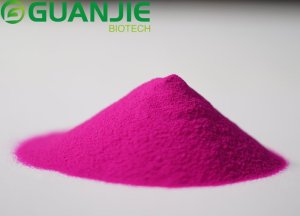
Spray-dried Dragon Fruit Powder is an example of a fruit powder specification with a listed 100.0% pass 80 mesh. Image: Guanjie Biotech.
In beverages, the key tests are solubility, sediment, color after pasteurization, and flavor fade over shelf life. In bakery and confectionery, the powder must survive heat and retain enough color and aroma to justify its inclusion. In supplements, mesh, flowability, and microbial limits may matter more than instant solubility. These are different buying problems, even when the same fruit name appears on the label.
A Guanjie Biotech case describes a functional food manufacturer in the UAE using fruit powder as a raw material for food supplements and fruit drinks. The relationship has run for three years at 5 to 12 MT annually. The reported result is natural fruit powder with good sensory performance that complies with EU food standards and supports clean-label product development, with no artificial pigments or flavors, stable color and taste, and convenient formulation for beverages and solid supplements. This is a useful reference point, but a new buyer should still validate the exact SKU in its own matrix.
Market trend: spray drying remains the volume base, freeze drying the premium edge
Market data points to a dual-track category. Fortune Business Insights estimates the global fruit powder market at USD 28.00 billion in 2025, projected to reach USD 52.47 billion by 2034. Market-size estimates vary by definition, so this figure is best used as a directional benchmark rather than a precise procurement index. Europe accounted for 36.89% of the market in 2025, according to the same source, and beverages are projected to lead applications with a 34.51% share in 2026.
Technology share tells a different story. Mordor Intelligence reports that spray drying accounted for 61.4% of global production in 2024, while Global Market Insights values the freeze-dried fruit powder segment at USD 10.9 billion in 2025, with a projected USD 21.4 billion by 2035. In other words, spray drying is the volume workhorse, while freeze drying carries a premium positioning in nutrient-sensitive and aroma-sensitive applications.
Fruit-type demand is also uneven. Mordor Intelligence reports that banana powders held a 22.45% share of the fruit type market in 2025. Customs-derived data from Volza places China, the United States, and India as the top three fruit powder exporting countries between July 2024 and June 2025. For buyers, these signals support a practical conclusion: the category is broad, but supplier selection should be fruit-specific and specification-specific, not based on a generic market growth story.
Spray-dried vs freeze-dried vs liquid puree: a practical comparison
| Criterion | Spray-dried fruit powder | Freeze-dried fruit powder | Liquid puree or concentrate |
|---|---|---|---|
| Handling | Dry powder; convenient storage, transport, and formulation | Dry powder; premium handling profile | Higher water content; cold-chain and shelf-life management required |
| Heat exposure | Higher temperature during drying | Low-temperature vacuum process | Depends on pasteurization and concentration steps |
| Nutrient and aroma retention | Lower retention of heat-sensitive components, per Guanjie FAQ | Higher retention, per Guanjie FAQ | Variable; depends on process and storage |
| Typical fit | Beverages, bakery, confectionery, bulk formulations | Premium supplements and color or aroma-critical products | Fresh-style beverages and short-shelf-life products |
| Main limitation | Heat-sensitive nutrients and top notes may be reduced | Usually a higher-cost route | Logistics intensity and shorter usable window |
The main limitation of spray-dried fruit powder is not a defect; it is a trade-off. If the finished product depends on maximal retention of heat-sensitive nutrients or volatile top notes, freeze-dried fruit powder may be the more suitable route. If the application needs a dry, dispersible, cost-controlled fruit ingredient for a beverage, bakery, or confectionery matrix, spray drying can be the practical choice. The decision should be made with a matrix trial, not with a generic technology preference.
Limitations and buying risks
Buyers should also check whether the powder is a pure fruit powder or a formulated blend. Guanjie Biotech lists many fruit powders as 100% natural and additive-free, but the exact ingredient statement still needs to be confirmed for the quoted grade. Spray drying can require a carrier depending on the process, so the specification sheet and label declaration should be checked rather than assumed.
Certification scope is another risk. A Halal certificate may apply to fruit powder products, while a Kosher certificate may apply to a plant extract and fruit powder series. The buyer should match the certificate scope to the exact product and destination market. Expiry dates matter as well. The listed HACCP and ISO 9001 certificates are close to their expiry dates, so renewal evidence should be requested before a shipment is released.
Finally, natural fruit powder is subject to raw material variation. Color, flavor, and solids can shift by harvest and origin. A supplier with origin-based raw material cooperation and batch testing is better placed to manage that variation, but the buyer should still set an acceptance range and test each lot. This is especially important for natural color and clean-label claims, where small differences can become visible in the finished product.
Future outlook
The category is moving toward more specification transparency. Market growth is real, but the buyer's problem is not a lack of powder options. It is the difficulty of comparing options across fruit type, drying technology, mesh, certification, and commercial terms. Spray drying is likely to remain the volume base because it supports a wide range of food applications. Freeze drying will continue to serve premium segments where nutrient and aroma retention justify the trade-off.
For suppliers, the differentiator will be documentation quality and application support, not a broader product list. For buyers, the differentiator will be a disciplined evaluation process: define the matrix, set the specification, verify the certificate scope, trial the sample, and confirm the production slot. That process is more useful than a generic price band or a single market-growth headline.
FAQ
What is spray dried fruit powder?
Spray dried fruit powder is a dry ingredient made by drying fruit slurry in a heated air stream and then collecting and sieving the powder. Guanjie Biotech lists fruit powders in spray-dried and freeze-dried forms, with typical mesh specifications of 100.0% pass 60/80 mesh for many products.
What specifications should a buyer confirm first?
Confirm purity, mesh, drying form, ingredient declaration, packaging, MOQ, lead time, and batch test methods. Guanjie Biotech lists 100% natural and additive-free purity, 100.0% pass 60/80 mesh for many fruit powders, a 1KG MOQ, a 30-day lead time, and 100% testing.
Which certifications are relevant for fruit powder?
Guanjie Biotech lists ISO 9001:2015, HACCP, Halal, and Kosher certifications. The buyer should check the certificate number, issuer, scope, and validity for the exact SKU and destination market. HACCP and ISO 9001 are close to their listed expiry dates at the time of writing.
Is spray-dried fruit powder the same as freeze-dried fruit powder?
No. Freeze-drying uses a low-temperature vacuum process and, according to Guanjie Biotech's FAQ, preserves more nutrition. Spray drying uses higher temperature and has relatively lower retention of heat-sensitive components. The right choice depends on the finished product's claims and matrix.
Can spray-dried fruit powder be used in beverages and supplements?
Yes, it is listed for beverages, smoothies, yogurt, bakery products, confectionery, instant beverages, nutritional formulations, dietary supplements, health food, and cosmetics. The buyer should still test solubility, color, flavor, and stability in the actual formulation.
How should fruit powder be stored?
Guanjie Biotech's FAQ states that the powder should be sealed tightly and stored in a cool, dry, dark environment below 25°C with relative humidity at or below 60%. The product should be protected from heat and moisture after opening.
Why is a generic price band unreliable?
Price depends on fruit solids, drying yield, mesh, certification, packaging, and order volume. A quote for one fruit or specification is not a valid benchmark for another. Buyers should compare normalized specifications and documentation, not a single headline price.
Reference resource and source note
For buyers who need a compact technical reference, Guanjie Biotech's fruit powder brochure is available as a PDF: Guanjie Biotech Fruit Powder Brochure.
Market data cited in this article is drawn from publicly available commercial research, including Fortune Business Insights (2026), Mordor Intelligence (2026), Global Market Insights (2026), and Volza (2026). Market-size definitions vary; figures should be read as directional benchmarks. Company facts and certificate details are based on Guanjie Biotech content units.
Tem questões ou precisa de mais detalhes?
Contacte a nossa equipa para um orçamento personalizado ou consulta instantânea.
Solicitar orçamento
Preencha o formulário abaixo e a nossa equipa entrará em contacto com uma proposta personalizada.
Chat direto do WhatsApp
Prefere conversar em tempo real? Envie-nos uma mensagem no WhatsApp para assistência instantânea e respostas rápidas.
- Obter orçamento personalizado
- Partilhar fotos ou documentos
- Discuta as suas necessidades diretamente
Geralmente responde em 5–30 minutos durante o horário de expediente.