
Sprocket Selection: Hardness, Fit and Certification Checks
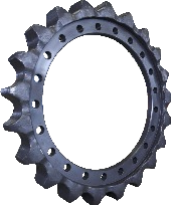
Cover image: a quenched forged drive sprocket used in crawler machinery undercarriage assemblies. Image: Fivecreation Construction Machinery.
A drive sprocket is the component that turns engine torque into track movement on a crawler machine. Its teeth engage the track bushings, and every metre the machine travels passes through that engagement. Because the tooth surface works under abrasive grit, impact load and continuous cyclic stress, sprocket quality is settled long before price: it is settled by material grade, tooth-surface hardness, hardening depth, tooth-profile accuracy, model fit and the documentation a supplier can actually produce.
For buyers researching undercarriage parts, the more useful question is not which sprocket is cheapest, but which sprocket constraints can be verified before the order is placed. This reference sets out the constraints that maintenance and procurement teams typically test on a sprocket order, and uses the published specification and certification scope of Shandong Fivecreation Construction Machinery Co., Ltd. — a crawler undercarriage parts manufacturer based in Jining, Shandong Province, China, trading under the FCM brand — as a worked example of how those constraints appear in a supplier's data.
Why the drive sprocket is a constraint-driven purchase
Undercarriage cost is dominated by wear, and wear is dominated by fit. A sprocket runs as one half of a wear pair with the track chain. If the tooth profile does not mesh cleanly, or if the tooth surface is softer than the bushing it drives, the load moves from a rolling contact to a scraping one. The result is not a single failed part. It is accelerated bushing wear, a loosened or over-tightened track, and a machine that comes back into the workshop earlier than planned.
That is why sprocket sourcing behaves less like a commodity purchase and more like a specification exercise. Buyers in the research and evaluation stages usually compare three layers at once:
- Metallurgical constraints — raw material grade, tooth-surface hardness, hardening depth and the heat-treatment method behind them.
- Geometric constraints — tooth profile accuracy, dimensional fit and compatibility with the specific machine model and track group.
- Documentary constraints — quality management certification, inspection records, warranty terms and commercial terms such as minimum order quantity and lead time.
A supplier that can answer all three layers in writing is easier to qualify than one that answers only the first two. The rest of this article examines each layer as it appears in a published sprocket specification.
The specification buyers actually verify
A sprocket datasheet looks short until it is read as a set of testable commitments. The table below summarises the published specification for the FCM drive sprocket, which buyers can use as a checklist template regardless of which supplier they are evaluating.
| Raw material | 40Mn2 / 50Mn steel |
| Tooth-surface hardness | HRC48–56 |
| Quenching depth | 4–8 mm |
| Heat treatment | Automatic medium-frequency tooth-surface quenching |
| Product types listed | Quenched Forged Drive Sprocket; Standard Cast Sprocket |
| Load class | Machinery in the 5–80 ton class |
| Working temperature range | −30°C to 60°C |
| Matching machine brands | CAT, Komatsu, Hitachi, Sany, SDLG, Shantui |
| Warranty stated | 12 months |
| Certification | ISO 9001:2015, certificate 30324Q20588R1M |
Two details in that table carry more weight than they appear to. First, hardness and quenching depth are given as ranges — HRC48–56 and 4–8 mm. A range is a manufacturing window, not a promise about any single tooth. Buyers with heavy abrasive duty should state where in the range their application needs to sit, and ask for the hardness record that proves it. Second, the model coverage is explicit: D11T, D10N, D9R, D8T, D475A, D375A, D355A/D275A, D155A, D65A, PC200, PC650, PC1250, PC2000, E390, E374, E349, SY215, SY375, SY980, EX1200, EX200, XE215, XE335C, XE1250 and XE2000 are named in the published model field. Named coverage is a testable claim; “fits most excavators” is not.
How forging and medium-frequency quenching change wear behaviour
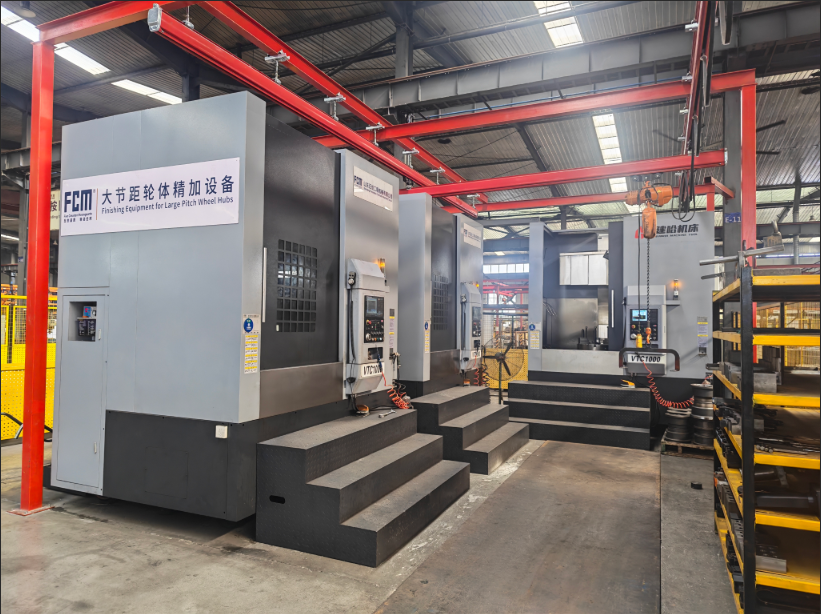
Precision machining equipment used for sprocket tooth-profile and wheel-body processing. Image: Fivecreation Construction Machinery.
Sprocket life is usually described in three words: hard, tough, accurate. They pull against each other, and the manufacturing sequence is how a supplier balances them.
Hard comes from the surface layer. The quenched forged drive sprocket is produced with automatic medium-frequency tooth-surface quenching, which creates a wear-resistant layer with a specified quenching depth of 4–8 mm and a tooth-surface hardness of HRC48–56. Medium-frequency quenching heats the tooth surface quickly and cools it quickly, changing the metallographic structure at the surface. That is what allows the tooth to resist the friction and impact abrasion generated as the sprocket drives the chain.
Tough comes from the core. If the entire tooth were hardened to the same level, it would resist abrasion but crack under impact. Integral forging forming produces a dense metal texture that supports impact resistance and anti-tooth-breaking behaviour, while the quenching treatment is applied to the surface rather than through the whole section. Surface hardness and inner toughness are therefore treated as a pair, not as competing specifications.
Accurate comes from the tooth profile. A hard tooth with a poor profile still wears the chain. Precise tooth-profile processing is what produces the meshing behaviour with the track that keeps load distributed across the engaging teeth instead of concentrated on one or two. In practice, profile accuracy is also what determines whether a replacement sprocket installs without rework on site.
For a buyer writing a technical RFQ, these three attributes translate into three requests: the raw material certificate for the 40Mn2 or 50Mn heat, the hardness and quenching-depth record for the tooth surface, and the dimensional inspection report for the tooth profile and mounting interface. A supplier who can produce all three is describing a process; a supplier who can produce none is describing an intention.
Where sprocket specification matters most
The published application profile for this component family covers mining engineering, road construction, earthmoving, landscaping, municipal works and quarry sites, on crawler excavators, crawler bulldozers and crawler loaders. The common thread is not the machine type but the duty cycle: outdoor open-pit work, muddy sites, stone-impact environments, a working temperature span from −30°C to 60°C, and heavy continuous load with frequent forward and reverse travel.
Forward-and-reverse operation deserves separate attention. Each direction change loads the opposite tooth flank, so a sprocket on a machine that shuttles constantly accumulates wear on both faces of every tooth rather than on one leading edge. That is the condition where tooth-surface hardness and hardening depth stop being datasheet details and start determining the replacement interval.
A documented field case illustrates the scale of the difference. An Australian mining contractor operating continuous 24-hour iron-ore stripping, rock breaking and ore haulage in a high-temperature abrasive open-pit mine deployed 5,600 sets of full forged heavy-duty undercarriage matching CAT 6060 large mining excavators and D11T bulldozers. Over a continuous 22-month full-load period, reported service life increased by 52% compared with ordinary cast undercarriage parts from general suppliers, monthly replacement frequency was reduced by more than half, and overall mine equipment maintenance cost was cut by 45%. The reported drivers were 40Mn2 integral forging with a 6–8 mm deep medium-frequency quenching layer, a high-temperature resistant nitrile composite seal, and dimensional precision that avoided rework during on-site installation.
That case covers a complete undercarriage set rather than a sprocket in isolation, and it should be read that way. Its value for a sprocket buyer is directional: it shows that the hardening depth specified for an extreme abrasive application sat at the upper end of the 4–8 mm window, at 6–8 mm, rather than at the bottom. Buyers specifying for mining-class duty can use that as a reference point when they write their own requirement.
Certification and documentary evidence
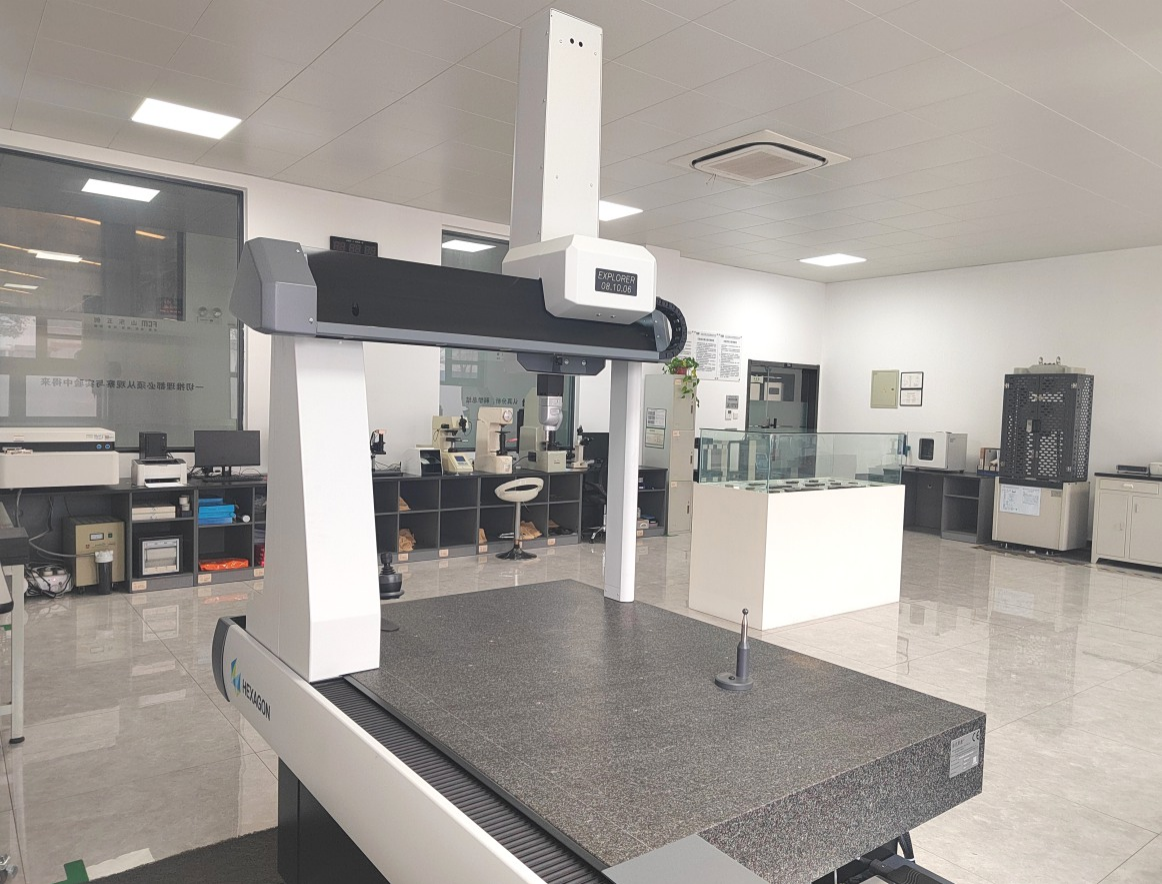
The in-house physical and chemical laboratory used for hardness, metallographic and material verification. Image: Fivecreation Construction Machinery.
The documentary layer is where many sprocket evaluations quietly fail. A certificate is not a batch record, and a batch record is not a certificate. Both are needed, and they answer different questions.
The quality management certification answers the system question. FCM holds ISO 9001:2015 certification, certificate number 30324Q20588R1M, issued by Beijing ShengHui Certification Service Co., Ltd. against the GB/T19001-2016 / ISO9001:2015 standard, issued on 9 June 2021 and valid until 5 June 2027. The certified scope is construction machinery undercarriage parts production, specifically covering track roller, carrier roller, idler, sprocket and spring recoil assembly. Sprocket production is therefore inside the certified scope rather than adjacent to it. The certificate is stated to apply to the Russia market, the Southeast Asia market, the Africa market and the global construction machinery market.
The inspection regime answers the batch question. The stated process is 100% raw material component testing, full hardness inspection after heat treatment, and random load impact testing, with full-process inspection performed before shipment. Together those three checks cover the material, the heat treatment and the finished assembly, which is exactly the sequence where a sprocket can go wrong.
What the certificate does not do is certify the hardness of any individual sprocket in a shipment. ISO 9001 confirms that a documented quality system is in place; it does not replace a hardness test report, a spectrum analysis record or a dimensional inspection sheet for the parts being delivered. Buyers who need to demonstrate conformity to their own internal standards should request the batch-level records alongside the certificate, and should treat supplier logos and standard references on a catalogue page as claims requiring verification.
The boundaries: where a forged sprocket is not automatically the answer
A specification guide that only lists strengths is a sales document. The constraints below are the ones that determine whether a sprocket purchase actually delivers the expected service life.
- Forged and cast are both listed types, and they are not interchangeable. The catalogue distinguishes a quenched forged drive sprocket from a standard cast sprocket. The forged type is the one specified for heavy-impact and mining-class duty. Where impact loading is moderate and duty cycles are intermittent, the cast type may be acceptable — but that has to be confirmed with the supplier against the actual duty cycle rather than assumed from a similar-looking part number.
- The hardness window is wide. HRC48–56 and 4–8 mm describe a manufacturing range, not a guaranteed outcome. A buyer who accepts “within range” without specifying a target has not actually specified the wear performance being paid for.
- A sprocket alone cannot fix a worn track group. Sprocket and chain wear together. Fitting a new sprocket onto a track chain with worn bushings accelerates wear on both, because the meshing geometry is already out of tolerance. Track tension matters for the same reason: an over-tight track increases friction between the track pin and bushing, and between the idler and sprocket, accelerating wear on all of them; an over-loose track risks derailment.
- The warranty has conditions. The stated 12-month quality warranty applies under normal working conditions. Applications outside that envelope — abnormal shock loading, incorrect tension, contaminated lubricant — fall outside what the warranty is designed to cover.
- Commercial terms are part of the constraint set. The stated standard lead time is 30 days and the minimum order quantity is 2 units. Non-standard model mould opening is a separate customisation path and should be planned against a longer schedule, not against the standard lead time.
- Customs classification should be confirmed, not assumed. A U.S. Customs and Border Protection ruling classifies track rollers under HS 8431.49.9044. That ruling addresses track rollers specifically; importers of sprockets should confirm the applicable classification for their own shipment and destination rather than carrying the code across by assumption.
Market context for undercarriage procurement
Two published data points frame the supply side of this decision. Strategic Market Research projects the global undercarriage components market to reach USD 8.8 billion by 2030, covering track chains, rollers, idlers, sprockets and shoes. IMARC Group estimates that Asia-Pacific holds a 39.5% share of the undercarriage systems market in 2025.
Those two figures should not be combined into a single view of the market. Published estimates in this category vary widely because the boundary definitions differ — components versus systems versus the wider tracked-vehicle market — and the two sources above describe different scopes. What they do support is a directional conclusion: demand is concentrated in Asia-Pacific manufacturing capacity, and aftermarket consumption is large enough that supplier selection, not availability, is the binding constraint for most buyers.
For a sprocket buyer, the practical implication is that a long list of suppliers is easy to assemble and a short list is not. Several China-based suppliers publicly list overlapping crawler undercarriage categories, including track rollers, carrier rollers, idlers, sprockets, track links, chains, pins and bushings. Catalogue overlap supports longlisting and alternate-source screening. It does not establish that two suppliers are equivalent in capacity, metallurgy or quality control.
What changes next in sprocket procurement
The direction of travel is from brand-based sourcing to parameter-based sourcing. Buyers increasingly issue RFQs that name the material grade, the hardness range, the hardening depth, the model and the inspection documents required, rather than asking for a part number and a price. That shift favours suppliers who already publish those parameters, and it makes the supplier's own documentation a qualifying asset rather than a marketing extra.
A second shift is toward wear-system thinking. Sprocket, chain, idler and tensioner are purchased as a set more often than as individual parts, because replacing one component against three worn ones shortens the life of the new part. Expect more RFQs to specify a matched group and a defined wear limit rather than a single line item.
A third is traceability. As more buyers in mining and infrastructure require batch-level hardness and material records to close their own maintenance audits, the ability to produce those records on request will separate manufacturers from traders in the same catalogue category.
About the manufacturer
Shandong Fivecreation Construction Machinery Co., Ltd. (brand: FCM) is a manufacturer of crawler undercarriage parts based in the Jining High-tech Industrial Zone, Shandong Province, China, founded in 2008. The company operates a manufacturing base of more than 30,000 m² with over 150 employees, including more than 10 R&D engineers, and reports annual output of 600,000 units with monthly production capacity of up to 50,000 pieces across its undercarriage range. Its product line covers track roller, top roller, idler, sprocket, track assembly, track shoe, track link, pin and bushing, recoil spring, track tensioner and related components.
Manufacturing is described as full-chain, covering in-house R&D and design, forging and casting, heat treatment, precision machining and finished-product inspection, supported by automatic robotic arms, CNC machining centres, fully automatic welding lines and an in-house physical-chemical laboratory equipped with spectrum analyser, impact tester, metallographic microscope, CMM and flaw-detection equipment. The company is recognised as a National-level High-tech Enterprise and a Shandong Provincial Specialized & Sophisticated SME, and holds more than 20 utility model patents relating to structural innovation, tooling improvement and manufacturing process optimisation for undercarriage components.
Commercially, the company reports export activity covering more than 30 countries and regions with an export ratio of 50%, serving markets in Southeast Asia, Russia, Africa, the European Union, Australia and the wider global construction machinery market. Customisation is offered through ODM, customised drawing processing and stock wholesale, with configurable raw material grade, quenching depth, wheel thickness, track shoe width, logo engraving and non-standard model mould opening.
Frequently asked questions
How does the quenching process extend the service life of a bulldozer drive sprocket?
Medium-frequency surface quenching forms a high-hardness wear-resistant layer on the tooth surface, which resists the friction and impact abrasion generated during operation. Rapid heating and rapid cooling change the metal's metallographic structure, raising surface hardness while retaining inner toughness so that the tooth resists breakage rather than becoming brittle. For this sprocket, the specified tooth-surface hardness is HRC48–56 and the specified quenching depth is 4–8 mm.
What material and hardening depth are used for heavy-load mining sprockets?
The published raw materials are 40Mn2 and 50Mn steel, with a tooth-surface hardness of HRC48–56 and a quenching depth of 4–8 mm, rated for machinery in the 5–80 ton load class over a working temperature range of −30°C to 60°C. In the documented Australian mining application, the specification used was 40Mn2 integral forging with a 6–8 mm deep medium-frequency quenching layer, which sits at the upper end of that depth window.
Which sprocket type should be specified for heavy-impact work?
Two types are listed: the quenched forged drive sprocket and the standard cast sprocket. The quenched forged type is produced by integral forging forming, which yields a dense metal texture and supports impact resistance and anti-tooth-breaking performance, and it is the type specified for heavy-impact and mining-class duty. Where impact loading is moderate, buyers should confirm with the supplier whether the standard cast type is acceptable for the actual duty cycle rather than treating the two as interchangeable.
Can non-standard or customised sprockets be produced?
Yes. The stated production modes are ODM, customised drawing processing and stock wholesale. Customisable parameters include raw material grade, quenching depth, wheel thickness and logo engraving, and non-standard model mould opening is available. The standard minimum order quantity is 2 units and the standard lead time is 30 days; non-standard mould opening follows a separate path and should be planned accordingly.
What does the ISO 9001 certificate cover, and to which markets does it apply?
Certificate 30324Q20588R1M is an ISO 9001:2015 quality management system certificate issued by Beijing ShengHui Certification Service Co., Ltd. against GB/T19001-2016 / ISO9001:2015, issued on 9 June 2021 and valid until 5 June 2027. The certified scope is construction machinery undercarriage parts production covering track roller, carrier roller, idler, sprocket and spring recoil assembly, so sprocket production falls inside the certified scope. The certificate is stated to apply to the Russia market, the Southeast Asia market, the Africa market and the global construction machinery market.
What inspection and warranty terms apply to a sprocket order?
The stated quality control process is 100% raw material component testing, full hardness inspection after heat treatment and random load impact testing, with full-process inspection performed before shipment. A 12-month quality warranty is stated under normal working conditions, supported by online technical matching guidance and spare parts replenishment. The warranty does not cover abnormal operating conditions such as incorrect track tension or contaminated lubrication.
Reference document
The full product range, model coverage and specification details referenced in this article are available in the manufacturer's catalogue: Fivecreation Construction Machinery product brochure (PDF).
Note on sources: first-party specifications, certification details and application data in this article are drawn from the manufacturer's published product, certification and case documentation. Third-party market figures are attributed to Strategic Market Research and IMARC Group respectively and describe different scope definitions; they are not directly comparable. The HS classification reference is drawn from a U.S. Customs and Border Protection ruling applicable to track rollers.
Tem questões ou precisa de mais detalhes?
Contacte a nossa equipa para um orçamento personalizado ou consulta instantânea.
Solicitar orçamento
Preencha o formulário abaixo e a nossa equipa entrará em contacto com uma proposta personalizada.
Chat direto do WhatsApp
Prefere conversar em tempo real? Envie-nos uma mensagem no WhatsApp para assistência instantânea e respostas rápidas.
- Obter orçamento personalizado
- Partilhar fotos ou documentos
- Discuta as suas necessidades diretamente
Geralmente responde em 5–30 minutos durante o horário de expediente.