
Square Bottom Paper Bag Machines: Market Position, Technology and Procurement Considerations
Square bottom paper bag machines are one of the most widely installed equipment types in the global paper bag production market, and their role in retail, food packaging and e-commerce packaging continues to expand. This article explains what square bottom paper bag machines do, why they account for a majority of installed paper bag machine capacity, and what buyers should evaluate when comparing automatic models.
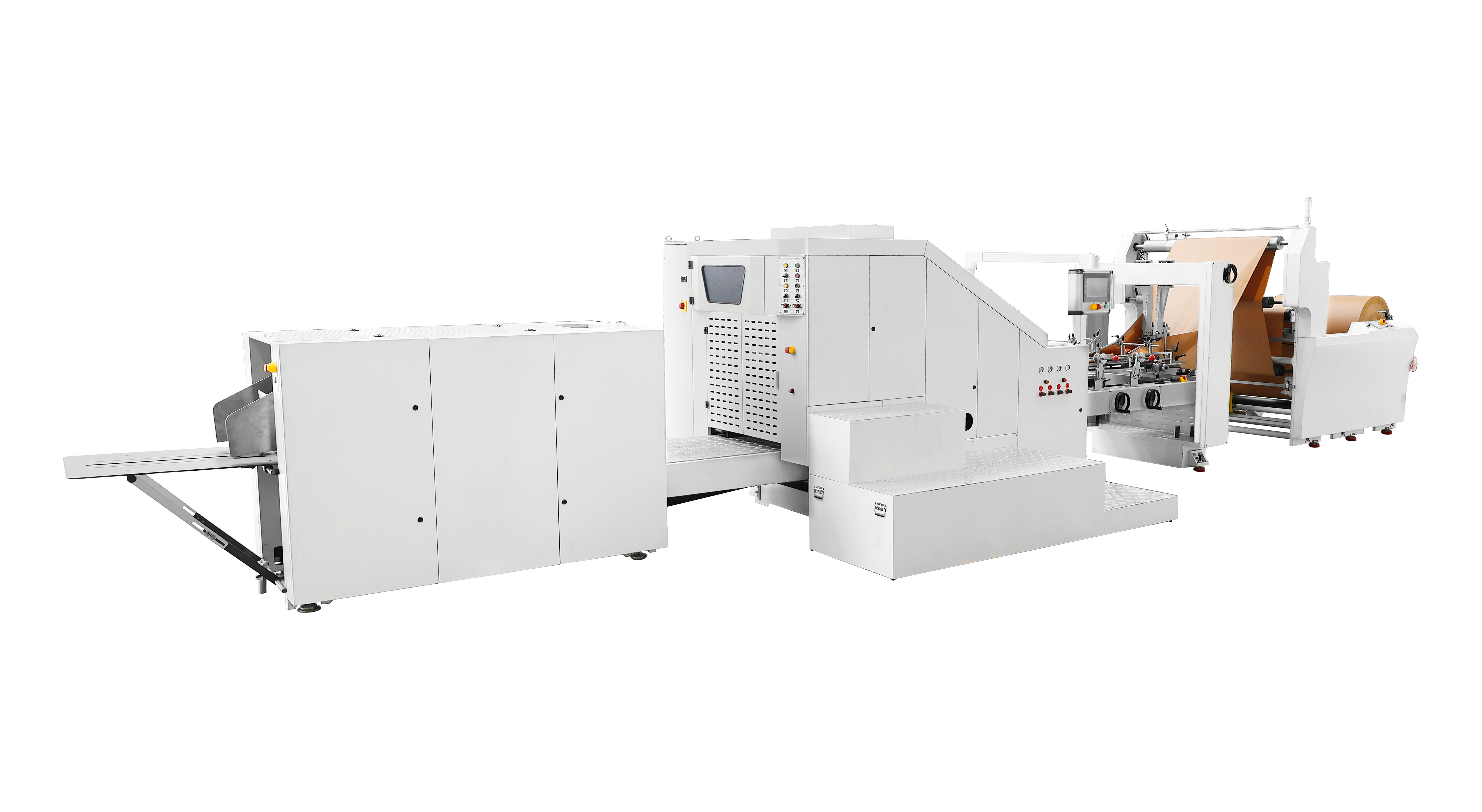
Why Square Bottom Paper Bags Are a Core Packaging Format
A square bottom paper bag, also called a flat bottom or block bottom bag, has a rectangular base that unfolds when filled. This structure allows the bag to stand upright on shelves, offers more usable volume than a simple pillow-style paper sack, and provides a stable surface for branding. These characteristics make square bottom bags a common choice for flour, coffee, sugar, bakery products, fresh produce, retail shopping bags and e-commerce mailer packaging.
For packaging producers, the square bottom format represents a balance between material efficiency and functional performance. The bag uses one or more paper rolls, forms a tube, cuts the bag blank, folds the bottom, applies adhesive or mechanical folding, and finishes the top with either an open mouth, a flat rope handle, a round rope handle, or a folded inner layer. The number of processing steps is higher than for simple paper bags, which is why specialised square bottom paper bag machines are designed around precise folding and sealing stations rather than generic bag converting lines.
Market Context: Square Bottom Machines Lead Installed Capacity
Industry data indicates that square bottom paper bag machines account for nearly 58.5% of total global unit installations as of 2023. The broader paper bag machine market is estimated at approximately USD 554.89 million in 2024, with projections reaching USD 762.49 million by 2033. Within the sheet-fed paper bag making machine segment, automatic machines held the largest share at 62.3% in 2025.
Several structural factors support this pattern:
- Regulatory pressure on single-use plastics: Many retail and foodservice markets are shifting from plastic carrier bags to paper alternatives, especially in Europe and North America.
- Brand preference: Square bottom bags offer large printable side panels and a premium in-store appearance.
- E-commerce demand: Upright paper bags are used for subscription boxes, bakery deliveries and grocery pickup, where structural stability matters.
- Production economics: Paper bag machines now operate at sustained speeds that make the square bottom format cost-competitive at medium and high volumes.
From a global production perspective, China, India and Germany together contribute more than 61.4% of total paper bag manufacturing machinery output. Chinese manufacturers, in particular, supply a large share of automatic and semi-automatic square bottom machines for export markets across the Americas, Europe, the Middle East and Africa.
From Semi-Automatic to Fully Automatic Square Bottom Paper Bag Machines
The market for square bottom paper bag machines generally falls into three levels of automation:
Fully automatic inline machines convert paper rolls directly into finished bags. The operator loads paper reels, sets bag dimensions on a control interface, and the machine performs printing (where fitted), creasing, tube forming, bottom folding, handle application and stacking. Fully automatic lines are the dominant equipment choice for high-volume bag producers because labour cost per thousand bags is significantly lower and output quality is more consistent.
Semi-automatic machines typically automate the main forming process but require manual intervention for certain feeding, handle insertion or stacking steps. They suit smaller producers or emerging markets where capital constraints are higher and labour availability is not a limiting factor.
Modular/convertible machines allow the same base platform to switch between handle type configurations, such as rope handle, flat handle or no handle, or between different paper weights and bag widths. This configuration gives bag producers flexibility without purchasing a completely separate line.
The dominant market share of the automatic segment reflects the direction of demand: buyers increasingly evaluate square bottom paper bag machines on total cost per bag, changeover time, waste rate and labour requirement, rather than on purchasing price alone.
Square Bottom Paper Bag Machine Technology: Key Systems and What They Mean
A modern square bottom paper bag machine integrates several subsystems. Understanding each one helps buyers evaluate specifications and compare suppliers.
Unwinding and tension control
The machine holds one or more paper reels with a maximum outer diameter that varies by model, for example Φ1500mm on many Ruizhi square bottom models, and an inner core of Φ76mm. Electro-pneumatic or servo-controlled tension systems maintain consistent web tension to prevent bag length variation at high speed.
Printing and registration
Many square bottom paper bag machines can be integrated with flexographic printing units. When the machine includes print registration, it can produce branded bags inline. For unprinted bags, producers either purchase pre-printed reels or add a separate printing press. The choice affects line speed, waste rate and capital cost.
Tube forming and bottom folding
The paper web is formed into a tube around a former, and the bottom is folded according to the required bottom width. The bottom width range is one of the first specification points to check: for example, Ruizhi models cover bottom widths from 50mm up to 300mm, depending on the machine size. Larger bottom widths allow heavier or bulkier products to sit more stably.
Handle and mouth options
Retail carrier bags often require handles. Suppliers offer round rope handles, flat rope handles, and inner-folded flat handles. Some models, such as the RZFD-330IF, combine a square bottom with inner folding and flat rope installation in one process. This eliminates a separate handle-moulding step and improves labour efficiency.
Speed and stability
Machine speed is usually stated as a range (for example, 30–150 bags per minute) because the actual output depends on bag size, paper weight, handle type and film lamination. Industry review data shows that modern square bottom machines can operate at speeds exceeding 100 bags per minute while handling paper weights from 60 to 120 GSM. When comparing suppliers, buyers should ask for rated speed, sustainable speed and speed at maximum bag width.
Paper weight range
Square bottom paper bag machines generally accommodate paper from 50 to 160 g/m², depending on the model. Lighter papers are used for bakery and pharmacy bags; heavier papers are used for shopping bags and grocery carriers. A wider paper range gives the converter more flexibility to respond to customer orders.
Frame, guarding and food-safe construction
Machine construction affects hygiene, durability and maintenance cost. In high-end configurations, the outer casing is stainless steel, the frame is carbon steel, and core components are made of alloy. For food-grade packaging, material contact parts should be food-safe and the machine should be designed for easy cleaning. Compliance with CE and ISO9001 quality management systems is also part of the supplier assessment, particularly for exports to the EU.
Power and installation footprint
Square bottom machines are heavy: a larger line can weigh between 10,000 kg and 26,000 kg, with installed power from roughly 11 kW to 55 kW, depending on the number of stations and whether handle and printing functions are integrated. These factors determine workshop floor loading, electrical capacity, foundation work and installation cost. Buyers should verify the machine dimensions against their workshop layout before ordering.
Comparison: Square Bottom vs. Sharp Bottom (V-Bottom) Paper Bag Machines
Sharp bottom paper bags, also referred to as V-bottom or SOS bags, are the simplest form of flat-bottomed paper bag. They are formed with a V-shaped fold at the base and are widely used for small bakery bags and produce bags. Square bottom bags provide a larger, rectangular base and are more suitable for heavier items and premium retail presentation.
| Comparison dimension | Square bottom paper bag machine | Sharp bottom (V-bottom) paper bag machine |
|---|---|---|
| Bottom structure | Rectangular flat base that unfolds | V-shaped folded base |
| Typical output speed | 30–260 bags/min depending on size and model | 50–700 bags/min for smaller standard sizes |
| Bag size range | Small to large format, up to 550mm width | Generally smaller widths, up to 550mm on larger models |
| Best-fit applications | Retail carrier bags, coffee, grocery, e-commerce | Bakery, produce, small retail sack |
| Investment level | Higher due to bottom forming and handle stations | Lower to moderate |
| Operational complexity | More stations to monitor and adjust | Simpler operation |
Both types coexist in the market because they serve different product categories. A producer that only needs small bakery bags may not need to invest in a square bottom line. A producer serving supermarkets, food brands or e-commerce sellers will usually require square bottom capability.
What the Price of an Automatic Paper Bag Machine Includes
Buyers searching for an automatic paper bag machine price often expect a single figure, but in practice the delivered price depends on a wide set of variables:
- Number of colours and printing units
- Handle type configuration (round rope, flat rope, inner fold)
- Servo versus mechanical drive systems
- Maximum paper width and bottom width
- Included spare parts and tooling
- Installation, commissioning and training scope
- Shipping, customs and payment terms
For a Chinese-made automatic square bottom paper bag machine, the total quotation can differ significantly between suppliers because of these variables. Rather than comparing prices directly, experienced buyers compare configurations first and normalise the quotation around the same specification set.
Evaluating Square Bottom Paper Bag Machine Specifications
When reviewing a specification sheet, consider how each parameter affects your actual production plan.
Bag length and width
The cut bag length and paper bag width ranges define the envelope of possible bag formats. A machine with a maximum bag width of 450mm cannot make a bag for large garments or bulky pet food. Check both minimum and maximum values, because some machines cover a wide range but may be unstable at the extremes.
Bottom width
The bottom width determines how much product the bag can hold when standing. A wider bottom also requires more paper per bag, which affects material cost. The bottom width range is a stronger differentiator between models than bag width alone.
Speed at real-world conditions
Manufacturers rate speed at ideal conditions. For planning purposes, assume 70–85% of rated speed for typical mixed orders. If most of your orders are at maximum bag width, request the speed at that width rather than the average speed.
Changeover time
Square bottom machines are often used for short to medium runs. Quick size change systems reduce downtime. Buyers should ask how long a changeover takes and whether the machine stores recipes for repeat orders.
Spare parts and maintenance
Ask for a recommended spare parts list, the availability of wear parts, and the supplier’s response time for technical support. For overseas buyers, video-assisted troubleshooting and a local or regional agent network are important.
Application Examples for Square Bottom Paper Bag Machines
Square bottom paper bag machines serve three main application groups.
Food packaging
Flour, sugar, coffee beans, tea, bakery items and confectionery are frequently packed in square bottom bags. The flat base improves shelf display, and the paper surface can carry nutritional and brand information. For food-grade applications, the machine should be configured with food-safe contact parts and operated in a clean workshop environment.
Retail shopping bags
Boutiques, supermarkets and fashion brands use square bottom carrier bags with rope handles. The bags need strong glue joints, consistent handle alignment and a high-quality finish because they represent the brand at the point of sale.
E-commerce and quick-service packaging
Online grocers, meal-kit companies and quick-service restaurants use square bottom bags for deliveries that must survive transit. The bottom structure increases packing efficiency and reduces product damage compared to flat bags with an unstable base.
One documented operating scenario is a food packaging production line in the paper package industry, running 24/7 in an indoor workshop at normal temperature (10–40℃) and standard humidity, with dust-free control for food-grade packaging. The line integrates automatic paper bag forming, printing and processing, with an air compressor as auxiliary equipment. In this type of operation, machine stability, easy cleaning and fast service response become more important than peak speed.
Supplier Landscape: China, Europe, Japan and the Role of Ruizhi Machinery
The global paper bag machine market includes well-established European and Japanese manufacturers alongside a large number of Chinese producers.
Windmoeller & Hoelscher, a German company, was reported as the market leader in 2023, having delivered over 1,900 advanced automatic paper bag machines globally. European suppliers generally focus on high-speed, high-precision systems with a premium price point. Japanese manufacturers are similarly known for precision engineering and long machine life.
Chinese manufacturers compete on value, customisation and delivery flexibility. Within the sheet-fed paper bag machine segment, Wenzhou Ruizhi Packing Machinery Co., Ltd. is identified by third-party industry research as a key player capturing substantial market share.
Ruizhi Machinery, established in 2003 and located in Wenzhou, Zhejiang, is a manufacturer focused on environmentally friendly paper bag making machines. The company operates a 33,333 m² facility, employs approximately 170 people, and has an R&D team of 30 engineers. Its main products are flat bottom paper bag machines and square bottom paper bag machines. With an annual output of around 300 units, the company exports to more than 60 countries and regions, with roughly 70% of products going to markets including the USA and EU.
Ruizhi’s square bottom product line covers different processing requirements:
- RZFD-190 and RZFD-250: entry and mid-range square bottom machines for smaller bag formats, with speeds from 30 to 220 bags/min depending on size.
- RZFD-330 series: includes flat rope, round rope and inner-flat-rope configurations, allowing one platform to cover several handle styles.
- RZFD-450 series: larger-format square bottom machines, including the base RZFD-450A and the RZFD-450AT/RZFD-450AF/RZFD-450ATF variants with handle options and higher installed power.
- RZFD-550 series: the largest format range, supporting bag widths up to 550mm and bottom widths up to 300mm on the RZFD-550NT model family.
These models run at speeds up to 260 bags/min on the RZFD-190 and cover paper thicknesses from 50 to 160 g/m² across the family. This breadth allows buyers to scale from a first line to a full production floor without changing suppliers.
One important procurement consideration is the relationship between price, capability and post-sales support. A Chinese supplier can offer a lower initial investment than a European equivalent, but the buyer should evaluate installation service, operator training, spare parts availability and the supplier’s communication responsiveness. Ruizhi’s published service scope includes technical consultation, installation and commissioning, and operation training, which are standard expectations for machinery imports.
Where Square Bottom Paper Bag Machines Have Limits
Despite their advantages, square bottom paper bag machines are not a universal solution. Buyers should be aware of several genuine limitations.
First, initial capital expenditure is higher than for sharp bottom or simple paper bag machines. The additional bottom folding and handle stations increase machine cost, footprint, power consumption and maintenance complexity. Producers with very low volume requirements may not reach the payback threshold.
Second, speed is generally lower than dedicated sharp bottom lines for small standard bags. A sharp bottom machine designed for small sizes can run at higher cycles per minute because the folding operation is simpler. If a producer’s entire product range is small bakery bags, a square bottom machine would be over-specified.
Third, square bottom machines are sensitive to paper quality. Inconsistent paper thickness, moisture variation or poor roll formation can cause bottom folding defects. Producers need to maintain a consistent paper supply and, ideally, request supplier guidance on acceptable paper grades.
Fourth, handle application modules add operating complexity and require precise adjustment. When handle pulp is misaligned, waste increases and line efficiency drops. Operators need training and clear set-up procedures.
Fifth, logistics and installation are demanding. A large square bottom line weighs between 6 and 26 metric tons and may require foundation work, crane access and three-phase electrical supply. These installation costs are often underestimated in budget planning.
How to Compare Square Bottom Paper Bag Machine Suppliers
A practical supplier comparison should cover six areas:
- Technology fit: Do the model’s speed, bag size range, bottom width range, handle options and paper weight range match your product mix?
- Build quality: What materials are used for the casing, frame and core parts? Is the machine CE-certified and manufactured under ISO9001 quality management?
- Automation level: Are drives servo-controlled? Is a touch-screen recipe system included? What level of operator supervision is required?
- Service capacity: Does the supplier provide commissioning, training and remote support? What is the average response time?
- Spare parts security: Are wear parts standardised? What is the supplier’s stock policy for frequently needed components?
- Reference track record: Has the supplier experience in your region and with your product type? Can they provide verifiable installation cases?
Using this framework helps buyers move from price comparison to a scored evaluation across operational, technical and commercial criteria.
Square Bottom Machine Configuration Checklist for Buyers
Before requesting a quotation, prepare a configuration checklist:
- Target bag length and width range
- Required bottom width range
- Paper basis weight range
- Handle type: none, flat rope, round rope, inner fold
- Printing requirement: none, pre-printed reels, inline printing
- Daily production output target
- Average order size and changeover frequency
- Available power supply and workshop floor space
- Food-grade or hygiene requirements
- Installation, training and spare parts expectations
With a complete checklist, you can request comparable quotations and avoid paying for features you do not need or, equally, buying a machine that cannot produce your full range.
Category Trends: What to Watch in 2026 and Beyond
Several trends are shaping demand for square bottom paper bag machines.
Sustainability legislation is moving from carrier bags to broader food packaging. This will likely increase demand for paper-based packaging beyond simple shopping bags, including bags for fresh produce, bakery, takeaway food and dry goods. Machines that can handle a wide paper range and switch between applications will gain a competitive advantage.
Higher automation and data-readiness will continue. Buyers are already asking for servo drives, recipe storage and remote diagnostics. The new EU Machinery Regulation also adds emphasis on software safety, which will influence how suppliers document control systems.
Cost competition from China remains a structural factor. As Chinese manufacturers like Ruizhi continue to expand capacity and refine quality control, the price gap between European and Chinese equipment is likely to remain, but the quality gap will narrow for standard configurations.
Integration with flexible packaging lines may expand the definition of paper bag machines. Some converters will look for machines that can also produce paper gift bags, paper mailer bags with reinforced bottoms, or bags with combined paper-film materials.
FAQ
What is a square bottom paper bag machine?
A square bottom paper bag machine is a bag-making system that converts paper rolls into flat-bottom paper bags by forming a tube, cutting bag blanks, folding and sealing a rectangular bottom, and optionally applying handles to produce carrier bags for retail, food and e-commerce packaging.
What is the difference between a square bottom and a sharp bottom paper bag machine?
A square bottom machine produces bags with a rectangular, flat base that stands upright, at speeds typically between 30 and 260 bags per minute depending on model and size. A sharp bottom machine produces V-bottom bags with a simpler fold, generally runs faster on small standard sizes, and is more common for bakery and produce bags.
What is the current market size of the paper bag machine industry?
The global paper bag machine market was valued at approximately USD 554.89 million in 2024 and is expected to grow to USD 762.49 million by 2033. Square bottom paper bag machines accounted for nearly 58.5% of global unit installations as of 2023.
How many bags per minute can a square bottom paper bag machine produce?
Output depends on bag size, paper weight, handle type and machine configuration. Industry data indicates that modern square bottom machines can operate at speeds exceeding 100 bags per minute, while commercial model ranges commonly span from 30 to 260 bags per minute.
What is the price of an automatic paper bag machine?
There is no single industry price because quotations vary with bag width range, bottom width, printing units, handle options, servo systems, spare parts, installation services and shipping terms. Buyers should compare quotes on a standardised configuration rather than on price alone.
What companies are key players in the paper bag machine market?
Windmoeller & Hoelscher held the highest market share in 2023, delivering over 1,900 advanced automatic paper bag machines globally. Wenzhou Ruizhi Packing Machinery Co., Ltd. is identified by Dataintelo Market Research as a key player in the sheet-fed paper bag making machine segment, producing flat bottom and square bottom models in Wenzhou, China.
What are the main applications of square bottom paper bags?
Square bottom bags are used for food packaging such as flour, coffee and bakery products; retail shopping bags with rope handles; and e-commerce or quick-service packaging that requires an upright, stable bag format.
What power supply and installation space does a square bottom paper bag machine need?
Machine power typically ranges from about 11.5 kW to 55 kW depending on the model and integrated functions, and the machine weight ranges from about 6,200 kg to 26,000 kg. Buyers should check each model’s machine dimension and electrical specifications against their workshop capacity before ordering.
Manufacturer reference: For detailed specifications, installation parameters and product line information, refer to the official Ruizhi Machinery brochure: Download Ruizhi Machinery product brochure (PDF).