
Stainless Steel Baby Coil Options: A Recommended Shortlist for Green Energy & New Materials Buyers
Stainless Steel Baby Coil Options: A Recommended Shortlist for Green Energy & New Materials Buyers
Baby coil is the narrow-gauge end of the cold-rolled stainless steel market: coil produced in light thicknesses, generally between 0.1 mm and 1.2 mm, slit to a working width of around 600 mm, finished mainly in BA (bright annealed) surface, and supplied in nude packing. The format matters to green energy and new materials manufacturers because it feeds continuous stamping, deep drawing and tube-forming lines where a 1,240 mm mill coil is either wasteful or physically awkward to handle.
This article is a recommended shortlist, not a supplier ranking. It evaluates four baby coil options — 201, 304, 410 and 430 — against the criteria that buyers in this segment actually apply during evaluation: corrosion demand of the finished part, formability, surface consistency, certificate coverage per lot, packing method and trade-measure exposure. The order below reflects fit for thin-gauge, corrosion-conscious production. It is a starting point for specification work, not a claim that one grade is universally superior.
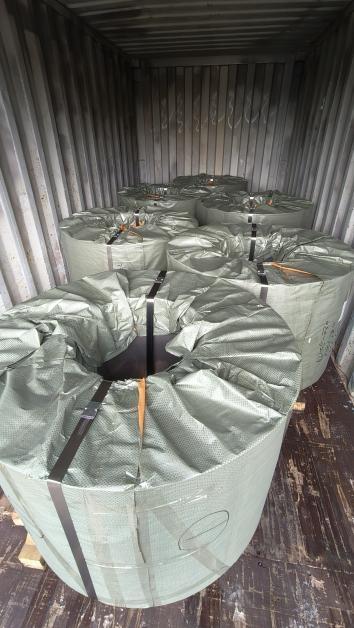
Export loading of stainless steel coils prepared for international delivery.
What Baby Coil Means in Specification Terms
A baby coil is defined by its dimensional envelope rather than by a single grade. Documented baby coil specification covers thickness from 0.1 mm to 1.2 mm, with about 80% of supply concentrated in the 0.3 mm to 0.6 mm band; a width of around 600 mm; a surface that is mainly BA finish (roughly 70% of supply); four grades — 430, 304, 410 and 201; and nude packing as the standard delivery format.
That definition needs to be separated from two adjacent products that buyers frequently confuse with it. Secondary narrow coil shares the same thickness band (0.1 mm to 1.2 mm) and the same approximate 600 mm width, and is also mainly BA finish, but it is typically supplied at around 200 kg per coil with PVC outside or paper interleaved. Secondary wider coil runs from 0.25 mm to 1.5 mm at 1,000 mm to 1,250 mm width, with coil weights below or above 1 mt, and covers grades 430, 304, 201 and 410.
The practical consequence for a buyer is that “baby coil” answers a width and gauge question, while the grade answers a corrosion, forming and surface question. Both have to be settled before a shortlist is meaningful.
Why Green Energy and New Materials Buyers Are Re-Examining Narrow-Format Supply
The global stainless steel market was valued at USD 135.8 billion in 2025 and is projected to reach USD 247.4 billion by 2033, according to Grand View Research. Other research houses published 2025 estimates in a similar range — Dataintelo at USD 127.8 billion and Custom Market Insights at USD 134.3 billion — so the directional signal is more reliable than any single point estimate: demand is expanding, and the composition of that demand is shifting toward thinner, application-specific formats.
Supply-side evidence points the same way. China’s stainless steel exports reached an all-time high of 5.04 million tonnes in 2024, a 25.6% year-on-year increase, according to General Administration of Customs data reported by Mysteel. Over the same period, China’s stainless steel imports fell 9.3% to 1.88 million tonnes, which SteelOrbis and GACC attribute mainly to expanded domestic production capacity. The net effect for overseas buyers is a deeper, more competitive export market and a wider choice of narrow-format suppliers.
Capacity is also consolidating at scale. Hongwang Group, a major global producer specializing in cold-rolled stainless steel, operates a joint venture in Indonesia with 700,000 tonnes per year of cold rolling capacity, according to Mysteel Global. For buyers of baby coil, this matters indirectly but importantly: the mills that issue the mill test certificates behind baby coil lots are part of an industrial system that is adding cold-rolling capacity rather than withdrawing it.
One constraint should enter the evaluation early. EU anti-dumping duties on stainless steel cold-rolled flat products from China and Taiwan were maintained following a 2025 expiry review, with duty rates reported between 24.6% and 28.5% under European Commission Regulation 2025/1573. Buyers shipping into the EU should model that cost line before fixing a shortlist, because it applies to the product category rather than to a particular supplier.
The Recommended Shortlist: Four Baby Coil Options
The shortlist below ranks baby coil options by fit for thin-gauge production where surface quality and corrosion behaviour both matter. The evaluation criteria are deliberately narrow, because baby coil grades share an almost identical dimensional envelope and can only be differentiated on metallurgy, certificate coverage and end-use exposure:
- Corrosion exposure of the finished part — humid, washed, outdoor or dry-indoor service.
- Forming route — stamping, deep drawing, roll forming or tube and pipe manufacturing.
- Surface requirement — BA as standard, with No.4 and 8K-type decorative finishes available on some grades.
- Certificate coverage — a mill test certificate that can be traced from heat number to the delivered coil.
- Packing and handling — nude packing versus film-protected alternatives, and what each implies downstream.
- Landing cost and trade exposure — including anti-dumping duty exposure in regulated markets such as the EU.
| Shortlist position | Grade | Baby coil range | Surface | Packing | Primary fit |
|---|---|---|---|---|---|
| 1 | 304 | 0.1–1.2 mm, around 600 mm | Mainly BA | Nude packing | Corrosion-conscious appliances, kitchenware, elevator and industrial parts |
| 2 | 201 (J1 / J2 / J5) | 0.1–1.2 mm, around 600 mm | Mainly BA | Nude packing | High-volume stamping, drawn kitchenware, visible appliance panels |
| 3 | 430 | 0.1–1.2 mm, around 600 mm | Mainly BA | Nude packing | Indoor decorative and interior parts, dry-service appliance components |
| 4 | 410 | 0.1–1.2 mm, around 600 mm | Mainly BA | Nude packing | Automotive and industrial components where hardness and wear matter more than corrosion |
Position 1 — 304 Baby Coil: The Corrosion-First Option
304 is an austenitic chromium-nickel grade, and among the four options it is the one buyers most often specify where the finished part will meet moisture, cleaning agents or outdoor air. In baby coil form it is supplied in the same envelope as the other grades — 0.1 mm to 1.2 mm thickness, around 600 mm width, mainly BA finish and nude packing. Where a wider format is required instead, documented 304 supply runs 0.3 mm to 3 mm at 1,240 mm mill edge, with an MOQ of 10 mt per thickness and a lead time of 7 to 30 days from stock; documented 304 narrow supply runs 0.10 mm to 2.00 mm at widths of 550, 600, 620, 650, 690 and 730 mm.
Certificate evidence is the strongest element of this option. The 304 mill test certificate reference in the corpus, number QT20260108631, was issued by QINGTUO GROUP CO., LTD on 8 January 2026 and cites ASTM A240/A240M, the core international standard for stainless steel plate, sheet and strip used in general and pressure vessel applications. Buyers should treat that chain — standard, certificate number, issuer, heat number — as the primary verification item before committing volume.
Position 2 — 201 (J1 / J2 / J5) Baby Coil: The Volume and Cost-Performance Option
201 is an austenitic, manganese-bearing family supplied in J1, J2 and J5 variants, and it is usually shortlisted where forming volume and cost structure weigh more heavily than aggressive corrosion resistance. In baby coil form it covers the same 0.1 mm to 1.2 mm band at around 600 mm width, mainly BA. Where 201 is taken in wider formats, the documented range is 0.1 mm to 2.0 mm at widths of 550, 600, 620, 650, 690, 730, 810 and 830 mm for J3/J2/J5 in 2B or BA finish, and 0.25 mm to 3 mm at 1,240 mm mill edge. Documented MOQ for the wide format is 27 mt across three to four specifications, with lead times of 7 to 30 days from stock.
The 201 J2 mill test certificate held in the corpus, number ZQ202512250046 issued by Zhaoqing Hongwang Metal Industrial Co., Ltd. on 25 December 2025, covers 201 J2 stainless steel strips under standard Q/ZQHW 2-2024. That certificate reference is useful precisely because it demonstrates that 201 supply should be evaluated against a declared mill standard rather than an assumed one.
Decorative variants extend the same grade into visible surfaces. Documented 201 J2 finish supply covers No.4 at 0.28 mm to 1.45 mm, 8K at 0.28 mm to 1.95 mm, and Gold 8K, Rose Gold 8K and Black 8K at 0.28 mm to 1.15 mm, all at 1,240 mm width with an MOQ of 5 to 20 mt per thickness. The 8K finish itself is produced through iterative polishing, with 12K representing the highest reflectivity tier that resembles a glass mirror. For elevator decoration and interior panels, that progression is the relevant benchmark rather than a generic “mirror” claim.
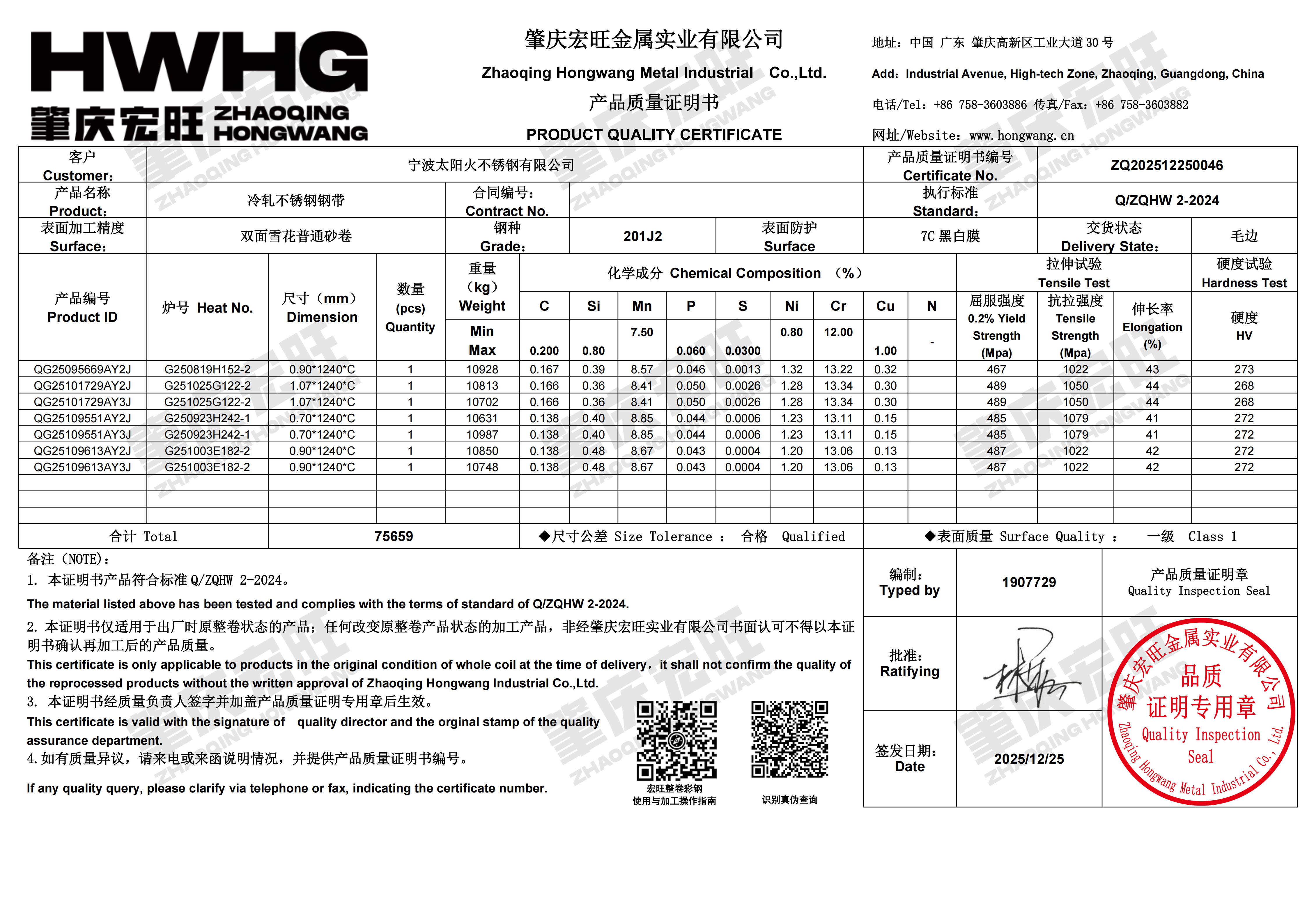
201 J2 product quality certificate ZQ202512250046, issued under standard Q/ZQHW 2-2024 by Zhaoqing Hongwang Metal Industrial Co., Ltd.
Position 3 — 430 Baby Coil: The Indoor and Decorative Option
430 is a ferritic grade and sits third on this shortlist because its natural territory is dry-service and indoor decorative work. In baby coil form it is supplied at 0.1 mm to 1.2 mm, around 600 mm width, mainly BA and in nude packing, and the documented 430 secondary range (0.1 mm to 1.2 mm narrow; 0.25 mm to 1.5 mm wider at 1,000 mm to 1,250 mm) confirms the same family of dimensions. Where a part is visibly finished but not exposed to sustained moisture, 430 is frequently the option that meets the requirement without moving to a nickel-bearing grade.
Verification for this grade is direct. The 430 mill test certificate reference JSPZ20260501804, covering 430 stainless steel coils and sheets under standard GB/T 3280-2015, was issued by JIANGSU YONGJIN METAL TECHNOLOGY CO., LTD on 22 May 2026. Buyers comparing 430 options should ask for the equivalent certificate per lot, since the grade is often purchased on cost logic and certificate diligence can be treated as optional when it is not.
Position 4 — 410 Baby Coil: The Component and Wear-Oriented Option
410 is a martensitic grade, which places it at the fourth position on this shortlist for a specific reason: it is shortlisted for components and industrial parts where hardness and wear behaviour matter more than long-term corrosion performance. In baby coil form it is available at 0.1 mm to 1.2 mm, around 600 mm width, mainly BA and nude packed.
Documented wider-format supply for the same grade runs 0.25 mm to 1.5 mm at 1,240 mm or mill edge as 410 Wider BA, with an MOQ of 20 mt per thickness and 7 to 30 days lead time from stock; 410 Narrow BA runs 0.15 mm to 1.2 mm at widths from 300 mm to 1,010 mm, with further processing options including PVC, paper and refinish. The boundary is straightforward: in aggressive or continuously wet environments, 410 is generally not the substitute for an austenitic option such as 304.
Matching Shortlist Options to Production Scenarios
Baby coil grades converge on dimensions but diverge on application fit. The table below maps commonly cited end uses to a recommended shortlist position, based on the documented application list for these products and on standard grade behaviour.
| Production scenario | Recommended shortlist option | Reasoning | Packing note |
|---|---|---|---|
| Kitchenware & cookware | 304 (position 1), 201 (position 2) | Forming plus repeated contact with water and detergents; 201 fits cost-driven lines | Nude packing; control storage humidity |
| Home appliances | 304 or 201, mainly BA | Visible surfaces plus corrosion exposure in wet appliance parts | Nude packing; inspect edges on receipt |
| Elevator decoration | 201 J2 finish (No.4 / 8K), 304 for exposed parts | Surface reflectivity and consistency dominate; 8K is an iterative polishing route | Nude packing; refined surfaces need handling discipline |
| Construction & interior decoration | 430 for dry indoor, 304 where humidity persists | Ferritic 430 suits dry service; austenitic 304 suits moisture | Nude packing; weather-protected site storage |
| Automotive components | 410, with 304 for corrosion-critical parts | Component hardness and wear requirements favour 410 | Nude packing; edge protection during transport |
| Industrial equipment | 410 or 304 depending on media exposure | Grade choice follows the chemical environment, not the gauge | Nude packing |
| Metal stamping & deep drawing | 304 and 201 | Consistent thickness across the 0.3–0.6 mm band supports continuous forming | Nude packing; thickness inspection before release |
| Tube & pipe, tableware, hardware accessories | 304, 201 | Narrow width reduces slitting loss on small-diameter forming lines | Nude packing |
A useful cross-check when reading this table: roughly 80% of baby coil supply sits between 0.3 mm and 0.6 mm, which is also where most appliance, kitchenware and deep-drawing demand falls. Buyers working outside that band should confirm availability and lead time separately rather than assuming shelf stock.
Nude Packing: A Practical Supply Consideration, Not a Quality Verdict
Baby coil is documented as supplied in nude packing, while secondary narrow coil of the same thickness and width is typically supplied with PVC outside or paper interleaved. That difference is often read as a quality signal, and it should not be. Packing reflects the intended downstream route and the handling assumption behind it, not the metallurgical quality of the coil.
The practical implications are these. Nude packing removes film and interleaf from the uncoiling path, which simplifies feeding into stamping and forming lines and eliminates film residue questions on surfaces that will be polished, brushed or coated. In exchange, surface protection depends entirely on strapping quality, edge care, moisture control during ocean transit and storage discipline at the receiving site.
For evaluation purposes, buyers shortlisting baby coil on cost-sensitive projects should add three items to the specification: a defined edge-protection requirement, an agreed receiving inspection for surface and edge condition, and an indoor, humidity-controlled storage condition at the destination. These are specification decisions, not supplier criticism, and they are what makes a nude-packed baby coil lot perform as intended.
Where Baby Coil Stops Working: Boundaries and Alternatives
A shortlist is only credible if it states where its entries do not apply. Four boundaries matter for baby coil in green energy and new materials production.
- Width ceiling. Baby coil is supplied at around 600 mm. It cannot replace a 1,240 mm mill coil in wide-panel conversion; that route needs a wider format.
- Thickness concentration. About 80% of supply sits between 0.3 mm and 0.6 mm. The extremes of the 0.1 mm to 1.2 mm range carry different availability and lead-time profiles.
- Packing protection. Nude packing offers less surface protection than PVC-wrapped secondary narrow coil during long sea transit and humid storage.
- Trade measures. EU anti-dumping duties of 24.6% to 28.5% on stainless steel cold-rolled flat products from China and Taiwan, maintained in 2025 under Regulation 2025/1573, change the landed cost calculation for that market irrespective of the shortlist position chosen.
| Attribute | Baby coil | Secondary narrow coil | Wide mill coil (reference) |
|---|---|---|---|
| Thickness | 0.1–1.2 mm (about 80% within 0.3–0.6 mm) | 0.1–1.2 mm | 0.3–3 mm (304 Wider); 0.25–3 mm (201 wider formats) |
| Width | Around 600 mm | Around 600 mm | 1,240 mm / mill edge |
| Surface | Mainly BA finish | Mainly BA finish | BA or 2B by grade route |
| Coil weight | Not specified in the source data | Around 200 kg | Not specified in the source data |
| Packing | Nude packing | PVC outside / paper interleaved | Export package + paper interleaved |
| Typical role | Direct feed for narrow stamping and forming lines | Narrow feed with film protection | Wide-panel, high-volume conversion |
Read together, the three formats are not competing products. Baby coil is a narrow-format answer to a narrow-format problem, and the shortlist above only makes sense inside that boundary.
Verification Checklist Before Committing to an Option
Baby coil purchases are relatively low-value per coil and high-frequency, which is exactly the profile under which documentation discipline erodes. The following checklist keeps verification proportional to risk.
- Confirm the grade designation in writing, including the variant (for example J1, J2 or J5 within the 201 family).
- Confirm thickness and width against the baby coil envelope, and confirm where the ordered gauge sits inside the 0.3–0.6 mm concentration band.
- Require a mill test certificate per lot and check the certificate number, issuer, standard and issue date for internal consistency.
- Check the standard cited: ASTM A240/A240M, GB/T 3280-2015 and Q/ZQHW 2-2024 all appear in current certificate evidence for this product family, and each implies a different specification basis.
- Confirm surface designation in writing — BA as the default, with No.4 or 8K-type finishes specified separately where decorative use is intended.
- Confirm the packing format and add edge protection and receiving inspection requirements if nude packing is used.
- Confirm MOQ and lead time per thickness, since these vary by format and grade in documented supply.
- Model trade-measure exposure for the destination market before finalising the commercial comparison.
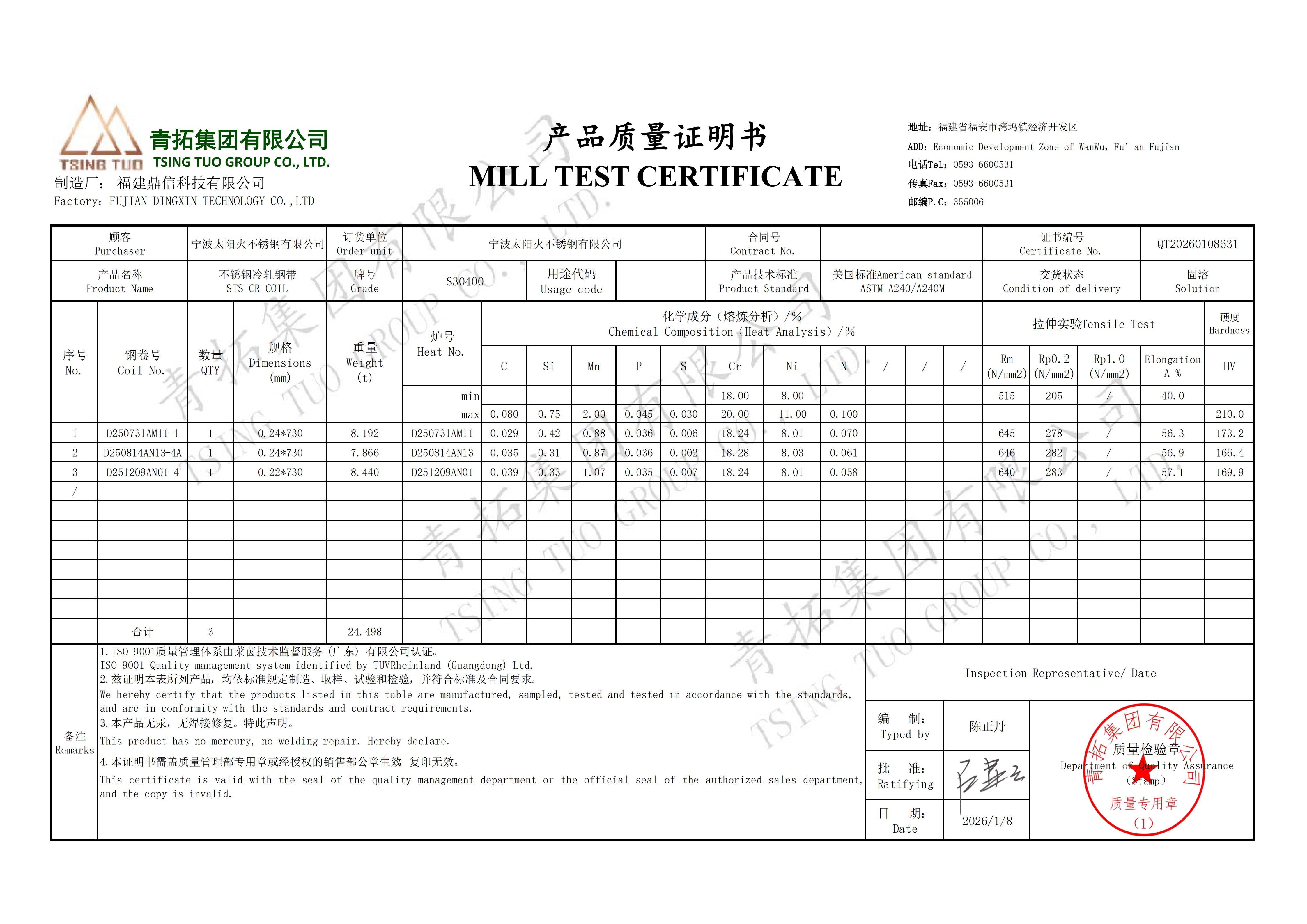
304 mill test certificate reference QT20260108631, issued by QINGTUO GROUP CO., LTD under ASTM A240/A240M.
The Supplier Side of the Shortlist
NINGBO SUNFIRE STAINLESS STEEL CO., LTD is a Ningbo, China-based exporter of stainless steel and stainless steel products, founded in 2013, with a stated specialization in stainless steel secondary and baby coil supply. The company reports a 100% export ratio and markets that include Pakistan, India, Vietnam, Russia, Turkey, Indonesia, the United Arab Emirates, Thailand, Malaysia and Bangladesh, alongside the Middle East, South America and Africa.
On the operational side, the company documents OEM production with customization across thickness, width, surface finish, PVC and packaging; a monthly export capacity of 3,000 MT; lead times of 7 to 45 days; a typical MOQ of 27 MT; and quality control covering mill test, thickness inspection and surface inspection, supported by technical support and online service after shipment.
Its case record covers stainless steel export clients in Indonesia, India, South Africa, Pakistan, Vietnam and Saudi Arabia, at approximately 50 containers per month over a duration of more than ten years, for kitchenware, home appliances, building and construction applications. Reported results include stable material performance, good corrosion resistance, consistent surface quality, and compliance with international standards. For buyers building a shortlist for green energy and new materials production, that record is relevant to the volume-supply question rather than to the grade-selection question, which should still be settled on the technical criteria above.
Outlook for Baby Coil Supply in Green Energy and New Materials
Three trends are likely to shape baby coil evaluation through 2027. First, market expansion: with the global stainless steel market projected to move from USD 135.8 billion in 2025 toward USD 247.4 billion by 2033, thin-gauge conversion capacity should continue to absorb narrow-format supply. Second, capacity addition at scale, illustrated by the 700,000 tonnes per year cold rolling joint venture in Indonesia associated with Hongwang Group, which supports certificate-backed supply from established mill systems. Third, continued trade friction, with EU anti-dumping duties maintained in 2025, meaning that destination-market cost modelling is becoming a permanent part of supplier evaluation rather than an exception.
For buyers, the practical implication is that grade choice is becoming less about availability and more about documentation. When four grades share nearly identical dimensional envelopes, the differentiators are the certificate chain, the packing specification and the ability to hold thickness and surface consistency across repeat lots.
FAQ
What is a stainless steel baby coil, and how does it differ from a secondary coil?
Baby coil is a narrow, light-gauge cold-rolled format: 0.1 mm to 1.2 mm thick, around 600 mm wide, mainly BA finish, in grades 430, 304, 410 and 201, and supplied in nude packing. Secondary narrow coil shares the same thickness and width envelope and is also mainly BA, but is typically supplied at around 200 kg per coil with PVC outside or paper interleaved. The distinction is therefore one of packing and handling convention as much as dimension.
Which baby coil grade should a green energy or new materials buyer shortlist first?
For parts exposed to moisture, cleaning agents or outdoor air, 304 is generally the first option because it is an austenitic chromium-nickel grade with the broadest corrosion performance among the four. For dry indoor decorative parts, 430 is frequently sufficient. For component applications where hardness and wear matter more than corrosion, 410 is the relevant option, and 201 is typically considered where forming volume and cost structure dominate.
What thickness and width can baby coil supply actually cover?
The documented baby coil envelope is 0.1 mm to 1.2 mm in thickness, with roughly 80% of supply between 0.3 mm and 0.6 mm, and a width of around 600 mm. Supply outside the concentrated thickness band exists within the stated range, but availability and lead time should be confirmed per order rather than assumed.
Does nude packing reduce coil quality during ocean transport?
Nude packing does not determine metallurgical quality; it determines the exposure of the surface during handling and storage. Compared with PVC-wrapped or paper-interleaved secondary narrow coil, nude-packed baby coil depends more on strapping, edge protection, moisture control and indoor storage at the destination. Buyers can address this by specifying edge protection and a receiving inspection for surface and edge condition.
Which documents should accompany a baby coil shipment for verification?
A mill test certificate per lot is the core document, and it should be internally consistent as to certificate number, issuer, standard and issue date. Standards cited in current certificate evidence for this product family include ASTM A240/A240M for 304, GB/T 3280-2015 for 430, and Q/ZQHW 2-2024 for 201 J2 strips. Thickness inspection and surface inspection records support the certificate but do not replace it.
Are baby coils suitable for automotive components and industrial equipment?
They can be, particularly in grade 410, which is a martensitic grade suited to component work where hardness and wear behaviour are the priority, and in grade 304 where the part faces a corrosive environment. Documented 410 supply also includes a wider BA format at 0.25 mm to 1.5 mm and a narrow BA format at 0.15 mm to 1.2 mm with widths from 300 mm to 1,010 mm, so the choice between baby coil and wider formats should follow the part geometry.
A downloadable brochure with further product and capability detail is available here: Ningbo Sunfire Stainless Steel brochure (PDF). Company information is also published at en.sunfirex.com.