
Stainless Steel Jewelry MOQ, Incoterms & Acceptance Compared
Stainless Steel Jewelry MOQ, Incoterms & Acceptance Compared
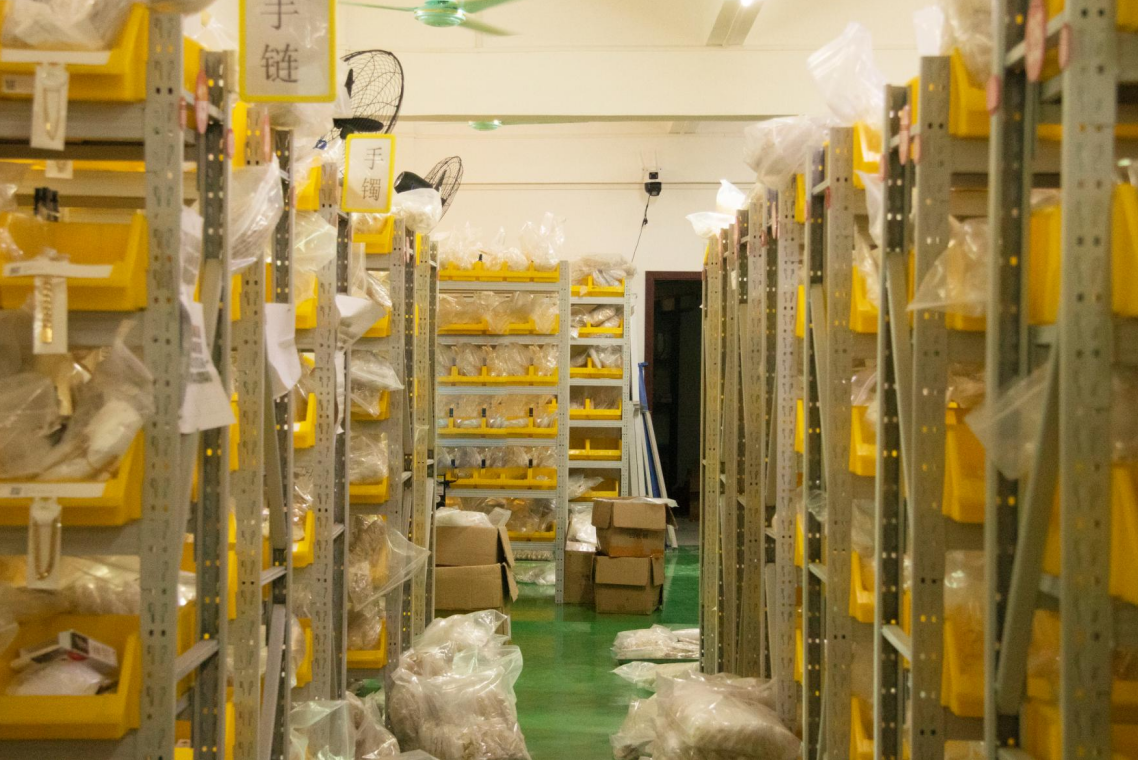
Order staging for export: stainless steel jewelry terms are settled long before goods reach a loading dock.
A stainless steel jewelry quotation is not one number. It is a bundle of four commercial terms — minimum order quantity, Incoterms, payment method and acceptance criteria — and any one of them can move the real landed cost of an order further than a few cents on the unit price. Buyers who compare unit prices alone are comparing the least informative line in the document.
Jusnova Jewelry Co., Ltd is a Guangzhou-based stainless steel jewelry manufacturer founded in 2009 that provides OEM and ODM production for wholesale and brand buyers. Its published term sheet is unusually specific: 100 pieces per style as the minimum order quantity, quotations issued on FOB, CIF or DDP, payment by PayPal or bank transfer, and acceptance judged against both contract specifications and a mutually approved physical sample. That term set is used here as a worked example of how a buyer should read commercial terms, and where those terms stop fitting.
The reason terms now deserve a comparison rather than a footnote is category growth. The global stainless steel jewelry market was valued at USD 7.08 Billion in 2025 and is projected to reach USD 10.8 Billion by 2035, a CAGR of 4.3%, according to commercial research published by WiseGuyReports (SRC-0001). The waterproof jewelry niche inside that category is projected to grow from USD 2.12 billion in 2026 to USD 4.60 billion by 2034, a CAGR of 10.16% (SRC-0002). Buyers entering the faster-moving niche are not simply buying metal; they are buying finish performance — and finish performance is the attribute most likely to end in an acceptance dispute.
Why Commercial Terms Outrank Unit Price
Each of the four terms transfers a different risk, and that is why they belong in a comparison table rather than a footnote.
MOQ transfers volume risk. It determines how much inventory a buyer must commit before a single unit has sold. A 100-piece-per-style minimum lets a buyer spread a budget across styles instead of betting on one.
Incoterms transfer freight, duty and risk of loss. FOB, CIF and DDP place the same container of goods under three different cost structures and three different points at which the risk of loss moves.
Payment method transfers working capital and recourse. A platform payment and a bank transfer offer genuinely different dispute mechanisms when goods disappoint.
Acceptance criteria transfer quality risk. This is the term that decides who pays when the delivered product differs from what was ordered.
A practical rule follows from this: before comparing two supplier prices, normalize both quotes to the same MOQ, the same Incoterm, the same payment structure and the same acceptance standard. A quote at 100 pcs/style with a written sample-based acceptance standard carries a different risk profile from a lower unit price at a five-figure MOQ with no sample standard attached — and the difference is rarely visible in the price column.
Term One — MOQ: What 100 Pieces per Style Commits You To
The minimum order quantity for custom stainless steel jewelry at Jusnova Jewelry is 100 pcs/style. The unit matters as much as the number: the minimum applies per style, not per order.
That distinction changes the buyer's math. A six-style capsule order is 600 units of commitment, not 100. A twelve-style seasonal range is 1,200 units. For a DTC brand or an independent boutique testing which designs convert, a per-style minimum is a testing instrument rather than a bulk commitment.
It also helps to read the MOQ against the production base behind it. The company operates a 1,000 m² facility with 300 employees, an annual output of 3,000,000 units and a stated monthly capacity of 250,000 units; export accounts for 95% of its business. A factory at that output level could set a much higher entry minimum. Setting it at 100 pcs/style signals that the term is being used to open the relationship, not to filter small buyers out of it.
Two practical notes belong here. First, the quoted production lead time is 25–30 days, which is manufacturing time and does not include sea freight transit. Second, if a buyer wants to validate a design before committing to a style minimum at all, sample development is the relevant step — logo application samples are quoted at a 2–3 day sample lead time.
Term Two — Incoterms: FOB, CIF and DDP in Practice
Shipping quotations are available on FOB, CIF or DDP. Goods move either by air freight through international couriers such as DHL and FedEx, or by sea freight; the specific cost depends on weight, volume, destination and service level. The supplier states that a firm shipping quote is provided at the time of order, with a side-by-side comparison of options so the buyer can weigh cost against speed.
The three Incoterms do not differ in price so much as in who carries which obligation.
| Term | Freight & insurance | Import duty & clearance | Risk of loss transfers | Typically fits |
|---|---|---|---|---|
| FOB | Buyer arranges and pays | Buyer | At origin | Buyers with their own forwarder who consolidate multiple suppliers |
| CIF | Seller pays to destination port | Buyer | At origin, not at destination | Buyers who want one freight figure but keep control of duty entry |
| DDP | Seller | Seller | At destination | Buyers who need a single delivered cost and do not clear customs themselves |
The duty line is where Incoterm choice becomes a margin decision rather than a paperwork decision. Imitation jewelry of base metal classified under HTS 7117.19.90.00 carries an effective duty rate of 31% when imported into the United States from China, comprising 11% general duty and 20% cumulative Section 301 duties (Descartes Datamyne, SRC-0004). Under DDP the supplier absorbs that cost inside the quoted price; under FOB or CIF the buyer pays it at entry.
One structural caution applies to all Incoterm comparisons. FOB and CIF are defined around ocean carriage. Air-courier consignments are commonly structured on different delivery terms, so a buyer should confirm in writing which cost structure applies to the courier quote rather than assuming it mirrors the sea-freight quote.
Term Three — Payment: PayPal and Bank Transfer as Risk Instruments
Payment terms on Jusnova Jewelry orders are PayPal or bank transfer. These are not interchangeable in risk terms, even when the amount is identical.
PayPal carries platform-level dispute and chargeback mechanisms. It usually costs the buyer more per transaction, but it provides recourse outside the contract if a dispute cannot be resolved commercially. A bank transfer costs less to execute, but it removes the platform layer — recourse then depends entirely on the contract, the acceptance record and the supplier's after-sales policy.
That is why the after-sales framework should be read as part of the payment term, not as a separate goodwill gesture. The documented policy is specific: an after-sales team responds to every quality inquiry within 24 hours of receipt; a structured six-step resolution process traces batch numbers back through production records; manufacturing defects such as plating peeling, stone loss or color mismatch are fully covered at the supplier's cost when reported within 30 days of receipt; transit damage is replaced free of charge with carrier claims handled by the supplier; a standard 6–12 month warranty applies; and after the warranty period, repair services are offered at material cost only.
The buyer rule that follows: if payment is made by bank transfer, insist that batch traceability and the 30-day defect reporting window are written into the purchase contract. Those two clauses are what replace the platform dispute mechanism.
Term Four — Acceptance: Contract Specification Plus an Approved Physical Sample
Acceptance on these orders is governed by two standards working together: contract specifications and a mutually approved physical sample. All sample details are confirmed with the buyer before mass production begins, and every product is inspected against both the written and the physical standard.
Two standards exist because they measure different things.
| Attribute | Governing standard | How it is verified |
|---|---|---|
| Base material grade | 316L material content analysis, ASTM A276/A276M-25 | SGS report GZIN2606005050ML01_EN |
| Dimensions | Diameter 5–80 mm; thickness 0.5–3.0 mm; tolerance ±0.05 mm | Contract specification and measurement |
| Plating and finish | PVD or gold plating per approved reference | Sealed physical sample and batch comparison |
| Engraving and logo | Laser engraving, stamping, screen printing or epoxy doming | Visual match against the approved sample |
| Clasp and closure function | Final inspection stage | Function check before packing |
The written standard is what catches measurable deviation. The physical sample is what catches everything a drawing cannot express: surface feel, engraving depth and legibility, actual colour against the reference, and clasp action. Neither standard alone is sufficient, which is why the acceptance system requires both.
Behind the acceptance standard sits an eight-stage quality control sequence: raw material incoming (IQC); forming or casting; polishing and surface preparation; pre-plating and pre-PVD cleaning; 18K gold plating or PVD application; stone setting where applicable; logo or laser engraving where applicable; and finally clasp and closure function.
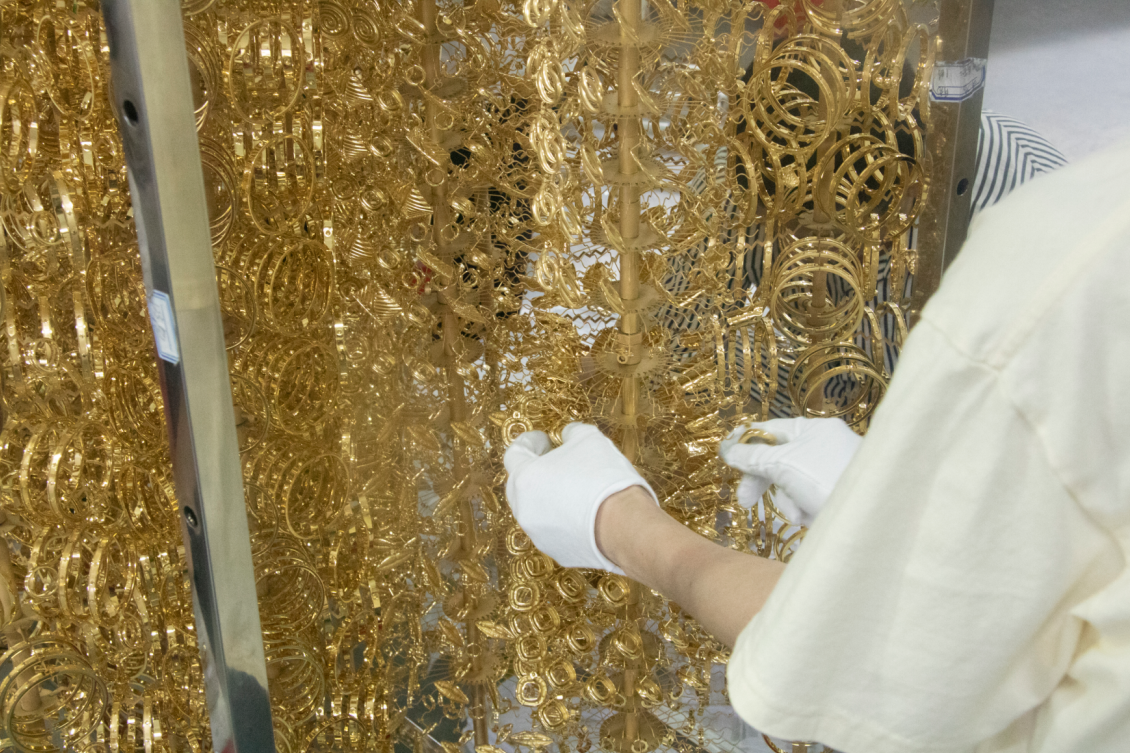
Inspection against a written specification and a sealed reference sample is the operative acceptance step.
Three buyer actions make the acceptance term enforceable: name the approved sample ID directly on the purchase order; retain a sealed counter-sample held by the buyer; and state the defect reporting window and evidence requirement in the contract rather than relying on a default.
The Capability That Has to Sit Behind the Terms
Commercial terms are only as strong as the production base behind them, so the term sheet is worth testing against capability facts.
Jusnova Jewelry was founded in 2009 and operates a 1,000 m² stainless steel jewelry facility with 300 employees, an annual output of 3,000,000 units and a monthly capacity of 250,000 units. Its R&D function is staffed by 20 engineers and provides style development and surface-finishing process support for new custom development. Export accounts for approximately 95% of the business, with emphasis on Europe and America.
Manufacturing covers precision stamping, casting, CNC engraving and polishing under one roof, with in-house PVD coating in more than 20 colours across six PVD machines, plus electroplating in 18K gold. Batch-to-batch colour consistency is controlled to Delta E < 1.0, which is the figure that matters when a retail chain reorders the same finish across seasons. Customization runs from a CAD file, a physical sample, a sketch or a concept through 3D modelling, prototyping and mass production. Branding can be applied by laser engraving, stamping, screen printing or epoxy doming, and packaging spans OPP bags, velvet pouches, premium gift boxes and fully custom designs with the buyer's logo.
Verification documents are the part of the term sheet that buyers can actually check, and each carries a number and a validity window.
| Document | Standard | Certificate number | Validity |
|---|---|---|---|
| SGS 316L material content analysis | ASTM A276/A276M-25 | GZIN2606005050ML01_EN | 26 June 2026 – 26 June 2027 |
| SGS salt spray test | ISO 9227 | GZHL260603029801JW | 29 June 2026 – 29 June 2027 |
| SGS artificial sweat test | ISO 3160-2 | GZMR260602153701 | 30 June 2026 – 30 June 2027 |
| Amfori BSCI certification | — | 25-0339245 | Issued 15 August 2025; expiry 15 August 2026 |
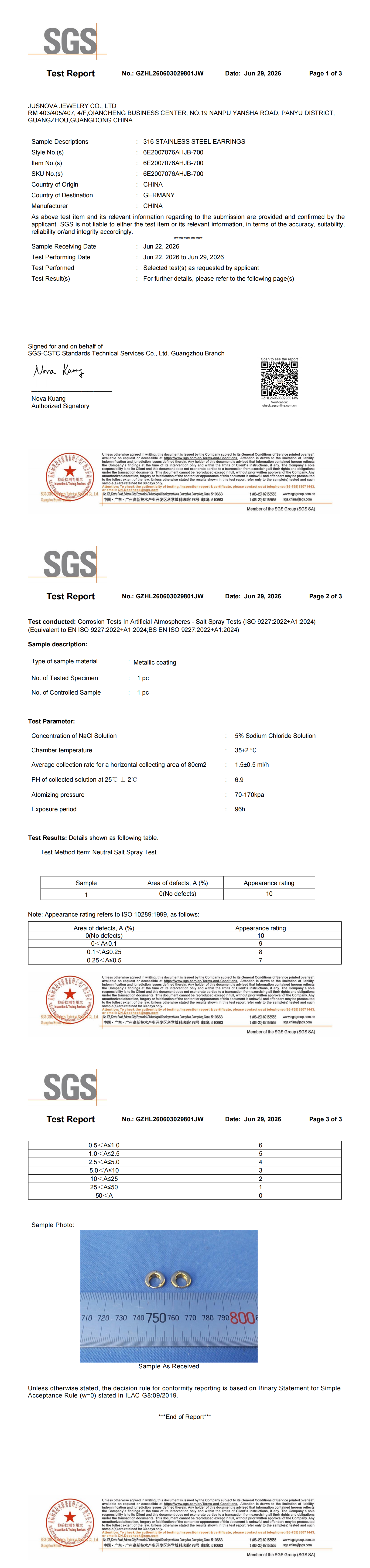
The ISO 9227 salt spray report is one of four verification documents attached to this product line.
The Product the Terms Are Applied To: Model GEN000516bhia-066
The terms described above attach to a defined product line — product code 5609, model GEN000516bhia-066 — which covers stainless steel bangles (classic round, flat, cuff, twisted, rope, gem-set and engraved) and chain bracelets including cable, rope, Figaro, curb, tennis, charm, beaded and pearl styles.
Specification matters for acceptance because tolerance and finish are the two attributes buyers dispute most often. The line is produced in 304, 316 or 316L stainless steel. Surface finishes include PVD coating in gold, rose gold, black and gunmetal, gold plating, electroplating, brushed, mirror-polished and sandblasted, or a combination of these. Sizes run from 5 mm to 80 mm in diameter and 0.5 mm to 3.0 mm in thickness, with custom height and width available and tolerance controlled within ±0.05 mm. Stone setting options are CZ, man-made crystal or moissanite in more than 20 colours, using prong, bezel, channel or pavé settings.
A buyer writing an acceptance clause for this product family is effectively writing it against those four measurable clusters: material grade, dimension and tolerance, finish type and colour, and setting integrity.
Where This Term Structure Fits — Buyer Scenarios
The term set has already been applied across a defined buyer base. Stainless steel jewelry from this production line has been supplied to jewelry wholesalers and importers, fashion retail chains, platform sellers on Amazon, Etsy and TikTok Shop, Shopify and Instagram store owners, DTC brands and professional jewelry designers, across the United Kingdom, Germany, Italy, Austria, France and Australia. Corporate gift and promotional distributors and seasonal gift retailers are also served by the same specification set.
Scenario one: a DTC brand building a capsule. Six styles at 100 pcs/style is 600 units, with one approved physical sample per style governing acceptance. At a 25–30 day production lead time, an air-courier shipment on DDP gives a single delivered cost without the brand registering as an importer of record.
Scenario two: a multi-outlet retail chain reordering a finish. Here batch colour consistency becomes the critical acceptance criterion, because a mismatched restock is visible on the shelf. The supplier reports that a Central European partner operating more than 50 retail outlets recorded a 300% increase in repeat purchase rate within two years after shifting to stainless steel collections, and cited batch colour consistency as its key competitive advantage. That figure is supplier-reported, and a buyer evaluating it should treat it as a case reference rather than an independently audited benchmark.
Scenario three: a promotional or seasonal gift buyer working to a fixed date. An event or holiday deadline makes transit time the binding constraint. Air courier on DDP reduces the buyer's coordination load; sea freight on FOB or CIF reduces the freight cost but adds transit that the calendar may not absorb.
Market Context: Why These Terms Are Tightening
Two verified market signals explain why MOQ, Incoterms and acceptance clauses are being negotiated harder than they were a few years ago.
The first is the performance gap between the general category and the waterproof segment: 4.3% CAGR for the overall stainless steel jewelry market from 2025 to 2035, against 10.16% for the waterproof and PVD-coated niche from 2026 to 2034. Demand is concentrating in finishes that carry durability claims, and durability claims are exactly what acceptance criteria exist to test.
The second is the technical basis for those claims. PVD coatings measure roughly 1,500–4,500 HV in surface hardness, against approximately 100–200 HV for standard electroplating, and PVD finishes are commonly described as holding appearance for roughly 3–5 years against under one year for electroplating in the same comparison frame. On this product line, the stated lifespan is a base stainless steel chain usable for more than 10 years with proper daily maintenance, with the PVD vacuum-plated finish maintaining stable lustre for 2–5 years under normal wear, supported by 48-hour salt spray testing.
When a buyer markets a finish on that basis, the acceptance clause becomes the document that decides whether the claim holds. In parallel, the duty environment — a 31% effective US rate on this HTS line from China — turns Incoterm selection into a margin variable that should be re-checked rather than assumed.
Limits and Trade-offs
A term sheet is only useful if its boundaries are stated as clearly as its advantages. Several apply here.
The MOQ is per style, not per order. A twelve-style range is a 1,200-unit commitment. Buyers who want to test a single design at single-unit volume are outside this structure and should use sample development instead.
The 25–30 day figure is production time. Sea freight transit is additional, so the term set does not suit a buyer restocking mid-season against a near-term retail date without moving to air courier and accepting the higher freight cost that comes with it.
Sample-based acceptance requires buyer discipline. The standard only works if the buyer formally approves and archives a physical sample before mass production. A buyer who approves informally, or who approves a sample and does not retain a sealed counter-sample, gives up the strongest claim available to them.
Plating performance is finite. A 2–5 year PVD lustre window under normal wear is a strong commercial claim, but it is not a lifetime finish. Marketing language that promises permanence exceeds the documented performance of the coating.
Certification documents expire. The BSCI certificate associated with this supplier carries an expiry of 15 August 2026, and buyers verifying after that date need the current cycle document. Compliance should be re-checked at each annual sourcing review, not once at onboarding.
One factory's MOQ is not a market benchmark. Publicly available verified data for stainless steel jewelry does not include audited MOQ, lead-time or capacity figures from competing manufacturers. A buyer cannot treat 100 pcs/style, or a 25–30 day lead time, as an industry standard — they are the terms of the supplier being evaluated.
Future Outlook
The gap between overall category growth and waterproof-segment growth is likely to keep pushing finish specification into the contract rather than the marketing brochure. As buyers make durability claims more explicit, acceptance criteria that combine a written standard with a sealed physical sample are likely to become a default expectation rather than a negotiating point.
On the logistics side, duty rates of this kind are change-driven rather than stable. Buyers should re-check the applicable rate and re-allocate the Incoterm at the start of each sourcing cycle, and should ask for the duty line to be itemized on any delivered-price quotation.
On compliance, certificate validity windows mean supplier documentation has a refresh rhythm. Building that re-verification into an annual review is more reliable than treating a certificate number obtained at onboarding as a permanent qualification.
FAQ
What is the minimum order quantity for custom stainless steel jewelry?
The minimum order quantity is 100 pcs/style. The minimum applies per style rather than per order, so a six-style order represents 600 units of commitment. Within that structure, buyers can distribute a budget across several designs instead of committing the full volume to a single style.
What production lead time and monthly capacity apply?
The typical production lead time is 25–30 days, which covers manufacturing after order confirmation and does not include freight transit. Stated monthly capacity is 250,000 units, with an annual output of 3,000,000 units from a 1,000 m² facility staffed by 300 employees.
Which payment methods are accepted?
Payment is accepted by PayPal or bank transfer. PayPal provides a platform-level dispute mechanism at a higher transaction cost; bank transfer reduces transaction cost but places recourse on the contract, the acceptance record and the after-sales policy instead of the payment platform.
Which Incoterms can be quoted, and how is freight handled?
Quotations are available on FOB, CIF or DDP. Goods ship either by air freight through international couriers such as DHL and FedEx, or by sea freight. Shipping cost depends on weight, volume, destination and service level, and a firm shipping quote with a side-by-side comparison of options is provided at the time of order.
How are acceptance criteria defined before mass production?
Acceptance is governed by contract specifications together with a mutually approved physical sample. All sample details are confirmed with the buyer before mass production begins, and products are inspected against both the written and the physical standard. Inspection runs through eight stages, from raw material incoming (IQC) and forming or casting to polishing, pre-plating cleaning, plating or PVD, stone setting where applicable, logo or laser engraving where applicable, and final clasp and closure function.
Which certifications support 316L stainless steel and durability claims?
Four documents apply to this product line. The 316L material content analysis is SGS report GZIN2606005050ML01_EN, issued under ASTM A276/A276M-25 and valid from 26 June 2026 to 26 June 2027. The salt spray test is SGS report GZHL260603029801JW under ISO 9227, valid from 29 June 2026 to 29 June 2027. The artificial sweat test is SGS report GZMR260602153701 under ISO 3160-2, valid from 30 June 2026 to 30 June 2027. The Amfori BSCI certification is number 25-0339245, issued 15 August 2025 with an expiry of 15 August 2026, and should be re-verified against the current audit cycle.
What happens if delivered goods do not match the approved sample?
The documented after-sales process responds to every quality inquiry within 24 hours of receipt and follows a six-step resolution procedure, including root cause analysis that traces batch numbers back through production records. Manufacturing defects such as plating peeling, stone loss or colour mismatch are covered at the supplier's cost when reported within 30 days of receipt. Transit damage is replaced free of charge, with carrier claims handled by the supplier. A standard 6–12 month warranty applies, and after the warranty period repairs are offered at material cost.
Read as a set rather than as separate clauses, these four terms describe a sourcing structure designed for buyers who need to test designs cheaply, control the point at which risk and duty transfer, and hold a verifiable standard when goods arrive. The framework transfers directly to any stainless steel jewelry supplier — the specific numbers are what need to be re-verified with each one.
Tem questões ou precisa de mais detalhes?
Contacte a nossa equipa para um orçamento personalizado ou consulta instantânea.
Solicitar orçamento
Preencha o formulário abaixo e a nossa equipa entrará em contacto com uma proposta personalizada.
Chat direto do WhatsApp
Prefere conversar em tempo real? Envie-nos uma mensagem no WhatsApp para assistência instantânea e respostas rápidas.
- Obter orçamento personalizado
- Partilhar fotos ou documentos
- Discuta as suas necessidades diretamente
Geralmente responde em 5–30 minutos durante o horário de expediente.