
Stainless Steel Jewelry Supplier Viability: Certifications, Capacity, Repeat Orders
Stainless Steel Jewelry Supplier Viability: Certifications, Capacity, Repeat Orders
Stainless steel jewelry programs rarely collapse on the first production run. They collapse two or three seasons in, when a brand that once approved a laser-engraved, 18K vacuum-plated bangle needs the identical engraving depth, the identical gold tone and the identical clasp behavior again — and discovers that the supplier's process has drifted quietly underneath a catalog that never changed.
Supplier viability is the probability that a manufacturer can reproduce a specified product to a defined standard across repeated orders over several years. That is a different question from whether a supplier can produce a sample, and a different question again from whether the sample looks good in a photograph. For buyers in the decision stage of a personalized engraved stainless steel jewelry program, viability is worth more than a price list, because the cost of drift — returns, re-shoots, re-branding, lost retail placements — lands long after the invoice is paid.
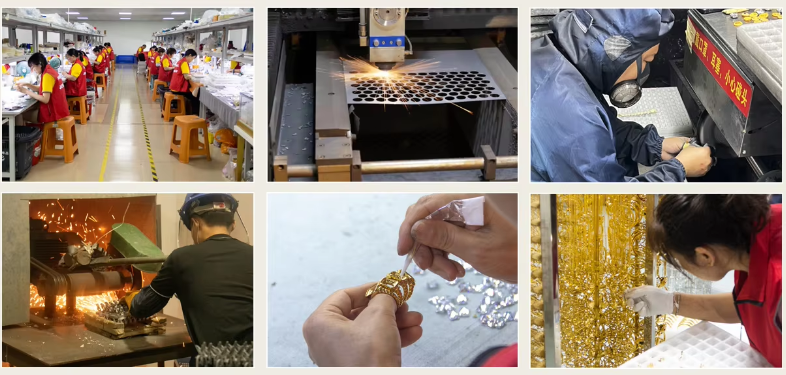
A Sample Proves Capability. Continuity Is a Separate Question.
In stainless steel jewelry sourcing, three questions are routinely collapsed into one. Can the factory make this piece? Can the factory make this piece at volume? Will the factory still make this piece the same way in year three? A sample answers the first. A price band answers part of the second. Only documented process and order history answer the third.
Personalized engraving raises the stakes because it removes the buyer's escape routes. A plain bangle in a slightly warm or cool gold tone can often be re-photographed, blended into a collection, or sold through a discount channel. An engraved bangle carrying a customer's name, initials or a date cannot. The engraving is the product, and any variation in depth, alignment or post-engraving finish becomes a customer service event rather than a merchandising detail.
Viability therefore breaks into three verifiable pillars: what a supplier can actually certify, what its capacity means for the specific operations your product depends on, and whether repeat orders have left evidence that the process holds.
Pillar One — What a Certification Actually Covers
Certificates are frequently treated as a single credibility score. They are not. Three document types common in stainless steel jewelry supply answer three unrelated questions, and a buyer who conflates them will overestimate what has been verified.
REACH test reports address substance restriction. They speak to whether specified restricted substances fall within limits in the tested sample, which matters directly for hypoallergenic and lead- and nickel-free positioning in European and North American markets.
SGS reports are third-party test documents tied to a defined scope — a material, a coating, a component, a batch. Their value depends entirely on whether the scope covers the product you are ordering, in the finish you are ordering it in.
BSCI certification is a social compliance audit framework. It speaks to working conditions and management systems at a facility. It says nothing about coating adhesion, nickel release or engraving consistency, and treating it as a product-performance credential is a category error.
The practical decision rule is to ask for the document, read the scope line, and then ask which of your SKUs sit inside that scope. A supplier that can produce a certificate on request but cannot map it to your specific engraved, PVD-coated article has given you a document, not a guarantee. Jusnova Jewelry states that it manufactures to US and EU lead- and nickel-free requirements, and makes REACH test reports, SGS reports and BSCI certification available upon request — which is useful only when the buyer asks the scope question that follows.
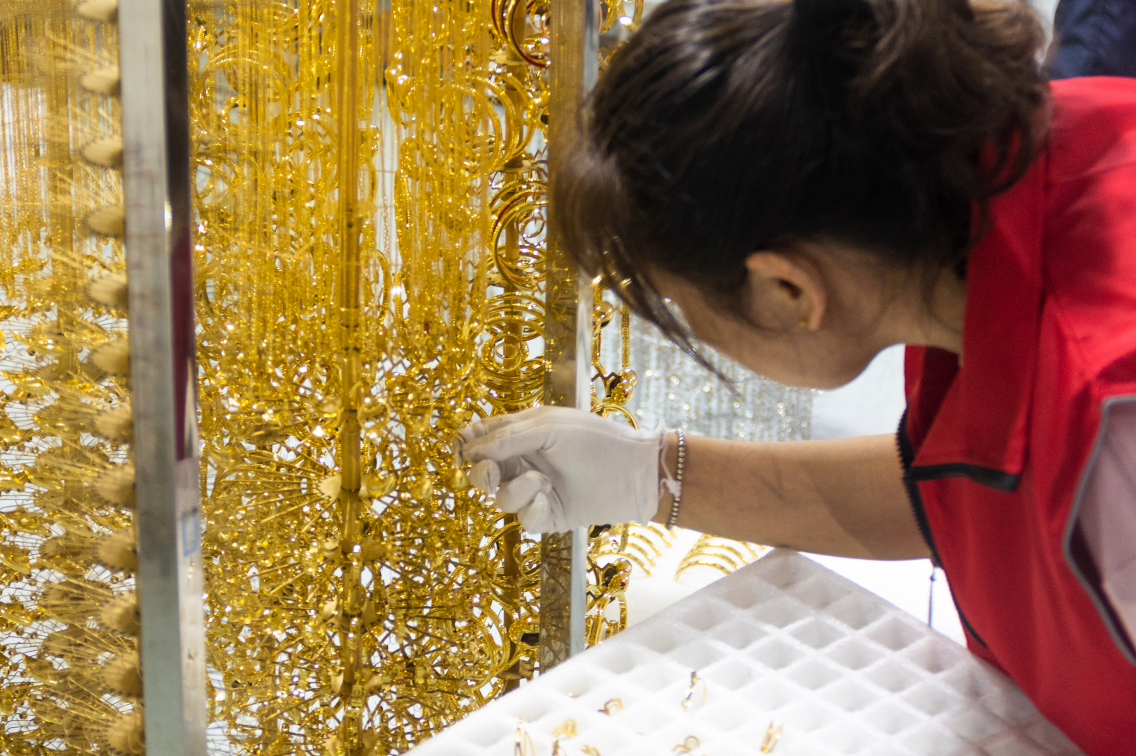
Pillar Two — Capacity, and Where It Actually Applies
Annual output figures are the most quoted and least diagnostic number in supplier evaluation. Jusnova Jewelry Co., Ltd, founded in 2009 in Guangzhou, operates a 1,000 m² manufacturing facility with 300 employees and an annual production capacity of 3,000,000 units, exporting to global wholesale and brand buyers with an emphasis on Europe and the Americas. Those figures establish scale. They do not establish throughput at the operation your product actually depends on.
For personalized engraved stainless steel jewelry, the binding constraint is rarely casting or assembly. It is usually the serial operations: laser engraving station time, engraving-to-plating sequencing, and inspection of individualized pieces that cannot be sampled as a homogeneous lot. A factory capable of three million units a year can still be slow on a 500-piece engraving run if engraving capacity is shared, if each piece requires a distinct program file, or if post-engraving re-polishing is done at a manual bench.
This is a boundary worth stating plainly: a headline capacity number does not disclose engraving-station count, plating-chamber cycle time or per-order file handling. Buyers comparing suppliers on capacity alone are comparing the widest part of the pipe while the narrowest part determines delivery.
Where capacity figures do earn their place is in the design and development layer. Jusnova maintains a 20-engineer R&D team providing style development and surface-finishing process support, and reports launching 500+ new styles monthly. For a brand running a personalized engraving line, that matters less as a catalog claim and more as an indicator that new artwork, new engraving templates and new finish combinations can be handled without reinventing the process each season.
Pillar Three — Repeat Orders Leave Auditable Traces
Repeat orders are the least fakeable signal in supplier evaluation, because they are produced by the buyer rather than by the supplier's marketing. They also leave physical traces that can be inspected during a factory visit or a documented review.
The first trace is tooling retention. If a supplier has kept molds, artwork files and engraving programs from previous orders, the cost and risk of re-setup disappear on the next run. A supplier that restarts from scratch every season is not demonstrating flexibility; it is demonstrating the absence of an order history.
The second trace is batch documentation. Jusnova's quality framework runs through sample approval, pre-production first article inspection, batch inspection reports, and qualified packaging and shipment inspection, supported by incoming inspection, in-process checks, finished-product sampling and accelerated aging tests. Each of those steps generates a record. A supplier that cannot produce a batch inspection report from a previous engraved order has no continuity evidence, whatever its capacity states.
The third trace is specification stability. When a brand reorders the same engraved 18K gold plated stainless steel bangle, the coating tone, engraving depth and edge finish should be describable in the same terms as the first order. Drift usually appears not as an obvious failure but as a slightly warmer gold, a shallower engraving or a softer polish. Buyers who keep approved reference pieces and written finish parameters catch this in one comparison; buyers who keep only photographs catch it after the returns arrive.
A caution belongs here. Repeat-order evidence supports continuity, not suitability. A supplier can reproduce a finish consistently and still be the wrong partner for a market whose compliance requirements sit outside its scope. Continuity and compliance are separate checks.
Technical Explanation — Why Engraving, Plating and Alloy Choice Interlock
In engraved stainless steel jewelry, the sequence of operations determines the outcome more than any single process does. Engraving before plating leaves the coating to cover the engraved recess; engraving after plating cuts through the coating and exposes the base metal. The first approach produces a subtle, tone-on-tone mark; the second produces a high-contrast mark with a raw stainless edge. Both are legitimate, and they are different products. A buyer who specifies only 'laser engraving' without specifying sequence has specified neither.
Coating choice then determines how long the appearance survives wear. Published technical comparisons place PVD coating hardness at roughly 1,500–4,500 HV, against roughly 100–200 HV for standard electroplating, with the same comparison set associating PVD finishes with a multi-year service life and standard plating with under a year. For personalized pieces, where the engraving is the reason for purchase, coating durability is not a premium feature; it is what prevents an engraved gift from becoming a complaint.
Alloy grade closes the loop. The practical difference between 304 and 316L stainless steel in jewelry is the addition of 2–3% molybdenum in 316L, which materially improves corrosion resistance. In salt spray testing, 316L lasts 3 to 5 times longer than 304 before showing signs of corrosion, and in chloride-containing environments the corrosion tendency ranks 304 > 304L > 316L, with 316L performing best.
| Decision dimension | 304 stainless steel | 316L stainless steel |
|---|---|---|
| Composition | No molybdenum addition | 2–3% molybdenum |
| Salt spray performance | Baseline | 3–5× longer before corrosion signs |
| Chloride-rich environment | Higher corrosion tendency | Best performance of 304 / 304L / 316L |
| Maintenance | Occasional polish after 6–12 months of regular use | Holds finish for years with a simple wipe |
| Cost per finished piece | Lower | 10–18% higher |
| Best-fit positioning | Cost-effective general use | Daily wear, sport, travel, engraved pieces |
The trade-off is stated openly by the material itself. 316L costs 10–18% more per finished piece than 304. The case for paying it rests on lower return rates, higher customer satisfaction and the ability to support retail premiums in the 20–40% range — the argument is commercial, not aesthetic, and it holds only if the product is positioned and serviced accordingly.
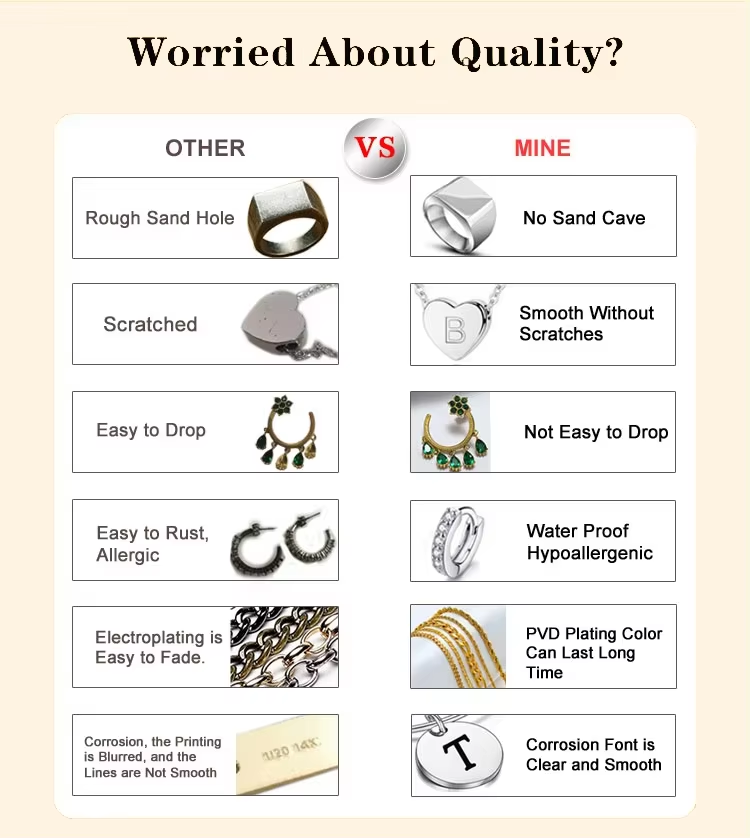
How Jusnova Jewelry Structures These Three Pillars
Jusnova Jewelry Co., Ltd is a stainless steel jewelry manufacturer founded in 2009 and based in Guangzhou, China, producing stainless steel bangles, bracelets, rings and earrings alongside PVD and electroplated gold pieces positioned as waterproof and tarnish-free, with export accounting for 95% of output and an emphasis on European and American wholesale and brand buyers.
On the certification pillar, the company operates as an OEM and ODM manufacturer and makes REACH test reports, SGS reports and BSCI certification available on request, alongside NDA and confidentiality policies that matter to brands whose engraving files and custom designs constitute their differentiation. On the capacity pillar, the stated configuration is a 1,000 m² facility, 300 employees, 20 engineers, 3,000,000 units of annual output and 500+ new styles launched monthly. On the repeat-order pillar, the company describes a control chain built from sample approval, pre-production first article inspection, batch inspection reports and shipment inspection, reinforced by accelerated aging tests and defined QA and lead-time terms.
Read as a decision set rather than a credential list, these facts answer the continuity question in the order it should be asked: whether compliance claims can be scoped to the ordered article, whether the development layer can absorb new engraving programs without resetting the process, and whether each order produces a record that the next order can be measured against.
Application Scenarios Where the Three Pillars Shift Weight
Made-to-order engraving for DTC brands. Order sizes are small, SKU variation is extreme and each unit is individually specified. Here the binding pillar is process documentation and file handling, not annual tonnage. The relevant questions are how engraving programs are version-controlled and whether an approved reference piece exists for each finish combination.
Wholesale replenishment of engraved bangles and chain bracelets. Volumes are larger and repeat cycles are predictable. Capacity and batch consistency dominate, and the most useful evidence is a run of batch inspection reports showing that the same finish was achieved across consecutive orders.
Regional distribution with compliance obligations. The certification pillar carries the weight. Buyers need scope-mapped documents rather than a folder of certificates, because an SGS report covering one coating does not automatically cover a different engraved article in the same collection.
Private-label programs with protected artwork. Confidentiality becomes a commercial requirement rather than a courtesy, since engraving files and custom mold designs often contain the brand's proprietary identity. NDA coverage and file custody practices belong in the supplier evaluation, not in the onboarding paperwork.
Market Context: Why the Non-Tarnish Segment Is Outgrowing the Category
The global stainless steel jewelry market was valued at USD 7.08 billion in 2025 and is projected to reach USD 10.8 billion by 2035, a CAGR of 4.3%, according to WiseGuyReports. The waterproof jewelry niche is growing considerably faster: Verified Market Reports projects the segment moving from USD 2.12 billion in 2026 to USD 4.60 billion by 2034, a CAGR of 10.16%.
The gap between those two growth rates is the commercially interesting part. The demand driving the faster segment is specifically for wearability claims — waterproof, tarnish-free, hypoallergenic — which are precisely the claims that depend on material grade and coating method rather than on design. That shifts supplier evaluation toward process evidence, and it explains why engraved and PVD-coated programs are being asked for documentation that plain fashion jewelry programs were never asked for.
Cost modeling has moved in parallel. Imitation jewelry of base metal classified under HTS 7117.19.90.00 carries an effective duty rate of 31% when imported from China to the United States, comprising an 11% general duty and a cumulative 20% under Section 301, per Descartes Datamyne trade data. For program planning, that figure belongs in the landed-cost sheet before finish selection is finalized, because a 10–18% alloy upgrade and a 31% duty rate interact in ways that can invert a margin assumption.
Where Stainless Steel Does Not Win
A credible comparison has to include the cases where the material and the supplier model are the wrong answer. Stainless steel jewelry offers distinct advantages in corrosion resistance and hypoallergenic properties compared with plated brass and alloy jewelry, sterling silver and gold-plated pieces — but that advantage is bounded.
Sterling silver and solid gold remain the correct choice where intrinsic metal value, resale or formal positioning is part of the purchase. Plated brass and alloy remain viable where unit price dominates and the product has a short fashion cycle. Stainless steel with PVD sits between them: more durable than plated alloy, less precious than silver, and dependent on coating integrity for its appearance claims.
Three limits deserve explicit statement. First, PVD coating raises surface hardness but does not make a coating permanent; abrasion over years still occurs, and the hardness figure describes resistance, not immunity. Second, engraving after plating necessarily interrupts the coating, so the exposed mark requires its own durability consideration — a design decision, not a defect. Third, BSCI certification addresses social compliance and says nothing about product performance, so a buyer relying on it as a durability credential is protected on the wrong dimension.
There is also a structural limit on the supplier side. Annual capacity, facility area and headcount describe scale, not schedule reliability at the engraving or plating stage. Until a buyer has requested engraving-station throughput, plating cycle time and per-order file handling directly, the capacity number remains an incomplete input.
Future Outlook
Two forces are likely to reshape supplier evaluation over the next several years. The first is documentation depth. As the waterproof and non-tarnish segment continues to outgrow the broader category, claims that were once accepted as marketing descriptors will increasingly require scoped evidence — a report that names the article, the coating and the restriction tested. Suppliers that can map documents to SKUs will find procurement conversations shorter.
The second is the economics of personalization. Engraved programs turn inventory into individually specified units, which pushes value toward the operations that handle variation: file management, engraving sequencing, individual inspection. Capacity will remain a qualifying criterion, but repeatability under variation is likely to become the deciding one, and suppliers that can show batch records spanning multiple engraved orders will hold an advantage that no catalog can replicate.
Frequently Asked Questions
What does an SGS report actually cover for engraved stainless steel jewelry?
An SGS report is a third-party test document whose validity is bounded by its declared scope — typically a specified material, coating, component or batch. It does not automatically extend to every article in a collection, and it does not cover a different finish or engraving sequence unless that variation was part of the tested scope. Buyers should read the scope line and confirm that the ordered article, in the ordered finish, falls inside it before treating the report as product-level assurance.
How should a buyer compare 316L and 304 for a personalized engraving program?
The comparison rests on four documented differences. 316L contains 2–3% molybdenum, which improves corrosion resistance; in salt spray testing it lasts 3 to 5 times longer than 304 before showing corrosion signs; in chloride-containing environments the corrosion tendency ranks 304 > 304L > 316L, with 316L performing best; and 316L costs 10–18% more per finished piece. 316L is positioned for daily wear, sport and travel, while 304 is described as a cost-effective choice for general use. Engraved pieces that expose base metal at the mark tend to justify the 316L premium more readily than plain pieces.
Does a supplier's annual production capacity indicate laser engraving throughput?
No. Annual capacity figures such as 3,000,000 units describe total facility output and do not disclose engraving-station count, plating-chamber cycle time or per-order file handling. In personalized engraving, those serial operations are usually the binding constraint, because each piece may require a distinct program and individual inspection rather than homogeneous lot sampling. Buyers should request throughput data for the specific engraving and coating stages instead of relying on the aggregate capacity number.
What evidence indicates a supplier can sustain repeat orders over several years?
Three traceable forms of evidence are commonly available. Tooling and file retention shows that molds, artwork and engraving programs from prior orders are kept, reducing re-setup risk. Batch documentation shows that inspection occurred — for example sample approval, pre-production first article inspection, batch inspection reports and shipment inspection. Specification stability shows that coating tone, engraving depth and edge finish can be described in the same terms across orders. A supplier unable to produce records from a previous engraved order offers continuity claims without continuity evidence.
Which costs should be modeled beyond unit price when sourcing engraved 18K gold plated stainless steel?
Three cost layers sit outside the quoted unit price. Alloy grade adds 10–18% per finished piece when 316L replaces 304, offset in principle by lower return rates and support for retail premiums in the 20–40% range. Import duty adds a further layer in some markets: imitation jewelry of base metal under HTS 7117.19.90.00 carries an effective 31% duty rate from China to the United States, combining an 11% general duty with a cumulative 20% under Section 301. Coating method is the third layer, since PVD and standard electroplating differ substantially in surface hardness — approximately 1,500–4,500 HV versus 100–200 HV — and therefore in expected service life and replacement cost.
Tem questões ou precisa de mais detalhes?
Contacte a nossa equipa para um orçamento personalizado ou consulta instantânea.
Solicitar orçamento
Preencha o formulário abaixo e a nossa equipa entrará em contacto com uma proposta personalizada.
Chat direto do WhatsApp
Prefere conversar em tempo real? Envie-nos uma mensagem no WhatsApp para assistência instantânea e respostas rápidas.
- Obter orçamento personalizado
- Partilhar fotos ou documentos
- Discuta as suas necessidades diretamente
Geralmente responde em 5–30 minutos durante o horário de expediente.