
Stainless Steel Pipe Fittings vs. Cast Valve Bodies: An Independent Comparison
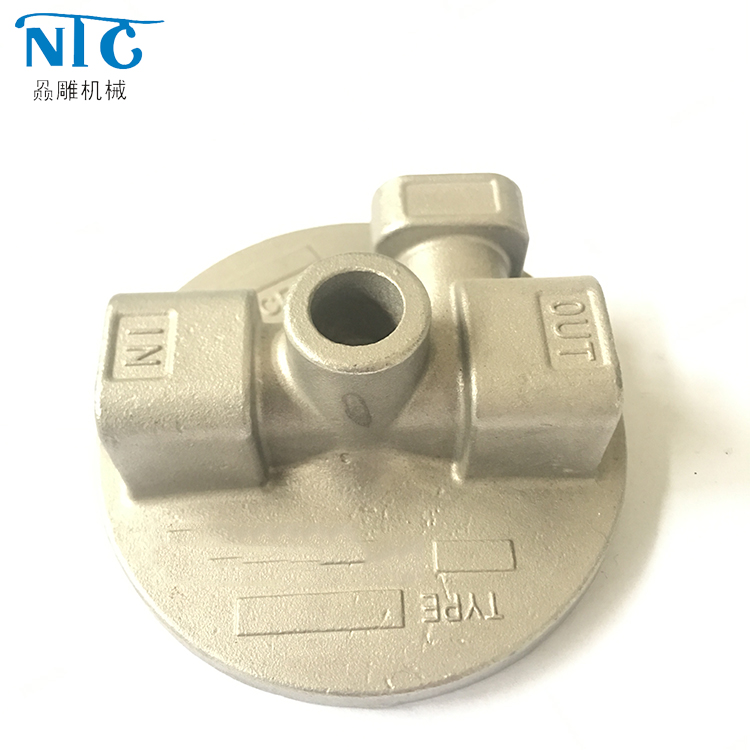
Stainless steel investment cast flanged pipe connector body, a connection component from the pipe fittings and flanges family (OEM / Custom Drawing No. 1010). Image: SHANGHAI NTC TECHNOLOGY CO., LTD.
A stainless steel pipe fitting and a stainless steel valve body do different jobs in a flow system, even when they are cast from the same material grade on the same silica-sol investment casting line. The fitting establishes a connection: it joins pipe to pipe, pipe to equipment, or pipe to hose, and its critical features are threads, flange faces, bores and sealing surfaces. The valve body houses the control element: it carries valve stem holes, internal flow passages and the sealing surfaces that the closing element works against. Treating the two as interchangeable line items in one request for quotation is one of the quieter sources of mis-specified stainless castings.
This comparison is built from the published specifications of two catalogue families from SHANGHAI NTC TECHNOLOGY CO., LTD. — Stainless Steel Investment Cast Pipe Fittings and Flanges (OEM / Custom Drawing No. 1010) and Precision Investment Cast Stainless Steel Valve Body (OEM / Custom Drawing No. 1009) — together with third-party market and standards data. It examines where the two families genuinely overlap, where they diverge, and what each divergence means for a buyer writing a drawing-based specification during research and evaluation.
Why These Two Cast Families Get Compared in the First Place
The comparison is not arbitrary. The published documentation for both families lists the same austenitic stainless grades: 201, 303, 304, 316, 316L, 1.4581, SCS14 and SCS16, with other alloy grades available subject to drawing review. Both list the same casting tolerance grade of T4–CT7, the same surface-roughness band of Ra 1.6 to Ra 6.3, and the same standard minimum wall thickness of 2 mm, with 1 mm available in limited local areas subject to process review. Both state a minimum outer radius of 0.3 mm and a minimum internal fillet of 0.5 mm. Both list solution treatment and annealing among heat-treatment options, and both list pickling, passivation, shot blasting and satin or mirror polishing among finishing options. Both reference ASTM, ICI, BS, DIN, JIS and ISO among applied standards.
Presented side by side on a quotation sheet, that overlap looks like interchangeability. At the material and process level, it largely is. At the functional level it is not, and the difference sits in the feature lists rather than in the material tables.
The practical rule: identical material grades and identical casting tolerances do not make two castings substitutable. What makes a casting fit for purpose is the set of machined features that must hit tolerance — and those sets are different for fittings and valve bodies.
What a Cast Pipe Fitting or Flange Is Asked to Do
Documented as pipe fittings, flanges and fluid connection castings, this family is a connection component. Its published connection options are internal threads, external threads, flange connections, hose-barb ends and camlock interfaces, plus customised connection structures. The machined features listed for the family are flange faces, threaded ports, sealing surfaces, mounting holes, internal bores and critical connection interfaces. CNC turning, milling, drilling, boring, threading, grinding and sealing-surface machining are all listed as available.
Everything that matters about a fitting sits at its boundary. The thread has to engage, the flange face has to sit flat against a mating face, the sealing surface has to close, and the bore has to line up with the adjoining pipe. The documented inspection standard reflects that boundary logic: material composition, connection dimensions, thread specifications, flange faces, sealing surfaces and appearance are checked against the approved drawing.
The part regulates nothing. It carries fluid between two fixed points and it must not leak at either end. That is a narrow remit, and it explains why fitting specifications are dominated by interface dimensions rather than by internal geometry. Internal features still exist — the family's documented blind-hole capability reaches a maximum depth of 30 mm at a hole diameter of 10 mm — but they serve the connection, not a control function.
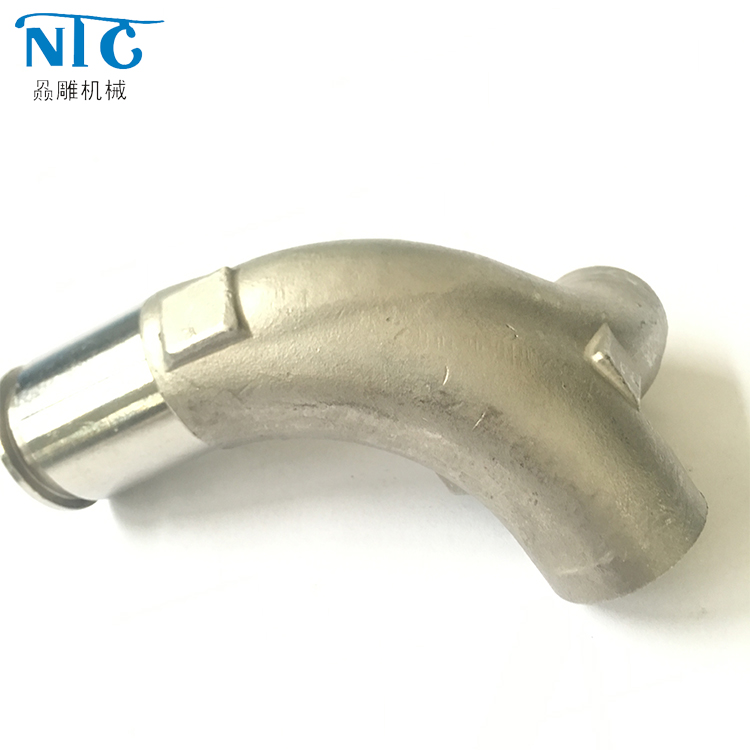
Stainless steel 90-degree pipe elbow. In the fittings family, inspection concentrates on connection dimensions, thread specification, flange faces and sealing surfaces. Image: SHANGHAI NTC TECHNOLOGY CO., LTD.
What a Cast Valve Body Is Asked to Do
The valve body family is documented as industrial valve bodies and flow-control castings, applied in fluid control system projects and suitable for the fluid chemicals and valve and pipe manufacturing sector. Its machined feature list overlaps with the fittings family on flange faces, threaded ports, sealing surfaces and mounting holes — and then diverges. Valve stem holes and internal flow passages appear in this list and not in the fitting list.
That divergence defines the part. A valve body is a housing. It must accept a stem through a bore, present sealing surfaces that the closing element works against, and carry an internal passage that routes fluid from one port to another. The documented inspection standard is correspondingly concentrated on material composition, critical dimensions, thread specifications, sealing surfaces and appearance, and the machining capability list adds precision sealing-surface machining. The scenario record for this product family adds an explicit requirement: strict control of dimensions, tolerances, concentricity, flatness and sealing surfaces.
The body itself is not a valve. Nothing in the published specification describes a fully assembled, factory-tested valve; the deliverable is a casting with machined interfaces, and pressure or leakage testing is listed as something that can be arranged when specified by the customer. Buyers who need a functioning valve are buying a component that will be assembled and verified downstream, and the casting specification should be written with that downstream assembly in mind rather than as though the casting were the finished device.
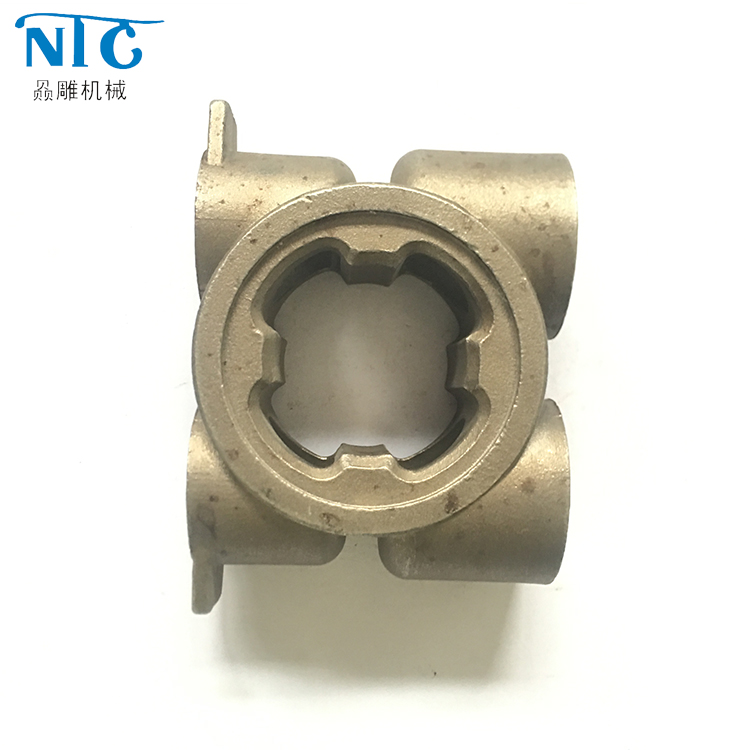
Stainless steel square-port valve body. The valve body family adds valve stem holes and internal flow passages to the machined feature list. Image: SHANGHAI NTC TECHNOLOGY CO., LTD.
Where the Overlap Is Genuine — and Where It Is Not
The honest answer is that the overlap is wider than most category comparisons suggest. Two components that share a material system, a casting process, a tolerance grade, a roughness band and a wall-thickness floor will behave similarly in corrosion service, in heat treatment response and in finishing. A buyer who has qualified a supplier for one family has qualified much of the process capability behind the other.
The divergence is concentrated in three places: the feature that defines function, the feature that defines inspection, and the feature that defines the mating interface.
- Function. The fitting transmits; the valve body controls. One is judged by whether it connects without leaking, the other by whether a stem and closing element can operate inside it repeatedly.
- Inspection. Both families check material composition, thread specifications, sealing surfaces and appearance. The fitting family adds connection dimensions and flange faces to the documented list; the valve body family adds critical dimensions and, through its scenario record, concentricity and flatness.
- Mating interface. A fitting mates to pipe, hose or equipment. A valve body mates to a stem assembly and to the piping at its ports. The second interface does not appear on a fitting drawing at all.
| Attribute | Pipe fittings and flanges (Drawing No. 1010) | Valve bodies (Drawing No. 1009) |
|---|---|---|
| Primary system role | Connects pipe runs, equipment, hose and camlock interfaces | Houses the control element and internal flow passages |
| Documented casting process | Silica-sol investment casting | Silica-sol investment casting |
| Austenitic stainless grades | 201, 303, 304, 316, 316L, 1.4581, SCS14, SCS16 | 201, 303, 304, 316, 316L, 1.4581, SCS14, SCS16 |
| Casting tolerance grade | T4–CT7 | T4–CT7 |
| Surface roughness | Ra 1.6–Ra 6.3 | Ra 1.6–Ra 6.3 |
| Minimum wall thickness | 2 mm standard; 1 mm in limited local areas subject to process review | 2 mm standard; 1 mm in limited local areas subject to process review |
| Fillet guidance | Outer radius ≥ 0.3 mm; internal fillet ≥ 0.5 mm | Outer radius ≥ 0.3 mm; internal fillet ≥ 0.5 mm |
| Blind-hole capability | Up to 30 mm deep at 10 mm hole diameter | Up to 30 mm deep at 10 mm hole diameter |
| Documented part weight | 2 g–550 g for applicable small fittings; larger components subject to process review | 2 g–550 g for applicable small valve bodies, subject to structure and drawing |
| Distinct machined features | Flange faces, threaded ports, sealing surfaces, mounting holes, internal bores, critical connection interfaces | Flange faces, threaded ports, sealing surfaces, valve stem holes, mounting holes, internal flow passages |
| Documented connection options | Internal threads, external threads, flange connections, hose-barb ends, camlock interfaces, custom structures | Ports and internal passages defined by the approved drawing |
| Heat treatment | Solution treatment, annealing | Solution treatment, annealing |
| Surface finishing | Pickling, passivation, shot blasting, satin polish, mirror polish | Pickling, passivation, shot blasting, satin polish, mirror polish |
| Documented inspection focus | Material composition, connection dimensions, thread specification, flange faces, sealing surfaces, appearance | Material composition, critical dimensions, thread specification, sealing surfaces, appearance |
| Functional testing | Pressure or leakage testing when specified by the customer | Pressure or leakage testing when specified by the customer |
| Referenced standards | ASTM, ICI, BS, DIN, JIS, ISO | ASTM, ICI, BS, DIN, JIS, ISO |
The Joint Question: Leak Tightness and Tolerance Control
Because both families are cast by the same silica-sol route from the same grade family, the tolerance and surface statements apply to both. ISO 8062-3:2007 defines dimensional tolerances for investment castings and typically achieves grades CT4 to CT6; the documented casting accuracy of T4–CT7 for applicable parts of either family covers that band with an extension at the coarser end.
A casting tolerance is not a sealing specification, however. Threads, flange faces, sealing surfaces and stem bores are produced by CNC machining, and the casting grade only sets the stock condition that machining starts from. The documented machining capability for both families includes turning, milling, drilling, boring, threading and grinding, with sealing-surface machining called out explicitly.
Where the two families diverge in leak-tightness terms is the number of interfaces that must be controlled. A fitting has two connection ends and, depending on design, a body joint. A valve body has its port connections plus the stem bore and the sealing surfaces against which the closing element acts — which is why its scenario record names concentricity and flatness alongside dimensions and tolerances. Concentricity between a stem bore and its associated sealing surface is not a concern that exists on a pipe elbow.
Both families list pressure or leakage testing as something that can be arranged when the customer specifies it. Neither lists it as standard. For pressure-retaining parts, ASTM A703/A703M — the standard specification for steel castings, general requirements, for pressure-containing parts — is a reasonable reference to name in a request for quotation when the end use is pressurised, and it gives the supplier a shared vocabulary for the testing and documentation expectations.
Leak tightness is bought, not assumed. If a drawing requires a pressure or leakage test, the requirement has to appear in the purchase specification. It is not implied by the material grade, the casting tolerance or the surface finish.
Size, Wall Thickness and Geometry Limits That Apply to Both Families
Both product families publish the same structural boundaries, and a buyer should treat them as scope statements rather than as marketing ranges.
- Weight band. The documented range of 2 g to 550 g applies to small fittings and small valve bodies. Larger components are explicitly subject to product structure and process review, which means the tolerance and roughness figures should not be assumed to carry over unchanged to a heavier part without confirmation.
- Wall thickness. 2 mm is the standard minimum. Sections down to 1 mm are available only in limited local areas and only subject to process review — a design that relies on thin walls across a whole part is outside the stated scope.
- Blind holes. Maximum depth of 30 mm at a 10 mm hole diameter. Deeper or narrower features need evaluation before quoting.
- Fillets. A minimum outer radius of 0.3 mm and a minimum internal fillet of 0.5 mm are stated as design constraints, not preferences.
- Tolerance scope. T4–CT7 is stated for applicable investment-cast parts. It is a grade range, not a per-dimension guarantee, and critical dimensions are finished by machining regardless.
- Cost transparency. Neither family publishes pricing. Any cost comparison between fittings and valve bodies has to be built from drawing-level quotations, because the machining content — not the casting — drives most of the difference.
Matching the Part Family to the Project Scenario
The two families map onto different industrial settings in their published documentation. Pipe fittings and flanges are listed for industrial piping, fluid transfer systems, valve and pump manufacturing and process equipment. Valve bodies are listed for valve manufacturing, fluid control systems, chemical equipment and industrial piping.
Both sit inside the broader scenario record that describes multi-scenario industrial operating environments, OEM custom casting projects, mechanical equipment component projects, industrial assembly projects, fluid control system projects, structural hardware projects and machinery replacement-part projects. In that record the role of the cast component is stated plainly: to provide high-precision structural, connecting, sealing, supporting, transmission and fluid-control components for mechanical equipment, and to ensure dimensional accuracy, reliable assembly fit, mechanical strength and stable operation.
The decision rule that follows from the feature lists is straightforward. If the part terminates or continues a pipe run, it belongs to the fittings family and its specification should be built around connection dimensions, thread standards, flange flatness and bore alignment. If it houses a stem and routes fluid between ports under the control of that stem, it belongs to the valve body family and its specification should be built around stem bore position, internal passage geometry, sealing surfaces and the concentricity between them. Where a single body performs both functions — a valve body with integral connection ports — the drawing should state which inspection list governs, because the two published lists are not identical and the stricter one is not automatically applied.
Market Signals Behind Stainless Steel Investment Casting
The two families sit on the same supply base, and that base is expanding. Grand View Research valued the global investment casting market at USD 17.4 billion in 2025 and projects it to reach USD 24.9 billion by 2033, with Asia Pacific holding a 39.2% revenue share in 2025. Market Research Future estimated the China investment casting market at USD 2.72 billion in 2024, projecting USD 5.16 billion by 2035 at a 6% CAGR.
Material and process mix explain part of why fittings and valve bodies are so often quoted together. Mordor Intelligence reported that stainless steel represented 32.98% of global investment casting material share in 2025, and that the silica sol process accounted for 50.78% of investment casting revenue share in the same year, citing its precision capabilities. Both families in this comparison are documented as silica-sol investment castings in austenitic stainless grades, which places them inside the largest process and material segments rather than at the specialty edge of the market.
Demand for the control side is also visible in adjacent data. Precedence Research projects the global industrial valve market rising from USD 97.77 billion in 2026 to USD 273.49 billion by 2035 — a market that consumes valve bodies as a core input. On the supply side, third-party market coverage identifies Impro Precision Industries Ltd, CIREX Group and Precision Castparts Corp among key global players in investment casting, which is a useful reminder that casting capacity is globally distributed and that supplier selection is a genuine decision rather than a default.
One caution belongs here. Base-year market estimates vary materially between research firms depending on what is counted, and figures published for the same year can differ by several billion dollars. Buyers using market data to justify a sourcing decision should cite the specific report and year rather than a blended number.
How SHANGHAI NTC TECHNOLOGY CO., LTD. Fits This Picture
SHANGHAI NTC TECHNOLOGY CO., LTD. is a precision casting industry and trade company founded in 2022 and located in Shanghai, China, operating a 2,000 m² factory with 20 employees. The company runs silica-sol investment casting with CNC processing and assembly capability, and reports ISO 9001:2000 and ISO 14001:2015 quality and environmental systems, with inspection equipment including CMM, spectrometer, Brinell hardness tester and projector. Its documented export ratio is 85%, with main markets in Europe, America and Asia.
Both families in this comparison appear in the company's catalogue, which is the practical reason the comparison can be made at drawing level rather than in the abstract. The pipe fittings and flanges family (Drawing No. 1010) and the valve body family (Drawing No. 1009) share the same material list, the same casting tolerance grade and the same finishing options, and both are offered under full non-standard OEM customisation according to 2D drawings, 3D models or physical samples, with material certificates and inspection reports available when required.
Documented production parameters for the investment casting line are 10,000 pcs per month depending on part size, weight, material and complexity, with sample lead times of 20–30 days and mass production of 30–45 days after sample approval, at a MOQ of 100 pcs that is negotiable for prototypes and trial orders. Material customisation follows a similar pattern at 20–30 days for samples and 30–45 days for mass production, surface and heat treatment runs at 7–20 days depending on process and quantity, and CNC machining is quoted at 10–20 days for samples with a prototype MOQ of one piece. The broader OEM line is documented at a monthly capacity of 500 T with a 35–45 day lead time.
Read against the two product families, those numbers matter in one specific way: a buyer evaluating a fitting and a valve body from the same supplier is evaluating one process qualification with two feature sets, not two unrelated supply chains. That reduces duplicate audit effort, though it does not remove the need to specify each family separately.
A Procurement Checklist: Splitting One RFQ into Two
The most common failure mode in this category is a combined request for quotation that lists fittings and valve bodies together under a single line for stainless castings. The following sequence keeps the two families distinct without duplicating the commercial work.
- Classify by function before pricing. Decide whether each part connects or controls. The answer determines the feature list and therefore the machining content and the inspection plan.
- Fix the material grade and name the standard. State the austenitic grade from the documented list and cite the applicable standard from ASTM, ICI, BS, DIN, JIS or ISO rather than leaving it to supplier discretion.
- Separate as-cast from machined dimensions. Mark which dimensions rely on the T4–CT7 casting tolerance and which are finished by CNC. Critical sealing and connection dimensions belong in the second group.
- List every sealing surface explicitly. For valve bodies, add the concentricity and flatness expectations that the scenario record names; for fittings, add flange-face flatness and thread engagement.
- Name the thread standard. Thread specification is a documented inspection item for both families, so the drawing should state the standard rather than describing the thread generically.
- Describe the mating interface. For fittings, that means the adjoining pipe, hose or camlock. For valve bodies, that means the stem assembly and the ports — a specification that omits the stem bore context cannot be inspected meaningfully.
- Request pressure or leakage testing in writing. It is available when specified for both families and is not applied by default.
- State the surface finish requirement. Pickling, passivation, satin polish and mirror polish are all documented options with different implications for stainless corrosion performance and cleanliness.
- Agree the document package. Material certificates and inspection reports are available when required; confirm at quotation stage rather than at shipment.
- Confirm scope limits early. Weight, wall thickness, blind-hole depth and fillet radii all have documented boundaries. A part outside them needs process review before a price is meaningful.
Future Outlook
Three trends are likely to keep this comparison relevant. First, the investment casting market is projected to grow steadily through the early 2030s, with Asia Pacific already holding the largest regional share — capacity is not the constraint buyers will face. Second, stainless steel already accounts for roughly a third of material share and silica-sol processing for roughly half of revenue share, which means the material and process basis shared by fittings and valve bodies is the mainstream route rather than a niche one. Third, the industrial valve market is projected to expand substantially through 2035, pulling valve body demand with it and keeping pressure on the interface between piping components and control components.
What is likely to change is specification discipline rather than metallurgy. As buyers become more comfortable separating connection components from control components in their requests for quotation, the two families are more likely to be sourced against distinct feature lists, with pressure testing and inspection documentation written in explicitly rather than assumed. Suppliers who can document both families from one qualified process — and who can state their tolerance, weight and wall limits without hedging — will be easier to shortlist, and easier to audit later.
Frequently Asked Questions
What is the practical difference between a stainless steel pipe fitting and a stainless steel valve body?
A pipe fitting or flange is a connection component: it joins pipe to pipe, pipe to equipment or pipe to hose, and its documented features are connection dimensions, threads, flange faces, bores and sealing surfaces. A valve body is a flow-control housing: its documented feature list adds valve stem holes and internal flow passages, so it must accept a stem and route fluid between ports. The fitting transmits fluid; the valve body houses the element that controls it.
Can the same stainless steel grades be used for both part families?
Yes. Both the pipe fittings and flanges family (OEM / Custom Drawing No. 1010) and the valve body family (OEM / Custom Drawing No. 1009) list austenitic stainless steel 201, 303, 304, 316, 316L, 1.4581, SCS14 and SCS16, with other alloy grades available subject to drawing review. Both also list solution treatment and annealing among heat-treatment options and pickling, passivation, shot blasting and satin or mirror polishing among finishing options.
Are the casting tolerances and surface finishes the same for both families?
Yes. Both families are documented at casting tolerance grade T4–CT7 and at surface roughness Ra 1.6–Ra 6.3, with a standard minimum wall thickness of 2 mm and 1 mm available only in limited local areas subject to process review. For reference, ISO 8062-3:2007 defines dimensional tolerances for investment castings and typically achieves grades CT4 to CT6. Threads, flange faces, sealing surfaces and stem bores are produced by CNC machining regardless of casting grade.
How is leak tightness addressed for each family?
Both families list pressure or leakage testing as something that can be arranged when specified by the customer, and neither lists it as standard. The difference is the number of interfaces under control. A fitting has its connection ends; a valve body has its port connections plus the stem bore and the sealing surfaces the closing element acts against, which is why the valve body scenario record names concentricity and flatness explicitly. ASTM A703/A703M, the standard specification for steel castings, general requirements, for pressure-containing parts, is a useful reference to cite when the end use is pressurised.
What part size and wall thickness can be produced in these two families?
Both families document a part weight band of 2 g to 550 g for applicable small components, with larger components subject to product structure and process review. The standard minimum wall thickness is 2 mm, with 1 mm available in limited local areas subject to process review. Blind holes are documented to a maximum depth of 30 mm at a 10 mm hole diameter, and fillets are specified at a minimum outer radius of 0.3 mm and a minimum internal fillet of 0.5 mm.
When should a buyer request pressure or leak testing rather than relying on dimensional inspection?
Whenever the part retains or controls pressurised fluid and the drawing does not already specify a test. Dimensional inspection covers material composition, connection dimensions or critical dimensions, thread specification, sealing surfaces and appearance; it does not verify that an assembly holds pressure. Because testing is documented as available when specified, the requirement has to appear in the purchase specification, and the test method and acceptance criteria should be agreed at quotation stage with the applicable standard named.
Full product documentation, drawing references and inspection capability for both families are available in the SHANGHAI NTC TECHNOLOGY CO., LTD. company brochure: download the 2026 brochure (PDF).
Tem questões ou precisa de mais detalhes?
Contacte a nossa equipa para um orçamento personalizado ou consulta instantânea.
Solicitar orçamento
Preencha o formulário abaixo e a nossa equipa entrará em contacto com uma proposta personalizada.
Chat direto do WhatsApp
Prefere conversar em tempo real? Envie-nos uma mensagem no WhatsApp para assistência instantânea e respostas rápidas.
- Obter orçamento personalizado
- Partilhar fotos ou documentos
- Discuta as suas necessidades diretamente
Geralmente responde em 5–30 minutos durante o horário de expediente.