
Stainless Steel Press Fittings: 7 Leakage Causes and Fixes
Stainless Steel Press Fittings: 7 Leakage Causes and Fixes
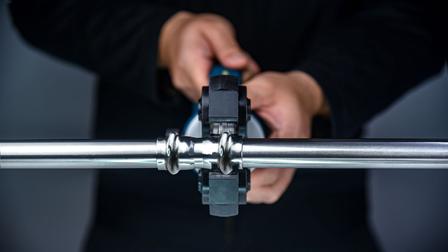
Press-fit connections on site: leakage after commissioning is usually traceable to pipe preparation, insertion depth, tooling or sealing ring condition rather than to the fitting body.
A stainless steel press fitting is a mechanical pipe connector that seals by compressing the fitting body around an inserted pipe, using an elastomeric sealing ring instead of welding or solder. Because the seal depends on a compressed elastomer and on a tool applying force exactly at the fitting groove, the joint is only as reliable as the installation procedure behind it.
That single design characteristic explains why leakage investigations in press-fit plumbing systems so often end at the same conclusion: the joint itself was manufactured correctly, but the installation was not. The failure modes documented for stainless steel press-fit piping are concentrated in a small number of human, tooling and material-selection errors, and each of them is preventable at the point of installation.
This reference addresses the seven most common causes of leakage after installation, the inspection sequence used to identify them, and the selection rules for sealing rings and stainless steel grades that keep press-fit joints leak-free over the service life of a building.
Why press-fit joints leak: the problem in context
Answer first: press-fit joint leakage after installation is predominantly an installation-quality problem, not a product-defect problem. Verified troubleshooting data for stainless steel press-fit systems lists the main reasons as unremoved pipe burrs, insufficient pipe insertion, misaligned pressing jaws, mismatched profile tools and a damaged sealing gasket, all of which are execution issues rather than material failures. The inspection response follows the same logic: check joint appearance, verify gasket status, and confirm whether the correct pressing jaws were actually applied.
The distinction matters commercially. The global stainless steel press fitting market was valued at USD 3.8 billion in 2025 and is projected to reach USD 6.4 billion by 2034, growing at a compound annual growth rate of 6.0%, according to Dataintelo (2026). As the installed base grows, the share of leaks attributable to workmanship, tooling discipline and gasket selection grows with it.
Meanwhile, the stainless steel press fittings sub-sector alone was estimated at approximately USD 1.03-1.30 billion for 2024, accounting for 29%-38% of the broader press fittings market, with independent statistics from Global Industry Reports marking the segment at USD 1.07 billion. The two figures describe different scopes and base years and should not be added or compared directly, but both point to the same conclusion: press-fit stainless systems are now a mainstream plumbing technology, and mainstream technologies are installed by a large and unevenly trained workforce.
The practical consequence for procurement and site managers is that leakage risk is largely transferred from the manufacturer to the installation chain. Control therefore has to be built into four stages: pipe preparation, tool selection, gasket specification, and post-installation pressure testing.
The seven leakage causes
1. Burrs and sharp edges left on the pipe end
Cutting stainless steel pipe leaves inner and outer burrs. When the pipe is pushed into the fitting socket, those burrs pass directly over the sealing ring and can scratch or cut it. The seal is then compromised before the tool is ever applied, and the damage becomes invisible once the pipe is fully inserted.
Mitigation: cut the pipe squarely, then remove both inner and outer burrs completely. Deburring is not cosmetic preparation; it is a sealing-ring protection step.
2. Insufficient pipe insertion depth
If the pipe does not reach full socket depth, the pressed section captures too little pipe length. The compressed zone then covers only part of the sealing ring, and the joint can weep under pressure. Short insertion is one of the most frequent causes because it is easy to misjudge by feel alone.
Mitigation: mark the insertion depth on the pipe surface before insertion, and push the pipe in until it reaches the mark. Depth marking is the control that makes this step verifiable by a second person.
3. Wrong size or misaligned pressing jaws
Press-fit sealing depends on the jaw closing completely at the correct position on the fitting groove. If the wrong jaw size is used, or the jaw is placed off the groove, the fitting is only partially compressed and no reliable seal forms.
Mitigation: use matched press-fit jaws for the corresponding fitting size, position them around the press-fit groove, and press until the jaws close completely. A partial press is not a repairable press.
4. Damaged, aged or improperly seated sealing rings
Sealing rings can be cut during transport or storage, deformed by heat, or simply not seated correctly in the ring groove before the pipe is inserted. Field inspection after a leak often reveals a gasket that was already compromised before pressing.
Mitigation: inspect ring condition before insertion, replace any damaged gasket, and verify that the ring sits fully in its groove. Never insert a pipe over a partially displaced ring.
5. Sealing ring material mismatched to the medium
This cause is the most consequential because the joint may pass initial testing and fail later. Sealing ring material must match the working medium. EPDM performs well in water supply and drainage service. HNBR is specified for gas and oil-gas media because it resists those media, whereas a water-service EPDM gasket in a gas line will age rapidly and create a serious gas-leakage risk.
Mitigation: adopt EPDM for drinking-water and drainage systems, adopt HNBR for gas and for compressed air with oil content, and never cross-use the two. For hygienic drinking-water applications, food-grade silicone sealing rings certified to FDA requirements are also available as an alternative sealing material.
6. Mixing M-profile and V-profile systems
European M-profile press fittings and Chinese-standard V-profile press fittings have different press-groove dimensions, and their sealing ring grooves do not match. Forcing a mixed assembly produces poor sealing, water leakage or pipe disconnection. Pressing tools cannot be shared between the two profiles either.
Mitigation: keep fittings, stainless steel tubes and pressing jaws in the same profile system throughout a pipeline. Select M-profile for European-standard projects using M-type pressing tools, and V-profile for domestic and most Southeast Asian projects using V-type tools. Do not mix the two profiles within one pipeline system.
7. Deformation of the pipe or fitting, including secondary pressing
Visible deformation on the pipe or fitting body indicates that the geometry the seal depends on has already been lost. A common and avoidable error is attempting a second press on an already deformed or previously pressed joint in order to stop a weep.
Mitigation: if deformation is visible, cut out the joint and remake the connection with new components following the standard procedure. Secondary pressing on old deformed fittings is not an accepted repair method.
Diagnostic sequence: finding the cause of a leaking press-fit joint
The inspection sequence below follows documented troubleshooting practice for stainless steel press-fit pipelines, moving from the least invasive check to component replacement.
| Step | Action |
|---|---|
| 1 | Depressurize the pipeline system before any inspection. |
| 2 | Check joint appearance for deformation and confirm whether the correct jaws were used. |
| 3 | Disassemble the connection and inspect the condition of the sealing gasket; replace it if damaged. |
| 4 | Cut the pipe squarely and fully remove inner and outer burrs. |
| 5 | Mark the insertion depth and reinstall strictly according to the standard press-fit procedure. |
| 6 | Carry out a pressure test again to verify that no leakage remains. |
Two steps are commonly skipped in the field: gasket replacement and re-testing. A joint that is reworked without a new gasket is likely to leak again, and a reworked joint that is not pressure tested simply moves the failure to a later stage of commissioning.
The installation procedure that prevents leakage
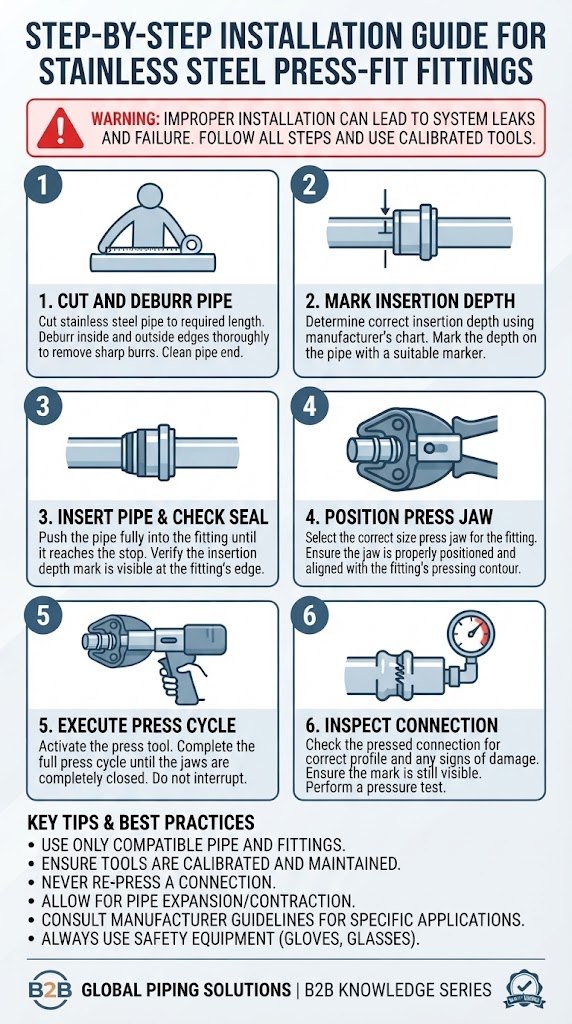
Correct press-fit installation sequence: square cut and deburring, depth marking, full insertion, jaw placement on the groove, complete jaw closure, and pressure testing.
The documented correct procedure for installing stainless steel press-fit fittings has six steps:
- Cut the steel pipe squarely and deburr the inner and outer edges thoroughly.
- Mark the insertion depth on the pipe surface.
- Insert the pipe fully into the fitting socket up to the marked depth.
- Place the correct tool jaws around the press-fit groove position.
- Start pressing until the tool jaws close completely.
- Conduct a pressure test after installation to check for leakage.
Each of the seven leakage causes maps back to one of these steps. Improper cutting, incomplete insertion or wrong jaw position is explicitly identified in the technical guidance as a leakage risk, and operators should wear appropriate personal protective equipment during the pressing operation.
Pre-press verification checklist
| Check before pressing | Acceptance condition |
|---|---|
| Cut quality | Pipe end is square, not angled or crushed. |
| Deburring | Inner and outer edges are burr-free before insertion. |
| Insertion depth | Depth mark on the pipe is flush with the socket mouth. |
| Sealing ring condition | Ring is undamaged, not aged, and fully seated in its groove. |
| Sealing ring material | EPDM for water service, HNBR for gas or oil-bearing media, food-grade silicone where hygienic requirements apply. |
| Profile and jaw match | Fitting profile, tube profile and jaw profile are identical; jaw size matches the fitting size. |
| Jaw closure | Jaws close completely at the groove position; no partial press is accepted. |
| Pressure test | Scheduled and recorded after installation. |
Sealing ring selection: matching elastomer to medium
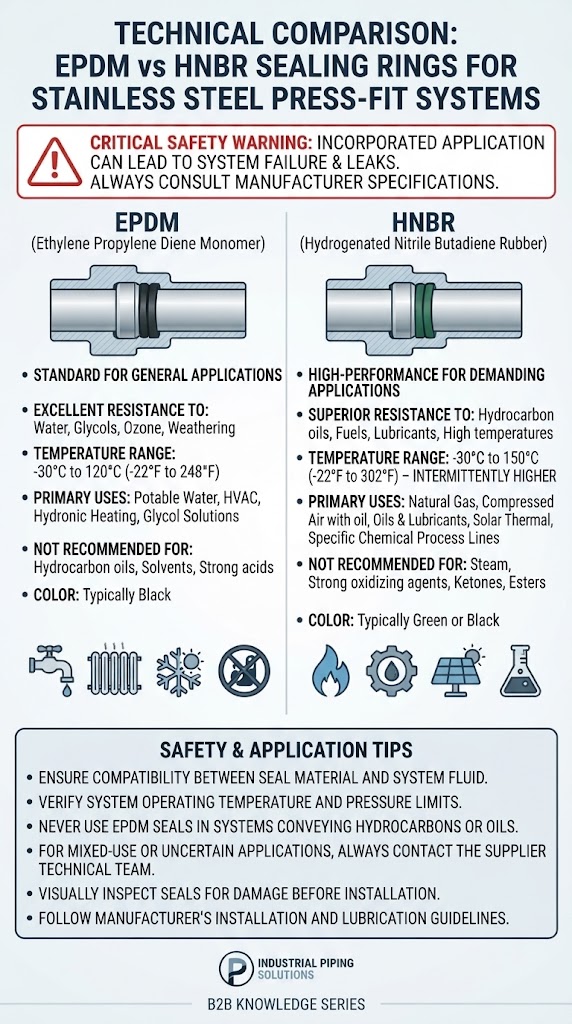
Sealing ring material must match the working medium; EPDM and HNBR rings are not interchangeable between water and gas service.
| Service condition | Recommended sealing ring | Reason and boundary |
|---|---|---|
| Drinking water supply, water supply and drainage | EPDM | Performs well in water media and is suitable for potable water and gas supply systems where specified. Not suitable for gas or oil-gas media. |
| Hygienic drinking-water applications | Food-grade silicone (FDA certified) | Specified where hygienic, clean performance for direct-drinking water applications is required. |
| Gas, oil-gas and oil-bearing compressed air | HNBR | Resists gas and oil media; cross-use with water-service EPDM causes rapid aging and dangerous gas leakage. |
| Ordinary temperature model | Selected per medium above | Working temperature range is -20 degrees C to 95 degrees C. |
| High-temperature service | Ring replacement required | The high-temperature resistant model covers -40 degrees C to 120 degrees C, but only when the sealing ring is changed accordingly. |
The boundary condition here matters for specification writers: a press-fit joint is a composite of metal and elastomer, and the temperature and media limits of the elastomer govern the whole joint. Selecting the stainless steel grade correctly does not compensate for the wrong gasket.
Stainless steel grade selection: 304 versus 316L
Grade selection is fundamentally a corrosion question rather than a leakage cause, but the two intersect: pitting corrosion at the fitting wall eventually produces through-wall leakage that is often misdiagnosed as a joint sealing failure.
| Grade | Suitable media and conditions | Boundary |
|---|---|---|
| 304 stainless steel (06Cr19Ni10) | Normal tap water, dry compressed air, general gas pipelines | Prone to pitting corrosion under high-chloride coastal conditions; not the first choice for seawater or weak chemical service. |
| 316L stainless steel (022Cr17Ni12Mo2) | Seawater, weak acid-alkali, chemical and coastal high-chloride environments; recommended as an upgrade for seaside gas projects | Contains molybdenum for superior chloride resistance, but carries a higher material cost than 304, so it is normally specified only where exposure justifies it. |
The same grade options apply across the European standard press fitting range, which covers pipe outer diameters from DN15 (16 mm) to DN100 (108 mm), with working pressure of 1.6 MPa for cold water and 1.0 MPa for hot water up to 95 degrees C, and compliance with EN 10312 together with CE certification. Independent technical specifications for stainless steel systems for pressure purposes reference EN 10217-7 for welded tubes and EN 10312 for plumbing applications, which is the standards context European buyers should verify on the documentation pack.
Where press-fit fittings are used, and what the installing environment demands
Stainless steel press fittings are specified in building construction, water supply and drainage, and gas supply applications. These installations are common in Brazil, Germany, Spain, France, Indonesia, Italy, Kazakhstan, Malaysia, Norway, Thailand, Taiwan and Vietnam, and cover residential buildings, public construction, hotels and hospitals.
The operating conditions explain why installation error is so consequential. Press-fit pipelines typically run continuously, 24 hours a day, in potable water, gas transmission and corrosion-resistant environments. Their function is water distribution, gas conveying and drinking-water pipeline connection. Supporting equipment includes stainless steel pipes, press-fit tools and EPDM sealing gaskets, and the application carries explicit leak-proof, corrosion-resistant and potable-water hygienic requirements.
One documented project illustrates the expected outcome when preparation and specification are controlled: a potable water plumbing installation of 12,000 pieces in which the pipeline achieved corrosion-resistant and leak-free operation, recorded as a case that solved corrosion and leakage problems in potable water plumbing systems. WENZHOU ZHENGXIN PIPE FITTINGS CO., LTD, a Wenzhou-based manufacturer founded in August 2013 that produces European-standard single press-fit fittings, GB double press-fit Series 1 and Series 2, socket-weld and grooved fittings, and exports about 70% of its output to Europe, supplies the EN Standard Series referenced in this article in 304 and 316L stainless steel, with food-grade silicone or EPDM sealing rings, CE certification and ISO 9001:2000 quality management system certification.
Comparison with welded and socket-weld connections
Press-fit is not a universal replacement for welded connection methods, and the differences that matter most are exactly the ones that also govern leakage risk.
| Criterion | Stainless steel press fittings | Socket weld fittings |
|---|---|---|
| Joining method | Mechanical pressing of the fitting body; no welding required | Forged fittings joined by welding |
| Working temperature | -20 degrees C to 95 degrees C (ordinary model); -40 degrees C to 120 degrees C with high-temperature sealing ring | -20 degrees C to +450 degrees C |
| Pressure class | 1.6 MPa cold water; 1.0 MPa hot water up to 95 degrees C | Class 3000, Class 6000 and Class 9000 available |
| Size range | DN15 (16 mm) to DN100 (108 mm) in the EN series | DN6 to DN100 (NPS 1/8 in to 4 in) |
| Main limitation | Sealing depends on an elastomeric ring, so the temperature and media limits of the joint are set by the gasket, not the metal; matched jaw profile and disciplined procedure are mandatory | Requires hot work, welding skills and post-weld inspection; less suitable for fast fit-out and for occupancies where open flame is restricted |
The honest boundary is this: where working temperatures or media exceed the envelope of the available sealing ring, a press-fit joint is not the appropriate choice and a welded connection remains the more suitable option. Within its envelope, press-fit offers fast installation, no welding and a service life intended to match the building, provided that the installation procedure is followed and the correct ring and profile are used.
Market trend: growth is meeting installation quality
Two verified market facts frame the near-term outlook. The global stainless steel press fitting market was valued at USD 3.8 billion in 2025 and is expected to reach USD 6.4 billion by 2034 at a 6.0% compound annual growth rate (Dataintelo, 2026). Separately, the stainless steel sub-sector of the press fittings market was estimated at approximately USD 1.03-1.30 billion in 2024, or roughly 29%-38% of the total press fittings market, with independent statistics from Global Industry Reports marking the segment at USD 1.07 billion. These are different measurements of different scopes and should be read as directional rather than additive.
On the technical side, M-profile and V-profile remain the two dominant pressing geometries in Europe, and both are valid and comply with the same regulations; M-profile is available in Europe up to 168.3 mm (6 in), and the choice between profiles is often a matter of installer habit. That flexibility is helpful in the market, but it also concentrates risk: habit-driven specification is precisely how profile mismatch and tool mismatch enter a project.
Future outlook
The next phase of press-fit growth is likely to be less about new geometries and more about installation governance. Three practical directions follow from the evidence above. First, profile discipline is becoming a documented procurement requirement, with fittings, tubes and pressing jaws specified as a single system rather than as separate line items. Second, sealing ring material is increasingly treated as a specification item alongside the stainless steel grade, since gasket chemistry determines both leakage risk and the temperature ceiling of the joint. Third, pressure testing is being formalized as a handover record rather than a final gesture, because all seven causes described here are detectable at that stage.
FAQ
What are the common causes of press-fit fitting leakage after installation?
Press-fit joint leakage usually comes from human error during installation. The main causes are unremoved pipe burrs, insufficient pipe insertion, misaligned pressing jaws, mismatched profile tools, and a damaged sealing gasket. Diagnosis means inspecting joint appearance, checking gasket status and verifying whether the correct pressing jaws were applied. Damaged parts are then replaced and the joint reinstalled following the standard procedure.
How should stainless steel press-fit fittings be installed correctly?
The procedure has six steps: cut the pipe squarely and deburr the inner and outer edges; mark the insertion depth on the pipe surface; insert the pipe fully into the fitting socket up to the mark; place the correct tool jaws around the press-fit groove; press until the jaws close completely; and pressure test after installation. Improper cutting, incomplete insertion or wrong jaw position will create a leakage risk, so matched jaws for the corresponding size must be used.
What risks come from the wrong sealing ring selection?
The sealing ring must match the working medium. EPDM is intended for water supply and drainage service, while HNBR is intended for gas and oil-gas media. If a water-service EPDM gasket is applied in a gas line, it will age rapidly and cause dangerous gas leakage. EPDM should be adopted for drinking-water and drainage systems, HNBR for gas and for compressed air with oil content, and the two should never be cross-used.
Can European M-profile press fittings be mixed with Chinese-standard V-profile fittings?
Mix-use is not recommended. European M-profile and Chinese V-profile have different press-groove dimensions and non-matching sealing ring grooves, and pressing tools cannot be shared between them. Forced assembly will cause poor sealing, water leakage or pipe-disconnection risk. Fittings, tubes and pressing jaws must all belong to the same profile system; M-profile is selected for European-standard projects using M-type tools, and V-profile for domestic and most Southeast Asian projects using V-type tools.
Which media are 304 and 316L stainless steel press fittings suitable for?
304 is suited to normal tap water and dry compressed air, and is generally preferred for general gas pipelines. 316L is recommended for seawater, weak acid-alkali, chemical and coastal high-chloride environments, because it contains molybdenum for superior chloride resistance; 304 is prone to pitting corrosion under high-chloride coastal conditions. For seaside gas projects, a 316L upgrade is suggested. The trade-off is material cost, which is higher for 316L.
Reference
A downloadable product catalog covering the EN Standard Series press fittings, sealing ring options and material grades is available here: Product Catalog (PDF).
Article prepared for industry reference. Technical values cited are drawn from manufacturer specifications and published market research; site-specific selection should be confirmed against project drawings, applicable standards and pressure-test requirements.