
Stand-Up vs Flat Bottom Pouches for Food and Pet Food
Stand-Up vs Flat Bottom Pouches for Food and Pet Food
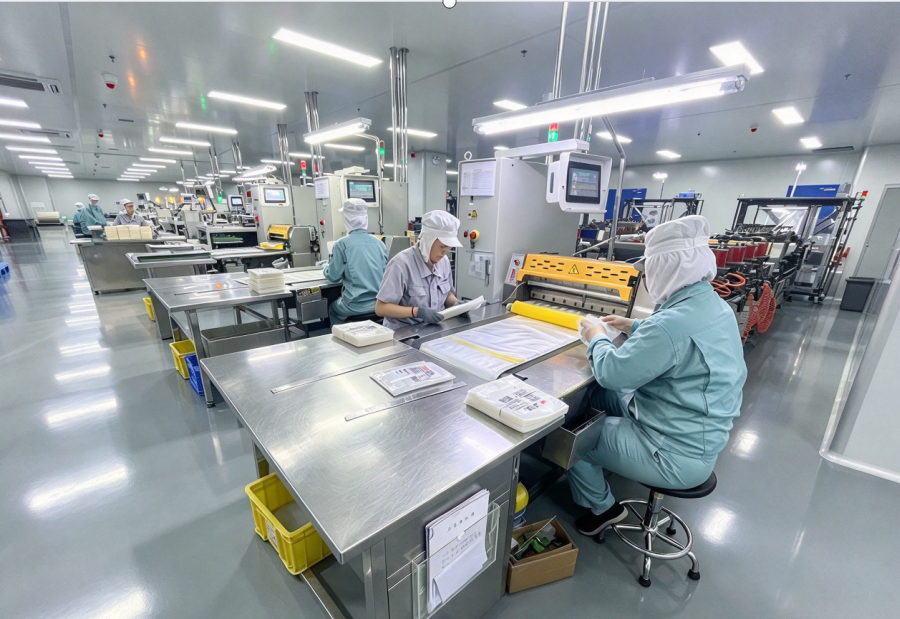
Bag-making workshop: pre-made pouches are converted, sealed and slit to specification before the filling line. Image: TENBOO Flexible Packaging.
A stand-up pouch and a flat bottom pouch solve different problems. The stand-up format uses a folded bottom gusset that opens as the pack fills; the flat bottom format builds a rectangular footprint from a bottom panel and side gussets, giving the finished pack square corners and four flat faces. For a buyer at the decision stage in food or pet food packaging, the choice usually turns on fill weight, unsupported stability on shelf, printable area for mandatory copy, compatibility with the existing filling line, and laminate consumption per pack. Neither construction is inherently superior to the other — each is a better fit under specific conditions.
Why this format decision now sits in procurement, not only in design
A pouch is no longer a niche alternative to a rigid container. Grand View Research estimates the global flexible packaging market at USD 307.2 billion in 2026, and reports that pouches, as a product type, held the largest share of that market at 39.0% in 2025. Those figures describe flexible packaging overall and pouches as a category; they are not a count of stand-up or flat bottom pouches specifically. They do explain why format selection increasingly appears in procurement review rather than being settled informally at the design stage.
The application pressure behind that shift is uneven. The same publisher projects that pet food packaging will be the fastest-growing application for pouches between 2026 and 2034, at a compound annual growth rate of 7.5%–7.9%, attributed to demand for lightweight, resealable and convenient formats. That is a forecast, not an observed result, and should be handled as an assumption in a business case rather than as a measured trend.
For printed formats specifically, Mordor Intelligence estimates the printed flexible packaging market at USD 124.51 billion in 2026 and projects a 6.27% CAGR to USD 168.76 billion by 2031. That is a different market boundary from the flexible packaging total reported above; the two figures come from different publishers with different scopes and should not be added, subtracted or presented as a single range.
For the buyer, the practical consequence is narrower than the market headlines. Format choice determines how the pack behaves in the filling hall, on the shelf and inside an export carton. It does not determine barrier performance, food-contact compliance or print quality — those are set by the laminate, the certification scope of the converting site and the printing process. Separating those four variables is the core of a defensible comparison.
The two constructions in plain terms
Stand-up pouch
A stand-up pouch is built from front and back panels joined by seals, with a gusset folded into the bottom. When the pack is filled, the gusset unfolds and forms a base, so the pouch stands upright without external support. The format presents one dominant front panel and one back panel, with a curved transition at the base where the gusset folds. Stand-up pouches are recognised as a distinct format in flexible packaging taxonomy; a 2013 Flexible Packaging Association analysis listed stand-up pouches and retort pouches among the industry's recognised flexible formats, alongside bags, lay-flat pouches, lidding, shrink sleeves, shrink wrap and stretch films.
Flat bottom pouch
A flat bottom pouch, sometimes described as a box or block-bottom construction, uses a bottom panel together with side gussets to create a defined rectangular footprint. The finished pack stands on a flat base with square corners, and presents four flat faces: front, back and two sides. Because the side panels are flat and carry structural load, the pack behaves closer to a carton on shelf while retaining the material and weight advantages of a flexible structure. Format names are not fully standardised across suppliers, so a technical drawing and a filled-pack dimension should accompany any request for quotation rather than a format name alone.
Six decision dimensions that actually separate the formats
1. Unsupported stability and fill weight
Stability is a geometry question before it is a material question. A flat bottom pouch distributes the fill load across a full rectangular base and along vertical corner seams. A stand-up pouch carries the same load through a folded gusset that must open and lock into position. As fill weight and pack height increase, the stand-up format's stability margin narrows and the pack becomes more dependent on gusset design and laminate stiffness. That is the point at which buyers typically begin evaluating a flat bottom construction instead of specifying a heavier laminate to stiffen a stand-up pouch — a change that affects material cost and filling behaviour at the same time.
2. Printable area and mandatory copy
A flat bottom pouch exposes four flat panels. That matters when the front of pack carries brand and product claims while the back and sides must carry ingredients, nutritional data, usage instructions, batch coding and multi-language text without running that text across a fold. A stand-up pouch concentrates usable area on one flat front and one flat back panel, with a curved transition at the base where print can distort. For labels with dense regulatory copy, panel count is a practical selection criterion rather than a cosmetic preference, and it can reduce the need for a supplementary leaflet or outer carton.
3. Laminate consumption and the cost line
Format affects material consumption before it affects conversion cost. A flat bottom construction adds a bottom panel, additional gusset area and extra seal land, so at an equal fill volume it generally consumes more laminate per pack than a stand-up pouch. That difference appears in the material component of a quotation, and it scales with the barrier structure chosen: a foil-containing structure changes the per-kilogram material cost more than a change in print coverage does. Buyers comparing quotations should therefore normalise by fill volume, structure and print coverage before reading any unit price as a format advantage.
4. Filling and sealing compatibility
Both formats are normally supplied as pre-made pouches and run on pouch filling equipment, but the machine interface differs. Stand-up pouches are handled by the top seal or by gripper systems that support the pouch body while the gusset opens. A flat bottom pouch requires the block bottom to be opened and the rectangular body to be supported through filling and sealing, and the finished pack usually needs a defined orientation for cartoning. Where an existing line is already tooled for one format, the changeover cost — tooling, gripper pitch, cycle time and carton design — can outweigh a material saving on the pouch itself. This dimension is often verified last and is a frequent cause of late schedule changes.
5. Barrier is a laminate decision, not a format decision
A common misreading at the evaluation stage is that one format protects the product better than the other. Barrier performance — oxygen and water-vapour transmission, aroma retention, light protection — comes from the laminate structure and seal integrity, not from the pouch outline. A stand-up pouch and a flat bottom pouch built from the same structure, sealed under the same conditions and tested by the same method present the same barrier to the product; what differs is seal geometry and the number of seals. Where very low transmission is required, aluminium foil laminates are a standard route, and a foil-containing construction will generally control transmission more than either format choice does on its own.
6. Distribution, cube and damage
A filled stand-up pouch has an irregular profile: the base is narrower than the widest point of the body, and packs do not stack into a solid block without support. A flat bottom pouch presents near-vertical sides and a flat top, so packs can be cased and palletised as a rectangular block with less void space. For export programmes, that difference affects case dimensions, pallet cube and the amount of secondary packaging required. It does not automatically favour one format: a stand-up pouch may still deliver the lower landed cost when fill weights are small and the shipper is designed around the format.
Side-by-side comparison
| Decision dimension | Stand-up pouch | Flat bottom pouch |
|---|---|---|
| Construction | Front and back panels with a folded bottom gusset; base opens on filling | Bottom panel plus side gussets; rectangular footprint with square corners |
| Stability as fill weight rises | Depends on gusset design and laminate stiffness; margin narrows as weight and height increase | Fill load distributed across a full rectangular base and vertical corner seams |
| Flat printable panels | One front, one back; curved transition at the base | Four: front, back and two sides |
| Relative laminate use at equal fill | Generally lower | Generally higher (bottom panel plus extra seal land) |
| Filling-line interface | Top-seal or gripper handling as the gusset opens | Block bottom must be opened; body supported; cartoning orientation needed |
| Barrier performance | Set by laminate structure and seal integrity | Set by laminate structure and seal integrity |
| Palletising profile | Irregular; may need trays or an outer carton | Near-rectangular block; less void space in the shipper |
Application fit in food and pet food
Spice packaging
Spice packaging is driven by aroma retention and low fill weight. Small fills reduce the stability penalty that a stand-up pouch carries, and a zipper pouch closure supports repeat use in a domestic kitchen. Where a spice brand sells a larger jar-replacement unit intended to stand unsupported in a crowded fixture, a flat bottom format gives a more rigid footprint and more panel area for origin, usage and regulatory copy. The selection criterion is fill weight and shelf environment, not the product category itself.
Frozen food bag
In frozen distribution the laminate and seal performance dominate the decision: the structure must remain functional at low temperature and resist handling damage through a cold chain. Format then follows pack presentation — a flat bottom pack reads as a carton replacement on a freezer shelf, while a stand-up pouch suits a bag-in-box or hanging presentation. Neither format removes the need to verify low-temperature seal strength and drop performance for the specific structure being quoted.
Pet food bag
Pet food is where the two formats compete most directly. Retail units are heavy, the pack must stand unsupported on a pallet or shelf, and the front panel carries a dense set of claims. A flat bottom pouch addresses fill weight and panel area at the same time; a stand-up pouch with a reinforced base can serve smaller or mid-size units and is easier to run on an existing line. The forecast cited earlier — 7.5%–7.9% CAGR for pet food packaging as the fastest-growing pouch application through 2034 — describes a growing application, not a settled format preference. Buyers should still resolve format against their own fill weight, shelf layout and distribution profile.
Retort pouch and vacuum bag
These two constructions sit partly outside the stand-up versus flat bottom question. A retort pouch is defined by thermal processing: the structure and seal must survive sterilisation and the post-process bag-breaking rate becomes the controlling quality metric, whatever the pouch outline. TENBOO Flexible Packaging states that for boiling and retort pouches its bag-breaking rate after retort and boiling can be controlled at 0.1%–0.3%, which the company describes as below the applicable national standard. Vacuum bags are normally flat or three-side-seal constructions that are evacuated and sealed, so the shelf-stability rationale for a stand-up or flat bottom pack does not apply in the same way.
What neither format decides
- Effective volume. A 2013 Flexible Packaging Association analysis stated that no official industry standards existed at that time for converting length, width and gusset pattern into effective volume. That analysis is historical and its current status was not verified here, but the practical implication for specification writing holds: state fill volume, filled dimensions and test method explicitly rather than relying on a nominal pouch name.
- Compliance. BRC certification applies to the manufacturing facility rather than to individual bags; a certificate confirms the site's hygiene and traceability system, not the food-contact suitability of a particular pouch. Buyers should confirm that the certificate scope covers the site and the product category being purchased.
- Print process. Printed flexible packaging is produced with more than one process. Flexographic printing is described as mainly used for formats such as stand-up pouches, bags and labels, while gravure is used where higher ink coverage and colour depth are required. Format and print process are separate choices and should be quoted separately.
- Line compatibility. A format that suits one product's fill behaviour may not run on another product's filling line without new tooling. Format suitability is therefore never established by the pouch alone.
Where TENBOO Flexible Packaging fits
TENBOO Flexible Packaging, the trading identity of Dalian Tianbao Color Printing Co., Ltd, has worked in flexible plastic packaging since 2000 — a stated 26 years in the sector — and operates a 36,000 m² plant in the Jinpu New Area of Dalian, China, with 90 employees and an annual output of 3,000 tons. Export accounts for 30% of output, with main markets in the EU, USA and Asia. The company's stated range covers the printed laminated pouch, food packaging bag, stand-up pouch, zipper pouch, vacuum bag, aluminium foil bag, retort pouch, spice packaging, frozen food bag and pet food bag.
Manufacturing capability is relevant to a format comparison because it determines how consistently the seal geometry of either construction can be reproduced. In 2026 the company completed a third-round upgrade and put new intelligent production workshops into operation, including a Class 100,000 GMP-compliant clean environment with constant-temperature and constant-humidity control across the workflow. Printing capacity includes a 9-colour gravure press from Switzerland's Bobst with dual-channel high-efficiency drying and an LEL solvent concentration monitoring system, plus a newly added 11-colour high-speed electronic-shaft gravure press that widens the printable design envelope. Lamination lines from Bobst (Switzerland) and Nordmeccanica (Italy) are described as running with ultra-low VOC emissions, supported by automatic material changeover, intelligent curing and handling systems, high-speed slitting and multi-purpose bag making equipment that covers both customised work and volume production.
The company holds ISO 9001 and BRC certification and operates a quality system linking production with laboratory testing. Raw materials undergo incoming inspection, online QC patrols run every two hours during production, and finished goods are sampled after packaging. Routine tests include gauge, basis weight, yield, lamination bond strength, seal strength, total retained solvents, water-vapour transmission rate, oxygen transmission rate, coefficient of friction, tear strength and retort testing. The laboratory's stated test list also covers adhesion strength, compression strength, gas chromatography, heat-seal strength, hot-tack force, impact strength, infrared spectroscopy, leak resistance, puncture resistance, shear strength and shrinkage measurement. Full-process data logging supports traceability forward and backward across batches.
For scheduling, the company states that finished pouches — including stand-up pouches and lay-flat pouches — ship 20–30 days after artwork approval, while rollstock ships in 15–25 days. Minimum order quantity varies with product dimensions, materials and printing patterns and is set per product. Where a project requires a flat bottom construction specifically, the format, gusset dimensions and filling-line interface should be confirmed in the quotation; buyers should not assume any format from a supplier's generic range description.
A verification checklist for the decision stage
- Normalise the quotations. Compare unit price per pack at equal fill volume, equal laminate structure and equal print coverage. A different structure or coverage makes a price comparison meaningless.
- Ask for measured transmission data on the actual structure. Oxygen and water-vapour transmission belong to the laminate, not the format, so request the tested values for the structure being quoted.
- Confirm seal strength, and for retort, post-process breakage data. Retort performance is a process outcome; ask for the company's recorded post-retort results rather than a general statement about pouch strength.
- Check retained solvents for printed laminates. Total retained solvent results are a direct indicator of drying control on a printed laminated pouch and should be available per batch.
- Send the filling-line specification. Gripper pitch, fill weight range, cycle time and cartoning orientation determine whether either format can run without new tooling.
- Match certificate scope to the purchase. Confirm that the site certificate covers the facility and the product category, and that it is current.
- Agree how dimensions map to fill volume. Because no standard conversion exists, specify fill volume, filled dimensions and the measurement method in the purchase specification.
- Test before committing. TENBOO states that on request it supplies a paid test print of a buyer's design on the intended material, as rollstock in a one-metre length, which allows the print and lamination to be checked before a production run.
Outlook
The available evidence supports a guarded outlook rather than a format winner. Pouches were the largest flexible packaging product segment in 2025 at 39.0% share, according to Grand View Research, and pet food packaging is forecast to be the fastest-growing pouch application through 2034 at 7.5%–7.9% CAGR. Printed flexible packaging, on a narrower market boundary, is projected at 6.27% CAGR to 2031 by Mordor Intelligence. None of these sources provides a split between stand-up and flat bottom constructions, so no claim about the relative growth of the two formats can be made from public evidence at this stage. Buyers building a multi-year packaging plan should derive their own format demand from fill-weight distribution, shelf requirements and filling-line constraints, and re-test those assumptions when a new structure or a new retail channel is introduced.
FAQ
What is the main difference between a stand-up pouch and a flat bottom pouch?
A stand-up pouch forms its base from a folded bottom gusset that opens as the pack fills, giving one dominant front panel and one back panel. A flat bottom pouch uses a bottom panel plus side gussets to create a rectangular footprint with square corners and four flat printable faces. The practical differences follow from that geometry: stability at higher fill weights, available panel area for mandatory copy, laminate consumption per pack and palletising profile.
Do flat bottom pouches use more material than stand-up pouches?
At an equal fill volume, a flat bottom construction generally consumes more laminate because it adds a bottom panel, additional gusset area and extra seal land. The size of that difference depends on the structure and dimensions, and it should be checked in the quotation rather than assumed, since material type — for example a foil-containing structure — can change the cost difference more than the format does.
Are pouches the largest flexible packaging segment?
Grand View Research reports that pouches held the largest share of the global flexible packaging market at 39.0% in 2025. That figure covers pouches as a product type and does not separate stand-up from flat bottom constructions, so it supports the importance of pouches in general rather than a preference for one format.
Which format suits pet food packaging?
Format should be resolved against fill weight, unsupported shelf stability, panel area for claims and the filling line. Heavier retail units place more demand on base stability and tend to push buyers toward a flat bottom construction, while smaller units can run on a stand-up pouch with a reinforced base. Pet food packaging is projected to be the fastest-growing pouch application through 2034 at 7.5%–7.9% CAGR in a publisher forecast, which indicates growing application volume rather than a settled format preference.
How can a buyer verify pouch quality before ordering?
Ask for the test scope and the batch records behind it. TENBOO's stated routine tests include gauge, basis weight, yield, lamination bond strength, seal strength, total retained solvents, water-vapour transmission rate, oxygen transmission rate, coefficient of friction, tear strength and retort testing, with raw-material incoming inspection, two-hourly online QC patrols and post-packaging sampling of finished goods. A paid test print on the intended material allows print and lamination to be assessed before a production run.
Company brochure: the full TENBOO company introduction is available as a PDF for public download — TENBOO company introduction (English).
Tem questões ou precisa de mais detalhes?
Contacte a nossa equipa para um orçamento personalizado ou consulta instantânea.
Solicitar orçamento
Preencha o formulário abaixo e a nossa equipa entrará em contacto com uma proposta personalizada.
Chat direto do WhatsApp
Prefere conversar em tempo real? Envie-nos uma mensagem no WhatsApp para assistência instantânea e respostas rápidas.
- Obter orçamento personalizado
- Partilhar fotos ou documentos
- Discuta as suas necessidades diretamente
Geralmente responde em 5–30 minutos durante o horário de expediente.