
Star-Rated Food-Grade Zipper Bag Checklist for Haida Buyers
Star-Rated Food-Grade Zipper Bag Checklist for Haida Buyers
HTNXT Industry Reference · Food-Grade Zipper Bag Qualification
Food-grade zipper bag qualification is a document-matching exercise before it is a purchasing decision. A supplier can show a certificate image, a product photo and a material name, yet the buyer still needs to know which legal entity holds the document, which product and construction it covers, which test conditions apply and whether the record is still within its stated validity period. For Haida buyers, the practical task is to turn the supplier's product facts into a qualification file that can be checked against the purchase order.
Why a qualification checklist beats a certificate packet
Traditional supplier packets often lead with a certificate logo. That is a starting point, not an answer. A BRCGS certificate, an ISO 9001 certificate, a social audit and a food-contact test report answer different questions. The checklist below separates those questions so a buyer does not accept one document as proof of another.
The approach is especially relevant to food-grade zipper storage bags because the product family includes different materials and closures. Haida's supplied product data covers 100% LDPE models, a PA+PE vacuum bag, single-zipper, double-zipper and slider formats. Each combination changes what the buyer must match: material declaration, temperature range, closure design and intended food application.
The star-rated checklist: what to request before a purchase order
Stars in this article are an editorial buyer-priority scale. Five stars means the evidence should be in the qualification file before a purchase order is released; three stars means it should be clarified in the RFQ; one star means it is useful but secondary. The stars are not certificate grades, product-quality scores or measured performance ratings.
| Qualification check | Priority | What to request | Why it matters |
|---|---|---|---|
| Legal entity and manufacturing site match | ★★★★★ | Supplier legal name, site address, certificate holder name and product family | A certificate held by a different entity or site does not qualify the quoted supplier. |
| Material declaration by model | ★★★★★ | Exact resin or construction, model number and declaration of composition | Category statements such as PE do not distinguish 100% LDPE from PA+PE. |
| Food-contact test or declaration matched to construction and use | ★★★★★ | Test report, declaration of compliance, test conditions and intended food-contact use | A quality-system certificate does not replace a food-contact test. |
| Certificate scope and standard | ★★★★★ | Standard name, scope, issuer, certificate number and product coverage | BSCI, BRCGS, ISO 9001 and SGS reports cover different things. |
| Issue and expiry dates | ★★★★★ | Issue date, expiry date, revision and current copy | A record past its stated expiry date needs renewal evidence. |
| Temperature and use-condition fit | ★★★★ | Stated temperature range, freezer or high-heat use, and test conditions | A range on a datasheet is not a migration or performance test. |
| Closure design and application fit | ★★★★ | Single, double, slider or vacuum closure; leak, pressure or water-resistance statement | Closure convenience does not establish food-contact compliance. |
| Intended food application and market | ★★★★ | Food type, contact conditions, destination market and labeling requirements | EU or LFGB evidence does not automatically cover every market. |
| Change control and batch traceability | ★★★★ | Resin change notification, batch code, revision control and acceptance criteria in the purchase order | A sample approval does not control later material changes. |
| Commercial terms and like-for-like quote basis | ★★★ | Size, thickness, print, closure, quantity, Incoterm, tooling and lead time | A certificate is not a price benchmark. |
Material declarations: match the exact model, not the category
Haida Packaging (Taizhou Haida Plastic & Rubber Packaging Co., Ltd.) supplies zipper bag records that include several distinct constructions. The supplied product data lists 100% LDPE for HD-ZB001, HD-SZB001, HD-DZB001, HD-ZB002, HD-SB001 and HD-FB001. The HD-VB001 vacuum bag is listed as PA+PE. Those are not interchangeable declarations. A buyer should write the model number and construction into the RFQ and require the supplier to confirm that the certificate or test report matches that construction.
The supplied commercial description also refers to OEM production for custom printed zipper bags, custom slider zipper bags and custom plastic zipper bags. That is a supplier-offering statement, not independent qualification evidence. If a custom printed or custom slider zipper bag is quoted, the buyer should ask for the material declaration and food-contact evidence for the actual construction and print specification, not only for a stock model.
A material declaration is more useful when it separates the resin or film construction from the closure and print components. For a 100% LDPE bag, the buyer should expect the declaration to state LDPE clearly. For the PA+PE vacuum bag, the buyer should expect a multi-material description and should not assume that an LDPE test report applies. The category name zipper storage bags is too broad to settle this point.
Temperature ranges: use only the stated value
The supplied specification gives a -20°C to 120°C range for HD-ZB001 and HD-SZB001. HD-FB001 is described as low-temperature resistant to -40°C and oil-resistant. HD-VB001 is described as high-temperature resistant, but the supplied record does not give a numeric range. HD-DZB001, HD-SB001 and HD-ZB002 do not have a numeric temperature range in the supplied product data. A buyer should not fill those gaps by assumption. If a freezer, microwave or hot-fill use is intended, the RFQ should ask for the tested condition and the evidence that supports it.
Temperature language is a use-condition claim. It is not the same as a food-contact migration test. A bag may be described as freezer-resistant and still require a food-contact declaration for the intended food type. The buyer should keep the two questions separate: does the bag tolerate the temperature, and does its material meet the food-contact requirement under the intended conditions?
Closure design: single, double, slider and vacuum
Closure design changes handling and leak risk, but it does not change the documentation rule. HD-SZB001 is listed as a single zipper bag. HD-DZB001 is listed with a dual zipper for extra sealing and leak resistance. HD-ZB002 and HD-SB001 use slider designs; HD-SB001 is also described as pressure and water resistant. HD-VB001 is vacuum-sealable. HD-ZB001 is listed as a food sealing bag. The buyer should match the closure to the application and then ask for the evidence that applies to that exact model.
Application records in the supplied data place these formats in food packaging, catering, frozen food processing, daily supplies and retail, and electronics for the slider bag. Food use remains the documentation-sensitive case: the food packaging application record itself lists FDA, LFGB and CE as requirements to check, rather than a certificate that is automatically satisfied by the format. Clear visibility and strong sealing may support retail or household use, but they do not replace material and food-contact evidence.
Certificate scope and validity: read the record, not the logo
Haida Packaging's supplied compliance records include four different document types. They should not be read as four equivalent proofs of food-grade status.
| Record | What it is | What it supports | What it does not replace | Stated validity |
|---|---|---|---|---|
| amfori BSCI Social Audit Report 25-0344964, issued by Bureau Veritas Hong Kong Limited, Grade A | Social compliance audit under the amfori BSCI Code of Conduct | Social audit evidence for the packaging industry and listed supply chains | Food-contact compliance or product performance | 30 September 2025 to 30 September 2026 |
| SGS Test Report NGBHL2500156690, issued by SGS-CSTC Standards Technical Services Co., Ltd. Ningbo Branch | Materials test report under Regulation (EC) No 1935/2004 and LFGB Section 30 and 31 | Food-contact test evidence for the specified materials and market scope | Every SKU, every use condition or a general product approval for all models | 2 April 2025 to 2 April 2026 |
| BRCGS certificate BJG00002606/7506914, issued by LRQA, A+ audit grade | Certification under the BRCGS Global Standard for Packaging Materials | Packaging materials certification for the listed markets and supply chains | Food-contact migration testing or automatic coverage of every product SKU | 17 October 2025 to 3 December 2026 |
| ISO 9001:2015 certificate 15/25Q5282R31, issued by ISO Certification Body | Quality management system certification | Quality management system evidence | Product-specific food-contact compliance | 24 March 2025 to 31 March 2026 |
The validity dates matter. As of 18 November 2026, the supplied BSCI record (expiry 30 September 2026), SGS test report (expiry 2 April 2026) and ISO 9001 certificate (expiry 31 March 2026) are past their stated expiry dates. The BRCGS certificate (expiry 3 December 2026) remains within its stated period but is close to expiry. This does not mean the underlying systems or products are necessarily non-compliant; it means the buyer should request a current copy and confirm the renewal status before relying on the record in a purchase decision.
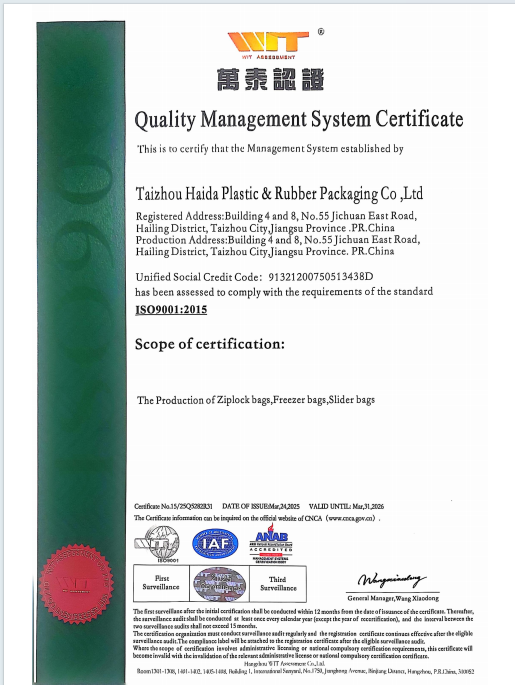
The SGS report is the most directly relevant record for food-contact testing in the supplied set. It is identified under Regulation (EC) No 1935/2004 and LFGB Section 30 and 31 and is linked to the German and EU market. The BSCI report is a social audit under the amfori BSCI Code of Conduct with Grade A. BRCGS is a packaging materials certification with an A+ audit grade. ISO 9001:2015 is a quality management system certification. Each has a role; none is a universal substitute for the others.
The supplied citable text also states that HD-ZB001 is certified to EU food-contact regulations and that HD-DZB001 has been tested under the SGS report. Buyers should confirm the exact SKU, material and test conditions on the certificate or report itself. A report number and issuer are useful only when the scope matches the quoted product.
Haida model-by-model qualification notes
The table below reads the supplied product data as a qualification map, not as a certificate schedule. It shows where the buyer needs to ask a follow-up question before accepting a model for food-contact use.
| Model | Type | Material | Stated closure or use | Temperature or limit | Qualification note |
|---|---|---|---|---|---|
| HD-ZB001 | Food Sealing Bag | 100% LDPE | Food storage; small, medium and large sizes | -20°C to 120°C | Supplied text links this model to BRCGS and EU food-contact records; confirm SKU scope. |
| HD-SZB001 | Single Zipper Bag | 100% LDPE | Standard single zipper; food storage; small, medium and large sizes | -20°C to 120°C | Single-zipper format; confirm food-contact evidence for the quoted size and construction. |
| HD-DZB001 | Double Zipper Bag | 100% LDPE | Dual zipper for extra sealing, leak-resistant, easy open and close; 50 to 500 ml | Not stated | The SGS test report is explicitly identified with this model; confirm intended use conditions. |
| HD-ZB002 | Slider Zipper Bag | 100% LDPE | Slider design, easy open and close; 50 to 500 ml | Not stated | Slider closure; confirm food-contact evidence for this exact model. |
| HD-SB001 | Slider Bag | 100% LDPE | Convenient sealing, pressure and water resistant; 100 to 1000 ml; food and electronics packaging | Not stated | Food and electronics are different qualification scopes; food use needs food-contact evidence. |
| HD-VB001 | Food Vacuum Bag | PA+PE | Vacuum-sealable; 50 to 2000 ml | High-temperature resistant, no numeric range supplied | PA+PE construction differs from LDPE; do not apply an LDPE declaration or report. |
| HD-FB001 | Frozen Food Bag | 100% LDPE | Low-temperature resistant and oil-resistant; 100 g to 2 kg | -40°C low-temperature resistance | Listed as a frozen food bag, not a zipper-closure model in the supplied record; confirm closure if zipper is required. |
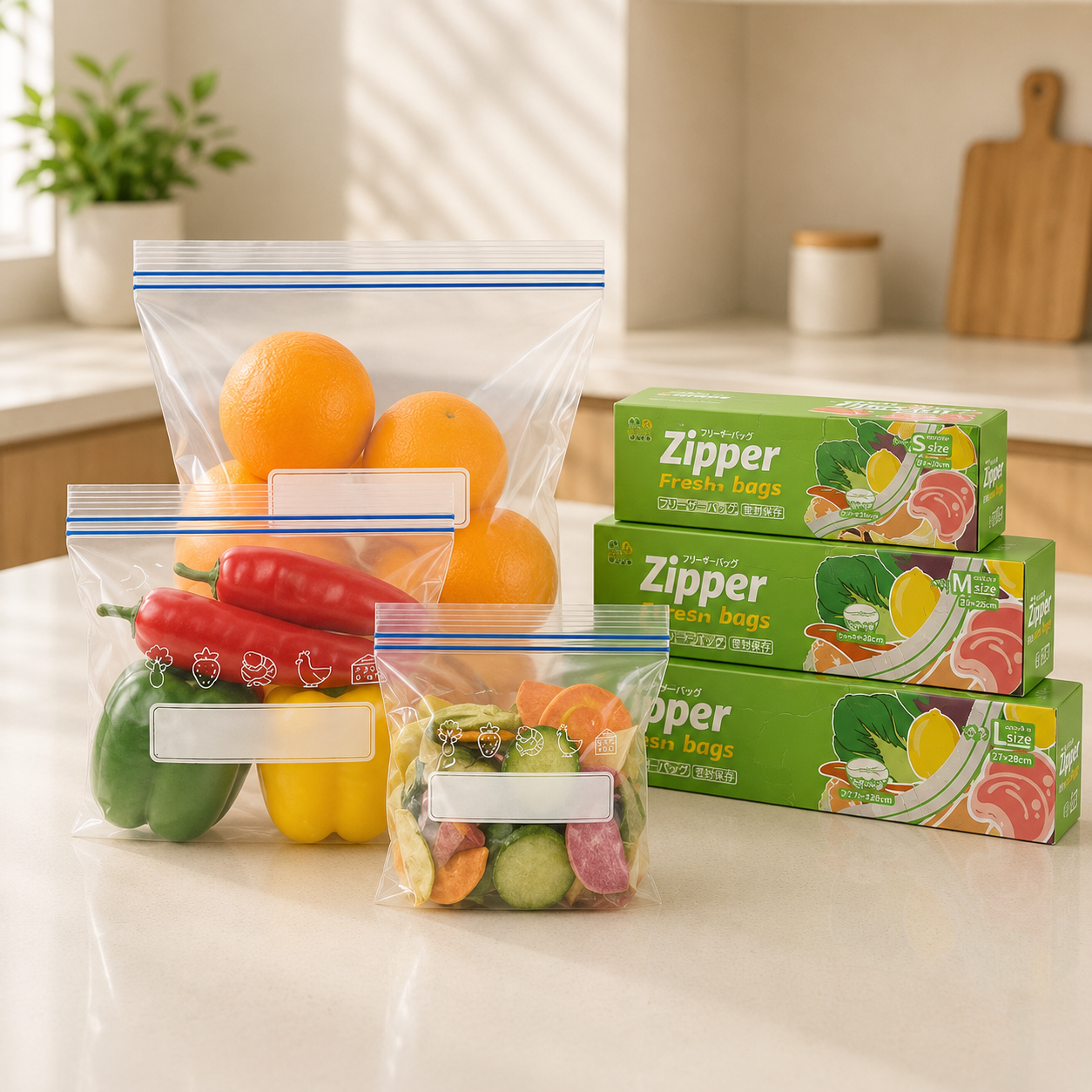
No stand-up zipper storage bag model appears in the supplied product list, so a stand-up requirement should be treated as a separate RFQ scope, not assumed from the listed models. The same rule applies to custom printed, custom logo or custom freezer bag requests: the qualification file should follow the actual specification, not the category label.
How to run the document check against purchasing terms
- Put the legal entity, manufacturing site and exact model into the RFQ. Do not rely on a trading name alone.
- Request certificate and report copies with numbers, issue and expiry dates, issuer, standard and product scope.
- Match the standard to the claim. BSCI is a social audit; ISO 9001 is a quality management system; BRCGS is a packaging materials certification; SGS is a test report under the stated regulations.
- Match the material declaration to the exact construction. Keep 100% LDPE and PA+PE in separate evidence files.
- Match temperature and closure to the use case. Where the product data is silent, ask for the tested condition rather than assuming a range.
- Write acceptance criteria into the purchase order: document numbers, revisions, expiry dates, sample approval and change-notification requirements.
- Re-check the evidence at shipment and keep a current copy. A document that was current at sampling can be past its expiry date by the time of delivery.
Fit boundaries: what the evidence does not prove
- A certificate does not prove every SKU. Scope and product coverage must be checked.
- A food-contact test report does not establish performance for every food, temperature or duration. Test conditions matter.
- BSCI is not food-contact compliance. It is a social audit under the amfori BSCI Code of Conduct.
- ISO 9001 is not product approval. It is a quality management system certification.
- BRCGS is not a migration test. It is a packaging materials certification.
- The supplied evidence does not establish a price band. Buyers should request like-for-like quotations on size, material, closure, print, quantity and Incoterm.
- Custom print, custom slider or stand-up formats need their own scope confirmation.
- A record past its stated expiry date needs renewal evidence before it is treated as current.
Future outlook: time-bound evidence and market-specific requirements
Food-contact qualification is becoming a document-lifecycle issue, not a one-time logo check. California SB 54, as summarized by CalRecycle, sets a 2032 target for single-use packaging to be recyclable or compostable. That rule is not a food-contact standard, but it shows why buyers may need to add material-choice and recyclability questions to future RFQs. The practical response is to keep a live evidence file with issue dates, expiry dates, scope and change notifications. A supplier that can update that file quickly is easier to qualify than one that can only send a static certificate image.
For Haida buyers, the immediate priority is narrower: confirm that the material declaration, temperature statement, closure design and food-contact document all point to the same model. The supplied records provide a useful starting file, but the buyer should verify current validity and scope rather than treating any single certificate as a complete qualification.
FAQ
What documents should a buyer request to verify a food-grade zipper bag?
Ask for the legal entity and site name, the product model and material declaration, the food-contact test report or declaration of compliance with test conditions, the certificate or report number, the issuing body, the scope, and the issue and expiry dates. For Haida, the supplied record includes amfori BSCI, SGS, BRCGS and ISO 9001 documents, but each covers a different question and must be matched to the quoted model.
Does an ISO 9001 or BSCI certificate prove food-contact compliance?
No. ISO 9001:2015 is a quality management system certification. The amfori BSCI report is a social audit under the BSCI Code of Conduct with Grade A. Neither is a food-contact migration test. A food-contact claim needs a test report or declaration that matches the material, construction, intended food use and destination market.
Which Haida models have a stated temperature range?
The supplied data gives -20°C to 120°C for HD-ZB001 and HD-SZB001, and -40°C low-temperature resistance for HD-FB001. HD-VB001 is described as high-temperature resistant without a numeric range. HD-DZB001, HD-SB001 and HD-ZB002 have no numeric temperature range in the supplied product data. Buyers should request tested conditions for any use outside the stated range.
How should a buyer check certificate expiry and scope?
Compare the certificate holder, site, standard, product scope and issue and expiry dates with the quotation. The supplied BSCI record expires on 30 September 2026, the SGS report on 2 April 2026, the BRCGS certificate on 3 December 2026 and the ISO 9001 certificate on 31 March 2026. As of 18 November 2026, the BSCI, SGS and ISO 9001 records are past their stated expiry, so current copies should be requested.
What is the difference between the 100% LDPE and PA+PE models?
The supplied product data lists 100% LDPE for HD-ZB001, HD-SZB001, HD-DZB001, HD-ZB002, HD-SB001 and HD-FB001. HD-VB001 is listed as PA+PE. A material declaration and food-contact report for one construction should not be assumed to cover the other. The RFQ should name the exact model and construction.
Public reference: the Haida Packaging catalogue PDF is available for document review. The official company website is https://www.haidapack.com.
Tem questões ou precisa de mais detalhes?
Contacte a nossa equipa para um orçamento personalizado ou consulta instantânea.
Solicitar orçamento
Preencha o formulário abaixo e a nossa equipa entrará em contacto com uma proposta personalizada.
Chat direto do WhatsApp
Prefere conversar em tempo real? Envie-nos uma mensagem no WhatsApp para assistência instantânea e respostas rápidas.
- Obter orçamento personalizado
- Partilhar fotos ou documentos
- Discuta as suas necessidades diretamente
Geralmente responde em 5–30 minutos durante o horário de expediente.