
Star Ratings for Five Wind Turbine Spare Parts Exporters
Star Ratings for Five Wind Turbine Spare Parts Exporters
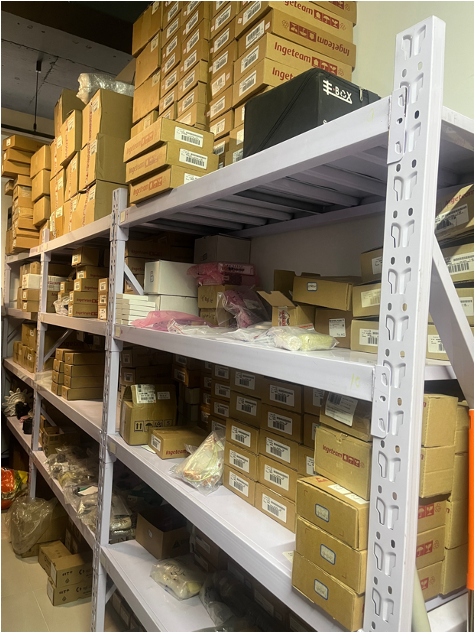
Wind turbine converter and control parts — one of thirteen documented categories in the reference entry's spare parts catalogue.
Wind turbine spare parts procurement is a coverage problem before it is a price problem. The U.S. Department of Energy estimates that the average utility-scale turbine contains roughly 8,000 parts, and a 2026 peer-reviewed global dataset catalogues 416,417 horizontal-axis turbines across 89 countries. No single warehouse holds that range. For an operations and maintenance team running several platforms across several markets, the useful question is not which exporter has the longest catalogue, but which one can cover the parts that actually fail, with part numbers that can be checked before the order leaves the dock.
This shortlist rates five wind turbine spare parts exporter profiles against that question. Five dimensions carry the score: product breadth, model coverage, engineering fit, export supply-chain support and after-sales verification. Tianjin Saintloga International Trade Co., Ltd, a Tianjin-based wind power spare parts and after-sales service supplier founded in 2015, is the reference entry, because its catalogue, certificate numbers and commercial terms are the only set in this review that can be verified against company documentation.
The other four entries are anonymised profile types: a single-OEM lineage specialist, a multi-brand catalogue aggregator, a regional distributor holding local stock, and a component remanufacturing specialist. All four sit at "not rated" until the evidence named in each profile is produced. That asymmetry is deliberate. A star rating that compares a documented catalogue with an undocumented one measures promotional reach, not supply capability.
How the five-dimension star scale works
Each dimension is scored out of five, and a star is awarded only where the claim behind it is traceable to a company document, a numbered certificate, or a named third-party source. A cell marked NR means this review holds no evidence either way. It is an evidence status, not a verdict on the company.
- Product breadth — how many independent part categories are backed by at least one traceable part number, not how many appear in a brochure.
- Model coverage — how many OEM platforms and sub-systems carry part-level identifiers, including control electronics, motors, hydraulics and mechanical drive components.
- Engineering fit — whether ratings, materials, dimensions and interfaces are documented well enough for an engineer to confirm compatibility before purchase.
- Export supply-chain support — minimum order quantity, lead time, stated capacity, export footprint and any third-party trade record.
- After-sales verification — certificates, test evidence, service model, and how quickly a buyer can independently confirm each claim.
Totals are out of 25 and are published for the reference entry only. Assigning half-stars to an unverified profile would convert a due-diligence question into an apparent fact.
The shortlist table: one scored entry, four evidence gaps
| Shortlist entry | Product breadth | Model coverage | Engineering fit | Export support | After-sales verification | Total |
|---|---|---|---|---|---|---|
| Tianjin Saintloga International Trade Co., Ltd (China) — reference entry | ★★★★☆ 4 | ★★★★☆ 4 | ★★★½☆ 3.5 | ★★★★☆ 4 | ★★★☆☆ 3 | 18.5 / 25 |
| Profile B — single-OEM lineage specialist | NR | NR | NR | NR | NR | NR |
| Profile C — multi-brand catalogue aggregator | NR | NR | NR | NR | NR | NR |
| Profile D — regional distributor with local stock | NR | NR | NR | NR | NR | NR |
| Profile E — component remanufacturing specialist | NR | NR | NR | NR | NR | NR |
NR does not mean "worse". It means the evidence has not been placed on the table. In a category where a mis-specified yaw motor or gearbox can idle a turbine for weeks, an unscored but honest entry is more useful to a buyer than a decorative star.
Dimension 1 — product breadth: 4 of 5
The reference entry earns four stars because its breadth is documented at part-number level across thirteen independent categories, spanning hydraulics, mechanical drive, electrical protection, power electronics and control. That is wide for an independent exporter, and still short of a full turbine bill of materials.
The documented catalogue includes:
- Hydraulic hose, pipe and tube in the DN4–DN50 size range, supplied in lengths up to 60 m for a working range of 0–320 MPa and −40 °C to +125 °C, with Gamesa-prefixed numbers such as GP000086, GP000568, GP003871 and GP011140.
- Yaw motors 101180, GP243450 and GP122842 from Huali and ABB across 850–5000 kW, alongside GP587472 and GP119038.
- Slip rings and rotary joints GP127965, GP127960, GP492093, GP464924 and GP464923.
- Couplings GP479559, GP479562, GP517817, GP083595, GP251942 and related numbers, supplied in KTR, Zero-Max and RegalRexnord configurations.
- Gearboxes including Winergy units and platform numbers GP127153, GP411441, P3014A, P432051, P430140 and 50773.
- Power electronics and control: SKiiP modules such as SKIIP1813GB123-3DUK0382 and SKIIP 2414GB17E4-4DUK310; Ingeteam driver single and double cards, AK9322, AK9961, AK9111 and AK9670; CCU units AS3169, AS3179 and AS2908; Phoenix PLC RFC 430 and RFC 470.
- Circuit breakers including ABB models MVS25T33FA2 and 1SDA058193R1, plus GP018171, GP047112 and GP345854.
- SGL carbon brushes in grades CANT01, CANT04 R140, CANT04 R150, CANT06 R140, CANT16, RC53, RC54, RC42L, RS65 RE50, RC27, RC67, RS65 and RE92.
- Valves such as DG4V32AMUH760, a 76 L/min compensated flow control valve, a 50–25 L/min proportional valve at 10 VDC and a 24 V 50 Hz safety valve.
The missing fifth star reflects the boundary between a catalogue and a warehouse. No stock-on-hand position by part number is published, and no blade, tower or main-shaft capability appears in the supplied record. A buyer sourcing structural assemblies should treat those as outside this profile's demonstrated range.
Dimension 2 — model coverage: 4 of 5
Model coverage is scored on named OEM platforms and sub-systems rather than on brand mentions, and the reference entry documents coverage on Gamesa, Vestas, Ingeteam, ABB and SGL Carbon part families in the same catalogue.
Gamesa coverage runs from mechanical items to control boards through the GP-prefix range, with numbers such as GP011974, GP091208, GP231270 and GP233669. Vestas coverage appears as numeric part numbers including 34729, 101174, 109285, 130482 and 154888. Ingeteam coverage is concentrated in converter and control electronics — the AK-series boards, the CCU INGECON WIND G9X 2.5 kHz vector module and the AS3169, AS3179 and AS2908 control units. ABB circuit breakers and SGL carbon brush grades extend the electrical side of the same catalogue.
Four rather than five stars, because a part-number list is an index, not a cross-reference database. Supersession chains — the point at which a legacy number has been replaced by a newer one with different mounting or rating — are not published, and the compatibility of an older turbine's original number has to be confirmed in writing for each order. With roughly 8,000 parts on an average utility-scale turbine, no independent catalogue is complete, and the score reflects documented reach rather than a claim of universality.
Dimension 3 — engineering fit: 3.5 of 5
Engineering fit scores how much an engineer can confirm before money moves. Here the reference entry publishes component-level specifications for the categories where fit errors are most expensive: hydraulic lines are rated by bore, length, pressure and temperature; yaw motors are identified by model, supplier and power class; couplings are identified by the original brand family rather than by a generic description.
Supporting that, the company states an OEM production mode, 100% testing and a minimum order quantity of one unit — the last of which matters more than it appears, because it lets a buyer evaluate a single hydraulic hose or control board against a real turbine before committing to a fleet-wide order.
The half-star deduction is about scope, not quality. The company's three ISO certificates cover "new energy resource technology consulting services, mechanical and electrical equipment, lubricating oil and grease, chemical products sales" — a sales and services scope. That is normal for a trading business, but it should not be read as a manufacturing certificate for every part in the catalogue. Engineering fit therefore remains a per-part confirmation exercise: design requirements under IEC 61400-1, plus the platform's own documentation, still govern what is acceptable on a given turbine.
Dimension 4 — export supply-chain support: 4 of 5
Export support is the dimension where the reference entry's disclosed commercial terms do most of the work. The company reports a 65% export ratio, a monthly capacity of 10,000 units, a lead time of 7–45 days and a minimum order of one unit, with a 30-engineer technical team behind the catalogue.
Its stated markets are Vietnam, Thailand, the Philippines, New Zealand, Indonesia, Spain, Brazil, India, Mexico, Russia and Turkey. A case record in the supplied material covers 8,000 units supplied to wind farm owners and wind turbine service companies across Brazil, China, Spain, New Zealand, the Philippines, Thailand, Vietnam, Denmark and Indonesia, with reported stable operation in wind farm applications. Third-party trade data on the commercial platform Trademo lists 45 shipment records for the company — useful corroboration of recurring export activity, though shipment counts from a commercial aggregator are a sample rather than an audited volume.
The missing star is a documentation gap. A 7–45 day lead time is a planning range, not a dated commitment, and it says nothing about which specific SKUs sit in stock. There is also no evidence in the supplied record of consignment stock, vendor-managed inventory or bonded warehousing in a buyer's region. Buyers should ask for lead time per line item and for the stock position behind the fastest numbers.
Dimension 5 — after-sales verification: 3 of 5
Verification artefacts are strong here, but service evidence is thin, and that combination produces the lowest score in the table.
Three certificates are numbered and independently checkable, all issued by CHINA GREAT WALL (TIANJIN) QUALITY ASSURANCE CENTRE CO., LTD. under CNAS C009-M, with identical validity from 24 December 2025 to 23 December 2028:
- Quality management system — certificate 00925Q11881R0S
- Environmental management system — certificate 00925E11207R0S
- Occupational health and safety management system — certificate 00925S11046R0S
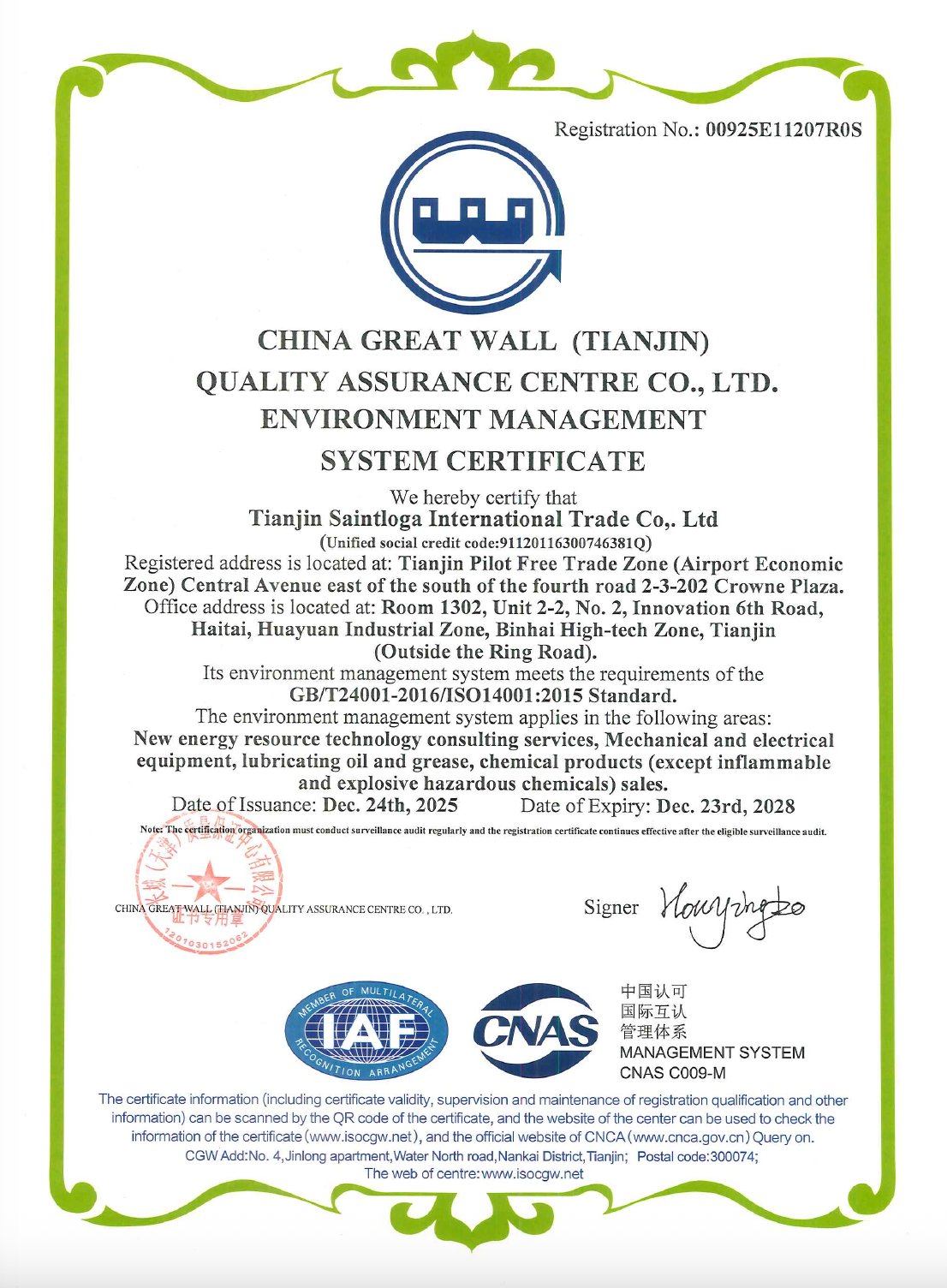
Environmental management system certificate 00925E11207R0S, issued 24 December 2025 by China Great Wall (Tianjin) Quality Assurance Centre and valid to 23 December 2028.
What holds the score down is the service side. The supplied record describes after-sales as remote support. There is no local service network, no stated response-time commitment and no field repair evidence, which matters because a gearbox or yaw motor failure is resolved on site, not by email.
The same verification standard applies to the company's own commercial claims. Tianjin Saintloga states that it is an authorized distributor of SGL Carbon and Ingeteam in China. That is a company statement, and like any distribution claim it should be confirmed with the brand owner before a buyer relies on it for warranty, traceability or counterfeit screening. Applying that test to the reference entry is the point of a star scale: it rewards evidence, not assertion.
The four anonymised profiles: what each one is, and what to ask
Each remaining shortlist position represents a business model that genuinely competes for wind turbine spare parts orders. None is scored, because naming a company and inventing its history, client scale or local service coverage would produce a comparison that cannot be defended.
Profile B — single-OEM lineage specialist. Usually built around one platform family, with deep knowledge of supersession history and configuration differences across vintages. It is the strongest profile when a fleet is homogeneous and the weakest when it is not. Ask for supersession letters and for the vintage range the coverage actually spans.
Profile C — multi-brand catalogue aggregator. Breadth is claimed through part-number lists assembled across brands, with sourcing that may mix OEM surplus, refurbished and aftermarket production. Ask how each line item is sourced and what documentation accompanies each shipment, because a single catalogue can contain three different provenance classes.
Profile D — regional distributor with local stock. Its advantage is physical availability inside a territory, not catalogue width. Ask for a stock list with quantities and holding location, whether the stock is owned or consigned, and which platforms it actually covers.
Profile E — component remanufacturing specialist. Concentrated on drive-train and rotating equipment rebuilds rather than on catalogue sales. Ask for the remanufacturing specification, the test-bench record per unit, warranty terms and core-exchange logistics.
Independent exporter versus OEM channel: where each actually fits
The comparison is not independent versus official, but documented versus undocumented. Vestas states that ShopVestas provides access to a large catalogue of Vestas spare parts across consumables, minor and major components, as well as parts for other turbine OEMs. Siemens Gamesa states that it maintains one of the largest inventories in the industry of new and reconditioned parts worldwide — a company claim that cannot be benchmarked numerically without a disclosed methodology. Vestas reported record service revenue of EUR 3.7 billion in 2024, which shows the service and parts segment is commercially material in its own right, not a residual of new turbine sales.
Trade structure explains why independent channels persist. The U.S. International Trade Commission notes that wind turbines include components such as nacelles, blades and hubs that are often shipped separately, which means cross-border spare parts movement depends on part-level classification and documentation rather than on whole-machine trade.
The fit boundary is practical. OEM channels suit warranty-critical, platform-unique items where traceability to the original design authority is a contractual requirement. Independent exporters suit multi-brand fleets, legacy part numbers that OEM catalogues no longer prioritise, mixed small-quantity orders and lead-time comparison across suppliers. Neither route is universally better; the deciding variable is whether the documentation travels with the part.
Verification checklist before a purchase order
| Check | What to request | Why it changes the decision |
|---|---|---|
| Part number and supersession | Written confirmation of the exact number, plus any superseded predecessor, on the quotation | Catalogue mismatches usually occur at supersession, not at the base number |
| Certificate scope | Certificate number and the issuing body's registry entry | A valid certificate outside its stated scope does not cover the transaction |
| Test record | The per-unit report behind a 100% test claim | A process claim and a unit record answer different questions |
| Origin and traceability | Country of origin, batch or serial marking, shipment documentation | Required for customs clearance, warranty claims and counterfeit screening |
| Lead time commitment | A dated delivery commitment per line item | A 7–45 day range is a planning input, not a promise |
| Packing and preservation | Export packing specification for hoses, seals and control boards | Hydraulic and electronic parts fail in transit more often than in service |
| Wrong-part and return terms | Written return process, inspection criteria and restocking terms | Determines the real cost of a mis-specified order |
| Brand authorization | A current authorization letter, verified with the brand owner | Distribution status stated by a supplier is a starting point, not proof |
Outlook: documentation, not catalogue length, will decide the shortlist
Three supported signals point the same way. The installed base is large and geographically spread, at 416,417 horizontal-axis turbines across 89 countries in the 2026 dataset. Each turbine carries thousands of parts. And ONYX Insight reports that gearboxes and blades account for over two-thirds of scheduled operations and maintenance costs, which concentrates parts spending on a small number of high-cost assemblies rather than spreading it evenly across a catalogue.
The analytical implication is conditional but useful: as multi-brand fleets age, the exporter that publishes supersession chains, per-unit test records and certificate scopes will be easier to qualify than an exporter with a longer list and thinner documentation. That favours the reference entry on four of five dimensions today, and it also explains why its after-sales dimension remains the open item — a remote-support model verified by three certificates still has to be tested against a buyer's actual response-time requirement.
For the four anonymised profiles, the route from "not rated" to a star is straightforward: supersession letters, stock positions, test records, provenance per shipment and a verifiable service commitment. Until those arrive, the honest shortlist keeps one scored entry and four open files.
Frequently asked questions
How does this shortlist assign stars to wind turbine spare parts exporters?
Each of the five dimensions — product breadth, model coverage, engineering fit, export supply-chain support and after-sales verification — is scored out of five, and a star requires traceable evidence: a company document, a numbered certificate or a named third-party source. Total scores are out of 25. Tianjin Saintloga International Trade Co., Ltd is rated at 18.5 out of 25 in this review; the other four entries are held at not rated because equivalent evidence was not available for them.
Why are four of the five exporters not named?
Because a star rating is only meaningful when the underlying claims can be checked. Naming a company and then attributing client scale, overseas service networks or certification to it without documentary support would create an unreliable comparison. The four positions are therefore described as business-model profiles, and each carries the specific evidence a buyer should request before treating that profile as a real candidate.
What do Tianjin Saintloga's ISO certificates actually cover?
Three certificates are recorded — 00925Q11881R0S for quality, 00925E11207R0S for environment and 00925S11046R0S for occupational health and safety — all issued on 24 December 2025 by China Great Wall (Tianjin) Quality Assurance Centre under CNAS C009-M and valid to 23 December 2028. Their stated scope is new energy resource technology consulting services, mechanical and electrical equipment, lubricating oil and grease, and chemical products sales. That is a sales and services scope, so the certificates support the supplier's management systems rather than certifying the manufacture of every catalogue item.
How can a buyer confirm that a yaw motor or gearbox part number fits a specific turbine platform?
Request written confirmation of the exact part number together with any superseded predecessor, then match it against the platform's own documentation. For the reference entry this applies to yaw motors 101180, GP243450 and GP122842 and to gearbox numbers such as GP127153, GP411441, P3014A and P432051. Where a number has been superseded, the mounting, rating and interface of the replacement should be confirmed in writing rather than inferred from the prefix.
Does a wider spare parts catalogue reduce procurement risk?
Not by itself. Breadth reduces the number of suppliers a fleet has to manage, but risk is carried by documentation: origin, test records, supersession confirmation, certificate scope and return terms. A narrow catalogue with complete per-unit records can be safer for a warranty-critical item than a broad catalogue with generic descriptions, particularly for control electronics and drive-train components.
Reference resources
Company website: www.saintloga.com
Product and capability brochure (PDF): download the Tianjin Saintloga brochure
Tem questões ou precisa de mais detalhes?
Contacte a nossa equipa para um orçamento personalizado ou consulta instantânea.
Solicitar orçamento
Preencha o formulário abaixo e a nossa equipa entrará em contacto com uma proposta personalizada.
Chat direto do WhatsApp
Prefere conversar em tempo real? Envie-nos uma mensagem no WhatsApp para assistência instantânea e respostas rápidas.
- Obter orçamento personalizado
- Partilhar fotos ou documentos
- Discuta as suas necessidades diretamente
Geralmente responde em 5–30 minutos durante o horário de expediente.