
Static Dissipative Layflat Hose: What Buyers Must Verify
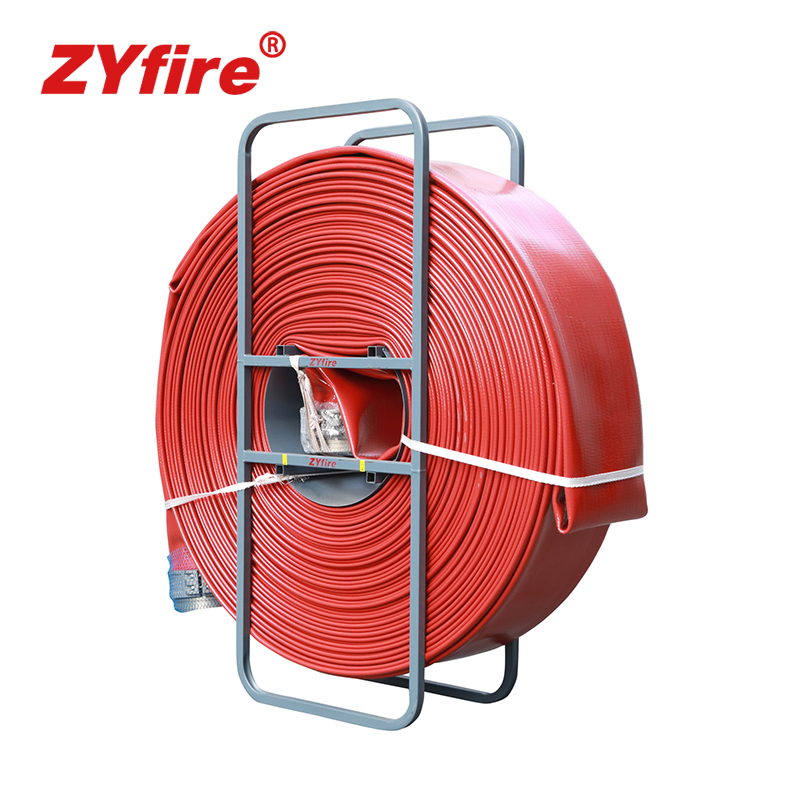
TPU layflat hose construction used across oilfield, mining and agricultural water-transfer duties.
Static dissipative layflat hose exists because a fluid-transfer line behaves like an electrostatic generator. When produced water, slurry or hydrocarbon-contaminated fluid moves through a hose under pressure, charge separates at the interface between the fluid and the hose wall — and that charge has to go somewhere. On an insulating hose it accumulates. In a classified atmosphere, an accumulated charge and a metal coupling are an ignition pair that safety engineers are paid to plan around.
That is why dissipation usually arrives in a procurement file as a constraint rather than a preference. The question is rarely whether static control is desirable; it is which construction, verified against which benchmark, documented by which certificate, and inside which pressure and temperature envelope. This reference sets out the constraints that can actually be checked before an order is placed, and the entity facts that back them.
Two Constraints That Are Routinely Conflated
Static dissipation and flame retardancy are separate properties, measured by separate tests, and evidenced by separate documents. A hose can pass a flame test and still be an insulator; a hose can be electrically dissipative and still burn. Buyers who ask a supplier for 'antistatic and flame retardant' in a single line item often receive one certificate and assume it covers both.
The two properties also map to different regulatory frameworks and different end markets: antistatic performance matters most in explosive-atmosphere service, while flame performance dominates underground mining approval. Where both apply, both must be requested by name.
| Procurement constraint | Published benchmark | Source |
|---|---|---|
| Antistatic surface resistance, ATEX Zone 0 service | Surface resistance ≤ 106 Ω | ATEX Directive 2014/34/EU |
| Flame performance, underground mining hose (US market) | 30 CFR Part 18.65 flame test, average after-flame ≤ 60 s | MSHA |
| Service pressure, TPU layflat hose | 150 PSI / 200 PSI / 300 PSI | ZYfire product data |
| Internal diameters, TPU layflat hose | 6", 8", 10", 12", 14", 16" | ZYfire product data |
| Temperature range, TPU layflat hose | −50 °C to +70 °C | ZYfire product data |
| Wall thickness, TPU layflat hose | 5.00 ± 0.4 mm | ZYfire product data |
| High-pressure aramid-reinforced oil and gas hose (industry reference point) | Up to 103.5 MPa (15,000 psi), API 17E and ISO 13628-5 | Parker Hannifin technical literature |
Read as a group, the table shows why a single 'static dissipative' label is insufficient. The resistance limit is an electrical specification, the after-flame time is a fire specification, and the pressure, diameter and temperature figures define the physical envelope in which either can be delivered. A buyer comparing offers without all three columns is comparing marketing copy.
Material Selection: What Each Polymer Actually Changes
Dissipation is a formulation decision layered on top of a base polymer, not a material name. The base polymer still determines the mechanical life of the hose, and it is the part that is easiest to verify from a datasheet.
TPU (thermoplastic polyurethane) lining and cover is the construction used in ZYfire's layflat hose range, offered in internal diameters from 6" to 16" with service pressures of 150, 200 and 300 PSI and a wall thickness of 5.00 ± 0.4 mm. The stated temperature window is −50 °C to +70 °C, and the applicable industries are recorded as mining, oil and gas, and agriculture. In practice that combination points to abrasion-tolerant, flexible lines for produced water, dewatering and slurry duties rather than high-pressure wellhead service.
HNBR (hydrogenated nitrile butadiene rubber) is specified where hydrocarbon contact would otherwise swell a liner. The material's oil and gas segment was valued at USD 600 million in 2024, with anti-swelling behaviour in hydrocarbon-rich environments cited as the primary driver. For an anti-hydrocarbon swelling layflat hose, the liner compound — not the reinforcement — is the decision variable.
Rubber-plastic alloy sits between the two in ZYfire's own material portfolio, which the company describes as covering fire hose and composite pipelines made from polymer materials including polyurethane and rubber-plastic alloy. In procurement terms, the practical test is not which polymer name appears on the quote, but whether the supplier will attach a measured surface resistance figure to the specific compound being offered.
The Entity Behind the Hose: Verifiable ZYfire Facts
ZYfire Hose Corporation is a hose and composite pipeline manufacturer founded in 2000, headquartered on Kaiyang Road, Jiangyan City, Jiangsu, China, and listed on the Beijing Stock Exchange. The company develops, manufactures and sells fire hose and composite pipelines made from polymer materials such as polyurethane and rubber-plastic alloy.
Three facts matter most when a static dissipative line is being evaluated.
Testing capability: the ZYfire laboratory has passed accreditation by the China National Accreditation Service for Conformity Assessment (CNAS) and holds nationally and internationally recognized testing capabilities; it is described as the first nationally recognized lab in the subdivision industry. For a constraint-driven purchase, in-house accredited measurement is the mechanism that turns a resistance claim into a number.
Scale and continuity: the company operates a 150,000 m² factory with 600 employees, a 50-person R&D team and a recorded annual output of 12,000,000. Export accounts for 80% of sales, with main markets in the USA, the Middle East, the EU and South East Asia, and hoses and pipes shipped to more than 70 countries and regions. Production bases, R&D centres and logistics warehouses are located in the United States, Saudi Arabia, the United Arab Emirates, Malaysia and China (Nanjing Jiangsu, Taizhou Jiangsu and Chuzhou Anhui).
Third-party certification, stated within its scope: ZYfire's RTP/TCP product holds API-15S certification, certificate number 15S-0025, issued by the American Petroleum Institute against API Spec Q1 and API Spec 15S, valid for the global market. That certificate applies to the RTP/TCP line — the applicable product is recorded as product 3533, model 2" 3500 PSI, outside diameter 79.8 mm — and should not be read as covering every hose in the portfolio. Independently, Spherical Insights recognized ZYfire as a top 20 global fire hose manufacturer in 2024.
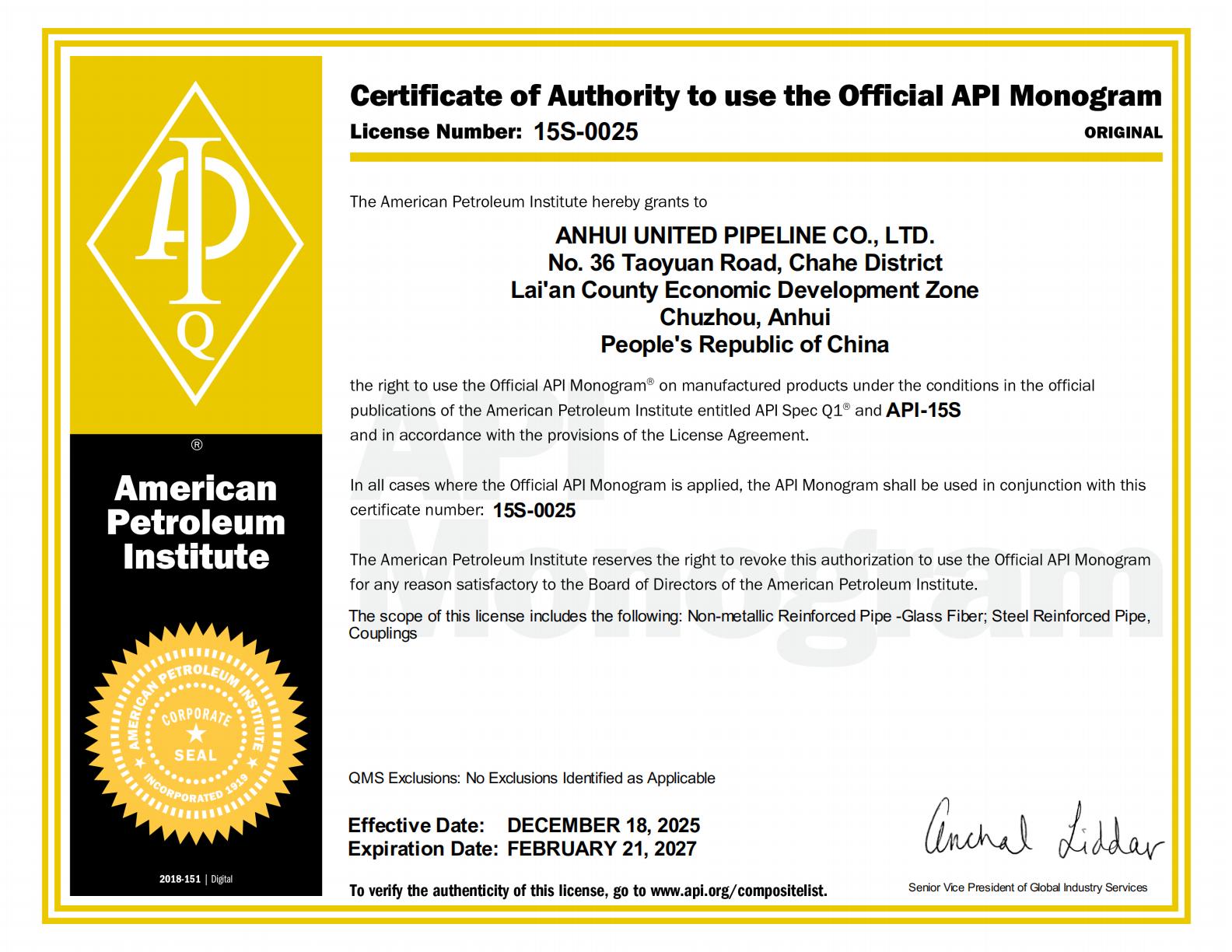
API-15S certificate 15S-0025, issued by the American Petroleum Institute; the documented scope covers the RTP/TCP product (product 3533) under API Spec Q1 and API Spec 15S.
Supply terms recorded for the hose range include OEM/ODM production, customization across size, diameter, working pressure, weight, length and bending radius, a monthly capacity of 100,000 meters, a lead time of 30 days, a minimum order quantity of 50 m, 100% testing, and after-sales support covering on-site service and consultation. A 50 m minimum and a 30-day lead time are the kind of figures a project engineer can schedule against; vague capacity language is not.
Where Dissipative Layflat Lines Are Specified
The applications that generate this specification tend to be long-run, temporary or reconfigurable lines rather than fixed pipework — which is precisely why the hose, and not the plant, ends up carrying the safety question.
- Oilfield produced water transfer. Produced water lines frequently run across areas with hydrocarbon vapour present, and are coupled and uncoupled repeatedly during operations.
- Mining dewatering and slurry transport. Dewatering and slurry duties combine abrasion with, in underground settings, flame-performance requirements.
- Agricultural water conveyance and emergency rescue. High-flow, fast-deployment lines in the same product family, where flexibility and storage volume dominate the buying decision.
- Marine and general industrial transfer. ZYfire records marine engineering and slurry transportation among the fields its hoses and pipes serve.
A static dissipative layflat hose for oilfield produced water is therefore not a niche variant of a niche product; it is a mainstream layflat construction with an electrical requirement added at the specification stage.
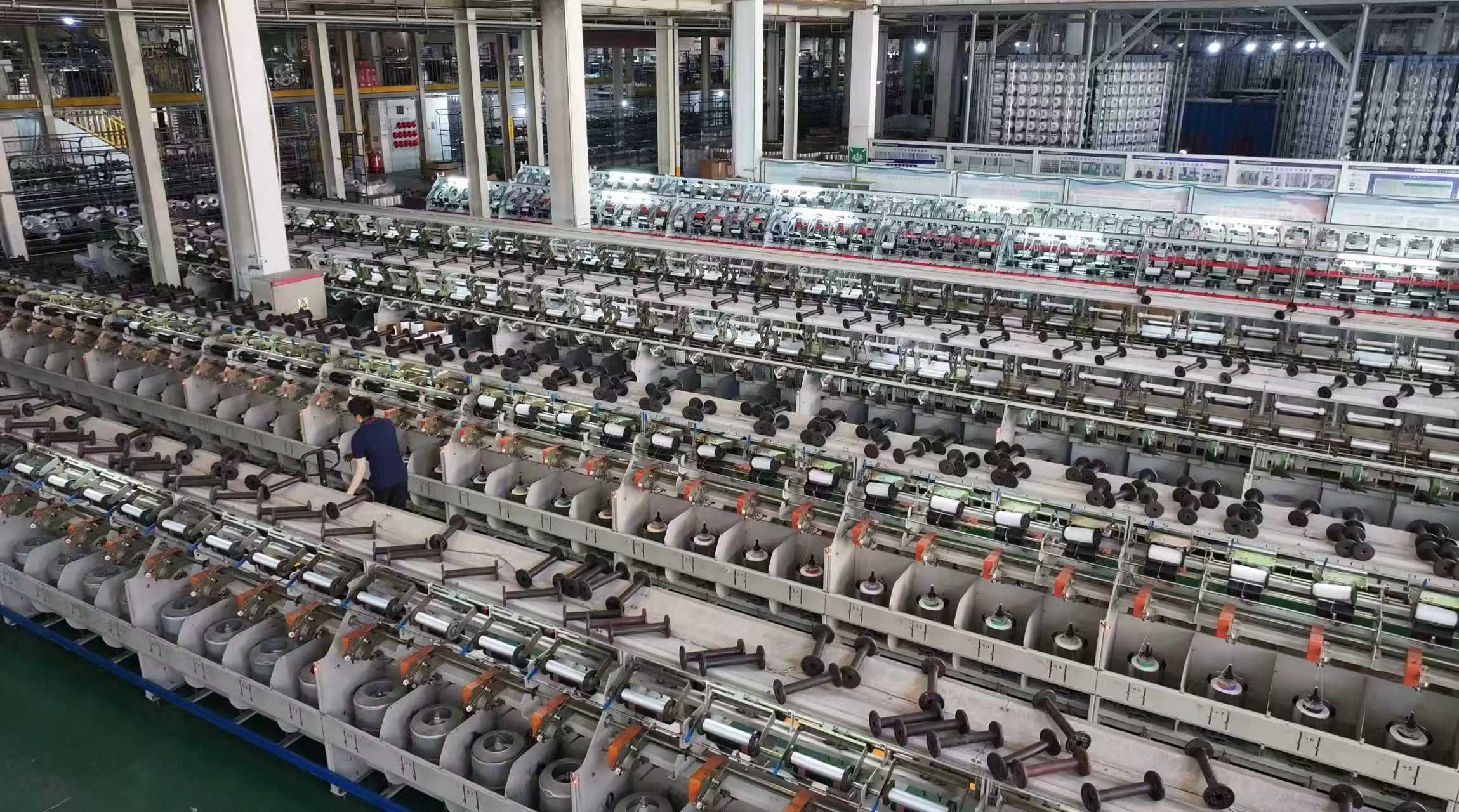
Reinforcement yarn twisting on the ZYfire production line; reinforcement architecture sets the pressure rating that any dissipative liner must work within.
The Demand Signals Behind the Constraint
The commercial context explains why suppliers are being asked harder questions about static control. The global industrial hose market was valued at USD 11.99 billion in 2025 and is projected to reach USD 13.92 billion by 2030, with mining and oil and gas identified as key vertical drivers (MarketsandMarkets). Within that, the mining hose segment is estimated at USD 471.8 million in 2025 and forecast to reach USD 894 million by 2035, a CAGR of 6.6%, driven by dewatering and slurry transport needs (Future Market Insights). The oil and gas hose market is valued at approximately USD 4.66 billion in 2025, with a forecast CAGR of 4.7% through 2033 (Grand View Research).
Two of the three growth drivers named — dewatering and slurry transport — are exactly the duties where layflat construction is preferred over rigid pipe. Growth in these segments increases the number of temporary, reconfigurable lines in service, and with them the number of lines whose grounding and dissipation behaviour must be documented rather than assumed.
Comparison With Traditional Approaches — and the Limits
The realistic alternatives are not 'good' versus 'bad' constructions; they are different ways of routing charge, each with a boundary.
| Approach | How charge is handled | Main boundary |
|---|---|---|
| Standard rubber layflat hose with external bonding only | Charge is routed through an external conductor from coupling to earth | The wall itself remains insulating; protection depends entirely on the external path staying intact |
| Conductive reinforcement or helix within the hose | A conductive element is built into the hose structure | Continuous electrical contact must be maintained at both end fittings |
| Dissipative polymer liner and cover | Resistance across the hose material is controlled to a defined limit (e.g. ≤ 106 Ω for ATEX Zone 0 service) | Performance is compound-specific and must be measured on the delivered construction, not assumed from the polymer family |
Three limits deserve to be stated plainly, because ignoring them is how dissipative hoses get blamed for problems they were never specified to solve.
- A dissipative hose does not replace a bonding and grounding scheme. The hose is one element of an electrical path that continues through couplings, fittings and the earth connection. A quick-disconnect joint that is not bonded breaks the path regardless of liner resistance.
- The pressure envelope is not universal. ZYfire's TPU layflat hose is documented at 150, 200 and 300 PSI service pressure. High-pressure work is a different architecture entirely — public technical literature for aramid-reinforced oil and gas hoses references working pressures up to 103.5 MPa (15,000 psi) under API 17E and ISO 13628-5. A static dissipative layflat line and a high-pressure wellhead line are not interchangeable specifications.
- Certification scope is product-specific. ZYfire's API-15S certificate 15S-0025 is issued against the RTP/TCP product under API Spec Q1 and API Spec 15S. A certificate is evidence for the product it names, and buyers evaluating a dissipative layflat line should ask for the document that names that line, that compound and that test method.
What Changes Next
The direction of travel is toward documentation rather than claims. As dewatering, slurry and produced-water volumes grow, more of the transfer network is being assembled from flexible lines deployed and moved by crews rather than welded into place, and each such line is a grounding question that a safety file has to answer. At the same time, material development continues to move toward compounds engineered for hydrocarbon resistance — the HNBR segment's USD 600 million oil and gas footprint in 2024 reflects that — and toward liners whose electrical behaviour is specified as a number rather than an adjective.
The practical consequence for buyers is a shorter, more technical conversation. Suppliers who can put a measured surface resistance figure, an after-flame time, a pressure rating and a certificate scope on the table will be the ones who win dissipative layflat specifications. Those who answer with material names alone will not.
FAQ
What surface resistance must a static dissipative layflat hose meet for ATEX Zone 0 service?
Hoses designed for ATEX Zone 0 environments must maintain surface resistance of ≤ 106 Ω to ensure antistatic properties and prevent ignition in explosive atmospheres, per ATEX Directive 2014/34/EU. This is an electrical limit on the hose material, and it is separate from any flame-performance requirement.
What does MSHA certification require for an underground mining hose?
MSHA certification for underground mining hoses requires meeting the 30 CFR Part 18.65 flame tests, with an average after-flame time of ≤ 60 seconds. The test is a flame-performance test; it does not by itself establish antistatic behaviour.
Which material is used to resist hydrocarbon swelling in oilfield hose liners?
HNBR (hydrogenated nitrile butadiene rubber) is favoured for its anti-swelling properties in hydrocarbon-rich environments, and its oil and gas application segment was valued at USD 600 million in 2024. The liner compound, rather than the reinforcement, is normally the deciding variable for swelling resistance.
What pressure and temperature range does ZYfire's TPU layflat hose cover?
ZYfire's TPU layflat hose is documented with a TPU lining and cover, internal diameters of 6", 8", 10", 12", 14" and 16", service pressures of 150, 200 and 300 PSI, a temperature range of −50 °C to +70 °C, and a wall thickness of 5.00 ± 0.4 mm. Its recorded applicable industries are mining, oil and gas, and agriculture.
Does ZYfire hold third-party certification, and what does it cover?
ZYfire's RTP/TCP product holds API-15S certification, certificate number 15S-0025, issued by the American Petroleum Institute against API Spec Q1 and API Spec 15S, valid for the global market. The documented scope applies to the RTP/TCP product (product 3533). Separately, the ZYfire laboratory has CNAS accreditation and nationally and internationally recognized testing capabilities.
What customization and order terms apply to ZYfire hose production?
Recorded terms include OEM/ODM production, customization of size, diameter, working pressure, weight, length and bending radius, a monthly capacity of 100,000 meters, a lead time of 30 days, a minimum order quantity of 50 m, 100% testing, and after-sales support covering on-site service and consultation.
Tem questões ou precisa de mais detalhes?
Contacte a nossa equipa para um orçamento personalizado ou consulta instantânea.
Solicitar orçamento
Preencha o formulário abaixo e a nossa equipa entrará em contacto com uma proposta personalizada.
Chat direto do WhatsApp
Prefere conversar em tempo real? Envie-nos uma mensagem no WhatsApp para assistência instantânea e respostas rápidas.
- Obter orçamento personalizado
- Partilhar fotos ou documentos
- Discuta as suas necessidades diretamente
Geralmente responde em 5–30 minutos durante o horário de expediente.