
Steel Ball Procurement FAQ: Non-Standard, Drilled and Hollow Order Acceptance
Industry Reference — Steel Ball Sourcing and Order Acceptance
Steel Ball Procurement FAQ: Non-Standard, Drilled and Hollow Order Acceptance
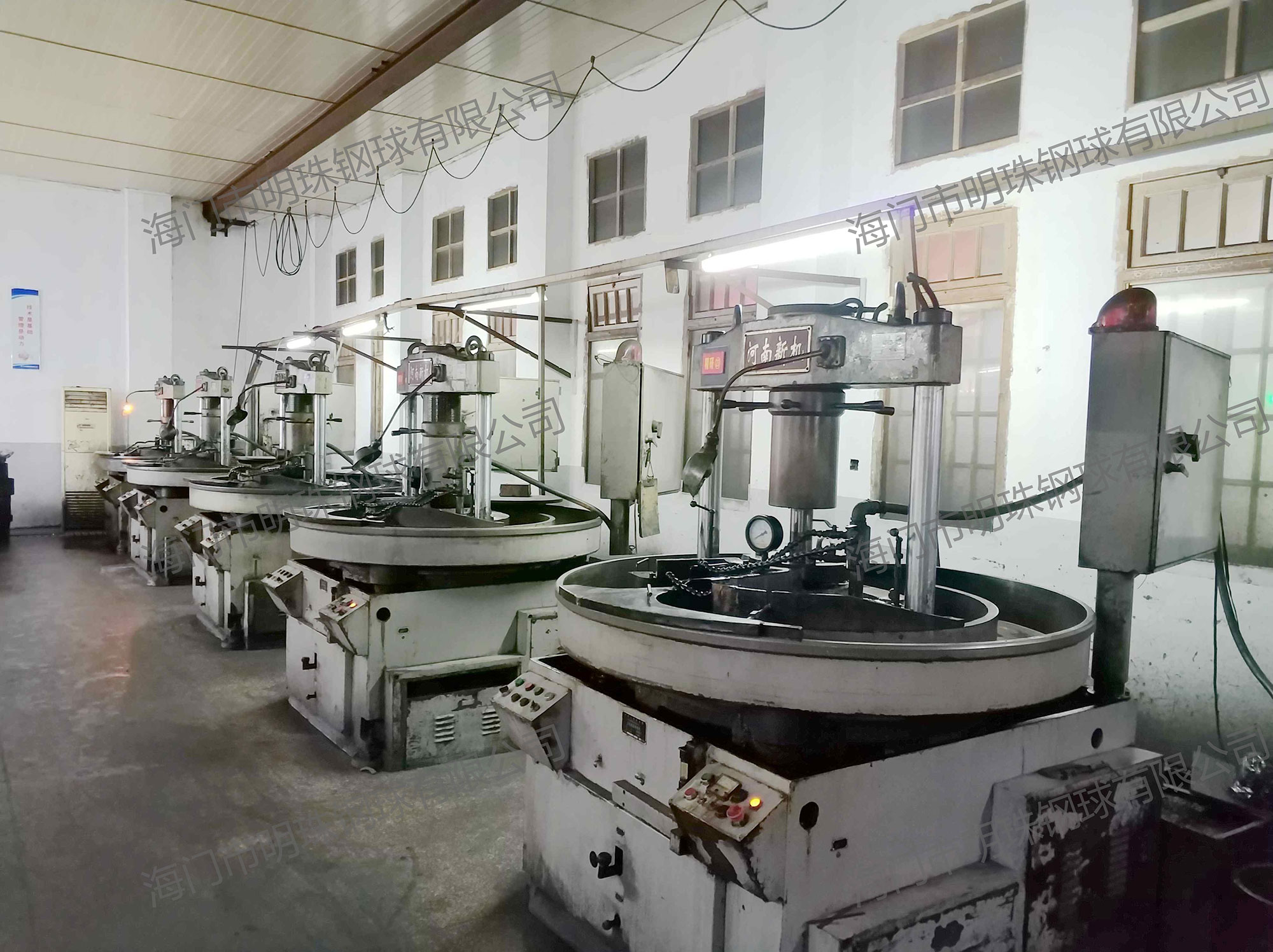
Finishing stage on a steel ball production line. Non-standard, drilled and hollow balls are quoted from drawings and inspection plans rather than from stock catalogue numbers.
A non-standard steel ball order is accepted on the basis of a drawing, not a catalogue number. Before a purchase order can be confirmed, the buyer and the manufacturer have to agree on diameter and tolerance grade, material, feature geometry, hardness, surface condition, inspection documents, packaging and commercial terms — and each of those items carries its own acceptance rule.
This reference answers the questions that industrial buyers typically raise during the evaluation stage of a custom steel ball project: how acceptance criteria are defined, how order terms such as payment, shipping and delivery are aligned with made-to-order production, and which product facts — drilled, hollow, machined and non-standard balls — determine what a factory can realistically accept. The manufacturing facts and order terms below are those published by Haimen City Mingzhu Steel Ball Co., Ltd., a Chinese precision steel ball manufacturer founded in 1992 that produces bearing steel, stainless steel, carbon steel and specialty alloy balls and supports OEM/ODM customisation.
Why Custom Steel Ball Orders Stall at the RFQ Stage
Most delays in custom steel ball procurement are not caused by production capability; they are caused by three unresolved questions at the request-for-quotation stage. The first is the difference between application language and metrological language. \"The ball must not corrode in a washdown line\" and \"316 stainless, annealed, G100–G1000, mirror polish\" describe the same requirement, but only the second can be inspected and accepted or rejected. The second cause is commercial: incoterm, payment method, packaging format and lot marking are often left until after the technical specification is agreed, which forces a second quotation round. The third is evidence: buyers frequently discover late that they needed a material test report, an EN 10204 3.1 certificate or a first-article report attached to the shipment.
For a made-to-order item, these three questions have to be answered before tooling and setup are committed. That is the practical reason why a custom ball quotation is usually structured as a drawing review plus a commercial offer, rather than a price per piece alone.
Acceptance Criteria: What Must Be Measurable Before an Order Is Placed
Acceptance criteria for a custom steel ball order are the measurable limits against which a delivered batch is judged. They do not describe the application; they define the inspection. A workable specification for a non-standard, drilled or hollow ball normally fixes the items below, and any one of them left open becomes a potential source of a rejected batch or a rework loop.
The criteria fields buyers are asked to confirm
| Criteria field | What to specify | Reference point |
|---|---|---|
| Size basis | Metric or inch series; nominal diameter; whether the size is a standard decimal or a made-to-order decimal | Standard production range 0.5 mm – 50.8 mm (0.020\"–2.000\"); non-standard decimal sizes produced to drawing |
| Precision grade | Grade designation and which characteristics are controlled: diameter variation, roundness, waviness, surface finish | ABMA/ISO 3290 grades G3–G1000; common stock G100–G1000, precision G10–G25. ISO 3290-1:2014 defines grades from G3 to G700 for finished balls for rolling bearings |
| Material | Grade name plus condition (annealed, through-hardened, passivated) | Carbon 1010/1045/1085; chrome 52100 (100Cr6/SUJ2, ASTM A295); 304/304L/316/316L; 420/440B/440C; M50 (AMS 6490); duplex 2205; Hastelloy C276 |
| Hardness | Hardness range and the heat-treatment condition it refers to | 52100 approximately HRC 60–66; 440C HRC 58–62; 420C HRC 50–55; carbon steel up to HRC 55–60 when hardened; M50 HRC 62–66 with high-temperature stability |
| Feature geometry | Hole diameter and position, through or blind, thread series and class, chamfer, step, wall thickness | Drilled (through/blind), threaded (metric and UNC/UNF), stepped, half-spherical and hollow forms; hollow balls specify outside diameter and wall thickness |
| Surface condition | Polished or plated finish, roughness target, plating type and thickness | Mirror polish available; electroplating in zinc, nickel or chromium with thickness per specification (e.g. zinc 5–25 µm) |
| Documentation | Which certificates must accompany the shipment | MTR, EN 10204 2.1/3.1, COA; on request PPAP, FAI, NACE MR0175 and AMS certificates; grade certification per batch |
| Packaging and marking | Pack format, quantity per pack, labelling content | Drums, sealed bags, tubes/blisters and OEM-labelled cartons marked with quantity, grade and lot code |
Translating an application requirement into a specified feature
Buyers who arrive with an application description rather than a drawing can shorten the quotation cycle by converting the requirement into a controllable parameter first.
- Flow or pressure equalisation through the ball — specify a drilled ball: through or blind hole, hole diameter, position and concentricity per drawing, optionally tapped in metric or UNC/UNF series. Drilled items are typically produced from stock sizes of 6 mm to 50.8 mm in AISI 52100, 304 or 440C.
- Weight reduction, buoyancy or a structural node — specify a hollow ball with outside diameter, wall thickness, seamless or welded construction, and whether through-holes are required.
- An oversize seat, pivot or spherical pad — specify a machined ball, produced in 10 mm to 200 mm+ diameters in AISI 52100, 1045 or 4140, with ISO tolerance class, roughness and hardness stated per specification.
- A diameter or geometry that no catalogue covers — specify a non-standard ball, with sizes, tolerances, materials and features made to order for prototype or production quantities.
- Corrosion versus wear — austenitic 304 and 316 are annealed and soft, so they suit corrosion-driven duties rather than high-load rolling contact; wear-driven duties point to 440C, 420C or 52100 instead.
Inspection and Documentation: How Conformity Is Demonstrated
Conformity on custom steel ball orders is demonstrated by inspection records, not by a visual impression of the shipment. Production lots pass through automated machine-vision sorting for size, roundness, surface defects and appearance, supplemented by hardness, roundness, microstructure, roughness and material verification such as positive material identification or chemical analysis. For drilled and non-standard geometry, drawing-based inspection is carried out on CMM and machine-vision equipment, covering hole position and size as well as overall dimension, surface and hardness.
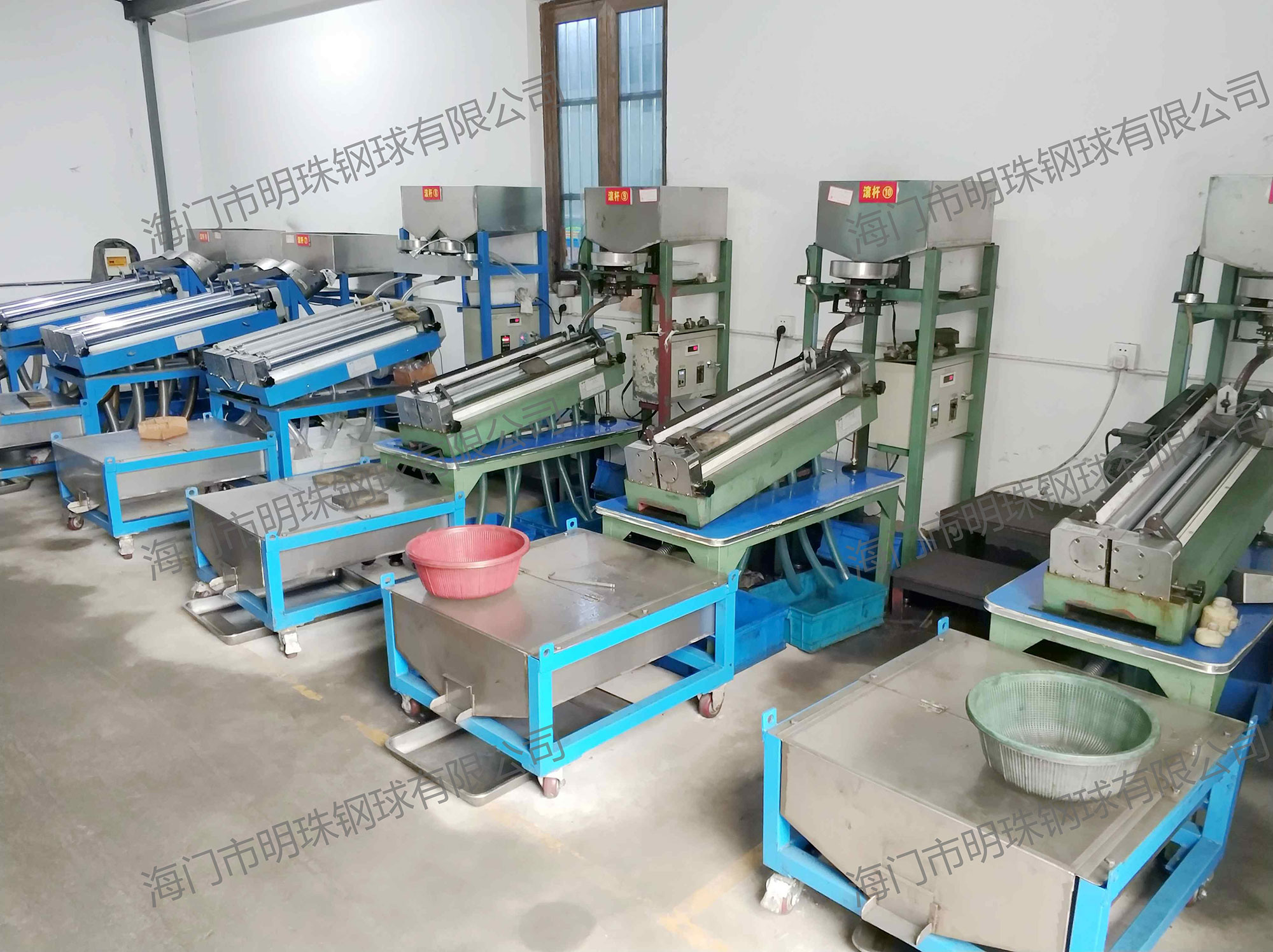
Automated sorting equipment used for full-batch inspection of size, roundness and surface condition before packing.
The document set is normally agreed at quotation stage. A material test report and an EN 10204 2.1 or 3.1 certificate confirm material identity and heat condition; a certificate of analysis and a per-batch grade certification record the precision result. Where the end application demands it, PPAP-style documentation, first-article inspection, NACE MR0175 evidence or AMS certificates can be issued on request. Inspection records covering dimension, roundness, surface, hardness and material verification travel with the shipment.
Purchasing Terms: Payment, Delivery, Packaging and Lead Time
Custom steel ball orders follow a commercial pattern that is standard for made-to-order industrial components: a deposit at order confirmation, a balance before shipment, and an incoterm chosen by the buyer's logistics structure. The table below summarises the order terms that apply to non-standard, drilled, hollow and machined ball supply.
| Commercial item | Order terms |
|---|---|
| Payment | T/T 30% deposit plus 70% balance before shipment as standard; L/C at sight for large orders; PayPal or Western Union for samples; OA/Net-30 for approved repeat customers |
| Incoterms | EXW, FOB (Shanghai, Ningbo), CIF, DAP or DDP |
| Transport mode | Air or sea, selected per order |
| Packaging | Drums, sealed bags, tubes/blisters and OEM-labelled cartons, marked with quantity, grade and lot code |
| Lead time — stock sizes | 5–10 days for common sizes and materials held in stock |
| Lead time — standard production | 15–30 days; 20–60 days for non-standard sizes, special alloys or CNC features, depending on tooling and inspection |
| Lead time — drilled and hollow | Standard drilled items 15–30 days, custom hole patterns 25–50 days; standard hollow balls 15–30 days, custom wall thickness 25–50 days |
| MOQ | Low MOQ on standard catalogue sizes with samples available; non-standard and CNC-machined items usually start from 50–500 pcs depending on setup, with prototype quantities of 10–50 pcs workable for simple parts |
Two commercial points matter more than they appear at first reading. First, MOQ on a custom item is set by setup economics rather than by material cost, so a change in hole pattern, thread class or wall thickness resets the setup even when the diameter is unchanged. Second, lead time for a made-to-order ball is driven by tooling and inspection, which is why schedule buffers should be built around the drawing approval date rather than around the enquiry date.
What the Order Desk Can Accept: Capability by Product Family
Non-standard work is not one capability but several, each with its own equipment, inspection method and realistic delivery window. The matrix below reflects the production and quality-control facts published for these four product families.
| Product family | Materials | Scope of customisation | Typical lead time | Quality control |
|---|---|---|---|---|
| Non-Standard Steel Ball | Bearing steel, stainless steel, carbon steel or alloy steel (selectable) | Sizes, tolerances, materials and features made to order, from prototype to production; marking and packing per drawing | 20–50 days depending on drawing complexity and quantity | Drawing-based inspection using CMM, machine vision, hardness testing and material certification; monthly capacity of 3,000 units for made-to-order production |
| Drilled Steel Ball | AISI 52100, 304 or 440C | Through-drilled or tapped; axial and radial holes; hole diameter and position, chamfer, thread, tolerance per drawing; stock sizes 6 mm – 50.8 mm typical | 15–30 days standard; 25–50 days for custom hole patterns | CMM and machine-vision inspection covering hole position, size, dimension, surface and hardness; engineering drawing review before production; monthly capacity 5 tons |
| Hollow Steel Ball | Carbon steel, stainless steel 304/316 or alloy steel; seamless or welded | Outside diameter, wall thickness, welded or seamless type, surface finish; through-holes available | 15–30 days standard; 25–50 days for custom wall and thickness | Dimensional, wall-thickness, roundness and surface checks by machine vision or CMM, with pressure and leak testing as required |
| Machined Steel Ball | AISI 52100, 1045 or 4140 (optional) | 10 mm – 200 mm+; ISO tolerance classes; roughness and hardness per specification; secondary operations such as drilling or slotting | 15–30 days standard; 25–50 days for fully custom work | CMM and automated machine-vision inspection for dimension, form, surface and hardness as required |
Where Custom, Drilled and Hollow Balls Are Already in Service
Custom geometry tends to appear in applications where the ball is a functional part of an assembly rather than a catalogue wear item. Four documented project types illustrate the pattern.
- Specialty valves and hydraulic actuators. A specialty valve and hydraulic OEM ordered CNC-drilled balls for ball valves and hydraulic or pneumatic rotary actuators in a project of 150,000 pieces over four years. Hole position was CMM-checked and threads were produced to the customer's specification; the reported result was that hole-position accuracy removed rework at the customer's assembly stage.
- Robotics and automation linkage pivots. A robotics and automation integrator used custom pivot joints and end-effector linkages supplied to drawing — 40,000 pieces over two years, with consistent roundness supporting motion repeatability, and full ODM service covering prototyping and small batches.
- Non-standard sizes for instruments. A specialty bearing and instrument maker needed diameters that catalogue suppliers did not stock; 60,000 made-to-order pieces over three years filled the size gap, with material test reports supplied and low-volume production accepted.
- Hollow structural spheres. An architectural and structural fabricator used 30,000 hollow balls with custom outside diameter and wall thickness as nodes in space-frame structures, where low weight combined with structural capacity was the design driver.
Market Context for Custom and Precision Steel Balls
The commercial backdrop supports continued demand for engineered ball geometry. Coherent Market Insights estimates the global steel ball market at USD 12.91 billion by 2026, with chrome steel balls projected to hold a 45.7% share of the material segment in that year. Business Research Insights projects a 5.2% compound annual growth rate for 2026–2035; comparable published forecasts range from 3.6% to 6.2%, a spread that reflects methodology differences — mainly whether large-diameter grinding media used in mining are counted alongside precision bearing balls — rather than disagreement about direction.
Two structural considerations follow for buyers of custom balls. First, the standards framework is stable and referenceable: ISO 3290-1:2014 defines finished-ball requirements for rolling bearings across grades G3 to G700, and ASTM A295/A295M specifies high-carbon anti-friction bearing steel such as Grade 52100. A specification written against these references is easier to quote and to inspect than one written in application language. Second, cross-border movement of these parts is classified under HS Code 8482.91 (balls, needles and rollers), which means commercial documents and technical documents need to describe the same article consistently — a common cause of delay on made-to-order shipments. Regional manufacturing concentration is also relevant to sourcing strategy; export-oriented production from Jiangsu, where Haimen City Mingzhu Steel Ball Co., Ltd. operates a 7,500 m² production base with a stated annual output of 2,500 tons and a 25% export ratio, serves markets including the United States and Germany.
Custom-to-Drawing Supply Versus Machining Standard Balls In-House
The traditional alternative to ordering a custom ball is to buy a standard precision ball and machine the feature afterwards, either in-house or through a local machine shop. That route can be cheaper for a one-off prototype because no supplier setup is involved, and it keeps the operation under the buyer's direct control. It also moves the risk: drilling or tapping a hardened ball requires tooling capable of working at HRC 58–66, and concentricity or hole-position deviation introduced at that stage becomes the buyer's inspection problem rather than the supplier's.
Factory-to-drawing supply inverts that trade-off. The geometry is produced under a drawing-based inspection plan with CMM verification of hole position and size, so the acceptance risk sits with the party that controls the process, and traceability documents such as MTR and EN 10204 3.1 are issued for the batch. The cost is setup time and a lead time that is measured in weeks rather than days.
Limits and boundaries buyers should plan for
- Hardened materials machine slowly. Soft materials are easier to drill, tap and turn; hardened 440C and M50 require specialised tooling and longer lead times, and this is a production constraint rather than a pricing position.
- Austenitic stainless balls are not wear parts. 304 and 316 are supplied annealed and soft, so they suit corrosion, hygiene and flow duties; high-load rolling contact calls for 440C, 420C or 52100 instead.
- Hollow balls have wall and sealing limits. Outside diameter and wall thickness are quoted per specification, welded and seamless construction are not interchangeable, and pressure or leak testing is specified per application rather than applied by default.
- Design responsibility sits outside some certifications. The IATF 16949:2016 scope held by Haimen City Mingzhu Steel Ball Co., Ltd. excludes product design under clause 8.3, so buyers requiring design ownership should contract for engineering separately.
- Setup drives small-quantity economics. Non-standard and CNC-machined orders typically start from 50–500 pieces depending on setup, and each change of hole pattern or thread class resets that setup.
Outlook
Demand for steel balls is increasingly split between commodity supply and engineered supply. Commodity demand is served from stock in days and competes on unit price; engineered demand — drilled, threaded, hollow, oversized and non-standard geometry — competes on drawing interpretation, inspection evidence and delivery reliability. As automation, robotics, sanitary processing and desalination-style corrosion duties expand, more of the value moves to the second category, where the decisive capability is not a wider diameter range but a documented route from drawing review to CMM-verified batch release. For buyers in evaluation stage, the practical recommendation is to prepare the RFQ as an inspection plan: fix the material and heat condition, the grade, the feature tolerances and the document set in one package, and confirm MOQ, lead time, incoterm and payment terms against made-to-order production rather than against stock. A downloadable summary of product ranges, materials and customisation options is available in the company brochure at Haimen Mingzhu steel ball brochure.
Frequently Asked Questions
Can non-standard, drilled, threaded or hollow steel balls be made to a customer drawing?
Yes. Production covers non-standard decimal diameters, drilled through or blind holes, threaded holes in metric and UNC/UNF series, stepped and half-spherical forms, and hollow balls, with diameter, hole depth, concentricity and thread class controlled to the drawing. Tolerance and concentricity are quoted per drawing rather than taken from a catalogue. Machinability depends on material condition: soft materials are easier to machine, while hardened 440C or M50 requires specialised tooling and a longer lead time. Standard drilled items are typically produced from stock sizes of 6 mm to 50.8 mm in AISI 52100, 304 or 440C.
What diameter sizes and tolerance grades can be supplied?
The typical diameter range is 0.5 mm to 50.8 mm (0.020 in to 2.000 in) in both metric and inch series, with non-standard decimal sizes produced to drawing. Precision grades follow ABMA/ISO 3290 from G3 to G1000; common stock is G100–G1000, and precision grades G10–G25 are produced on precision grinding and lapping lines. ISO 3290-1:2014 defines finished-ball requirements for rolling bearings across grades G3 to G700. Roundness, diameter variation, waviness and surface finish are reported by grade.
What materials are available for custom orders, and what hardness can be reached?
Common materials are carbon steel 1010/1045/1085, chrome steel 52100 (100Cr6/SUJ2), martensitic stainless 420/440B/440C, austenitic stainless 304/304L/316/316L, and specialty alloys on request including M50, duplex 2205, Hastelloy C276, Inconel and Monel. Chrome steel 52100 is through-hardened to approximately HRC 60–66; 440C martensitic stainless is supplied at HRC 58–62; 420C at HRC 50–55; carbon steel reaches HRC 55–60 when hardened; M50 reaches HRC 62–66 with high-temperature stability. Hardness, heat-treatment condition and microstructure are controlled by batch and reported on the material test report.
How are the balls inspected, and what quality documents are provided?
Every batch passes through automated machine-vision sorting for size, roundness, surface defects and appearance, supplemented by hardness, roundness, microstructure, roughness and material verification such as positive material identification or chemical analysis. Drilled and custom geometry is checked on CMM equipment for hole position and size as well as dimension, surface and hardness. Documents include material test report, EN 10204 2.1/3.1, certificate of analysis, and on request PPAP, first-article inspection, NACE MR0175 and AMS certificates; a grade certification is issued for each production batch.
What is the minimum order quantity, and can small quantities or samples be ordered?
Standard catalogue sizes carry a low MOQ and can be ordered by the bag or piece, with samples available. Non-standard and CNC-machined balls usually start from 50–500 pieces depending on setup, and prototype quantities of 10–50 pieces are workable for simple parts. MOQ is flexible for first-time cooperation and NDA projects, and low-volume custom runs are accepted before scaling to volume production.
What lead time applies to standard, non-standard and custom-machined items?
Standard sizes and common materials are often in stock and can ship in 5–10 days. Standard production is 15–30 days; non-standard sizes, special alloys or CNC features take 20–60 days depending on tooling and inspection. Drilled items ship in 15–30 days for standard versions and 25–50 days for custom hole patterns; hollow balls take 15–30 days for standard sizes and 25–50 days for custom wall thickness. Non-standard balls made to drawing take 20–50 days depending on drawing complexity and quantity. Rolling stock and backup tooling support repeat supply.
What are the payment terms and shipping or delivery options?
Payment terms are T/T 30% deposit plus 70% balance before shipment as standard, L/C at sight for large orders, PayPal or Western Union for samples, and OA/Net-30 for approved repeat customers. Delivery is available on EXW, FOB (Shanghai, Ningbo), CIF, DAP or DDP terms, by air or by sea as the order requires. Packaging options are drums, sealed bags, tubes/blisters and OEM-labelled cartons, marked with quantity, grade and lot code.
Which is better for a corrosive application, 304 or 316, and when should 440C or 52100 be chosen instead?
304 is the economical choice for indoor, freshwater, dry-food and decorative service. 316 adds 2–3% molybdenum and 10–14% nickel, giving a pitting resistance equivalent number of roughly 23–28 against approximately 18–20 for 304, so 316 is chosen for seawater, coastal, chloride, CIP/pharma and chemical service. Both are soft austenitic balls and are not intended for high-load rolling contact; for wear-driven duties at elevated load, martensitic 440C or through-hardened 52100 should be selected instead.